AMINOACYL TRNA SYNTHETAGE AND
CHARGING OF TRNA
Presented by-
Luna Devi
Kaliabor College
INTRODUCTION
 Protein are giant molecules of utmost
biological importance because these not
only form the building material of the cell,
but act as enzymes controlling all the
biochemical reactions going on in the living
system and also control the expression of
phenotypic traits.
 Chemically protein is polymer of amino
acid. Only 20 amino acid are biologically
important and participate in the formation
of polypeptide chains of protein.
 These protein molecule synthesis in
ribosome. The whole process of protein
synthesis is called Central Dogma.
transcription
DNA RNA
REVERSE
TRANSCRIPTION
Protein
translation
THE RAW MATERIALS OF PROTEIN SYNTHESIS
 Ribosomes-Where protein synthesis occurs
 Amino acids-the the building blocks of protein
 MessengerRNA (mRNA)-where genetic
information encoded
 Transfer RNA (tRNA)-which decode the mRNA
 Some types of enzymes
 ATP, etc.
PROTEIN SYNTHESIS
 Protein synthesis has two completed in two
steps - transcription
translation
 In transcription mRNA molecules are
transcripted from the parent DNA molecule
and transcribed mRNA move out of the
nucleus to the ribosomes in the cytoplasm.
 In translation genetic information carried by
mRNA are determines the order of amino acid.
TRANSLATION
Translation subdivided into -
pre initiation stage
Initiation
Elongation
Termination
………..
 In pre-initiation stage involves-
1. activation of amino acids
2. Attachment of activated amino acids
with tRNA
ACTIVATION OF AMINO ACIDS
 Amino acids in cytoplasm occur in inactive form
and they can not take in protein synthesis. Hence
these are activated by giving them energy. The
activation is facilitated through ATP, whose
molecules unite with the amino acids forming
highly reactive amino acid phosphate adenyl
complexes which are known as aminoacyl
adenylates. These process governs by specific
enzyme aminoacyl tRNA synthetage enzyme.
Amino acid + ATP AMP AA+ PP
Activating
enzyme
Pyrophosphate
Activated amino
acid
FIG: TRANSFER RNA MOLECULES
ATTACHMENT OF ACTIVATED AMINO ACIDS WITH
TRNA
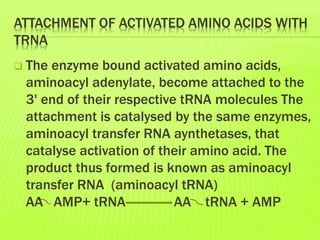
 The enzyme bound activated amino acids,
aminoacyl adenylate, become attached to the
3' end of their respective tRNA molecules The
attachment is catalysed by the same enzymes,
aminoacyl transfer RNA aynthetases, that
catalyse activation of their amino acid. The
product thus formed is known as aminoacyl
transfer RNA (aminoacyl tRNA)
AA AMP+ tRNA AA tRNA + AMP
FIG: PROCESS OF AMINO ACID ACTIVATION BY
ENZYME AMINO ACYL TRNA SYNTHETASE
NOTE
 The specific amino acids join specific tRNA molecules.
This means that for 20 amino acid at least there are 20
different tRNA molecules and 20 different enzymes,
tRNA charged with cognate amino acid serves as an
adaptor molecule for decoding the information on
mRNA. Therefore, tRNA is also called adaptor RNA. The
RNA with attached amino acid is said to be acylated or
charged. The RNA molecule without an amino acid is
uncharged tRNA while with an correct amino acid, it is
called mischarged tRNA. There are no tRNA for
termination codons. Hence, synthesis of polypeptide
chain terminates at a codon for which there is no tRNA.
tRNA charging

tRNA charging

  • 1.
    AMINOACYL TRNA SYNTHETAGEAND CHARGING OF TRNA Presented by- Luna Devi Kaliabor College
  • 2.
    INTRODUCTION  Protein aregiant molecules of utmost biological importance because these not only form the building material of the cell, but act as enzymes controlling all the biochemical reactions going on in the living system and also control the expression of phenotypic traits.  Chemically protein is polymer of amino acid. Only 20 amino acid are biologically important and participate in the formation of polypeptide chains of protein.  These protein molecule synthesis in ribosome. The whole process of protein synthesis is called Central Dogma. transcription DNA RNA REVERSE TRANSCRIPTION Protein translation
  • 3.
    THE RAW MATERIALSOF PROTEIN SYNTHESIS  Ribosomes-Where protein synthesis occurs  Amino acids-the the building blocks of protein  MessengerRNA (mRNA)-where genetic information encoded  Transfer RNA (tRNA)-which decode the mRNA  Some types of enzymes  ATP, etc.
  • 4.
    PROTEIN SYNTHESIS  Proteinsynthesis has two completed in two steps - transcription translation  In transcription mRNA molecules are transcripted from the parent DNA molecule and transcribed mRNA move out of the nucleus to the ribosomes in the cytoplasm.  In translation genetic information carried by mRNA are determines the order of amino acid.
  • 5.
    TRANSLATION Translation subdivided into- pre initiation stage Initiation Elongation Termination
  • 6.
    ………..  In pre-initiationstage involves- 1. activation of amino acids 2. Attachment of activated amino acids with tRNA
  • 7.
    ACTIVATION OF AMINOACIDS  Amino acids in cytoplasm occur in inactive form and they can not take in protein synthesis. Hence these are activated by giving them energy. The activation is facilitated through ATP, whose molecules unite with the amino acids forming highly reactive amino acid phosphate adenyl complexes which are known as aminoacyl adenylates. These process governs by specific enzyme aminoacyl tRNA synthetage enzyme. Amino acid + ATP AMP AA+ PP Activating enzyme Pyrophosphate Activated amino acid
  • 8.
  • 9.
    ATTACHMENT OF ACTIVATEDAMINO ACIDS WITH TRNA  The enzyme bound activated amino acids, aminoacyl adenylate, become attached to the 3' end of their respective tRNA molecules The attachment is catalysed by the same enzymes, aminoacyl transfer RNA aynthetases, that catalyse activation of their amino acid. The product thus formed is known as aminoacyl transfer RNA (aminoacyl tRNA) AA AMP+ tRNA AA tRNA + AMP
  • 10.
    FIG: PROCESS OFAMINO ACID ACTIVATION BY ENZYME AMINO ACYL TRNA SYNTHETASE
  • 11.
    NOTE  The specificamino acids join specific tRNA molecules. This means that for 20 amino acid at least there are 20 different tRNA molecules and 20 different enzymes, tRNA charged with cognate amino acid serves as an adaptor molecule for decoding the information on mRNA. Therefore, tRNA is also called adaptor RNA. The RNA with attached amino acid is said to be acylated or charged. The RNA molecule without an amino acid is uncharged tRNA while with an correct amino acid, it is called mischarged tRNA. There are no tRNA for termination codons. Hence, synthesis of polypeptide chain terminates at a codon for which there is no tRNA.