Ram Sastry
Ram.Sastry@outlook.com
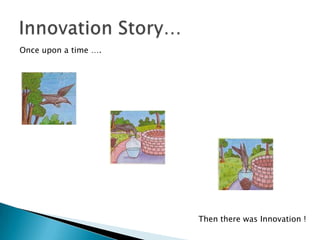
Once upon a time ….
Then there was Innovation !
 Thinking
 Innovating
 Have you made attempts at Inventing, any time in your
life?
 What are some of the greatest Inventions ?
◦ Wheel : 3100 BC
◦ Printing Press : John Gutenberg
◦ Communication : Morse, Marconi, Tesla
◦ Steam Engine : James Watt
◦ Automobile : Karl Benz, Henry Ford
◦ Light Bulb : Thomas Edison
◦ Computer : Alan Turing
◦ Internet : DARPA
 Can you imagine such Inventions in the future ?
 Inventions vs. Innovations
 Today’s businesses thrives on Innovation.
 There is a need for innovating constantly &
putting them to use pretty quickly (time to
market).
 Examples of some companies excelled by
constantly innovating:
◦ Nokia/Samsung in mobile technologies while Motorola
was the one to invent mobile
◦ Sony/Canon/Nikon excelled in digital photography while
Kodak relegated to history
◦ Epson/HP in modern printing technology vis-à-vis Xerox
◦ The Apple Story
 Is it intuition or methodical ?
 Is it individualistic or a process ?
 Is it Eureka moment or result of brainstorming ?
 Is it Laissez faire or restricted ?
 Is it inspirational or systematic ?
 How about a structured approach for
Innovation to solve problems?
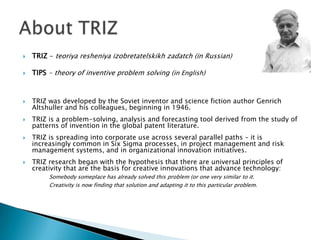
 TRIZ - teoriya resheniya izobretatelskikh zadatch (in Russian)
 TIPS - theory of inventive problem solving (in English)
 TRIZ was developed by the Soviet inventor and science fiction author Genrich
Altshuller and his colleagues, beginning in 1946.
 TRIZ is a problem-solving, analysis and forecasting tool derived from the study of
patterns of invention in the global patent literature.
 TRIZ is spreading into corporate use across several parallel paths – it is
increasingly common in Six Sigma processes, in project management and risk
management systems, and in organizational innovation initiatives.
 TRIZ research began with the hypothesis that there are universal principles of
creativity that are the basis for creative innovations that advance technology:
Somebody someplace has already solved this problem (or one very similar to it.
Creativity is now finding that solution and adapting it to this particular problem.
The Arrows represent transformation from one formulation of
the problem or solution to another. The Gray arrows represent
the analysis of the problems and analytic use of the TRIZ
databases. The Purple arrow represents thinking by analogy to
develop the specific solution.
Your Specific
Problem
TRIZ General
Problem
TRIZ Specific
Solution
Your Specific
Solution
 A fundamental concept of TRIZ is that contradictions should be eliminated.
TRIZ recognizes two categories of contradictions:
◦ Technical contradictions are the classical engineering "trade-offs." The desired state can't be
reached because something else in the system prevents it. In other words, when something gets
better, something else gets worse. Classical examples include:
 The product gets stronger (good), but the weight increases (bad).
 The bandwidth for a communication system increases (good), but requires more power (bad).
 Service is customized to each customer (good), but the service delivery system gets complicated
(bad).
 Training is comprehensive (good), but keeps employees away from their assignments (bad).
◦ Physical contradictions, also called "inherent" contradictions, are situations in which one object or
system has contradictory, opposite requirements. Everyday examples abound:
 Surveillance aircraft should fly fast (to get to the destination), but should fly slowly to collect
data directly over the target for long time periods.
 Software should be complex (to have many features), but should be simple (to be easy to learn).
 Coffee should be hot for enjoyable drinking, but cold to prevent burning the customer
 Training should take a long time (to be thorough), but not take any time.
 The 40 TRIZ principles are known solutions to
solve contradictions.
 Using these known solutions in new problems
can bring innovative solutions!
 Discover the 40 principles of TRIZ with some
examples:
 To use this table, go down the left hand side until
you come to the property which you desire to
improve.
 Then think about the parameters or properties that
degrade or get worse as you try to do this. Find
these on the X axis.
 At the intersection of these two (or more) you will
find the number of the TRIZ inventive principle(s)
that are most often used to resolve this
contradiction.
 An empty box indicates that many of the 40
principles may apply and so all of them should be
considered.
Thank You!

Triz

  • 1.
  • 2.
    Once upon atime …. Then there was Innovation !
  • 3.
  • 4.
     Have youmade attempts at Inventing, any time in your life?  What are some of the greatest Inventions ? ◦ Wheel : 3100 BC ◦ Printing Press : John Gutenberg ◦ Communication : Morse, Marconi, Tesla ◦ Steam Engine : James Watt ◦ Automobile : Karl Benz, Henry Ford ◦ Light Bulb : Thomas Edison ◦ Computer : Alan Turing ◦ Internet : DARPA  Can you imagine such Inventions in the future ?  Inventions vs. Innovations
  • 5.
     Today’s businessesthrives on Innovation.  There is a need for innovating constantly & putting them to use pretty quickly (time to market).  Examples of some companies excelled by constantly innovating: ◦ Nokia/Samsung in mobile technologies while Motorola was the one to invent mobile ◦ Sony/Canon/Nikon excelled in digital photography while Kodak relegated to history ◦ Epson/HP in modern printing technology vis-à-vis Xerox ◦ The Apple Story
  • 6.
     Is itintuition or methodical ?  Is it individualistic or a process ?  Is it Eureka moment or result of brainstorming ?  Is it Laissez faire or restricted ?  Is it inspirational or systematic ?  How about a structured approach for Innovation to solve problems?
  • 7.
     TRIZ -teoriya resheniya izobretatelskikh zadatch (in Russian)  TIPS - theory of inventive problem solving (in English)  TRIZ was developed by the Soviet inventor and science fiction author Genrich Altshuller and his colleagues, beginning in 1946.  TRIZ is a problem-solving, analysis and forecasting tool derived from the study of patterns of invention in the global patent literature.  TRIZ is spreading into corporate use across several parallel paths – it is increasingly common in Six Sigma processes, in project management and risk management systems, and in organizational innovation initiatives.  TRIZ research began with the hypothesis that there are universal principles of creativity that are the basis for creative innovations that advance technology: Somebody someplace has already solved this problem (or one very similar to it. Creativity is now finding that solution and adapting it to this particular problem.
  • 8.
    The Arrows representtransformation from one formulation of the problem or solution to another. The Gray arrows represent the analysis of the problems and analytic use of the TRIZ databases. The Purple arrow represents thinking by analogy to develop the specific solution. Your Specific Problem TRIZ General Problem TRIZ Specific Solution Your Specific Solution
  • 9.
     A fundamentalconcept of TRIZ is that contradictions should be eliminated. TRIZ recognizes two categories of contradictions: ◦ Technical contradictions are the classical engineering "trade-offs." The desired state can't be reached because something else in the system prevents it. In other words, when something gets better, something else gets worse. Classical examples include:  The product gets stronger (good), but the weight increases (bad).  The bandwidth for a communication system increases (good), but requires more power (bad).  Service is customized to each customer (good), but the service delivery system gets complicated (bad).  Training is comprehensive (good), but keeps employees away from their assignments (bad). ◦ Physical contradictions, also called "inherent" contradictions, are situations in which one object or system has contradictory, opposite requirements. Everyday examples abound:  Surveillance aircraft should fly fast (to get to the destination), but should fly slowly to collect data directly over the target for long time periods.  Software should be complex (to have many features), but should be simple (to be easy to learn).  Coffee should be hot for enjoyable drinking, but cold to prevent burning the customer  Training should take a long time (to be thorough), but not take any time.
  • 10.
     The 40TRIZ principles are known solutions to solve contradictions.  Using these known solutions in new problems can bring innovative solutions!  Discover the 40 principles of TRIZ with some examples:
  • 11.
     To usethis table, go down the left hand side until you come to the property which you desire to improve.  Then think about the parameters or properties that degrade or get worse as you try to do this. Find these on the X axis.  At the intersection of these two (or more) you will find the number of the TRIZ inventive principle(s) that are most often used to resolve this contradiction.  An empty box indicates that many of the 40 principles may apply and so all of them should be considered.
  • 12.