Anticipatory   failure determination
Alternatives

• Failure Modes & Effects Analysis [FMEA]
• Potential Problem Analysis [PPA]
• Hazards Operability Analysis [HAZOP]
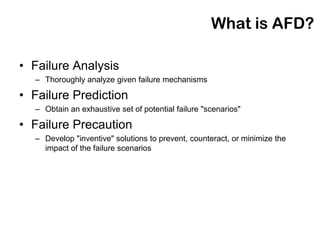
What is AFD?

• Failure Analysis
  – Thoroughly analyze given failure mechanisms

• Failure Prediction
  – Obtain an exhaustive set of potential failure "scenarios"

• Failure Precaution
  – Develop "inventive" solutions to prevent, counteract, or minimize the
    impact of the failure scenarios
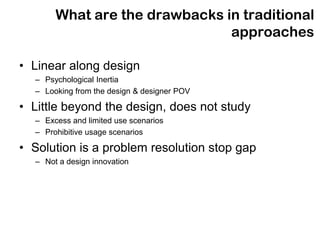
What are the drawbacks in traditional
                               approaches

• Linear along design
  – Psychological Inertia
  – Looking from the design & designer POV

• Little beyond the design, does not study
  – Excess and limited use scenarios
  – Prohibitive usage scenarios

• Solution is a problem resolution stop gap
  – Not a design innovation
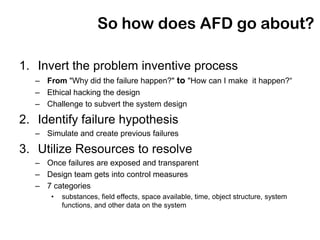
So how does AFD go about?

1. Invert the problem inventive process
   – From "Why did the failure happen?" to "How can I make it happen?“
   – Ethical hacking the design
   – Challenge to subvert the system design

2. Identify failure hypothesis
   – Simulate and create previous failures

3. Utilize Resources to resolve
   – Once failures are exposed and transparent
   – Design team gets into control measures
   – 7 categories
       •   substances, field effects, space available, time, object structure, system
           functions, and other data on the system
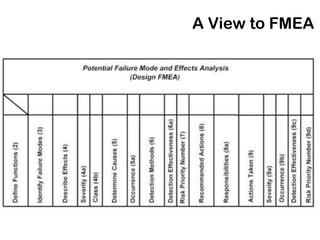
A View to FMEA
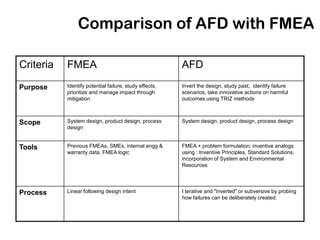
Comparison of AFD with FMEA

Criteria   FMEA                                         AFD

Purpose    Identify potential failure, study effects,   Invert the design, study past, identify failure
           prioritize and manage impact through         scenarios, take innovative actions on harmful
           mitigation                                   outcomes using TRIZ methods


Scope      System design, product design, process       System design, product design, process design
           design


Tools      Previous FMEAs, SMEs, internal engg &        FMEA + problem formulation; inventive analogs
           warranty data, FMEA logic                    using : Inventive Principles, Standard Solutions,
                                                        incorporation of System and Environmental
                                                        Resources


Process    Linear following design intent               I terative and "inverted" or subversive by probing
                                                        how failures can be deliberately created.
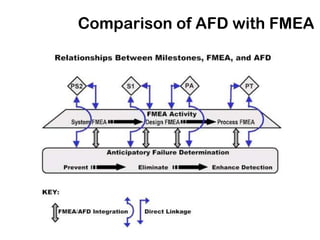
Comparison of AFD with FMEA
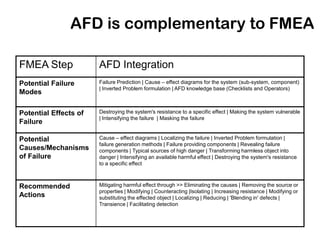
AFD is complementary to FMEA

FMEA Step              AFD Integration
Potential Failure      Failure Prediction | Cause – effect diagrams for the system (sub-system, component)
                       | Inverted Problem formulation | AFD knowledge base (Checklists and Operators)
Modes

Potential Effects of   Destroying the system's resistance to a specific effect | Making the system vulnerable
                       | Intensifying the failure | Masking the failure
Failure

Potential              Cause – effect diagrams | Localizing the failure | Inverted Problem formulation |
                       failure generation methods | Failure providing components | Revealing failure
Causes/Mechanisms      components | Typical sources of high danger | Transforming harmless object into
of Failure             danger | Intensifying an available harmful effect | Destroying the system's resistance
                       to a specific effect


Recommended            Mitigating harmful effect through >> Eliminating the causes | Removing the source or
                       properties | Modifying | Counteracting |Isolating | Increasing resistance | Modifying or
Actions                substituting the effected object | Localizing | Reducing | 'Blending in' defects |
                       Transience | Facilitating detection
References

• Genrich Altshuller, Boris Zlotin, Alla Zusman, Vitalii Filatov.
  “Searching for New Ideas.” Kishniev: Kartya
  Moldovenyaska Publishing House, 1989.
• Boris Zlotin, Alla Zusman, “Solving All Scientific
  Problems” Kishniev: Kartya Moldovenyaska Publishing House,
  1989.
• Stan Kaplan, “Finding Failures before They Find Us: An
  Introduction to The Theory of Scenario Structuring and the Method
  of Anticipatory Failure Determination.” Proceedings of the 9th
  Symposium on Quality Function Deployment, June, l997.
  http://www.qfdi.org
• Ideation International AFD™ Software, 1999. www.ideationtriz.com

Anticipatory Failure Determination

  • 1.
    Anticipatory failure determination
  • 2.
    Alternatives • Failure Modes& Effects Analysis [FMEA] • Potential Problem Analysis [PPA] • Hazards Operability Analysis [HAZOP]
  • 3.
    What is AFD? •Failure Analysis – Thoroughly analyze given failure mechanisms • Failure Prediction – Obtain an exhaustive set of potential failure "scenarios" • Failure Precaution – Develop "inventive" solutions to prevent, counteract, or minimize the impact of the failure scenarios
  • 4.
    What are thedrawbacks in traditional approaches • Linear along design – Psychological Inertia – Looking from the design & designer POV • Little beyond the design, does not study – Excess and limited use scenarios – Prohibitive usage scenarios • Solution is a problem resolution stop gap – Not a design innovation
  • 5.
    So how doesAFD go about? 1. Invert the problem inventive process – From "Why did the failure happen?" to "How can I make it happen?“ – Ethical hacking the design – Challenge to subvert the system design 2. Identify failure hypothesis – Simulate and create previous failures 3. Utilize Resources to resolve – Once failures are exposed and transparent – Design team gets into control measures – 7 categories • substances, field effects, space available, time, object structure, system functions, and other data on the system
  • 6.
  • 7.
    Comparison of AFDwith FMEA Criteria FMEA AFD Purpose Identify potential failure, study effects, Invert the design, study past, identify failure prioritize and manage impact through scenarios, take innovative actions on harmful mitigation outcomes using TRIZ methods Scope System design, product design, process System design, product design, process design design Tools Previous FMEAs, SMEs, internal engg & FMEA + problem formulation; inventive analogs warranty data, FMEA logic using : Inventive Principles, Standard Solutions, incorporation of System and Environmental Resources Process Linear following design intent I terative and "inverted" or subversive by probing how failures can be deliberately created.
  • 8.
  • 9.
    AFD is complementaryto FMEA FMEA Step AFD Integration Potential Failure Failure Prediction | Cause – effect diagrams for the system (sub-system, component) | Inverted Problem formulation | AFD knowledge base (Checklists and Operators) Modes Potential Effects of Destroying the system's resistance to a specific effect | Making the system vulnerable | Intensifying the failure | Masking the failure Failure Potential Cause – effect diagrams | Localizing the failure | Inverted Problem formulation | failure generation methods | Failure providing components | Revealing failure Causes/Mechanisms components | Typical sources of high danger | Transforming harmless object into of Failure danger | Intensifying an available harmful effect | Destroying the system's resistance to a specific effect Recommended Mitigating harmful effect through >> Eliminating the causes | Removing the source or properties | Modifying | Counteracting |Isolating | Increasing resistance | Modifying or Actions substituting the effected object | Localizing | Reducing | 'Blending in' defects | Transience | Facilitating detection
  • 10.
    References • Genrich Altshuller,Boris Zlotin, Alla Zusman, Vitalii Filatov. “Searching for New Ideas.” Kishniev: Kartya Moldovenyaska Publishing House, 1989. • Boris Zlotin, Alla Zusman, “Solving All Scientific Problems” Kishniev: Kartya Moldovenyaska Publishing House, 1989. • Stan Kaplan, “Finding Failures before They Find Us: An Introduction to The Theory of Scenario Structuring and the Method of Anticipatory Failure Determination.” Proceedings of the 9th Symposium on Quality Function Deployment, June, l997. http://www.qfdi.org • Ideation International AFD™ Software, 1999. www.ideationtriz.com