Trigonometric  ratios are used with
 right triangles to solve for missing
 angles and/or sides.
The 3 main trig ratios are:
Sine
Cosine
Tangent
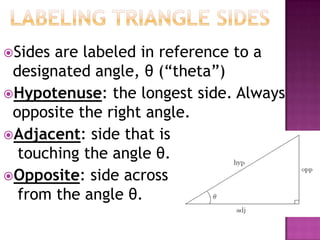
Sides are labeled in reference to a
 designated angle, θ (“theta”)
Hypotenuse: the longest side. Always
 opposite the right angle.
Adjacent: side that is
  touching the angle θ.
Opposite: side across
  from the angle θ.
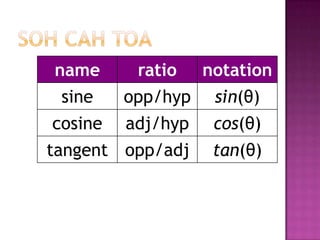
name      ratio    notation
 sine    opp/hyp    sin(θ)
cosine   adj/hyp    cos(θ)
tangent opp/adj     tan(θ)
Set up the ratio using the
 correct side lengths.
Reduce if possible.
OR – divide and round your
 answer.
Depends on the directions given.
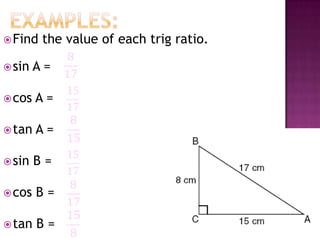
 Find   the value of each trig ratio.

 sin   A=

 cos   A=

 tan   A=

 sin   B=

 cos   B=

 tan   B=
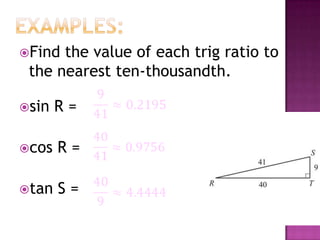
Find the value of each trig ratio to
 the nearest ten-thousandth.

sin   R=

cos   R=

tan   S=
Inverse  trig ratios are used to solve
 for missing angle measures.
They include:
sin-1
cos-1
tan-1
On your calculator: hit “2nd” and
 then the trig button you need
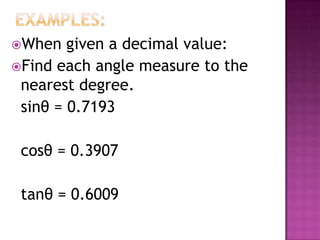
When   given a decimal value:
Find each angle measure to the
 nearest degree.
 sinθ = 0.7193

 cosθ = 0.3907

 tanθ = 0.6009
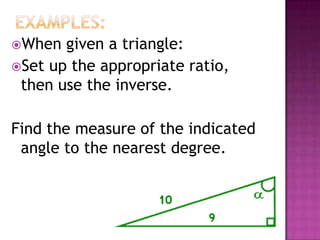
When  given a triangle:
Set up the appropriate ratio,
 then use the inverse.

Find the measure of the indicated
 angle to the nearest degree.
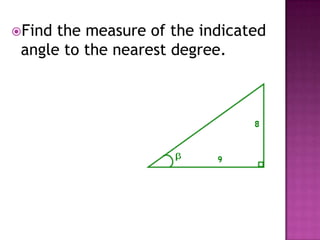
Find the measure of the indicated
 angle to the nearest degree.
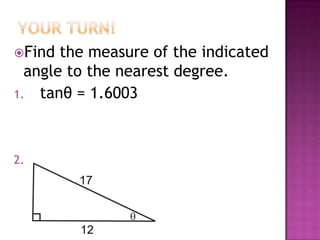
Find  the measure of the indicated
  angle to the nearest degree.
1. tanθ = 1.6003


2.
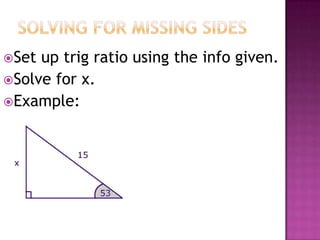
Set up trig ratio using the info given.
Solve for x.
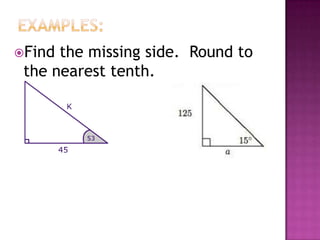
Example:
Find the missing side. Round to
 the nearest tenth.
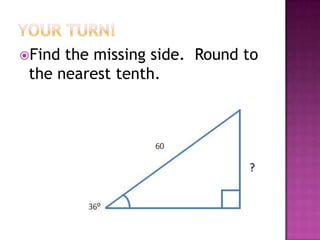
Find the missing side. Round to
 the nearest tenth.
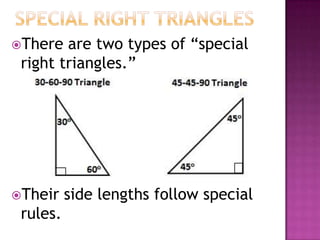
There  are two types of “special
 right triangles.”


Their    side lengths follow special
 rules.
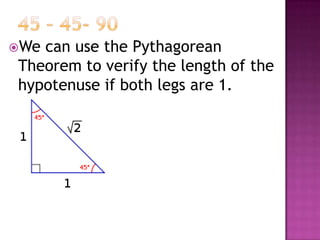
Wecan use the Pythagorean
Theorem to verify the length of the
hypotenuse if both legs are 1.
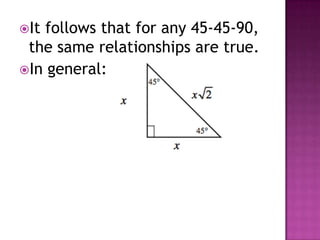
It follows that for any 45-45-90,
 the same relationships are true.
In general:
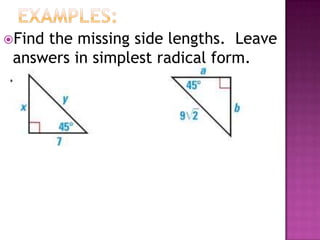
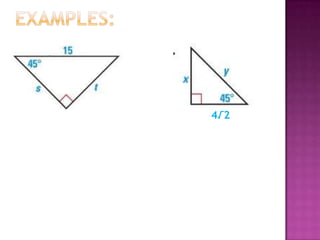
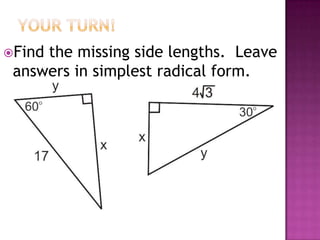
Findthe missing side lengths. Leave
 answers in simplest radical form.
4√2
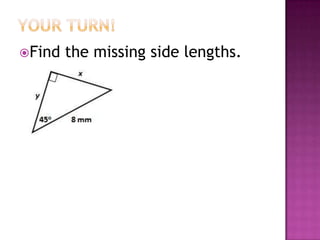
Find   the missing side lengths.
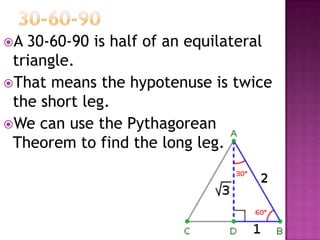
A 30-60-90 is half of an equilateral
 triangle.
That means the hypotenuse is twice
 the short leg.
We can use the Pythagorean
 Theorem to find the long leg.
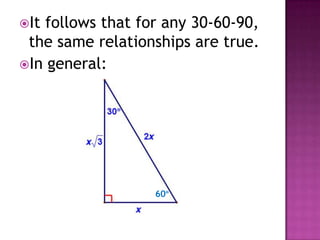
It follows that for any 30-60-90,
 the same relationships are true.
In general:


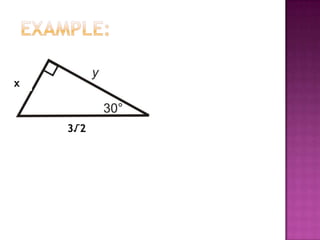
                   60º
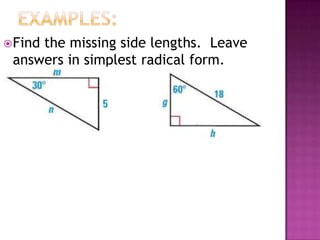
 Find
     the missing side lengths. Leave
 answers in simplest radical form.
x


    3√2
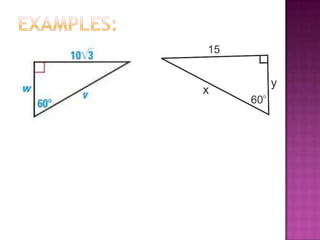
Findthe missing side lengths. Leave
 answers in simplest radical form.
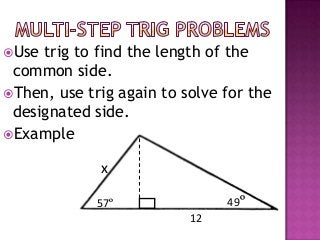
Use trig to find the length of the
 common side.
Then, use trig again to solve for the
 designated side.
Example

             x

             57º               49º
                          12
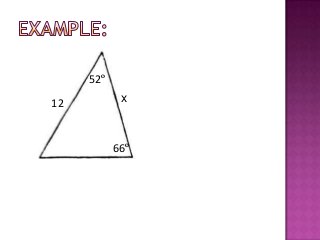
52º
12          x


           66º
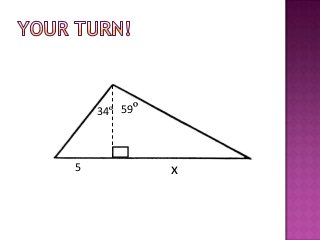
34º 59º


5             x
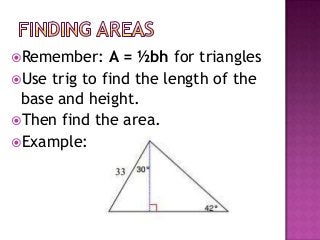
Remember:    A = ½bh for triangles
Use trig to find the length of the
 base and height.
Then find the area.
Example:
 Hints for successful problem solving:
 Draw a picture!
 Label all given information.
 Mark the angles or sides you need to find.
  Use a different variable for each quantity.
 Create a game plan!
 Solve using trig.
 Check that your answer is reasonable.
  The hypotenuse is always the longest
  side!
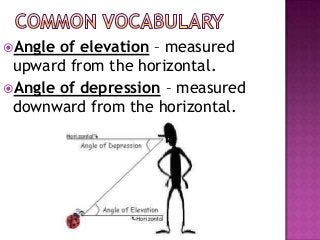
Angle of elevation – measured
 upward from the horizontal.
Angle of depression – measured
 downward from the horizontal.
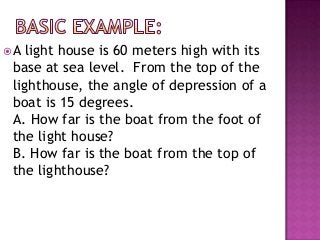
A  light house is 60 meters high with its
 base at sea level. From the top of the
 lighthouse, the angle of depression of a
 boat is 15 degrees.
 A. How far is the boat from the foot of
 the light house?
 B. How far is the boat from the top of
 the lighthouse?
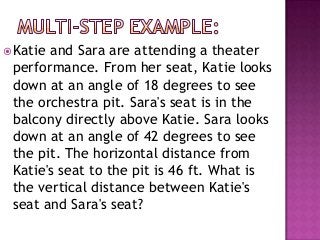
 Katieand Sara are attending a theater
 performance. From her seat, Katie looks
 down at an angle of 18 degrees to see
 the orchestra pit. Sara's seat is in the
 balcony directly above Katie. Sara looks
 down at an angle of 42 degrees to see
 the pit. The horizontal distance from
 Katie's seat to the pit is 46 ft. What is
 the vertical distance between Katie's
 seat and Sara's seat?

Trig mini unit

  • 2.
    Trigonometric ratiosare used with right triangles to solve for missing angles and/or sides. The 3 main trig ratios are: Sine Cosine Tangent
  • 3.
    Sides are labeledin reference to a designated angle, θ (“theta”) Hypotenuse: the longest side. Always opposite the right angle. Adjacent: side that is touching the angle θ. Opposite: side across from the angle θ.
  • 4.
    name ratio notation sine opp/hyp sin(θ) cosine adj/hyp cos(θ) tangent opp/adj tan(θ)
  • 5.
    Set up theratio using the correct side lengths. Reduce if possible. OR – divide and round your answer. Depends on the directions given.
  • 6.
     Find the value of each trig ratio.  sin A=  cos A=  tan A=  sin B=  cos B=  tan B=
  • 7.
    Find the valueof each trig ratio to the nearest ten-thousandth. sin R= cos R= tan S=
  • 8.
    Inverse trigratios are used to solve for missing angle measures. They include: sin-1 cos-1 tan-1 On your calculator: hit “2nd” and then the trig button you need
  • 9.
    When given a decimal value: Find each angle measure to the nearest degree. sinθ = 0.7193 cosθ = 0.3907 tanθ = 0.6009
  • 10.
    When givena triangle: Set up the appropriate ratio, then use the inverse. Find the measure of the indicated angle to the nearest degree.
  • 11.
    Find the measureof the indicated angle to the nearest degree.
  • 12.
    Find themeasure of the indicated angle to the nearest degree. 1. tanθ = 1.6003 2.
  • 13.
    Set up trigratio using the info given. Solve for x. Example:
  • 14.
    Find the missingside. Round to the nearest tenth.
  • 15.
    Find the missingside. Round to the nearest tenth.
  • 16.
    There aretwo types of “special right triangles.” Their side lengths follow special rules.
  • 17.
    Wecan use thePythagorean Theorem to verify the length of the hypotenuse if both legs are 1.
  • 18.
    It follows thatfor any 45-45-90, the same relationships are true. In general:
  • 19.
    Findthe missing sidelengths. Leave answers in simplest radical form.
  • 20.
  • 21.
    Find the missing side lengths.
  • 22.
    A 30-60-90 ishalf of an equilateral triangle. That means the hypotenuse is twice the short leg. We can use the Pythagorean Theorem to find the long leg.
  • 23.
    It follows thatfor any 30-60-90, the same relationships are true. In general: 60º
  • 24.
     Find the missing side lengths. Leave answers in simplest radical form.
  • 26.
    x 3√2
  • 27.
    Findthe missing sidelengths. Leave answers in simplest radical form.
  • 28.
    Use trig tofind the length of the common side. Then, use trig again to solve for the designated side. Example x 57º 49º 12
  • 29.
    52º 12 x 66º
  • 30.
  • 31.
    Remember: A = ½bh for triangles Use trig to find the length of the base and height. Then find the area. Example:
  • 32.
     Hints forsuccessful problem solving:  Draw a picture!  Label all given information.  Mark the angles or sides you need to find. Use a different variable for each quantity.  Create a game plan!  Solve using trig.  Check that your answer is reasonable. The hypotenuse is always the longest side!
  • 33.
    Angle of elevation– measured upward from the horizontal. Angle of depression – measured downward from the horizontal.
  • 34.
    A lighthouse is 60 meters high with its base at sea level. From the top of the lighthouse, the angle of depression of a boat is 15 degrees. A. How far is the boat from the foot of the light house? B. How far is the boat from the top of the lighthouse?
  • 35.
     Katieand Saraare attending a theater performance. From her seat, Katie looks down at an angle of 18 degrees to see the orchestra pit. Sara's seat is in the balcony directly above Katie. Sara looks down at an angle of 42 degrees to see the pit. The horizontal distance from Katie's seat to the pit is 46 ft. What is the vertical distance between Katie's seat and Sara's seat?