'Trie' Data Structure for Auto
Search Complete
This document delves into the application of Trie data structures for implementing auto search complete functionality. It explores
the rationale behind using Tries, examining their benefits and limitations. Additionally, we will compare Trie-based solutions to
traditional relational database approaches and discuss other alternative methods. Along with a sample C# code snippet to give you
a basic idea of how it works. It's not a complete solution, but it should help you understand the concept better.
by Sonil Kumar
Problem Statement
Auto search complete, a feature commonly found in search bars, suggests relevant
terms as the user types. This functionality enhances user experience by reducing
typing effort and providing accurate suggestions. The core challenge lies in
efficiently storing and retrieving frequently used terms for accurate auto-
completion. Traditional relational database solutions face limitations in handling
this specific use case, leading to performance issues.
Why Trie?
Tries, also known as prefix trees, are a specialized tree data structure optimized for efficient prefix searching. Each node represents
a character, and the path from the root to a node represents a prefix. This structure enables rapid search operations for strings
starting with a particular prefix, making it highly suitable for auto-complete scenarios.
Benefits of Trie
1 Efficient Prefix Search
Tries allow for rapid retrieval of strings with a given
prefix, crucial for auto-complete functionality. The
search time is proportional to the length of the prefix,
ensuring fast results even for longer queries.
2 Space Optimization
Tries optimize storage by sharing common prefixes.
Instead of storing each word individually, common
prefixes are shared among multiple words, reducing
memory consumption, particularly for a large
vocabulary.
3 Dynamic Updates
Tries facilitate dynamic updates to the data set. New
words can be added or removed efficiently without
disrupting the existing structure, enabling real-time
updates for evolving search suggestions.
4 Word Frequency Tracking
Tries can incorporate additional information like word
frequency at each node, allowing for the prioritization of
frequently used terms in auto-complete suggestions,
leading to improved user experience.
Limitations of Trie
While Tries offer advantages, they also have inherent limitations:
Space Complexity: In scenarios involving a very large vocabulary, the space
occupied by a Trie can become substantial, potentially impacting performance.
Difficult to Handle Non-Prefix Searches: Tries are primarily designed for prefix-
based searches, making them less efficient for queries involving non-prefix
matching, such as partial substring searches.
Memory Management: Implementing a Trie requires careful memory
management to avoid memory leaks and optimize performance, which can be
complex in large-scale applications.
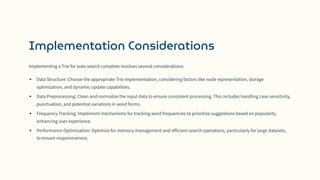
Implementation Considerations
Implementing a Trie for auto search complete involves several considerations:
Data Structure: Choose the appropriate Trie implementation, considering factors like node representation, storage
optimization, and dynamic update capabilities.
Data Preprocessing: Clean and normalize the input data to ensure consistent processing. This includes handling case sensitivity,
punctuation, and potential variations in word forms.
Frequency Tracking: Implement mechanisms for tracking word frequencies to prioritize suggestions based on popularity,
enhancing user experience.
Performance Optimization: Optimize for memory management and efficient search operations, particularly for large datasets,
to ensure responsiveness.
Comparison to Relational
DB Approach
Relational databases, while powerful for structured data, pose challenges for auto-
complete scenarios due to their reliance on full-text indexing. Relational DB
approaches involve storing each word in a separate row, making prefix searches
inefficient.
Trie Relational DB
Efficient prefix search Less efficient prefix search
Optimized for space, sharing
common prefixes
Stores each word separately,
potentially leading to higher storage
requirements
Dynamic updates are efficient Updates may require re-indexing,
impacting performance
Other Alternative
Approaches
Beyond Tries, several alternative solutions cater to auto search complete:
Elasticsearch: A powerful search engine offering efficient full-text indexing and
autocomplete features. It is scalable and handles large datasets efficiently.
Lucene: A high-performance, open-source search engine library known for its
relevance ranking capabilities and support for autocomplete suggestions. It
offers flexibility for customization.
Bloom Filter: A probabilistic data structure for efficient membership testing,
useful for identifying previously seen words in auto-complete suggestions.
https://www.slideshare.net/slideshow/bloom-filters-a-comprehensive-
guide-with-csharp-sample/271013251
Implementing a Trie Data Structure in C#
The Trie (also known as a prefix tree) is a powerful data structure that can be used to enable auto-complete search functionality. It
provides benefits like fast prefix-based lookups and space-efficient storage, though it has some limitations around memory usage.
Here's an example implementation of a Trie in C#:
namespace TrieSample
{
public class TrieNode
{
public Dictionary<char, TrieNode> Children { get; private set; }
public bool IsEndOfWord { get; set; }
public TrieNode()
{
Children = new Dictionary<char, TrieNode>();
IsEndOfWord = false;
}
}
public class Trie
{
private TrieNode root;
public Trie()
{
root = new TrieNode();
}
// Insert a word into the Trie
public void Insert(string word)
{
var current = root;
foreach (var ch in word)
{
if (!current.Children.ContainsKey(ch))
{
current.Children[ch] = new TrieNode();
}
current = current.Children[ch];
}
current.IsEndOfWord = true;
}
// Search for a word in the Trie
public bool Search(string word)
{
var current = root;
foreach (var ch in word)
{
if (!current.Children.ContainsKey(ch))
{
return false;
}
current = current.Children[ch];
}
return current.IsEndOfWord;
}
// Check if any word in the Trie starts with the given prefix
public bool StartsWith(string prefix)
{
var current = root;
foreach (var ch in prefix)
{
if (!current.Children.ContainsKey(ch))
{
return false;
}
current = current.Children[ch];
}
return true;
}
// Find all words in the Trie that start with the given prefix
public List<string> GetWordsWithPrefix(string prefix)
{
var current = root;
foreach (var ch in prefix)
{
if (!current.Children.ContainsKey(ch))
{
return new List<string>(); // Prefix not found, return an empty list
}
current = current.Children[ch];
}
// Perform DFS to find all words starting from the current node
List<string> result = new List<string>();
FindAllWordsFromNode(current, prefix, result);
return result;
}
// Helper method to perform DFS and find all words from a given node
private void FindAllWordsFromNode(TrieNode node, string prefix, List<string> result)
{
if (node.IsEndOfWord)
{
result.Add(prefix);
}
foreach (var child in node.Children)
{
FindAllWordsFromNode(child.Value, prefix + child.Key, result);
}
}
}
}
This implementation provides the basic operations of inserting, searching, and finding words with a given prefix. The Trie data
structure is a powerful tool for search applications, but it's important to consider its trade-offs and implementation details when
deciding if it's the right approach for your use case.
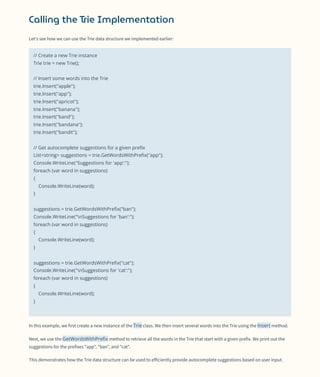
Calling the Trie Implementation
Let's see how we can use the Trie data structure we implemented earlier:
// Create a new Trie instance
Trie trie = new Trie();
// Insert some words into the Trie
trie.Insert("apple");
trie.Insert("app");
trie.Insert("apricot");
trie.Insert("banana");
trie.Insert("band");
trie.Insert("bandana");
trie.Insert("bandit");
// Get autocomplete suggestions for a given prefix
List<string> suggestions = trie.GetWordsWithPrefix("app");
Console.WriteLine("Suggestions for 'app':");
foreach (var word in suggestions)
{
Console.WriteLine(word);
}
suggestions = trie.GetWordsWithPrefix("ban");
Console.WriteLine("nSuggestions for 'ban':");
foreach (var word in suggestions)
{
Console.WriteLine(word);
}
suggestions = trie.GetWordsWithPrefix("cat");
Console.WriteLine("nSuggestions for 'cat':");
foreach (var word in suggestions)
{
Console.WriteLine(word);
}
In this example, we first create a new instance of the Trie class. We then insert several words into the Trie using the Insert method.
Next, we use the GetWordsWithPrefix method to retrieve all the words in the Trie that start with a given prefix. We print out the
suggestions for the prefixes "app", "ban", and "cat".
This demonstrates how the Trie data structure can be used to efficiently provide autocomplete suggestions based on user input.
Conclusion
Trie data structures offer a compelling solution for Auto SearchComplete functionalities, combining efficient prefix matching, space
optimization, and dynamic updates. However, understanding the limitations and considering alternative approaches like
Elasticsearch and Lucene is crucial for selecting the most suitable solution based on the specific needs and scale of the application.
The choice ultimately depends on factors like dataset size, query complexity, and performance requirements. It's essential to
conduct thorough evaluation and experimentation to determine the most effective approach for a particular Auto SearchComplete
implementation.

'Trie' Data Structure for Auto Search Complete

  • 1.
    'Trie' Data Structurefor Auto Search Complete This document delves into the application of Trie data structures for implementing auto search complete functionality. It explores the rationale behind using Tries, examining their benefits and limitations. Additionally, we will compare Trie-based solutions to traditional relational database approaches and discuss other alternative methods. Along with a sample C# code snippet to give you a basic idea of how it works. It's not a complete solution, but it should help you understand the concept better. by Sonil Kumar
  • 2.
    Problem Statement Auto searchcomplete, a feature commonly found in search bars, suggests relevant terms as the user types. This functionality enhances user experience by reducing typing effort and providing accurate suggestions. The core challenge lies in efficiently storing and retrieving frequently used terms for accurate auto- completion. Traditional relational database solutions face limitations in handling this specific use case, leading to performance issues.
  • 3.
    Why Trie? Tries, alsoknown as prefix trees, are a specialized tree data structure optimized for efficient prefix searching. Each node represents a character, and the path from the root to a node represents a prefix. This structure enables rapid search operations for strings starting with a particular prefix, making it highly suitable for auto-complete scenarios.
  • 4.
    Benefits of Trie 1Efficient Prefix Search Tries allow for rapid retrieval of strings with a given prefix, crucial for auto-complete functionality. The search time is proportional to the length of the prefix, ensuring fast results even for longer queries. 2 Space Optimization Tries optimize storage by sharing common prefixes. Instead of storing each word individually, common prefixes are shared among multiple words, reducing memory consumption, particularly for a large vocabulary. 3 Dynamic Updates Tries facilitate dynamic updates to the data set. New words can be added or removed efficiently without disrupting the existing structure, enabling real-time updates for evolving search suggestions. 4 Word Frequency Tracking Tries can incorporate additional information like word frequency at each node, allowing for the prioritization of frequently used terms in auto-complete suggestions, leading to improved user experience.
  • 5.
    Limitations of Trie WhileTries offer advantages, they also have inherent limitations: Space Complexity: In scenarios involving a very large vocabulary, the space occupied by a Trie can become substantial, potentially impacting performance. Difficult to Handle Non-Prefix Searches: Tries are primarily designed for prefix- based searches, making them less efficient for queries involving non-prefix matching, such as partial substring searches. Memory Management: Implementing a Trie requires careful memory management to avoid memory leaks and optimize performance, which can be complex in large-scale applications.
  • 6.
    Implementation Considerations Implementing aTrie for auto search complete involves several considerations: Data Structure: Choose the appropriate Trie implementation, considering factors like node representation, storage optimization, and dynamic update capabilities. Data Preprocessing: Clean and normalize the input data to ensure consistent processing. This includes handling case sensitivity, punctuation, and potential variations in word forms. Frequency Tracking: Implement mechanisms for tracking word frequencies to prioritize suggestions based on popularity, enhancing user experience. Performance Optimization: Optimize for memory management and efficient search operations, particularly for large datasets, to ensure responsiveness.
  • 7.
    Comparison to Relational DBApproach Relational databases, while powerful for structured data, pose challenges for auto- complete scenarios due to their reliance on full-text indexing. Relational DB approaches involve storing each word in a separate row, making prefix searches inefficient. Trie Relational DB Efficient prefix search Less efficient prefix search Optimized for space, sharing common prefixes Stores each word separately, potentially leading to higher storage requirements Dynamic updates are efficient Updates may require re-indexing, impacting performance
  • 8.
    Other Alternative Approaches Beyond Tries,several alternative solutions cater to auto search complete: Elasticsearch: A powerful search engine offering efficient full-text indexing and autocomplete features. It is scalable and handles large datasets efficiently. Lucene: A high-performance, open-source search engine library known for its relevance ranking capabilities and support for autocomplete suggestions. It offers flexibility for customization. Bloom Filter: A probabilistic data structure for efficient membership testing, useful for identifying previously seen words in auto-complete suggestions. https://www.slideshare.net/slideshow/bloom-filters-a-comprehensive- guide-with-csharp-sample/271013251
  • 9.
    Implementing a TrieData Structure in C# The Trie (also known as a prefix tree) is a powerful data structure that can be used to enable auto-complete search functionality. It provides benefits like fast prefix-based lookups and space-efficient storage, though it has some limitations around memory usage. Here's an example implementation of a Trie in C#: namespace TrieSample { public class TrieNode { public Dictionary<char, TrieNode> Children { get; private set; } public bool IsEndOfWord { get; set; } public TrieNode() { Children = new Dictionary<char, TrieNode>(); IsEndOfWord = false; } } public class Trie { private TrieNode root; public Trie() { root = new TrieNode(); } // Insert a word into the Trie public void Insert(string word) { var current = root; foreach (var ch in word) { if (!current.Children.ContainsKey(ch)) { current.Children[ch] = new TrieNode(); } current = current.Children[ch]; } current.IsEndOfWord = true; } // Search for a word in the Trie public bool Search(string word) { var current = root; foreach (var ch in word) { if (!current.Children.ContainsKey(ch)) { return false; } current = current.Children[ch]; } return current.IsEndOfWord; } // Check if any word in the Trie starts with the given prefix public bool StartsWith(string prefix) { var current = root; foreach (var ch in prefix) { if (!current.Children.ContainsKey(ch)) { return false; } current = current.Children[ch]; } return true; } // Find all words in the Trie that start with the given prefix public List<string> GetWordsWithPrefix(string prefix) { var current = root; foreach (var ch in prefix) { if (!current.Children.ContainsKey(ch)) { return new List<string>(); // Prefix not found, return an empty list } current = current.Children[ch]; } // Perform DFS to find all words starting from the current node List<string> result = new List<string>(); FindAllWordsFromNode(current, prefix, result); return result; } // Helper method to perform DFS and find all words from a given node private void FindAllWordsFromNode(TrieNode node, string prefix, List<string> result) { if (node.IsEndOfWord) { result.Add(prefix); } foreach (var child in node.Children) { FindAllWordsFromNode(child.Value, prefix + child.Key, result); } } } } This implementation provides the basic operations of inserting, searching, and finding words with a given prefix. The Trie data structure is a powerful tool for search applications, but it's important to consider its trade-offs and implementation details when deciding if it's the right approach for your use case.
  • 10.
    Calling the TrieImplementation Let's see how we can use the Trie data structure we implemented earlier: // Create a new Trie instance Trie trie = new Trie(); // Insert some words into the Trie trie.Insert("apple"); trie.Insert("app"); trie.Insert("apricot"); trie.Insert("banana"); trie.Insert("band"); trie.Insert("bandana"); trie.Insert("bandit"); // Get autocomplete suggestions for a given prefix List<string> suggestions = trie.GetWordsWithPrefix("app"); Console.WriteLine("Suggestions for 'app':"); foreach (var word in suggestions) { Console.WriteLine(word); } suggestions = trie.GetWordsWithPrefix("ban"); Console.WriteLine("nSuggestions for 'ban':"); foreach (var word in suggestions) { Console.WriteLine(word); } suggestions = trie.GetWordsWithPrefix("cat"); Console.WriteLine("nSuggestions for 'cat':"); foreach (var word in suggestions) { Console.WriteLine(word); } In this example, we first create a new instance of the Trie class. We then insert several words into the Trie using the Insert method. Next, we use the GetWordsWithPrefix method to retrieve all the words in the Trie that start with a given prefix. We print out the suggestions for the prefixes "app", "ban", and "cat". This demonstrates how the Trie data structure can be used to efficiently provide autocomplete suggestions based on user input.
  • 11.
    Conclusion Trie data structuresoffer a compelling solution for Auto SearchComplete functionalities, combining efficient prefix matching, space optimization, and dynamic updates. However, understanding the limitations and considering alternative approaches like Elasticsearch and Lucene is crucial for selecting the most suitable solution based on the specific needs and scale of the application. The choice ultimately depends on factors like dataset size, query complexity, and performance requirements. It's essential to conduct thorough evaluation and experimentation to determine the most effective approach for a particular Auto SearchComplete implementation.