1 G BHARATHKUMAR, ASSISTANTPROFESSOR,CSEDEPARTMENT
MODULE -2
I. ADT STACK AND ITS OPERATIONS
ADT: The abstract datatype is special kind of datatype, whose behavior is defined by a set of
values and set of operations. The keyword “Abstract” is used as we can use these datatypes,
we can perform different operations. But how those operations are working that is totally
hidden from the user. The ADT is made of with primitive datatypes, but operation logics are
hidden.
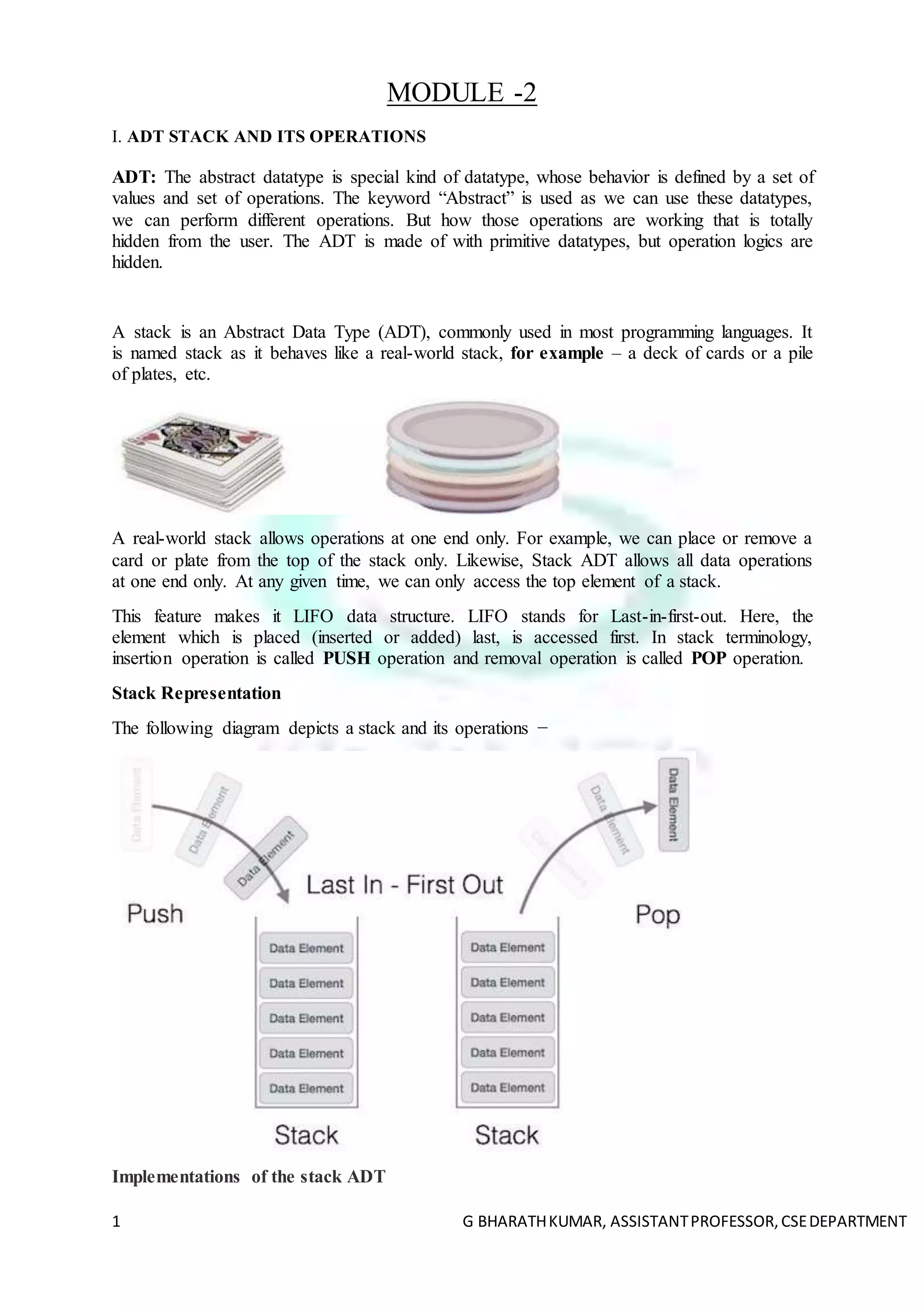
A stack is an Abstract Data Type (ADT), commonly used in most programming languages. It
is named stack as it behaves like a real-world stack, for example – a deck of cards or a pile
of plates, etc.
A real-world stack allows operations at one end only. For example, we can place or remove a
card or plate from the top of the stack only. Likewise, Stack ADT allows all data operations
at one end only. At any given time, we can only access the top element of a stack.
This feature makes it LIFO data structure. LIFO stands for Last-in-first-out. Here, the
element which is placed (inserted or added) last, is accessed first. In stack terminology,
insertion operation is called PUSH operation and removal operation is called POP operation.
Stack Representation
The following diagram depicts a stack and its operations −
Implementations of the stack ADT
2 G BHARATHKUMAR, ASSISTANTPROFESSOR,CSEDEPARTMENT
A stack can be implemented by means of Array, Structure, Pointer, and Linked List. Stack
can either be a fixed size one or it may have a sense of dynamic resizing. Here, we are going
to implement stack using arrays, which makes it a fixed size stack implementation.
Basic Operations
Here we will see the stack ADT. These are few operations or functions of the Stack ADT.
1. peek(), This is used to get the top most element of the stack
2. isFull(), This is used to check whether stack is full or not
3. isEmpry(), This is used to check whether stack is empty or not
4. push(x), This is used to push x into the stack
5. pop(), This is used to delete one element from top of the stack
6. size(), this function is used to get number of elements present into the stack
1. peek()
Algorithm of peek() function −
begin procedure peek
return stack[top]
end procedure
Implementation of peek() function in C programming language −
Example
int peek() {
return stack[top];
}
2. isfull()
Algorithm of isfull() function −
begin procedure isfull
if top equals to MAXSIZE
return true
else
return false
endif
end procedure
Implementation of isfull() function in C programming language −
Example
3 G BHARATHKUMAR, ASSISTANTPROFESSOR,CSEDEPARTMENT
bool isfull() {
if(top == MAXSIZE)
return true;
else
return false;
}
3. isempty()
Algorithm of isempty() function −
begin procedure isempty
if top less than 1
return true
else
return false
endif
end procedure
Implementation of isempty() function in C programming language is slightly different. We
initialize top at -1, as the index in array starts from 0. So we check if the top is below zero or
-1 to determine if the stack is empty. Here's the code −
Example
bool isempty() {
if(top == -1)
return true;
else
return false;
}
4. Push Operation
The process of putting a new data element onto stack is known as a Push Operation. Push
operation involves a series of steps −
 Step 1 − Checks if the stack is full.
 Step 2 − If the stack is full, produces an error and exit.
 Step 3 − If the stack is not full, increments top to point next empty space.
 Step 4 − Adds data element to the stack location, where top is pointing.
4 G BHARATHKUMAR, ASSISTANTPROFESSOR,CSEDEPARTMENT
 Step 5 − Returns success.
If the linked list is used to implement the stack, then in step 3, we need to allocate space
dynamically.
Algorithm for PUSH Operation
A simple algorithm for Push operation can be derived as follows −
begin procedure push: stack, data
if stack is full
return null
endif
top ← top + 1
stack[top] ← data
end procedure
Implementation of this algorithm in C, is very easy. See the following code −
Example
void push(int data) {
if(!isFull()) {
top = top + 1;
stack[top] = data;
} else {
printf("Could not insert data, Stack is full.n");
}
5 G BHARATHKUMAR, ASSISTANTPROFESSOR,CSEDEPARTMENT
}
5. Pop Operation
Accessing the content while removing it from the stack, is known as a Pop Operation. In an
array implementation of pop() operation, the data element is not actually removed,
instead top is decremented to a lower position in the stack to point to the next value. But in
linked-list implementation, pop() actually removes data element and deallocates memory
space.
A Pop operation may involve the following steps −
 Step 1 − Checks if the stack is empty.
 Step 2 − If the stack is empty, produces an error and exit.
 Step 3 − If the stack is not empty, accesses the data element at which top is pointing.
 Step 4 − Decreases the value of top by 1.
 Step 5 − Returns success.
Algorithm for Pop Operation
A simple algorithm for Pop operation can be derived as follows −
begin procedure pop: stack
if stack is empty
return null
endif
data ← stack[top]
top ← top - 1
return data
6 G BHARATHKUMAR, ASSISTANTPROFESSOR,CSEDEPARTMENT
end procedure
Implementation of this algorithm in C, is as follows −
Example
int pop(int data) {
if(!isempty()) {
data = stack[top];
top = top - 1;
return data;
} else {
printf("Could not retrieve data, Stack is empty.n");
}
}
PROGRAM
#include <stdio.h>
int MAXSIZE = 8;
int stack[8];
int top = -1;
int isempty() {
if(top == -1)
return 1;
else
return 0;
}
int isfull() {
if(top == MAXSIZE)
return 1;
else
return 0;
}
7 G BHARATHKUMAR, ASSISTANTPROFESSOR,CSEDEPARTMENT
int peek() {
return stack[top];
}
int pop() {
int data;
if(!isempty()) {
data = stack[top];
top = top - 1;
return data;
} else {
printf("Could not retrieve data, Stack is empty.n");
}
}
int push(int data) {
if(!isfull()) {
top = top + 1;
stack[top] = data;
} else {
printf("Could not insert data, Stack is full.n");
}
}
int main() {
// push items on to the stack
push(3);
push(5);
push(9);
push(1);
push(12);
push(15);
printf("Element at top of the stack: %dn" ,peek());
printf("Elements: n");
8 G BHARATHKUMAR, ASSISTANTPROFESSOR,CSEDEPARTMENT
// print stack data
while(!isempty()) {
int data = pop();
printf("%dn",data);
}
printf("Stack full: %sn" , isfull()?"true":"false");
printf("Stack empty: %sn" , isempty()?"true":"false");
return 0;
}
Output
Element at top of the stack: 15
Elements:
15
12
1
9
5
3
Stack full: false
Stack empty: true
Run-time complexity of stack operations
 For all the standard stack operations (push, pop, isEmpty, size), the worst-case run-
time complexity can be O(1).
 It's obvious that size and isEmpty constant-time operations.
 push and pop are also O(1) because they only work with one end of the data structure
- the top of the stack.
 The upshot of all this is that stacks can and should be implemented easily and
efficiently.
Expression Parsing
The way to write arithmetic expression is known as a notation. An arithmetic expression can
be written in three different but equivalent notations, i.e., without changing the essence or
output of an expression. These notations are −
9 G BHARATHKUMAR, ASSISTANTPROFESSOR,CSEDEPARTMENT
 Infix Notation
 Prefix (Polish) Notation
 Postfix (Reverse-Polish) Notation
Infix Notation
 We write expression in infix notation, e.g. a - b + c, where operators are used in-
between operands. It is easy for us humans to read, write, and speak in infix notation
but the same does not go well with computing devices. An algorithm to process infix
notation could be difficult and costly in terms of time and space consumption.
Prefix Notation
 In this notation, operator is prefixed to operands, i.e. operator is written ahead of
operands. For example, +ab. This is equivalent to its infix notation a + b. Prefix
notation is also known as Polish Notation.
Postfix Notation
 This notation style is known as Reversed Polish Notation. In this notation style, the
operator is postfixed to the operands i.e., the operator is written after the operands.
For example, ab+. This is equivalent to its infix notation a + b.
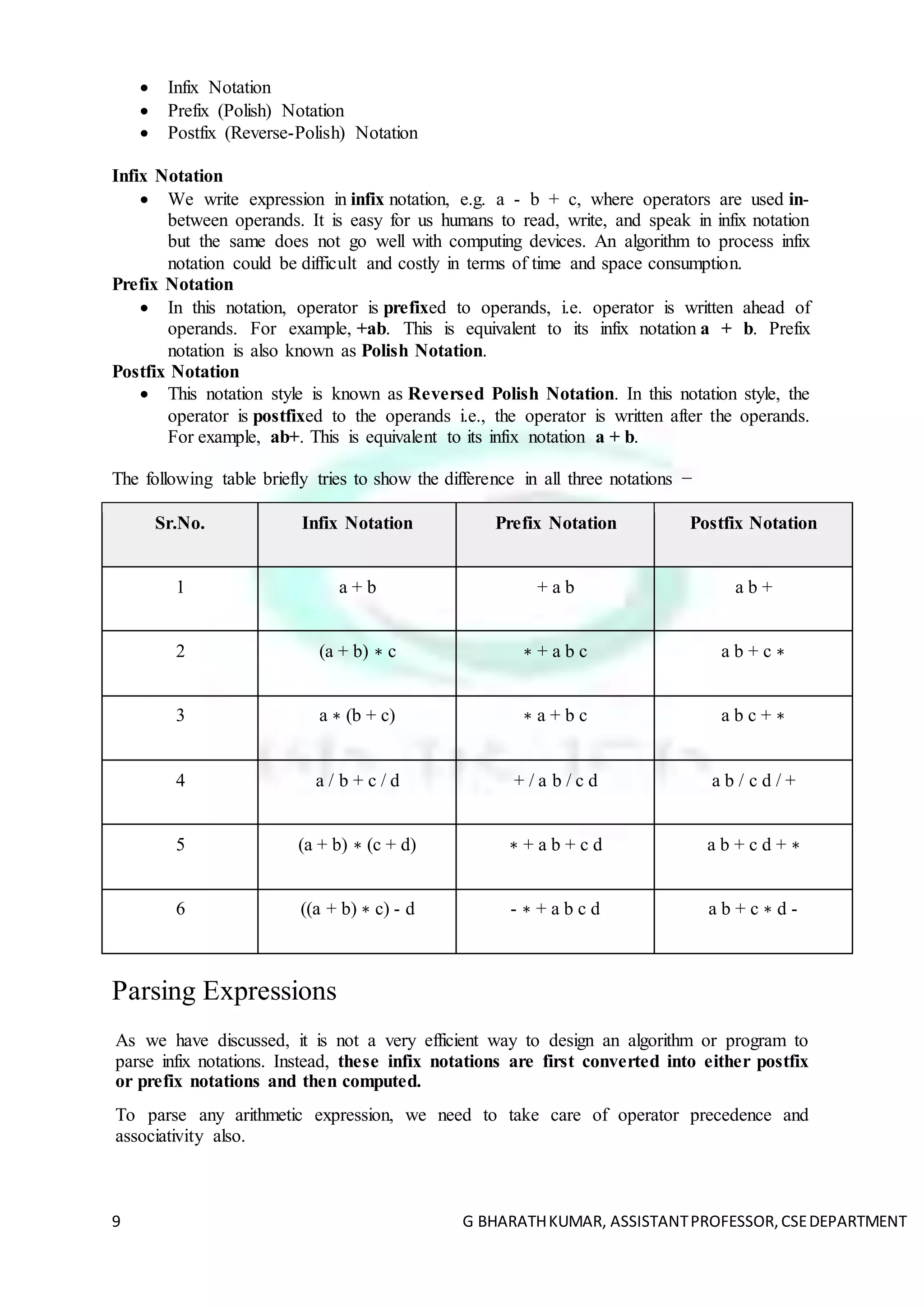
The following table briefly tries to show the difference in all three notations −
Sr.No. Infix Notation Prefix Notation Postfix Notation
1 a + b + a b a b +
2 (a + b) ∗ c ∗ + a b c a b + c ∗
3 a ∗ (b + c) ∗ a + b c a b c + ∗
4 a / b + c / d + / a b / c d a b / c d / +
5 (a + b) ∗ (c + d) ∗ + a b + c d a b + c d + ∗
6 ((a + b) ∗ c) - d - ∗ + a b c d a b + c ∗ d -
Parsing Expressions
As we have discussed, it is not a very efficient way to design an algorithm or program to
parse infix notations. Instead, these infix notations are first converted into either postfix
or prefix notations and then computed.
To parse any arithmetic expression, we need to take care of operator precedence and
associativity also.
10 G BHARATHKUMAR, ASSISTANTPROFESSOR,CSEDEPARTMENT
Precedence
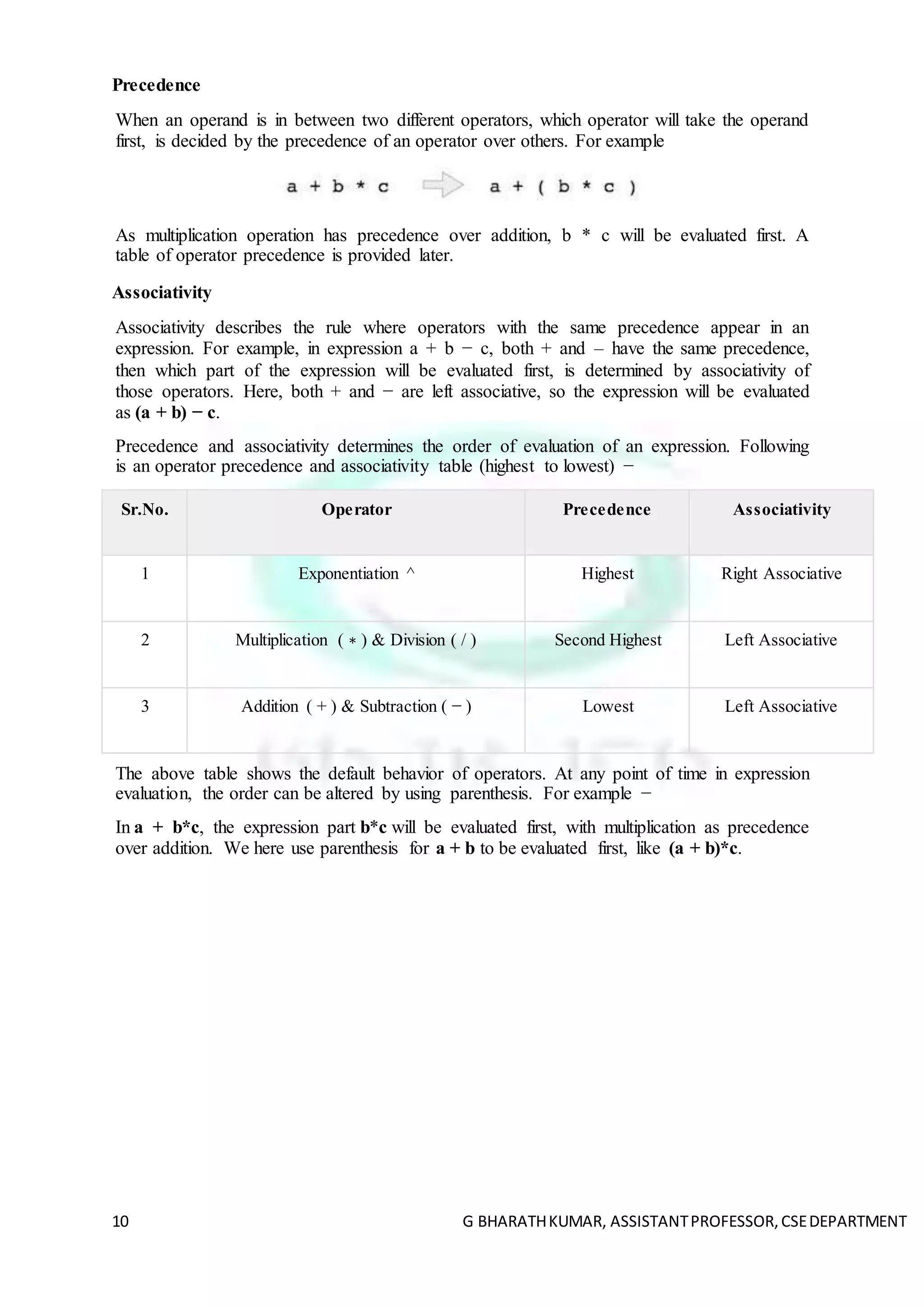
When an operand is in between two different operators, which operator will take the operand
first, is decided by the precedence of an operator over others. For example
As multiplication operation has precedence over addition, b * c will be evaluated first. A
table of operator precedence is provided later.
Associativity
Associativity describes the rule where operators with the same precedence appear in an
expression. For example, in expression a + b − c, both + and – have the same precedence,
then which part of the expression will be evaluated first, is determined by associativity of
those operators. Here, both + and − are left associative, so the expression will be evaluated
as (a + b) − c.
Precedence and associativity determines the order of evaluation of an expression. Following
is an operator precedence and associativity table (highest to lowest) −
Sr.No. Operator Precedence Associativity
1 Exponentiation ^ Highest Right Associative
2 Multiplication ( ∗ ) & Division ( / ) Second Highest Left Associative
3 Addition ( + ) & Subtraction ( − ) Lowest Left Associative
The above table shows the default behavior of operators. At any point of time in expression
evaluation, the order can be altered by using parenthesis. For example −
In a + b*c, the expression part b*c will be evaluated first, with multiplication as precedence
over addition. We here use parenthesis for a + b to be evaluated first, like (a + b)*c.
11 G BHARATHKUMAR, ASSISTANTPROFESSOR,CSEDEPARTMENT
Applications of stack:
 Reversing a list or String
 Expression Evaluation
 Postfix Evaluation
 Prefix Evaluation
 Expression Conversion.
i. Infix to Postfix.
ii. Infix to Prefix.
iii. Postfix to Infix.
iv. Prefix to Infix.
 Backtracking.
 Memory Management.
 Towers of Honai
Postfix Evaluation Algorithm
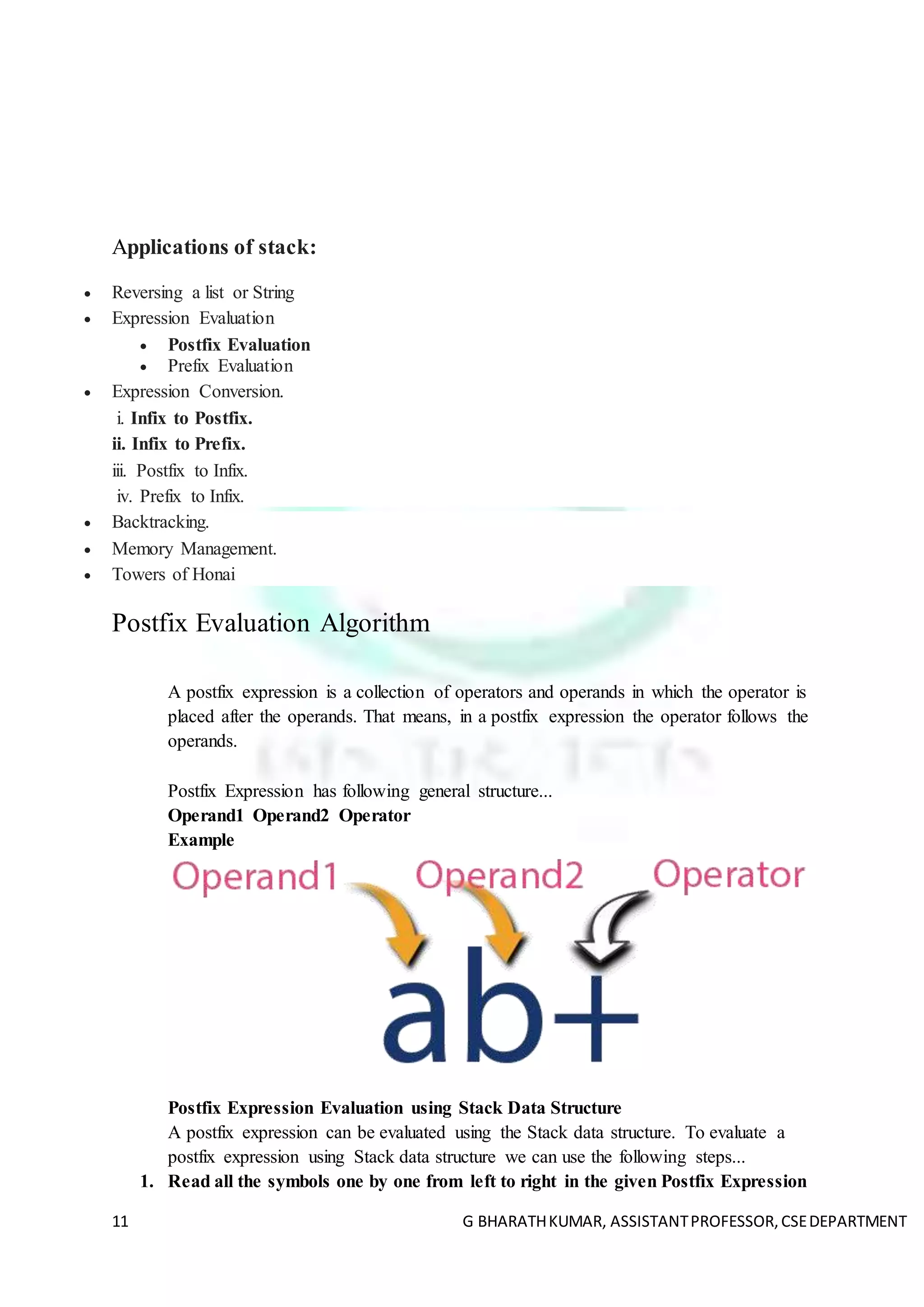
A postfix expression is a collection of operators and operands in which the operator is
placed after the operands. That means, in a postfix expression the operator follows the
operands.
Postfix Expression has following general structure...
Operand1 Operand2 Operator
Example
Postfix Expression Evaluation using Stack Data Structure
A postfix expression can be evaluated using the Stack data structure. To evaluate a
postfix expression using Stack data structure we can use the following steps...
1. Read all the symbols one by one from left to right in the given Postfix Expression
12 G BHARATHKUMAR, ASSISTANTPROFESSOR,CSEDEPARTMENT
2. If the reading symbol is operand, then push it on to the Stack.
3. If the reading symbol is operator (+ , - , * , / etc.,), then perform TWO pop
operations and store the two popped oparands in two different variables
(operand1 and operand2). Then perform reading symbol operation using
operand1 and operand2 and push result back on to the Stack.
4. Finally! perform a pop operation and display the popped value as final result.
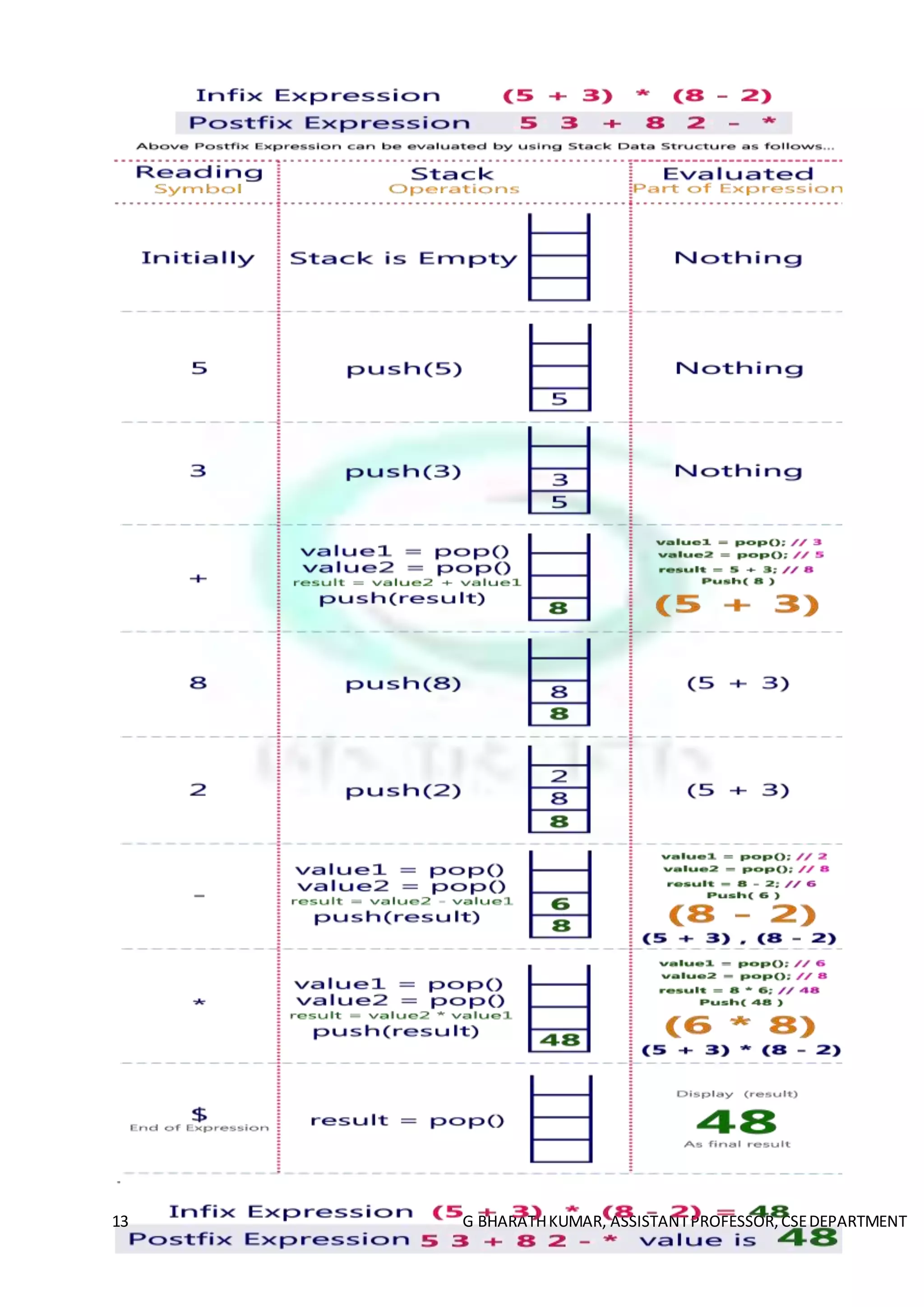
Example
Consider the following Expression...
13 G BHARATHKUMAR, ASSISTANTPROFESSOR,CSEDEPARTMENT
14 G BHARATHKUMAR, ASSISTANTPROFESSOR,CSEDEPARTMENT
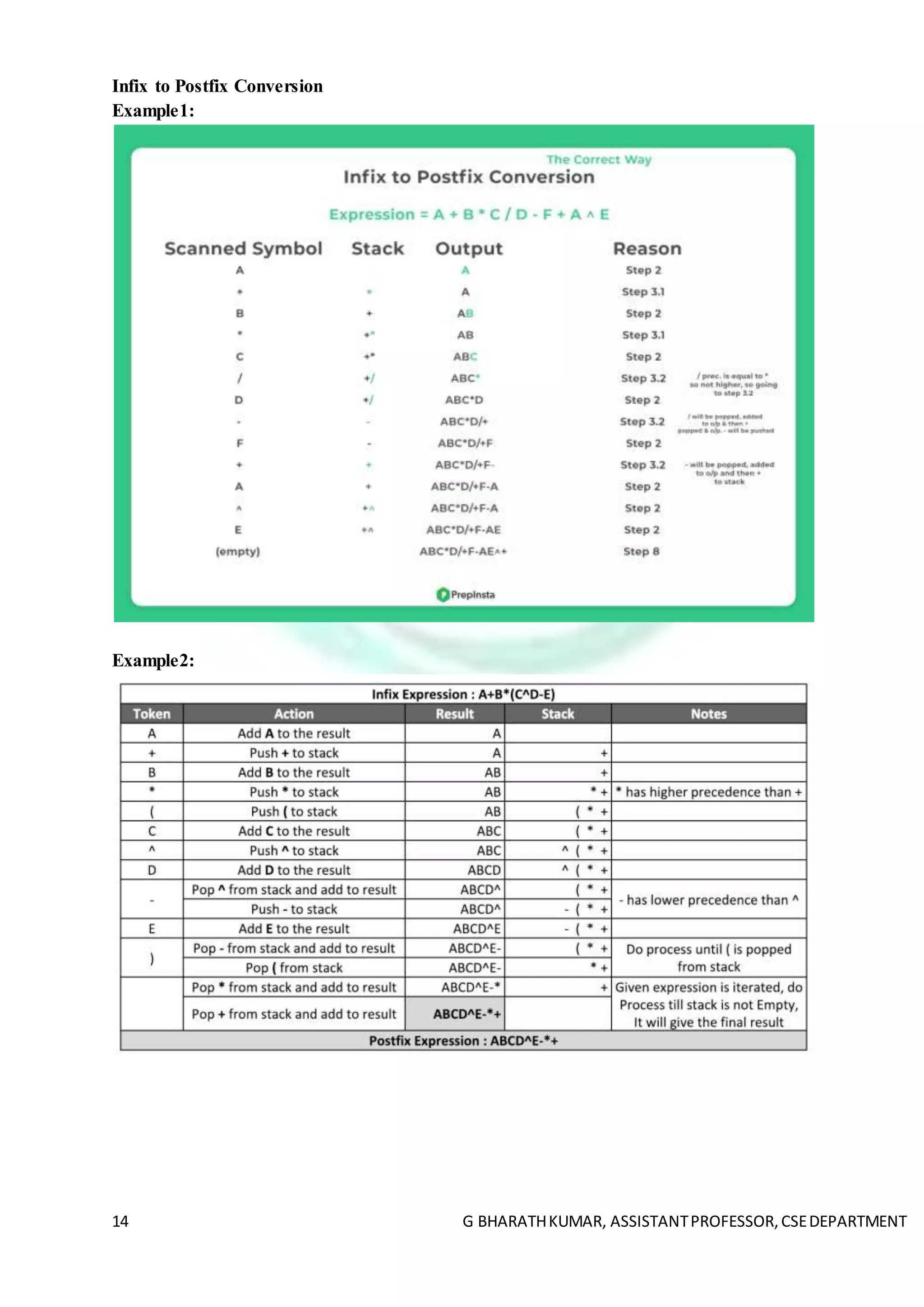
Infix to Postfix Conversion
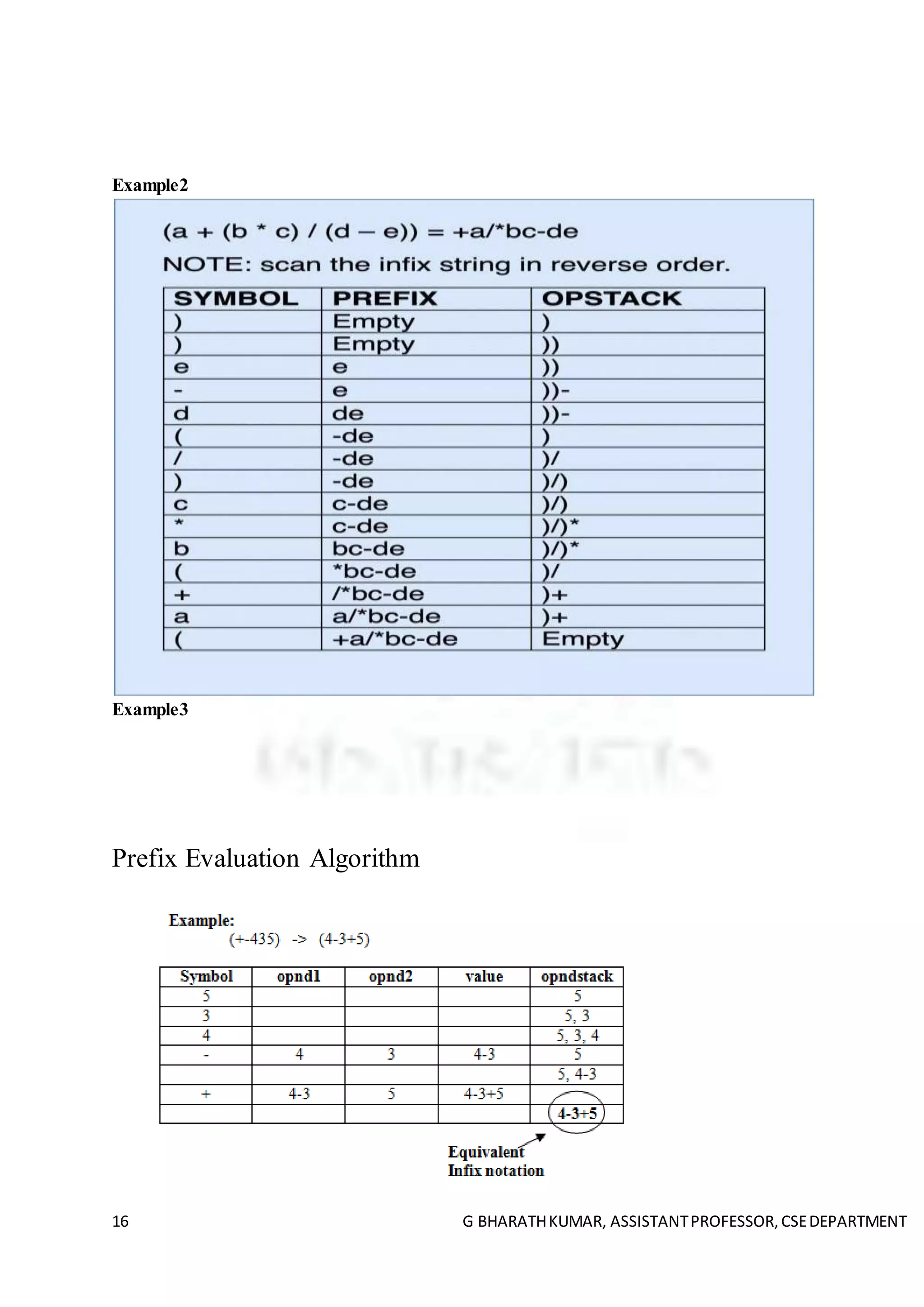
Example1:
Example2:
15 G BHARATHKUMAR, ASSISTANTPROFESSOR,CSEDEPARTMENT
Example3:
Example4:
Infix to Prefix Conversion
Example1
16 G BHARATHKUMAR, ASSISTANTPROFESSOR,CSEDEPARTMENT
Example2
Example3
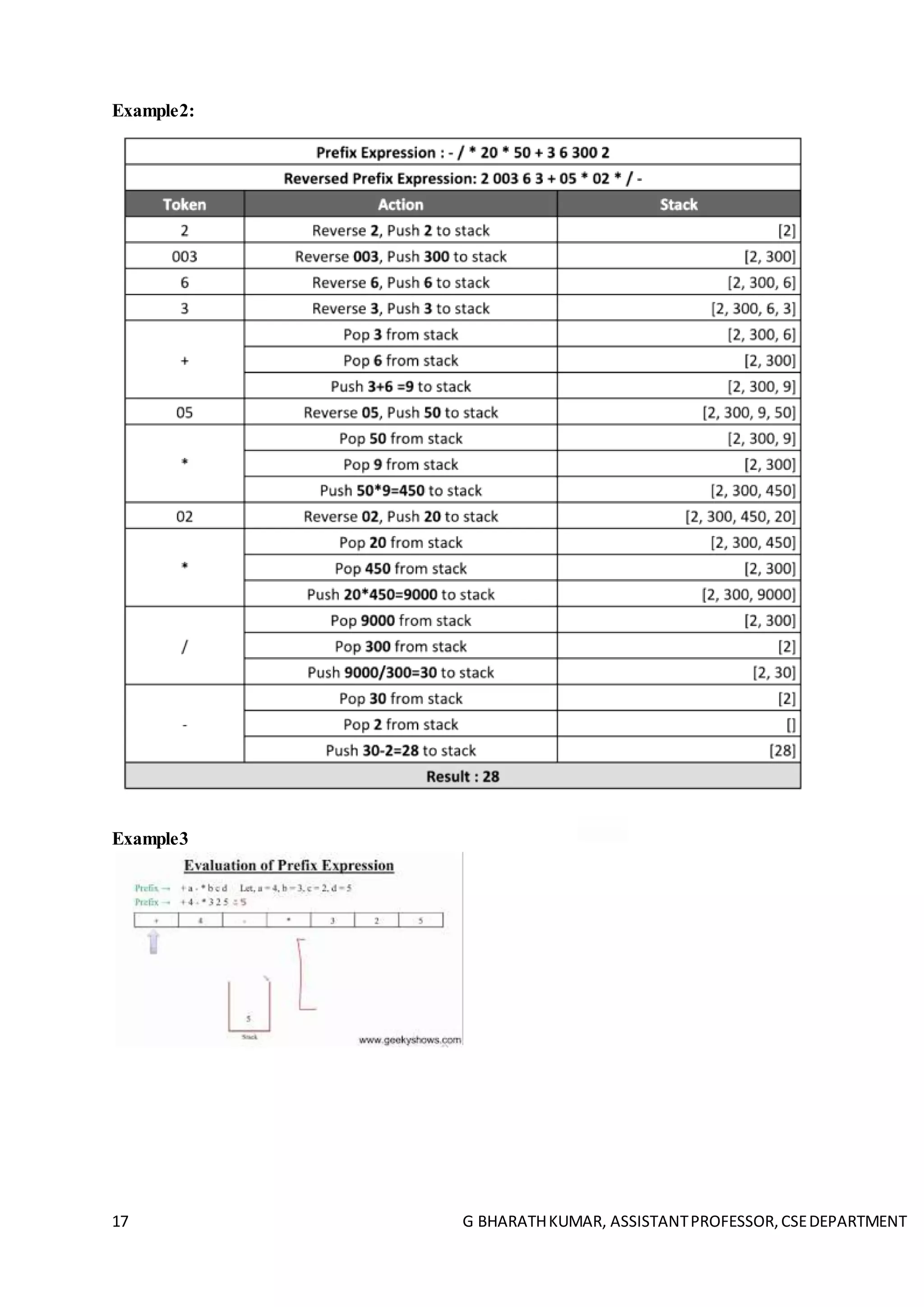
Prefix Evaluation Algorithm
17 G BHARATHKUMAR, ASSISTANTPROFESSOR,CSEDEPARTMENT
Example2:
Example3
18 G BHARATHKUMAR, ASSISTANTPROFESSOR,CSEDEPARTMENT
Source Code:
#include<stdio.h>
char stack[100];
int top = -1;
void push(char x)
{
stack[++top] = x;
}
char pop()
{
if(top == -1)
return -1;
else
return stack[top--];
}
int priority(char x)
{
if(x == '(')
return 0;
if(x == '+' || x == '-')
return 1;
if(x == '*' || x == '/')
return 2;
return 0;
}
int main()
{
char exp[100];
char *e, x;
printf("Enter the expression : ");
scanf("%s",exp);
printf("n");
e = exp;
while(*e != '0')
{
if(isalnum(*e))
printf("%c ",*e);
else if(*e == '(')
19 G BHARATHKUMAR, ASSISTANTPROFESSOR,CSEDEPARTMENT
push(*e);
else if(*e == ')')
{
while((x = pop()) != '(')
printf("%c ", x);
}
else
{
while(priority(stack[top]) >= priority(*e))
printf("%c ",pop());
push(*e);
}
e++;
}
while(top != -1)
{
printf("%c ",pop());
}return 0;
}
Output:
Queue:
Queue is an abstract data structure, somewhat similar to Stacks. Unlike stacks, a queue is
open at both its ends. One end is always used to insert data (enqueue) and the other is used
to remove data (dequeue). Queue follows First-In-First-Out methodology, i.e., the data item
stored first will be accessed first.
A real-world example of queue can be a single-lane one-way road, where the vehicle enters
first, exits first. More real-world examples can be seen as queues at the ticket windows and
bus-stops.
Types of Queues
20 G BHARATHKUMAR, ASSISTANTPROFESSOR,CSEDEPARTMENT
A queue is a useful data structure in programming. It is similar to the ticket queue outside a
cinema hall, where the first person entering the queue is the first person who gets the ticket.
There are four different types of queues:
 Simple Queue
 Circular Queue
 Priority Queue
 Double Ended Queue
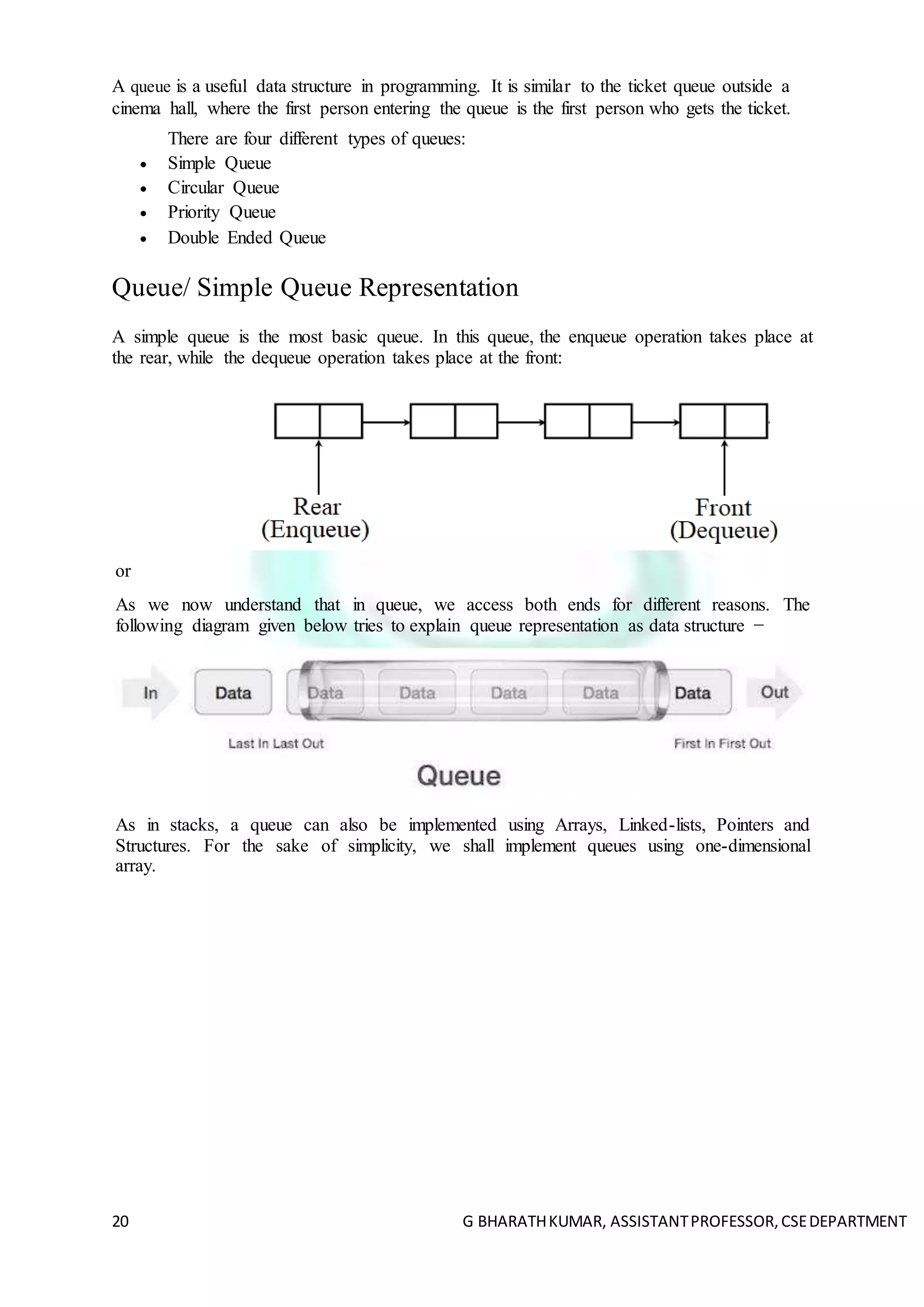
Queue/ Simple Queue Representation
A simple queue is the most basic queue. In this queue, the enqueue operation takes place at
the rear, while the dequeue operation takes place at the front:
or
As we now understand that in queue, we access both ends for different reasons. The
following diagram given below tries to explain queue representation as data structure −
As in stacks, a queue can also be implemented using Arrays, Linked-lists, Pointers and
Structures. For the sake of simplicity, we shall implement queues using one-dimensional
array.
21 G BHARATHKUMAR, ASSISTANTPROFESSOR,CSEDEPARTMENT
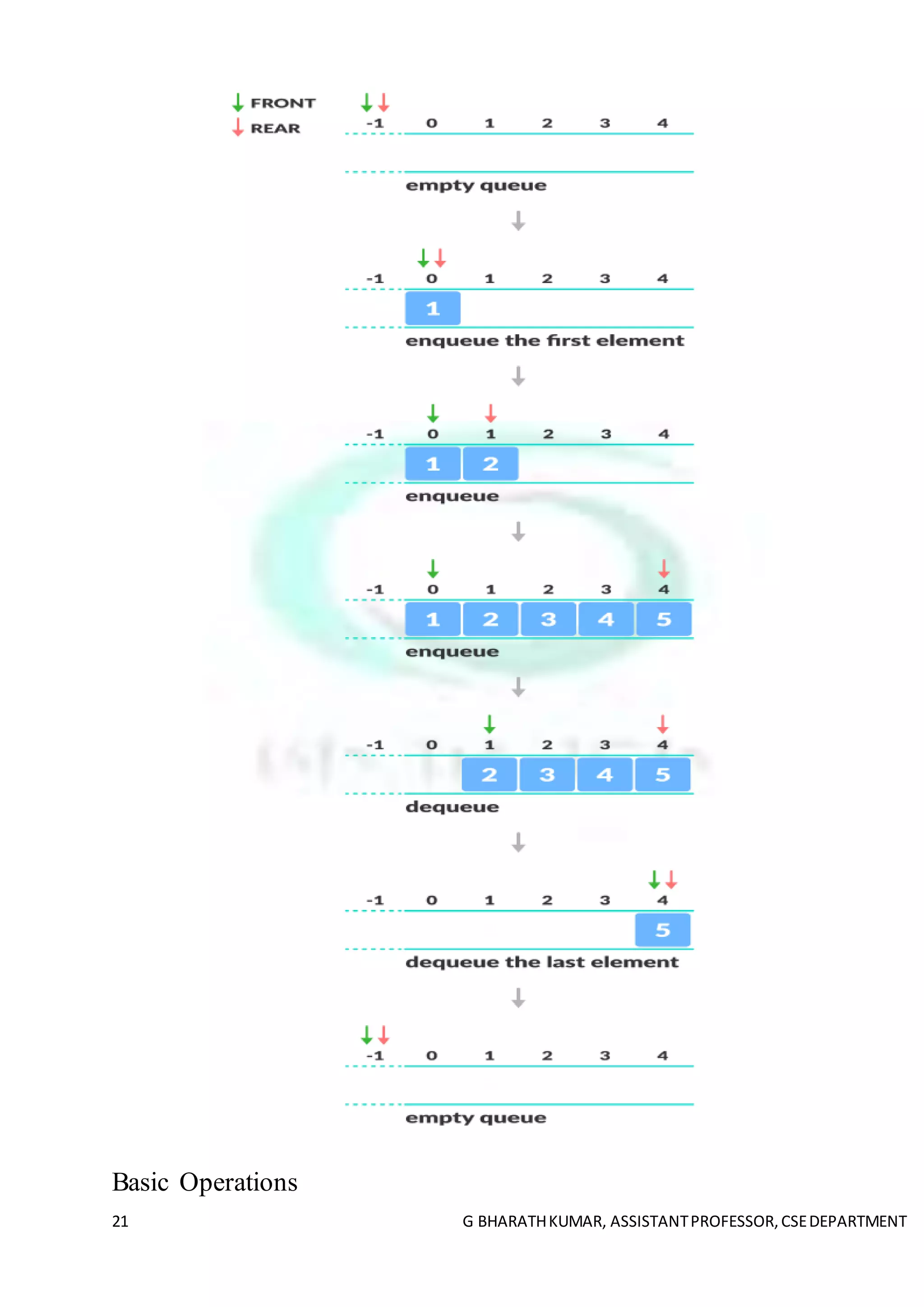
Basic Operations
22 G BHARATHKUMAR, ASSISTANTPROFESSOR,CSEDEPARTMENT
 peek() − Gets the element at the front of the queue without removing it.
 isfull() − Checks if the queue is full.
 isempty() − Checks if the queue is empty.
 enqueue() − add (store) an item to the queue.
 dequeue() − remove (access) an item from the queue.
In queue, we always dequeue (or access) data, pointed by front pointer and while enqueing
(or storing) data in the queue we take help of rear pointer.
Let's first learn about supportive functions of a queue −
peek()
This function helps to see the data at the front of the queue. The algorithm of peek()
function is as follows −
Algorithm
begin procedure peek
return queue[front]
end procedure
Implementation of peek() function in C programming language −
Example
int peek() {
return queue[front];
}
isfull()
As we are using single dimension array to implement queue, we just check for the rear
pointer to reach at MAXSIZE to determine that the queue is full. In case we maintain the
queue in a circular linked-list, the algorithm will differ. Algorithm of isfull() function −
Algorithm
begin procedure isfull
if rear equals to MAXSIZE
return true
else
return false
endif
end procedure
Implementation of isfull() function in C programming language −
Example
bool isfull() {
if(rear == MAXSIZE - 1)
return true;
else
return false;
}
23 G BHARATHKUMAR, ASSISTANTPROFESSOR,CSEDEPARTMENT
isempty()
Algorithm of isempty() function −
Algorithm
begin procedure isempty
if front is less than MIN OR front is greater than rear
return true
else
return false
endif
end procedure
If the value of front is less than MIN or 0, it tells that the queue is not yet initialized, hence
empty.
Here's the C programming code −
Example
bool isempty() {
if(front < 0 || front > rear)
return true;
else
return false;
}
Enqueue Operation
Queues maintain two data pointers, front and rear. Therefore, its operations are
comparatively difficult to implement than that of stacks.
The following steps should be taken to enqueue (insert) data into a queue −
 Step 1 − Check if the queue is full.
 Step 2 − If the queue is full, produce overflow error and exit.
 Step 3 − If the queue is not full, increment rear pointer to point the next empty
space.
 Step 4 − Add data element to the queue location, where the rear is pointing.
 Step 5 − return success.
24 G BHARATHKUMAR, ASSISTANTPROFESSOR,CSEDEPARTMENT
Sometimes, we also check to see if a queue is initialized or not, to handle any unforeseen
situations.
Algorithm for enqueue operation
procedure enqueue(data)
if queue is full
return overflow
endif
rear ← rear + 1
queue[rear] ← data
return true
end procedure
Implementation of enqueue() in C programming language −
Example
int enqueue(int data)
if(isfull())
return 0;
rear = rear + 1;
queue[rear] = data;
return 1;
end procedure
Dequeue Operation
Accessing data from the queue is a process of two tasks − access the data where front is
pointing and remove the data after access. The following steps are taken to
perform dequeue operation −
 Step 1 − Check if the queue is empty.
25 G BHARATHKUMAR, ASSISTANTPROFESSOR,CSEDEPARTMENT
 Step 2 − If the queue is empty, produce underflow error and exit.
 Step 3 − If the queue is not empty, access the data where front is pointing.
 Step 4 − Increment front pointer to point to the next available data element.
 Step 5 − Return success.
Algorithm for dequeue operation
procedure dequeue
if queue is empty
return underflow
end if
data = queue[front]
front ← front + 1
return true
end procedure
Implementation of dequeue() in C programming language −
Example
int dequeue() {
if(isempty())
return 0;
int data = queue[front];
front = front + 1;
return data;
}
#include <stdio.h>
#include <string.h>
#include <stdlib.h>
#include <stdbool.h>
#define MAX 6
int intArray[MAX];
26 G BHARATHKUMAR, ASSISTANTPROFESSOR,CSEDEPARTMENT
int front = 0;
int rear = -1;
int itemCount = 0;
int peek() {
return intArray[front];
}
bool isEmpty() {
return itemCount == 0;
}
bool isFull() {
return itemCount == MAX;
}
int size() {
return itemCount;
}
void insert(int data) {
if(!isFull()) {
if(rear == MAX-1) {
rear = -1;
}
intArray[++rear] = data;
itemCount++;
}
}
int removeData() {
int data = intArray[front++];
if(front == MAX) {
front = 0;
}
itemCount--;
return data;
}
int main() {
/* insert 5 items */
insert(3);
insert(5);
insert(9);
insert(1);
insert(12);
// front : 0
// rear : 4
// ------------------
27 G BHARATHKUMAR, ASSISTANTPROFESSOR,CSEDEPARTMENT
// index : 0 1 2 3 4
// ------------------
// queue : 3 5 9 1 12
insert(15);
// front : 0
// rear : 5
// ---------------------
// index : 0 1 2 3 4 5
// ---------------------
// queue : 3 5 9 1 12 15
if(isFull()) {
printf("Queue is full!n");
}
// remove one item
int num = removeData();
printf("Element removed: %dn",num);
// front : 1
// rear : 5
// -------------------
// index : 1 2 3 4 5
// -------------------
// queue : 5 9 1 12 15
// insert more items
insert(16);
// front : 1
// rear : -1
// ----------------------
// index : 0 1 2 3 4 5
// ----------------------
// queue : 16 5 9 1 12 15
// As queue is full, elements will not be inserted.
insert(17);
insert(18);
// ----------------------
// index : 0 1 2 3 4 5
// ----------------------
// queue : 16 5 9 1 12 15
printf("Element at front: %dn",peek());
printf("----------------------n");
printf("index : 5 4 3 2 1 0n");
printf("----------------------n");
printf("Queue: ");
while(!isEmpty()) {
int n = removeData();
printf("%d ",n);
28 G BHARATHKUMAR, ASSISTANTPROFESSOR,CSEDEPARTMENT
}
}
If we compile and run the above program, it will produce the following result −
Output
Queue is full!
Element removed: 3
Element at front: 5
----------------------
index : 5 4 3 2 1 0
----------------------
Queue: 5 9 1 12 15 16
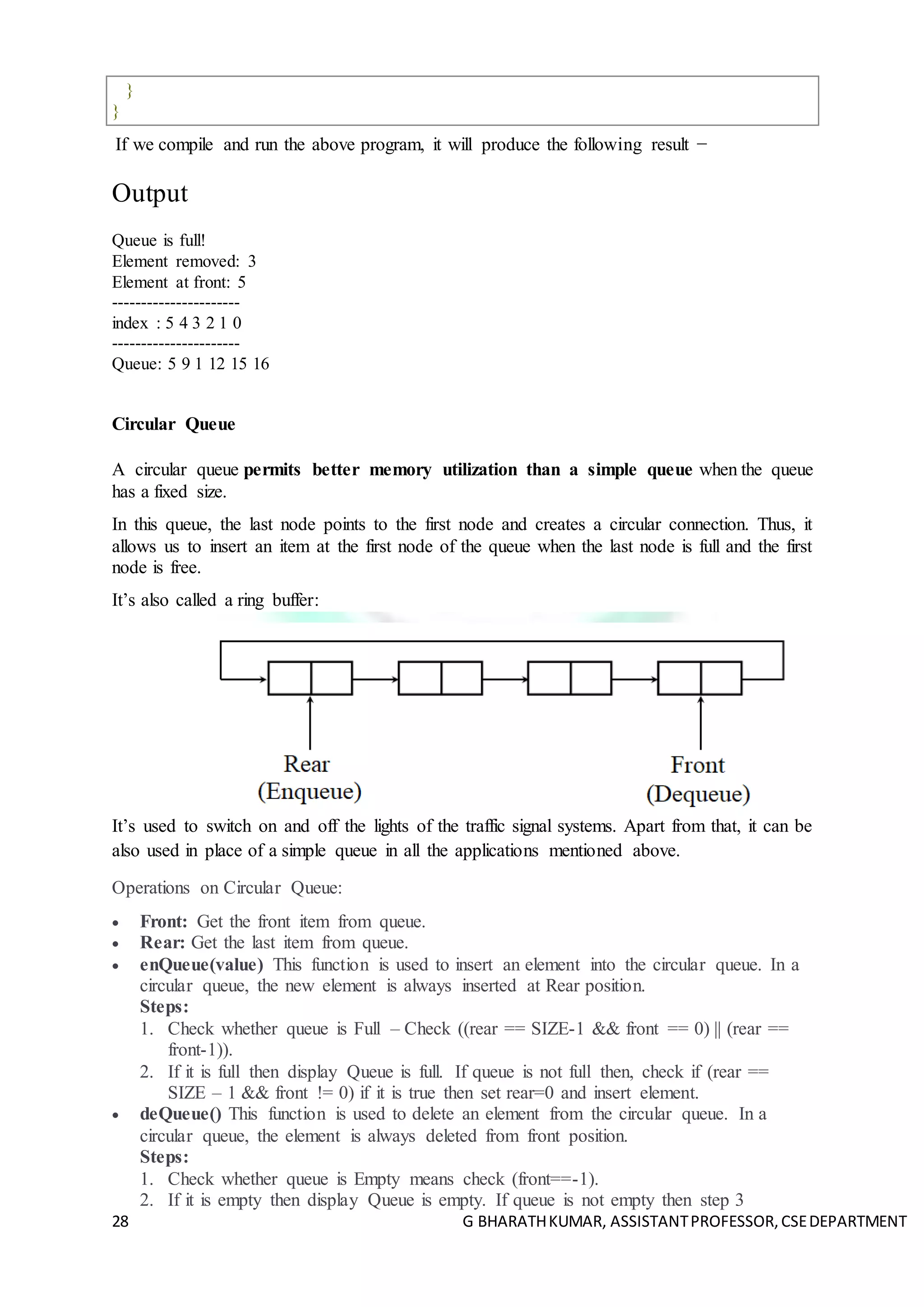
Circular Queue
A circular queue permits better memory utilization than a simple queue when the queue
has a fixed size.
In this queue, the last node points to the first node and creates a circular connection. Thus, it
allows us to insert an item at the first node of the queue when the last node is full and the first
node is free.
It’s also called a ring buffer:
It’s used to switch on and off the lights of the traffic signal systems. Apart from that, it can be
also used in place of a simple queue in all the applications mentioned above.
Operations on Circular Queue:
 Front: Get the front item from queue.
 Rear: Get the last item from queue.
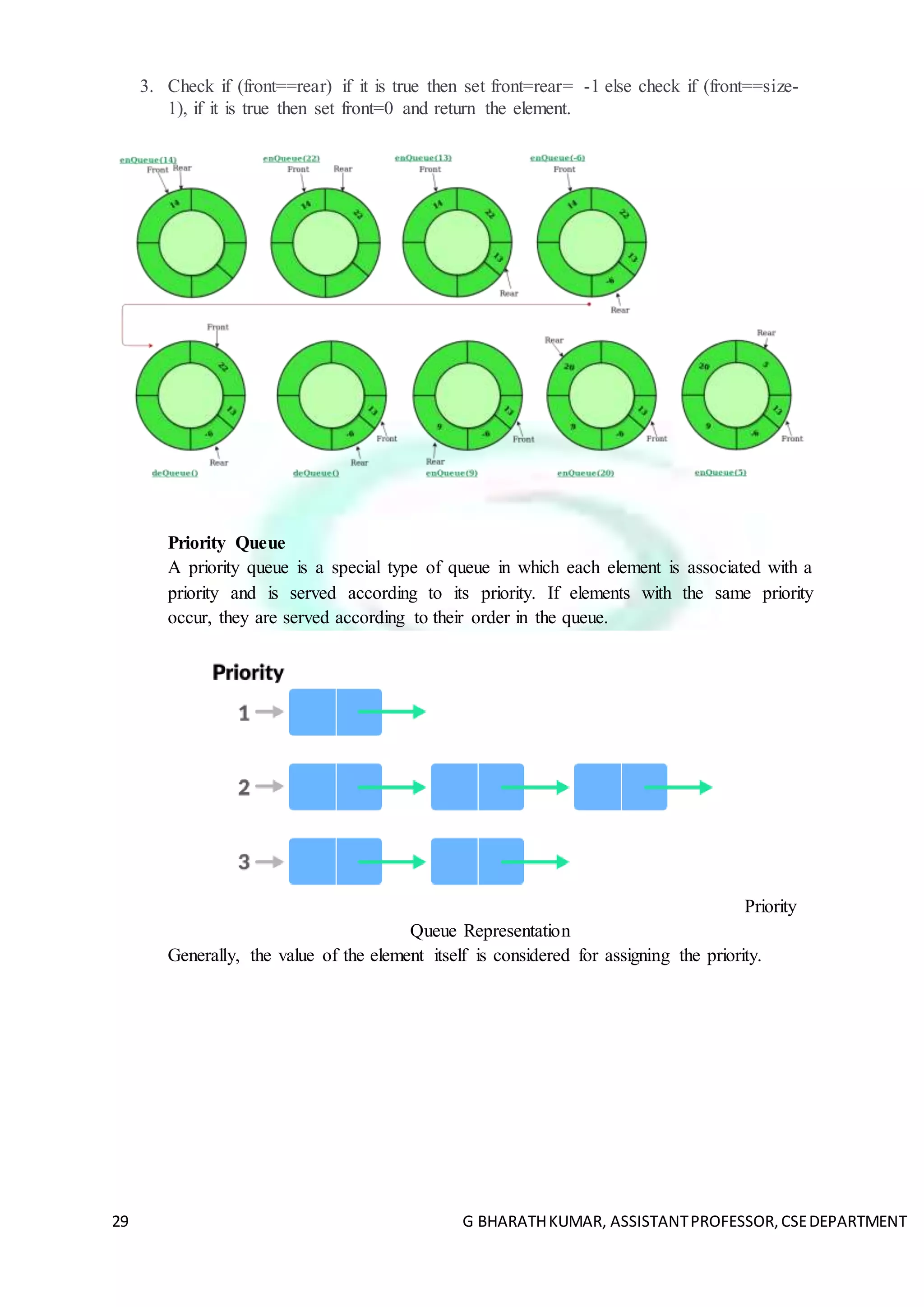
 enQueue(value) This function is used to insert an element into the circular queue. In a
circular queue, the new element is always inserted at Rear position.
Steps:
1. Check whether queue is Full – Check ((rear == SIZE-1 && front == 0) || (rear ==
front-1)).
2. If it is full then display Queue is full. If queue is not full then, check if (rear ==
SIZE – 1 && front != 0) if it is true then set rear=0 and insert element.
 deQueue() This function is used to delete an element from the circular queue. In a
circular queue, the element is always deleted from front position.
Steps:
1. Check whether queue is Empty means check (front==-1).
2. If it is empty then display Queue is empty. If queue is not empty then step 3
29 G BHARATHKUMAR, ASSISTANTPROFESSOR,CSEDEPARTMENT
3. Check if (front==rear) if it is true then set front=rear= -1 else check if (front==size-
1), if it is true then set front=0 and return the element.
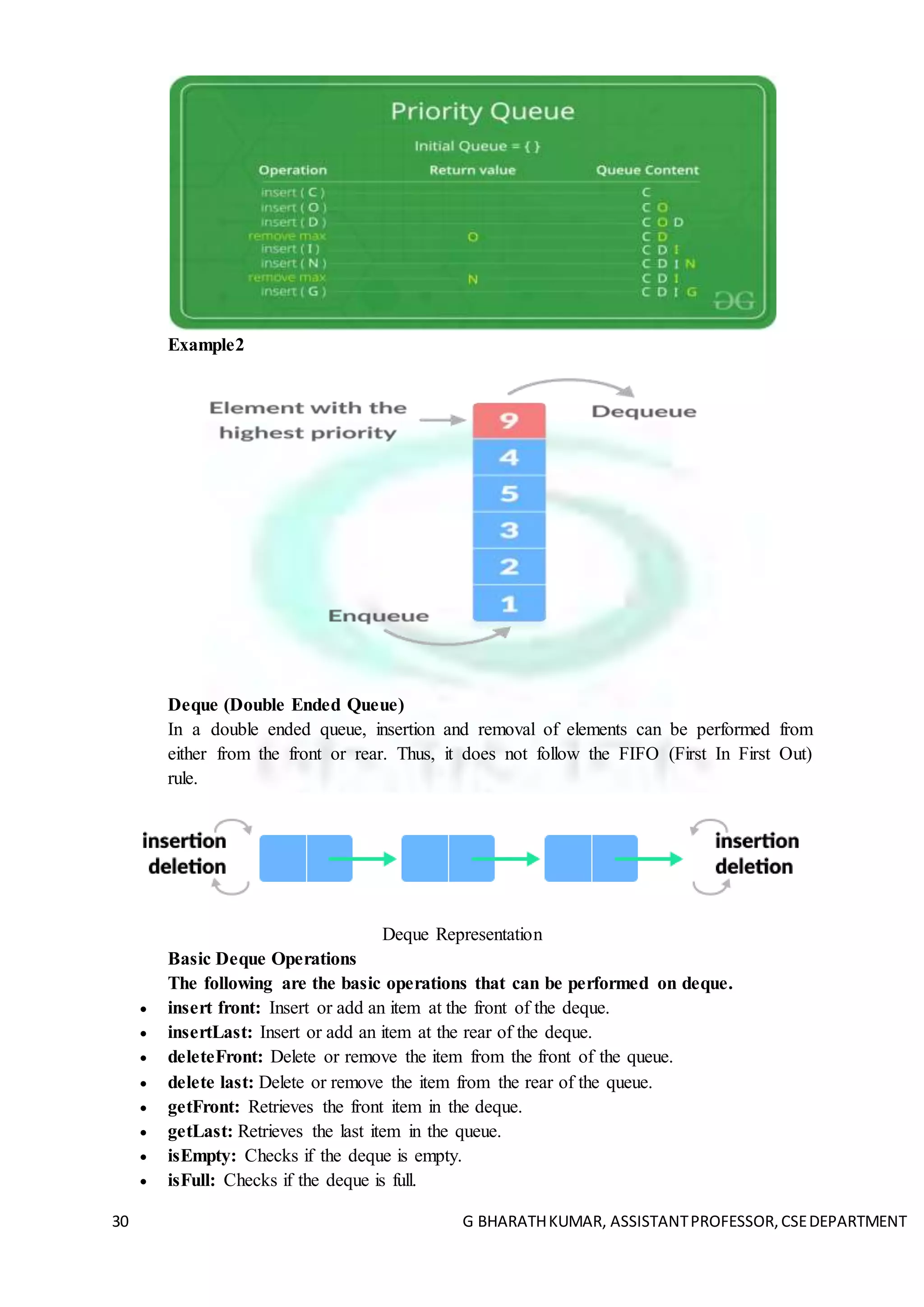
Priority Queue
A priority queue is a special type of queue in which each element is associated with a
priority and is served according to its priority. If elements with the same priority
occur, they are served according to their order in the queue.
Priority
Queue Representation
Generally, the value of the element itself is considered for assigning the priority.
30 G BHARATHKUMAR, ASSISTANTPROFESSOR,CSEDEPARTMENT
Example2
Deque (Double Ended Queue)
In a double ended queue, insertion and removal of elements can be performed from
either from the front or rear. Thus, it does not follow the FIFO (First In First Out)
rule.
Deque Representation
Basic Deque Operations
The following are the basic operations that can be performed on deque.
 insert front: Insert or add an item at the front of the deque.
 insertLast: Insert or add an item at the rear of the deque.
 deleteFront: Delete or remove the item from the front of the queue.
 delete last: Delete or remove the item from the rear of the queue.
 getFront: Retrieves the front item in the deque.
 getLast: Retrieves the last item in the queue.
 isEmpty: Checks if the deque is empty.
 isFull: Checks if the deque is full.
31 G BHARATHKUMAR, ASSISTANTPROFESSOR,CSEDEPARTMENT
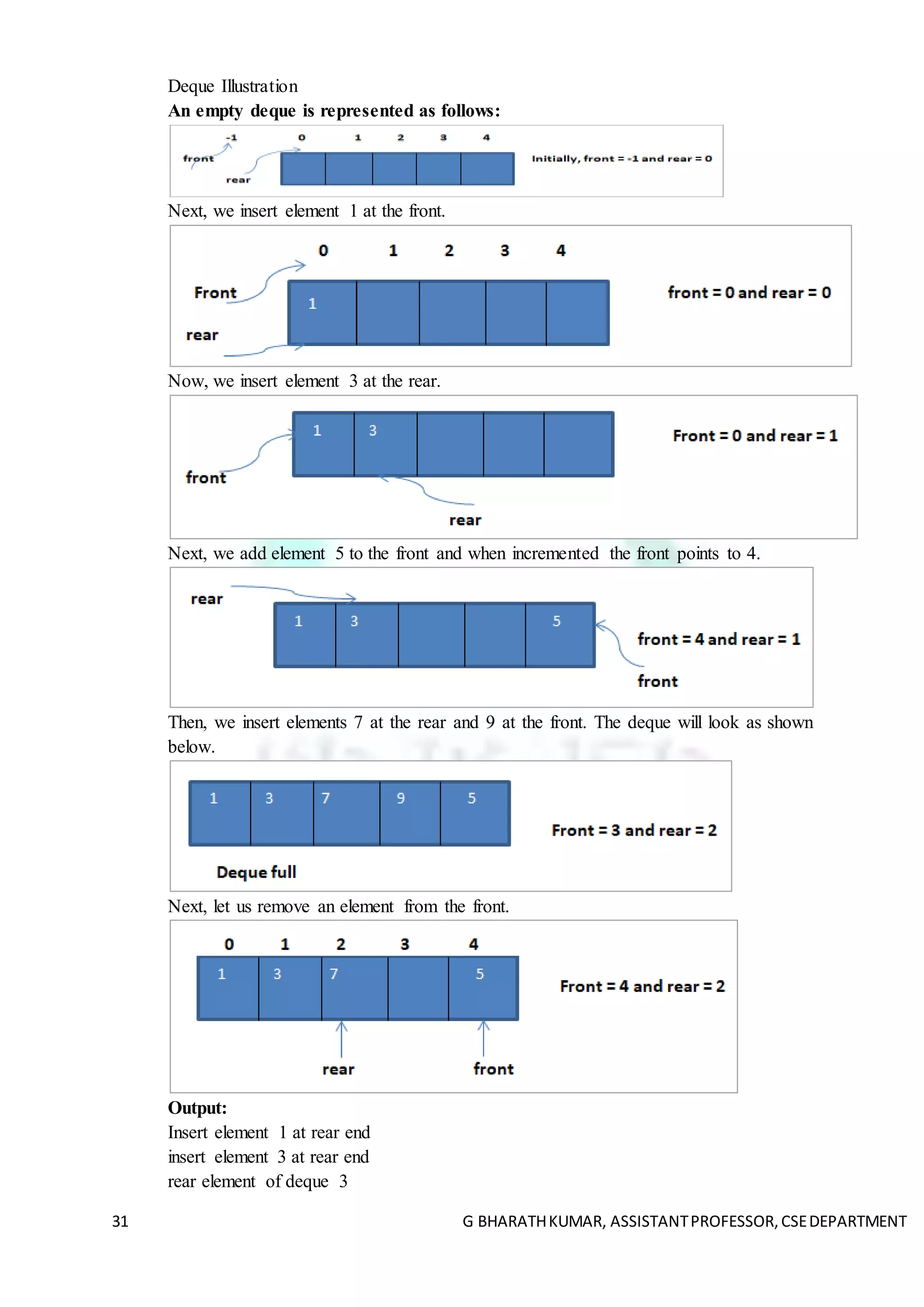
Deque Illustration
An empty deque is represented as follows:
Next, we insert element 1 at the front.
Now, we insert element 3 at the rear.
Next, we add element 5 to the front and when incremented the front points to 4.
Then, we insert elements 7 at the rear and 9 at the front. The deque will look as shown
below.
Next, let us remove an element from the front.
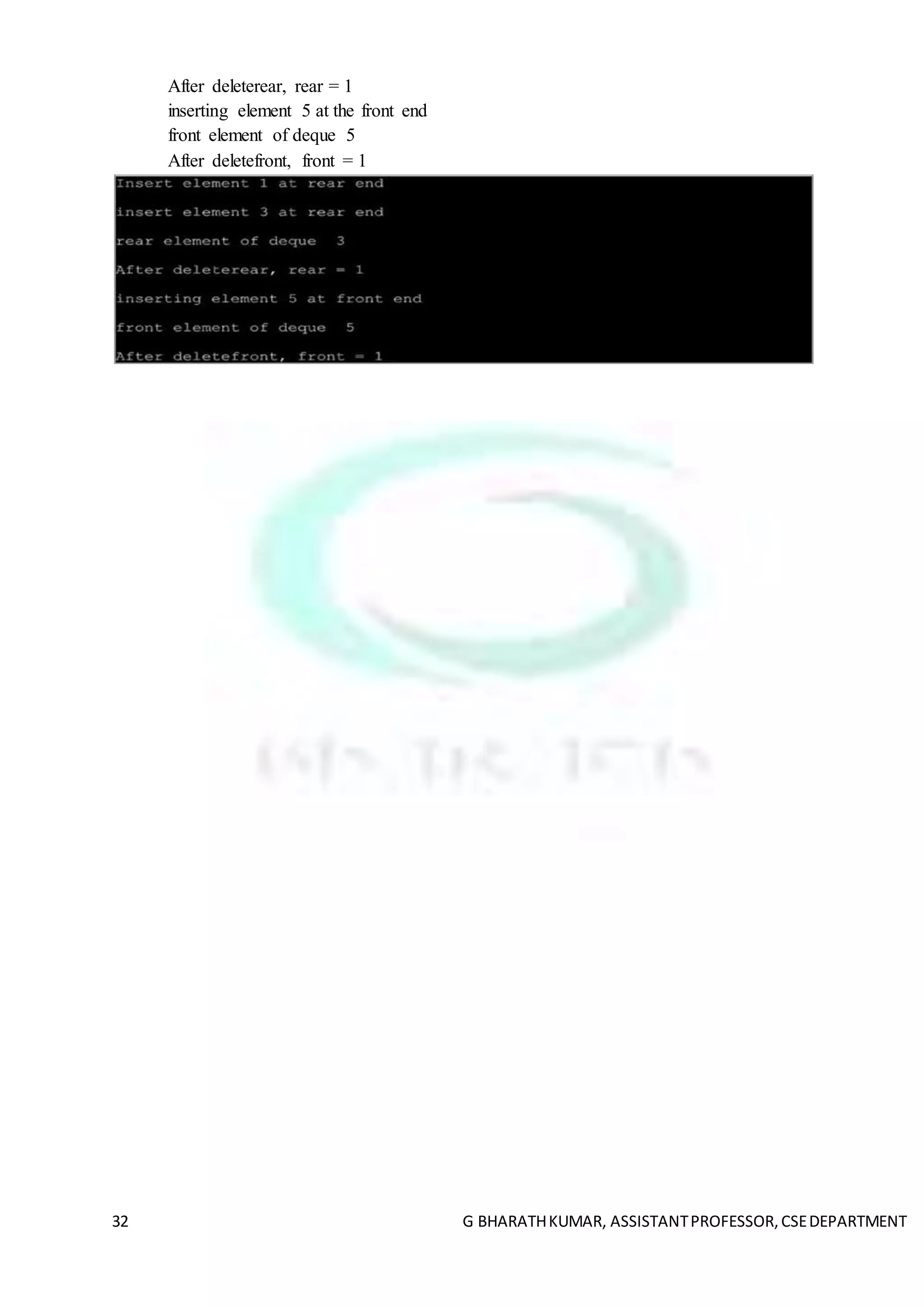
Output:
Insert element 1 at rear end
insert element 3 at rear end
rear element of deque 3
32 G BHARATHKUMAR, ASSISTANTPROFESSOR,CSEDEPARTMENT
After deleterear, rear = 1
inserting element 5 at the front end
front element of deque 5
After deletefront, front = 1

ADT STACK and Queues

  • 1.
    1 G BHARATHKUMAR,ASSISTANTPROFESSOR,CSEDEPARTMENT MODULE -2 I. ADT STACK AND ITS OPERATIONS ADT: The abstract datatype is special kind of datatype, whose behavior is defined by a set of values and set of operations. The keyword “Abstract” is used as we can use these datatypes, we can perform different operations. But how those operations are working that is totally hidden from the user. The ADT is made of with primitive datatypes, but operation logics are hidden. A stack is an Abstract Data Type (ADT), commonly used in most programming languages. It is named stack as it behaves like a real-world stack, for example – a deck of cards or a pile of plates, etc. A real-world stack allows operations at one end only. For example, we can place or remove a card or plate from the top of the stack only. Likewise, Stack ADT allows all data operations at one end only. At any given time, we can only access the top element of a stack. This feature makes it LIFO data structure. LIFO stands for Last-in-first-out. Here, the element which is placed (inserted or added) last, is accessed first. In stack terminology, insertion operation is called PUSH operation and removal operation is called POP operation. Stack Representation The following diagram depicts a stack and its operations − Implementations of the stack ADT
  • 2.
    2 G BHARATHKUMAR,ASSISTANTPROFESSOR,CSEDEPARTMENT A stack can be implemented by means of Array, Structure, Pointer, and Linked List. Stack can either be a fixed size one or it may have a sense of dynamic resizing. Here, we are going to implement stack using arrays, which makes it a fixed size stack implementation. Basic Operations Here we will see the stack ADT. These are few operations or functions of the Stack ADT. 1. peek(), This is used to get the top most element of the stack 2. isFull(), This is used to check whether stack is full or not 3. isEmpry(), This is used to check whether stack is empty or not 4. push(x), This is used to push x into the stack 5. pop(), This is used to delete one element from top of the stack 6. size(), this function is used to get number of elements present into the stack 1. peek() Algorithm of peek() function − begin procedure peek return stack[top] end procedure Implementation of peek() function in C programming language − Example int peek() { return stack[top]; } 2. isfull() Algorithm of isfull() function − begin procedure isfull if top equals to MAXSIZE return true else return false endif end procedure Implementation of isfull() function in C programming language − Example
  • 3.
    3 G BHARATHKUMAR,ASSISTANTPROFESSOR,CSEDEPARTMENT bool isfull() { if(top == MAXSIZE) return true; else return false; } 3. isempty() Algorithm of isempty() function − begin procedure isempty if top less than 1 return true else return false endif end procedure Implementation of isempty() function in C programming language is slightly different. We initialize top at -1, as the index in array starts from 0. So we check if the top is below zero or -1 to determine if the stack is empty. Here's the code − Example bool isempty() { if(top == -1) return true; else return false; } 4. Push Operation The process of putting a new data element onto stack is known as a Push Operation. Push operation involves a series of steps −  Step 1 − Checks if the stack is full.  Step 2 − If the stack is full, produces an error and exit.  Step 3 − If the stack is not full, increments top to point next empty space.  Step 4 − Adds data element to the stack location, where top is pointing.
  • 4.
    4 G BHARATHKUMAR,ASSISTANTPROFESSOR,CSEDEPARTMENT  Step 5 − Returns success. If the linked list is used to implement the stack, then in step 3, we need to allocate space dynamically. Algorithm for PUSH Operation A simple algorithm for Push operation can be derived as follows − begin procedure push: stack, data if stack is full return null endif top ← top + 1 stack[top] ← data end procedure Implementation of this algorithm in C, is very easy. See the following code − Example void push(int data) { if(!isFull()) { top = top + 1; stack[top] = data; } else { printf("Could not insert data, Stack is full.n"); }
  • 5.
    5 G BHARATHKUMAR,ASSISTANTPROFESSOR,CSEDEPARTMENT } 5. Pop Operation Accessing the content while removing it from the stack, is known as a Pop Operation. In an array implementation of pop() operation, the data element is not actually removed, instead top is decremented to a lower position in the stack to point to the next value. But in linked-list implementation, pop() actually removes data element and deallocates memory space. A Pop operation may involve the following steps −  Step 1 − Checks if the stack is empty.  Step 2 − If the stack is empty, produces an error and exit.  Step 3 − If the stack is not empty, accesses the data element at which top is pointing.  Step 4 − Decreases the value of top by 1.  Step 5 − Returns success. Algorithm for Pop Operation A simple algorithm for Pop operation can be derived as follows − begin procedure pop: stack if stack is empty return null endif data ← stack[top] top ← top - 1 return data
  • 6.
    6 G BHARATHKUMAR,ASSISTANTPROFESSOR,CSEDEPARTMENT end procedure Implementation of this algorithm in C, is as follows − Example int pop(int data) { if(!isempty()) { data = stack[top]; top = top - 1; return data; } else { printf("Could not retrieve data, Stack is empty.n"); } } PROGRAM #include <stdio.h> int MAXSIZE = 8; int stack[8]; int top = -1; int isempty() { if(top == -1) return 1; else return 0; } int isfull() { if(top == MAXSIZE) return 1; else return 0; }
  • 7.
    7 G BHARATHKUMAR,ASSISTANTPROFESSOR,CSEDEPARTMENT int peek() { return stack[top]; } int pop() { int data; if(!isempty()) { data = stack[top]; top = top - 1; return data; } else { printf("Could not retrieve data, Stack is empty.n"); } } int push(int data) { if(!isfull()) { top = top + 1; stack[top] = data; } else { printf("Could not insert data, Stack is full.n"); } } int main() { // push items on to the stack push(3); push(5); push(9); push(1); push(12); push(15); printf("Element at top of the stack: %dn" ,peek()); printf("Elements: n");
  • 8.
    8 G BHARATHKUMAR,ASSISTANTPROFESSOR,CSEDEPARTMENT // print stack data while(!isempty()) { int data = pop(); printf("%dn",data); } printf("Stack full: %sn" , isfull()?"true":"false"); printf("Stack empty: %sn" , isempty()?"true":"false"); return 0; } Output Element at top of the stack: 15 Elements: 15 12 1 9 5 3 Stack full: false Stack empty: true Run-time complexity of stack operations  For all the standard stack operations (push, pop, isEmpty, size), the worst-case run- time complexity can be O(1).  It's obvious that size and isEmpty constant-time operations.  push and pop are also O(1) because they only work with one end of the data structure - the top of the stack.  The upshot of all this is that stacks can and should be implemented easily and efficiently. Expression Parsing The way to write arithmetic expression is known as a notation. An arithmetic expression can be written in three different but equivalent notations, i.e., without changing the essence or output of an expression. These notations are −
  • 9.
    9 G BHARATHKUMAR,ASSISTANTPROFESSOR,CSEDEPARTMENT  Infix Notation  Prefix (Polish) Notation  Postfix (Reverse-Polish) Notation Infix Notation  We write expression in infix notation, e.g. a - b + c, where operators are used in- between operands. It is easy for us humans to read, write, and speak in infix notation but the same does not go well with computing devices. An algorithm to process infix notation could be difficult and costly in terms of time and space consumption. Prefix Notation  In this notation, operator is prefixed to operands, i.e. operator is written ahead of operands. For example, +ab. This is equivalent to its infix notation a + b. Prefix notation is also known as Polish Notation. Postfix Notation  This notation style is known as Reversed Polish Notation. In this notation style, the operator is postfixed to the operands i.e., the operator is written after the operands. For example, ab+. This is equivalent to its infix notation a + b. The following table briefly tries to show the difference in all three notations − Sr.No. Infix Notation Prefix Notation Postfix Notation 1 a + b + a b a b + 2 (a + b) ∗ c ∗ + a b c a b + c ∗ 3 a ∗ (b + c) ∗ a + b c a b c + ∗ 4 a / b + c / d + / a b / c d a b / c d / + 5 (a + b) ∗ (c + d) ∗ + a b + c d a b + c d + ∗ 6 ((a + b) ∗ c) - d - ∗ + a b c d a b + c ∗ d - Parsing Expressions As we have discussed, it is not a very efficient way to design an algorithm or program to parse infix notations. Instead, these infix notations are first converted into either postfix or prefix notations and then computed. To parse any arithmetic expression, we need to take care of operator precedence and associativity also.
  • 10.
    10 G BHARATHKUMAR,ASSISTANTPROFESSOR,CSEDEPARTMENT Precedence When an operand is in between two different operators, which operator will take the operand first, is decided by the precedence of an operator over others. For example As multiplication operation has precedence over addition, b * c will be evaluated first. A table of operator precedence is provided later. Associativity Associativity describes the rule where operators with the same precedence appear in an expression. For example, in expression a + b − c, both + and – have the same precedence, then which part of the expression will be evaluated first, is determined by associativity of those operators. Here, both + and − are left associative, so the expression will be evaluated as (a + b) − c. Precedence and associativity determines the order of evaluation of an expression. Following is an operator precedence and associativity table (highest to lowest) − Sr.No. Operator Precedence Associativity 1 Exponentiation ^ Highest Right Associative 2 Multiplication ( ∗ ) & Division ( / ) Second Highest Left Associative 3 Addition ( + ) & Subtraction ( − ) Lowest Left Associative The above table shows the default behavior of operators. At any point of time in expression evaluation, the order can be altered by using parenthesis. For example − In a + b*c, the expression part b*c will be evaluated first, with multiplication as precedence over addition. We here use parenthesis for a + b to be evaluated first, like (a + b)*c.
  • 11.
    11 G BHARATHKUMAR,ASSISTANTPROFESSOR,CSEDEPARTMENT Applications of stack:  Reversing a list or String  Expression Evaluation  Postfix Evaluation  Prefix Evaluation  Expression Conversion. i. Infix to Postfix. ii. Infix to Prefix. iii. Postfix to Infix. iv. Prefix to Infix.  Backtracking.  Memory Management.  Towers of Honai Postfix Evaluation Algorithm A postfix expression is a collection of operators and operands in which the operator is placed after the operands. That means, in a postfix expression the operator follows the operands. Postfix Expression has following general structure... Operand1 Operand2 Operator Example Postfix Expression Evaluation using Stack Data Structure A postfix expression can be evaluated using the Stack data structure. To evaluate a postfix expression using Stack data structure we can use the following steps... 1. Read all the symbols one by one from left to right in the given Postfix Expression
  • 12.
    12 G BHARATHKUMAR,ASSISTANTPROFESSOR,CSEDEPARTMENT 2. If the reading symbol is operand, then push it on to the Stack. 3. If the reading symbol is operator (+ , - , * , / etc.,), then perform TWO pop operations and store the two popped oparands in two different variables (operand1 and operand2). Then perform reading symbol operation using operand1 and operand2 and push result back on to the Stack. 4. Finally! perform a pop operation and display the popped value as final result. Example Consider the following Expression...
  • 13.
    13 G BHARATHKUMAR,ASSISTANTPROFESSOR,CSEDEPARTMENT
  • 14.
    14 G BHARATHKUMAR,ASSISTANTPROFESSOR,CSEDEPARTMENT Infix to Postfix Conversion Example1: Example2:
  • 15.
    15 G BHARATHKUMAR,ASSISTANTPROFESSOR,CSEDEPARTMENT Example3: Example4: Infix to Prefix Conversion Example1
  • 16.
    16 G BHARATHKUMAR,ASSISTANTPROFESSOR,CSEDEPARTMENT Example2 Example3 Prefix Evaluation Algorithm
  • 17.
    17 G BHARATHKUMAR,ASSISTANTPROFESSOR,CSEDEPARTMENT Example2: Example3
  • 18.
    18 G BHARATHKUMAR,ASSISTANTPROFESSOR,CSEDEPARTMENT Source Code: #include<stdio.h> char stack[100]; int top = -1; void push(char x) { stack[++top] = x; } char pop() { if(top == -1) return -1; else return stack[top--]; } int priority(char x) { if(x == '(') return 0; if(x == '+' || x == '-') return 1; if(x == '*' || x == '/') return 2; return 0; } int main() { char exp[100]; char *e, x; printf("Enter the expression : "); scanf("%s",exp); printf("n"); e = exp; while(*e != '0') { if(isalnum(*e)) printf("%c ",*e); else if(*e == '(')
  • 19.
    19 G BHARATHKUMAR,ASSISTANTPROFESSOR,CSEDEPARTMENT push(*e); else if(*e == ')') { while((x = pop()) != '(') printf("%c ", x); } else { while(priority(stack[top]) >= priority(*e)) printf("%c ",pop()); push(*e); } e++; } while(top != -1) { printf("%c ",pop()); }return 0; } Output: Queue: Queue is an abstract data structure, somewhat similar to Stacks. Unlike stacks, a queue is open at both its ends. One end is always used to insert data (enqueue) and the other is used to remove data (dequeue). Queue follows First-In-First-Out methodology, i.e., the data item stored first will be accessed first. A real-world example of queue can be a single-lane one-way road, where the vehicle enters first, exits first. More real-world examples can be seen as queues at the ticket windows and bus-stops. Types of Queues
  • 20.
    20 G BHARATHKUMAR,ASSISTANTPROFESSOR,CSEDEPARTMENT A queue is a useful data structure in programming. It is similar to the ticket queue outside a cinema hall, where the first person entering the queue is the first person who gets the ticket. There are four different types of queues:  Simple Queue  Circular Queue  Priority Queue  Double Ended Queue Queue/ Simple Queue Representation A simple queue is the most basic queue. In this queue, the enqueue operation takes place at the rear, while the dequeue operation takes place at the front: or As we now understand that in queue, we access both ends for different reasons. The following diagram given below tries to explain queue representation as data structure − As in stacks, a queue can also be implemented using Arrays, Linked-lists, Pointers and Structures. For the sake of simplicity, we shall implement queues using one-dimensional array.
  • 21.
    21 G BHARATHKUMAR,ASSISTANTPROFESSOR,CSEDEPARTMENT Basic Operations
  • 22.
    22 G BHARATHKUMAR,ASSISTANTPROFESSOR,CSEDEPARTMENT  peek() − Gets the element at the front of the queue without removing it.  isfull() − Checks if the queue is full.  isempty() − Checks if the queue is empty.  enqueue() − add (store) an item to the queue.  dequeue() − remove (access) an item from the queue. In queue, we always dequeue (or access) data, pointed by front pointer and while enqueing (or storing) data in the queue we take help of rear pointer. Let's first learn about supportive functions of a queue − peek() This function helps to see the data at the front of the queue. The algorithm of peek() function is as follows − Algorithm begin procedure peek return queue[front] end procedure Implementation of peek() function in C programming language − Example int peek() { return queue[front]; } isfull() As we are using single dimension array to implement queue, we just check for the rear pointer to reach at MAXSIZE to determine that the queue is full. In case we maintain the queue in a circular linked-list, the algorithm will differ. Algorithm of isfull() function − Algorithm begin procedure isfull if rear equals to MAXSIZE return true else return false endif end procedure Implementation of isfull() function in C programming language − Example bool isfull() { if(rear == MAXSIZE - 1) return true; else return false; }
  • 23.
    23 G BHARATHKUMAR,ASSISTANTPROFESSOR,CSEDEPARTMENT isempty() Algorithm of isempty() function − Algorithm begin procedure isempty if front is less than MIN OR front is greater than rear return true else return false endif end procedure If the value of front is less than MIN or 0, it tells that the queue is not yet initialized, hence empty. Here's the C programming code − Example bool isempty() { if(front < 0 || front > rear) return true; else return false; } Enqueue Operation Queues maintain two data pointers, front and rear. Therefore, its operations are comparatively difficult to implement than that of stacks. The following steps should be taken to enqueue (insert) data into a queue −  Step 1 − Check if the queue is full.  Step 2 − If the queue is full, produce overflow error and exit.  Step 3 − If the queue is not full, increment rear pointer to point the next empty space.  Step 4 − Add data element to the queue location, where the rear is pointing.  Step 5 − return success.
  • 24.
    24 G BHARATHKUMAR,ASSISTANTPROFESSOR,CSEDEPARTMENT Sometimes, we also check to see if a queue is initialized or not, to handle any unforeseen situations. Algorithm for enqueue operation procedure enqueue(data) if queue is full return overflow endif rear ← rear + 1 queue[rear] ← data return true end procedure Implementation of enqueue() in C programming language − Example int enqueue(int data) if(isfull()) return 0; rear = rear + 1; queue[rear] = data; return 1; end procedure Dequeue Operation Accessing data from the queue is a process of two tasks − access the data where front is pointing and remove the data after access. The following steps are taken to perform dequeue operation −  Step 1 − Check if the queue is empty.
  • 25.
    25 G BHARATHKUMAR,ASSISTANTPROFESSOR,CSEDEPARTMENT  Step 2 − If the queue is empty, produce underflow error and exit.  Step 3 − If the queue is not empty, access the data where front is pointing.  Step 4 − Increment front pointer to point to the next available data element.  Step 5 − Return success. Algorithm for dequeue operation procedure dequeue if queue is empty return underflow end if data = queue[front] front ← front + 1 return true end procedure Implementation of dequeue() in C programming language − Example int dequeue() { if(isempty()) return 0; int data = queue[front]; front = front + 1; return data; } #include <stdio.h> #include <string.h> #include <stdlib.h> #include <stdbool.h> #define MAX 6 int intArray[MAX];
  • 26.
    26 G BHARATHKUMAR,ASSISTANTPROFESSOR,CSEDEPARTMENT int front = 0; int rear = -1; int itemCount = 0; int peek() { return intArray[front]; } bool isEmpty() { return itemCount == 0; } bool isFull() { return itemCount == MAX; } int size() { return itemCount; } void insert(int data) { if(!isFull()) { if(rear == MAX-1) { rear = -1; } intArray[++rear] = data; itemCount++; } } int removeData() { int data = intArray[front++]; if(front == MAX) { front = 0; } itemCount--; return data; } int main() { /* insert 5 items */ insert(3); insert(5); insert(9); insert(1); insert(12); // front : 0 // rear : 4 // ------------------
  • 27.
    27 G BHARATHKUMAR,ASSISTANTPROFESSOR,CSEDEPARTMENT // index : 0 1 2 3 4 // ------------------ // queue : 3 5 9 1 12 insert(15); // front : 0 // rear : 5 // --------------------- // index : 0 1 2 3 4 5 // --------------------- // queue : 3 5 9 1 12 15 if(isFull()) { printf("Queue is full!n"); } // remove one item int num = removeData(); printf("Element removed: %dn",num); // front : 1 // rear : 5 // ------------------- // index : 1 2 3 4 5 // ------------------- // queue : 5 9 1 12 15 // insert more items insert(16); // front : 1 // rear : -1 // ---------------------- // index : 0 1 2 3 4 5 // ---------------------- // queue : 16 5 9 1 12 15 // As queue is full, elements will not be inserted. insert(17); insert(18); // ---------------------- // index : 0 1 2 3 4 5 // ---------------------- // queue : 16 5 9 1 12 15 printf("Element at front: %dn",peek()); printf("----------------------n"); printf("index : 5 4 3 2 1 0n"); printf("----------------------n"); printf("Queue: "); while(!isEmpty()) { int n = removeData(); printf("%d ",n);
  • 28.
    28 G BHARATHKUMAR,ASSISTANTPROFESSOR,CSEDEPARTMENT } } If we compile and run the above program, it will produce the following result − Output Queue is full! Element removed: 3 Element at front: 5 ---------------------- index : 5 4 3 2 1 0 ---------------------- Queue: 5 9 1 12 15 16 Circular Queue A circular queue permits better memory utilization than a simple queue when the queue has a fixed size. In this queue, the last node points to the first node and creates a circular connection. Thus, it allows us to insert an item at the first node of the queue when the last node is full and the first node is free. It’s also called a ring buffer: It’s used to switch on and off the lights of the traffic signal systems. Apart from that, it can be also used in place of a simple queue in all the applications mentioned above. Operations on Circular Queue:  Front: Get the front item from queue.  Rear: Get the last item from queue.  enQueue(value) This function is used to insert an element into the circular queue. In a circular queue, the new element is always inserted at Rear position. Steps: 1. Check whether queue is Full – Check ((rear == SIZE-1 && front == 0) || (rear == front-1)). 2. If it is full then display Queue is full. If queue is not full then, check if (rear == SIZE – 1 && front != 0) if it is true then set rear=0 and insert element.  deQueue() This function is used to delete an element from the circular queue. In a circular queue, the element is always deleted from front position. Steps: 1. Check whether queue is Empty means check (front==-1). 2. If it is empty then display Queue is empty. If queue is not empty then step 3
  • 29.
    29 G BHARATHKUMAR,ASSISTANTPROFESSOR,CSEDEPARTMENT 3. Check if (front==rear) if it is true then set front=rear= -1 else check if (front==size- 1), if it is true then set front=0 and return the element. Priority Queue A priority queue is a special type of queue in which each element is associated with a priority and is served according to its priority. If elements with the same priority occur, they are served according to their order in the queue. Priority Queue Representation Generally, the value of the element itself is considered for assigning the priority.
  • 30.
    30 G BHARATHKUMAR,ASSISTANTPROFESSOR,CSEDEPARTMENT Example2 Deque (Double Ended Queue) In a double ended queue, insertion and removal of elements can be performed from either from the front or rear. Thus, it does not follow the FIFO (First In First Out) rule. Deque Representation Basic Deque Operations The following are the basic operations that can be performed on deque.  insert front: Insert or add an item at the front of the deque.  insertLast: Insert or add an item at the rear of the deque.  deleteFront: Delete or remove the item from the front of the queue.  delete last: Delete or remove the item from the rear of the queue.  getFront: Retrieves the front item in the deque.  getLast: Retrieves the last item in the queue.  isEmpty: Checks if the deque is empty.  isFull: Checks if the deque is full.
  • 31.
    31 G BHARATHKUMAR,ASSISTANTPROFESSOR,CSEDEPARTMENT Deque Illustration An empty deque is represented as follows: Next, we insert element 1 at the front. Now, we insert element 3 at the rear. Next, we add element 5 to the front and when incremented the front points to 4. Then, we insert elements 7 at the rear and 9 at the front. The deque will look as shown below. Next, let us remove an element from the front. Output: Insert element 1 at rear end insert element 3 at rear end rear element of deque 3
  • 32.
    32 G BHARATHKUMAR,ASSISTANTPROFESSOR,CSEDEPARTMENT After deleterear, rear = 1 inserting element 5 at the front end front element of deque 5 After deletefront, front = 1