1
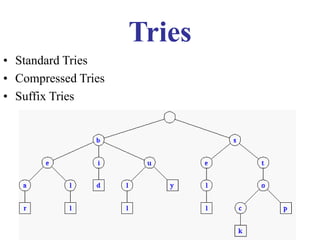
Tries
• Standard Tries
• Compressed Tries
• Suffix Tries
2
Standard Tries
• The standard trie for a set of strings S is an ordered tree such that:
– each node but the root is labeled with a character
– the children of a node are alphabetically ordered
– the paths from the external nodes to the root yield the strings of S
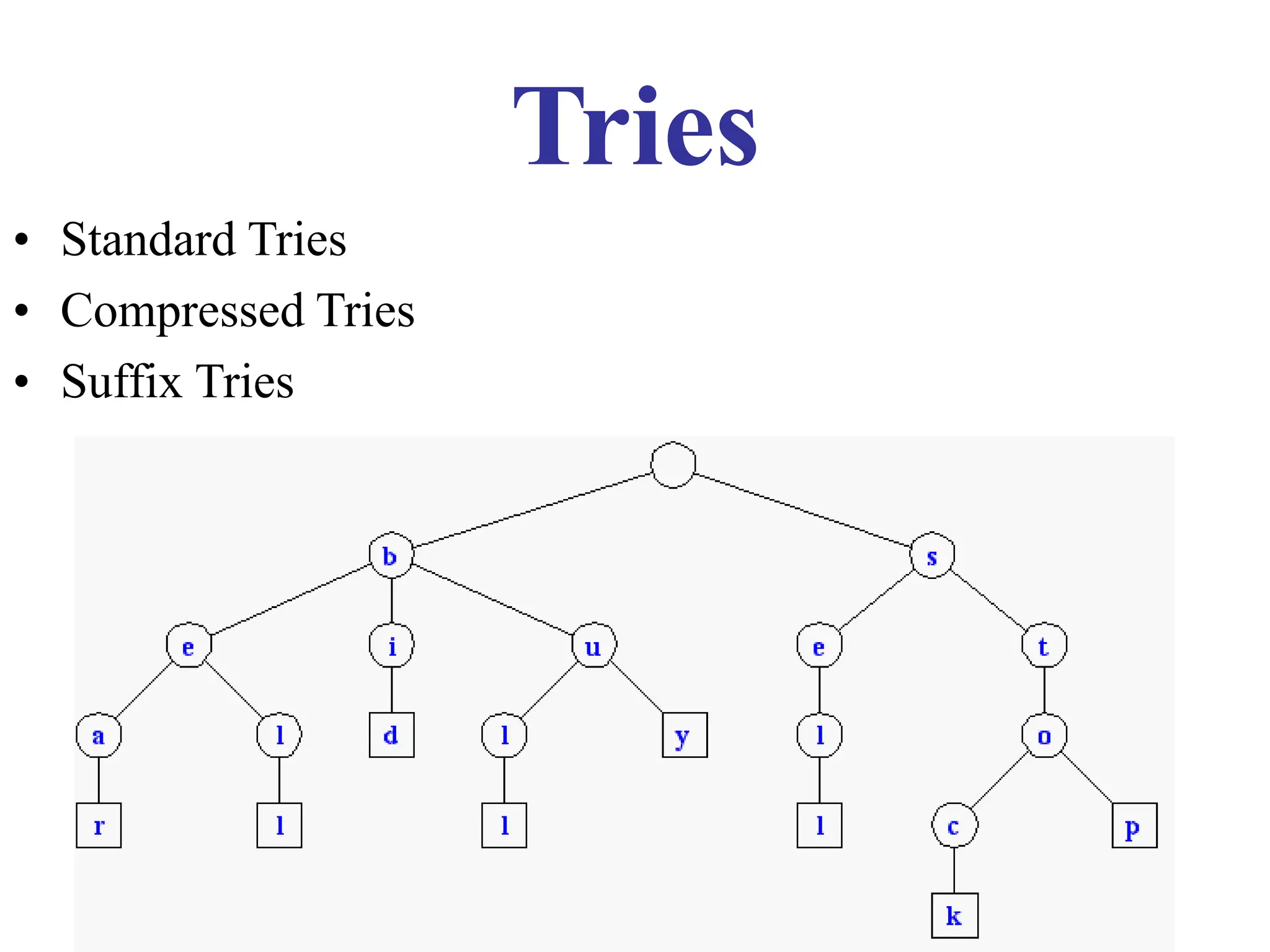
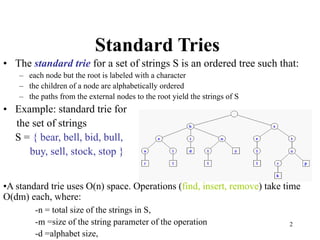
• Example: standard trie for
the set of strings
S = { bear, bell, bid, bull,
buy, sell, stock, stop }
•A standard trie uses O(n) space. Operations (find, insert, remove) take time
O(dm) each, where:
-n = total size of the strings in S,
-m =size of the string parameter of the operation
-d =alphabet size,
3
Applications of Tries
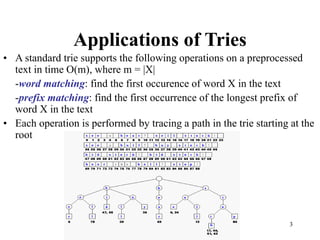
• A standard trie supports the following operations on a preprocessed
text in time O(m), where m = |X|
-word matching: find the first occurence of word X in the text
-prefix matching: find the first occurrence of the longest prefix of
word X in the text
• Each operation is performed by tracing a path in the trie starting at the
root
4
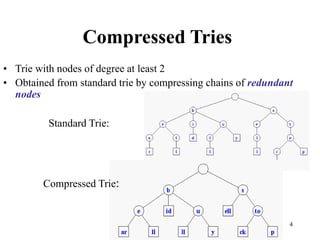
Compressed Tries
• Trie with nodes of degree at least 2
• Obtained from standard trie by compressing chains of redundant
nodes
Compressed Trie:
Standard Trie:
5
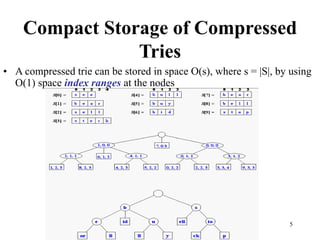
Compact Storage of Compressed
Tries
• A compressed trie can be stored in space O(s), where s = |S|, by using
O(1) space index ranges at the nodes
6
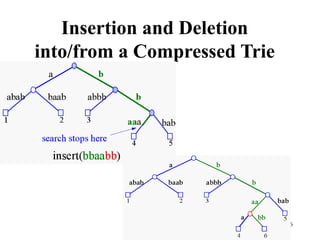
Insertion and Deletion
into/from a Compressed Trie
7
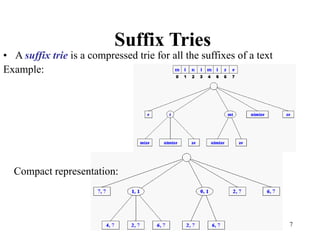
Suffix Tries
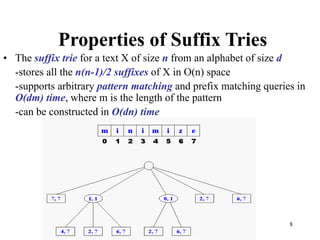
• A suffix trie is a compressed trie for all the suffixes of a text
Example:
Compact representation:
8
Properties of Suffix Tries
• The suffix trie for a text X of size n from an alphabet of size d
-stores all the n(n-1)/2 suffixes of X in O(n) space
-supports arbitrary pattern matching and prefix matching queries in
O(dm) time, where m is the length of the pattern
-can be constructed in O(dn) time
9
Tries and Web Search Engines
• The index of a search engine (collection of all searchable words) is stored
into a compressed trie
• Each leaf of the trie is associated with a word and has a list of pages (URLs)
containing that word, called occurrence list
• The trie is kept in internal memory
• The occurrence lists are kept in external memory and are ranked by
relevance
• Boolean queries for sets of words (e.g., Java and coffee) correspond to set
operations (e.g., intersection) on the occurrence lists
• Additional information retrieval techniques are used, such as
– stopword elimination (e.g., ignore “the” “a” “is”)
– stemming (e.g., identify “add” “adding” “added”)
– link analysis (recognize authoritative pages)
10
Tries and Internet Routers
• Computers on the internet (hosts) are identified by a unique 32-bit IP
(internet protocol) addres, usually written in “dotted-quad-decimal” notation
• E.g., www.iitd.ac.in is 103.27.9.24
• Use nslookup on Unix to find out IP addresses
• An organization uses a subset of IP addresses with the same prefix, e.g.,
IITD uses 103.27.*.*, Yale uses 130.132.*.*
• Data is sent to a host by fragmenting it into packets. Each packet carries the
IP address of its destination.
• The internet whose nodes are routers, and whose edges are communication
links.
• A router forwards packets to its neighbors using IP prefix matching rules.
E.g., a packet with IP prefix 103.27. should be forwarded to the IITD
gateway router.
• Routers use tries on the alphabet 0,1 to do prefix matching.

data structure and algorithm notes - tries

  • 1.
    1 Tries • Standard Tries •Compressed Tries • Suffix Tries
  • 2.
    2 Standard Tries • Thestandard trie for a set of strings S is an ordered tree such that: – each node but the root is labeled with a character – the children of a node are alphabetically ordered – the paths from the external nodes to the root yield the strings of S • Example: standard trie for the set of strings S = { bear, bell, bid, bull, buy, sell, stock, stop } •A standard trie uses O(n) space. Operations (find, insert, remove) take time O(dm) each, where: -n = total size of the strings in S, -m =size of the string parameter of the operation -d =alphabet size,
  • 3.
    3 Applications of Tries •A standard trie supports the following operations on a preprocessed text in time O(m), where m = |X| -word matching: find the first occurence of word X in the text -prefix matching: find the first occurrence of the longest prefix of word X in the text • Each operation is performed by tracing a path in the trie starting at the root
  • 4.
    4 Compressed Tries • Triewith nodes of degree at least 2 • Obtained from standard trie by compressing chains of redundant nodes Compressed Trie: Standard Trie:
  • 5.
    5 Compact Storage ofCompressed Tries • A compressed trie can be stored in space O(s), where s = |S|, by using O(1) space index ranges at the nodes
  • 6.
  • 7.
    7 Suffix Tries • Asuffix trie is a compressed trie for all the suffixes of a text Example: Compact representation:
  • 8.
    8 Properties of SuffixTries • The suffix trie for a text X of size n from an alphabet of size d -stores all the n(n-1)/2 suffixes of X in O(n) space -supports arbitrary pattern matching and prefix matching queries in O(dm) time, where m is the length of the pattern -can be constructed in O(dn) time
  • 9.
    9 Tries and WebSearch Engines • The index of a search engine (collection of all searchable words) is stored into a compressed trie • Each leaf of the trie is associated with a word and has a list of pages (URLs) containing that word, called occurrence list • The trie is kept in internal memory • The occurrence lists are kept in external memory and are ranked by relevance • Boolean queries for sets of words (e.g., Java and coffee) correspond to set operations (e.g., intersection) on the occurrence lists • Additional information retrieval techniques are used, such as – stopword elimination (e.g., ignore “the” “a” “is”) – stemming (e.g., identify “add” “adding” “added”) – link analysis (recognize authoritative pages)
  • 10.
    10 Tries and InternetRouters • Computers on the internet (hosts) are identified by a unique 32-bit IP (internet protocol) addres, usually written in “dotted-quad-decimal” notation • E.g., www.iitd.ac.in is 103.27.9.24 • Use nslookup on Unix to find out IP addresses • An organization uses a subset of IP addresses with the same prefix, e.g., IITD uses 103.27.*.*, Yale uses 130.132.*.* • Data is sent to a host by fragmenting it into packets. Each packet carries the IP address of its destination. • The internet whose nodes are routers, and whose edges are communication links. • A router forwards packets to its neighbors using IP prefix matching rules. E.g., a packet with IP prefix 103.27. should be forwarded to the IITD gateway router. • Routers use tries on the alphabet 0,1 to do prefix matching.