Presentation onTypes of
Trickling filters
By:Muttu j Hugar
1MS14CV072
M S raMaIaH INStItutE OF
tECCHONOLOgy
Types of Trickling Filters
They are classified based on
1)According to Organic & Hydraulic loadings
2)According to the number of units used in series
1)According to Organic & Hydraulic loadings
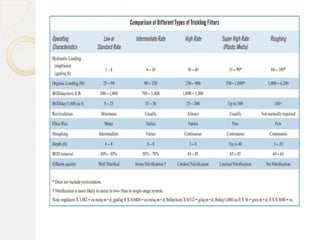
1)Low rate trickling filters
2)High rate trickling filters
3)Intermediate rate trickling filters
4)roughing trickling filters
2)According to the number of units used in series
1)Single stage trickling filters
2)Double stage trickling filters
Low rate trickling filters (LRTF)
➢
These relatively simple treatment units that normally
produce a consistent effluent quality even with
varying influent strength.
➢
They are generally not provided with recirculation of
effluent.
➢
Depending upon the dosing system, wastewater is
applied intermittently
➢
With proper loadings the LRTF, including primary
and secondary sedimentation units, should remove
from 80 to 85 percent of the applied BOD.
High Rate Trickling Filters (HRTF)
●
When recirculation is used, the hydraulic loading
per unit area of filter media is increased.
●
As a result, higher flow velocities will usually occur
causing a more continuous and uniform sloughing
of excess growths.
●
High-rate trickling filters, including primary and
secondary sedimentation, should, under normal
operation, remove from 65 to 85 percent of the
BOD of the wastewater.
 Roughing Filter
●
Roughing filters are high rate type filters
designed with plastic packing.
●
In most cases roughing filters are used to
treat wastewater prior to secondary
treatment.
●
low energy is required for BOD removal of
high strength wastewaters as compared to
activated sludge process because the
energy required is only for pumping the
influent wastewater and recirculation flows
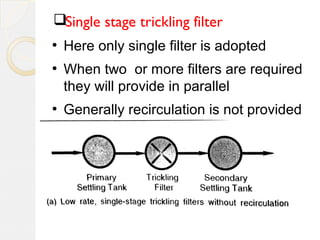
Single stage trickling filter
●
Here only single filter is adopted
●
When two or more filters are required
they will provide in parallel
●
Generally recirculation is not provided
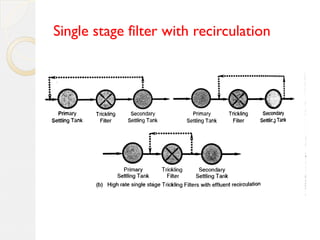
Single stage filter with recirculation
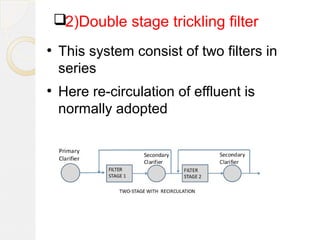
2)Double stage trickling filter
●
This system consist of two filters in
series
●
Here re-circulation of effluent is
normally adopted
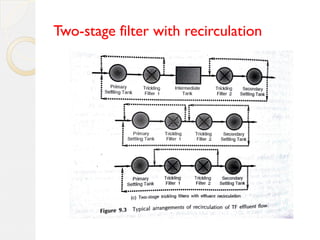
Two-stage filter with recirculation
 Advantages
The effluent obtain is highly nitrified and stabilised
They can remove about 80% of suspended solids and about 80%
BOD
The rate of loading is in comparison with contact bed process
It is simple, cheap and does not required any skilled supervision
They are self cleansing
Mechanical wear ant tear is less as it contain less mechanical
equipments
It require less electricity power to run mechanical equipment
The moisture content of sludge obtained from this is as high as
99%
Disadvantages
 High capital costs
The loss of head through the filter system
is high thus making the automatic dosing
It requires large area
Final settlement in humus tank necessary
This process may develop odur and fly
nuisance
THANKYOU

Trickling filters

  • 1.
    Presentation onTypes of Tricklingfilters By:Muttu j Hugar 1MS14CV072 M S raMaIaH INStItutE OF tECCHONOLOgy
  • 2.
    Types of TricklingFilters They are classified based on 1)According to Organic & Hydraulic loadings 2)According to the number of units used in series 1)According to Organic & Hydraulic loadings 1)Low rate trickling filters 2)High rate trickling filters 3)Intermediate rate trickling filters 4)roughing trickling filters 2)According to the number of units used in series 1)Single stage trickling filters 2)Double stage trickling filters
  • 3.
    Low rate tricklingfilters (LRTF) ➢ These relatively simple treatment units that normally produce a consistent effluent quality even with varying influent strength. ➢ They are generally not provided with recirculation of effluent. ➢ Depending upon the dosing system, wastewater is applied intermittently ➢ With proper loadings the LRTF, including primary and secondary sedimentation units, should remove from 80 to 85 percent of the applied BOD.
  • 4.
    High Rate TricklingFilters (HRTF) ● When recirculation is used, the hydraulic loading per unit area of filter media is increased. ● As a result, higher flow velocities will usually occur causing a more continuous and uniform sloughing of excess growths. ● High-rate trickling filters, including primary and secondary sedimentation, should, under normal operation, remove from 65 to 85 percent of the BOD of the wastewater.
  • 5.
     Roughing Filter ● Roughingfilters are high rate type filters designed with plastic packing. ● In most cases roughing filters are used to treat wastewater prior to secondary treatment. ● low energy is required for BOD removal of high strength wastewaters as compared to activated sludge process because the energy required is only for pumping the influent wastewater and recirculation flows
  • 7.
    Single stage tricklingfilter ● Here only single filter is adopted ● When two or more filters are required they will provide in parallel ● Generally recirculation is not provided
  • 8.
    Single stage filterwith recirculation
  • 9.
    2)Double stage tricklingfilter ● This system consist of two filters in series ● Here re-circulation of effluent is normally adopted
  • 10.
    Two-stage filter withrecirculation
  • 11.
     Advantages The effluentobtain is highly nitrified and stabilised They can remove about 80% of suspended solids and about 80% BOD The rate of loading is in comparison with contact bed process It is simple, cheap and does not required any skilled supervision They are self cleansing Mechanical wear ant tear is less as it contain less mechanical equipments It require less electricity power to run mechanical equipment The moisture content of sludge obtained from this is as high as 99%
  • 12.
    Disadvantages  High capitalcosts The loss of head through the filter system is high thus making the automatic dosing It requires large area Final settlement in humus tank necessary This process may develop odur and fly nuisance
  • 13.