BY Manish Shivale
Email id:-
manishshivalerockstar@gmail.com
TRIBES
CHARACTERSTICS OF TRIBES
 GEOGRAPHICAL:
have well demarcated geographical territory.
Lived in forest or hilly mountiainous areas.
Are isolated or semi isolated from other social
groups.
 SOCIO-CULTURAL:
Have their own culture , cosmology and belief
system.
Have their own language without any script.
Simple societies with no rigid social stratification.
Strong belongings to their community and
considered themselves the sons of soil.
 ECONOMICAL:
Economically self sufficient cling to primitive
technology.
Lack monetary economy.
Dependent on barter system.
More rely on earning todays need and meal.
Do not bother about future requirements.
 POLITICAL:
Earlier had stateless system i.e without any tribal
chief.
Manage law and order through family and kinship
ties.
Later on state system came , can select tribal
chief.
Today this autonomy lost and they are part of
local administrations.
 RELIGION:
Have their own deities and belief system.
Forms of religion are generally:
1. Animism ( worship of soul and ancestors)
2. Animatism ( worship of any non living bodies
like stone)
3. Totemism ( worship of any tree or animal
founding ancestors )
4. Naturism ( worship of nature like river or wood )
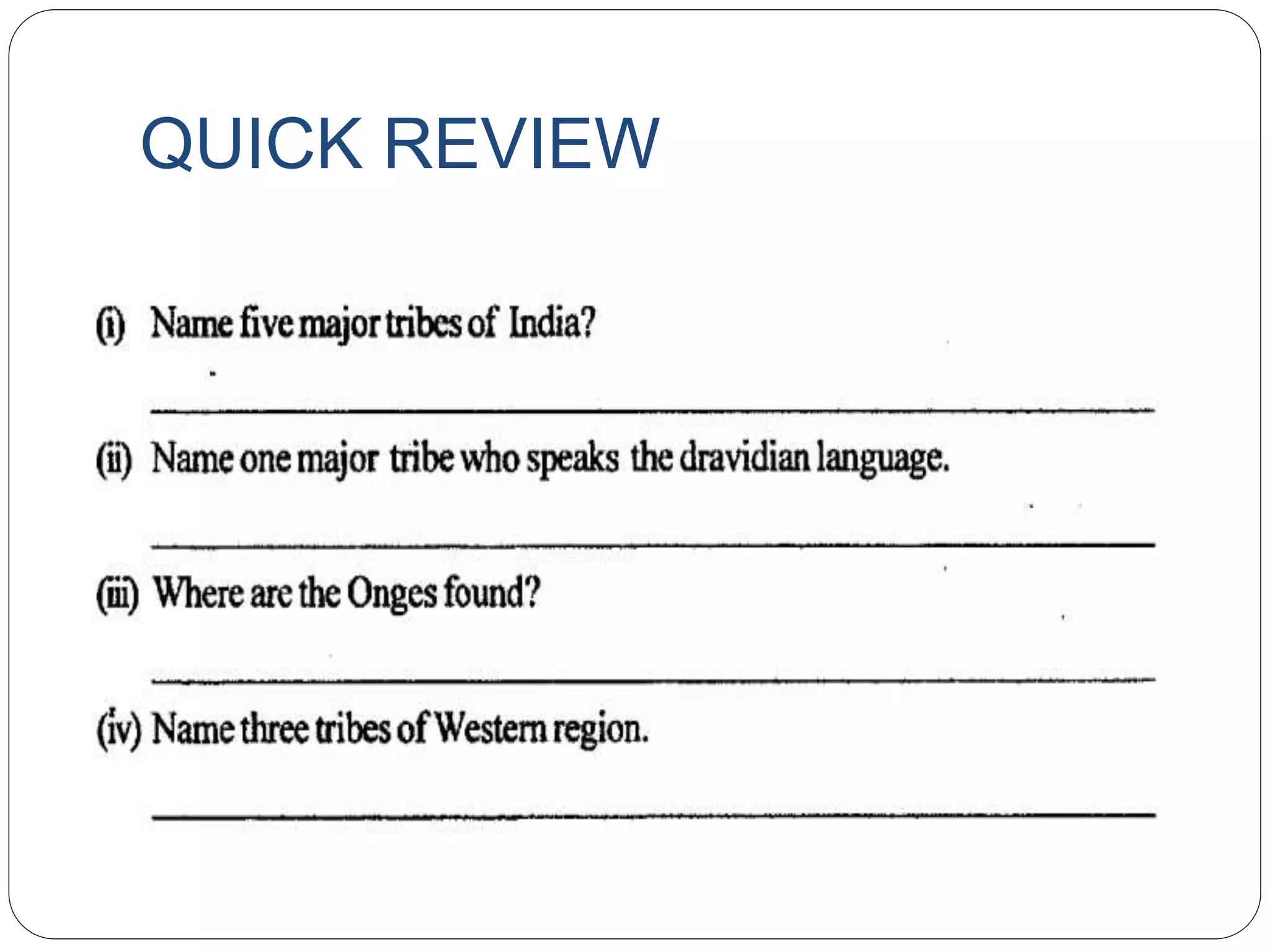
QUICK REVIEW
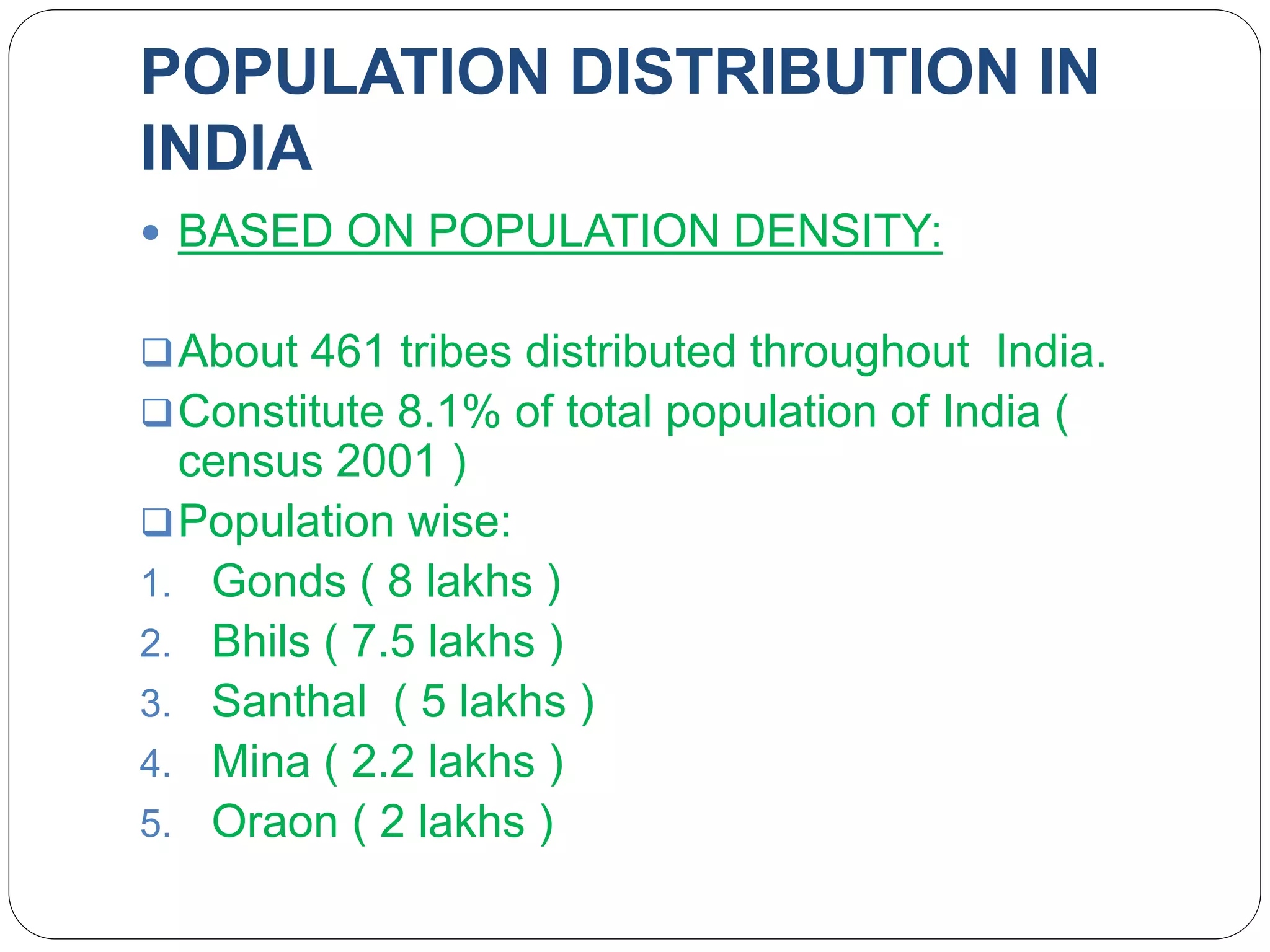
POPULATION DISTRIBUTION IN
INDIA
 BASED ON POPULATION DENSITY:
About 461 tribes distributed throughout India.
Constitute 8.1% of total population of India (
census 2001 )
Population wise:
1. Gonds ( 8 lakhs )
2. Bhils ( 7.5 lakhs )
3. Santhal ( 5 lakhs )
4. Mina ( 2.2 lakhs )
5. Oraon ( 2 lakhs )
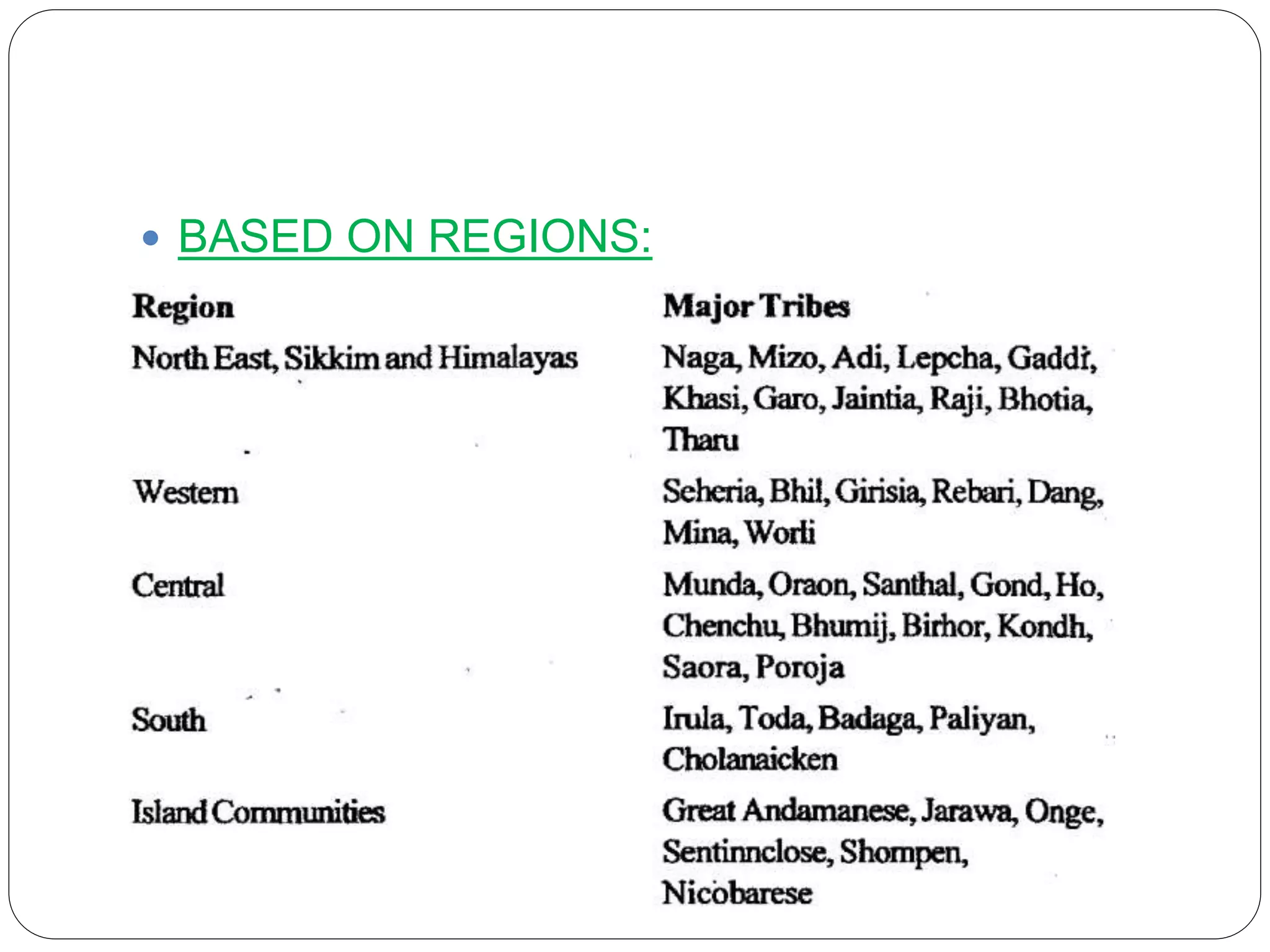
 BASED ON REGIONS:
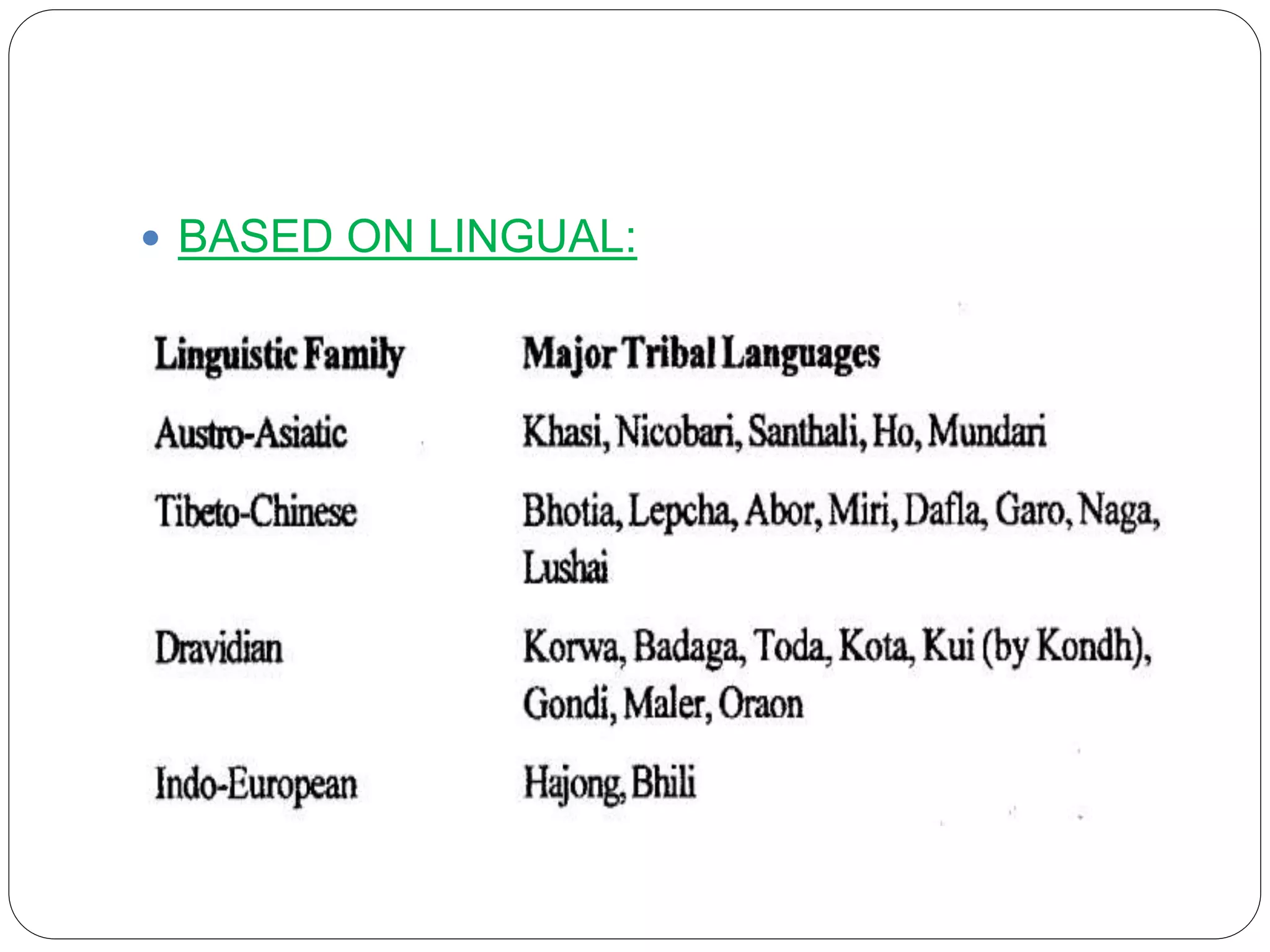
 BASED ON LINGUAL:
QUICK REVIEW
EXPLOITATIVE CONTACT WITH
BRITISH
The Britishers wanted to rule over the Tribals .
They wanted to syphon off the resources from
tribals areas especially rich in mineral resources.
They wanted to preach Christianity under the
pretext of rationality.
CULTURAL CONTACT WITH
OUTSIDERS
Existence of mineral resources in tribal areas .
Entry of missionaries and administrators .
Entry of specialist man like medicine man,
vendors and agents.
Development of transport and communication
facilitating entry of outsiders.
Displacement of tribal population from their
habitat due to industrial construction and irrigation
projects.
TRIBAL PROBLEMS
EMERGING DUE TO THESE CULURAL CONTACT
ARE:
1. LAND ALIENATION:
Caused due to introduction of monetary economy
.
Need money for consumption , no source of
earning .
Mortgaged land or sold it off .
Industrialisation resulted into acquisition of land
by state .
2. INDEBTEDNESS:
Regular consumption of liquor, bride price for
marriage and fine for any deviant behaviour.
All require money hence they go to money
lenders.
Moneylenders provide personal loans on heavy
rate of interest.
In this way, they are heavily indebt.
3. BONDED LABOUR:
A serious problem due to rampant poverty and
lack of stable income.
Unable to repay personal loans mostly.
Hence serves as a bonded labour.
4. ILLITERACY:
Major hindrance towards their development.
School timings usually clash with economic and
agricutlural operations.
Education has spread very slow due to
inaccessible habitat of tribes.
5. PROBLEMS OF HEALTH AND NUTRITION:
Lack of proper medical and sanitary facilities and
poverty.
Practice of indigenous medicine and magical
practices for treatment have been good in the
past.
Disease range between jaundice diarrhea , small
pox , filaria to AIDS etc.
PART OF INDIAN
CONSTITUTION
 Officially recognized by the Indian government as
"Scheduled Tribes" in the Fifth Schedule of the
Constitution of India, they are often grouped together
with scheduled castes in the category "Scheduled
Castes and Tribes", which is eligible for certain
affirmative action measures.
 Scheduled Castes 16.2%
 Scheduled Tribes 8.02%
(As per 2001 census)
CHIEF MEASURES FOR TRIBAL
DEVELOPMENT
Representation in legislatures and Panchayats.
Reservation in the service .
Tribes’ Advisory council.
Commissioner for the scheduled tribes and caste.
Welfare department in the states.
Vocational and technical training for educational
facilities.
17.5% of the merits scholarships are granted by
the centre.
Tribal and Harijan research institute.
Tribes of India and thier types

Tribes of India and thier types

  • 1.
    BY Manish Shivale Emailid:- manishshivalerockstar@gmail.com TRIBES
  • 2.
    CHARACTERSTICS OF TRIBES GEOGRAPHICAL: have well demarcated geographical territory. Lived in forest or hilly mountiainous areas. Are isolated or semi isolated from other social groups.
  • 3.
     SOCIO-CULTURAL: Have theirown culture , cosmology and belief system. Have their own language without any script. Simple societies with no rigid social stratification. Strong belongings to their community and considered themselves the sons of soil.
  • 4.
     ECONOMICAL: Economically selfsufficient cling to primitive technology. Lack monetary economy. Dependent on barter system. More rely on earning todays need and meal. Do not bother about future requirements.
  • 5.
     POLITICAL: Earlier hadstateless system i.e without any tribal chief. Manage law and order through family and kinship ties. Later on state system came , can select tribal chief. Today this autonomy lost and they are part of local administrations.
  • 6.
     RELIGION: Have theirown deities and belief system. Forms of religion are generally: 1. Animism ( worship of soul and ancestors) 2. Animatism ( worship of any non living bodies like stone) 3. Totemism ( worship of any tree or animal founding ancestors ) 4. Naturism ( worship of nature like river or wood )
  • 7.
  • 9.
    POPULATION DISTRIBUTION IN INDIA BASED ON POPULATION DENSITY: About 461 tribes distributed throughout India. Constitute 8.1% of total population of India ( census 2001 ) Population wise: 1. Gonds ( 8 lakhs ) 2. Bhils ( 7.5 lakhs ) 3. Santhal ( 5 lakhs ) 4. Mina ( 2.2 lakhs ) 5. Oraon ( 2 lakhs )
  • 10.
     BASED ONREGIONS:
  • 11.
     BASED ONLINGUAL:
  • 12.
  • 14.
    EXPLOITATIVE CONTACT WITH BRITISH TheBritishers wanted to rule over the Tribals . They wanted to syphon off the resources from tribals areas especially rich in mineral resources. They wanted to preach Christianity under the pretext of rationality.
  • 15.
    CULTURAL CONTACT WITH OUTSIDERS Existenceof mineral resources in tribal areas . Entry of missionaries and administrators . Entry of specialist man like medicine man, vendors and agents. Development of transport and communication facilitating entry of outsiders. Displacement of tribal population from their habitat due to industrial construction and irrigation projects.
  • 16.
    TRIBAL PROBLEMS EMERGING DUETO THESE CULURAL CONTACT ARE:
  • 17.
    1. LAND ALIENATION: Causeddue to introduction of monetary economy . Need money for consumption , no source of earning . Mortgaged land or sold it off . Industrialisation resulted into acquisition of land by state .
  • 18.
    2. INDEBTEDNESS: Regular consumptionof liquor, bride price for marriage and fine for any deviant behaviour. All require money hence they go to money lenders. Moneylenders provide personal loans on heavy rate of interest. In this way, they are heavily indebt.
  • 19.
    3. BONDED LABOUR: Aserious problem due to rampant poverty and lack of stable income. Unable to repay personal loans mostly. Hence serves as a bonded labour.
  • 20.
    4. ILLITERACY: Major hindrancetowards their development. School timings usually clash with economic and agricutlural operations. Education has spread very slow due to inaccessible habitat of tribes.
  • 21.
    5. PROBLEMS OFHEALTH AND NUTRITION: Lack of proper medical and sanitary facilities and poverty. Practice of indigenous medicine and magical practices for treatment have been good in the past. Disease range between jaundice diarrhea , small pox , filaria to AIDS etc.
  • 22.
    PART OF INDIAN CONSTITUTION Officially recognized by the Indian government as "Scheduled Tribes" in the Fifth Schedule of the Constitution of India, they are often grouped together with scheduled castes in the category "Scheduled Castes and Tribes", which is eligible for certain affirmative action measures.  Scheduled Castes 16.2%  Scheduled Tribes 8.02% (As per 2001 census)
  • 23.
    CHIEF MEASURES FORTRIBAL DEVELOPMENT Representation in legislatures and Panchayats. Reservation in the service . Tribes’ Advisory council. Commissioner for the scheduled tribes and caste. Welfare department in the states. Vocational and technical training for educational facilities. 17.5% of the merits scholarships are granted by the centre. Tribal and Harijan research institute.