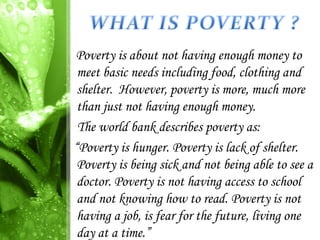
Poverty is about not having enough money to
 meet basic needs including food, clothing and
 shelter. However, poverty is more, much more
 than just not having enough money.
 The world bank describes poverty as:
“Poverty is hunger. Poverty is lack of shelter.
 Poverty is being sick and not being able to see a
 doctor. Poverty is not having access to school
 and not knowing how to read. Poverty is not
 having a job, is fear for the future, living one
 day at a time.”
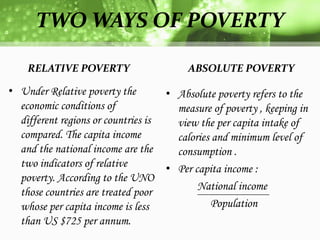
TWO WAYS OF POVERTY

    RELATIVE POVERTY                       ABSOLUTE POVERTY

• Under Relative poverty the          • Absolute poverty refers to the
  economic conditions of                measure of poverty , keeping in
  different regions or countries is     view the per capita intake of
  compared. The capita income           calories and minimum level of
  and the national income are the       consumption .
  two indicators of relative          • Per capita income :
  poverty. According to the UNO
  those countries are treated poor           National income
  whose per capita income is less               Population
  than US $725 per annum.
MEASUREMENT OF POVERTY
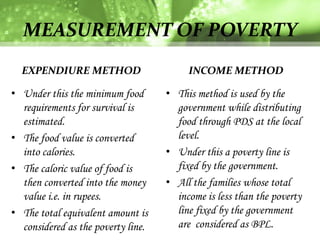
  EXPENDIURE METHOD                      INCOME METHOD

• Under this the minimum food       • This method is used by the
  requirements for survival is        government while distributing
  estimated.                          food through PDS at the local
• The food value is converted         level.
  into calories.                    • Under this a poverty line is
• The caloric value of food is        fixed by the government.
  then converted into the money     • All the families whose total
  value i.e. in rupees.               income is less than the poverty
• The total equivalent amount is      line fixed by the government
  considered as the poverty line.     are considered as BPL.
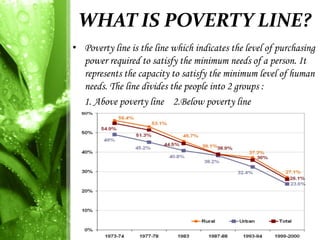
WHAT IS POVERTY LINE?
• Poverty line is the line which indicates the level of purchasing
  power required to satisfy the minimum needs of a person. It
  represents the capacity to satisfy the minimum level of human
  needs. The line divides the people into 2 groups :
  1. Above poverty line 2.Below poverty line
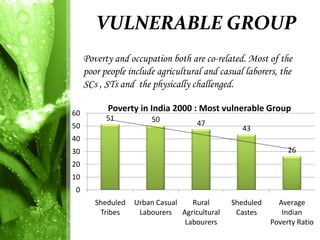
VULNERABLE GROUP
     Poverty and occupation both are co-related. Most of the
     poor people include agricultural and casual laborers, the
     SCs , STs and the physically challenged.

60
           Poverty in India 2000 : Most vulnerable Group
           51          50
50                                  47
                                                43
40
30                                                           26
20
10
0
        Sheduled   Urban Casual   Rural      Sheduled     Average
         Tribes     Labourers Agricultural    Castes       Indian
                                Labourers               Poverty Ratio
CAUSES OF POVERTY
•   BRITISH RULE
•   RURAL ECONOMY
•   HEAVY PRESSURE OF POPULATION
•   CHRONIC UNEMPLOYMENT AND UNDEREMPLOYMENT
•   LACK OF PROPER INDUSTRIALISATION
•   SOCIAL FACTORS
•   INDIA’S ECONOMIC POLICY
•   NEO-LIBERAL POLICIES AND THEIR EFFECTS
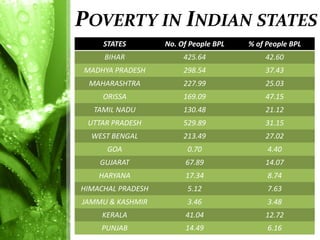
POVERTY IN INDIAN STATES
     STATES        No. Of People BPL   % of People BPL
     BIHAR              425.64             42.60
MADHYA PRADESH          298.54             37.43
 MAHARASHTRA            227.99             25.03
     ORISSA             169.09             47.15
   TAMIL NADU           130.48             21.12
 UTTAR PRADESH          529.89             31.15
  WEST BENGAL           213.49             27.02
      GOA                0.70               4.40
    GUJARAT             67.89              14.07
    HARYANA             17.34               8.74
HIMACHAL PRADESH         5.12               7.63
JAMMU & KASHMIR          3.46               3.48
     KERALA             41.04              12.72
    PUNJAB              14.49               6.16
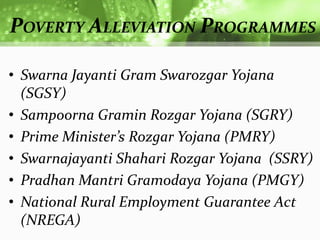
POVERTY ALLEVIATION PROGRAMMES

• Swarna Jayanti Gram Swarozgar Yojana
  (SGSY)
• Sampoorna Gramin Rozgar Yojana (SGRY)
• Prime Minister’s Rozgar Yojana (PMRY)
• Swarnajayanti Shahari Rozgar Yojana (SSRY)
• Pradhan Mantri Gramodaya Yojana (PMGY)
• National Rural Employment Guarantee Act
  (NREGA)
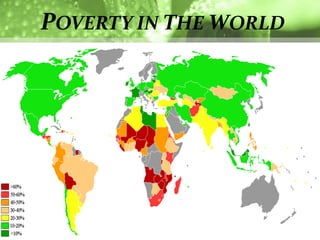
POVERTY IN THE WORLD
Sst ppt

Sst ppt

  • 3.
    Poverty is aboutnot having enough money to meet basic needs including food, clothing and shelter. However, poverty is more, much more than just not having enough money. The world bank describes poverty as: “Poverty is hunger. Poverty is lack of shelter. Poverty is being sick and not being able to see a doctor. Poverty is not having access to school and not knowing how to read. Poverty is not having a job, is fear for the future, living one day at a time.”
  • 4.
    TWO WAYS OFPOVERTY RELATIVE POVERTY ABSOLUTE POVERTY • Under Relative poverty the • Absolute poverty refers to the economic conditions of measure of poverty , keeping in different regions or countries is view the per capita intake of compared. The capita income calories and minimum level of and the national income are the consumption . two indicators of relative • Per capita income : poverty. According to the UNO those countries are treated poor National income whose per capita income is less Population than US $725 per annum.
  • 5.
    MEASUREMENT OF POVERTY EXPENDIURE METHOD INCOME METHOD • Under this the minimum food • This method is used by the requirements for survival is government while distributing estimated. food through PDS at the local • The food value is converted level. into calories. • Under this a poverty line is • The caloric value of food is fixed by the government. then converted into the money • All the families whose total value i.e. in rupees. income is less than the poverty • The total equivalent amount is line fixed by the government considered as the poverty line. are considered as BPL.
  • 6.
    WHAT IS POVERTYLINE? • Poverty line is the line which indicates the level of purchasing power required to satisfy the minimum needs of a person. It represents the capacity to satisfy the minimum level of human needs. The line divides the people into 2 groups : 1. Above poverty line 2.Below poverty line
  • 7.
    VULNERABLE GROUP Poverty and occupation both are co-related. Most of the poor people include agricultural and casual laborers, the SCs , STs and the physically challenged. 60 Poverty in India 2000 : Most vulnerable Group 51 50 50 47 43 40 30 26 20 10 0 Sheduled Urban Casual Rural Sheduled Average Tribes Labourers Agricultural Castes Indian Labourers Poverty Ratio
  • 8.
    CAUSES OF POVERTY • BRITISH RULE • RURAL ECONOMY • HEAVY PRESSURE OF POPULATION • CHRONIC UNEMPLOYMENT AND UNDEREMPLOYMENT • LACK OF PROPER INDUSTRIALISATION • SOCIAL FACTORS • INDIA’S ECONOMIC POLICY • NEO-LIBERAL POLICIES AND THEIR EFFECTS
  • 9.
    POVERTY IN INDIANSTATES STATES No. Of People BPL % of People BPL BIHAR 425.64 42.60 MADHYA PRADESH 298.54 37.43 MAHARASHTRA 227.99 25.03 ORISSA 169.09 47.15 TAMIL NADU 130.48 21.12 UTTAR PRADESH 529.89 31.15 WEST BENGAL 213.49 27.02 GOA 0.70 4.40 GUJARAT 67.89 14.07 HARYANA 17.34 8.74 HIMACHAL PRADESH 5.12 7.63 JAMMU & KASHMIR 3.46 3.48 KERALA 41.04 12.72 PUNJAB 14.49 6.16
  • 10.
    POVERTY ALLEVIATION PROGRAMMES •Swarna Jayanti Gram Swarozgar Yojana (SGSY) • Sampoorna Gramin Rozgar Yojana (SGRY) • Prime Minister’s Rozgar Yojana (PMRY) • Swarnajayanti Shahari Rozgar Yojana (SSRY) • Pradhan Mantri Gramodaya Yojana (PMGY) • National Rural Employment Guarantee Act (NREGA)
  • 11.