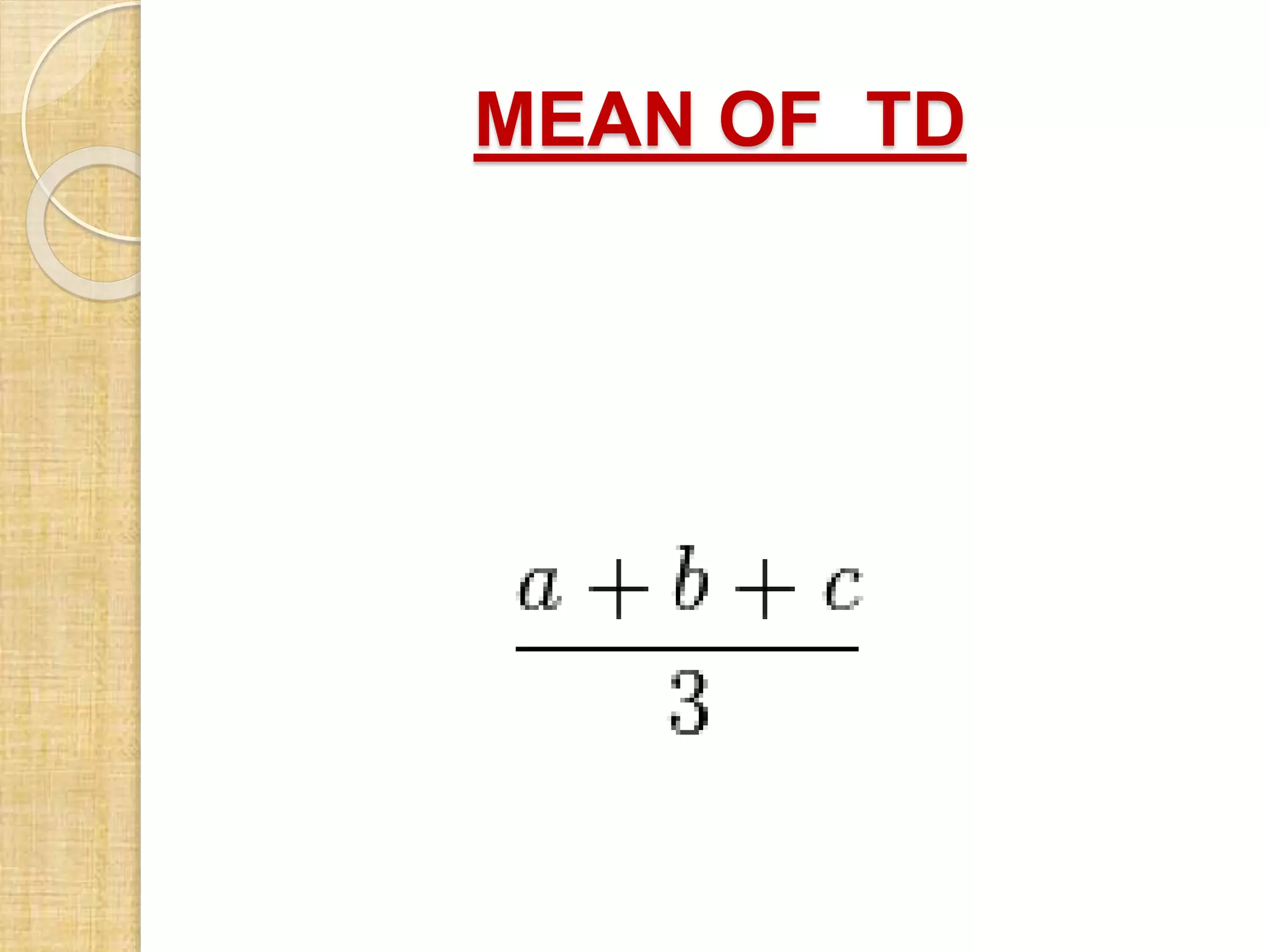
The document discusses triangular distributions, which are a type of continuous probability distribution defined by three values: a minimum, a maximum, and a peak value between the minimum and maximum. It describes the probability density function and how to calculate probabilities using the triangular distribution. Some key uses of triangular distributions include three-point estimation when limited data is available, business simulations when the minimum, maximum, and most likely outcome are known, and modeling events in project management.
WHAT IS TRIANGULAR
DISTRIBUTION?
A triangular distribution is a continuous
probability distribution with a
probability density function shaped like
a triangle. It is defined by three values:
the minimum value a,
the maximum value b, and
the peak value c.
where a < b and a ≤ c ≤ b.
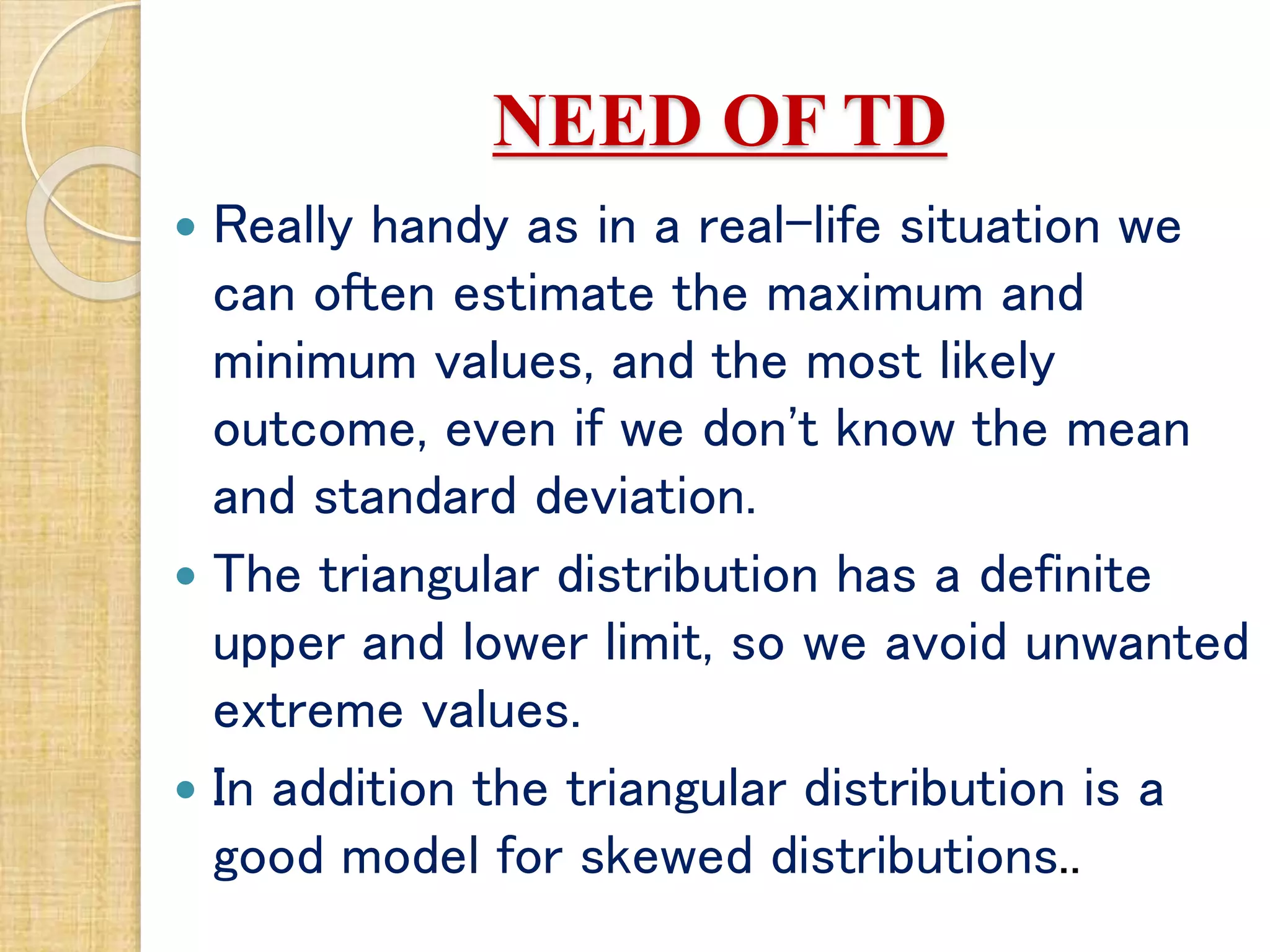
NEED OF TD
Really handy as in a real-life situation we
can often estimate the maximum and
minimum values, and the most likely
outcome, even if we don't know the mean
and standard deviation.
The triangular distribution has a definite
upper and lower limit, so we avoid unwanted
extreme values.
In addition the triangular distribution is a
good model for skewed distributions..
8.
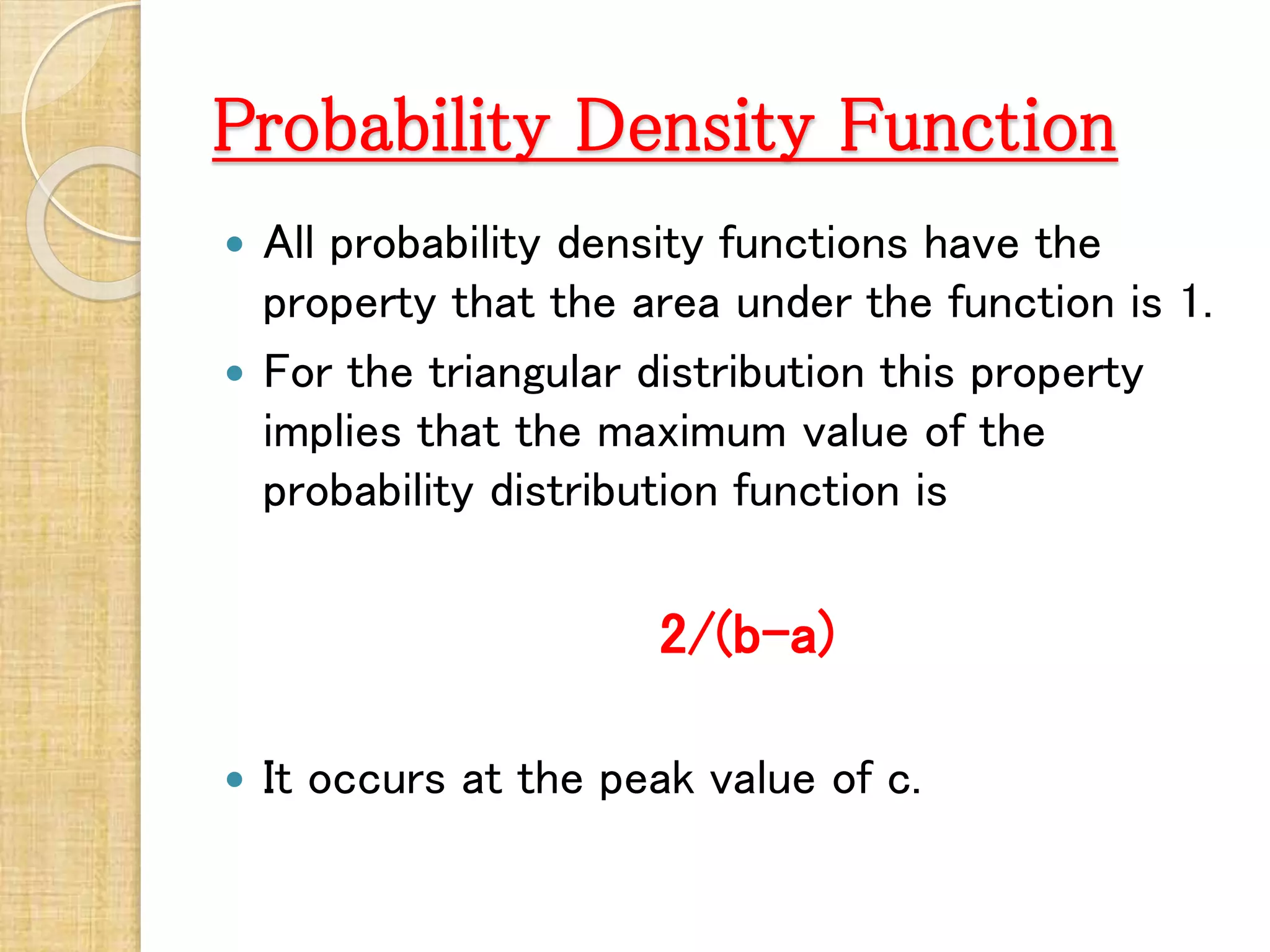
Probability Density Function
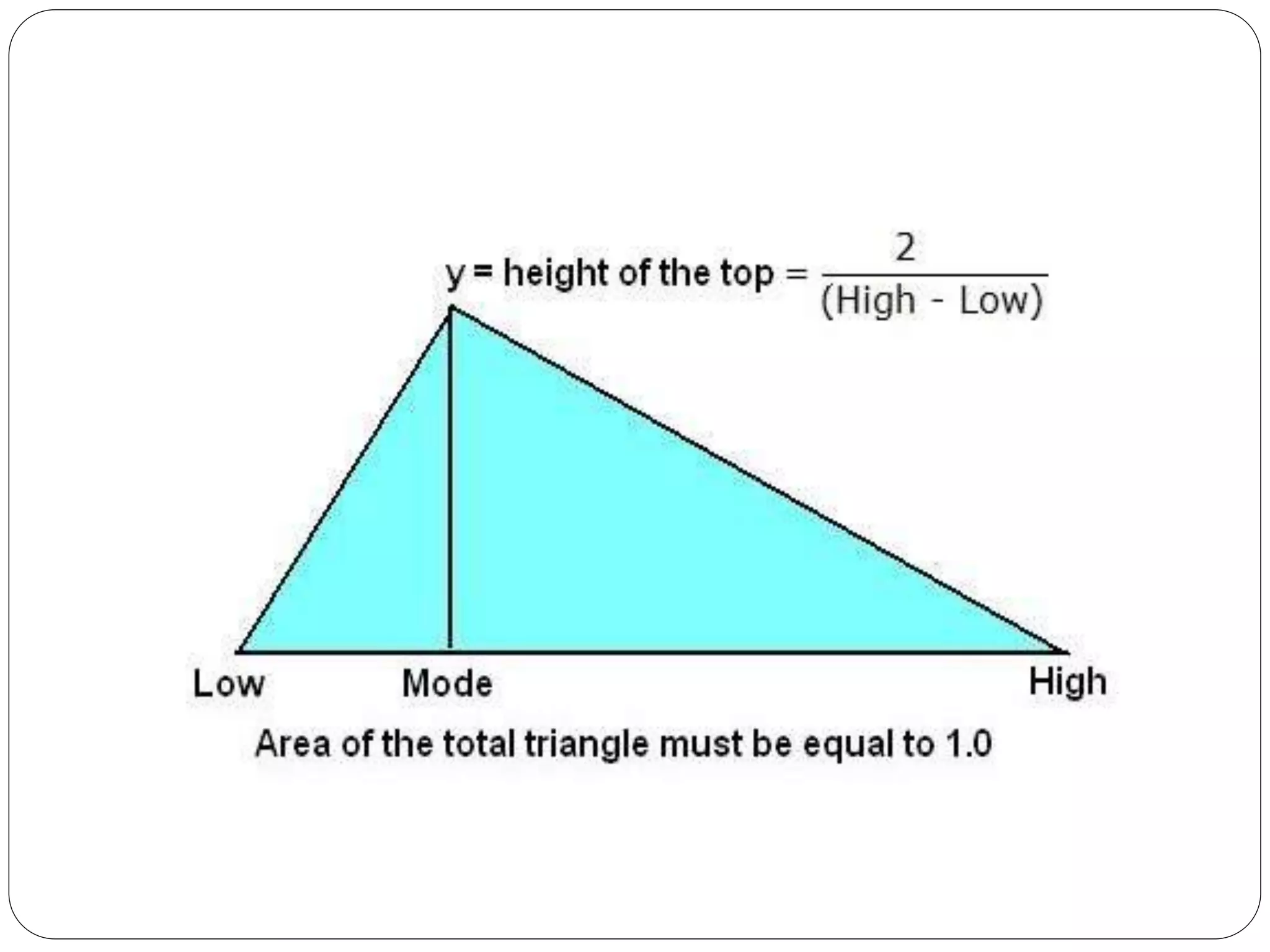
All probability density functions have the
property that the area under the function is 1.
For the triangular distribution this property
implies that the maximum value of the
probability distribution function is
2/(b-a)
It occurs at the peak value of c.
9.
The probabilitydensity function of a
triangular distribution is zero for
values below a and values above b.
It is piecewise linear rising from 0 at
a to 2/(b-a) at c, then dropping
down to 0 at b.
Calculating probabilities
Theprobability density function is used to
determine the probability that the random
variable falls in some range. We want to
determine the probability that the random
variable is
above a given value,
below a given value, or
between a pair of values.
It is simply a matter of finding the area under the
curve for the required interval. For a triangular
distribution this involves finding the area of one
or two triangles and, possibly, a simple
calculation.
13.
STEPS
Determine whicharea is
needed,
Determine which triangle(s)
to use,
Calculate the area(s) of the
triangle(s),
14.
EXAMPLE FOR TD
QUESTION :
A burger franchise planning a new outlet
in Auckland wants to determine the
probability the new outlet will have weekly
sales of less than $2000. If the weekly
sales are less than this the outlet is
unlikely to cover its costs.
So, they wish to calculate pr(x<2000) .
They use a triangular distribution to model
the future weekly sales with a minimum
value of a=$1000, and maximum value of
b=$6000 and a peak value of c=$3000.
15.
SOLUTION
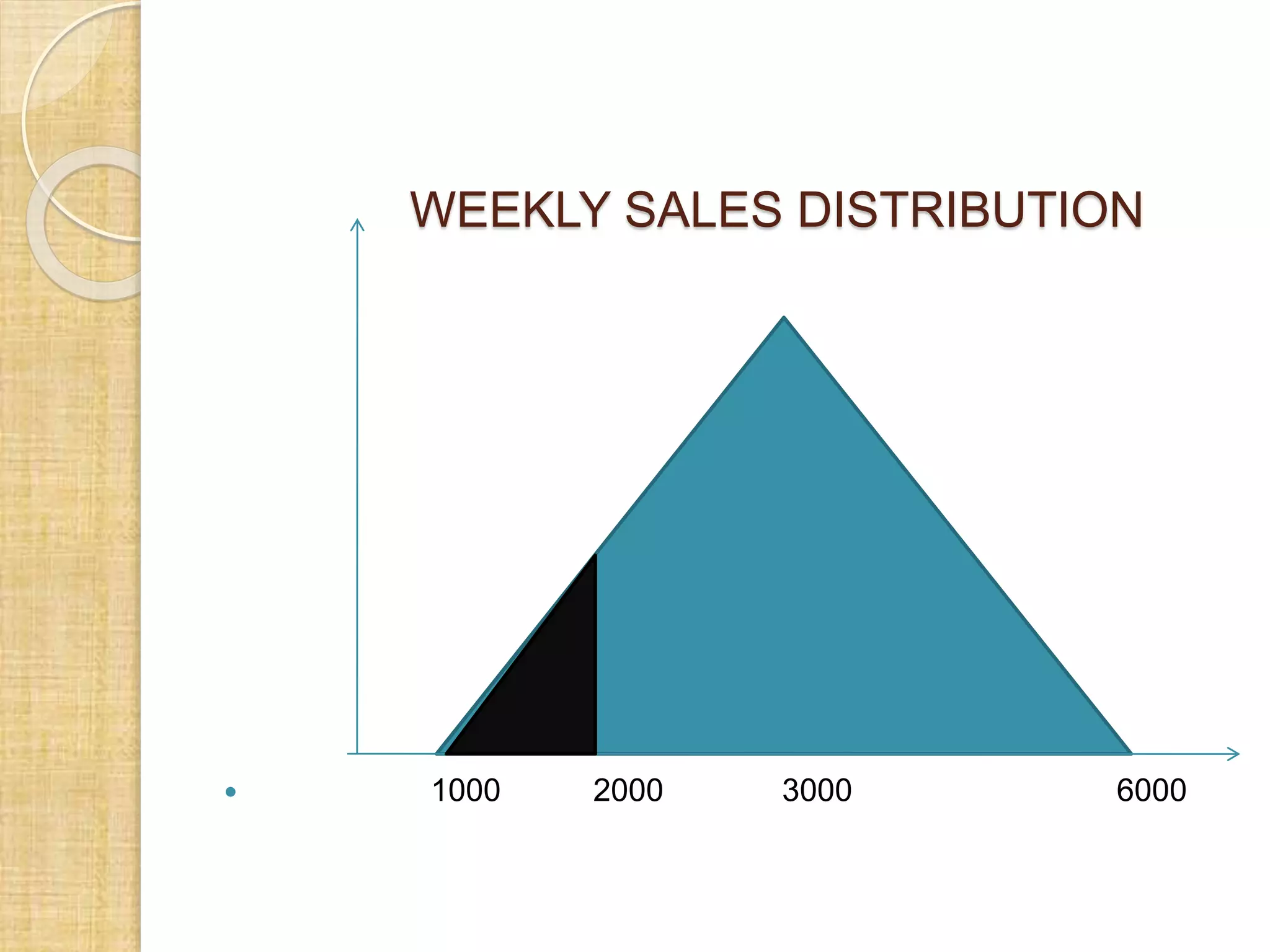
Step 1.The area needed is shown as
the shaded area in the graph below.
That is, pr(x<2000) is the area under
the probability density function for all
values of X below 2000. In this case the
probability sought is the area of a
triangle.
Step 2. The shaded area is the triangle
to use.
STEP 3:
Thearea of a triangle is
Area = ½(bh)
Here base =2000-1000
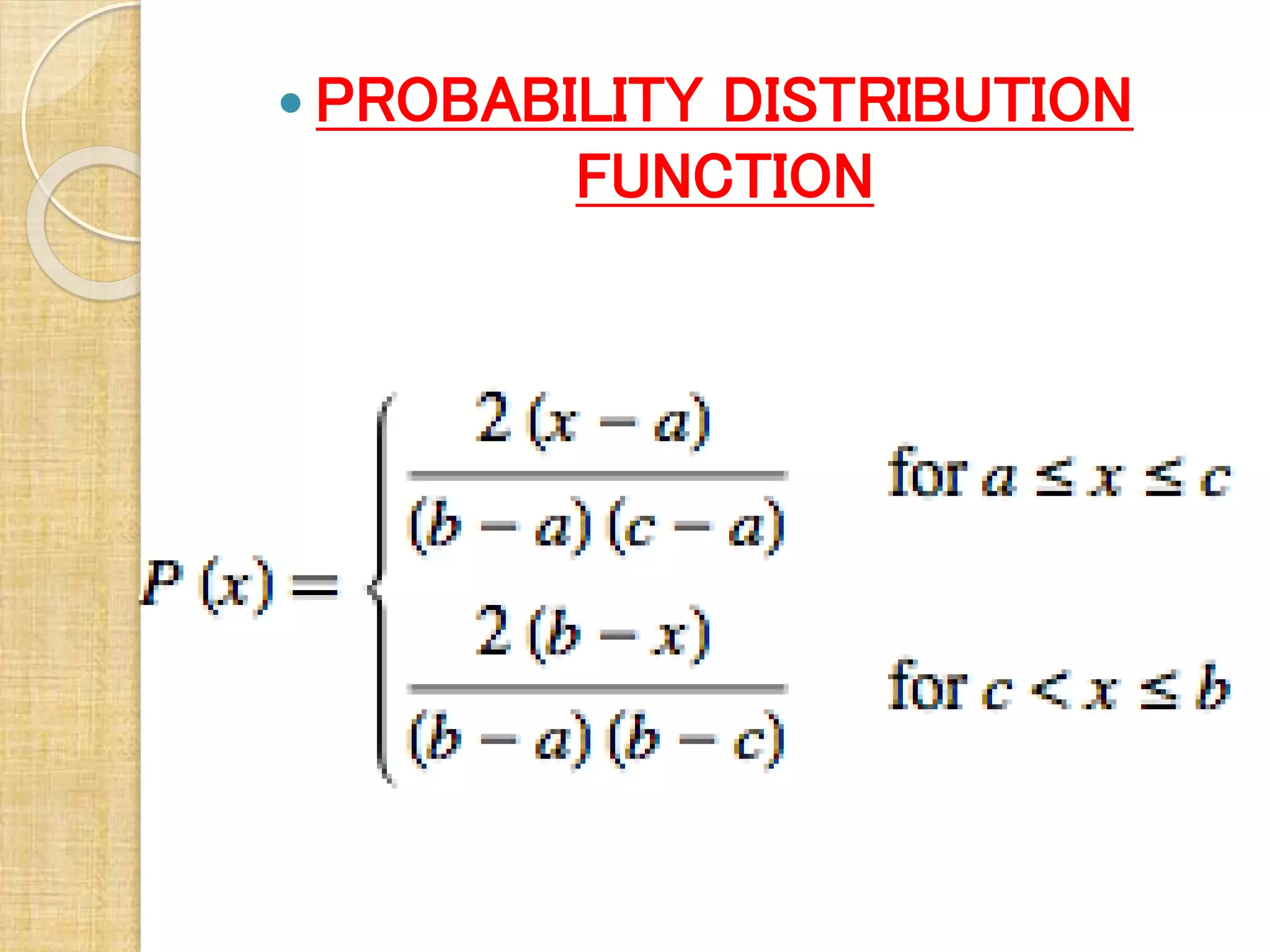
Height =f(2000),using pdf formula:
2(2000-a)/(b-a)(c-a)
= 2(2000-1000)/(6000-1000)(3000-
1000)=.0002
So the area = 1/2(1000*.0002)=0.1
18.
Step 4.
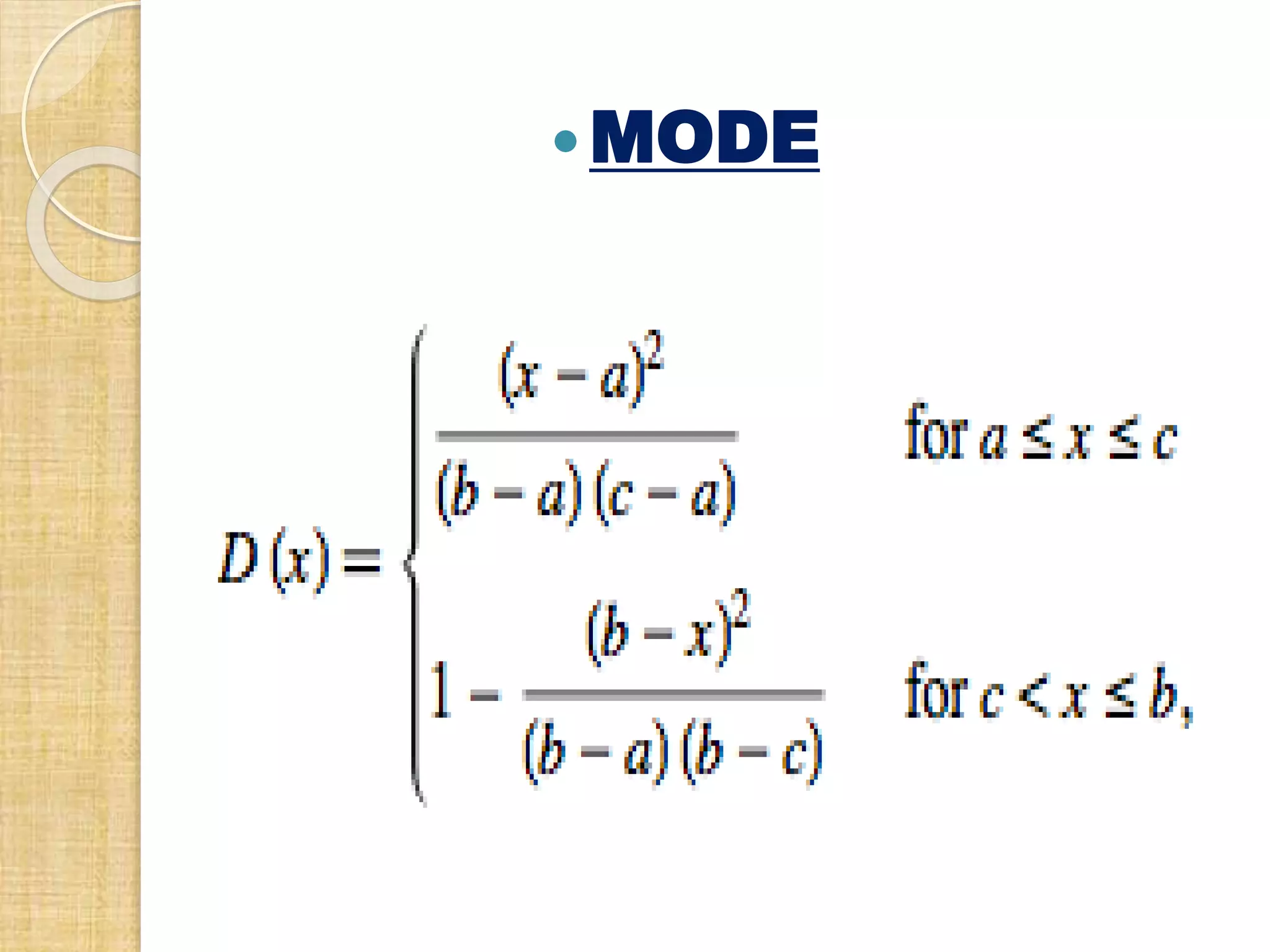
The probability is just the area of the
triangle,
Here pr(x<2000)=0.1 or 10 %
19.
APPLICATIONS OF TD
Three-point estimation
The triangular distribution is typically used as a
subjective description of a population for which
there is only limited sample data, and especially
in cases where the relationship between
variables is known but data is scarce (possibly
because of the high cost of collection).
It is based on a knowledge of the minimum and
maximum and an "inspired guess" as to the
modal value. For these reasons, the triangle
distribution has been called a "lack of knowledge"
distribution.
20.
Business simulations
The triangular distribution is often used
in business decision making particularly
in simulations .
Generally, when not much is known
about the distribution of an outcome,
(say, only its smallest and largest
values) it is possible to use the uniform
distribution.
But if the most likely outcome is also
known, then the outcome can be
simulated by a triangular distribution.
21.
Project management:
The triangular distribution, along with
is widely used in project
management (as an input
into PERT and hence critical path
method(CPM)) to model events which
take place within an interval defined
by a minimum and maximum value.
22.
Audio dithering:
The symmetric triangular distribution is
commonly used in audio dithering,
where it is called TPDF (Triangular
Probability Density Function).



![[DSC Europe 25] Vid Stimac - Policy Parsimony: Between Oversimplifying and Ov...](https://cdn.slidesharecdn.com/ss_thumbnails/eqlepagzqp2rhg3gbluh-dsc-stimac-251120-251205090438-059e7f54-thumbnail.jpg?width=640&height=640&fit=bounds)


![[DSC Europe 25] Jim Sterne - Adopting Generative AI Capabilities Into the Ent...](https://cdn.slidesharecdn.com/ss_thumbnails/sxhpofuorcagxsaulkmt-3-251204082258-7e66bc48-thumbnail.jpg?width=640&height=640&fit=bounds)
![[DSC Europe 25] Goran Obradovic - The Rise of Sovereign AI: Building the Regi...](https://cdn.slidesharecdn.com/ss_thumbnails/7nw2xxixrxqdxvrb5wca-6-251205085714-ab09a2ac-thumbnail.jpg?width=640&height=640&fit=bounds)

![[DSC Europe 25] Dragan Vucic - Building the Learning Organization - How AI Tr...](https://cdn.slidesharecdn.com/ss_thumbnails/8brigo2sbu6qur6gxrra-7-251205085715-6ae07d24-thumbnail.jpg?width=640&height=640&fit=bounds)


![[DSC Europe 25] Nikola Rajovic - Hardware Technologies Under the Hood: RISC-V...](https://cdn.slidesharecdn.com/ss_thumbnails/o2gptrmtoyqndgoshwgq-dsc2025-tenstorrent-rajovic-251205090438-814685f5-thumbnail.jpg?width=640&height=640&fit=bounds)


![[DSC Europe 25] Max Talanov - Non digital NNs.pptx](https://cdn.slidesharecdn.com/ss_thumbnails/wif8tr3gtua74qvtopke-non-digital-nns-251205090438-26b0eea6-thumbnail.jpg?width=640&height=640&fit=bounds)
![[DSC Europe 25] Petar Zivanov - AI meets documents From chatbots to AI-powere...](https://cdn.slidesharecdn.com/ss_thumbnails/xer2bb6nrdc8pdpev0pc-8-251204082258-7c2fa4a1-thumbnail.jpg?width=640&height=640&fit=bounds)