Statistical Inference
and
Hypothesis Testing
Why ?
• Samples drawn from an infinite population
• Features of population may vary from those of
samples
• Sample statistics may vary with samples
• Question is whether the sample properties
satisfactorily explain population properties
• Parameter -> population characteristics (mean,
variance etc.)
• Statistic -> sample characteristics
Statistical Inference
• Statistical inference The process of going to
unknown population parameters from estimated
sample statistics possible with random
sampling
• 2 problems -> no idea about the feature of the
population – estimation, then testing of
hypothesis
• -> tentative idea about the feature of the
population – testing of hypothesis
Estimation
• Interval estimation -> a range of values within which
the unknown parameter has a chance to belong
• Point estimation -> estimate a particular value for
the unknown parameter – test whether the
estimation is satisfactory/ reliable – hypothesis
testing
• Testing reliability (whether statistically significant) of
estimation needs knowledge of probability
distribution function
Probability
• Probability of an event = (Number of cases
favourable to the event) / (Total number of cases)
• Example: Coin tossing (2 times)
• Events: HH, HT, TH, TT
• Probability (Different outcomes) = 2/ 4
• In axiomatic approach of probability relative
frequency of an event is considered as the event’s
probability of occurrence when the total number of
cases is very large (n -> ∞)
Probability distribution
• Y is a random variable => Y occurs with probability
• As probability is defined by relative frequency,
distribution of Y in the infinite population is
represented by its probabilities => Probabilities of
occurrence of different values of Y are presented
against those values of Y
• Y is discrete -> for any particular value of Y (let it be
c), f(c) = f(Y at c)= Pr(Y=c)
• f(Y) is the pmf (probability mass function) of Y if
• f(Y) ≥ 0, for any Y
• ∑ f(Y) = 1, summation with all values that Y can
assume
Probability distribution
• Y is continuous -> for two values of Y, a (lower) and b
(upper),
b
• Pr(a≤Y≤b) = ∫ f(Y)dY
a
• f(Y) is the pdf (probability density function) of Y if
• f(Y) ≥ 0, for any Y
∫ f(Y)dY = 1, integration for all values of Y, (-∞, +∞)
Distribution function
• Statistical inference involves inferring the nature of a
population (central tendency - mean, variance,
skewness and kurtosis) from the nature of a sample
• -> we take help of distribution function
• For any value c of the continuous variable Y,
c
• F(c) = Pr( Y ≤ c)) = ∫ f(Y)
-∞
is called the cumulative distribution function or
distribution function of Y
Theoretical distribution
• -> f (a theoretical distribution) gives a fairly
close approximation to the actual distribution
of the population variable
• -> inference problem is related to having an
idea about the numerical values of (or
estimate) the parameters appearing in f
• -> We have an idea regarding the central
tendency of the variable concerned from its
theoretical distribution (mean, variance etc.)
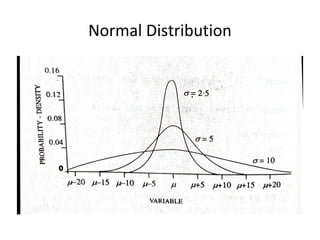
Normal Distribution
• Most used form of distribution for a continuous
variable because
• – has very simple properties – comparatively easy to
deal with
• - many non-normal distributions become
asymptotically normal
• - transformation of variables often make them follow
normal distribution
• Central limit theorem and law of large numbers
• f(Y) = (1/(σ√2π) exp[-(Y-μ)2
/2σ2
], -∞ ≤Y ≤ +∞
• Mean(Y) = μ, Var(Y)= σ2
Normal Distribution
Properties of normal distribution
f(Y) > 0 for all values of Y
∞
∫ f(Y)dY = 1
-∞
The distribution is symmetrical
=> mean and median are the same
Any linear function of some normal variables is also
normally distributed.
=> If Y1
, Y2
, Y3
are normally distributed, (Y1
+ Y2
+ Y3
)/3
is also normally distributed
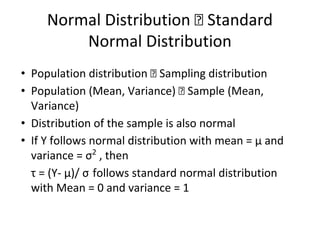
Normal Distribution Standard
Normal Distribution
• Population distribution Sampling distribution
• Population (Mean, Variance) Sample (Mean,
Variance)
• Distribution of the sample is also normal
• If Y follows normal distribution with mean = μ and
variance = σ2
, then
τ = (Y- μ)/ σ follows standard normal distribution
with Mean = 0 and variance = 1
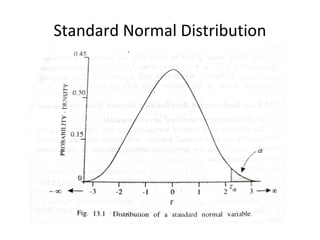
Standard Normal Distribution
Statistical Inference
Let us denote by τα,
a value of τ, such that
Pr[τ > τα
] = α
and Pr[τ < τ1-α
] = α
⇒ Pr[τ < τα
] = 1-α
For statistical inference value of α is normally
considered as 0.01 (99 per cent) or 0.05 (95 per cent)
and Pr[ -τα/2
< τ < τα/2
] = 1-α
The interval is defined as confidence limit and (1-α) is
confidence coefficient
Interval estimation
• Constructing a range of values (interval) within which
the unknown parameter has a chance to belong
• If y is sample mean (samples being y1
, y2
, ......., yn
), it
can be shown that E(y) = μ, Var(y)= σ2
/n (sampling
with replacement)
• If y1
, y2
, ......., yn
follow normal distribution, y also
follows normal distribution
• Define τ = (y- μ)/ (σ/√n ), τ = [y- Mean(y)]/ √Var(y),
• τ follows standard normal distribution
Interval estimation
99 per cent confidence interval of μ is
Pr [-2.576 ≤ (y- μ)/ (σ/√n ) ≤2.576] = 0.99
Pr [-2.576 (σ/√n ) ≤ (y- μ) ≤2.576 (σ/√n )] = 0.99
Pr [- y- 2.576 (σ/√n ) ≤ - μ ≤ -y +2.576 (σ/√n )] = 0.99
=> Pr [y- 2.576 (σ/√n ) ≤ μ ≤ y +2.576 (σ/√n )] = 0.99
=> In repeated sampling, in 99 per cent of the cases the
above interval will include μ (the probability that the
above interval will include μ is 0.99)
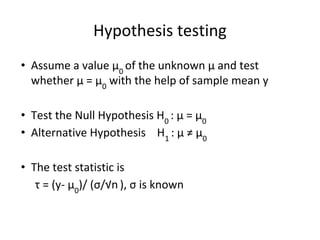
Hypothesis testing
• Assume a value μ0
of the unknown μ and test
whether μ = μ0
with the help of sample mean y
• Test the Null Hypothesis H0
: μ = μ0
• Alternative Hypothesis H1
: μ ≠ μ0
• The test statistic is
τ = (y- μ0
)/ (σ/√n ), σ is known
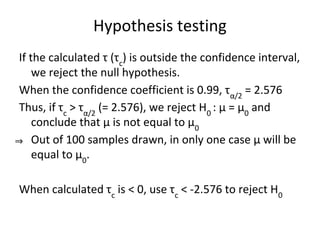
Hypothesis testing
If the calculated τ (τc
) is outside the confidence interval,
we reject the null hypothesis.
When the confidence coefficient is 0.99, τα/2
= 2.576
Thus, if τc
> τα/2
(= 2.576), we reject H0
: μ = μ0
and
conclude that μ is not equal to μ0
⇒ Out of 100 samples drawn, in only one case μ will be
equal to μ0
.
When calculated τc
is < 0, use τc
< -2.576 to reject H0
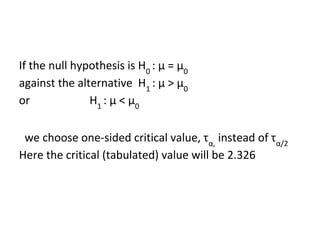
If the null hypothesis is H0
: μ = μ0
against the alternative H1
: μ > μ0
or H1
: μ < μ0
we choose one-sided critical value, τα,
instead of τα/2
Here the critical (tabulated) value will be 2.326
t-distribution
• When σ is unknown, it is replaced by its sample
estimate.
• Then the ratio [(y-mean)/std. dev] follows
t-distribution
• The (1-α) percent confidence interval is
Pr [y- tα/2,n-1
(s’/√n ) ≤ μ ≤ y + tα/2,n-1
(s’/√n )] = 1-α
Hypothesis testing in a bivariate
regression
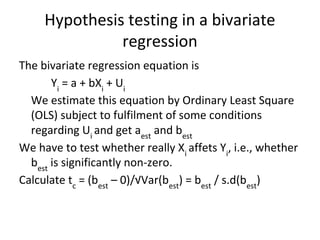
The bivariate regression equation is
Yi
= a + bXi
+ Ui
We estimate this equation by Ordinary Least Square
(OLS) subject to fulfilment of some conditions
regarding Ui
and get aest
and best
We have to test whether really Xi
affets Yi
, i.e., whether
best
is significantly non-zero.
Calculate tc
= (best
– 0)/√Var(best
) = best
/ s.d(best
)
Hypothesis testing in a bivariate
regression
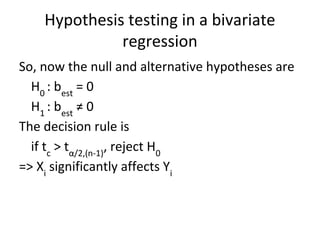
So, now the null and alternative hypotheses are
H0
: best
= 0
H1
: best
≠ 0
The decision rule is
if tc
> tα/2,(n-1)
, reject H0
=> Xi
significantly affects Yi
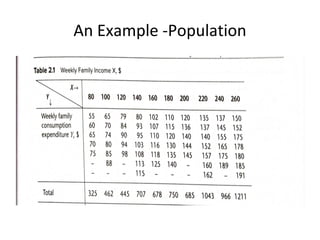
An Example -Population
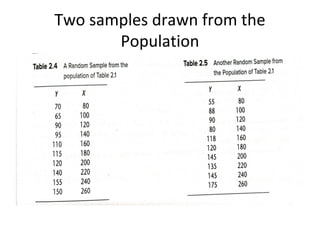
Two samples drawn from the
Population
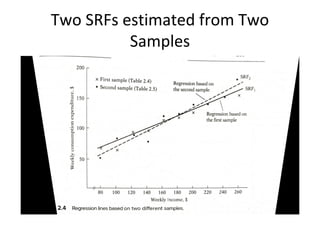
Two SRFs estimated from Two
Samples
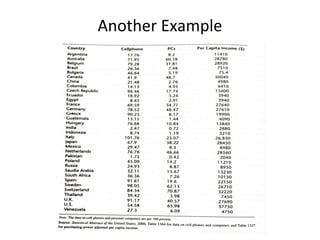
Another Example
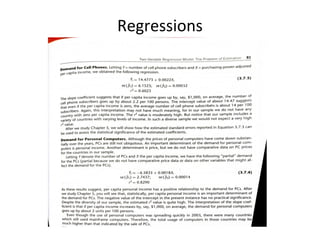
Regressions
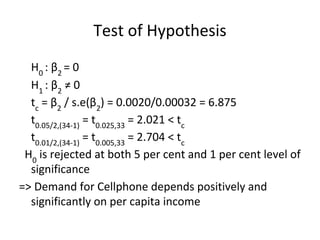
Test of Hypothesis
H0
: β2
= 0
H1
: β2
≠ 0
tc
= β2
/ s.e(β2
) = 0.0020/0.00032 = 6.875
t0.05/2,(34-1)
= t0.025,33
= 2.021 < tc
t0.01/2,(34-1)
= t0.005,33
= 2.704 < tc
H0
is rejected at both 5 per cent and 1 per cent level of
significance
=> Demand for Cellphone depends positively and
significantly on per capita income

Statistical Inference & Hypothesis Testing.pdf

  • 1.
  • 2.
    Why ? • Samplesdrawn from an infinite population • Features of population may vary from those of samples • Sample statistics may vary with samples • Question is whether the sample properties satisfactorily explain population properties • Parameter -> population characteristics (mean, variance etc.) • Statistic -> sample characteristics
  • 3.
    Statistical Inference • Statisticalinference The process of going to unknown population parameters from estimated sample statistics possible with random sampling • 2 problems -> no idea about the feature of the population – estimation, then testing of hypothesis • -> tentative idea about the feature of the population – testing of hypothesis
  • 4.
    Estimation • Interval estimation-> a range of values within which the unknown parameter has a chance to belong • Point estimation -> estimate a particular value for the unknown parameter – test whether the estimation is satisfactory/ reliable – hypothesis testing • Testing reliability (whether statistically significant) of estimation needs knowledge of probability distribution function
  • 5.
    Probability • Probability ofan event = (Number of cases favourable to the event) / (Total number of cases) • Example: Coin tossing (2 times) • Events: HH, HT, TH, TT • Probability (Different outcomes) = 2/ 4 • In axiomatic approach of probability relative frequency of an event is considered as the event’s probability of occurrence when the total number of cases is very large (n -> ∞)
  • 6.
    Probability distribution • Yis a random variable => Y occurs with probability • As probability is defined by relative frequency, distribution of Y in the infinite population is represented by its probabilities => Probabilities of occurrence of different values of Y are presented against those values of Y • Y is discrete -> for any particular value of Y (let it be c), f(c) = f(Y at c)= Pr(Y=c) • f(Y) is the pmf (probability mass function) of Y if • f(Y) ≥ 0, for any Y • ∑ f(Y) = 1, summation with all values that Y can assume
  • 7.
    Probability distribution • Yis continuous -> for two values of Y, a (lower) and b (upper), b • Pr(a≤Y≤b) = ∫ f(Y)dY a • f(Y) is the pdf (probability density function) of Y if • f(Y) ≥ 0, for any Y ∫ f(Y)dY = 1, integration for all values of Y, (-∞, +∞)
  • 8.
    Distribution function • Statisticalinference involves inferring the nature of a population (central tendency - mean, variance, skewness and kurtosis) from the nature of a sample • -> we take help of distribution function • For any value c of the continuous variable Y, c • F(c) = Pr( Y ≤ c)) = ∫ f(Y) -∞ is called the cumulative distribution function or distribution function of Y
  • 9.
    Theoretical distribution • ->f (a theoretical distribution) gives a fairly close approximation to the actual distribution of the population variable • -> inference problem is related to having an idea about the numerical values of (or estimate) the parameters appearing in f • -> We have an idea regarding the central tendency of the variable concerned from its theoretical distribution (mean, variance etc.)
  • 10.
    Normal Distribution • Mostused form of distribution for a continuous variable because • – has very simple properties – comparatively easy to deal with • - many non-normal distributions become asymptotically normal • - transformation of variables often make them follow normal distribution • Central limit theorem and law of large numbers • f(Y) = (1/(σ√2π) exp[-(Y-μ)2 /2σ2 ], -∞ ≤Y ≤ +∞ • Mean(Y) = μ, Var(Y)= σ2
  • 11.
  • 12.
    Properties of normaldistribution f(Y) > 0 for all values of Y ∞ ∫ f(Y)dY = 1 -∞ The distribution is symmetrical => mean and median are the same Any linear function of some normal variables is also normally distributed. => If Y1 , Y2 , Y3 are normally distributed, (Y1 + Y2 + Y3 )/3 is also normally distributed
  • 13.
    Normal Distribution Standard NormalDistribution • Population distribution Sampling distribution • Population (Mean, Variance) Sample (Mean, Variance) • Distribution of the sample is also normal • If Y follows normal distribution with mean = μ and variance = σ2 , then τ = (Y- μ)/ σ follows standard normal distribution with Mean = 0 and variance = 1
  • 14.
  • 15.
    Statistical Inference Let usdenote by τα, a value of τ, such that Pr[τ > τα ] = α and Pr[τ < τ1-α ] = α ⇒ Pr[τ < τα ] = 1-α For statistical inference value of α is normally considered as 0.01 (99 per cent) or 0.05 (95 per cent) and Pr[ -τα/2 < τ < τα/2 ] = 1-α The interval is defined as confidence limit and (1-α) is confidence coefficient
  • 16.
    Interval estimation • Constructinga range of values (interval) within which the unknown parameter has a chance to belong • If y is sample mean (samples being y1 , y2 , ......., yn ), it can be shown that E(y) = μ, Var(y)= σ2 /n (sampling with replacement) • If y1 , y2 , ......., yn follow normal distribution, y also follows normal distribution • Define τ = (y- μ)/ (σ/√n ), τ = [y- Mean(y)]/ √Var(y), • τ follows standard normal distribution
  • 17.
    Interval estimation 99 percent confidence interval of μ is Pr [-2.576 ≤ (y- μ)/ (σ/√n ) ≤2.576] = 0.99 Pr [-2.576 (σ/√n ) ≤ (y- μ) ≤2.576 (σ/√n )] = 0.99 Pr [- y- 2.576 (σ/√n ) ≤ - μ ≤ -y +2.576 (σ/√n )] = 0.99 => Pr [y- 2.576 (σ/√n ) ≤ μ ≤ y +2.576 (σ/√n )] = 0.99 => In repeated sampling, in 99 per cent of the cases the above interval will include μ (the probability that the above interval will include μ is 0.99)
  • 18.
    Hypothesis testing • Assumea value μ0 of the unknown μ and test whether μ = μ0 with the help of sample mean y • Test the Null Hypothesis H0 : μ = μ0 • Alternative Hypothesis H1 : μ ≠ μ0 • The test statistic is τ = (y- μ0 )/ (σ/√n ), σ is known
  • 19.
    Hypothesis testing If thecalculated τ (τc ) is outside the confidence interval, we reject the null hypothesis. When the confidence coefficient is 0.99, τα/2 = 2.576 Thus, if τc > τα/2 (= 2.576), we reject H0 : μ = μ0 and conclude that μ is not equal to μ0 ⇒ Out of 100 samples drawn, in only one case μ will be equal to μ0 . When calculated τc is < 0, use τc < -2.576 to reject H0
  • 20.
    If the nullhypothesis is H0 : μ = μ0 against the alternative H1 : μ > μ0 or H1 : μ < μ0 we choose one-sided critical value, τα, instead of τα/2 Here the critical (tabulated) value will be 2.326
  • 21.
    t-distribution • When σis unknown, it is replaced by its sample estimate. • Then the ratio [(y-mean)/std. dev] follows t-distribution • The (1-α) percent confidence interval is Pr [y- tα/2,n-1 (s’/√n ) ≤ μ ≤ y + tα/2,n-1 (s’/√n )] = 1-α
  • 22.
    Hypothesis testing ina bivariate regression The bivariate regression equation is Yi = a + bXi + Ui We estimate this equation by Ordinary Least Square (OLS) subject to fulfilment of some conditions regarding Ui and get aest and best We have to test whether really Xi affets Yi , i.e., whether best is significantly non-zero. Calculate tc = (best – 0)/√Var(best ) = best / s.d(best )
  • 23.
    Hypothesis testing ina bivariate regression So, now the null and alternative hypotheses are H0 : best = 0 H1 : best ≠ 0 The decision rule is if tc > tα/2,(n-1) , reject H0 => Xi significantly affects Yi
  • 24.
  • 25.
    Two samples drawnfrom the Population
  • 26.
    Two SRFs estimatedfrom Two Samples
  • 27.
  • 28.
  • 29.
    Test of Hypothesis H0 :β2 = 0 H1 : β2 ≠ 0 tc = β2 / s.e(β2 ) = 0.0020/0.00032 = 6.875 t0.05/2,(34-1) = t0.025,33 = 2.021 < tc t0.01/2,(34-1) = t0.005,33 = 2.704 < tc H0 is rejected at both 5 per cent and 1 per cent level of significance => Demand for Cellphone depends positively and significantly on per capita income