Fluids, Electrolytes, Acid-
Base Balance
ES Garba
Teaching Objectives
Body fluids distribution
The kidneys' role in electrolyte balance
The body's way of compensating for acid-base
imbalances
Major acid-base imbalances.
Body Homeostasis
Depend on:
I. Fluid
II. Electrolyte
III. Acid-base balance
Disrupting factors:
I. Surgery
II. Illness
III. Injury
Body Fluid Composition
Made up of water containing solutes.
These solutes are necessary for physiologic
functioning.
Solutes include: (AGE)
Electrolytes
Glucose
Amino acids
Other nutrients.
Types of Body Fluids
1. Intracellular fluid (ICF)
2. Intravascular fluid (IVF) (plasma, is found within
the blood vessels and the lymphatic system)
3. Interstitial fluid (ISF) is found in the loose tissue
around cells.
4. Extracellular fluid (ECF), found in the spaces
between cells, includes IVF and ISF.
Three Different Types of Solutions
Commonly found as :
Isotonic
Hypotonic
Hypertonic.
The body constantly strives to maintain a state
of balance.
Transporting nutrients to cells and wastes from cells
Transporting hormones, enzymes, blood platelets, and red
and white blood cells
Facilitating cellular metabolism and proper cellular chemical
functioning
Acting as a solvent for electrolytes and nonelectrolytes
Helping maintain normal body temperature
Facilitating digestion and promoting elimination
Acting as a tissue lubricant
Functions of Water in the Body
Osmolality is determined by the number of dissolved
particles, mainly Na, urea and glucose per kilogram of
H2O
Na is the largest contributor of particles
To maintain balance between ICF and ECF, the body
continues to shift Na and H2O between them
ICF is maintained by K+
ECF is maintained by Na+
Types of Fluids
Crystalloids:
• 0.9% saline - not “ normal “ !
• 5% dextrose
• 0.18% saline + 0.45% dextrose
• Others
Colloids:
• Blood
• Plasma / albumin
• Synthetics
Simple Rules of Fluid Replacement
Replace blood with blood
Replace plasma with colloid
Resuscitate with colloid
Replace ECF depletion with saline
Rehydrate with dextrose
How does movement from space to
space occur?
Diffusion
Osmosis
Filtration
Active transport
Assessment of Fluid Deficit
Hypotension
Weak rapid pulse
Temperature decreased if hypovolemic, and
increased in dehydration
Weight loss
Skin turgor poor in dehydration and possible
edema in hypovolemic
Concentrated urine and blood
Causes of Third-Spacing
Burns
Peritonitis
Bowel obstruction
Massive bleeding into joint or cavity
Liver or renal failure
Lowered plasma proteins
Increased capillary permeability
24
Normal Saline (NS)
Expands IV volume
Preferred fluid for immediate response
Risk for fluid overload higher
Does not change ICF volume
Blood products
Compatible with most medications
Lactated Ringer’s
Isotonic
More similar to plasma than NS
Has less NaCl
Has K, Ca, PO4
3-, lactate (metabolized to HCO3
-
)
Expands ECF
Plasma Expanders
Stay in vascular space and increase osmotic
pressure
Colloids (protein solutions)
o Packed RBCs
o Albumin
o Plasma
Electrolytes
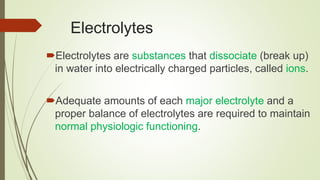
Electrolytes are substances that dissociate (break up)
in water into electrically charged particles, called ions.
Adequate amounts of each major electrolyte and a
proper balance of electrolytes are required to maintain
normal physiologic functioning.
Electrolytes
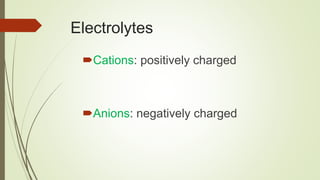
Cations: positively charged
Anions: negatively charged
Electrolytes
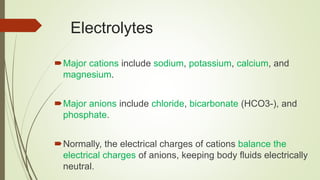
Major cations include sodium, potassium, calcium, and
magnesium.
Major anions include chloride, bicarbonate (HCO3-), and
phosphate.
Normally, the electrical charges of cations balance the
electrical charges of anions, keeping body fluids electrically
neutral.
Effects of electrolytes in the body
Affect the body's:
• Water distribution
• Osmolarity, and
• Acid-base balance.
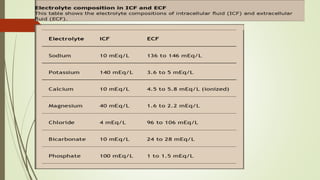
Electrolyte Composition
ICF
oPrevalent cation is K+
oPrevalent anion is PO4
3-
ECF
oPrevalent cation is Na+
oPrevalent anion is Cl-
Sodium (Na++)
Functions
 Regulates volume of body fluids
 Maintains water balance
 Regulates ECF
 Influences ICF
 Generation and transmission of nerve impulses
 Sodium-Potassium pump
Electrolyte balance
K + (Potassium)
• Major intracellular cation
• 150- 160 mEq/ L
• Regulates resting membrane potential
• Regulates fluid, ion balance inside cell
Regulation in kidney through:
• Aldosterone
• Insulin
Acid Base Balance
Blood - normal pH of 7.2 – 7.45
< 7.2 = acidosis > 7.45 = alkalosis
3 buffer systems to maintain normal blood pH
Buffers
Removal of CO2 by lungs
Removal of H+ ions by kidneys
Acid Base Balance
An acid is a substance that yields hydrogen ions when
dissociated (changed from a complex to a simpler compound)
in solution.
A strong acid dissociates almost completely, releasing a large
number of hydrogen ions.
A base dissociates in water, releasing ions that can combine
with hydrogen ions. Like a strong acid, a strong base
dissociates almost completely, releasing many ions.
The hydrogen ion concentration of a fluid determines
whether it's acidic or basic (alkaline).
A neutral solution, such as pure water, dissociates
only slightly.
Acid Base Balance
The body produces acids, thus yielding hydrogen
ions, through the following mechanisms:
Protein catabolism yields nonvolatile acids, such as
sulfuric, phosphoric, and uric acids.
Fat oxidation produces acid ketone bodies.
Acid Base Balance
Hydrogen (H) ion concentration is commonly expressed as
pH, which indicates the degree of acidity or alkalinity of a
solution:
A pH of 7 indicates neutrality or equal amounts of H and
hydroxyl (OH-) ions.
An acidic solution contains more H ions than OH- ions; its
pH is less than 7.
An alkaline solution contains fewer H ions than OH-
ions; its pH exceeds 7.
Overall, as H ion concentration increases, pH goes
down.
Maintenance of Acid-Base Balance
 Respiratory System: removal of CO2 by lungs –
stabilizes the ECF, has direct effect on Carbonic
Acid – Bicarbonate Buffer System
 Urinary System: removal of H+ ions by kidneys
Summary
Classify fluids.
What regulates fluid shift in the body?
What is acid base balance?
How is acid base balance regulated in the body.
Thanks

Fluids and Electrolytes in Surgical Practice.pptx

  • 1.
  • 2.
    Teaching Objectives Body fluidsdistribution The kidneys' role in electrolyte balance The body's way of compensating for acid-base imbalances Major acid-base imbalances.
  • 3.
    Body Homeostasis Depend on: I.Fluid II. Electrolyte III. Acid-base balance Disrupting factors: I. Surgery II. Illness III. Injury
  • 4.
    Body Fluid Composition Madeup of water containing solutes. These solutes are necessary for physiologic functioning. Solutes include: (AGE) Electrolytes Glucose Amino acids Other nutrients.
  • 5.
    Types of BodyFluids 1. Intracellular fluid (ICF) 2. Intravascular fluid (IVF) (plasma, is found within the blood vessels and the lymphatic system) 3. Interstitial fluid (ISF) is found in the loose tissue around cells. 4. Extracellular fluid (ECF), found in the spaces between cells, includes IVF and ISF.
  • 6.
    Three Different Typesof Solutions Commonly found as : Isotonic Hypotonic Hypertonic. The body constantly strives to maintain a state of balance.
  • 7.
    Transporting nutrients tocells and wastes from cells Transporting hormones, enzymes, blood platelets, and red and white blood cells Facilitating cellular metabolism and proper cellular chemical functioning Acting as a solvent for electrolytes and nonelectrolytes Helping maintain normal body temperature Facilitating digestion and promoting elimination Acting as a tissue lubricant Functions of Water in the Body
  • 8.
    Osmolality is determinedby the number of dissolved particles, mainly Na, urea and glucose per kilogram of H2O Na is the largest contributor of particles To maintain balance between ICF and ECF, the body continues to shift Na and H2O between them ICF is maintained by K+ ECF is maintained by Na+
  • 9.
    Types of Fluids Crystalloids: •0.9% saline - not “ normal “ ! • 5% dextrose • 0.18% saline + 0.45% dextrose • Others Colloids: • Blood • Plasma / albumin • Synthetics
  • 10.
    Simple Rules ofFluid Replacement Replace blood with blood Replace plasma with colloid Resuscitate with colloid Replace ECF depletion with saline Rehydrate with dextrose
  • 11.
    How does movementfrom space to space occur? Diffusion Osmosis Filtration Active transport
  • 12.
    Assessment of FluidDeficit Hypotension Weak rapid pulse Temperature decreased if hypovolemic, and increased in dehydration Weight loss Skin turgor poor in dehydration and possible edema in hypovolemic Concentrated urine and blood
  • 13.
    Causes of Third-Spacing Burns Peritonitis Bowelobstruction Massive bleeding into joint or cavity Liver or renal failure Lowered plasma proteins Increased capillary permeability 24
  • 14.
    Normal Saline (NS) ExpandsIV volume Preferred fluid for immediate response Risk for fluid overload higher Does not change ICF volume Blood products Compatible with most medications
  • 15.
    Lactated Ringer’s Isotonic More similarto plasma than NS Has less NaCl Has K, Ca, PO4 3-, lactate (metabolized to HCO3 - ) Expands ECF
  • 16.
    Plasma Expanders Stay invascular space and increase osmotic pressure Colloids (protein solutions) o Packed RBCs o Albumin o Plasma
  • 17.
    Electrolytes Electrolytes are substancesthat dissociate (break up) in water into electrically charged particles, called ions. Adequate amounts of each major electrolyte and a proper balance of electrolytes are required to maintain normal physiologic functioning.
  • 18.
  • 19.
    Electrolytes Major cations includesodium, potassium, calcium, and magnesium. Major anions include chloride, bicarbonate (HCO3-), and phosphate. Normally, the electrical charges of cations balance the electrical charges of anions, keeping body fluids electrically neutral.
  • 21.
    Effects of electrolytesin the body Affect the body's: • Water distribution • Osmolarity, and • Acid-base balance.
  • 22.
    Electrolyte Composition ICF oPrevalent cationis K+ oPrevalent anion is PO4 3- ECF oPrevalent cation is Na+ oPrevalent anion is Cl-
  • 23.
    Sodium (Na++) Functions  Regulatesvolume of body fluids  Maintains water balance  Regulates ECF  Influences ICF  Generation and transmission of nerve impulses  Sodium-Potassium pump
  • 24.
    Electrolyte balance K +(Potassium) • Major intracellular cation • 150- 160 mEq/ L • Regulates resting membrane potential • Regulates fluid, ion balance inside cell Regulation in kidney through: • Aldosterone • Insulin
  • 25.
    Acid Base Balance Blood- normal pH of 7.2 – 7.45 < 7.2 = acidosis > 7.45 = alkalosis 3 buffer systems to maintain normal blood pH Buffers Removal of CO2 by lungs Removal of H+ ions by kidneys
  • 26.
    Acid Base Balance Anacid is a substance that yields hydrogen ions when dissociated (changed from a complex to a simpler compound) in solution. A strong acid dissociates almost completely, releasing a large number of hydrogen ions. A base dissociates in water, releasing ions that can combine with hydrogen ions. Like a strong acid, a strong base dissociates almost completely, releasing many ions.
  • 27.
    The hydrogen ionconcentration of a fluid determines whether it's acidic or basic (alkaline). A neutral solution, such as pure water, dissociates only slightly.
  • 28.
    Acid Base Balance Thebody produces acids, thus yielding hydrogen ions, through the following mechanisms: Protein catabolism yields nonvolatile acids, such as sulfuric, phosphoric, and uric acids. Fat oxidation produces acid ketone bodies.
  • 29.
    Acid Base Balance Hydrogen(H) ion concentration is commonly expressed as pH, which indicates the degree of acidity or alkalinity of a solution: A pH of 7 indicates neutrality or equal amounts of H and hydroxyl (OH-) ions. An acidic solution contains more H ions than OH- ions; its pH is less than 7.
  • 30.
    An alkaline solutioncontains fewer H ions than OH- ions; its pH exceeds 7. Overall, as H ion concentration increases, pH goes down.
  • 31.
    Maintenance of Acid-BaseBalance  Respiratory System: removal of CO2 by lungs – stabilizes the ECF, has direct effect on Carbonic Acid – Bicarbonate Buffer System  Urinary System: removal of H+ ions by kidneys
  • 32.
    Summary Classify fluids. What regulatesfluid shift in the body? What is acid base balance? How is acid base balance regulated in the body.
  • 33.