Triage of cases-with seriousness
and expectedness
Name – Sumit
Roll no. 2250981548
Triaging
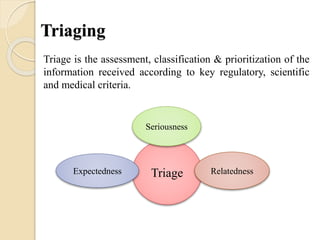
Triage is the assessment, classification & prioritization of the
information received according to key regulatory, scientific
and medical criteria.
Triage
Seriousness
Relatedness
Expectedness
SERIOUSNESS ASSESSMENT
 Seriousness of an ADR is related to its life threatening
nature and is defined as any untoward reaction to the
medicinal product that may result in death and requires
patient hospitalization.
 Seriousness of reaction is categorized according to FDA
criteria on the basis of their life threatening nature.
1. Death.
2. Life-threatening.
3. Hospitalization (initial or prolonged).
4. Disability or Permanent Damage.
5. Congenital Anomaly/Birth Defect.
6. Medical Significant.
1. Death
1. Death should be considered as seriousness criteria only if
it is reported by reporter.
2. The reporter must mention in the report that patient died
while on/after receiving treatment medication.
3. If reported event is completed suicide then it should be
categorised under death.
4. If reported event is suicide then follow up request to be
sent to confirm as attempted suicide or completed suicide.
For example: A patient experienced an ADR after the
administration of Drug A and died in an airplane accident.
2. Life-threatening
1. Life-threatening refers to a reaction in which the patient
was at risk of death at the time of the reaction; It does not
refer to a reaction that hypothetically might have caused
death if more severe.
2. For example, if patient had cardiac arrest and taken to
hospital then seriousness willbe hospitalisation not life
threatening.
3. If patient was in coma or require ventilator support can be
considered as lifE threatening conditions.
4. Life threatening can be considered as seriousness if
reporter clearly mentions inreport that patient is in Life
threatening condition.
3. Hospitalization:
 Hospitalisation considered as serious criteria if patient
administered to hospital (with minimum 24 hrs stay) or
caused prolongation of hospitalisation for any event.
 Example:
 Patient was admitted to emergency department due to
severe headache experienced after administration of Drug
A.
 Patient was admitted to emergency department due to
diabetic foot and was put on Drug A. On the day of
discharge, she experienced severe gastritis, vomiting and
abdominal pain. Patient was treated with Drug B ad
discharged after 2 days.
4. Disability/incapacity:
 A substantial disruption of a person’s ability to conduct
normal life function.’’ (FDA definition)
 Applicable when and ADR resulted in alteration of function
or of quality of life for a particular duration •
 For example: –
 Headache lasting 24 hours
 Partial deafness in one ear
5. Congenital anomaly/birth defect:
1. Congenital anomalies, also commonly referred to as birth
defects, congenital disorders, congenital malformations,
or congenital abnormalities, are conditions of prenatal
origin that are present at birth, potentially impacting an
infant's health, development and/or survival.
2. This seriousness criteria can be used only in pregnancy
reports where parent exposed to medication while mother
being pregnant and baby had birth defect
because of medication.
6. Medically Important/Significant:
 Medical judgment shall be exercised to define the
seriousness of the case-based type of adverse event and
intervention required to treat the adverse event. •
 These cases will be considered as serious.
 Under EU Pharmacovigilance system, an important medical
event (IME) terms list is available based on the Medical
Dictionary for Regulatory Activities (MedDRA) Preferred
terms. The IME list is referred to define seriousness of case
based on Medically Important/Significant.
 In safety database, the IME list is integrated to assign the
seriousness automatically once the particular adverse event
is populated.
EXPECTEDNESS DETERMINATION
 Very important part of case processing to determine
expectedness of adverse event reported in the relevant
Reference safety information documents of the medicinal
product.
 A signs, symptoms or diagnosis reported in a case which
are present in the list (even as synonyms) of adverse
reactions in an RSI document will be classified as
‘‘Expected’’.
 A signs, symptoms or diagnosis reported in a case which
are different or present with different severity (mild,
moderate, severe) in adverse reactions list of RSI will be
classified as ‘‘Unexpected’’.
 RSI may be one or more of the following:
Investigator Brochure (IB)
Company’s core safety information (CCSI) within its
internal core data sheet, or
The official local data sheet (e.g., Package Insert in the
US, Summary of Product Characteristics (SPC) in the
EU).
 The terms Listed/Unlisted will be used for ADRs referred
in IB/CCSI
 The terms Labeled/Unlabeled will be used for ADRs
referred in PI/SmPC.
 The terms 'Listed/Labelled” are used during assessment for
the “Marketed products”.
 The term “Expectedness” is used during assessment for
“Developmental drugs or Investigational molecules.
POINTS TO CONSIDER:
 Medical judgments shall be made in regards to choice of
term and clinical evidence of the term to assess the
expectedness.
 If ‘‘verbatim’’ term of ADR reported is not present in the
RSI, synonym or medically equivalent term should be
identified and consider for expectedness.
 If ADR presented in the RSI in overdose section then same
ADR if reported with normal dose of the drug should be
considered as “Unexpected”.
 Expectedness should be determine for drug associated
medical experiences only like any adverse event happened
before the drug administrations should not be considered
for expectedness assessment.
 In addition to Adverse Event list of RSI document, other
sections clinical pharmacology, contraindications,
warnings, precautions should also be included for
expectedness assessment.
 Death Cases: In situations where ADR is associated with
death as outcome, the case should be considered
‘Unexpected’ until unless the RSI specify a fatal outcome
associated with ADR.
 TRIAGE Categories
Serious + Unexpected
Serious + Expected
Non-serious + Unexpected
Non-serious + Expected
triage ppt.pptx

triage ppt.pptx

  • 1.
    Triage of cases-withseriousness and expectedness Name – Sumit Roll no. 2250981548
  • 2.
    Triaging Triage is theassessment, classification & prioritization of the information received according to key regulatory, scientific and medical criteria. Triage Seriousness Relatedness Expectedness
  • 3.
    SERIOUSNESS ASSESSMENT  Seriousnessof an ADR is related to its life threatening nature and is defined as any untoward reaction to the medicinal product that may result in death and requires patient hospitalization.  Seriousness of reaction is categorized according to FDA criteria on the basis of their life threatening nature. 1. Death. 2. Life-threatening. 3. Hospitalization (initial or prolonged). 4. Disability or Permanent Damage. 5. Congenital Anomaly/Birth Defect. 6. Medical Significant.
  • 4.
    1. Death 1. Deathshould be considered as seriousness criteria only if it is reported by reporter. 2. The reporter must mention in the report that patient died while on/after receiving treatment medication. 3. If reported event is completed suicide then it should be categorised under death. 4. If reported event is suicide then follow up request to be sent to confirm as attempted suicide or completed suicide. For example: A patient experienced an ADR after the administration of Drug A and died in an airplane accident.
  • 5.
    2. Life-threatening 1. Life-threateningrefers to a reaction in which the patient was at risk of death at the time of the reaction; It does not refer to a reaction that hypothetically might have caused death if more severe. 2. For example, if patient had cardiac arrest and taken to hospital then seriousness willbe hospitalisation not life threatening. 3. If patient was in coma or require ventilator support can be considered as lifE threatening conditions. 4. Life threatening can be considered as seriousness if reporter clearly mentions inreport that patient is in Life threatening condition.
  • 6.
    3. Hospitalization:  Hospitalisationconsidered as serious criteria if patient administered to hospital (with minimum 24 hrs stay) or caused prolongation of hospitalisation for any event.  Example:  Patient was admitted to emergency department due to severe headache experienced after administration of Drug A.  Patient was admitted to emergency department due to diabetic foot and was put on Drug A. On the day of discharge, she experienced severe gastritis, vomiting and abdominal pain. Patient was treated with Drug B ad discharged after 2 days.
  • 7.
    4. Disability/incapacity:  Asubstantial disruption of a person’s ability to conduct normal life function.’’ (FDA definition)  Applicable when and ADR resulted in alteration of function or of quality of life for a particular duration •  For example: –  Headache lasting 24 hours  Partial deafness in one ear
  • 8.
    5. Congenital anomaly/birthdefect: 1. Congenital anomalies, also commonly referred to as birth defects, congenital disorders, congenital malformations, or congenital abnormalities, are conditions of prenatal origin that are present at birth, potentially impacting an infant's health, development and/or survival. 2. This seriousness criteria can be used only in pregnancy reports where parent exposed to medication while mother being pregnant and baby had birth defect because of medication.
  • 9.
    6. Medically Important/Significant: Medical judgment shall be exercised to define the seriousness of the case-based type of adverse event and intervention required to treat the adverse event. •  These cases will be considered as serious.  Under EU Pharmacovigilance system, an important medical event (IME) terms list is available based on the Medical Dictionary for Regulatory Activities (MedDRA) Preferred terms. The IME list is referred to define seriousness of case based on Medically Important/Significant.  In safety database, the IME list is integrated to assign the seriousness automatically once the particular adverse event is populated.
  • 10.
    EXPECTEDNESS DETERMINATION  Veryimportant part of case processing to determine expectedness of adverse event reported in the relevant Reference safety information documents of the medicinal product.  A signs, symptoms or diagnosis reported in a case which are present in the list (even as synonyms) of adverse reactions in an RSI document will be classified as ‘‘Expected’’.  A signs, symptoms or diagnosis reported in a case which are different or present with different severity (mild, moderate, severe) in adverse reactions list of RSI will be classified as ‘‘Unexpected’’.
  • 11.
     RSI maybe one or more of the following: Investigator Brochure (IB) Company’s core safety information (CCSI) within its internal core data sheet, or The official local data sheet (e.g., Package Insert in the US, Summary of Product Characteristics (SPC) in the EU).  The terms Listed/Unlisted will be used for ADRs referred in IB/CCSI  The terms Labeled/Unlabeled will be used for ADRs referred in PI/SmPC.  The terms 'Listed/Labelled” are used during assessment for the “Marketed products”.  The term “Expectedness” is used during assessment for “Developmental drugs or Investigational molecules.
  • 12.
    POINTS TO CONSIDER: Medical judgments shall be made in regards to choice of term and clinical evidence of the term to assess the expectedness.  If ‘‘verbatim’’ term of ADR reported is not present in the RSI, synonym or medically equivalent term should be identified and consider for expectedness.  If ADR presented in the RSI in overdose section then same ADR if reported with normal dose of the drug should be considered as “Unexpected”.  Expectedness should be determine for drug associated medical experiences only like any adverse event happened before the drug administrations should not be considered for expectedness assessment.
  • 13.
     In additionto Adverse Event list of RSI document, other sections clinical pharmacology, contraindications, warnings, precautions should also be included for expectedness assessment.  Death Cases: In situations where ADR is associated with death as outcome, the case should be considered ‘Unexpected’ until unless the RSI specify a fatal outcome associated with ADR.  TRIAGE Categories Serious + Unexpected Serious + Expected Non-serious + Unexpected Non-serious + Expected