A  Product Development Services  Company From Lab to Market Approval Regulatory Strategy Strategy Implementation  Pre-Clinical Assays Global Clinical Trials Global Regulatory Submissions Contact:  Patrick Burke  at  [email_address] 301-528-7000 Amarex Clinical Research Washington DC metro area
Thank you! Goal of these Seminars Information sharing Professional Development Networking
FDA Acceptance of  Foreign Clinical Trial Data in  INDs and NDA/BLA  Mukesh Kumar, PhD, RAC Senior Director, Regulatory Affairs Amarex Clinical Research Germantown, MD  20874, USA Tel:  001-240-750-4893 Email:  [email_address]
Agenda for this Seminar Legal Aspects Current regulations History of acceptance Practical Aspects Regulatory issues Logistical issues Scientific issues Business issues
Kinds of Foreign Clinical Trails IND studies:  Studies partially or completed conducted at foreign sites under a US IND All US IND rules apply Percent split of foreign verses US subjects Non-IND Studies:  Studies conducted at foreign sites Foreign sponsors Conditions apply for acceptance
IND Studies Foreign sites for speed and reduced cost All non-US sites treated same (?) More than 50% of all IND trials have non-US sites More than 40% investigators are non-US Involve FDA supervision and discussions Percent split in study subjects between US and non-US sites Early studies: up to 100% at foreign sites Pivotal studies: statistically justifiable subject split between US and foreign sites Bridging study for extrapolation of results might be needed
Non-IND Studies Foreign manufacturers US market not initially intended Product invented/discovered outside the US Used in support of an IND or NDA/BLA Up to 15% of non-IND data
FDA Acceptance of  Foreign Clinical Data Legally acceptable so long as the clinical trials meet the following criteria Good Clinical Practices (ICH E6) Clinical Investigators of recognized Competence Valid Scientific Evidence Applicable to U.S. Population/Medical Practice 21 CFR  §312.120 21 CFR  § 860.7
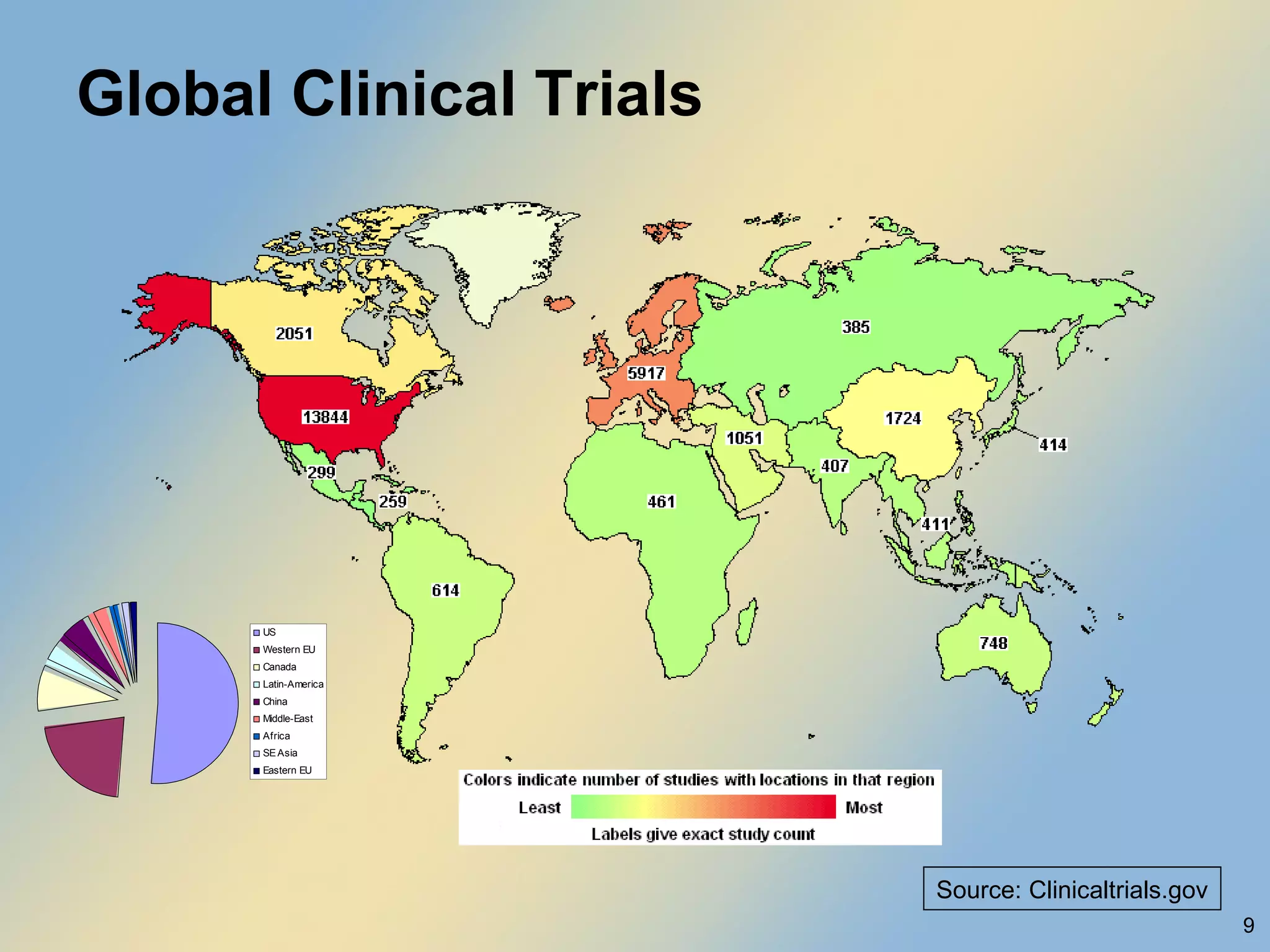
Global Clinical Trials Source: Clinicaltrials.gov
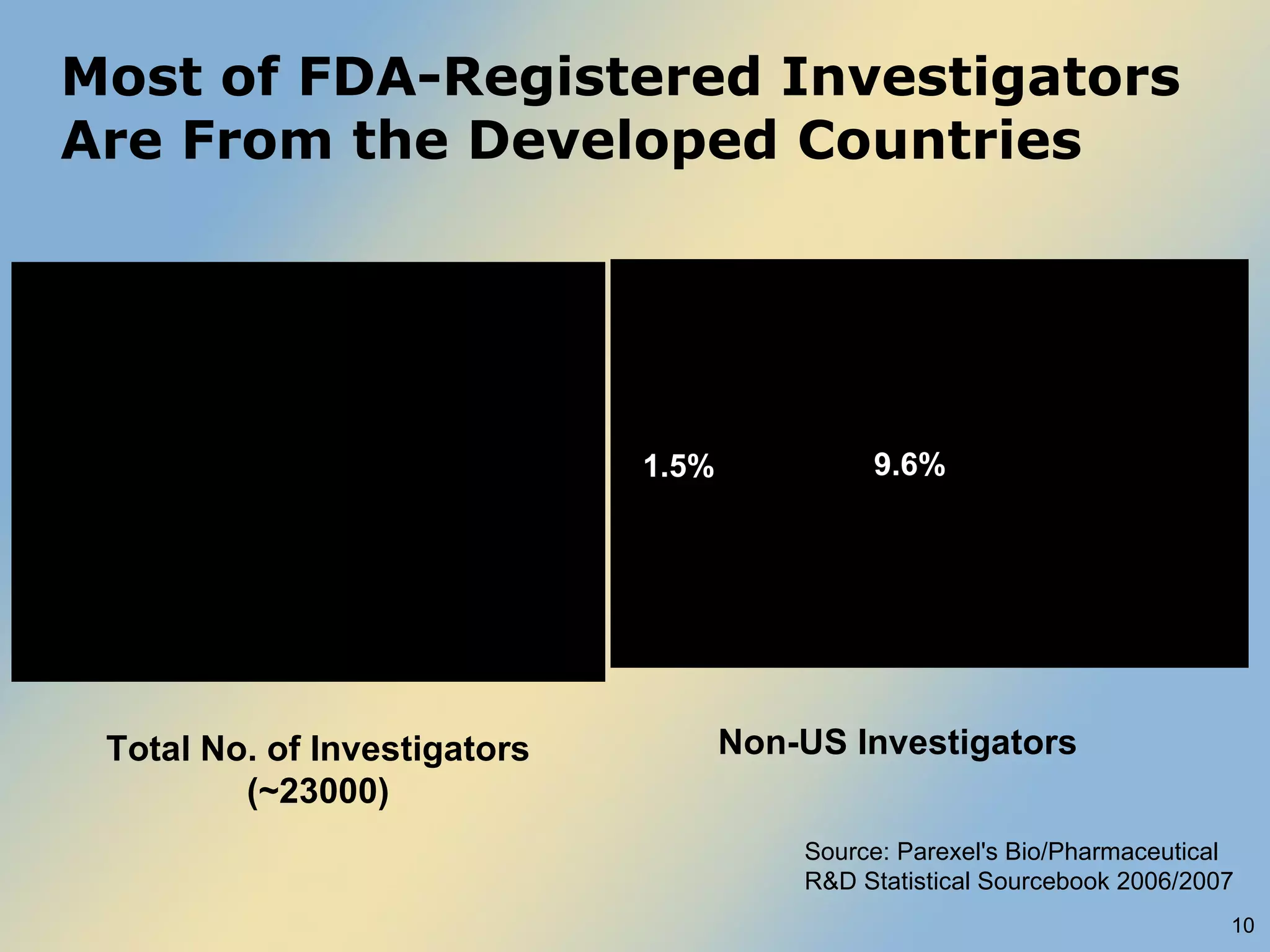
Most of FDA-Registered Investigators Are From the Developed Countries Source: Parexel's Bio/Pharmaceutical  R&D Statistical Sourcebook 2006/2007  Total No. of Investigators (~23000) Non-US Investigators 9.6% 3.9% 1.3% 1.5% 1.9%
FDA Guidance Documents June 1998: ICH E5 – Ethnic factors in the acceptability of foreign clinical data Sep. 2006: Clarifications and Q&A April 2008: Foreign clinical studies not conducted under an IND application
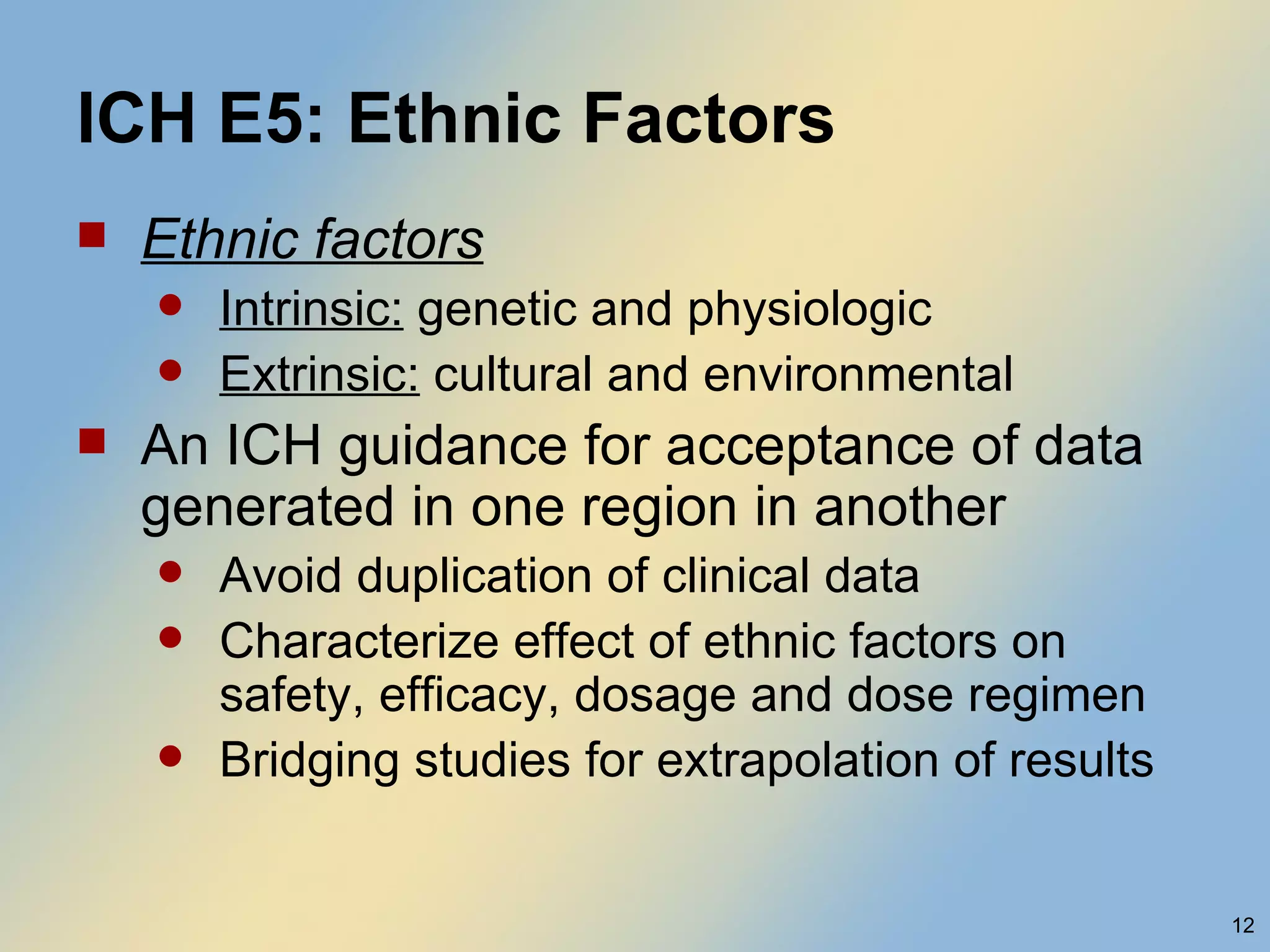
ICH E5: Ethnic Factors Ethnic factors Intrinsic:  genetic and physiologic Extrinsic:  cultural and environmental An ICH guidance for acceptance of data generated in one region in another Avoid duplication of clinical data Characterize effect of ethnic factors on safety, efficacy, dosage and dose regimen Bridging studies for extrapolation of results
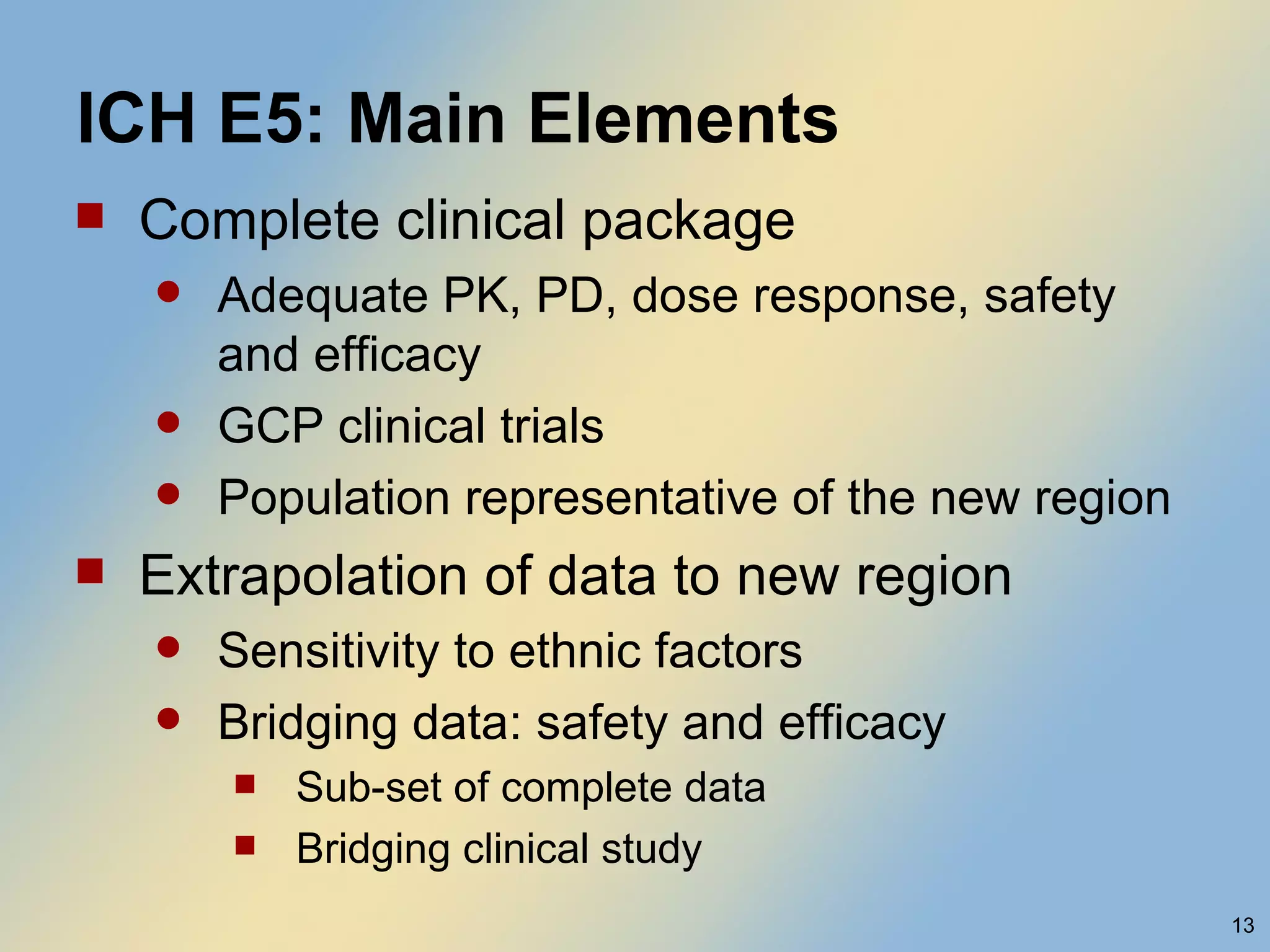
ICH E5: Main Elements Complete clinical package Adequate PK, PD, dose response, safety and efficacy GCP clinical trials Population representative of the new region Extrapolation of data to new region Sensitivity to ethnic factors Bridging data: safety and efficacy Sub-set of complete data Bridging clinical study
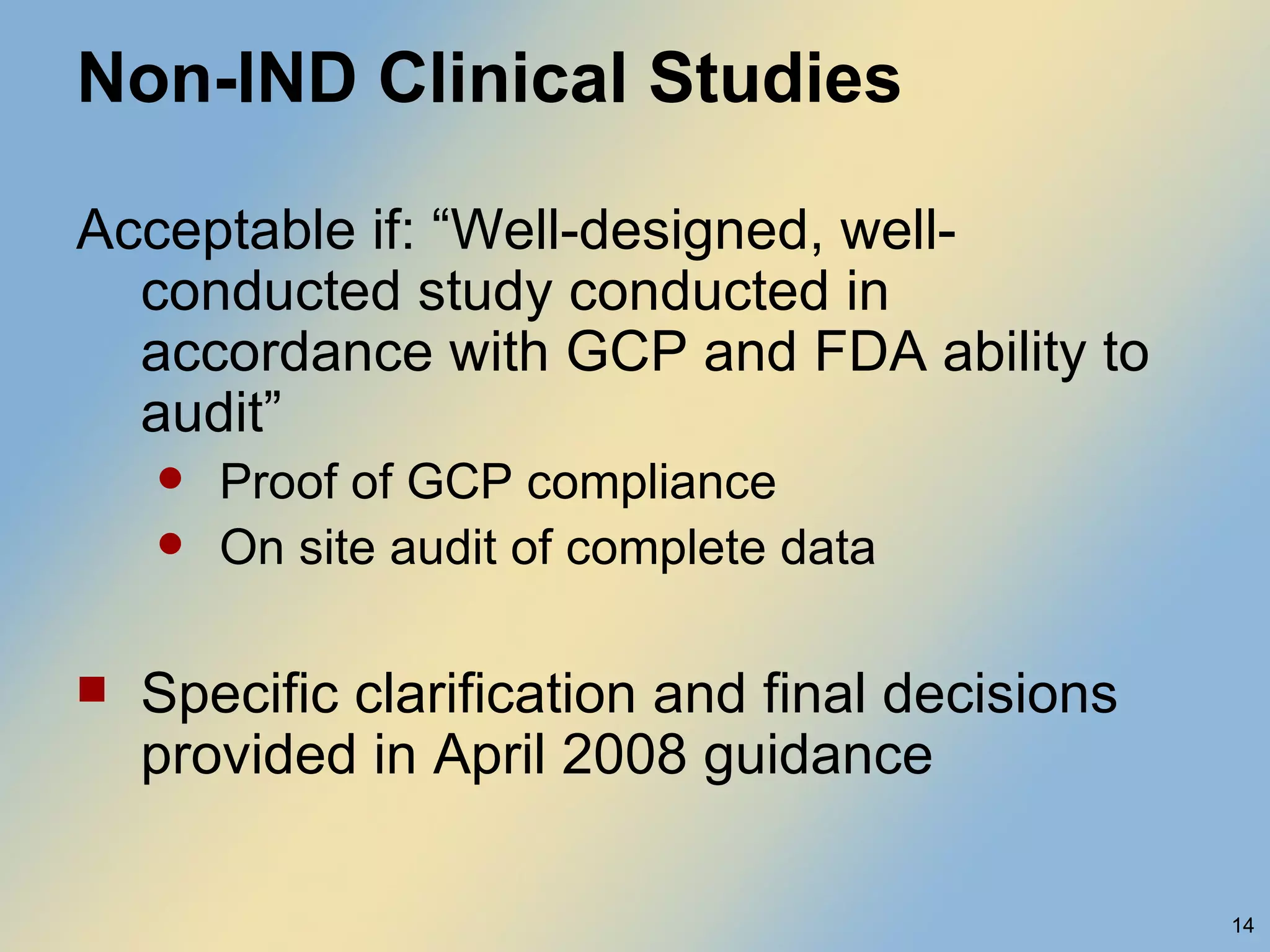
Non-IND Clinical Studies Acceptable if: “Well-designed, well-conducted study conducted in accordance with GCP and FDA ability to audit” Proof of GCP compliance On site audit of complete data Specific clarification and final decisions provided in April 2008 guidance
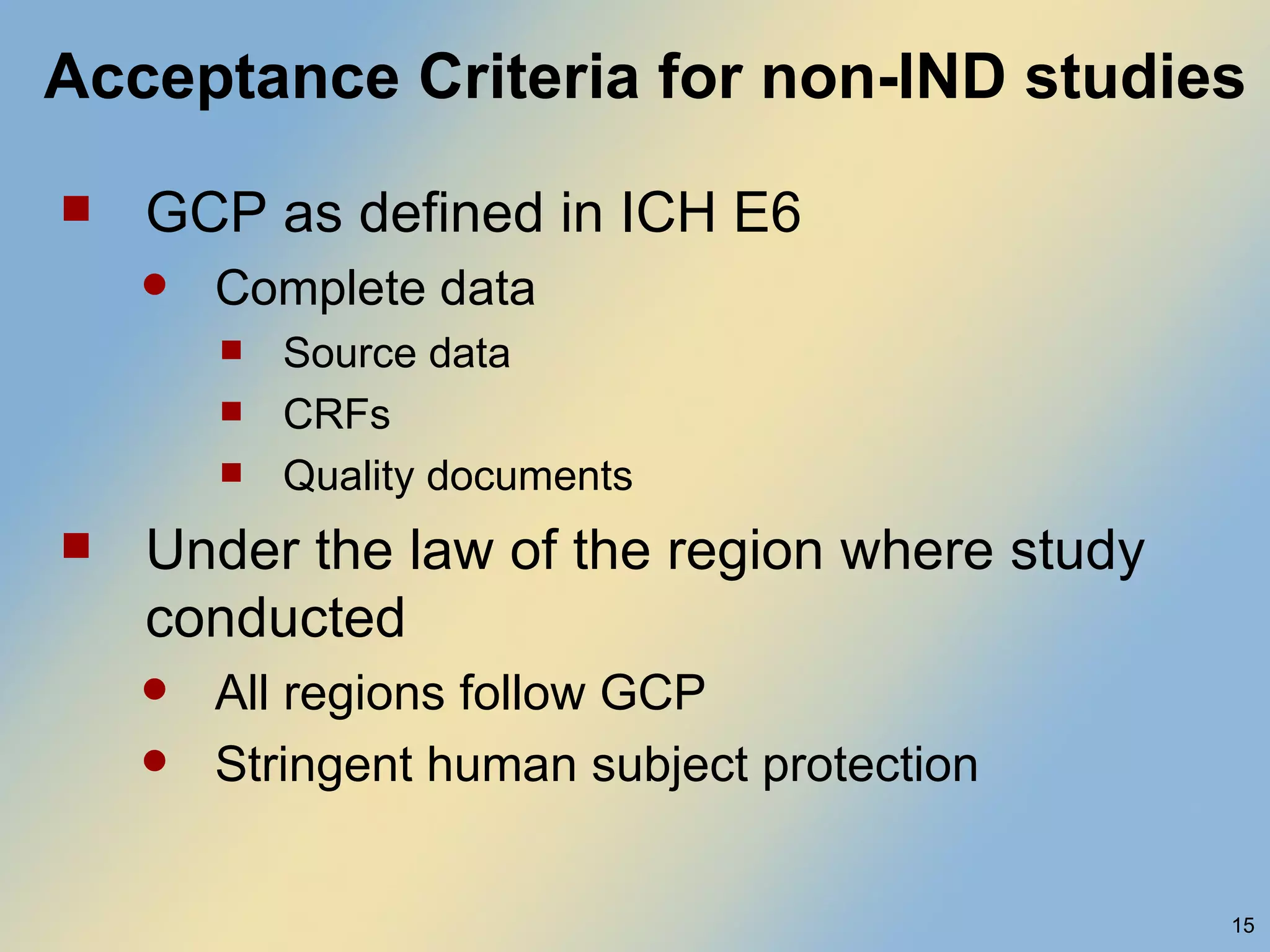
Acceptance Criteria for non-IND studies GCP as defined in ICH E6 Complete data Source data CRFs Quality documents Under the law of the region where study conducted All regions follow GCP Stringent human subject protection
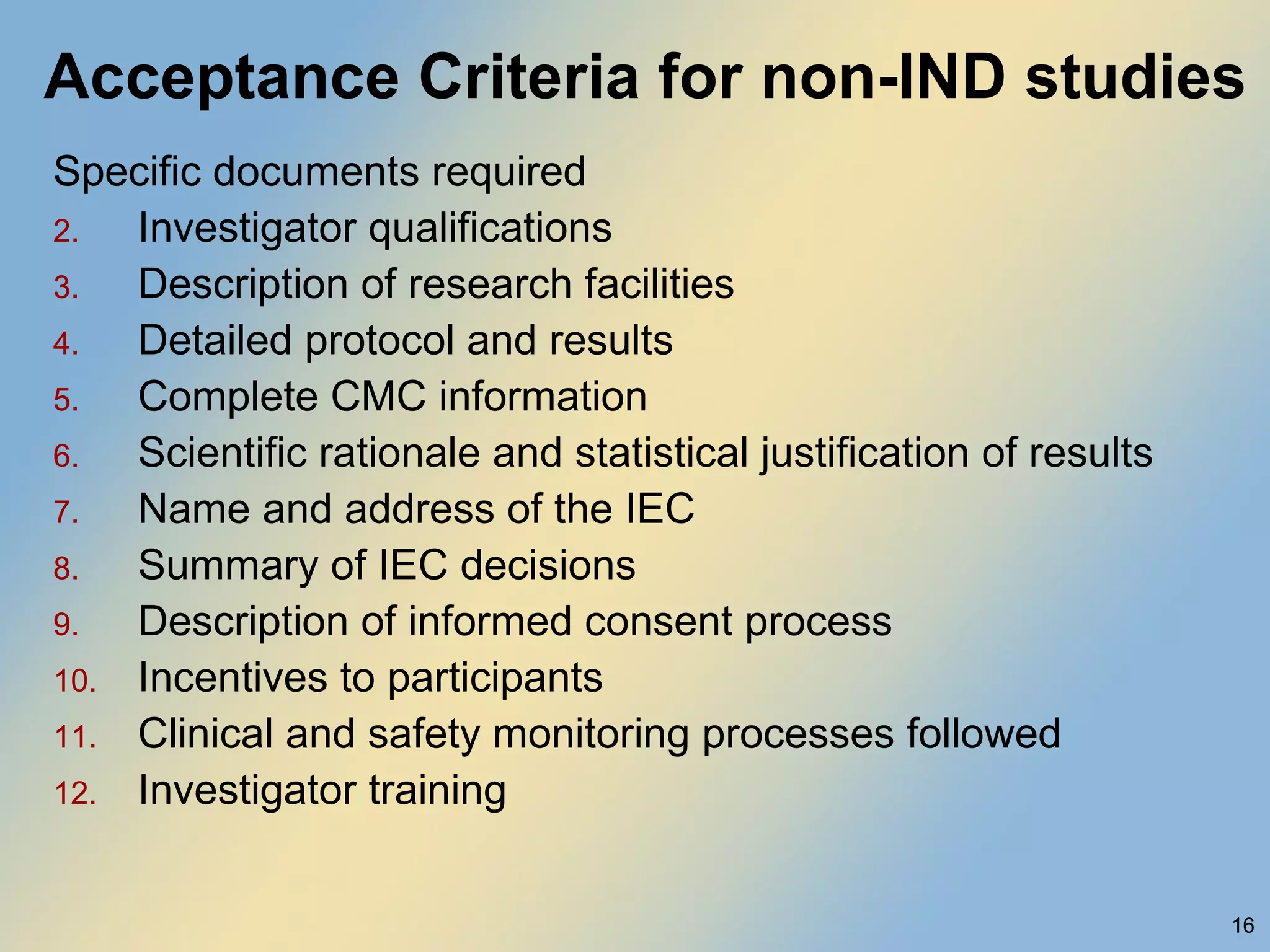
Acceptance Criteria for non-IND studies Specific documents required Investigator qualifications Description of research facilities Detailed protocol and results Complete CMC information Scientific rationale and statistical justification of results Name and address of the IEC Summary of IEC decisions Description of informed consent process Incentives to participants Clinical and safety monitoring processes followed Investigator training
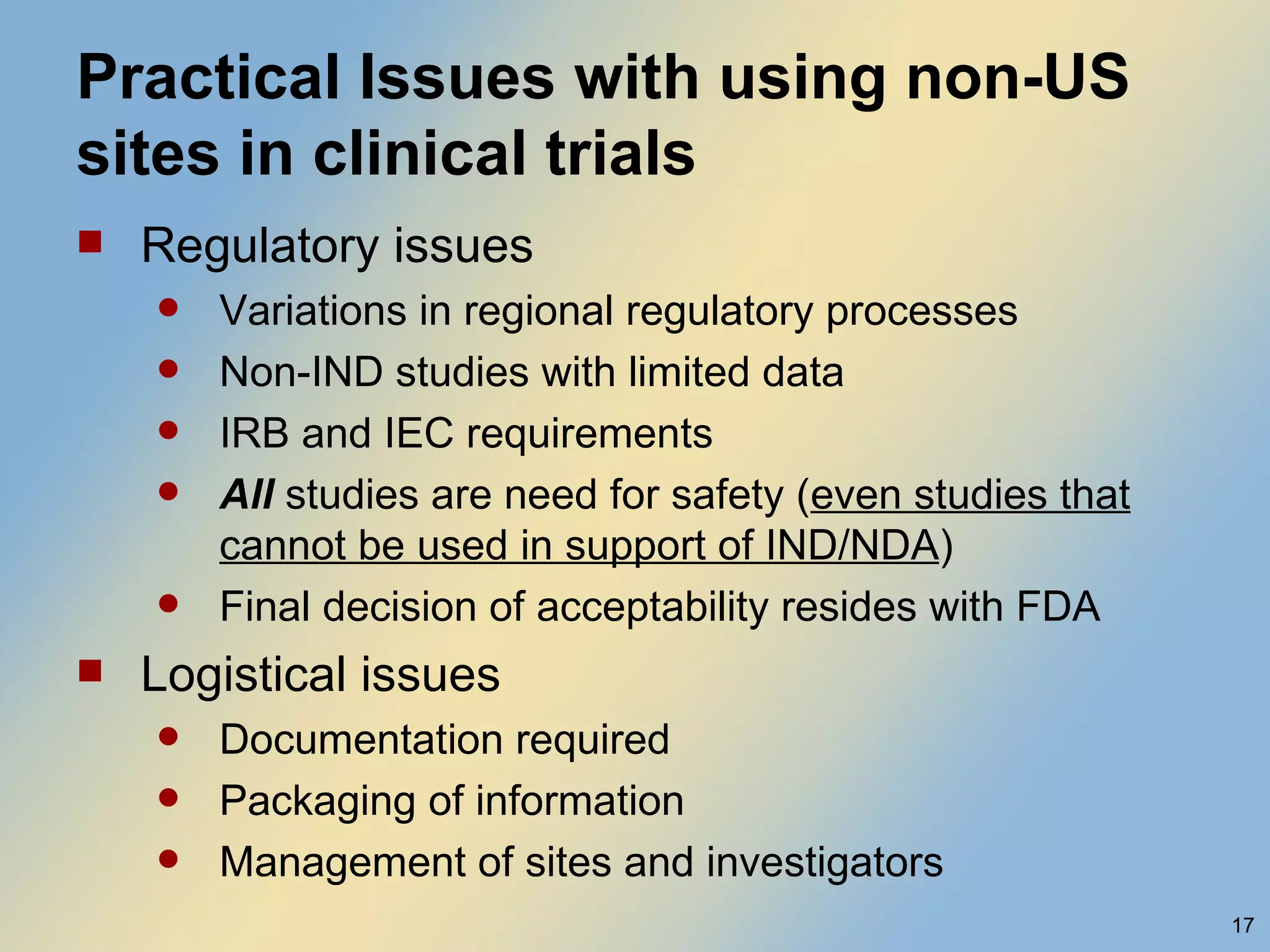
Practical Issues with using non-US sites in clinical trials Regulatory issues Variations in regional regulatory processes Non-IND studies with limited data IRB and IEC requirements All  studies are need for safety ( even studies that cannot be used in support of IND/NDA ) Final decision of acceptability resides with FDA Logistical issues Documentation required  Packaging of information  Management of sites and investigators
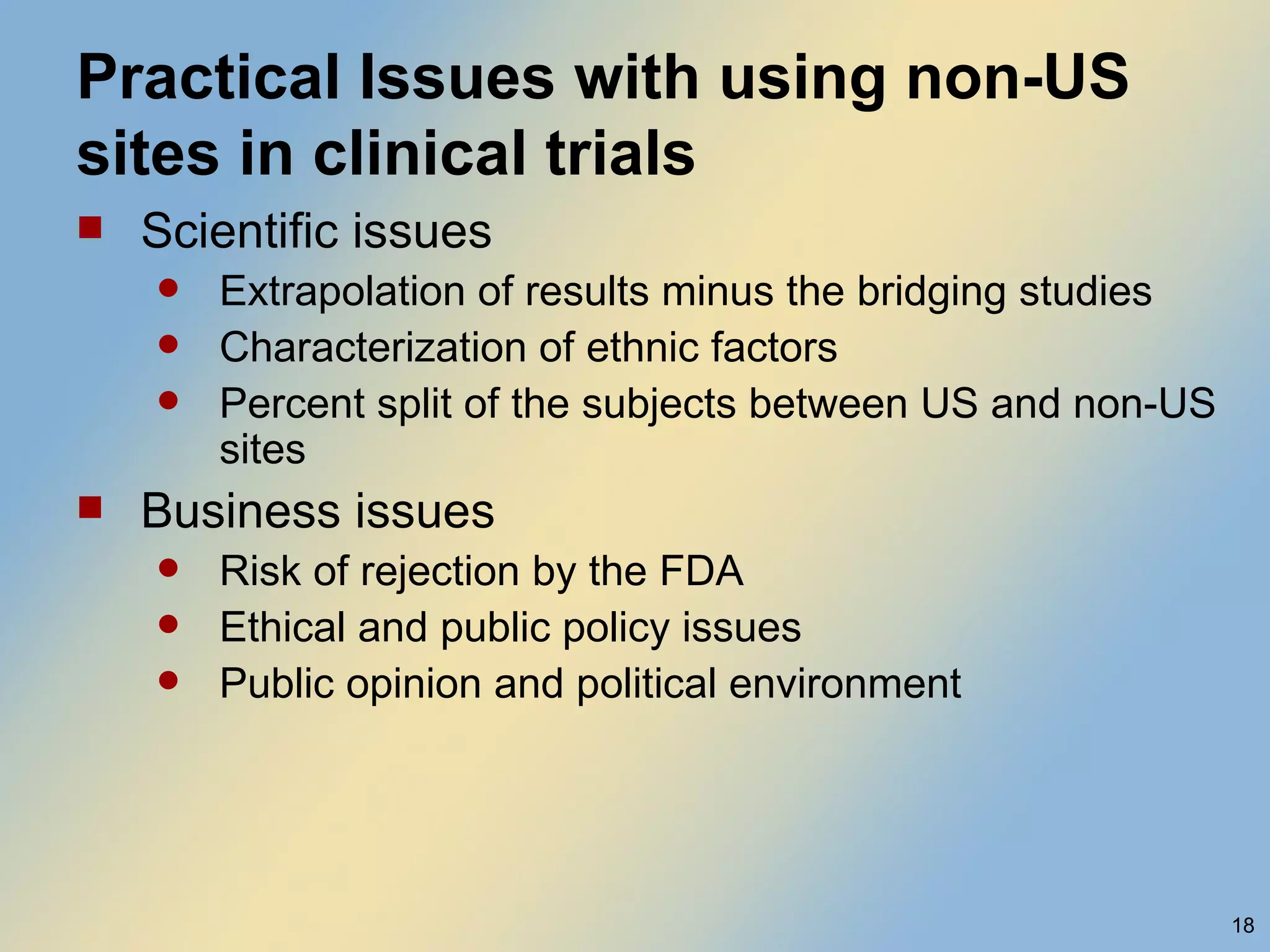
Practical Issues with using non-US sites in clinical trials Scientific issues Extrapolation of results minus the bridging studies Characterization of ethnic factors Percent split of the subjects between US and non-US sites Business issues Risk of rejection by the FDA Ethical and public policy issues Public opinion and political environment
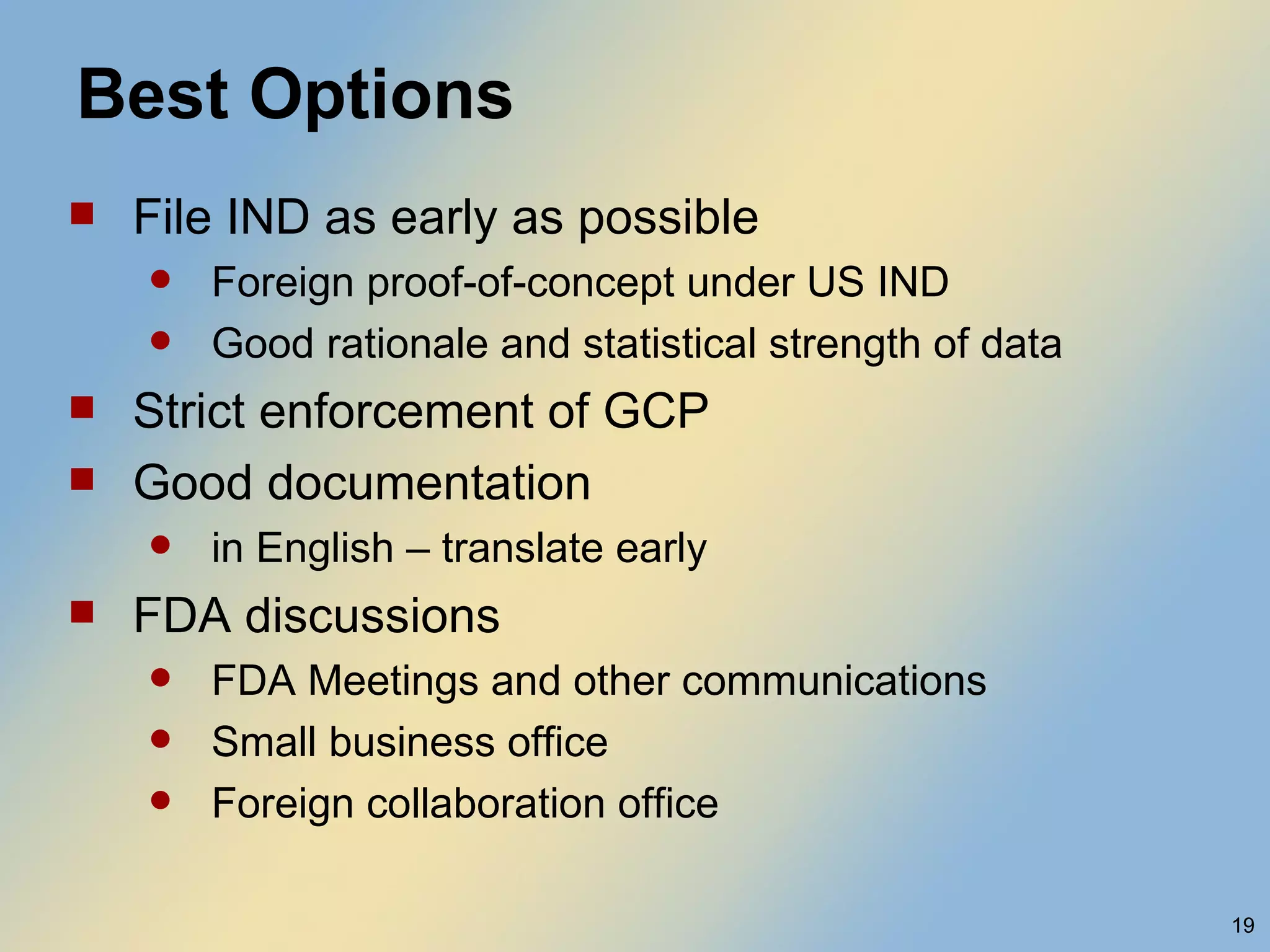
Best Options File IND as early as possible Foreign proof-of-concept under US IND Good rationale and statistical strength of data Strict enforcement of GCP Good documentation  in English – translate early FDA discussions FDA Meetings and other communications Small business office Foreign collaboration office
"It takes 20 years to build a reputation and five minutes to ruin it." Warren Buffett Investor, businessman and philanthropist
Thank You! Questions and Comments  Mukesh Kumar, PhD, RAC Senior Director, Regulatory Affairs Amarex Clinical Research Germantown, MD  20874, USA Tel:  001-240-750-4893 Email:  [email_address]

Fda Acceptance Of Foreign Clinical Trial Data Feb 2009

  • 1.
    A ProductDevelopment Services Company From Lab to Market Approval Regulatory Strategy Strategy Implementation Pre-Clinical Assays Global Clinical Trials Global Regulatory Submissions Contact: Patrick Burke at [email_address] 301-528-7000 Amarex Clinical Research Washington DC metro area
  • 2.
    Thank you! Goalof these Seminars Information sharing Professional Development Networking
  • 3.
    FDA Acceptance of Foreign Clinical Trial Data in INDs and NDA/BLA Mukesh Kumar, PhD, RAC Senior Director, Regulatory Affairs Amarex Clinical Research Germantown, MD 20874, USA Tel: 001-240-750-4893 Email: [email_address]
  • 4.
    Agenda for thisSeminar Legal Aspects Current regulations History of acceptance Practical Aspects Regulatory issues Logistical issues Scientific issues Business issues
  • 5.
    Kinds of ForeignClinical Trails IND studies: Studies partially or completed conducted at foreign sites under a US IND All US IND rules apply Percent split of foreign verses US subjects Non-IND Studies: Studies conducted at foreign sites Foreign sponsors Conditions apply for acceptance
  • 6.
    IND Studies Foreignsites for speed and reduced cost All non-US sites treated same (?) More than 50% of all IND trials have non-US sites More than 40% investigators are non-US Involve FDA supervision and discussions Percent split in study subjects between US and non-US sites Early studies: up to 100% at foreign sites Pivotal studies: statistically justifiable subject split between US and foreign sites Bridging study for extrapolation of results might be needed
  • 7.
    Non-IND Studies Foreignmanufacturers US market not initially intended Product invented/discovered outside the US Used in support of an IND or NDA/BLA Up to 15% of non-IND data
  • 8.
    FDA Acceptance of Foreign Clinical Data Legally acceptable so long as the clinical trials meet the following criteria Good Clinical Practices (ICH E6) Clinical Investigators of recognized Competence Valid Scientific Evidence Applicable to U.S. Population/Medical Practice 21 CFR §312.120 21 CFR § 860.7
  • 9.
    Global Clinical TrialsSource: Clinicaltrials.gov
  • 10.
    Most of FDA-RegisteredInvestigators Are From the Developed Countries Source: Parexel's Bio/Pharmaceutical R&D Statistical Sourcebook 2006/2007 Total No. of Investigators (~23000) Non-US Investigators 9.6% 3.9% 1.3% 1.5% 1.9%
  • 11.
    FDA Guidance DocumentsJune 1998: ICH E5 – Ethnic factors in the acceptability of foreign clinical data Sep. 2006: Clarifications and Q&A April 2008: Foreign clinical studies not conducted under an IND application
  • 12.
    ICH E5: EthnicFactors Ethnic factors Intrinsic: genetic and physiologic Extrinsic: cultural and environmental An ICH guidance for acceptance of data generated in one region in another Avoid duplication of clinical data Characterize effect of ethnic factors on safety, efficacy, dosage and dose regimen Bridging studies for extrapolation of results
  • 13.
    ICH E5: MainElements Complete clinical package Adequate PK, PD, dose response, safety and efficacy GCP clinical trials Population representative of the new region Extrapolation of data to new region Sensitivity to ethnic factors Bridging data: safety and efficacy Sub-set of complete data Bridging clinical study
  • 14.
    Non-IND Clinical StudiesAcceptable if: “Well-designed, well-conducted study conducted in accordance with GCP and FDA ability to audit” Proof of GCP compliance On site audit of complete data Specific clarification and final decisions provided in April 2008 guidance
  • 15.
    Acceptance Criteria fornon-IND studies GCP as defined in ICH E6 Complete data Source data CRFs Quality documents Under the law of the region where study conducted All regions follow GCP Stringent human subject protection
  • 16.
    Acceptance Criteria fornon-IND studies Specific documents required Investigator qualifications Description of research facilities Detailed protocol and results Complete CMC information Scientific rationale and statistical justification of results Name and address of the IEC Summary of IEC decisions Description of informed consent process Incentives to participants Clinical and safety monitoring processes followed Investigator training
  • 17.
    Practical Issues withusing non-US sites in clinical trials Regulatory issues Variations in regional regulatory processes Non-IND studies with limited data IRB and IEC requirements All studies are need for safety ( even studies that cannot be used in support of IND/NDA ) Final decision of acceptability resides with FDA Logistical issues Documentation required Packaging of information Management of sites and investigators
  • 18.
    Practical Issues withusing non-US sites in clinical trials Scientific issues Extrapolation of results minus the bridging studies Characterization of ethnic factors Percent split of the subjects between US and non-US sites Business issues Risk of rejection by the FDA Ethical and public policy issues Public opinion and political environment
  • 19.
    Best Options FileIND as early as possible Foreign proof-of-concept under US IND Good rationale and statistical strength of data Strict enforcement of GCP Good documentation in English – translate early FDA discussions FDA Meetings and other communications Small business office Foreign collaboration office
  • 20.
    "It takes 20years to build a reputation and five minutes to ruin it." Warren Buffett Investor, businessman and philanthropist
  • 21.
    Thank You! Questionsand Comments Mukesh Kumar, PhD, RAC Senior Director, Regulatory Affairs Amarex Clinical Research Germantown, MD 20874, USA Tel: 001-240-750-4893 Email: [email_address]