RBM Change Management –
How TRI can make RBM a reality for your business
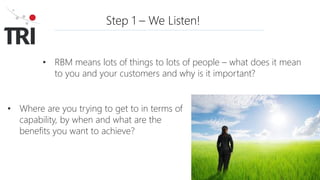
Step 1 – We Listen!
• RBM means lots of things to lots of people – what does it mean
to you and your customers and why is it important?
• Where are you trying to get to in terms of
capability, by when and what are the
benefits you want to achieve?
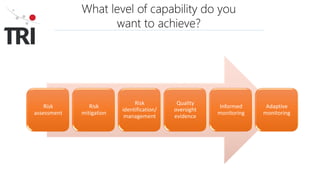
What level of capability do you
want to achieve?
Risk
assessment
Risk
mitigation
Risk
identification/
management
Quality
oversight
evidence
Informed
monitoring
Adaptive
monitoring
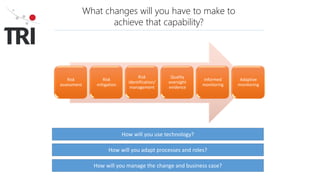
What changes will you have to make to
achieve that capability?
Risk
assessment
Risk
mitigation
Risk
identification/
management
Quality
oversight
evidence
Informed
monitoring
Adaptive
monitoring
How will you use technology?
How will you adapt processes and roles?
How will you manage the change and business case?
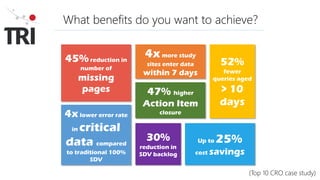
(Top 10 CRO case study)
4xlower error rate
in critical
data compared
to traditional 100%
SDV
45%reduction in
number of
missing
pages 47% higher
Action Item
closure
30%
reduction in
SDV backlog
4xmore study
sites enter data
within 7 days
52%
fewer
queries aged
> 10
days
Up to 25%
cost savings
What benefits do you want to achieve?
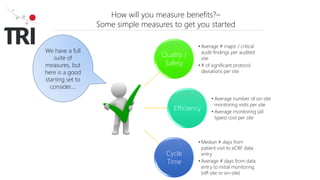
How will you measure benefits?–
Some simple measures to get you started
Quality /
Safety
• Average # major / critical
audit findings per audited
site
• # of significant protocol
deviations per site
Efficiency
• Average number of on-site
monitoring visits per site
• Average monitoring (all
types) cost per site
Cycle
Time
• Median # days from
patient visit to eCRF data
entry
• Average # days from data
entry to initial monitoring
(off-site or on-site)
We have a full
suite of
measures, but
here is a good
starting set to
consider….
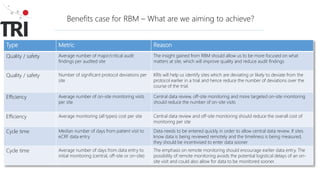
Benefits case for RBM – What are we aiming to achieve?
Type Metric Reason
Quality / safety Average number of major/critical audit
findings per audited site
The insight gained from RBM should allow us to be more focused on what
matters at site, which will improve quality and reduce audit findings
Quality / safety Number of significant protocol deviations per
site
KRIs will help us identify sites which are deviating or likely to deviate from the
protocol earlier in a trial and hence reduce the number of deviations over the
course of the trial.
Efficiency Average number of on-site monitoring visits
per site
Central data review, off-site monitoring and more targeted on-site monitoring
should reduce the number of on-site visits
Efficiency Average monitoring (all types) cost per site Central data review and off-site monitoring should reduce the overall cost of
monitoring per site
Cycle time Median number of days from patient visit to
eCRF data entry
Data needs to be entered quickly in order to allow central data review. If sites
know data is being reviewed remotely and the timeliness is being measured,
they should be incentivised to enter data sooner
Cycle time Average number of days from data entry to
initial monitoring (central, off-site or on-site)
The emphasis on remote monitoring should encourage earlier data entry. The
possibility of remote monitoring avoids the potential logistical delays of an on-
site visit and could also allow for data to be monitored sooner.
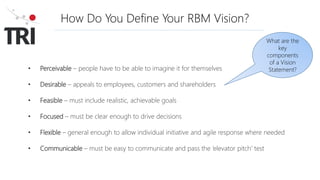
How Do You Define Your RBM Vision?
• Perceivable – people have to be able to imagine it for themselves
• Desirable – appeals to employees, customers and shareholders
• Feasible – must include realistic, achievable goals
• Focused – must be clear enough to drive decisions
• Flexible – general enough to allow individual initiative and agile response where needed
• Communicable – must be easy to communicate and pass the ‘elevator pitch’ test
What are the
key
components
of a Vision
Statement?
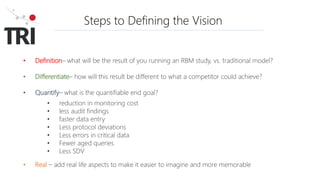
Steps to Defining the Vision
• Definition– what will be the result of you running an RBM study, vs. traditional model?
• Differentiate– how will this result be different to what a competitor could achieve?
• Quantify– what is the quantifiable end goal?
• reduction in monitoring cost
• less audit findings
• faster data entry
• Less protocol deviations
• Less errors in critical data
• Fewer aged queries
• Less SDV
• Real – add real life aspects to make it easier to imagine and more memorable
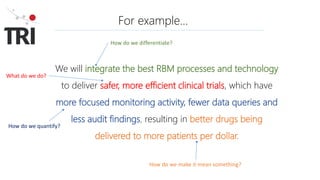
For example…
We will integrate the best RBM processes and technology
to deliver safer, more efficient clinical trials, which have
more focused monitoring activity, fewer data queries and
less audit findings, resulting in better drugs being
delivered to more patients per dollar.
How do we differentiate?
What do we do?
How do we quantify?
How do we make it mean something?
What Next ?
Now we know what you are trying to achieve
in terms of capability, your vision for RBM in
your company and how you intend to
measure the benefits, we need to put a
program of change in place to ensure you
achieve the vision and benefits……
Our Change Management Approach
There are six core challenges in
implementing change,
and four key stages of change….
Our Change Management Approach
The Core Challenges:
1. Defining your vison and case for RBM
2. Designing the processes and technology to deliver
3. Designing your organization structure and roles to deliver
4. Enabling leadership to drive the change
5. Engaging and enabling your staff to change
6. Driving behavioral change to ensure adoption
Our Change Management Approach
The Core Stages:
1. Ensure the organization understands the need
2. Planning for success
3. Delivering the vision and benefits
4. Ensuring longevity
Our Change Management Approach
At each stage the six challenges must be addressed.
This matrix of 24 activities will become your change plan
and take you from vision to benefits realization.
If that sounds like a challenge, it is!
But TRI has done it many times, and we’re here to help……
How Can TRI Help?
• Definition of vision, goals and benefits
• Define change program to meet you needs / timeframe / budget
• Training / guidance on all core aspects of RBM
• Development / update of processes and SOPs
• Support with marketing / positioning to partners / customers
• Implementation of supporting technology
Making Contact
We’d love to hear from you and find out
more about your RBM experiences so far
and where you’d like to be….
www.tritrials.com
info@tritrials.com
TRI RBM Change Management Approach

TRI RBM Change Management Approach

  • 1.
    RBM Change Management– How TRI can make RBM a reality for your business
  • 2.
    Step 1 –We Listen! • RBM means lots of things to lots of people – what does it mean to you and your customers and why is it important? • Where are you trying to get to in terms of capability, by when and what are the benefits you want to achieve?
  • 3.
    What level ofcapability do you want to achieve? Risk assessment Risk mitigation Risk identification/ management Quality oversight evidence Informed monitoring Adaptive monitoring
  • 4.
    What changes willyou have to make to achieve that capability? Risk assessment Risk mitigation Risk identification/ management Quality oversight evidence Informed monitoring Adaptive monitoring How will you use technology? How will you adapt processes and roles? How will you manage the change and business case?
  • 5.
    (Top 10 CROcase study) 4xlower error rate in critical data compared to traditional 100% SDV 45%reduction in number of missing pages 47% higher Action Item closure 30% reduction in SDV backlog 4xmore study sites enter data within 7 days 52% fewer queries aged > 10 days Up to 25% cost savings What benefits do you want to achieve?
  • 6.
    How will youmeasure benefits?– Some simple measures to get you started Quality / Safety • Average # major / critical audit findings per audited site • # of significant protocol deviations per site Efficiency • Average number of on-site monitoring visits per site • Average monitoring (all types) cost per site Cycle Time • Median # days from patient visit to eCRF data entry • Average # days from data entry to initial monitoring (off-site or on-site) We have a full suite of measures, but here is a good starting set to consider….
  • 7.
    Benefits case forRBM – What are we aiming to achieve? Type Metric Reason Quality / safety Average number of major/critical audit findings per audited site The insight gained from RBM should allow us to be more focused on what matters at site, which will improve quality and reduce audit findings Quality / safety Number of significant protocol deviations per site KRIs will help us identify sites which are deviating or likely to deviate from the protocol earlier in a trial and hence reduce the number of deviations over the course of the trial. Efficiency Average number of on-site monitoring visits per site Central data review, off-site monitoring and more targeted on-site monitoring should reduce the number of on-site visits Efficiency Average monitoring (all types) cost per site Central data review and off-site monitoring should reduce the overall cost of monitoring per site Cycle time Median number of days from patient visit to eCRF data entry Data needs to be entered quickly in order to allow central data review. If sites know data is being reviewed remotely and the timeliness is being measured, they should be incentivised to enter data sooner Cycle time Average number of days from data entry to initial monitoring (central, off-site or on-site) The emphasis on remote monitoring should encourage earlier data entry. The possibility of remote monitoring avoids the potential logistical delays of an on- site visit and could also allow for data to be monitored sooner.
  • 8.
    How Do YouDefine Your RBM Vision? • Perceivable – people have to be able to imagine it for themselves • Desirable – appeals to employees, customers and shareholders • Feasible – must include realistic, achievable goals • Focused – must be clear enough to drive decisions • Flexible – general enough to allow individual initiative and agile response where needed • Communicable – must be easy to communicate and pass the ‘elevator pitch’ test What are the key components of a Vision Statement?
  • 9.
    Steps to Definingthe Vision • Definition– what will be the result of you running an RBM study, vs. traditional model? • Differentiate– how will this result be different to what a competitor could achieve? • Quantify– what is the quantifiable end goal? • reduction in monitoring cost • less audit findings • faster data entry • Less protocol deviations • Less errors in critical data • Fewer aged queries • Less SDV • Real – add real life aspects to make it easier to imagine and more memorable
  • 10.
    For example… We willintegrate the best RBM processes and technology to deliver safer, more efficient clinical trials, which have more focused monitoring activity, fewer data queries and less audit findings, resulting in better drugs being delivered to more patients per dollar. How do we differentiate? What do we do? How do we quantify? How do we make it mean something?
  • 11.
    What Next ? Nowwe know what you are trying to achieve in terms of capability, your vision for RBM in your company and how you intend to measure the benefits, we need to put a program of change in place to ensure you achieve the vision and benefits……
  • 12.
    Our Change ManagementApproach There are six core challenges in implementing change, and four key stages of change….
  • 13.
    Our Change ManagementApproach The Core Challenges: 1. Defining your vison and case for RBM 2. Designing the processes and technology to deliver 3. Designing your organization structure and roles to deliver 4. Enabling leadership to drive the change 5. Engaging and enabling your staff to change 6. Driving behavioral change to ensure adoption
  • 14.
    Our Change ManagementApproach The Core Stages: 1. Ensure the organization understands the need 2. Planning for success 3. Delivering the vision and benefits 4. Ensuring longevity
  • 15.
    Our Change ManagementApproach At each stage the six challenges must be addressed. This matrix of 24 activities will become your change plan and take you from vision to benefits realization. If that sounds like a challenge, it is! But TRI has done it many times, and we’re here to help……
  • 16.
    How Can TRIHelp? • Definition of vision, goals and benefits • Define change program to meet you needs / timeframe / budget • Training / guidance on all core aspects of RBM • Development / update of processes and SOPs • Support with marketing / positioning to partners / customers • Implementation of supporting technology
  • 17.
    Making Contact We’d loveto hear from you and find out more about your RBM experiences so far and where you’d like to be…. www.tritrials.com info@tritrials.com