O V E RV I E W
RESULTS BASED STRATEGIC
MANAGEMENT
(c) Francis Loughheed 2016
1
RESULTS BASED MANAGEMENT
• A management strategy by which an organization ensures
that its processes, outputs and services contribute to the
achievement of clearly stated expected accomplishments and
objectives. It is focused on achieving results and improving
performance, integrating lessons learned into management
decisions and monitoring of and reporting on performance.
(UN-MECD)
• A comprehensive, lifecycle approach to management that
integrates strategy, people, resources, processes and
measurements to improve decision-making and drive change.
The approach focuses on getting the right design early in a
process, foussing on outcomes, implementing performance
measurement, learning and changing, and reporting
performance. (TBS)
(c) Francis Loughheed 2016 2
STRATEGIC MANAGEMENT
• An essential tool for organizations to forge a state of
excellence and respond constructively to a rapidly
changing world.
• An ongoing process that integrates strategic planning
with other management systems and links to operational
requirements for service delivery and evaluation. (Strategic
Management in Public and Non-profit Organizations – Jack Koten)
(c) Francis Loughheed 2016 3
RESULTS BASED STRATEGIC
MANAGEMENT
• An ongoing management process that ensures key
business process activities and outputs contribute to
identified strategic and operational impacts and
outcomes.
• A systemic approach to leveraging the strategic and
operational plan to achieve measurable results,
enhancing accountability, promoting broad organizational
alignment of activities, outputs and impacts to improve
overall performance.
(c) Francis Loughheed 2016 4
BENEFITS OF RBSM
• Alignment of strategy, operations and day to day activity
• Informed by performance measurement
• Periodic review and ability to adapt in real time
• Ability to reduce variability, lower costs and enhance
both efficiency and effectiveness
• Enhance transparency, inform decision making and tell a
compelling performance story.
(c) Francis Loughheed 2016 5
Risk
Profile
BP Results
Logic
RESULTS-BASED STRATEGIC MANAGEMENT
Excellence Agenda
Change
Agenda
Sustaining
Agenda
Reporting
Tools
Formal
Planning
Tools
Supporting
Strategies
and
Frameworks
Operational
Plan/Budget
KPI’s and CPMS
Org/Executive Dept./Team
Team/Individua
l
Annual
Updates
Monthly
Tracker
90 Day
Review
Strategic
Plan
90 Day
Planner
Performance
Measurement
Strategy
CI Environment
(c) Francis Loughheed 2016 6
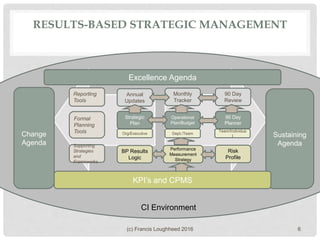
KEY PILLARS OF RBSM
• Excellence Agenda
• The core mandate of the organization and the key success factors that contribute
to sustainability and success.
• Typically service level agreements, key assets, people, core skills and unique
abilities.
• Change Agenda
• Guided by the Vision and requiring Leadership, the Change Agenda are a series
of projects that build new capacity and response –abilities to adapt to changing
business environments.
• Sustaining Agenda
• Guided by the Mission, the sustaining agenda are the “meat and potatoes”
services provided to both internal and external clients that are the core day to day
activities of the organizations that contribute to expected results and outcomes.
• Corporate Performance Measurement System
• Provides the internal navigations system that measures results over time to
assess and provide feedback on the impacts of activities and outputs to corporate
objectives and expected results.
(c) Francis Loughheed 2016 7
SUPPORTING STRATEGIES AND
FRAMEWORKS
• RBSM is built on three key supporting strategies and
frameworks:
• Key Business Process Results Logic
• Using identified Key Business Processes
• A results logic defined for each process
• Key Performance Indicators (KPI’s) were defined for each
• Links to TC Strategic and Program related Outcomes
• Performance Measurement Strategy
• Using the results logic a Performance Measurement Strategy was
defined.
• Is the foundation of the rebuild Business Objects system
• Corporate Risk Profile
• The Corporate Risk Profile can cross walk to the performance
measurement system and the Strategic and Operational Plans
(c) Francis Loughheed 2016 8
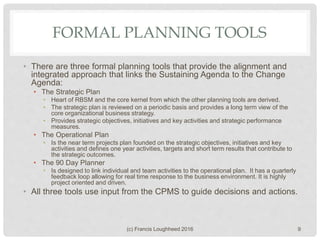
FORMAL PLANNING TOOLS
• There are three formal planning tools that provide the alignment and
integrated approach that links the Sustaining Agenda to the Change
Agenda:
• The Strategic Plan
• Heart of RBSM and the core kernel from which the other planning tools are derived.
• The strategic plan is reviewed on a periodic basis and provides a long term view of the
core organizational business strategy.
• Provides strategic objectives, initiatives and key activities and strategic performance
measures.
• The Operational Plan
• Is the near term projects plan founded on the strategic objectives, initiatives and key
activities and defines one year activities, targets and short term results that contribute to
the strategic outcomes.
• The 90 Day Planner
• Is designed to link individual and team activities to the operational plan. It has a quarterly
feedback loop allowing for real time response to the business environment. It is highly
project oriented and driven.
• All three tools use input from the CPMS to guide decisions and actions.
(c) Francis Loughheed 2016 9
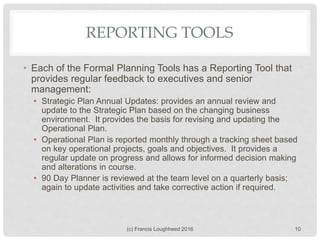
REPORTING TOOLS
• Each of the Formal Planning Tools has a Reporting Tool that
provides regular feedback to executives and senior
management:
• Strategic Plan Annual Updates: provides an annual review and
update to the Strategic Plan based on the changing business
environment. It provides the basis for revising and updating the
Operational Plan.
• Operational Plan is reported monthly through a tracking sheet based
on key operational projects, goals and objectives. It provides a
regular update on progress and allows for informed decision making
and alterations in course.
• 90 Day Planner is reviewed at the team level on a quarterly basis;
again to update activities and take corrective action if required.
(c) Francis Loughheed 2016 10
RESULTS
• The creation of a core system that Executives and
Senior Managers can use to align their activities,
projects and outputs to contribute to strategic objectives
and corporate impacts.
• As all good management systems – it needs an owner.
• The role of the process owner is to ensure that all of the
elements of the RBSM are functioning, aligned and
updated as required.
(c) Francis Loughheed 2016 11

Results Based Strategic Management Overview

  • 1.
    O V ERV I E W RESULTS BASED STRATEGIC MANAGEMENT (c) Francis Loughheed 2016 1
  • 2.
    RESULTS BASED MANAGEMENT •A management strategy by which an organization ensures that its processes, outputs and services contribute to the achievement of clearly stated expected accomplishments and objectives. It is focused on achieving results and improving performance, integrating lessons learned into management decisions and monitoring of and reporting on performance. (UN-MECD) • A comprehensive, lifecycle approach to management that integrates strategy, people, resources, processes and measurements to improve decision-making and drive change. The approach focuses on getting the right design early in a process, foussing on outcomes, implementing performance measurement, learning and changing, and reporting performance. (TBS) (c) Francis Loughheed 2016 2
  • 3.
    STRATEGIC MANAGEMENT • Anessential tool for organizations to forge a state of excellence and respond constructively to a rapidly changing world. • An ongoing process that integrates strategic planning with other management systems and links to operational requirements for service delivery and evaluation. (Strategic Management in Public and Non-profit Organizations – Jack Koten) (c) Francis Loughheed 2016 3
  • 4.
    RESULTS BASED STRATEGIC MANAGEMENT •An ongoing management process that ensures key business process activities and outputs contribute to identified strategic and operational impacts and outcomes. • A systemic approach to leveraging the strategic and operational plan to achieve measurable results, enhancing accountability, promoting broad organizational alignment of activities, outputs and impacts to improve overall performance. (c) Francis Loughheed 2016 4
  • 5.
    BENEFITS OF RBSM •Alignment of strategy, operations and day to day activity • Informed by performance measurement • Periodic review and ability to adapt in real time • Ability to reduce variability, lower costs and enhance both efficiency and effectiveness • Enhance transparency, inform decision making and tell a compelling performance story. (c) Francis Loughheed 2016 5
  • 6.
    Risk Profile BP Results Logic RESULTS-BASED STRATEGICMANAGEMENT Excellence Agenda Change Agenda Sustaining Agenda Reporting Tools Formal Planning Tools Supporting Strategies and Frameworks Operational Plan/Budget KPI’s and CPMS Org/Executive Dept./Team Team/Individua l Annual Updates Monthly Tracker 90 Day Review Strategic Plan 90 Day Planner Performance Measurement Strategy CI Environment (c) Francis Loughheed 2016 6
  • 7.
    KEY PILLARS OFRBSM • Excellence Agenda • The core mandate of the organization and the key success factors that contribute to sustainability and success. • Typically service level agreements, key assets, people, core skills and unique abilities. • Change Agenda • Guided by the Vision and requiring Leadership, the Change Agenda are a series of projects that build new capacity and response –abilities to adapt to changing business environments. • Sustaining Agenda • Guided by the Mission, the sustaining agenda are the “meat and potatoes” services provided to both internal and external clients that are the core day to day activities of the organizations that contribute to expected results and outcomes. • Corporate Performance Measurement System • Provides the internal navigations system that measures results over time to assess and provide feedback on the impacts of activities and outputs to corporate objectives and expected results. (c) Francis Loughheed 2016 7
  • 8.
    SUPPORTING STRATEGIES AND FRAMEWORKS •RBSM is built on three key supporting strategies and frameworks: • Key Business Process Results Logic • Using identified Key Business Processes • A results logic defined for each process • Key Performance Indicators (KPI’s) were defined for each • Links to TC Strategic and Program related Outcomes • Performance Measurement Strategy • Using the results logic a Performance Measurement Strategy was defined. • Is the foundation of the rebuild Business Objects system • Corporate Risk Profile • The Corporate Risk Profile can cross walk to the performance measurement system and the Strategic and Operational Plans (c) Francis Loughheed 2016 8
  • 9.
    FORMAL PLANNING TOOLS •There are three formal planning tools that provide the alignment and integrated approach that links the Sustaining Agenda to the Change Agenda: • The Strategic Plan • Heart of RBSM and the core kernel from which the other planning tools are derived. • The strategic plan is reviewed on a periodic basis and provides a long term view of the core organizational business strategy. • Provides strategic objectives, initiatives and key activities and strategic performance measures. • The Operational Plan • Is the near term projects plan founded on the strategic objectives, initiatives and key activities and defines one year activities, targets and short term results that contribute to the strategic outcomes. • The 90 Day Planner • Is designed to link individual and team activities to the operational plan. It has a quarterly feedback loop allowing for real time response to the business environment. It is highly project oriented and driven. • All three tools use input from the CPMS to guide decisions and actions. (c) Francis Loughheed 2016 9
  • 10.
    REPORTING TOOLS • Eachof the Formal Planning Tools has a Reporting Tool that provides regular feedback to executives and senior management: • Strategic Plan Annual Updates: provides an annual review and update to the Strategic Plan based on the changing business environment. It provides the basis for revising and updating the Operational Plan. • Operational Plan is reported monthly through a tracking sheet based on key operational projects, goals and objectives. It provides a regular update on progress and allows for informed decision making and alterations in course. • 90 Day Planner is reviewed at the team level on a quarterly basis; again to update activities and take corrective action if required. (c) Francis Loughheed 2016 10
  • 11.
    RESULTS • The creationof a core system that Executives and Senior Managers can use to align their activities, projects and outputs to contribute to strategic objectives and corporate impacts. • As all good management systems – it needs an owner. • The role of the process owner is to ensure that all of the elements of the RBSM are functioning, aligned and updated as required. (c) Francis Loughheed 2016 11