Lean Midland Forum
16 October 2013
Education Centre, Good Hope Hospital
For more information, please email help@leanlondon.org.uk or telephone 0207 824 8448
- 2 -
Confidential not to be used without consent
We have some broad aims of the forum
•  Create the environment where Lean Solutions in the NHS
are shared, discussed and acted upon by practitioners in
the health service
•  Engage in a debate about strengths and weakness of
lean/service improvement methods in the current NHS
climate
–  The QIPP agenda in reducing costs across the health system
–  Clinical Commissioning Groups that will redefine ‘end to end’ health systems
processes
•  To network with colleagues and friends
- 3 -
Confidential not to be used without consent
Agenda
•  1800 - 1810 Welcome and introductions
•  1810 - 1835 “Improvement; Infection; Impossible? – Dr Mathew Diggle
(Consultant, Nottingham University Hospitals NHS Trust)
•  1835 - 1900 “How effective use of SPC in the NHS results in better
decision making” – Mike Davidge (Director, NHS Elect)
•  1900 - 1930 Hot seat session
•  1930 - 2000 Networking and drinks
Where?	
  	
  
Clinical	
  Microbiology	
  Department	
  
No7ngham	
  University	
  Hospitals	
  NHS	
  Trust	
  
Queens	
  Medical	
  Centre	
  
Derby	
  Road	
  
No7ngham	
  
UK	
  
NG7	
  2UH	
  
hFp://www.nuh.nhs.uk/microbiology/	


The	
  No7ngham	
  Experience	
  
• 	
  DiagnosOc	
  service:	
  24/7,	
  365	
  days	
  per	
  year	
  
• 	
  PopulaOon	
  served:	
  >2.5	
  million	
  (>	
  5	
  million)	
  
• 	
  Workload:	
  970,000	
  pa	
  (>	
  1.8	
  Million)	
  
• 	
  IsolaOon,	
  idenOficaOon	
  and	
  detecOon	
  of	


• 	


  medically	
  important	
  bacteria,	
  
• 	


  viruses	
  and	
  parasites.	
  
And now for
something
completely
different...
NHS	
  Improvement	
  -­‐	
  EM	
  SHA	
  Microbiology	
  Sites	
  
LEAN?
LEAN
Microbiology
What	
  the…………….	
  
The	
  Path-­‐ology	
  
The	
  Project	
  
Challenges	


•  CollaboraOons	


•  ConsolidaOon	


•  CompeOOon	


The	
  “C”s……….	
  	
  
The	
  No7ngham	
  Experience	
  
Challenges	


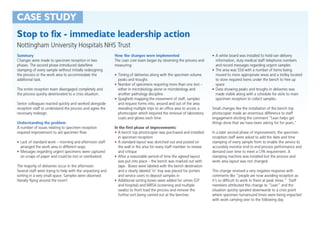
•  Developing	
  a	
  lean	
  culture	
  
•  Find	
  a	
  champion	
  	
  
•  Engagement	
  of	
  your	
  staff	
  
•  What	
  is	
  engagement?	
  
•  CommunicaOon	
  
•  While	
  under	
  a	
  seize	
  mentality	
  	
  
h:p://www.improvement.nhs.uk/documents/Microbiology_Guide.pdf	
  
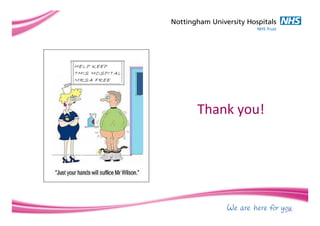
Thank	
  you!
How effective use of SPC in the NHS
results in better decision making
Mike Davidge
How	
  we	
  assess	
  performance:	
  
RAG	
  raGngs	
  
Sep 11 Oct11 Nov11 Dec 11 Jan12 Feb 12 Mar12 Apr12 May12 Jun12 Jul12 Aug 12
90 97 77 93 76 84 76 89 84 84 93 70
Why has performance deteriorated so badly in August 2012? What decision
are you going to make?
Indicator	
  
YTD	
  Perf	
  
Vs	
  Target
Perf	
  	
  Trend	
  -­‐
Sustainability	
  	
  
(latest	
  3mths)
ExcepOon	
  	
  
Report	
  	
  
Produced
Perf View on
Quality
of Plan
Improve-­‐	
  
Date	
  set	
  by	
  	
  
Owner/In-­‐Month	
  	
  
Performance
Target	
  	
  
Owner
Risks/Comments	
  and	
  
likely	
  delivery	
  against	
  	
  
Improvement	
  date	
  
PosiOon	
  vs.	
  
last	
  month	
  &	
  
PMO	
  Monitor
NoF	
   G G Not required Not required G CH
Patient Safety
Perf Notice Rec
Loss of Income in 2012
Improvement Date
slippage
A	
  &	
  E	
  
-­‐	
  4	
  hours	
  
R R G Not required G CH
Patient Safety
Perf Notice Rec
Loss of income in
2013/14
A	
  &	
  E	
  
-­‐	
  CQIs	
  
A A G A A CH
Patient Safety
Perf Notice Rec
Loss of Income in
2013/14
CQC visits
Regulatory issues
Stroke	
  Unit	
  
-­‐	
  90%	
  
G G Not required Not required R CH
Patient Safety
Increased risk of perf
measures. Feb has met
target – and sustained
HSMR	
   G G Not required Not required Not Req’d RC-H
CDiff	
   A A G Not required R CO
Patient Safety
CQC/Regulatory Issues
Performance Overview – April 2013
Follow	
  up	
  metric	
  
Monito
r Q1
Return
Monito
r Q2
Return
Dec
Monito
r Q3
Return
Jan Feb RAG
YTD
Target
YTD
Actual
YTD
RAG &
12
month
Trend
l 95% 96.7% Ç96.7% 96.2% 97.4% 96.5% 96.9% 97.6%
Indicator
description
2012 /13
Annual/Year
end Target
Receiving follow up within
7 days of discharge (all
discharges)
95%
What you get presented with
What do you decide to do?
A&E	
  performance	
  
Area	
  
•  Minor	
  aFendances	
  
•  Thursdays	
  
•  Q3	
  2004/05	
  
Performance	
  
•  96.9%	
  seen	
  and	
  discharged	
  
within	
  4	
  hours	
  
Verdict: Ok?
How long
does it take
you to get to
work? How many patients need a
home visit today?
How long does it take
to take a patients
BP?
In	
  the	
  real	
  world,	
  everything	
  varies....	
  
What’s	
  a	
  person’s	
  normal	
  
body	
  temperature?	
  
“Data contains both signal and
noise. To be able to extract
information, one must separate
the signal from the noise within
the data.”
Walter Shewhart
There	
  are	
  two	
  types	
  of	
  variaGon	
  
While	
  every	
  process	
  displays	
  variaOon:	
  
•  some	
  processes	
  display	
  controlled	
  	
  
variaOon	
  (common	
  cause)	
  
–  Stable	
  pa)ern	
  of	
  varia0on	
  =	
  noise	
  
–  constant	
  causes/	
  “chance”	
  
•  while	
  others	
  display	
  uncontrolled	
  variaOon	
  
–  pa)ern	
  changes	
  over	
  0me	
  =	
  signal	
  
–  special	
  cause	
  varia0on/“assignable”	
  cause	
  eg	
  infec0on	
  or	
  
hypothermia	
  
We should display data in a way that shows which is present
Control charts
• Plot data in time order
• Calculate and display mean as a line and
control limits as lines
• Analyse chart by studying how values fall
around mean and between control limits
Control	
  charts	
  
SPC	
  chart	
  of	
  RAG	
  score	
  
Sep 11 Oct11 Nov11 Dec 11 Jan12 Feb 12 Mar12 Apr12 May12 Jun12 Jul12 Aug 12
90 97 77 93 76 84 76 89 84 84 93 70
Indicator	
  
YTD	
  Perf	
  
Vs	
  Target
Perf	
  	
  Trend	
  -­‐
Sustainability	
  	
  
(latest	
  3mths)
ExcepOon	
  	
  
Report	
  	
  
Produced
Perf View on
Quality
of Plan
Improve-­‐	
  
Date	
  set	
  by	
  	
  
Owner/In-­‐Month	
  	
  
Performance
Target	
  	
  
Owner
Risks/Comments	
  and	
  
likely	
  delivery	
  against	
  	
  
Improvement	
  date	
  
PosiOon	
  vs.	
  
last	
  month	
  &	
  
PMO	
  Monitor
NoF	
   G G Not required Not required G CH
Patient Safety
Perf Notice Rec
Loss of Income in 2012
Improvement Date
slippage
A	
  &	
  E	
  
-­‐	
  4	
  hours	
  
R R G Not required G CH
Patient Safety
Perf Notice Rec
Loss of income in
2013/14
A	
  &	
  E	
  
-­‐	
  CQIs	
  
A A G A A CH
Patient Safety
Perf Notice Rec
Loss of Income in
2013/14
CQC visits
Regulatory issues
Stroke	
  Unit	
  
-­‐	
  90%	
  
G G Not required Not required R CH
Patient Safety
Increased risk of perf
measures. Feb has met
target – and sustained
HSMR	
   G G Not required Not required Not Req’d RC-H
CDiff	
   A A G Not required R CO
Patient Safety
CQC/Regulatory Issues
Performance Overview – April 2013
Not	
  so	
  peachy	
  
Apr2012
May2012
Jun2012
Jul2012
Aug2012
Sep2012
Oct2012
Nov2012
Dec2012
Jan2013
Feb2013
Mar2013
Apr2013
Month
50
60
70
80
90
100
percentage % patients achieving 90% time in stroke unit
BaseLine
Verdict
Stable within
limits
(66 -100)
Not Capable of
achieving
target
Apr2012
May2012
Jun2012
Jul2012
Aug2012
Sep2012
Oct2012
Nov2012
Dec2012
Jan2013
Feb2013
Months
90
92
94
96
98
100
102
104
Percent Receiving follow up within 7 days of discharge
BaseLine
Verdict
Stable within
limits
(93 -100)
Not Capable of
achieving
target
Monito
r Q1
Return
Monito
r Q2
Return
Dec
Monito
r Q3
Return
Jan Feb RAG
YTD
Target
YTD
Actual
YTD
RAG &
12
month
Trend
l 95% 96.7% Ç96.7% 96.2% 97.4% 96.5% 96.9% 97.6%
Indicator
description
2012 /13
Annual/Year
end Target
Receiving follow up within
7 days of discharge (all
discharges)
95%
A&E	
  –	
  the	
  real	
  situaGon	
  
0
200
400
600
800
1000
1200
0
6
/0
1
0
0
:1
2
0
6
/0
1
1
2
:1
2
0
6
/0
1
1
8
:3
6
1
3
/0
1
1
0
:1
8
1
3
/0
1
1
5
:5
1
1
3
/0
1
2
3
:0
2
2
0
/0
1
1
1
:1
0
2
0
/0
1
1
6
:4
7
2
7
/0
1
0
0
:0
2
2
7
/0
1
1
2
:2
2
2
7
/0
1
1
8
:4
4
0
3
/0
2
0
9
:1
1
0
3
/0
2
1
5
:3
0
0
3
/0
2
2
2
:4
8
1
0
/0
2
1
1
:4
6
1
0
/0
2
1
7
:2
0
1
7
/0
2
0
3
:0
8
1
7
/0
2
1
3
:4
6
1
7
/0
2
1
8
:3
1
2
4
/0
2
0
4
:3
7
2
4
/0
2
1
4
:0
8
2
4
/0
2
2
1
:2
9
0
3
/0
3
1
2
:1
7
0
3
/0
3
1
9
:2
6
1
0
/0
3
0
9
:3
3
1
0
/0
3
1
6
:0
1
1
0
/0
3
2
2
:3
9
1
7
/0
3
1
1
:1
5
1
7
/0
3
1
6
:3
3
1
7
/0
3
2
1
:3
1
2
4
/0
3
1
2
:0
9
2
4
/0
3
1
8
:4
3
3
1
/0
3
0
7
:5
7
3
1
/0
3
1
5
:0
0
Time in A&E department Jan-Mar 2005
Infirmary : Minor attendance : Thursday
Time in
Dept
Average
(01:50)
LCL
(00:00)
UCL
(05:05)
4 hr target
The	
  two	
  types	
  of	
  mistake	
  
Mistake	
  One	
  
•  InterpreOng	
  the	
  rouOne	
  variaOon	
  of	
  noise	
  as	
  if	
  it	
  amounted	
  to	
  a	
  
signal	
  of	
  a	
  change	
  in	
  the	
  underlying	
  process,	
  thereby	
  sounding	
  a	
  
false	
  alarm.	
  	
  
[false	
  posiOve]	
  
Mistake	
  Two	
  
•  Thinking	
  that	
  a	
  signal	
  of	
  a	
  change	
  in	
  the	
  underlying	
  process	
  is	
  
merely	
  the	
  noise	
  of	
  rouOne	
  variaOon,	
  thereby	
  missing	
  a	
  signal.	
  
[false	
  negaOve]	
  
SPC	
  –	
  do	
  it	
  right	
  
•  Use	
  the	
  correct	
  way	
  of	
  determining	
  the	
  measure	
  of	
  
variaOon	
  
•  Use	
  the	
  correct	
  mulOple	
  of	
  variaOon	
  to	
  derive	
  the	
  control	
  
limits	
  
•  Don’t	
  exclude	
  data	
  points	
  just	
  because	
  they’re	
  ‘odd’	
  
Using	
  the	
  wrong	
  calculaGon	
  
0
100
200
300
400
500
600
700
800
0
2
A
p
r
1
2
3
0
A
p
r
1
2
2
8
M
a
y
1
2
2
5
Ju
n
1
2
2
3
Ju
l1
2
2
0
A
u
g
1
2
1
7
S
e
p
1
2
1
5
O
ct
1
2
1
2
N
o
v
1
2
1
0
D
e
c
1
2
0
7
Ja
n
1
3
0
4
F
e
b
1
3
0
4
M
a
r
1
3
N
u
m
b
e
r
A&E 4 hr breaches
52 weeks from 2 April 2012
St Elsewhere's Hospital
A&E 4 hr breaches Average (497.9) Lower limit (340.8) Upper limit (655.0)
Shaded area
using standard
deviation
statistic gives
lower limit if 272
and upper limit
of 723
Using	
  the	
  wrong	
  limits	
  
01Apr2012
01May2012
01Jun2012
01Jul2012
01Aug2012
01Sep2012
01Oct2012
01Nov2012
01Dec2012
01Jan2013
01Feb2013
Months
0
10
20
30
40
50
60
70
80
Number Delayed transfers of care
BaseLine
2 sigma
limits
IniGal	
  chart	
  with	
  special	
  causes	
  flagged	
  
01/10/2012
08/10/2012
15/10/2012
22/10/2012
29/10/2012
05/11/2012
12/11/2012
19/11/2012
26/11/2012
03/12/2012
10/12/2012
17/12/2012
24/12/2012
Week
0
50
100
150
200
250
300
350
400
Hours Weekly referral hours into MRI
BaseLine
Average and
limits driven by 2
final data points
that are very
low. Should we
exclude them?
Modified	
  chart	
  
01/10/2012
08/10/2012
15/10/2012
22/10/2012
29/10/2012
05/11/2012
12/11/2012
19/11/2012
26/11/2012
03/12/2012
10/12/2012
17/12/2012
24/12/2012
Week
0
50
100
150
200
250
300
350
400
Hours Weekly referral hours into MRI
BaseLine
A	
  proper	
  RAG	
  status	
  
•  Green	
  =	
  stable	
  and	
  capable	
  i.e.	
  no	
  special	
  causes	
  and	
  
process	
  limits	
  within	
  specificaOon	
  limits	
  
–  Ac0on:	
  masterly	
  inac0vity	
  and	
  catlike	
  observa0on	
  
•  Amber	
  =	
  unstable	
  i.e.	
  special	
  causes	
  
–  Ac0on:	
  inves0gate	
  special	
  causes,	
  diagnose	
  and	
  treat	
  with	
  a	
  
countermeasure.	
  
•  Red	
  =	
  stable	
  but	
  incapable	
  i.e.	
  no	
  special	
  causes	
  and	
  
process	
  limits	
  outside	
  specificaOon	
  limits	
  
–  Ac0on:	
  improve	
  or	
  redesign	
  depending	
  on	
  level	
  of	
  experience/
skill	
  
My	
  final	
  slide:	
  Shipman	
  
Source: Malcolm Gall in The Times, 1
February 2000	

Taken from “Bristol, Shipman and clinical
governance: Shewhart’s forgotten lessons”
Mohammed et all, The Lancet, volume 357,
2001
•  Focus on Value from a Customer (Patient) point of view on every step of
process
•  Obsession on removing waste within the ‘whole system’
•  Bottom up approach in identifying value and waste – assumption that
much of waste and value is hidden
•  A true lean system would “flow” and need little command and control
Recap – What is Lean?
- 45 -
Confidential not to be used without consent
What’s Next?
•  Today’s presentation and feedback survey sent out by email within
72 hours
•  The Next Lean Midland Forum will be held on 26 February 2014.
–  Register at www.leanmidland.org.uk
–  We will send out reminders to all participants from today
–  We have a Lean London Forum on 5 March 2014 taking place in London. Register at
www.leanlondon.org.uk
–  If you’d like to take up one of our presentation slots, please do let us know. We are
keen to hear from Community Trust and GP Groups
•  Find us on and - LeanNHS
- 46 -
Confidential not to be used without consent
Past Presentations at the Forum
http://kinetik.uk.com/pdf/Lean
London.pdf
1. The 'Leaning' of Bedford Hospital - the story so far, Susan
Whittaker, Bedford Hospital
2. Future Developments in Lean, Rob Worth, Kinetik Solutions
3. Transformation of Camberwell Sexual Health Centre, Rachel
Paxford-Jenkins, Camberwell Sexual Heath Centre
4. Building Lean Expertise, Daniel McDonald, Lean Executives
5. Use of Data in Lean Projects, Andrew Castle
http://kinetik.uk.com/pdf/
Lean_London_Sep_09_web.pdf
1. Radiology Lean Review - The Journey has begun, Carol Darnell,
Bedford Hospital Trust
2. Recruiting for the Lean & Service Transformation, Daniel
McDonald, Lean Executives
3. Lean and Systems Thinking, Rob Worth, Kinetik Solutions
4. Don't water your weeds - starting afresh with Lean, Ian Greddor,
Cyril Swett
http://kinetik.uk.com/pdf/Lean
London_Feb.pdf
1. Challenges in Implementing Lean - A Clinical Perspective, Dr
Ahmed Chekairi, Whittington Hospital
2. A Better Definition of 'Value' in Lean, Ketan Varia, Kinetik Solutions
3. Lean in the pharmaceutical drugs supply process, Niall Ferguson,
Milton Keynes Hospital
- 47 -
Confidential not to be used without consent
Past Presentations at the Forum
http://kinetik.uk.com/pdf/
leanlondon_sep11.pdf
1. Transforming Surgical Productivity, Christopher Kennedy, Guy's
& St Thomas NHS Foundation Trust
2. Transforming Treatment Rooms, Dr Rebecca Hewitson, The
Whittington Hospital NHS Trust
http://kinetik.uk.com/pdf/
leanlondon_mar12_presentation.
pdf
1. The Path-ology to Lean Thinking - Dr Mathew Diggle,
Nottingham Hospital Trust & Suzanne Horobin, NHS Improvement -
Diagnostics
2. Pre-Operative Health Evaluation - Engagement with Primary
Care, Dr Ahmed Chekairi, Whittington Hospital
http://kinetik.uk.com/pdf/
leanmidland0712.pdf
1. How many appointments do we need to make?, Kate Silvester,
South Warwickshire NHS Trust
2. The Path-ology to Lean Thinking - Dr Mathew Diggle,
Nottingham Hospital Trust
- 48 -
Confidential not to be used without consent
Past Presentations at the Forum
http://kinetik.uk.com/pdf/
leanlondon_sep12.pdf
1. Sleek & Slim Hearing for Children - Dr Sebastian Hendrick, Barnet
& Chase Farm Hospital
2. Developing value through transformation of care - What does it
take?, Peter Lachman, Great Ormond Hospital
http://kinetik.uk.com/pdf/
kinetik_dec_12.pdf
1. Network Improvement Services in Tower Hamlets, Florence Cantle,
Tower Hamlets NHS Trust
2. Using improvement science in Ambulatory Care, Simon Dodds,
Heart of England Trust
http://kinetik.uk.com/pdf/Lean
Midland_June11.pdf
1. Lean Transformation at Bedford Hospital, Susan Whittaker, Bedford
Hospital
2. How do drive change by understanding patient value?, Ketan Varia,
Kinetik Solutions
3. Global Lean Knowledge: The Effects of Culture, Maria Gilgeous,
Kinetik Solutions
http://kinetik.uk.com/pdf/
leanlondon_19sep13.pdf
1. Takeing a new look at your service - "Lean" a process approach to
change, Pauline Connor, North Middlesex University Hospital Trust
2. "Improvement; Infestion; Impossible?", Dr Mathew Diggle,
Nottingham University Hospital Trust
- 49 -
Confidential not to be used without consent
Big Thanks To Our Presenters
Dr Mathew Diggle
Mr Mike Davidge
..and to you all for attending
- 50 -
Confidential not to be used without consent
Thanks to Our Sponsors
Assisting with Lean Transformations
in the health sector and beyond
www.kinetik.uk.com

Lean midland presentation-161013

  • 1.
    Lean Midland Forum 16October 2013 Education Centre, Good Hope Hospital For more information, please email help@leanlondon.org.uk or telephone 0207 824 8448
  • 2.
    - 2 - Confidentialnot to be used without consent We have some broad aims of the forum •  Create the environment where Lean Solutions in the NHS are shared, discussed and acted upon by practitioners in the health service •  Engage in a debate about strengths and weakness of lean/service improvement methods in the current NHS climate –  The QIPP agenda in reducing costs across the health system –  Clinical Commissioning Groups that will redefine ‘end to end’ health systems processes •  To network with colleagues and friends
  • 3.
    - 3 - Confidentialnot to be used without consent Agenda •  1800 - 1810 Welcome and introductions •  1810 - 1835 “Improvement; Infection; Impossible? – Dr Mathew Diggle (Consultant, Nottingham University Hospitals NHS Trust) •  1835 - 1900 “How effective use of SPC in the NHS results in better decision making” – Mike Davidge (Director, NHS Elect) •  1900 - 1930 Hot seat session •  1930 - 2000 Networking and drinks
  • 5.
    Where?     Clinical  Microbiology  Department   No7ngham  University  Hospitals  NHS  Trust   Queens  Medical  Centre   Derby  Road   No7ngham   UK   NG7  2UH   hFp://www.nuh.nhs.uk/microbiology/    
  • 6.
    The  No7ngham  Experience   •   DiagnosOc  service:  24/7,  365  days  per  year   •   PopulaOon  served:  >2.5  million  (>  5  million)   •   Workload:  970,000  pa  (>  1.8  Million)   •   IsolaOon,  idenOficaOon  and  detecOon  of           •           medically  important  bacteria,   •           viruses  and  parasites.  
  • 7.
  • 8.
    NHS  Improvement  -­‐  EM  SHA  Microbiology  Sites  
  • 9.
  • 10.
  • 11.
  • 13.
  • 14.
  • 16.
    Challenges       •  CollaboraOons     •  ConsolidaOon     •  CompeOOon       The  “C”s……….    
  • 17.
    The  No7ngham  Experience   Challenges       •  Developing  a  lean  culture   •  Find  a  champion     •  Engagement  of  your  staff   •  What  is  engagement?   •  CommunicaOon   •  While  under  a  seize  mentality    
  • 18.
  • 20.
  • 21.
    How effective useof SPC in the NHS results in better decision making Mike Davidge
  • 22.
    How  we  assess  performance:   RAG  raGngs   Sep 11 Oct11 Nov11 Dec 11 Jan12 Feb 12 Mar12 Apr12 May12 Jun12 Jul12 Aug 12 90 97 77 93 76 84 76 89 84 84 93 70 Why has performance deteriorated so badly in August 2012? What decision are you going to make?
  • 23.
    Indicator   YTD  Perf   Vs  Target Perf    Trend  -­‐ Sustainability     (latest  3mths) ExcepOon     Report     Produced Perf View on Quality of Plan Improve-­‐   Date  set  by     Owner/In-­‐Month     Performance Target     Owner Risks/Comments  and   likely  delivery  against     Improvement  date   PosiOon  vs.   last  month  &   PMO  Monitor NoF   G G Not required Not required G CH Patient Safety Perf Notice Rec Loss of Income in 2012 Improvement Date slippage A  &  E   -­‐  4  hours   R R G Not required G CH Patient Safety Perf Notice Rec Loss of income in 2013/14 A  &  E   -­‐  CQIs   A A G A A CH Patient Safety Perf Notice Rec Loss of Income in 2013/14 CQC visits Regulatory issues Stroke  Unit   -­‐  90%   G G Not required Not required R CH Patient Safety Increased risk of perf measures. Feb has met target – and sustained HSMR   G G Not required Not required Not Req’d RC-H CDiff   A A G Not required R CO Patient Safety CQC/Regulatory Issues Performance Overview – April 2013
  • 24.
    Follow  up  metric   Monito r Q1 Return Monito r Q2 Return Dec Monito r Q3 Return Jan Feb RAG YTD Target YTD Actual YTD RAG & 12 month Trend l 95% 96.7% Ç96.7% 96.2% 97.4% 96.5% 96.9% 97.6% Indicator description 2012 /13 Annual/Year end Target Receiving follow up within 7 days of discharge (all discharges) 95% What you get presented with What do you decide to do?
  • 25.
    A&E  performance   Area   •  Minor  aFendances   •  Thursdays   •  Q3  2004/05   Performance   •  96.9%  seen  and  discharged   within  4  hours   Verdict: Ok?
  • 26.
    How long does ittake you to get to work? How many patients need a home visit today? How long does it take to take a patients BP? In  the  real  world,  everything  varies....  
  • 27.
    What’s  a  person’s  normal   body  temperature?  
  • 28.
    “Data contains bothsignal and noise. To be able to extract information, one must separate the signal from the noise within the data.” Walter Shewhart
  • 29.
    There  are  two  types  of  variaGon   While  every  process  displays  variaOon:   •  some  processes  display  controlled     variaOon  (common  cause)   –  Stable  pa)ern  of  varia0on  =  noise   –  constant  causes/  “chance”   •  while  others  display  uncontrolled  variaOon   –  pa)ern  changes  over  0me  =  signal   –  special  cause  varia0on/“assignable”  cause  eg  infec0on  or   hypothermia   We should display data in a way that shows which is present
  • 30.
    Control charts • Plot datain time order • Calculate and display mean as a line and control limits as lines • Analyse chart by studying how values fall around mean and between control limits Control  charts  
  • 31.
    SPC  chart  of  RAG  score   Sep 11 Oct11 Nov11 Dec 11 Jan12 Feb 12 Mar12 Apr12 May12 Jun12 Jul12 Aug 12 90 97 77 93 76 84 76 89 84 84 93 70
  • 32.
    Indicator   YTD  Perf   Vs  Target Perf    Trend  -­‐ Sustainability     (latest  3mths) ExcepOon     Report     Produced Perf View on Quality of Plan Improve-­‐   Date  set  by     Owner/In-­‐Month     Performance Target     Owner Risks/Comments  and   likely  delivery  against     Improvement  date   PosiOon  vs.   last  month  &   PMO  Monitor NoF   G G Not required Not required G CH Patient Safety Perf Notice Rec Loss of Income in 2012 Improvement Date slippage A  &  E   -­‐  4  hours   R R G Not required G CH Patient Safety Perf Notice Rec Loss of income in 2013/14 A  &  E   -­‐  CQIs   A A G A A CH Patient Safety Perf Notice Rec Loss of Income in 2013/14 CQC visits Regulatory issues Stroke  Unit   -­‐  90%   G G Not required Not required R CH Patient Safety Increased risk of perf measures. Feb has met target – and sustained HSMR   G G Not required Not required Not Req’d RC-H CDiff   A A G Not required R CO Patient Safety CQC/Regulatory Issues Performance Overview – April 2013
  • 33.
    Not  so  peachy   Apr2012 May2012 Jun2012 Jul2012 Aug2012 Sep2012 Oct2012 Nov2012 Dec2012 Jan2013 Feb2013 Mar2013 Apr2013 Month 50 60 70 80 90 100 percentage % patients achieving 90% time in stroke unit BaseLine Verdict Stable within limits (66 -100) Not Capable of achieving target
  • 34.
    Apr2012 May2012 Jun2012 Jul2012 Aug2012 Sep2012 Oct2012 Nov2012 Dec2012 Jan2013 Feb2013 Months 90 92 94 96 98 100 102 104 Percent Receiving followup within 7 days of discharge BaseLine Verdict Stable within limits (93 -100) Not Capable of achieving target Monito r Q1 Return Monito r Q2 Return Dec Monito r Q3 Return Jan Feb RAG YTD Target YTD Actual YTD RAG & 12 month Trend l 95% 96.7% Ç96.7% 96.2% 97.4% 96.5% 96.9% 97.6% Indicator description 2012 /13 Annual/Year end Target Receiving follow up within 7 days of discharge (all discharges) 95%
  • 35.
    A&E  –  the  real  situaGon   0 200 400 600 800 1000 1200 0 6 /0 1 0 0 :1 2 0 6 /0 1 1 2 :1 2 0 6 /0 1 1 8 :3 6 1 3 /0 1 1 0 :1 8 1 3 /0 1 1 5 :5 1 1 3 /0 1 2 3 :0 2 2 0 /0 1 1 1 :1 0 2 0 /0 1 1 6 :4 7 2 7 /0 1 0 0 :0 2 2 7 /0 1 1 2 :2 2 2 7 /0 1 1 8 :4 4 0 3 /0 2 0 9 :1 1 0 3 /0 2 1 5 :3 0 0 3 /0 2 2 2 :4 8 1 0 /0 2 1 1 :4 6 1 0 /0 2 1 7 :2 0 1 7 /0 2 0 3 :0 8 1 7 /0 2 1 3 :4 6 1 7 /0 2 1 8 :3 1 2 4 /0 2 0 4 :3 7 2 4 /0 2 1 4 :0 8 2 4 /0 2 2 1 :2 9 0 3 /0 3 1 2 :1 7 0 3 /0 3 1 9 :2 6 1 0 /0 3 0 9 :3 3 1 0 /0 3 1 6 :0 1 1 0 /0 3 2 2 :3 9 1 7 /0 3 1 1 :1 5 1 7 /0 3 1 6 :3 3 1 7 /0 3 2 1 :3 1 2 4 /0 3 1 2 :0 9 2 4 /0 3 1 8 :4 3 3 1 /0 3 0 7 :5 7 3 1 /0 3 1 5 :0 0 Time in A&E department Jan-Mar 2005 Infirmary : Minor attendance : Thursday Time in Dept Average (01:50) LCL (00:00) UCL (05:05) 4 hr target
  • 36.
    The  two  types  of  mistake   Mistake  One   •  InterpreOng  the  rouOne  variaOon  of  noise  as  if  it  amounted  to  a   signal  of  a  change  in  the  underlying  process,  thereby  sounding  a   false  alarm.     [false  posiOve]   Mistake  Two   •  Thinking  that  a  signal  of  a  change  in  the  underlying  process  is   merely  the  noise  of  rouOne  variaOon,  thereby  missing  a  signal.   [false  negaOve]  
  • 37.
    SPC  –  do  it  right   •  Use  the  correct  way  of  determining  the  measure  of   variaOon   •  Use  the  correct  mulOple  of  variaOon  to  derive  the  control   limits   •  Don’t  exclude  data  points  just  because  they’re  ‘odd’  
  • 38.
    Using  the  wrong  calculaGon   0 100 200 300 400 500 600 700 800 0 2 A p r 1 2 3 0 A p r 1 2 2 8 M a y 1 2 2 5 Ju n 1 2 2 3 Ju l1 2 2 0 A u g 1 2 1 7 S e p 1 2 1 5 O ct 1 2 1 2 N o v 1 2 1 0 D e c 1 2 0 7 Ja n 1 3 0 4 F e b 1 3 0 4 M a r 1 3 N u m b e r A&E 4 hr breaches 52 weeks from 2 April 2012 St Elsewhere's Hospital A&E 4 hr breaches Average (497.9) Lower limit (340.8) Upper limit (655.0) Shaded area using standard deviation statistic gives lower limit if 272 and upper limit of 723
  • 39.
    Using  the  wrong  limits   01Apr2012 01May2012 01Jun2012 01Jul2012 01Aug2012 01Sep2012 01Oct2012 01Nov2012 01Dec2012 01Jan2013 01Feb2013 Months 0 10 20 30 40 50 60 70 80 Number Delayed transfers of care BaseLine 2 sigma limits
  • 40.
    IniGal  chart  with  special  causes  flagged   01/10/2012 08/10/2012 15/10/2012 22/10/2012 29/10/2012 05/11/2012 12/11/2012 19/11/2012 26/11/2012 03/12/2012 10/12/2012 17/12/2012 24/12/2012 Week 0 50 100 150 200 250 300 350 400 Hours Weekly referral hours into MRI BaseLine Average and limits driven by 2 final data points that are very low. Should we exclude them?
  • 41.
  • 42.
    A  proper  RAG  status   •  Green  =  stable  and  capable  i.e.  no  special  causes  and   process  limits  within  specificaOon  limits   –  Ac0on:  masterly  inac0vity  and  catlike  observa0on   •  Amber  =  unstable  i.e.  special  causes   –  Ac0on:  inves0gate  special  causes,  diagnose  and  treat  with  a   countermeasure.   •  Red  =  stable  but  incapable  i.e.  no  special  causes  and   process  limits  outside  specificaOon  limits   –  Ac0on:  improve  or  redesign  depending  on  level  of  experience/ skill  
  • 43.
    My  final  slide:  Shipman   Source: Malcolm Gall in The Times, 1 February 2000 Taken from “Bristol, Shipman and clinical governance: Shewhart’s forgotten lessons” Mohammed et all, The Lancet, volume 357, 2001
  • 44.
    •  Focus onValue from a Customer (Patient) point of view on every step of process •  Obsession on removing waste within the ‘whole system’ •  Bottom up approach in identifying value and waste – assumption that much of waste and value is hidden •  A true lean system would “flow” and need little command and control Recap – What is Lean?
  • 45.
    - 45 - Confidentialnot to be used without consent What’s Next? •  Today’s presentation and feedback survey sent out by email within 72 hours •  The Next Lean Midland Forum will be held on 26 February 2014. –  Register at www.leanmidland.org.uk –  We will send out reminders to all participants from today –  We have a Lean London Forum on 5 March 2014 taking place in London. Register at www.leanlondon.org.uk –  If you’d like to take up one of our presentation slots, please do let us know. We are keen to hear from Community Trust and GP Groups •  Find us on and - LeanNHS
  • 46.
    - 46 - Confidentialnot to be used without consent Past Presentations at the Forum http://kinetik.uk.com/pdf/Lean London.pdf 1. The 'Leaning' of Bedford Hospital - the story so far, Susan Whittaker, Bedford Hospital 2. Future Developments in Lean, Rob Worth, Kinetik Solutions 3. Transformation of Camberwell Sexual Health Centre, Rachel Paxford-Jenkins, Camberwell Sexual Heath Centre 4. Building Lean Expertise, Daniel McDonald, Lean Executives 5. Use of Data in Lean Projects, Andrew Castle http://kinetik.uk.com/pdf/ Lean_London_Sep_09_web.pdf 1. Radiology Lean Review - The Journey has begun, Carol Darnell, Bedford Hospital Trust 2. Recruiting for the Lean & Service Transformation, Daniel McDonald, Lean Executives 3. Lean and Systems Thinking, Rob Worth, Kinetik Solutions 4. Don't water your weeds - starting afresh with Lean, Ian Greddor, Cyril Swett http://kinetik.uk.com/pdf/Lean London_Feb.pdf 1. Challenges in Implementing Lean - A Clinical Perspective, Dr Ahmed Chekairi, Whittington Hospital 2. A Better Definition of 'Value' in Lean, Ketan Varia, Kinetik Solutions 3. Lean in the pharmaceutical drugs supply process, Niall Ferguson, Milton Keynes Hospital
  • 47.
    - 47 - Confidentialnot to be used without consent Past Presentations at the Forum http://kinetik.uk.com/pdf/ leanlondon_sep11.pdf 1. Transforming Surgical Productivity, Christopher Kennedy, Guy's & St Thomas NHS Foundation Trust 2. Transforming Treatment Rooms, Dr Rebecca Hewitson, The Whittington Hospital NHS Trust http://kinetik.uk.com/pdf/ leanlondon_mar12_presentation. pdf 1. The Path-ology to Lean Thinking - Dr Mathew Diggle, Nottingham Hospital Trust & Suzanne Horobin, NHS Improvement - Diagnostics 2. Pre-Operative Health Evaluation - Engagement with Primary Care, Dr Ahmed Chekairi, Whittington Hospital http://kinetik.uk.com/pdf/ leanmidland0712.pdf 1. How many appointments do we need to make?, Kate Silvester, South Warwickshire NHS Trust 2. The Path-ology to Lean Thinking - Dr Mathew Diggle, Nottingham Hospital Trust
  • 48.
    - 48 - Confidentialnot to be used without consent Past Presentations at the Forum http://kinetik.uk.com/pdf/ leanlondon_sep12.pdf 1. Sleek & Slim Hearing for Children - Dr Sebastian Hendrick, Barnet & Chase Farm Hospital 2. Developing value through transformation of care - What does it take?, Peter Lachman, Great Ormond Hospital http://kinetik.uk.com/pdf/ kinetik_dec_12.pdf 1. Network Improvement Services in Tower Hamlets, Florence Cantle, Tower Hamlets NHS Trust 2. Using improvement science in Ambulatory Care, Simon Dodds, Heart of England Trust http://kinetik.uk.com/pdf/Lean Midland_June11.pdf 1. Lean Transformation at Bedford Hospital, Susan Whittaker, Bedford Hospital 2. How do drive change by understanding patient value?, Ketan Varia, Kinetik Solutions 3. Global Lean Knowledge: The Effects of Culture, Maria Gilgeous, Kinetik Solutions http://kinetik.uk.com/pdf/ leanlondon_19sep13.pdf 1. Takeing a new look at your service - "Lean" a process approach to change, Pauline Connor, North Middlesex University Hospital Trust 2. "Improvement; Infestion; Impossible?", Dr Mathew Diggle, Nottingham University Hospital Trust
  • 49.
    - 49 - Confidentialnot to be used without consent Big Thanks To Our Presenters Dr Mathew Diggle Mr Mike Davidge ..and to you all for attending
  • 50.
    - 50 - Confidentialnot to be used without consent Thanks to Our Sponsors Assisting with Lean Transformations in the health sector and beyond www.kinetik.uk.com