Automated Analysis of TLS 1.3
0-RTT, Resumption and Delayed Authentication
2 May 2016
Cas
Cremers
Marko
Horvat
Sam
Scott
Thyla
van der Merwe
Cas Cremers, Marko Horvat, Sam Scott, Thyla van der Merwe Automated Analysis of TLS 1.3
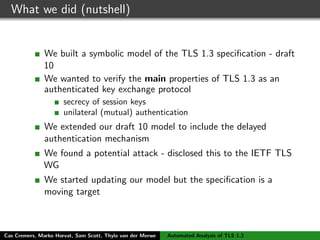
What we did (nutshell)
We built a symbolic model of the TLS 1.3 specification - draft
10
We wanted to verify the main properties of TLS 1.3 as an
authenticated key exchange protocol
secrecy of session keys
unilateral (mutual) authentication
We extended our draft 10 model to include the delayed
authentication mechanism
We found a potential attack - disclosed this to the IETF TLS
WG
We started updating our model but the specification is a
moving target
Cas Cremers, Marko Horvat, Sam Scott, Thyla van der Merwe Automated Analysis of TLS 1.3
Where our work fits in...
2011$ 2015$
1995$
1996$
1999$
2006$
2008$
2016$
$$10$
2009$
2012$
2013$
2014$
1998$
2002$
Program'
verifica-on'
Provable'
security'
Formal'
methods'
Dowling(et(al.(
[dra0105](
Kohlweiss(et(al.(
[dra0105](
Krawczyk(and(
Wee([OPTLS](
Dowling(et(al.(
[dra0110](
We'are'here!'
Ongoing(work(–
later(talks(
Cas Cremers, Marko Horvat, Sam Scott, Thyla van der Merwe Automated Analysis of TLS 1.3
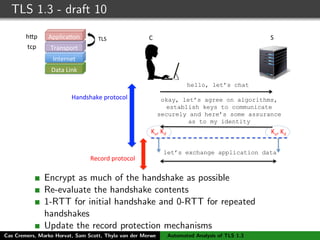
TLS 1.3 - draft 10
Ku,$Kd$
Data$Link$
Internet$
Transport$
Applica7on$ TLS$h:p$
tcp$
hello, let’s chat
okay, let’s agree on algorithms,
establish keys to communicate
securely and here’s some assurance
as to my identity
Ku,$Kd$
let’s exchange application data
Handshake$protocol$
Record$protocol$
C S
Encrypt as much of the handshake as possible
Re-evaluate the handshake contents
1-RTT for initial handshake and 0-RTT for repeated
handshakes
Update the record protection mechanisms
Cas Cremers, Marko Horvat, Sam Scott, Thyla van der Merwe Automated Analysis of TLS 1.3
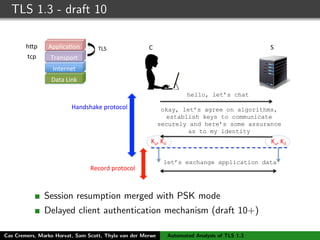
TLS 1.3 - draft 10
Ku,$Kd$
Data$Link$
Internet$
Transport$
Applica7on$ TLS$h:p$
tcp$
hello, let’s chat
okay, let’s agree on algorithms,
establish keys to communicate
securely and here’s some assurance
as to my identity
Ku,$Kd$
let’s exchange application data
Handshake$protocol$
Record$protocol$
C S
Session resumption merged with PSK mode
Delayed client authentication mechanism (draft 10+)
Cas Cremers, Marko Horvat, Sam Scott, Thyla van der Merwe Automated Analysis of TLS 1.3
TLS 1.3 - the OPTLS connection
OPTimized and/or One-Point-Three TLS, designed by
Krawczyk and Wee
Meant as the basis for the TLS 1.3 handshake
Incorporates Pefect Forward Secrecy (PFS) and 0-RTT
functionality
Designed to be flexible, simple, textbook crypto
Cas Cremers, Marko Horvat, Sam Scott, Thyla van der Merwe Automated Analysis of TLS 1.3
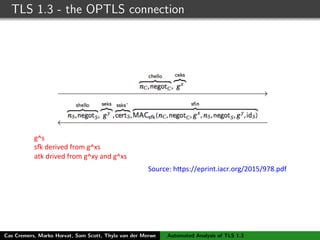
TLS 1.3 - the OPTLS connection
g^s$
s%$derived$from$g^xs$
atk$drived$from$g^xy$and$g^xs$
Source:$h9ps://eprint.iacr.org/2015/978.pdf$
Cas Cremers, Marko Horvat, Sam Scott, Thyla van der Merwe Automated Analysis of TLS 1.3
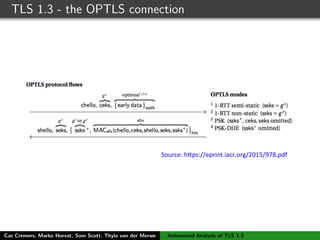
TLS 1.3 - the OPTLS connection
Source:(h*ps://eprint.iacr.org/2015/978.pdf(
Cas Cremers, Marko Horvat, Sam Scott, Thyla van der Merwe Automated Analysis of TLS 1.3
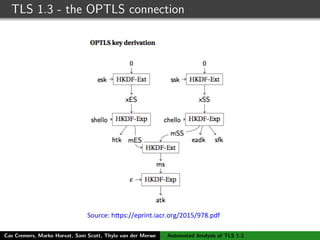
TLS 1.3 - the OPTLS connection
Source:(h*ps://eprint.iacr.org/2015/978.pdf(
Cas Cremers, Marko Horvat, Sam Scott, Thyla van der Merwe Automated Analysis of TLS 1.3
TLS 1.3 - draft 10
C S
ClientHello, ClientKeyShare
HelloRetryRequest
ClientHello, ClientKeyShare
ServerHello, ServerKeyShare, {EncryptedExtensions},
{ServerConfiguration*},{Certificate}, {CertificateRequest*},
{CertificateVerify}, {Finished}
{Certificate*}, {CertificateVerify*}, {Finished}
[Application data]
Initial (EC)DHE handshake
Cas Cremers, Marko Horvat, Sam Scott, Thyla van der Merwe Automated Analysis of TLS 1.3
TLS 1.3 - draft 10
C S
ClientHello, ClientKeyShare, EarlyDataIndication,
(EncryptedExtensions), (Certificate*), (Certificate Verify*),
(ApplicationData)
ServerHello, ServerKeyShare, EarlyDataIndication,
{EncryptedExtensions}, {ServerConfiguration*},{Certificate}
{CertificateRequest*}, {CertificateVerify}, {Finished}
{Finished}
[Application data]
0-RTT handshake
Cas Cremers, Marko Horvat, Sam Scott, Thyla van der Merwe Automated Analysis of TLS 1.3
TLS 1.3 - draft 10
C S
Initial handshake (see Figure (a))
[NewSessionTicket]
[Application data]
ClientHello, ClientKeyShare, PreSharedKeyExtension
ServerHello, PreSharedKeyExtension,
{EncryptedExtensions}, {Finished}
{Finished}
[Application data]
PSK-resumption handshake
Cas Cremers, Marko Horvat, Sam Scott, Thyla van der Merwe Automated Analysis of TLS 1.3
TLS 1.3 - draft 10
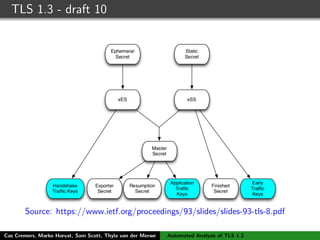
Source: https://www.ietf.org/proceedings/93/slides/slides-93-tls-8.pdf
Cas Cremers, Marko Horvat, Sam Scott, Thyla van der Merwe Automated Analysis of TLS 1.3
TLS 1.3 - draft 10
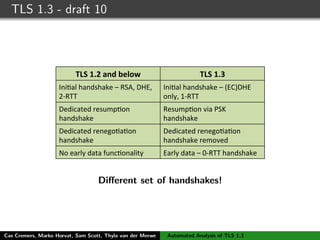
TLS$1.2$and$below$ TLS$1.3$
Ini$al'handshake'–'RSA,'DHE,'
26RTT'
Ini$al'handshake'–'(EC)DHE'
only,'16RTT'
Dedicated'resump$on'
handshake'
Resump$on'via'PSK'
handshake'
Dedicated'renego$a$on'
handshake'
Dedicated'renego$a$on'
handshake'removed'
No'early'data'func$onality' Early'data'–'06RTT'handshake'
Different set of handshakes!
Cas Cremers, Marko Horvat, Sam Scott, Thyla van der Merwe Automated Analysis of TLS 1.3
TLS 1.3 - draft 10
C S
ClientHello, ClientKeyShare
HelloRetryRequest
ClientHello, ClientKeyShare
ServerHello, ServerKeyShare, {EncryptedExtensions},
{ServerConfiguration*},{Certificate}, {CertificateRequest*},
{CertificateVerify}, {Finished}
{Certificate*}, {CertificateVerify*}, {Finished}
[Application data]
(a) Initial (EC)DHE handshake
C S
ClientHello, ClientKeyShare, EarlyDataIndication,
(EncryptedExtensions), (Certificate*), (Certificate Verify*),
(ApplicationData)
ServerHello, ServerKeyShare, EarlyDataIndication,
{EncryptedExtensions}, {ServerConfiguration*},{Certificate}
{CertificateRequest*}, {CertificateVerify}, {Finished}
{Finished}
[Application data]
(b) 0-RTT handshake
C S
Initial handshake (see Figure (a))
[NewSessionTicket]
[Application data]
ClientHello, ClientKeyShare, PreSharedKeyExtension
ServerHello, PreSharedKeyExtension,
{EncryptedExtensions}, {Finished}
{Finished}
[Application data]
(c) PSK-resumption handshake
(+ PSK-DHE)
Look at the full interaction of all these components!
Cas Cremers, Marko Horvat, Sam Scott, Thyla van der Merwe Automated Analysis of TLS 1.3
TLS 1.3 - draft 10
C S
ClientHello, ClientKeyShare
HelloRetryRequest
ClientHello, ClientKeyShare
ServerHello, ServerKeyShare, {EncryptedExtensions},
{ServerConfiguration*},{Certificate}, {CertificateRequest*},
{CertificateVerify}, {Finished}
{Certificate*}, {CertificateVerify*}, {Finished}
[Application data]
(a) Initial (EC)DHE handshake
C S
ClientHello, ClientKeyShare, EarlyDataIndication,
(EncryptedExtensions), (Certificate*), (Certificate Verify*),
(ApplicationData)
ServerHello, ServerKeyShare, EarlyDataIndication,
{EncryptedExtensions}, {ServerConfiguration*},{Certificate}
{CertificateRequest*}, {CertificateVerify}, {Finished}
{Finished}
[Application data]
(b) 0-RTT handshake
C S
Initial handshake (see Figure (a))
[NewSessionTicket]
[Application data]
ClientHello, ClientKeyShare, PreSharedKeyExtension
ServerHello, PreSharedKeyExtension,
{EncryptedExtensions}, {Finished}
{Finished}
[Application data]
(c) PSK-resumption handshake
(+ PSK-DHE)
Look at the full interaction of all these components!
Cas Cremers, Marko Horvat, Sam Scott, Thyla van der Merwe Automated Analysis of TLS 1.3
Symbolic analysis
A symbolic model allows us to examine the logical soundness of
the protocol
We systematically specify and hope to exclude a class of
attacks - ‘logical’ attacks (think Triple Handshake for TLS 1.2)
We assume black-box cryptography
We analyse the specification only
Cas Cremers, Marko Horvat, Sam Scott, Thyla van der Merwe Automated Analysis of TLS 1.3
Using Tamarin
Tool details available at:
http://www.infsec.ethz.ch/research/software/tamarin.html
Cas Cremers, Marko Horvat, Sam Scott, Thyla van der Merwe Automated Analysis of TLS 1.3
Using Tamarin
We built our model for use in the Tamarin prover
Automated tool for protocol analysis
Good symbolic Diffie-Hellman support
Considers an unbounded number of parties/handshakes
How does it work?
For simple models/properties, can prove automatically
Complex models require more user interaction
A proof shows that a property holds in all possible
combinations of client, server, and adversary behaviours
Cas Cremers, Marko Horvat, Sam Scott, Thyla van der Merwe Automated Analysis of TLS 1.3
Using Tamarin
We built our model for use in the Tamarin prover
Automated tool for protocol analysis
Good symbolic Diffie-Hellman support
Considers an unbounded number of parties/handshakes
How does it work?
For simple models/properties, can prove automatically
Complex models require more user interaction
A proof shows that a property holds in all possible
combinations of client, server, and adversary behaviours
Tamarin is good because
We can precisely model the TLS state machines
We can accurately capture security properties
Cas Cremers, Marko Horvat, Sam Scott, Thyla van der Merwe Automated Analysis of TLS 1.3
Using Tamarin
We built our model for use in the Tamarin prover
Automated tool for protocol analysis
Good symbolic Diffie-Hellman support
Considers an unbounded number of parties/handshakes
How does it work?
For simple models/properties, can prove automatically
Complex models require more user interaction
A proof shows that a property holds in all possible
combinations of client, server, and adversary behaviours
Tamarin is good because
We can precisely model the TLS state machines
We can accurately capture security properties
Cas Cremers, Marko Horvat, Sam Scott, Thyla van der Merwe Automated Analysis of TLS 1.3
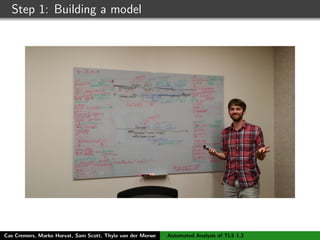
Step 1: Building a model
Cas Cremers, Marko Horvat, Sam Scott, Thyla van der Merwe Automated Analysis of TLS 1.3
Step 1: Building a model
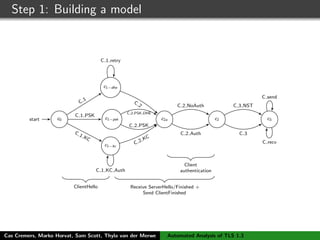
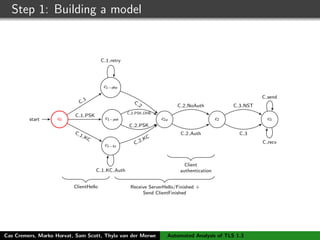
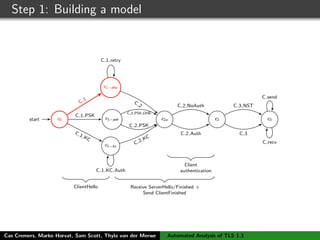
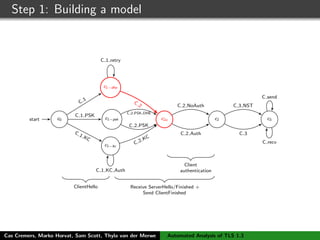
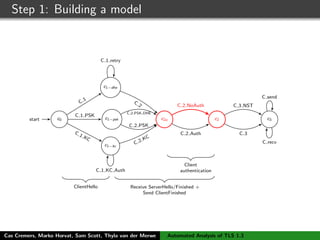
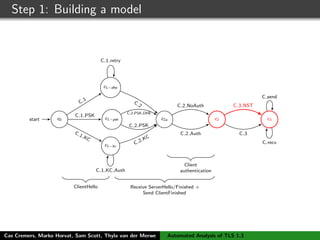
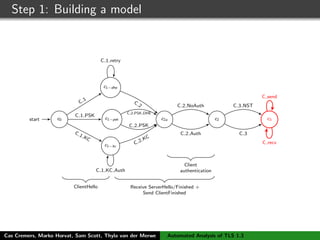
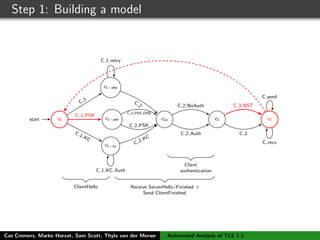
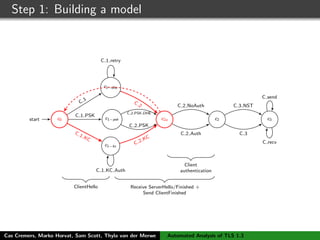
Encode honest party and adversary actions as Tamarin ‘rules’
For honest clients and servers rules correspond to flights of
messages
Rules transition the protocol from one state to the next
Cas Cremers, Marko Horvat, Sam Scott, Thyla van der Merwe Automated Analysis of TLS 1.3
Step 1: Building a model
c0start
c1−dhe
c1−psk
c1−kc
c2a c2 c3
ClientHello Receive ServerHello/Finished +
Send ClientFinished
Client
authentication
C
1
C 1 PSK
C 1 KC
C 2 PSK
C 2 PSK DHE
C 1 KC Auth
C 1 retry
C
2
C 2 KC
C 2 NoAuth
C 2 Auth C 3
C 3 NST
C send
C recv
Cas Cremers, Marko Horvat, Sam Scott, Thyla van der Merwe Automated Analysis of TLS 1.3
Step 1: Building a model
c0start
c1−dhe
c1−psk
c1−kc
c2a c2 c3
ClientHello Receive ServerHello/Finished +
Send ClientFinished
Client
authentication
C
1
C 1 PSK
C 1 KC
C 2 PSK
C 2 PSK DHE
C 1 KC Auth
C 1 retry
C
2
C 2 KC
C 2 NoAuth
C 2 Auth C 3
C 3 NST
C send
C recv
Cas Cremers, Marko Horvat, Sam Scott, Thyla van der Merwe Automated Analysis of TLS 1.3
Step 1: Building a model
c0start
c1−dhe
c1−psk
c1−kc
c2a c2 c3
ClientHello Receive ServerHello/Finished +
Send ClientFinished
Client
authentication
C
1
C 1 PSK
C 1 KC
C 2 PSK
C 2 PSK DHE
C 1 KC Auth
C 1 retry
C
2
C 2 KC
C 2 NoAuth
C 2 Auth C 3
C 3 NST
C send
C recv
Cas Cremers, Marko Horvat, Sam Scott, Thyla van der Merwe Automated Analysis of TLS 1.3
Step 1: Building a model
c0start
c1−dhe
c1−psk
c1−kc
c2a c2 c3
ClientHello Receive ServerHello/Finished +
Send ClientFinished
Client
authentication
C
1
C 1 PSK
C 1 KC
C 2 PSK
C 2 PSK DHE
C 1 KC Auth
C 1 retry
C
2
C 2 KC
C 2 NoAuth
C 2 Auth C 3
C 3 NST
C send
C recv
Cas Cremers, Marko Horvat, Sam Scott, Thyla van der Merwe Automated Analysis of TLS 1.3
Step 1: Building a model
c0start
c1−dhe
c1−psk
c1−kc
c2a c2 c3
ClientHello Receive ServerHello/Finished +
Send ClientFinished
Client
authentication
C
1
C 1 PSK
C 1 KC
C 2 PSK
C 2 PSK DHE
C 1 KC Auth
C 1 retry
C
2
C 2 KC
C 2 NoAuth
C 2 Auth C 3
C 3 NST
C send
C recv
Cas Cremers, Marko Horvat, Sam Scott, Thyla van der Merwe Automated Analysis of TLS 1.3
Step 1: Building a model
c0start
c1−dhe
c1−psk
c1−kc
c2a c2 c3
ClientHello Receive ServerHello/Finished +
Send ClientFinished
Client
authentication
C
1
C 1 PSK
C 1 KC
C 2 PSK
C 2 PSK DHE
C 1 KC Auth
C 1 retry
C
2
C 2 KC
C 2 NoAuth
C 2 Auth C 3
C 3 NST
C send
C recv
Cas Cremers, Marko Horvat, Sam Scott, Thyla van der Merwe Automated Analysis of TLS 1.3
Step 1: Building a model
c0start
c1−dhe
c1−psk
c1−kc
c2a c2 c3
ClientHello Receive ServerHello/Finished +
Send ClientFinished
Client
authentication
C
1
C 1 PSK
C 1 KC
C 2 PSK
C 2 PSK DHE
C 1 KC Auth
C 1 retry
C
2
C 2 KC
C 2 NoAuth
C 2 Auth C 3
C 3 NST
C send
C recv
Cas Cremers, Marko Horvat, Sam Scott, Thyla van der Merwe Automated Analysis of TLS 1.3
Step 1: Building a model
c0start
c1−dhe
c1−psk
c1−kc
c2a c2 c3
ClientHello Receive ServerHello/Finished +
Send ClientFinished
Client
authentication
C
1
C 1 PSK
C 1 KC
C 2 PSK
C 2 PSK DHE
C 1 KC Auth
C 1 retry
C
2
C 2 KC
C 2 NoAuth
C 2 Auth C 3
C 3 NST
C send
C recv
Cas Cremers, Marko Horvat, Sam Scott, Thyla van der Merwe Automated Analysis of TLS 1.3
Step 1: Building a model
c0start
c1−dhe
c1−psk
c1−kc
c2a c2 c3
ClientHello Receive ServerHello/Finished +
Send ClientFinished
Client
authentication
C
1
C 1 PSK
C 1 KC
C 2 PSK
C 2 PSK DHE
C 1 KC Auth
C 1 retry
C
2
C 2 KC
C 2 NoAuth
C 2 Auth C 3
C 3 NST
C send
C recv
Cas Cremers, Marko Horvat, Sam Scott, Thyla van der Merwe Automated Analysis of TLS 1.3
Step 1: Building a model
rule C_1:
let
// Default C1 values
tid = ~nc
// Client Hello
C = $C
nc = ~nc
pc = $pc
S = $S
// Client Key Share
ga = ’g’^~a
messages = <nc, pc,ga>
in
[ Fr(nc)
, Fr(~a)
]
--[ C1(tid)
, Start(tid, C, ’client’)
, Running(C, S, ’client’, nc)
, DH(C, ~a)
]->
[ St_C_1_init(tid, C, nc, pc, S, ~a, messages, ’no_auth’)
, Out(<C,nc, pc,ga>)
]
Cas Cremers, Marko Horvat, Sam Scott, Thyla van der Merwe Automated Analysis of TLS 1.3
Step 1: Building a model
Cas Cremers, Marko Horvat, Sam Scott, Thyla van der Merwe Automated Analysis of TLS 1.3
Step 2: Encoding security properties
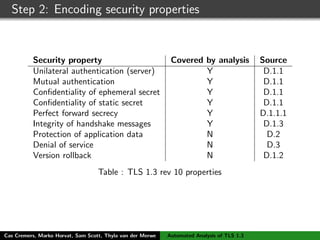
TLS 1.3 goals include:
unilateral authentication of the server (mandatory)
mutual authentication (optional)
confidentiality and perfect forward secrecy of session keys
We have Dolev-Yao style adversary that has the ability to
compromise long-term keys
Cas Cremers, Marko Horvat, Sam Scott, Thyla van der Merwe Automated Analysis of TLS 1.3
Step 2: Encoding security properties
Security property Covered by analysis Source
Unilateral authentication (server) Y D.1.1
Mutual authentication Y D.1.1
Confidentiality of ephemeral secret Y D.1.1
Confidentiality of static secret Y D.1.1
Perfect forward secrecy Y D.1.1.1
Integrity of handshake messages Y D.1.3
Protection of application data N D.2
Denial of service N D.3
Version rollback N D.1.2
Table : TLS 1.3 rev 10 properties
Cas Cremers, Marko Horvat, Sam Scott, Thyla van der Merwe Automated Analysis of TLS 1.3
Step 2: Encoding security properties
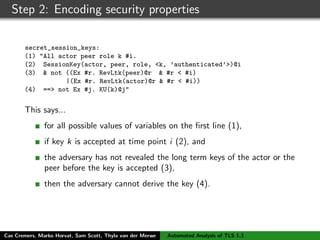
secret_session_keys:
(1) "All actor peer role k #i.
(2) SessionKey(actor, peer, role, <k, ’authenticated’>)@i
(3) & not ((Ex #r. RevLtk(peer)@r & #r < #i)
|(Ex #r. RevLtk(actor)@r & #r < #i))
(4) ==> not Ex #j. KU(k)@j"
This says...
for all possible values of variables on the first line (1),
if key k is accepted at time point i (2), and
the adversary has not revealed the long term keys of the actor or the
peer before the key is accepted (3),
then the adversary cannot derive the key (4).
Want to show that this holds for all combinations of client, server and
adversary behaviours - ALL traces
Cas Cremers, Marko Horvat, Sam Scott, Thyla van der Merwe Automated Analysis of TLS 1.3
Step 2: Encoding security properties
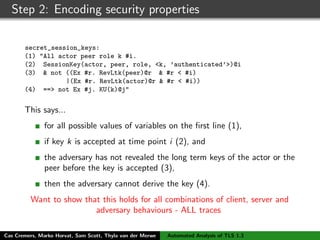
secret_session_keys:
(1) "All actor peer role k #i.
(2) SessionKey(actor, peer, role, <k, ’authenticated’>)@i
(3) & not ((Ex #r. RevLtk(peer)@r & #r < #i)
|(Ex #r. RevLtk(actor)@r & #r < #i))
(4) ==> not Ex #j. KU(k)@j"
This says...
for all possible values of variables on the first line (1),
if key k is accepted at time point i (2), and
the adversary has not revealed the long term keys of the actor or the
peer before the key is accepted (3),
then the adversary cannot derive the key (4).
Want to show that this holds for all combinations of client, server and
adversary behaviours - ALL traces
Cas Cremers, Marko Horvat, Sam Scott, Thyla van der Merwe Automated Analysis of TLS 1.3
Step 3: Proving security properties
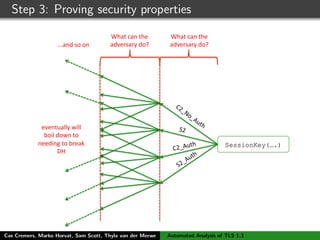
SessionKey(….)
What	
  can	
  the	
  
adversary	
  do?	
  
S2	
  
C2_Auth	
  
What	
  can	
  the	
  
adversary	
  do?	
  ...and	
  so	
  on	
  
eventually	
  will	
  
boil	
  down	
  to	
  
needing	
  to	
  break	
  
DH	
  	
  
Cas Cremers, Marko Horvat, Sam Scott, Thyla van der Merwe Automated Analysis of TLS 1.3
Step 3: Proving security properties
Not a straightforward application of Tamarin
several man-months of work
specification a moving target
updating takes time, can be error-prone
Need an intimate knowledge of the protocol - high degree of
interaction with the tool in some cases
Not a push-button analysis
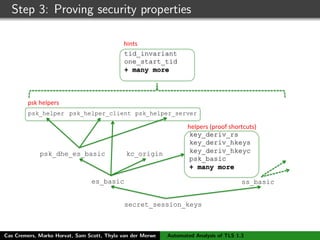
We have 45 auxiliary lemmas
Cas Cremers, Marko Horvat, Sam Scott, Thyla van der Merwe Automated Analysis of TLS 1.3
Step 3: Proving security properties
secret_session_keys
!
es_basic
psk_dhe_es_basic kc_origin
psk_helper psk_helper_client psk_helper_server
key_deriv_rs
key_deriv_hkeys
key_deriv_hkeyc
psk_basic
+ many more
!
helpers!(proof!shortcuts)!
tid_invariant
one_start_tid
+ many more
!
hints!
ss_basic
psk!helpers!
Cas Cremers, Marko Horvat, Sam Scott, Thyla van der Merwe Automated Analysis of TLS 1.3
Step 3: Proving security properties
We verified the main properties of TLS 1.3 revision 10 as an
authenticated key exchange protocol:
Secrecy of session keys
holds for both client and server
forward secrecy
Mutual authentication
Cas Cremers, Marko Horvat, Sam Scott, Thyla van der Merwe Automated Analysis of TLS 1.3
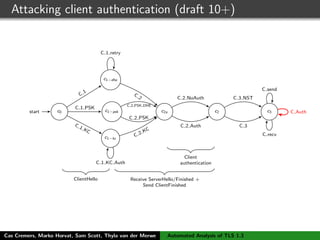
Attacking client authentication (draft 10+)
c0start
c1−dhe
c1−psk
c1−kc
c2a c2 c3
ClientHello Receive ServerHello/Finished +
Send ClientFinished
Client
authentication
C
1
C 1 PSK
C 1 KC
C 2 PSK
C 2 PSK DHE
C 1 KC Auth
C 1 retry
C
2
C 2 KC
C 2 NoAuth
C 2 Auth C 3
C 3 NST
C send
C Auth
C recv
Cas Cremers, Marko Horvat, Sam Scott, Thyla van der Merwe Automated Analysis of TLS 1.3
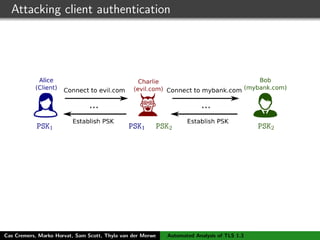
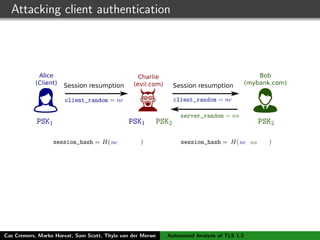
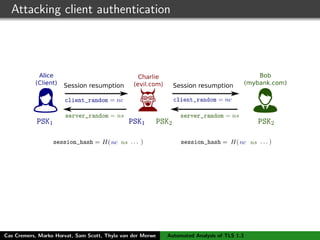
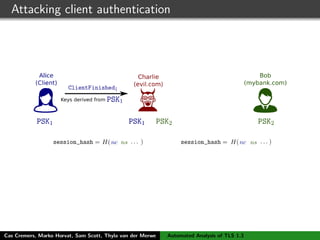
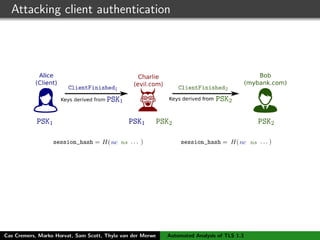
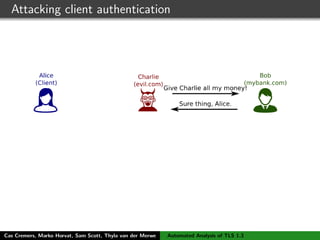
Attacking client authentication
Cas Cremers, Marko Horvat, Sam Scott, Thyla van der Merwe Automated Analysis of TLS 1.3
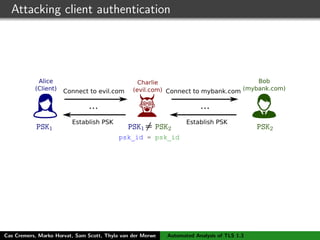
Attacking client authentication
psk_id = psk_id
Cas Cremers, Marko Horvat, Sam Scott, Thyla van der Merwe Automated Analysis of TLS 1.3
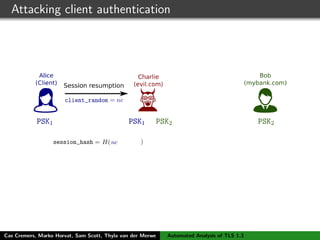
Attacking client authentication
Cas Cremers, Marko Horvat, Sam Scott, Thyla van der Merwe Automated Analysis of TLS 1.3
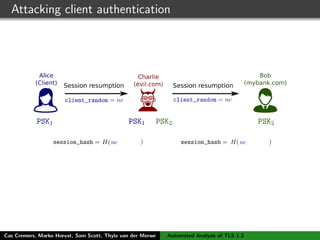
Attacking client authentication
Cas Cremers, Marko Horvat, Sam Scott, Thyla van der Merwe Automated Analysis of TLS 1.3
Attacking client authentication
Cas Cremers, Marko Horvat, Sam Scott, Thyla van der Merwe Automated Analysis of TLS 1.3
Attacking client authentication
Cas Cremers, Marko Horvat, Sam Scott, Thyla van der Merwe Automated Analysis of TLS 1.3
Attacking client authentication
Cas Cremers, Marko Horvat, Sam Scott, Thyla van der Merwe Automated Analysis of TLS 1.3
Attacking client authentication
Cas Cremers, Marko Horvat, Sam Scott, Thyla van der Merwe Automated Analysis of TLS 1.3
Attacking client authentication
Cas Cremers, Marko Horvat, Sam Scott, Thyla van der Merwe Automated Analysis of TLS 1.3
Attacking client authentication
Cas Cremers, Marko Horvat, Sam Scott, Thyla van der Merwe Automated Analysis of TLS 1.3
Attacking client authentication
Cas Cremers, Marko Horvat, Sam Scott, Thyla van der Merwe Automated Analysis of TLS 1.3
Attacking client authentication
Cas Cremers, Marko Horvat, Sam Scott, Thyla van der Merwe Automated Analysis of TLS 1.3
Attacking client authentication
Cas Cremers, Marko Horvat, Sam Scott, Thyla van der Merwe Automated Analysis of TLS 1.3
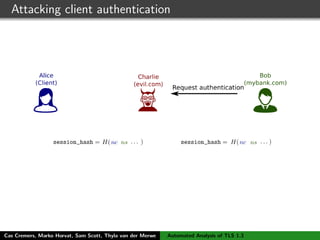
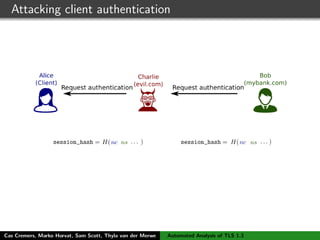
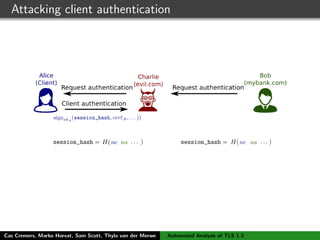
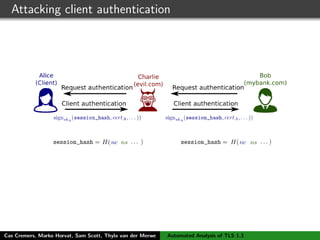
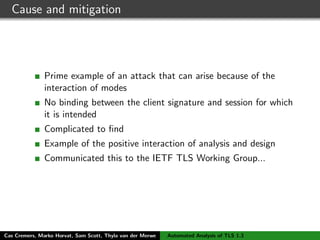
Cause and mitigation
Prime example of an attack that can arise because of the
interaction of modes
No binding between the client signature and session for which
it is intended
Complicated to find
Example of the positive interaction of analysis and design
Communicated this to the IETF TLS Working Group...
Cas Cremers, Marko Horvat, Sam Scott, Thyla van der Merwe Automated Analysis of TLS 1.3
Cause and mitigation
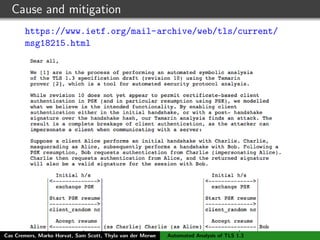
https://www.ietf.org/mail-archive/web/tls/current/
msg18215.html
Cas Cremers, Marko Horvat, Sam Scott, Thyla van der Merwe Automated Analysis of TLS 1.3
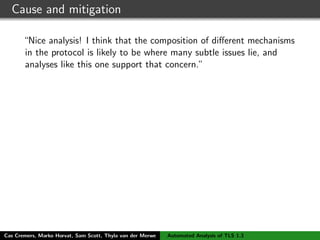
Cause and mitigation
“Nice analysis! I think that the composition of different mechanisms
in the protocol is likely to be where many subtle issues lie, and
analyses like this one support that concern.”
“Thanks for posting this. It’s great to see people doing real formal
analysis of the TLS 1.3 draft; this is really helpful in guiding the
design.”
Cas Cremers, Marko Horvat, Sam Scott, Thyla van der Merwe Automated Analysis of TLS 1.3
Cause and mitigation
“Nice analysis! I think that the composition of different mechanisms
in the protocol is likely to be where many subtle issues lie, and
analyses like this one support that concern.”
“Thanks for posting this. It’s great to see people doing real formal
analysis of the TLS 1.3 draft; this is really helpful in guiding the
design.”
“This result motivates and confirms the need to modify the
handshake hashes to contain the server Finished when we add
post-handshake authentication as is done in PR#316...”
Cas Cremers, Marko Horvat, Sam Scott, Thyla van der Merwe Automated Analysis of TLS 1.3
Cause and mitigation
“Nice analysis! I think that the composition of different mechanisms
in the protocol is likely to be where many subtle issues lie, and
analyses like this one support that concern.”
“Thanks for posting this. It’s great to see people doing real formal
analysis of the TLS 1.3 draft; this is really helpful in guiding the
design.”
“This result motivates and confirms the need to modify the
handshake hashes to contain the server Finished when we add
post-handshake authentication as is done in PR#316...”
Although already included in PR316, the attack highlights strict
necessity of including the Finished message in the session hash
and draft 11 does this - creates a binding between signature and the
session
Cas Cremers, Marko Horvat, Sam Scott, Thyla van der Merwe Automated Analysis of TLS 1.3
Cause and mitigation
“Nice analysis! I think that the composition of different mechanisms
in the protocol is likely to be where many subtle issues lie, and
analyses like this one support that concern.”
“Thanks for posting this. It’s great to see people doing real formal
analysis of the TLS 1.3 draft; this is really helpful in guiding the
design.”
“This result motivates and confirms the need to modify the
handshake hashes to contain the server Finished when we add
post-handshake authentication as is done in PR#316...”
Although already included in PR316, the attack highlights strict
necessity of including the Finished message in the session hash
and draft 11 does this - creates a binding between signature and the
session
Cas Cremers, Marko Horvat, Sam Scott, Thyla van der Merwe Automated Analysis of TLS 1.3
Where we stand
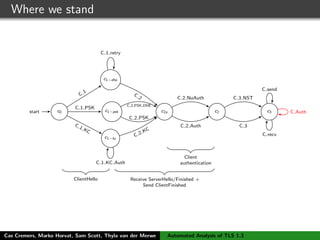
We showed that draft 10 meets the goals of authenticated key
exchange, and the changes in draft 11 appear to address the
attack
First comprehensive analysis of the interaction of the new TLS
1.3 modes
we confirmed the base design is solid
prevented a potential weakness
Draft 11...
Cas Cremers, Marko Horvat, Sam Scott, Thyla van der Merwe Automated Analysis of TLS 1.3
Where we stand
c0start
c1−dhe
c1−psk
c1−kc
c2a c2 c3
ClientHello Receive ServerHello/Finished +
Send ClientFinished
Client
authentication
C
1
C 1 PSK
C 1 KC
C 2 PSK
C 2 PSK DHE
C 1 KC Auth
C 1 retry
C
2
C 2 KC
C 2 NoAuth
C 2 Auth C 3
C 3 NST
C send
C Auth
C recv
Cas Cremers, Marko Horvat, Sam Scott, Thyla van der Merwe Automated Analysis of TLS 1.3
Where we stand
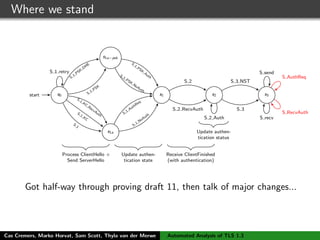
s0start
s1a−psk
s1a
s1 s2 s3
S
1
S
1
KC
S
1
KC
RecvAuth
S
1
PSK
S
1
PSK
DHE S
1
PSK
AuthS
1
PSK
NoAuth
S
1
NoAuthS
1
AuthReq
S 1 retry
S 2
S 2 RecvAuth
S 2 Auth
S 3
S 3 NST
S send
S recv
S AuthReq
S RecvAuth
Process ClientHello +
Send ServerHello
Update authen-
tication state
Receive ClientFinished
(with authentication)
Update authen-
tication status
Got half-way through proving draft 11, then talk of major changes...
Cas Cremers, Marko Horvat, Sam Scott, Thyla van der Merwe Automated Analysis of TLS 1.3
Where we stand
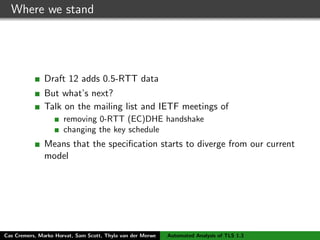
Draft 12 adds 0.5-RTT data
But what’s next?
Talk on the mailing list and IETF meetings of
removing 0-RTT (EC)DHE handshake
changing the key schedule
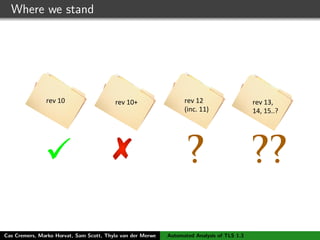
Means that the specification starts to diverge from our current
model
Cas Cremers, Marko Horvat, Sam Scott, Thyla van der Merwe Automated Analysis of TLS 1.3
Where we stand
rev$10$ rev$10+$ rev$12$
(inc.$11)$
rev$13,$
14,$15..?$
Cas Cremers, Marko Horvat, Sam Scott, Thyla van der Merwe Automated Analysis of TLS 1.3
Making changes
The model can be updated to accommodate changes
Additions can complicate the analysis (adding loops)
Reductions/simplifications are easier to handle
Changes mean more man-hours
http://tls13tamarin.github.io/TLS13Tamarin/
Authors:
Cas Cremers
cas.cremers@cs.ox.ac.uk
Sam Scott
sam.scott.2012@live.rhul.ac.uk
Marko Horvat
marko.horvat@cs.ox.ac.uk
Thyla van der Merwe
thyla.vandermerwe.2012@live.rhul.ac.uk
Cas Cremers, Marko Horvat, Sam Scott, Thyla van der Merwe Automated Analysis of TLS 1.3
Making changes
The model can be updated to accommodate changes
Additions can complicate the analysis (adding loops)
Reductions/simplifications are easier to handle
Changes mean more man-hours
http://tls13tamarin.github.io/TLS13Tamarin/
Authors:
Cas Cremers
cas.cremers@cs.ox.ac.uk
Sam Scott
sam.scott.2012@live.rhul.ac.uk
Marko Horvat
marko.horvat@cs.ox.ac.uk
Thyla van der Merwe
thyla.vandermerwe.2012@live.rhul.ac.uk
Cas Cremers, Marko Horvat, Sam Scott, Thyla van der Merwe Automated Analysis of TLS 1.3

Automated Analysis of TLS 1.3

  • 1.
    Automated Analysis ofTLS 1.3 0-RTT, Resumption and Delayed Authentication 2 May 2016 Cas Cremers Marko Horvat Sam Scott Thyla van der Merwe Cas Cremers, Marko Horvat, Sam Scott, Thyla van der Merwe Automated Analysis of TLS 1.3
  • 2.
    What we did(nutshell) We built a symbolic model of the TLS 1.3 specification - draft 10 We wanted to verify the main properties of TLS 1.3 as an authenticated key exchange protocol secrecy of session keys unilateral (mutual) authentication We extended our draft 10 model to include the delayed authentication mechanism We found a potential attack - disclosed this to the IETF TLS WG We started updating our model but the specification is a moving target Cas Cremers, Marko Horvat, Sam Scott, Thyla van der Merwe Automated Analysis of TLS 1.3
  • 3.
    Where our workfits in... 2011$ 2015$ 1995$ 1996$ 1999$ 2006$ 2008$ 2016$ $$10$ 2009$ 2012$ 2013$ 2014$ 1998$ 2002$ Program' verifica-on' Provable' security' Formal' methods' Dowling(et(al.( [dra0105]( Kohlweiss(et(al.( [dra0105]( Krawczyk(and( Wee([OPTLS]( Dowling(et(al.( [dra0110]( We'are'here!' Ongoing(work(– later(talks( Cas Cremers, Marko Horvat, Sam Scott, Thyla van der Merwe Automated Analysis of TLS 1.3
  • 4.
    TLS 1.3 -draft 10 Ku,$Kd$ Data$Link$ Internet$ Transport$ Applica7on$ TLS$h:p$ tcp$ hello, let’s chat okay, let’s agree on algorithms, establish keys to communicate securely and here’s some assurance as to my identity Ku,$Kd$ let’s exchange application data Handshake$protocol$ Record$protocol$ C S Encrypt as much of the handshake as possible Re-evaluate the handshake contents 1-RTT for initial handshake and 0-RTT for repeated handshakes Update the record protection mechanisms Cas Cremers, Marko Horvat, Sam Scott, Thyla van der Merwe Automated Analysis of TLS 1.3
  • 5.
    TLS 1.3 -draft 10 Ku,$Kd$ Data$Link$ Internet$ Transport$ Applica7on$ TLS$h:p$ tcp$ hello, let’s chat okay, let’s agree on algorithms, establish keys to communicate securely and here’s some assurance as to my identity Ku,$Kd$ let’s exchange application data Handshake$protocol$ Record$protocol$ C S Session resumption merged with PSK mode Delayed client authentication mechanism (draft 10+) Cas Cremers, Marko Horvat, Sam Scott, Thyla van der Merwe Automated Analysis of TLS 1.3
  • 6.
    TLS 1.3 -the OPTLS connection OPTimized and/or One-Point-Three TLS, designed by Krawczyk and Wee Meant as the basis for the TLS 1.3 handshake Incorporates Pefect Forward Secrecy (PFS) and 0-RTT functionality Designed to be flexible, simple, textbook crypto Cas Cremers, Marko Horvat, Sam Scott, Thyla van der Merwe Automated Analysis of TLS 1.3
  • 7.
    TLS 1.3 -the OPTLS connection g^s$ s%$derived$from$g^xs$ atk$drived$from$g^xy$and$g^xs$ Source:$h9ps://eprint.iacr.org/2015/978.pdf$ Cas Cremers, Marko Horvat, Sam Scott, Thyla van der Merwe Automated Analysis of TLS 1.3
  • 8.
    TLS 1.3 -the OPTLS connection Source:(h*ps://eprint.iacr.org/2015/978.pdf( Cas Cremers, Marko Horvat, Sam Scott, Thyla van der Merwe Automated Analysis of TLS 1.3
  • 9.
    TLS 1.3 -the OPTLS connection Source:(h*ps://eprint.iacr.org/2015/978.pdf( Cas Cremers, Marko Horvat, Sam Scott, Thyla van der Merwe Automated Analysis of TLS 1.3
  • 10.
    TLS 1.3 -draft 10 C S ClientHello, ClientKeyShare HelloRetryRequest ClientHello, ClientKeyShare ServerHello, ServerKeyShare, {EncryptedExtensions}, {ServerConfiguration*},{Certificate}, {CertificateRequest*}, {CertificateVerify}, {Finished} {Certificate*}, {CertificateVerify*}, {Finished} [Application data] Initial (EC)DHE handshake Cas Cremers, Marko Horvat, Sam Scott, Thyla van der Merwe Automated Analysis of TLS 1.3
  • 11.
    TLS 1.3 -draft 10 C S ClientHello, ClientKeyShare, EarlyDataIndication, (EncryptedExtensions), (Certificate*), (Certificate Verify*), (ApplicationData) ServerHello, ServerKeyShare, EarlyDataIndication, {EncryptedExtensions}, {ServerConfiguration*},{Certificate} {CertificateRequest*}, {CertificateVerify}, {Finished} {Finished} [Application data] 0-RTT handshake Cas Cremers, Marko Horvat, Sam Scott, Thyla van der Merwe Automated Analysis of TLS 1.3
  • 12.
    TLS 1.3 -draft 10 C S Initial handshake (see Figure (a)) [NewSessionTicket] [Application data] ClientHello, ClientKeyShare, PreSharedKeyExtension ServerHello, PreSharedKeyExtension, {EncryptedExtensions}, {Finished} {Finished} [Application data] PSK-resumption handshake Cas Cremers, Marko Horvat, Sam Scott, Thyla van der Merwe Automated Analysis of TLS 1.3
  • 13.
    TLS 1.3 -draft 10 Source: https://www.ietf.org/proceedings/93/slides/slides-93-tls-8.pdf Cas Cremers, Marko Horvat, Sam Scott, Thyla van der Merwe Automated Analysis of TLS 1.3
  • 14.
    TLS 1.3 -draft 10 TLS$1.2$and$below$ TLS$1.3$ Ini$al'handshake'–'RSA,'DHE,' 26RTT' Ini$al'handshake'–'(EC)DHE' only,'16RTT' Dedicated'resump$on' handshake' Resump$on'via'PSK' handshake' Dedicated'renego$a$on' handshake' Dedicated'renego$a$on' handshake'removed' No'early'data'func$onality' Early'data'–'06RTT'handshake' Different set of handshakes! Cas Cremers, Marko Horvat, Sam Scott, Thyla van der Merwe Automated Analysis of TLS 1.3
  • 15.
    TLS 1.3 -draft 10 C S ClientHello, ClientKeyShare HelloRetryRequest ClientHello, ClientKeyShare ServerHello, ServerKeyShare, {EncryptedExtensions}, {ServerConfiguration*},{Certificate}, {CertificateRequest*}, {CertificateVerify}, {Finished} {Certificate*}, {CertificateVerify*}, {Finished} [Application data] (a) Initial (EC)DHE handshake C S ClientHello, ClientKeyShare, EarlyDataIndication, (EncryptedExtensions), (Certificate*), (Certificate Verify*), (ApplicationData) ServerHello, ServerKeyShare, EarlyDataIndication, {EncryptedExtensions}, {ServerConfiguration*},{Certificate} {CertificateRequest*}, {CertificateVerify}, {Finished} {Finished} [Application data] (b) 0-RTT handshake C S Initial handshake (see Figure (a)) [NewSessionTicket] [Application data] ClientHello, ClientKeyShare, PreSharedKeyExtension ServerHello, PreSharedKeyExtension, {EncryptedExtensions}, {Finished} {Finished} [Application data] (c) PSK-resumption handshake (+ PSK-DHE) Look at the full interaction of all these components! Cas Cremers, Marko Horvat, Sam Scott, Thyla van der Merwe Automated Analysis of TLS 1.3
  • 16.
    TLS 1.3 -draft 10 C S ClientHello, ClientKeyShare HelloRetryRequest ClientHello, ClientKeyShare ServerHello, ServerKeyShare, {EncryptedExtensions}, {ServerConfiguration*},{Certificate}, {CertificateRequest*}, {CertificateVerify}, {Finished} {Certificate*}, {CertificateVerify*}, {Finished} [Application data] (a) Initial (EC)DHE handshake C S ClientHello, ClientKeyShare, EarlyDataIndication, (EncryptedExtensions), (Certificate*), (Certificate Verify*), (ApplicationData) ServerHello, ServerKeyShare, EarlyDataIndication, {EncryptedExtensions}, {ServerConfiguration*},{Certificate} {CertificateRequest*}, {CertificateVerify}, {Finished} {Finished} [Application data] (b) 0-RTT handshake C S Initial handshake (see Figure (a)) [NewSessionTicket] [Application data] ClientHello, ClientKeyShare, PreSharedKeyExtension ServerHello, PreSharedKeyExtension, {EncryptedExtensions}, {Finished} {Finished} [Application data] (c) PSK-resumption handshake (+ PSK-DHE) Look at the full interaction of all these components! Cas Cremers, Marko Horvat, Sam Scott, Thyla van der Merwe Automated Analysis of TLS 1.3
  • 17.
    Symbolic analysis A symbolicmodel allows us to examine the logical soundness of the protocol We systematically specify and hope to exclude a class of attacks - ‘logical’ attacks (think Triple Handshake for TLS 1.2) We assume black-box cryptography We analyse the specification only Cas Cremers, Marko Horvat, Sam Scott, Thyla van der Merwe Automated Analysis of TLS 1.3
  • 18.
    Using Tamarin Tool detailsavailable at: http://www.infsec.ethz.ch/research/software/tamarin.html Cas Cremers, Marko Horvat, Sam Scott, Thyla van der Merwe Automated Analysis of TLS 1.3
  • 19.
    Using Tamarin We builtour model for use in the Tamarin prover Automated tool for protocol analysis Good symbolic Diffie-Hellman support Considers an unbounded number of parties/handshakes How does it work? For simple models/properties, can prove automatically Complex models require more user interaction A proof shows that a property holds in all possible combinations of client, server, and adversary behaviours Cas Cremers, Marko Horvat, Sam Scott, Thyla van der Merwe Automated Analysis of TLS 1.3
  • 20.
    Using Tamarin We builtour model for use in the Tamarin prover Automated tool for protocol analysis Good symbolic Diffie-Hellman support Considers an unbounded number of parties/handshakes How does it work? For simple models/properties, can prove automatically Complex models require more user interaction A proof shows that a property holds in all possible combinations of client, server, and adversary behaviours Tamarin is good because We can precisely model the TLS state machines We can accurately capture security properties Cas Cremers, Marko Horvat, Sam Scott, Thyla van der Merwe Automated Analysis of TLS 1.3
  • 21.
    Using Tamarin We builtour model for use in the Tamarin prover Automated tool for protocol analysis Good symbolic Diffie-Hellman support Considers an unbounded number of parties/handshakes How does it work? For simple models/properties, can prove automatically Complex models require more user interaction A proof shows that a property holds in all possible combinations of client, server, and adversary behaviours Tamarin is good because We can precisely model the TLS state machines We can accurately capture security properties Cas Cremers, Marko Horvat, Sam Scott, Thyla van der Merwe Automated Analysis of TLS 1.3
  • 22.
    Step 1: Buildinga model Cas Cremers, Marko Horvat, Sam Scott, Thyla van der Merwe Automated Analysis of TLS 1.3
  • 23.
    Step 1: Buildinga model Encode honest party and adversary actions as Tamarin ‘rules’ For honest clients and servers rules correspond to flights of messages Rules transition the protocol from one state to the next Cas Cremers, Marko Horvat, Sam Scott, Thyla van der Merwe Automated Analysis of TLS 1.3
  • 24.
    Step 1: Buildinga model c0start c1−dhe c1−psk c1−kc c2a c2 c3 ClientHello Receive ServerHello/Finished + Send ClientFinished Client authentication C 1 C 1 PSK C 1 KC C 2 PSK C 2 PSK DHE C 1 KC Auth C 1 retry C 2 C 2 KC C 2 NoAuth C 2 Auth C 3 C 3 NST C send C recv Cas Cremers, Marko Horvat, Sam Scott, Thyla van der Merwe Automated Analysis of TLS 1.3
  • 25.
    Step 1: Buildinga model c0start c1−dhe c1−psk c1−kc c2a c2 c3 ClientHello Receive ServerHello/Finished + Send ClientFinished Client authentication C 1 C 1 PSK C 1 KC C 2 PSK C 2 PSK DHE C 1 KC Auth C 1 retry C 2 C 2 KC C 2 NoAuth C 2 Auth C 3 C 3 NST C send C recv Cas Cremers, Marko Horvat, Sam Scott, Thyla van der Merwe Automated Analysis of TLS 1.3
  • 26.
    Step 1: Buildinga model c0start c1−dhe c1−psk c1−kc c2a c2 c3 ClientHello Receive ServerHello/Finished + Send ClientFinished Client authentication C 1 C 1 PSK C 1 KC C 2 PSK C 2 PSK DHE C 1 KC Auth C 1 retry C 2 C 2 KC C 2 NoAuth C 2 Auth C 3 C 3 NST C send C recv Cas Cremers, Marko Horvat, Sam Scott, Thyla van der Merwe Automated Analysis of TLS 1.3
  • 27.
    Step 1: Buildinga model c0start c1−dhe c1−psk c1−kc c2a c2 c3 ClientHello Receive ServerHello/Finished + Send ClientFinished Client authentication C 1 C 1 PSK C 1 KC C 2 PSK C 2 PSK DHE C 1 KC Auth C 1 retry C 2 C 2 KC C 2 NoAuth C 2 Auth C 3 C 3 NST C send C recv Cas Cremers, Marko Horvat, Sam Scott, Thyla van der Merwe Automated Analysis of TLS 1.3
  • 28.
    Step 1: Buildinga model c0start c1−dhe c1−psk c1−kc c2a c2 c3 ClientHello Receive ServerHello/Finished + Send ClientFinished Client authentication C 1 C 1 PSK C 1 KC C 2 PSK C 2 PSK DHE C 1 KC Auth C 1 retry C 2 C 2 KC C 2 NoAuth C 2 Auth C 3 C 3 NST C send C recv Cas Cremers, Marko Horvat, Sam Scott, Thyla van der Merwe Automated Analysis of TLS 1.3
  • 29.
    Step 1: Buildinga model c0start c1−dhe c1−psk c1−kc c2a c2 c3 ClientHello Receive ServerHello/Finished + Send ClientFinished Client authentication C 1 C 1 PSK C 1 KC C 2 PSK C 2 PSK DHE C 1 KC Auth C 1 retry C 2 C 2 KC C 2 NoAuth C 2 Auth C 3 C 3 NST C send C recv Cas Cremers, Marko Horvat, Sam Scott, Thyla van der Merwe Automated Analysis of TLS 1.3
  • 30.
    Step 1: Buildinga model c0start c1−dhe c1−psk c1−kc c2a c2 c3 ClientHello Receive ServerHello/Finished + Send ClientFinished Client authentication C 1 C 1 PSK C 1 KC C 2 PSK C 2 PSK DHE C 1 KC Auth C 1 retry C 2 C 2 KC C 2 NoAuth C 2 Auth C 3 C 3 NST C send C recv Cas Cremers, Marko Horvat, Sam Scott, Thyla van der Merwe Automated Analysis of TLS 1.3
  • 31.
    Step 1: Buildinga model c0start c1−dhe c1−psk c1−kc c2a c2 c3 ClientHello Receive ServerHello/Finished + Send ClientFinished Client authentication C 1 C 1 PSK C 1 KC C 2 PSK C 2 PSK DHE C 1 KC Auth C 1 retry C 2 C 2 KC C 2 NoAuth C 2 Auth C 3 C 3 NST C send C recv Cas Cremers, Marko Horvat, Sam Scott, Thyla van der Merwe Automated Analysis of TLS 1.3
  • 32.
    Step 1: Buildinga model c0start c1−dhe c1−psk c1−kc c2a c2 c3 ClientHello Receive ServerHello/Finished + Send ClientFinished Client authentication C 1 C 1 PSK C 1 KC C 2 PSK C 2 PSK DHE C 1 KC Auth C 1 retry C 2 C 2 KC C 2 NoAuth C 2 Auth C 3 C 3 NST C send C recv Cas Cremers, Marko Horvat, Sam Scott, Thyla van der Merwe Automated Analysis of TLS 1.3
  • 33.
    Step 1: Buildinga model rule C_1: let // Default C1 values tid = ~nc // Client Hello C = $C nc = ~nc pc = $pc S = $S // Client Key Share ga = ’g’^~a messages = <nc, pc,ga> in [ Fr(nc) , Fr(~a) ] --[ C1(tid) , Start(tid, C, ’client’) , Running(C, S, ’client’, nc) , DH(C, ~a) ]-> [ St_C_1_init(tid, C, nc, pc, S, ~a, messages, ’no_auth’) , Out(<C,nc, pc,ga>) ] Cas Cremers, Marko Horvat, Sam Scott, Thyla van der Merwe Automated Analysis of TLS 1.3
  • 34.
    Step 1: Buildinga model Cas Cremers, Marko Horvat, Sam Scott, Thyla van der Merwe Automated Analysis of TLS 1.3
  • 35.
    Step 2: Encodingsecurity properties TLS 1.3 goals include: unilateral authentication of the server (mandatory) mutual authentication (optional) confidentiality and perfect forward secrecy of session keys We have Dolev-Yao style adversary that has the ability to compromise long-term keys Cas Cremers, Marko Horvat, Sam Scott, Thyla van der Merwe Automated Analysis of TLS 1.3
  • 36.
    Step 2: Encodingsecurity properties Security property Covered by analysis Source Unilateral authentication (server) Y D.1.1 Mutual authentication Y D.1.1 Confidentiality of ephemeral secret Y D.1.1 Confidentiality of static secret Y D.1.1 Perfect forward secrecy Y D.1.1.1 Integrity of handshake messages Y D.1.3 Protection of application data N D.2 Denial of service N D.3 Version rollback N D.1.2 Table : TLS 1.3 rev 10 properties Cas Cremers, Marko Horvat, Sam Scott, Thyla van der Merwe Automated Analysis of TLS 1.3
  • 37.
    Step 2: Encodingsecurity properties secret_session_keys: (1) "All actor peer role k #i. (2) SessionKey(actor, peer, role, <k, ’authenticated’>)@i (3) & not ((Ex #r. RevLtk(peer)@r & #r < #i) |(Ex #r. RevLtk(actor)@r & #r < #i)) (4) ==> not Ex #j. KU(k)@j" This says... for all possible values of variables on the first line (1), if key k is accepted at time point i (2), and the adversary has not revealed the long term keys of the actor or the peer before the key is accepted (3), then the adversary cannot derive the key (4). Want to show that this holds for all combinations of client, server and adversary behaviours - ALL traces Cas Cremers, Marko Horvat, Sam Scott, Thyla van der Merwe Automated Analysis of TLS 1.3
  • 38.
    Step 2: Encodingsecurity properties secret_session_keys: (1) "All actor peer role k #i. (2) SessionKey(actor, peer, role, <k, ’authenticated’>)@i (3) & not ((Ex #r. RevLtk(peer)@r & #r < #i) |(Ex #r. RevLtk(actor)@r & #r < #i)) (4) ==> not Ex #j. KU(k)@j" This says... for all possible values of variables on the first line (1), if key k is accepted at time point i (2), and the adversary has not revealed the long term keys of the actor or the peer before the key is accepted (3), then the adversary cannot derive the key (4). Want to show that this holds for all combinations of client, server and adversary behaviours - ALL traces Cas Cremers, Marko Horvat, Sam Scott, Thyla van der Merwe Automated Analysis of TLS 1.3
  • 39.
    Step 3: Provingsecurity properties SessionKey(….) What  can  the   adversary  do?   S2   C2_Auth   What  can  the   adversary  do?  ...and  so  on   eventually  will   boil  down  to   needing  to  break   DH     Cas Cremers, Marko Horvat, Sam Scott, Thyla van der Merwe Automated Analysis of TLS 1.3
  • 40.
    Step 3: Provingsecurity properties Not a straightforward application of Tamarin several man-months of work specification a moving target updating takes time, can be error-prone Need an intimate knowledge of the protocol - high degree of interaction with the tool in some cases Not a push-button analysis We have 45 auxiliary lemmas Cas Cremers, Marko Horvat, Sam Scott, Thyla van der Merwe Automated Analysis of TLS 1.3
  • 41.
    Step 3: Provingsecurity properties secret_session_keys ! es_basic psk_dhe_es_basic kc_origin psk_helper psk_helper_client psk_helper_server key_deriv_rs key_deriv_hkeys key_deriv_hkeyc psk_basic + many more ! helpers!(proof!shortcuts)! tid_invariant one_start_tid + many more ! hints! ss_basic psk!helpers! Cas Cremers, Marko Horvat, Sam Scott, Thyla van der Merwe Automated Analysis of TLS 1.3
  • 42.
    Step 3: Provingsecurity properties We verified the main properties of TLS 1.3 revision 10 as an authenticated key exchange protocol: Secrecy of session keys holds for both client and server forward secrecy Mutual authentication Cas Cremers, Marko Horvat, Sam Scott, Thyla van der Merwe Automated Analysis of TLS 1.3
  • 43.
    Attacking client authentication(draft 10+) c0start c1−dhe c1−psk c1−kc c2a c2 c3 ClientHello Receive ServerHello/Finished + Send ClientFinished Client authentication C 1 C 1 PSK C 1 KC C 2 PSK C 2 PSK DHE C 1 KC Auth C 1 retry C 2 C 2 KC C 2 NoAuth C 2 Auth C 3 C 3 NST C send C Auth C recv Cas Cremers, Marko Horvat, Sam Scott, Thyla van der Merwe Automated Analysis of TLS 1.3
  • 44.
    Attacking client authentication CasCremers, Marko Horvat, Sam Scott, Thyla van der Merwe Automated Analysis of TLS 1.3
  • 45.
    Attacking client authentication psk_id= psk_id Cas Cremers, Marko Horvat, Sam Scott, Thyla van der Merwe Automated Analysis of TLS 1.3
  • 46.
    Attacking client authentication CasCremers, Marko Horvat, Sam Scott, Thyla van der Merwe Automated Analysis of TLS 1.3
  • 47.
    Attacking client authentication CasCremers, Marko Horvat, Sam Scott, Thyla van der Merwe Automated Analysis of TLS 1.3
  • 48.
    Attacking client authentication CasCremers, Marko Horvat, Sam Scott, Thyla van der Merwe Automated Analysis of TLS 1.3
  • 49.
    Attacking client authentication CasCremers, Marko Horvat, Sam Scott, Thyla van der Merwe Automated Analysis of TLS 1.3
  • 50.
    Attacking client authentication CasCremers, Marko Horvat, Sam Scott, Thyla van der Merwe Automated Analysis of TLS 1.3
  • 51.
    Attacking client authentication CasCremers, Marko Horvat, Sam Scott, Thyla van der Merwe Automated Analysis of TLS 1.3
  • 52.
    Attacking client authentication CasCremers, Marko Horvat, Sam Scott, Thyla van der Merwe Automated Analysis of TLS 1.3
  • 53.
    Attacking client authentication CasCremers, Marko Horvat, Sam Scott, Thyla van der Merwe Automated Analysis of TLS 1.3
  • 54.
    Attacking client authentication CasCremers, Marko Horvat, Sam Scott, Thyla van der Merwe Automated Analysis of TLS 1.3
  • 55.
    Attacking client authentication CasCremers, Marko Horvat, Sam Scott, Thyla van der Merwe Automated Analysis of TLS 1.3
  • 56.
    Attacking client authentication CasCremers, Marko Horvat, Sam Scott, Thyla van der Merwe Automated Analysis of TLS 1.3
  • 57.
    Cause and mitigation Primeexample of an attack that can arise because of the interaction of modes No binding between the client signature and session for which it is intended Complicated to find Example of the positive interaction of analysis and design Communicated this to the IETF TLS Working Group... Cas Cremers, Marko Horvat, Sam Scott, Thyla van der Merwe Automated Analysis of TLS 1.3
  • 58.
    Cause and mitigation https://www.ietf.org/mail-archive/web/tls/current/ msg18215.html CasCremers, Marko Horvat, Sam Scott, Thyla van der Merwe Automated Analysis of TLS 1.3
  • 59.
    Cause and mitigation “Niceanalysis! I think that the composition of different mechanisms in the protocol is likely to be where many subtle issues lie, and analyses like this one support that concern.” “Thanks for posting this. It’s great to see people doing real formal analysis of the TLS 1.3 draft; this is really helpful in guiding the design.” Cas Cremers, Marko Horvat, Sam Scott, Thyla van der Merwe Automated Analysis of TLS 1.3
  • 60.
    Cause and mitigation “Niceanalysis! I think that the composition of different mechanisms in the protocol is likely to be where many subtle issues lie, and analyses like this one support that concern.” “Thanks for posting this. It’s great to see people doing real formal analysis of the TLS 1.3 draft; this is really helpful in guiding the design.” “This result motivates and confirms the need to modify the handshake hashes to contain the server Finished when we add post-handshake authentication as is done in PR#316...” Cas Cremers, Marko Horvat, Sam Scott, Thyla van der Merwe Automated Analysis of TLS 1.3
  • 61.
    Cause and mitigation “Niceanalysis! I think that the composition of different mechanisms in the protocol is likely to be where many subtle issues lie, and analyses like this one support that concern.” “Thanks for posting this. It’s great to see people doing real formal analysis of the TLS 1.3 draft; this is really helpful in guiding the design.” “This result motivates and confirms the need to modify the handshake hashes to contain the server Finished when we add post-handshake authentication as is done in PR#316...” Although already included in PR316, the attack highlights strict necessity of including the Finished message in the session hash and draft 11 does this - creates a binding between signature and the session Cas Cremers, Marko Horvat, Sam Scott, Thyla van der Merwe Automated Analysis of TLS 1.3
  • 62.
    Cause and mitigation “Niceanalysis! I think that the composition of different mechanisms in the protocol is likely to be where many subtle issues lie, and analyses like this one support that concern.” “Thanks for posting this. It’s great to see people doing real formal analysis of the TLS 1.3 draft; this is really helpful in guiding the design.” “This result motivates and confirms the need to modify the handshake hashes to contain the server Finished when we add post-handshake authentication as is done in PR#316...” Although already included in PR316, the attack highlights strict necessity of including the Finished message in the session hash and draft 11 does this - creates a binding between signature and the session Cas Cremers, Marko Horvat, Sam Scott, Thyla van der Merwe Automated Analysis of TLS 1.3
  • 63.
    Where we stand Weshowed that draft 10 meets the goals of authenticated key exchange, and the changes in draft 11 appear to address the attack First comprehensive analysis of the interaction of the new TLS 1.3 modes we confirmed the base design is solid prevented a potential weakness Draft 11... Cas Cremers, Marko Horvat, Sam Scott, Thyla van der Merwe Automated Analysis of TLS 1.3
  • 64.
    Where we stand c0start c1−dhe c1−psk c1−kc c2ac2 c3 ClientHello Receive ServerHello/Finished + Send ClientFinished Client authentication C 1 C 1 PSK C 1 KC C 2 PSK C 2 PSK DHE C 1 KC Auth C 1 retry C 2 C 2 KC C 2 NoAuth C 2 Auth C 3 C 3 NST C send C Auth C recv Cas Cremers, Marko Horvat, Sam Scott, Thyla van der Merwe Automated Analysis of TLS 1.3
  • 65.
    Where we stand s0start s1a−psk s1a s1s2 s3 S 1 S 1 KC S 1 KC RecvAuth S 1 PSK S 1 PSK DHE S 1 PSK AuthS 1 PSK NoAuth S 1 NoAuthS 1 AuthReq S 1 retry S 2 S 2 RecvAuth S 2 Auth S 3 S 3 NST S send S recv S AuthReq S RecvAuth Process ClientHello + Send ServerHello Update authen- tication state Receive ClientFinished (with authentication) Update authen- tication status Got half-way through proving draft 11, then talk of major changes... Cas Cremers, Marko Horvat, Sam Scott, Thyla van der Merwe Automated Analysis of TLS 1.3
  • 66.
    Where we stand Draft12 adds 0.5-RTT data But what’s next? Talk on the mailing list and IETF meetings of removing 0-RTT (EC)DHE handshake changing the key schedule Means that the specification starts to diverge from our current model Cas Cremers, Marko Horvat, Sam Scott, Thyla van der Merwe Automated Analysis of TLS 1.3
  • 67.
    Where we stand rev$10$rev$10+$ rev$12$ (inc.$11)$ rev$13,$ 14,$15..?$ Cas Cremers, Marko Horvat, Sam Scott, Thyla van der Merwe Automated Analysis of TLS 1.3
  • 68.
    Making changes The modelcan be updated to accommodate changes Additions can complicate the analysis (adding loops) Reductions/simplifications are easier to handle Changes mean more man-hours http://tls13tamarin.github.io/TLS13Tamarin/ Authors: Cas Cremers cas.cremers@cs.ox.ac.uk Sam Scott sam.scott.2012@live.rhul.ac.uk Marko Horvat marko.horvat@cs.ox.ac.uk Thyla van der Merwe thyla.vandermerwe.2012@live.rhul.ac.uk Cas Cremers, Marko Horvat, Sam Scott, Thyla van der Merwe Automated Analysis of TLS 1.3
  • 69.
    Making changes The modelcan be updated to accommodate changes Additions can complicate the analysis (adding loops) Reductions/simplifications are easier to handle Changes mean more man-hours http://tls13tamarin.github.io/TLS13Tamarin/ Authors: Cas Cremers cas.cremers@cs.ox.ac.uk Sam Scott sam.scott.2012@live.rhul.ac.uk Marko Horvat marko.horvat@cs.ox.ac.uk Thyla van der Merwe thyla.vandermerwe.2012@live.rhul.ac.uk Cas Cremers, Marko Horvat, Sam Scott, Thyla van der Merwe Automated Analysis of TLS 1.3