MycoRhizaSoil
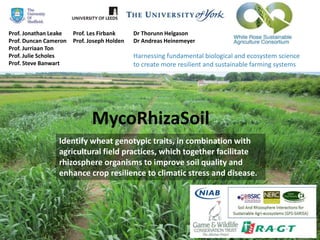
Identify wheat genotypic traits, in combination with
agricultural field practices, which together facilitate
rhizosphere organisms to improve soil quality and
enhance crop resilience to climatic stress and disease.
Prof. Jonathan Leake
Prof. Duncan Cameron
Prof. Jurriaan Ton
Prof. Julie Scholes
Prof. Steve Banwart
Prof. Les Firbank
Prof. Joseph Holden
Dr Thorunn Helgason
Dr Andreas Heinemeyer
Dr Richard Summers
Peter Burgis
Oliver Pilbeam
MycoRhizaSoil
Dr Alastair Leake
Dr Nicola Hinton
Harnessing fundamental biological and ecosystem science
to create more resilient and sustainable farming systems
Identify wheat genotypic traits, in combination with
agricultural field practices, which together facilitate
rhizosphere organisms to improve soil quality and
enhance crop resilience to climatic stress and disease.
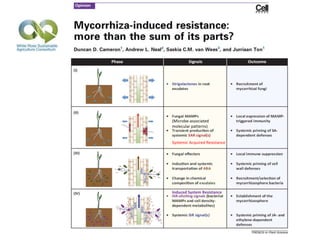
(Microbe-associated
molecular patterns)
Induced System Resistance
Systemic Acquired Resistance
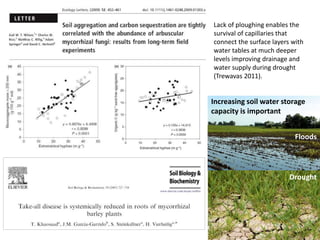
Floods
Drought
Increasing soil water storage
capacity is important
Lack of ploughing enables the
survival of capillaries that
connect the surface layers with
water tables at much deeper
levels improving drainage and
water supply during drought
(Trewavas 2011).
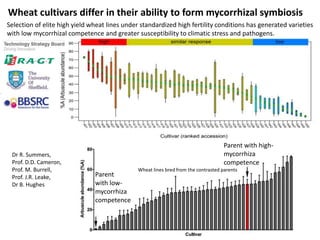
Wheat cultivars differ in their ability to form mycorrhizal symbiosis
Dr R. Summers,
Prof. D.D. Cameron,
Prof. M. Burrell,
Prof. J.R. Leake,
Dr B. Hughes
Selection of elite high yield wheat lines under standardized high fertility conditions has generated varieties
with low mycorrhizal competence and greater susceptibility to climatic stress and pathogens.
Parent
with low-
mycorrhiza
competence
Parent with high-
mycorrhiza
competence
Wheat lines bred from the contrasted parents
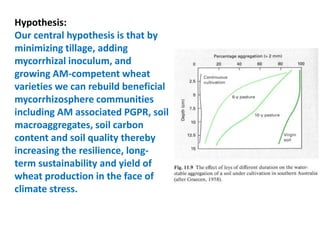
Hypothesis:
Our central hypothesis is that by
minimizing tillage, adding
mycorrhizal inoculum, and
growing AM-competent wheat
varieties we can rebuild beneficial
mycorrhizosphere communities
including AM associated PGPR, soil
macroaggregates, soil carbon
content and soil quality thereby
increasing the resilience, long-
term sustainability and yield of
wheat production in the face of
climate stress.
MycoRhizaSoil
Research Objectives
To address 3 major needs and opportunities in relation to sustainable
wheat production using selected pairs of double-haploid wheat lines
bred from parents with contrasting mycorrhizal competence:
1. Determine the benefits of arbuscular mycorrhiza (AM) competent wheat for soil
quality (macroaggregate abundance, organic carbon, drainage and water-holding
capacity) and maintaining yields under typical climatic and biotic stresses.
2. Establish the mechanistic basis of synergistic benefits of mycorrhiza
competent wheat arising from AM x Plant Growth Promoting Rhizobacteria
interactions increasing resistance to the major pathogens Take-All and Leaf
Blotch (Gaeumannomyces graminis var. Tritici, Septoria tritici).
3. Determine the efficacy of wheat genotypic traits in combination with
management change (use of commercial AM inoculants, switch to minimal
tillage, and use of grass leys) to restore AM functioning, beneficial
rhizobacteria, soil structure, carbon storage and related soil quality.
Establish resulting benefits from increased crop resilience to drought and
excess rainfall, resistance to pathogens and sustainable yields.
MycoRhizaSoil
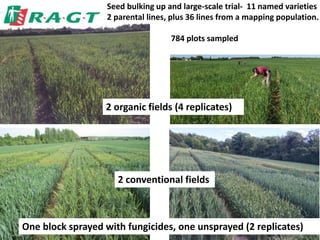
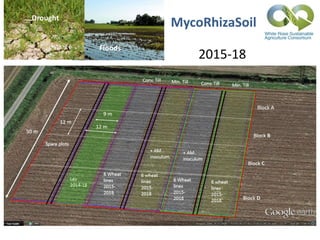
Seed bulking up and large-scale trial- 11 named varieties
2 parental lines, plus 36 lines from a mapping population.
784 plots sampled
2 organic fields (4 replicates)
2 conventional fields
One block sprayed with fungicides, one unsprayed (2 replicates)
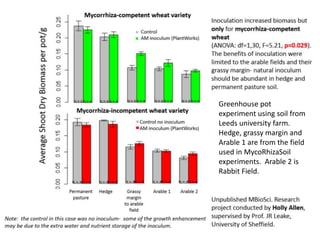
Greenhouse pot
experiment using soil from
Leeds university farm.
Hedge, grassy margin and
Arable 1 are from the field
used in MycoRhizaSoil
experiments. Arable 2 is
Rabbit Field.
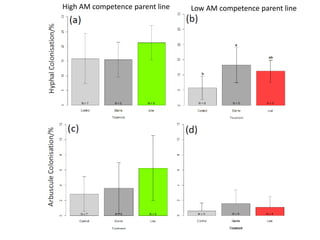
High AM competence parent line Low AM competence parent line
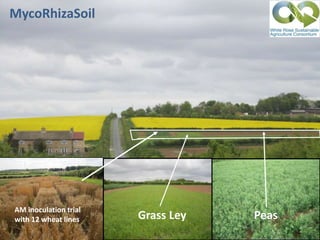
Grass Ley Peas
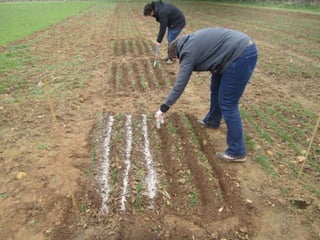
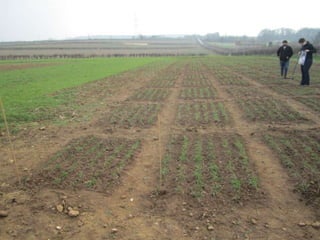
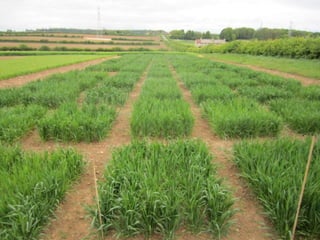
AM inoculation trial
with 12 wheat lines
MycoRhizaSoil
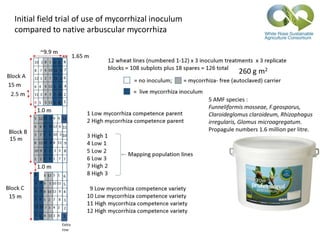
260 g m2
Initial field trial of use of mycorrhizal inoculum
compared to native arbuscular mycorrhiza
5 AMF species :
Funneliformis mosseae, F.geosporus,
Claroideglomus claroideum, Rhizophagus
irregularis, Glomus microagregatum.
Propagule numbers 1.6 million per litre.
1
12
Control
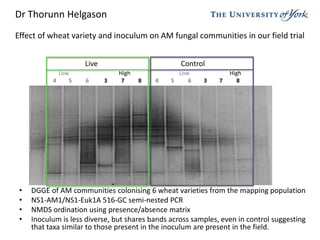
Low High Low High
4 5 6 3 7 8 4 5 6 3 7 8
Live Control
• DGGE of AM communities colonising 6 wheat varieties from the mapping population
• NS1-AM1/NS1-Euk1A 516-GC semi-nested PCR
• NMDS ordination using presence/absence matrix
• Inoculum is less diverse, but shares bands across samples, even in control suggesting
that taxa similar to those present in the inoculum are present in the field.
Dr Thorunn Helgason
Effect of wheat variety and inoculum on AM fungal communities in our field trial
-1.0 -0.5 0.0 0.5 1.0
-1.0-0.50.00.51.0
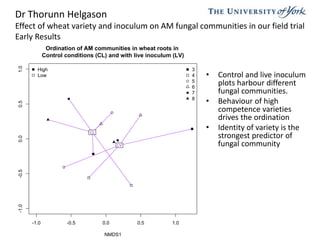
Ordination of AM communities in wheat roots in
Control conditions (CL) and with live inoculum (LV)
NMDS1
NMDS2
3
4
5
6
7
8
High
Low
CL
LV
• Control and live inoculum
plots harbour different
fungal communities.
• Behaviour of high
competence varieties
drives the ordination
• Identity of variety is the
strongest predictor of
fungal community
Dr Thorunn Helgason
Effect of wheat variety and inoculum on AM fungal communities in our field trial
Early Results
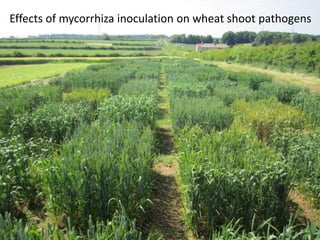
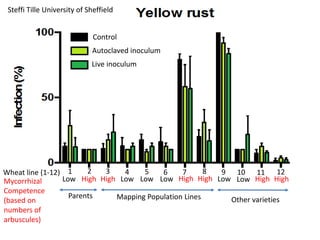
Effects of mycorrhiza inoculation on wheat shoot pathogens
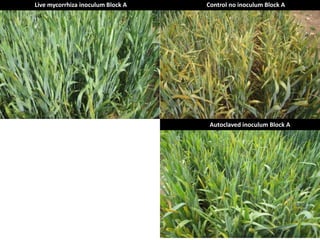
Live mycorrhiza inoculum Block A Control no inoculum Block A
Autoclaved inoculum Block A
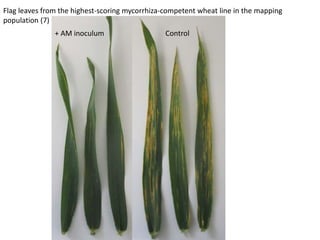
Flag leaves from the highest-scoring mycorrhiza-competent wheat line in the mapping
population (7)
+ AM inoculum Control
Low Low Low LowHigh High High High High HighLow Low
Control
Autoclaved inoculum
Live inoculum
Mycorrhizal
Competence
(based on
numbers of
arbuscules)
Parents Mapping Population Lines Other varieties
1 2 3 4 5 6 7 8 9 10 11 12
Steffi Tille University of Sheffield
Wheat line (1-12)
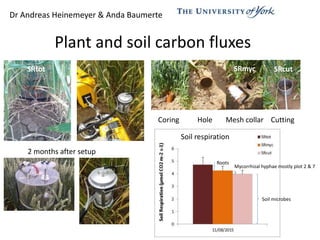
Plant and soil carbon fluxes
2 months after setup
Coring Hole Mesh collar Cutting
SRtot SRmyc SRcut
Roots
Mycorrhizal hyphae mostly plot 2 & 7
Soil microbes
Dr Andreas Heinemeyer & Anda Baumerte
Soil respiration
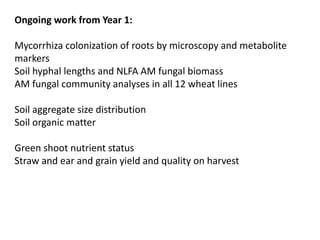
Ongoing work from Year 1:
Mycorrhiza colonization of roots by microscopy and metabolite
markers
Soil hyphal lengths and NLFA AM fungal biomass
AM fungal community analyses in all 12 wheat lines
Soil aggregate size distribution
Soil organic matter
Green shoot nutrient status
Straw and ear and grain yield and quality on harvest
MycoRhizaSoil
2015-18
Floods
Drought
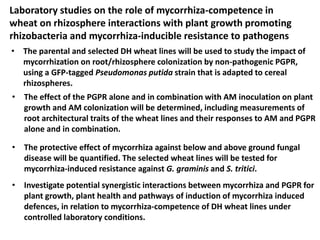
• The parental and selected DH wheat lines will be used to study the impact of
mycorrhization on root/rhizosphere colonization by non-pathogenic PGPR,
using a GFP-tagged Pseudomonas putida strain that is adapted to cereal
rhizospheres.
Laboratory studies on the role of mycorrhiza-competence in
wheat on rhizosphere interactions with plant growth promoting
rhizobacteria and mycorrhiza-inducible resistance to pathogens
• The effect of the PGPR alone and in combination with AM inoculation on plant
growth and AM colonization will be determined, including measurements of
root architectural traits of the wheat lines and their responses to AM and PGPR
alone and in combination.
• The protective effect of mycorrhiza against below and above ground fungal
disease will be quantified. The selected wheat lines will be tested for
mycorrhiza-induced resistance against G. graminis and S. tritici.
• Investigate potential synergistic interactions between mycorrhiza and PGPR for
plant growth, plant health and pathways of induction of mycorrhiza induced
defences, in relation to mycorrhiza-competence of DH wheat lines under
controlled laboratory conditions.
MycorrhizaSoil
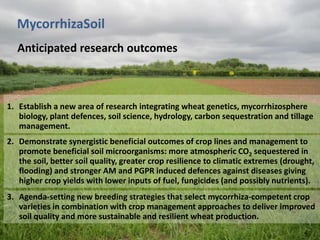
1. Establish a new area of research integrating wheat genetics, mycorrhizosphere
biology, plant defences, soil science, hydrology, carbon sequestration and tillage
management.
2. Demonstrate synergistic beneficial outcomes of crop lines and management to
promote beneficial soil microorganisms: more atmospheric CO2 sequestered in
the soil, better soil quality, greater crop resilience to climatic extremes (drought,
flooding) and stronger AM and PGPR induced defences against diseases giving
higher crop yields with lower inputs of fuel, fungicides (and possibly nutrients).
3. Agenda-setting new breeding strategies that select mycorrhiza-competent crop
varieties in combination with crop management approaches to deliver improved
soil quality and more sustainable and resilient wheat production.
Anticipated research outcomes
Acknowledgements:
Dr Alastair Leake
Dr Nicola Hinton Dr Richard Summers
Peter Burgis
Oliver Pilbeam
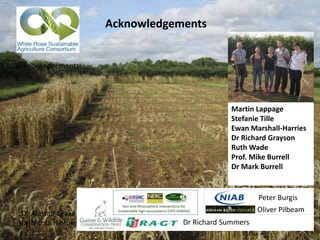
Martin Lappage
Stefanie Tille
Ewan Marshall-Harries
Dr Richard Grayson
Ruth Wade
Prof. Mike Burrell
Dr Mark Burrell
Acknowledgements
MycoRhizaSoil

MycoRhizaSoil

  • 1.
    MycoRhizaSoil Identify wheat genotypictraits, in combination with agricultural field practices, which together facilitate rhizosphere organisms to improve soil quality and enhance crop resilience to climatic stress and disease. Prof. Jonathan Leake Prof. Duncan Cameron Prof. Jurriaan Ton Prof. Julie Scholes Prof. Steve Banwart Prof. Les Firbank Prof. Joseph Holden Dr Thorunn Helgason Dr Andreas Heinemeyer Dr Richard Summers Peter Burgis Oliver Pilbeam MycoRhizaSoil Dr Alastair Leake Dr Nicola Hinton Harnessing fundamental biological and ecosystem science to create more resilient and sustainable farming systems Identify wheat genotypic traits, in combination with agricultural field practices, which together facilitate rhizosphere organisms to improve soil quality and enhance crop resilience to climatic stress and disease.
  • 3.
    (Microbe-associated molecular patterns) Induced SystemResistance Systemic Acquired Resistance
  • 4.
    Floods Drought Increasing soil waterstorage capacity is important Lack of ploughing enables the survival of capillaries that connect the surface layers with water tables at much deeper levels improving drainage and water supply during drought (Trewavas 2011).
  • 5.
    Wheat cultivars differin their ability to form mycorrhizal symbiosis Dr R. Summers, Prof. D.D. Cameron, Prof. M. Burrell, Prof. J.R. Leake, Dr B. Hughes Selection of elite high yield wheat lines under standardized high fertility conditions has generated varieties with low mycorrhizal competence and greater susceptibility to climatic stress and pathogens. Parent with low- mycorrhiza competence Parent with high- mycorrhiza competence Wheat lines bred from the contrasted parents
  • 6.
    Hypothesis: Our central hypothesisis that by minimizing tillage, adding mycorrhizal inoculum, and growing AM-competent wheat varieties we can rebuild beneficial mycorrhizosphere communities including AM associated PGPR, soil macroaggregates, soil carbon content and soil quality thereby increasing the resilience, long- term sustainability and yield of wheat production in the face of climate stress.
  • 7.
    MycoRhizaSoil Research Objectives To address3 major needs and opportunities in relation to sustainable wheat production using selected pairs of double-haploid wheat lines bred from parents with contrasting mycorrhizal competence: 1. Determine the benefits of arbuscular mycorrhiza (AM) competent wheat for soil quality (macroaggregate abundance, organic carbon, drainage and water-holding capacity) and maintaining yields under typical climatic and biotic stresses. 2. Establish the mechanistic basis of synergistic benefits of mycorrhiza competent wheat arising from AM x Plant Growth Promoting Rhizobacteria interactions increasing resistance to the major pathogens Take-All and Leaf Blotch (Gaeumannomyces graminis var. Tritici, Septoria tritici). 3. Determine the efficacy of wheat genotypic traits in combination with management change (use of commercial AM inoculants, switch to minimal tillage, and use of grass leys) to restore AM functioning, beneficial rhizobacteria, soil structure, carbon storage and related soil quality. Establish resulting benefits from increased crop resilience to drought and excess rainfall, resistance to pathogens and sustainable yields.
  • 8.
  • 9.
    Seed bulking upand large-scale trial- 11 named varieties 2 parental lines, plus 36 lines from a mapping population. 784 plots sampled 2 organic fields (4 replicates) 2 conventional fields One block sprayed with fungicides, one unsprayed (2 replicates)
  • 10.
    Greenhouse pot experiment usingsoil from Leeds university farm. Hedge, grassy margin and Arable 1 are from the field used in MycoRhizaSoil experiments. Arable 2 is Rabbit Field.
  • 11.
    High AM competenceparent line Low AM competence parent line
  • 12.
    Grass Ley Peas AMinoculation trial with 12 wheat lines MycoRhizaSoil
  • 13.
    260 g m2 Initialfield trial of use of mycorrhizal inoculum compared to native arbuscular mycorrhiza 5 AMF species : Funneliformis mosseae, F.geosporus, Claroideglomus claroideum, Rhizophagus irregularis, Glomus microagregatum. Propagule numbers 1.6 million per litre. 1 12
  • 17.
    Control Low High LowHigh 4 5 6 3 7 8 4 5 6 3 7 8 Live Control • DGGE of AM communities colonising 6 wheat varieties from the mapping population • NS1-AM1/NS1-Euk1A 516-GC semi-nested PCR • NMDS ordination using presence/absence matrix • Inoculum is less diverse, but shares bands across samples, even in control suggesting that taxa similar to those present in the inoculum are present in the field. Dr Thorunn Helgason Effect of wheat variety and inoculum on AM fungal communities in our field trial
  • 18.
    -1.0 -0.5 0.00.5 1.0 -1.0-0.50.00.51.0 Ordination of AM communities in wheat roots in Control conditions (CL) and with live inoculum (LV) NMDS1 NMDS2 3 4 5 6 7 8 High Low CL LV • Control and live inoculum plots harbour different fungal communities. • Behaviour of high competence varieties drives the ordination • Identity of variety is the strongest predictor of fungal community Dr Thorunn Helgason Effect of wheat variety and inoculum on AM fungal communities in our field trial Early Results
  • 19.
    Effects of mycorrhizainoculation on wheat shoot pathogens
  • 20.
    Live mycorrhiza inoculumBlock A Control no inoculum Block A Autoclaved inoculum Block A
  • 21.
    Flag leaves fromthe highest-scoring mycorrhiza-competent wheat line in the mapping population (7) + AM inoculum Control
  • 22.
    Low Low LowLowHigh High High High High HighLow Low Control Autoclaved inoculum Live inoculum Mycorrhizal Competence (based on numbers of arbuscules) Parents Mapping Population Lines Other varieties 1 2 3 4 5 6 7 8 9 10 11 12 Steffi Tille University of Sheffield Wheat line (1-12)
  • 23.
    Plant and soilcarbon fluxes 2 months after setup Coring Hole Mesh collar Cutting SRtot SRmyc SRcut Roots Mycorrhizal hyphae mostly plot 2 & 7 Soil microbes Dr Andreas Heinemeyer & Anda Baumerte Soil respiration
  • 24.
    Ongoing work fromYear 1: Mycorrhiza colonization of roots by microscopy and metabolite markers Soil hyphal lengths and NLFA AM fungal biomass AM fungal community analyses in all 12 wheat lines Soil aggregate size distribution Soil organic matter Green shoot nutrient status Straw and ear and grain yield and quality on harvest
  • 25.
  • 26.
    • The parentaland selected DH wheat lines will be used to study the impact of mycorrhization on root/rhizosphere colonization by non-pathogenic PGPR, using a GFP-tagged Pseudomonas putida strain that is adapted to cereal rhizospheres. Laboratory studies on the role of mycorrhiza-competence in wheat on rhizosphere interactions with plant growth promoting rhizobacteria and mycorrhiza-inducible resistance to pathogens • The effect of the PGPR alone and in combination with AM inoculation on plant growth and AM colonization will be determined, including measurements of root architectural traits of the wheat lines and their responses to AM and PGPR alone and in combination. • The protective effect of mycorrhiza against below and above ground fungal disease will be quantified. The selected wheat lines will be tested for mycorrhiza-induced resistance against G. graminis and S. tritici. • Investigate potential synergistic interactions between mycorrhiza and PGPR for plant growth, plant health and pathways of induction of mycorrhiza induced defences, in relation to mycorrhiza-competence of DH wheat lines under controlled laboratory conditions.
  • 27.
    MycorrhizaSoil 1. Establish anew area of research integrating wheat genetics, mycorrhizosphere biology, plant defences, soil science, hydrology, carbon sequestration and tillage management. 2. Demonstrate synergistic beneficial outcomes of crop lines and management to promote beneficial soil microorganisms: more atmospheric CO2 sequestered in the soil, better soil quality, greater crop resilience to climatic extremes (drought, flooding) and stronger AM and PGPR induced defences against diseases giving higher crop yields with lower inputs of fuel, fungicides (and possibly nutrients). 3. Agenda-setting new breeding strategies that select mycorrhiza-competent crop varieties in combination with crop management approaches to deliver improved soil quality and more sustainable and resilient wheat production. Anticipated research outcomes
  • 28.
    Acknowledgements: Dr Alastair Leake DrNicola Hinton Dr Richard Summers Peter Burgis Oliver Pilbeam Martin Lappage Stefanie Tille Ewan Marshall-Harries Dr Richard Grayson Ruth Wade Prof. Mike Burrell Dr Mark Burrell Acknowledgements