Unit 4:
Transposons
Molecular Biology
(21BTG2T441)
Semester: IV
Dr. Nibedita Pradhan
Department of Life Science
Kristu Jayanti College
March 2023
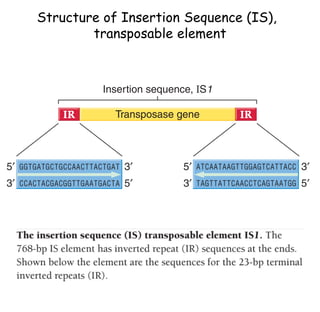
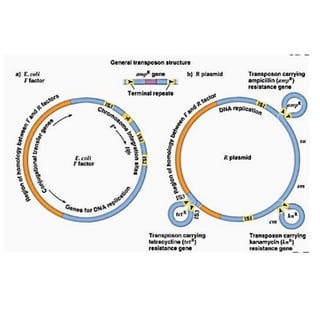
Structure of Insertion Sequence (IS),
transposable element
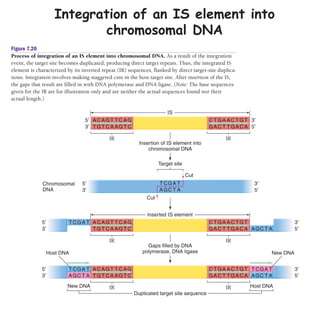
Integration of an IS element into
chromosomal DNA
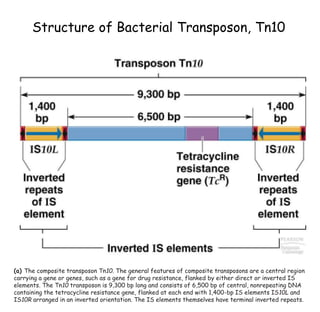
Structure of Bacterial Transposon, Tn10
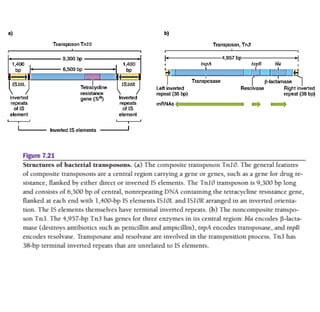
(a) The composite transposon Tn10. The general features of composite transposons are a central region
carrying a gene or genes, such as a gene for drug resistance, flanked by either direct or inverted IS
elements. The Tn10 transposon is 9,300 bp long and consists of 6,500 bp of central, nonrepeating DNA
containing the tetracycline resistance gene, flanked at each end with 1,400-bp IS elements IS10L and
IS10R arranged in an inverted orientation. The IS elements themselves have terminal inverted repeats.
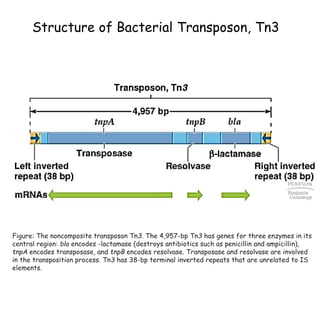
Structure of Bacterial Transposon, Tn3
Figure: The noncomposite transposon Tn3. The 4,957-bp Tn3 has genes for three enzymes in its
central region: bla encodes -lactamase (destroys antibiotics such as penicillin and ampicillin),
tnpA encodes transposase, and tnpB encodes resolvase. Transposase and resolvase are involved
in the transposition process. Tn3 has 38-bp terminal inverted repeats that are unrelated to IS
elements.
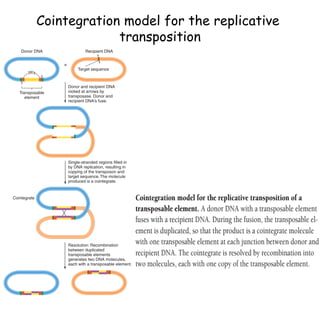
Cointegration model for the replicative
transposition
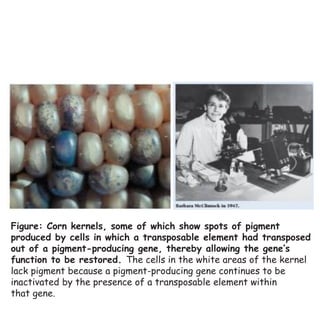
Figure: Corn kernels, some of which show spots of pigment
produced by cells in which a transposable element had transposed
out of a pigment-producing gene, thereby allowing the gene’s
function to be restored. The cells in the white areas of the kernel
lack pigment because a pigment-producing gene continues to be
inactivated by the presence of a transposable element within
that gene.
❑Like some of the transposable elements discussed earlier, plant
transposable elements have inverted repeated (IR) sequences at their
ends and generate short, direct repeats of the target-site DNA when
they integrate
❑May be Autonomous or Non-autonomous
❑Autonomous elements, which can transpose by themselves, and
nonautonomous elements, which cannot transpose by themselves because
they lack the gene for transposition
❑The nonautonomous elements require an autonomous element to supply the
missing functions. Often, the nonautonomous element is a defective
derivative of the autonomous element in the family. When an autonomous
element is inserted into a host gene, the resulting mutant allele is
unstable, because the element can excise and transpose to a new location.
This transposition event results in restoration of function of the gene.
❑ The frequency of transposition out of a gene is higher than the
spontaneous reversion frequency for a regular point mutation; therefore,
the allele produced by an autonomous element is called a mutable allele.
❑By contrast, mutant alleles resulting from the insertion of a
nonautonomous element in a gene are stable, because the element is
unable to transpose out of the locus by itself.
Plant Transposons
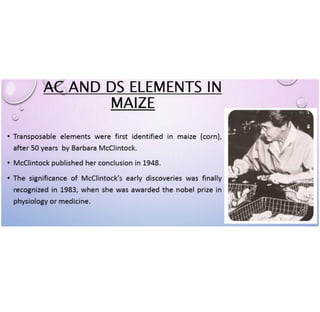
McClintock’s Discovery of Transposons in Corn
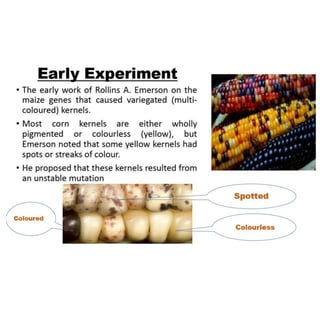
• McClintock discovered that the cause of the unstable mutation
was a gene that moved.
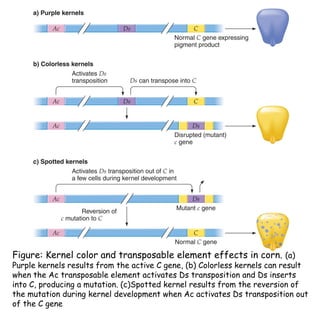
• c/c = White kernels; C/C= Purple Kernels .
• If reversion of c to C occurs in a cell, cell will produce purple
pigment and a spot.
• She concluded “c” allele results from an non- autonomous
transposon called the “Ds” inserted into the “C” gene. Ds=Dissociation
• But only if another gene, the activator (Ac), also was present.
Figure: Kernel color and transposable element effects in corn. (a)
Purple kernels results from the active C gene, (b) Colorless kernels can result
when the Ac transposable element activates Ds transposition and Ds inserts
into C, producing a mutation. (c)Spotted kernel results from the reversion of
the mutation during kernel development when Ac activates Ds transposition out
of the C gene
❑ A Ds element, transposing under the influence of a nearby Ac
element, may insert into the C allele, destroying its ability to
produce pigment.
❑ After the transposition of Ds into the C allele, this kernel will
be colorless (white or yellow), because neither the Ct nor the c
allele confers pigment.
❑The Ac-Ds family of controlling elements has been studied
in detail. The autonomous Ac element is 4,563 bp long, with
short terminal inverted repeats and a single gene encoding
the transposase.
❑Upon insertion into the genome, it generates an 8-bp direct
duplication of the target site
❑Ds elements are heterogeneous in length and sequence, but
all have the same terminal IRs as Ac elements, because
most have been generated from Ac by the deletion of
segments or by more complex sequence rearrangements
❑As a result, Ds elements have no complete transposase
gene; hence, these elements cannot transpose on their own.
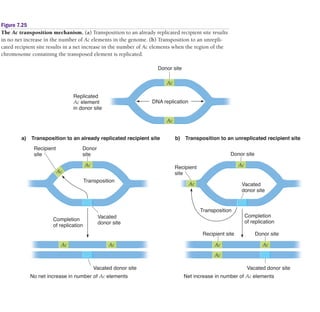
❑Transposition of the Ac element occurs only during
chromosome replication and is a result of the cut-and paste
(conservative) transposition mechanism
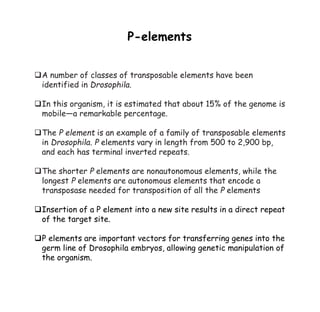
❑A number of classes of transposable elements have been
identified in Drosophila.
❑In this organism, it is estimated that about 15% of the genome is
mobile—a remarkable percentage.
❑The P element is an example of a family of transposable elements
in Drosophila. P elements vary in length from 500 to 2,900 bp,
and each has terminal inverted repeats.
❑The shorter P elements are nonautonomous elements, while the
longest P elements are autonomous elements that encode a
transposase needed for transposition of all the P elements
❑Insertion of a P element into a new site results in a direct repeat
of the target site.
❑P elements are important vectors for transferring genes into the
germ line of Drosophila embryos, allowing genetic manipulation of
the organism.
P-elements
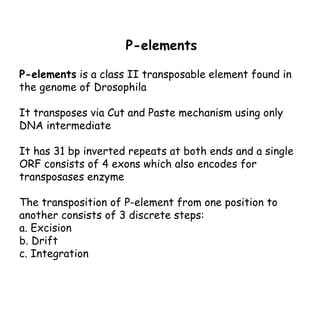
P-elements
P-elements is a class II transposable element found in
the genome of Drosophila
It transposes via Cut and Paste mechanism using only
DNA intermediate
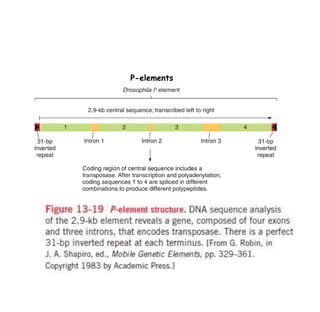
It has 31 bp inverted repeats at both ends and a single
ORF consists of 4 exons which also encodes for
transposases enzyme
The transposition of P-element from one position to
another consists of 3 discrete steps:
a. Excision
b. Drift
c. Integration
P-elements
P-elements
▪ The gene is transcribed to RNA, spliceosome removes the introns
▪ and joins the exons together
▪ The mature mRNA is translated to polypeptide that folds into transposase
▪ The transposases recognize and bind to the TIRs of transposons and
multimerize
▪ It facilitates the excision of entire transposons from DNA
▪ The transposons move with the transposases which is drift step to the
recipient site
▪ There the transposase will cut the DNA and facilitate the insertion of
transposon. Integrated P-elements always flanked by 8 bp direct repeats
originated from the genomic seq. of the insertion site.
P-elements
Diversity of P-elements:
▪ Autonomous: Intact TIR and 4 coding genes
▪ Non-autonomous: Deletion in the exons of the coding
genes of transposase, preventing the expression of
functional transposase protein
▪ Immobile: with degraded TIR; these are locked in
their current genomic position as they can not be
excised by transposases
P-elements
❑ There are 2 strains of Drosophila :
▪ M-strain (without P-elements)
▪ P-strain (with P-elements)
❑ In P-strain flies P-element can’t transpose in Somatic cells except
the germ line cell as somatic cells are lack of enzyme necessary for splicing
event to generate functional Transposase, so transposition only occur in
Germ line cells.
❑ This phenomena resulting from the movement of P-element in germ-line
cells is known as Hybrid Dysgenesis.
❑ Now Cross between 2 M strain flies no offspring carry P-element
❑ But cross between P strain-male and M-strain female : Hybrid Dysgenesis
occour
❑ P elements are commonly used as mutagenic agents in genetic experiments
with Drosophila. One advantage of this approach is that the mutations are
easy to locate.
❑ In hybrid dysgenesis, one strain of Drosophila mates with another strain
of Drosophila, producing hybrid offspring and causing chromosomal damage
known to be dysgenic.
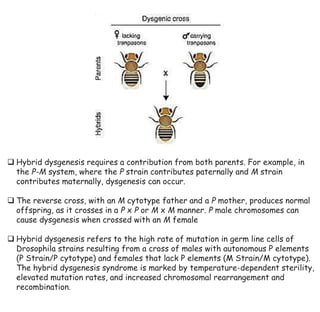
❑ Hybrid dysgenesis requires a contribution from both parents. For example, in
the P-M system, where the P strain contributes paternally and M strain
contributes maternally, dysgenesis can occur.
❑ The reverse cross, with an M cytotype father and a P mother, produces normal
offspring, as it crosses in a P x P or M x M manner. P male chromosomes can
cause dysgenesis when crossed with an M female
❑ Hybrid dysgenesis refers to the high rate of mutation in germ line cells of
Drosophila strains resulting from a cross of males with autonomous P elements
(P Strain/P cytotype) and females that lack P elements (M Strain/M cytotype).
The hybrid dysgenesis syndrome is marked by temperature-dependent sterility,
elevated mutation rates, and increased chromosomal rearrangement and
recombination.
❑ The hybrid dysgenesis phenotype is affected by the
transposition of P elements within the germ-line cells of
offspring of P strain males with M strain females. Transposition
only occurs in germ-line cells, because a splicing event needed to
make transposase mRNA does not occur in somatic cells.
❑ Hybrid dysgenesis manifests when crossing P strain males with
M strain females and not when crossing P strain females
(females with autonomous P elements) with M strain males. The
eggs of P strain females contain high amounts of a repressor
protein that prevents transcription of the transposase gene. The
eggs of M strain mothers, which do not contain the repressor
protein, allow for transposition of P elements from the sperm of
fathers. In P strain females, the repressors are found in the
cytoplasm. Hence, when P strain males fertilize M strain females
(whose cytoplasm contain no repressor), the male contributes its
genome with the P element but not the male cytoplasm leading to
P strain progeny.
❑ This effect contributes to piRNAs being inherited only in the
maternal line, which provides a defense mechanism against P
elements.
Use in molecular biology:
❑ The P element has found wide use in Drosophila research as a
mutagen.
❑ The mutagenesis system typically uses an autonomous but
immobile element, and a mobile nonautonomous element. Flies
from subsequent generations can then be screened by phenotype
or PCR. Naturally-occurring P elements contain coding sequence
for the enzyme transposase and recognition sequences for
transposase action. Transposase regulates and catalyzes the
excision of a P element from the host DNA, cutting at the two
recognition sites, and then reinserting randomly. It is the random
insertion that may interfere with existing genes, or carry an
additional gene, that can be used for genetic research.
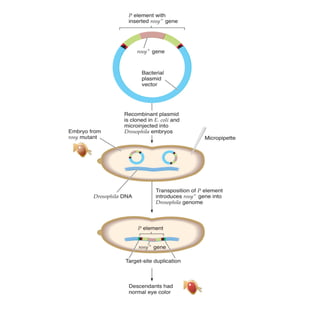
❑ To use this as a useful and controllable genetic tool, the two
parts of the P element must be separated to prevent
uncontrolled transposition. The normal genetic tools are DNA
coding for transposase, with no transposase recognition
sequences, as it cannot insert with a "P Plasmid". P Plasmids
always contain a Drosophila reporter gene, often a red-eye
marker (the product of the white gene), and transposase
recognition sequences. They may contain a gene of interest, an E.
coli selectable marker gene, often some kind of antibiotic
resistance, an origin of replication or other
associated plasmid "housekeeping" sequences.
transposable element.pdf

transposable element.pdf

  • 1.
    Unit 4: Transposons Molecular Biology (21BTG2T441) Semester:IV Dr. Nibedita Pradhan Department of Life Science Kristu Jayanti College March 2023
  • 2.
    Structure of InsertionSequence (IS), transposable element
  • 3.
    Integration of anIS element into chromosomal DNA
  • 4.
    Structure of BacterialTransposon, Tn10 (a) The composite transposon Tn10. The general features of composite transposons are a central region carrying a gene or genes, such as a gene for drug resistance, flanked by either direct or inverted IS elements. The Tn10 transposon is 9,300 bp long and consists of 6,500 bp of central, nonrepeating DNA containing the tetracycline resistance gene, flanked at each end with 1,400-bp IS elements IS10L and IS10R arranged in an inverted orientation. The IS elements themselves have terminal inverted repeats.
  • 5.
    Structure of BacterialTransposon, Tn3 Figure: The noncomposite transposon Tn3. The 4,957-bp Tn3 has genes for three enzymes in its central region: bla encodes -lactamase (destroys antibiotics such as penicillin and ampicillin), tnpA encodes transposase, and tnpB encodes resolvase. Transposase and resolvase are involved in the transposition process. Tn3 has 38-bp terminal inverted repeats that are unrelated to IS elements.
  • 7.
    Cointegration model forthe replicative transposition
  • 9.
    Figure: Corn kernels,some of which show spots of pigment produced by cells in which a transposable element had transposed out of a pigment-producing gene, thereby allowing the gene’s function to be restored. The cells in the white areas of the kernel lack pigment because a pigment-producing gene continues to be inactivated by the presence of a transposable element within that gene.
  • 11.
    ❑Like some ofthe transposable elements discussed earlier, plant transposable elements have inverted repeated (IR) sequences at their ends and generate short, direct repeats of the target-site DNA when they integrate ❑May be Autonomous or Non-autonomous ❑Autonomous elements, which can transpose by themselves, and nonautonomous elements, which cannot transpose by themselves because they lack the gene for transposition ❑The nonautonomous elements require an autonomous element to supply the missing functions. Often, the nonautonomous element is a defective derivative of the autonomous element in the family. When an autonomous element is inserted into a host gene, the resulting mutant allele is unstable, because the element can excise and transpose to a new location. This transposition event results in restoration of function of the gene. ❑ The frequency of transposition out of a gene is higher than the spontaneous reversion frequency for a regular point mutation; therefore, the allele produced by an autonomous element is called a mutable allele. ❑By contrast, mutant alleles resulting from the insertion of a nonautonomous element in a gene are stable, because the element is unable to transpose out of the locus by itself. Plant Transposons
  • 13.
    McClintock’s Discovery ofTransposons in Corn • McClintock discovered that the cause of the unstable mutation was a gene that moved. • c/c = White kernels; C/C= Purple Kernels . • If reversion of c to C occurs in a cell, cell will produce purple pigment and a spot. • She concluded “c” allele results from an non- autonomous transposon called the “Ds” inserted into the “C” gene. Ds=Dissociation • But only if another gene, the activator (Ac), also was present.
  • 14.
    Figure: Kernel colorand transposable element effects in corn. (a) Purple kernels results from the active C gene, (b) Colorless kernels can result when the Ac transposable element activates Ds transposition and Ds inserts into C, producing a mutation. (c)Spotted kernel results from the reversion of the mutation during kernel development when Ac activates Ds transposition out of the C gene
  • 15.
    ❑ A Dselement, transposing under the influence of a nearby Ac element, may insert into the C allele, destroying its ability to produce pigment. ❑ After the transposition of Ds into the C allele, this kernel will be colorless (white or yellow), because neither the Ct nor the c allele confers pigment.
  • 16.
    ❑The Ac-Ds familyof controlling elements has been studied in detail. The autonomous Ac element is 4,563 bp long, with short terminal inverted repeats and a single gene encoding the transposase. ❑Upon insertion into the genome, it generates an 8-bp direct duplication of the target site ❑Ds elements are heterogeneous in length and sequence, but all have the same terminal IRs as Ac elements, because most have been generated from Ac by the deletion of segments or by more complex sequence rearrangements ❑As a result, Ds elements have no complete transposase gene; hence, these elements cannot transpose on their own. ❑Transposition of the Ac element occurs only during chromosome replication and is a result of the cut-and paste (conservative) transposition mechanism
  • 18.
    ❑A number ofclasses of transposable elements have been identified in Drosophila. ❑In this organism, it is estimated that about 15% of the genome is mobile—a remarkable percentage. ❑The P element is an example of a family of transposable elements in Drosophila. P elements vary in length from 500 to 2,900 bp, and each has terminal inverted repeats. ❑The shorter P elements are nonautonomous elements, while the longest P elements are autonomous elements that encode a transposase needed for transposition of all the P elements ❑Insertion of a P element into a new site results in a direct repeat of the target site. ❑P elements are important vectors for transferring genes into the germ line of Drosophila embryos, allowing genetic manipulation of the organism. P-elements
  • 19.
    P-elements P-elements is aclass II transposable element found in the genome of Drosophila It transposes via Cut and Paste mechanism using only DNA intermediate It has 31 bp inverted repeats at both ends and a single ORF consists of 4 exons which also encodes for transposases enzyme The transposition of P-element from one position to another consists of 3 discrete steps: a. Excision b. Drift c. Integration
  • 20.
  • 21.
    P-elements ▪ The geneis transcribed to RNA, spliceosome removes the introns ▪ and joins the exons together ▪ The mature mRNA is translated to polypeptide that folds into transposase ▪ The transposases recognize and bind to the TIRs of transposons and multimerize ▪ It facilitates the excision of entire transposons from DNA ▪ The transposons move with the transposases which is drift step to the recipient site ▪ There the transposase will cut the DNA and facilitate the insertion of transposon. Integrated P-elements always flanked by 8 bp direct repeats originated from the genomic seq. of the insertion site.
  • 22.
    P-elements Diversity of P-elements: ▪Autonomous: Intact TIR and 4 coding genes ▪ Non-autonomous: Deletion in the exons of the coding genes of transposase, preventing the expression of functional transposase protein ▪ Immobile: with degraded TIR; these are locked in their current genomic position as they can not be excised by transposases
  • 23.
    P-elements ❑ There are2 strains of Drosophila : ▪ M-strain (without P-elements) ▪ P-strain (with P-elements) ❑ In P-strain flies P-element can’t transpose in Somatic cells except the germ line cell as somatic cells are lack of enzyme necessary for splicing event to generate functional Transposase, so transposition only occur in Germ line cells. ❑ This phenomena resulting from the movement of P-element in germ-line cells is known as Hybrid Dysgenesis. ❑ Now Cross between 2 M strain flies no offspring carry P-element ❑ But cross between P strain-male and M-strain female : Hybrid Dysgenesis occour ❑ P elements are commonly used as mutagenic agents in genetic experiments with Drosophila. One advantage of this approach is that the mutations are easy to locate. ❑ In hybrid dysgenesis, one strain of Drosophila mates with another strain of Drosophila, producing hybrid offspring and causing chromosomal damage known to be dysgenic.
  • 24.
    ❑ Hybrid dysgenesisrequires a contribution from both parents. For example, in the P-M system, where the P strain contributes paternally and M strain contributes maternally, dysgenesis can occur. ❑ The reverse cross, with an M cytotype father and a P mother, produces normal offspring, as it crosses in a P x P or M x M manner. P male chromosomes can cause dysgenesis when crossed with an M female ❑ Hybrid dysgenesis refers to the high rate of mutation in germ line cells of Drosophila strains resulting from a cross of males with autonomous P elements (P Strain/P cytotype) and females that lack P elements (M Strain/M cytotype). The hybrid dysgenesis syndrome is marked by temperature-dependent sterility, elevated mutation rates, and increased chromosomal rearrangement and recombination.
  • 25.
    ❑ The hybriddysgenesis phenotype is affected by the transposition of P elements within the germ-line cells of offspring of P strain males with M strain females. Transposition only occurs in germ-line cells, because a splicing event needed to make transposase mRNA does not occur in somatic cells. ❑ Hybrid dysgenesis manifests when crossing P strain males with M strain females and not when crossing P strain females (females with autonomous P elements) with M strain males. The eggs of P strain females contain high amounts of a repressor protein that prevents transcription of the transposase gene. The eggs of M strain mothers, which do not contain the repressor protein, allow for transposition of P elements from the sperm of fathers. In P strain females, the repressors are found in the cytoplasm. Hence, when P strain males fertilize M strain females (whose cytoplasm contain no repressor), the male contributes its genome with the P element but not the male cytoplasm leading to P strain progeny. ❑ This effect contributes to piRNAs being inherited only in the maternal line, which provides a defense mechanism against P elements.
  • 26.
    Use in molecularbiology: ❑ The P element has found wide use in Drosophila research as a mutagen. ❑ The mutagenesis system typically uses an autonomous but immobile element, and a mobile nonautonomous element. Flies from subsequent generations can then be screened by phenotype or PCR. Naturally-occurring P elements contain coding sequence for the enzyme transposase and recognition sequences for transposase action. Transposase regulates and catalyzes the excision of a P element from the host DNA, cutting at the two recognition sites, and then reinserting randomly. It is the random insertion that may interfere with existing genes, or carry an additional gene, that can be used for genetic research. ❑ To use this as a useful and controllable genetic tool, the two parts of the P element must be separated to prevent uncontrolled transposition. The normal genetic tools are DNA coding for transposase, with no transposase recognition sequences, as it cannot insert with a "P Plasmid". P Plasmids always contain a Drosophila reporter gene, often a red-eye marker (the product of the white gene), and transposase recognition sequences. They may contain a gene of interest, an E. coli selectable marker gene, often some kind of antibiotic resistance, an origin of replication or other associated plasmid "housekeeping" sequences.