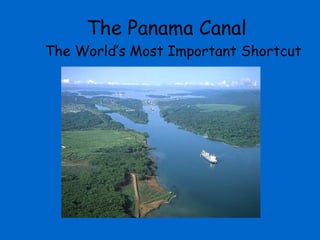
The Panama Canal
The World’s Most Important Shortcut
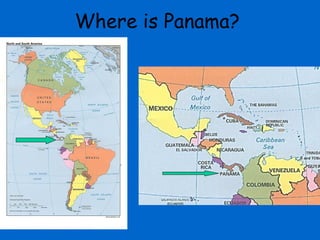
Where is Panama?
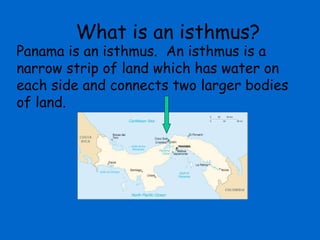
What is an isthmus?
Panama is an isthmus. An isthmus is a
narrow strip of land which has water on
each side and connects two larger bodies
of land.
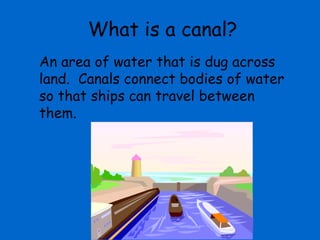
What is a canal?
An area of water that is dug across
land. Canals connect bodies of water
so that ships can travel between
them.
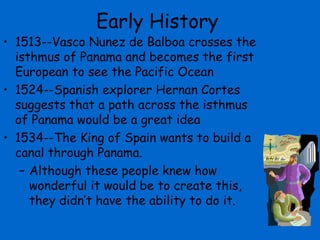
Early History
• 1513--Vasco Nunez de Balboa crosses the
  isthmus of Panama and becomes the first
  European to see the Pacific Ocean
• 1524--Spanish explorer Hernan Cortes
  suggests that a path across the isthmus
  of Panama would be a great idea
• 1534--The King of Spain wants to build a
  canal through Panama.
   – Although these people knew how
     wonderful it would be to create this,
     they didn’t have the ability to do it.
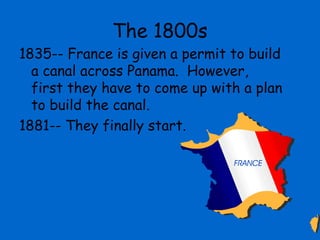
The 1800s
1835-- France is given a permit to build
  a canal across Panama. However,
  first they have to come up with a plan
  to build the canal.
1881-- They finally start.
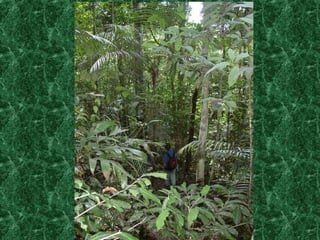
Building the Canal
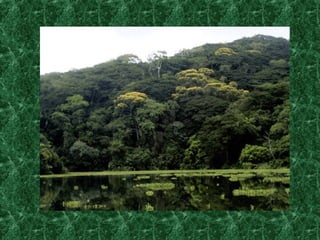
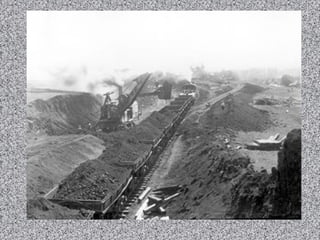
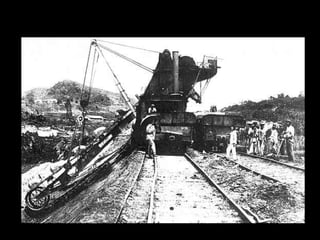
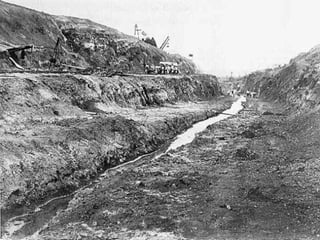
  The next few pictures show
what the area looked like when
the French started building the
 canal. What challenges do you
   think they faced building a
   canal in this type of area?
After looking at these pictures, what
do you think would be the challenges
 of trying to build a canal through a
   tropical jungle and mountains?
The French Give Up
• 1881--A French company begins
  construction on the canal.
• 1890--After eight years France gives
  up on the project.
  – Over 20,000 construction workers died
    working on the project for France
  – The company trying to build the canal
    goes bankrupt.
The United States


 • 1904 The United States begins
   working on the Canal.

 • 1914 The canal is completed.

 • 1977 The United States signs a
   treaty with Panama and agrees to give
   Panama control of the canal in 1999.
Why was it so important to
      build a canal?
• It is 1904. Theodore Roosevelt is
  president, and the United States is
  fast becoming one of the most
  powerful nations in the world. Such
  recent inventions as the telephone
  and the automobile make the 3,000
  mile-wide country seem a lot smaller.
Imagine you are living on the East Coast.
Your family is in the clothing business and
wants to sell clothes to new stores in San
Francisco. Of course, the clothes can’t
be loaded on a plane-there aren't any
planes, and trains are expensive for
shipping goods.
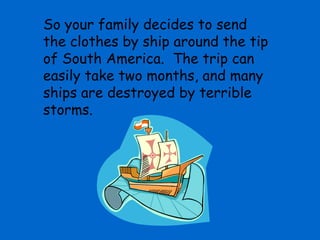
So your family decides to send
the clothes by ship around the tip
of South America. The trip can
easily take two months, and many
ships are destroyed by terrible
storms.
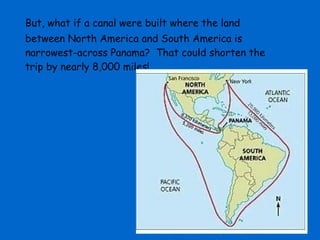
But, what if a canal were built where the land
between North America and South America is
narrowest-across Panama? That could shorten the
trip by nearly 8,000 miles!
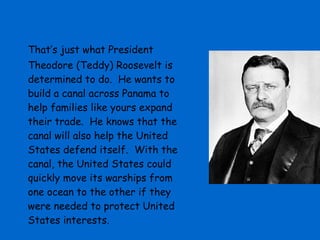
That’s just what President
Theodore (Teddy) Roosevelt is
determined to do. He wants to
build a canal across Panama to
help families like yours expand
their trade. He knows that the
canal will also help the United
States defend itself. With the
canal, the United States could
quickly move its warships from
one ocean to the other if they
were needed to protect United
States interests.
So the United States is ready to do what seemed
  impossible-to join the Atlantic and Pacific Oceans!


But a major decision had to be made. Should the canal be
  built at sea level like the Suez Canal?


Or should it follow the natural rise of the land? This would
 mean building locks (enclosed chambers with gates at
 each end) to raise and lower ships as they pass through
 the canal. Locks this big had never been made before.
 The decision was made in favor of having locks. Now
 they just had to figure out how to build them.
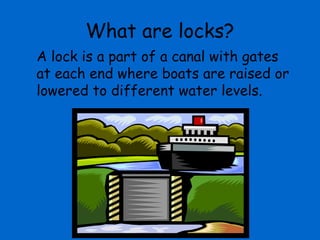
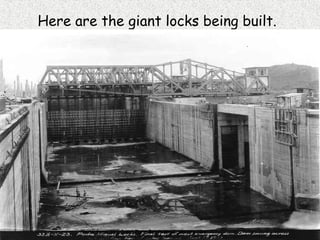
What are locks?
A lock is a part of a canal with gates
at each end where boats are raised or
lowered to different water levels.
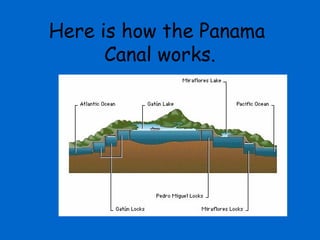
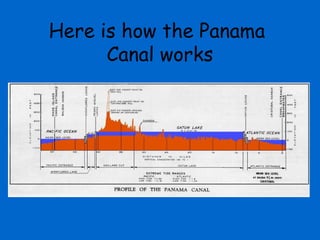
How do locks work?
The ship goes through a set of gates into a
lock chamber. The water in the chamber is
still at sea level. Then more water comes
pouring into the chamber through valves.

The ship rises like a toy boat in a bathtub
filling with water. When the water rises high
enough, the ship passes through a second set
of gates and enters a small lake. It goes to
the next lock and the water is raised again.
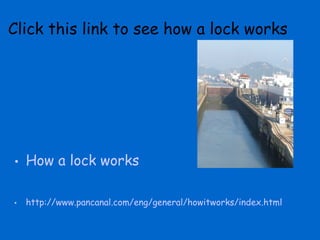
Click this link to see how a lock works


• How a lock works

• http://www.pancanal.com/eng/general/howitworks/index.html
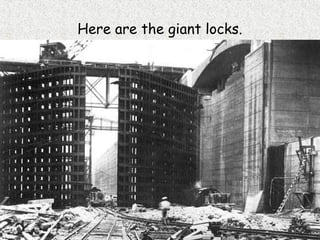
Here are the giant locks.
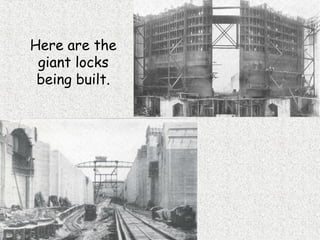
Here are the giant locks being built.


      Photo from the Canal Zone Brats www.czbrats.com
Here are the
 giant locks
 being built.
Here is how the Panama
      Canal works.
Here is how the Panama
      Canal works
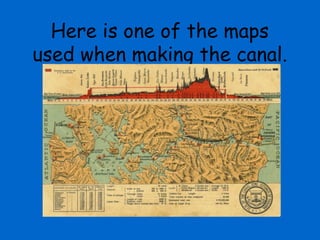
Here is one of the maps
used when making the canal.
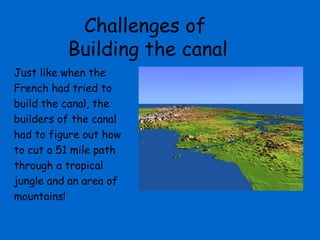
Challenges of
          Building the canal
Just like when the
French had tried to
build the canal, the
builders of the canal
had to figure out how
to cut a 51 mile path
through a tropical
jungle and an area of
mountains!
Working Conditions
Imagine working on the Panama Canal.
By noon the temperature is about 100
degrees. It’s humid-so humid that
after it rains steam rises from the
ground and your clothes become
soaking wet. There is no shade, no
air-conditioning, and no place to get
cool.
Working Conditions
The average yearly rainfall is about
80 inches. Flooding makes the
ground like pudding, and you can sink
up to your knees in mud. Tropical
diseases, such as yellow fever and
malaria are spread easily by
mosquitoes.
Working Conditions

A tropical jungle may be a fascinating
place for scientists to work, but for
workers trying to build a canal, it’s a
nightmare. Imagine trying to dig out
tons of dirt in a jungle like this. And
there was no insect repellent to keep
the bugs from biting.
Working conditions
As one worker said, “There was no
shelter from the sun or the rain.
There were no trees, and when the
sun shines, you get it. When the rain
falls you get it.”
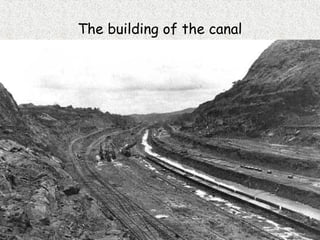
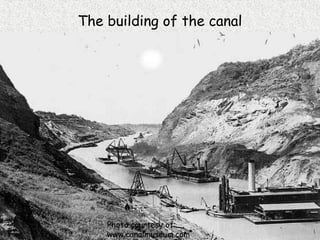
The building of the canal


    Photo courtesy of:
    www.canalmuseum.com
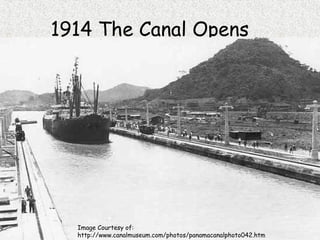
1914 The Canal Opens


  Image Courtesy of:
  http://www.canalmuseum.com/photos/panamacanalphoto042.htm
The Panama Canal Today
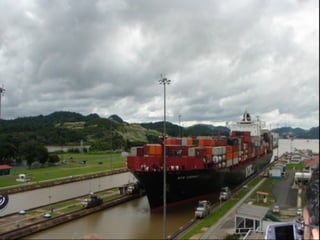
Today the canal is a busy place. Ships get
stuck in traffic jams because there are so
many of them and often have to wait in line
for up to 20 hours just to get up to the
canal! Then the trip through the canal
takes another eight hours!
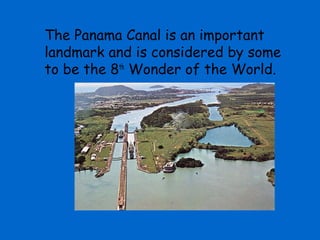
The Panama Canal is an important
landmark and is considered by some
to be the 8th Wonder of the World.
Panama canal presentation

Panama canal presentation

  • 1.
    The Panama Canal TheWorld’s Most Important Shortcut
  • 2.
  • 3.
    What is anisthmus? Panama is an isthmus. An isthmus is a narrow strip of land which has water on each side and connects two larger bodies of land.
  • 4.
    What is acanal? An area of water that is dug across land. Canals connect bodies of water so that ships can travel between them.
  • 5.
    Early History • 1513--VascoNunez de Balboa crosses the isthmus of Panama and becomes the first European to see the Pacific Ocean • 1524--Spanish explorer Hernan Cortes suggests that a path across the isthmus of Panama would be a great idea • 1534--The King of Spain wants to build a canal through Panama. – Although these people knew how wonderful it would be to create this, they didn’t have the ability to do it.
  • 6.
    The 1800s 1835-- Franceis given a permit to build a canal across Panama. However, first they have to come up with a plan to build the canal. 1881-- They finally start.
  • 7.
    Building the Canal The next few pictures show what the area looked like when the French started building the canal. What challenges do you think they faced building a canal in this type of area?
  • 13.
    After looking atthese pictures, what do you think would be the challenges of trying to build a canal through a tropical jungle and mountains?
  • 14.
    The French GiveUp • 1881--A French company begins construction on the canal. • 1890--After eight years France gives up on the project. – Over 20,000 construction workers died working on the project for France – The company trying to build the canal goes bankrupt.
  • 15.
    The United States • 1904 The United States begins working on the Canal. • 1914 The canal is completed. • 1977 The United States signs a treaty with Panama and agrees to give Panama control of the canal in 1999.
  • 16.
    Why was itso important to build a canal? • It is 1904. Theodore Roosevelt is president, and the United States is fast becoming one of the most powerful nations in the world. Such recent inventions as the telephone and the automobile make the 3,000 mile-wide country seem a lot smaller.
  • 17.
    Imagine you areliving on the East Coast. Your family is in the clothing business and wants to sell clothes to new stores in San Francisco. Of course, the clothes can’t be loaded on a plane-there aren't any planes, and trains are expensive for shipping goods.
  • 18.
    So your familydecides to send the clothes by ship around the tip of South America. The trip can easily take two months, and many ships are destroyed by terrible storms.
  • 19.
    But, what ifa canal were built where the land between North America and South America is narrowest-across Panama? That could shorten the trip by nearly 8,000 miles!
  • 20.
    That’s just whatPresident Theodore (Teddy) Roosevelt is determined to do. He wants to build a canal across Panama to help families like yours expand their trade. He knows that the canal will also help the United States defend itself. With the canal, the United States could quickly move its warships from one ocean to the other if they were needed to protect United States interests.
  • 21.
    So the UnitedStates is ready to do what seemed impossible-to join the Atlantic and Pacific Oceans! But a major decision had to be made. Should the canal be built at sea level like the Suez Canal? Or should it follow the natural rise of the land? This would mean building locks (enclosed chambers with gates at each end) to raise and lower ships as they pass through the canal. Locks this big had never been made before. The decision was made in favor of having locks. Now they just had to figure out how to build them.
  • 22.
    What are locks? Alock is a part of a canal with gates at each end where boats are raised or lowered to different water levels.
  • 23.
    How do lockswork? The ship goes through a set of gates into a lock chamber. The water in the chamber is still at sea level. Then more water comes pouring into the chamber through valves. The ship rises like a toy boat in a bathtub filling with water. When the water rises high enough, the ship passes through a second set of gates and enters a small lake. It goes to the next lock and the water is raised again.
  • 24.
    Click this linkto see how a lock works • How a lock works • http://www.pancanal.com/eng/general/howitworks/index.html
  • 25.
    Here are thegiant locks.
  • 26.
    Here are thegiant locks being built. Photo from the Canal Zone Brats www.czbrats.com
  • 27.
    Here are the giant locks being built.
  • 28.
    Here is howthe Panama Canal works.
  • 29.
    Here is howthe Panama Canal works
  • 30.
    Here is oneof the maps used when making the canal.
  • 31.
    Challenges of Building the canal Just like when the French had tried to build the canal, the builders of the canal had to figure out how to cut a 51 mile path through a tropical jungle and an area of mountains!
  • 32.
    Working Conditions Imagine workingon the Panama Canal. By noon the temperature is about 100 degrees. It’s humid-so humid that after it rains steam rises from the ground and your clothes become soaking wet. There is no shade, no air-conditioning, and no place to get cool.
  • 33.
    Working Conditions The averageyearly rainfall is about 80 inches. Flooding makes the ground like pudding, and you can sink up to your knees in mud. Tropical diseases, such as yellow fever and malaria are spread easily by mosquitoes.
  • 34.
    Working Conditions A tropicaljungle may be a fascinating place for scientists to work, but for workers trying to build a canal, it’s a nightmare. Imagine trying to dig out tons of dirt in a jungle like this. And there was no insect repellent to keep the bugs from biting.
  • 35.
    Working conditions As oneworker said, “There was no shelter from the sun or the rain. There were no trees, and when the sun shines, you get it. When the rain falls you get it.”
  • 36.
    The building ofthe canal
  • 37.
    The building ofthe canal Photo courtesy of: www.canalmuseum.com
  • 38.
    1914 The CanalOpens Image Courtesy of: http://www.canalmuseum.com/photos/panamacanalphoto042.htm
  • 39.
    The Panama CanalToday Today the canal is a busy place. Ships get stuck in traffic jams because there are so many of them and often have to wait in line for up to 20 hours just to get up to the canal! Then the trip through the canal takes another eight hours!
  • 40.
    The Panama Canalis an important landmark and is considered by some to be the 8th Wonder of the World.