Transportation Problems
(Initial Solution)
Mr.Harish G. Nemade
Dept. of Mathematics
Dhanaji Nana Mahavidyalaya,Faizpur
Outline
• Introduction
• Solution Procedure for Transportation Problem
• Finding an Initial Feasible Solution
• Finding the Optimal Solution
• Special Cases in Transportation Problems
• Maximisation in Transportation Problems
• Exercises
The main typical issues in OR :
Formulate the problem
Build a mathematical model
 Decision Variable
 Objective Function
 Constraints
 Optimize the model
Operation Research
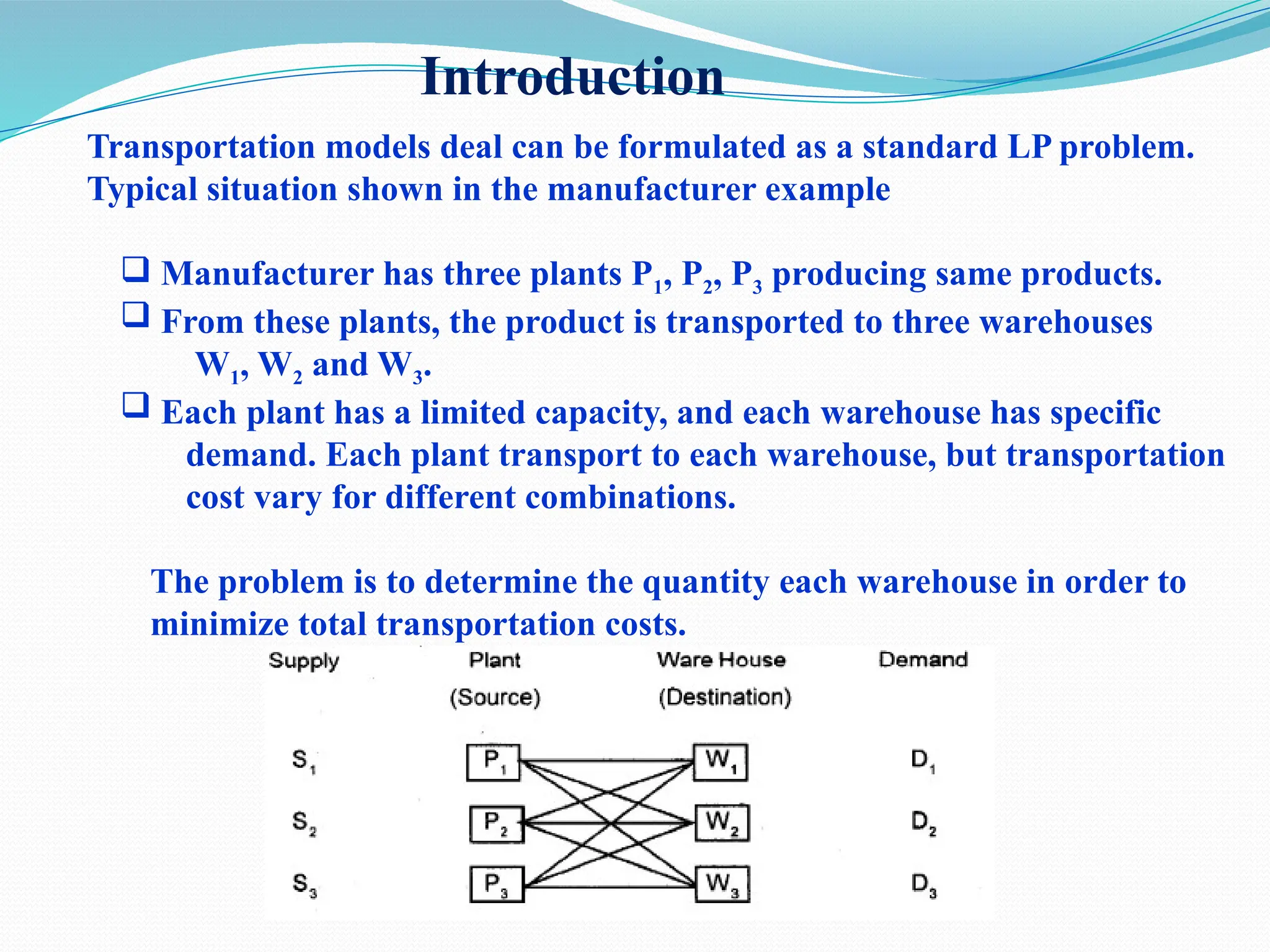
Transportation models deal can be formulated as a standard LP problem.
Typical situation shown in the manufacturer example
 Manufacturer has three plants P1, P2, P3 producing same products.
 From these plants, the product is transported to three warehouses
W1, W2 and W3.
 Each plant has a limited capacity, and each warehouse has specific
demand. Each plant transport to each warehouse, but transportation
cost vary for different combinations.
The problem is to determine the quantity each warehouse in order to
minimize total transportation costs.
Introduction
Solution Procedure for Transportation Problem
 Conceptually, the transportation is similar to simplex
method.
 Begin with an initial feasible solution.
This initial feasible solution may or may not be optimal.
The only way you can find it out is to test it.
 If the solution is not optimal, it is revised and the test is
repeated. Each iteration should bring you closer to the
optimal solution.
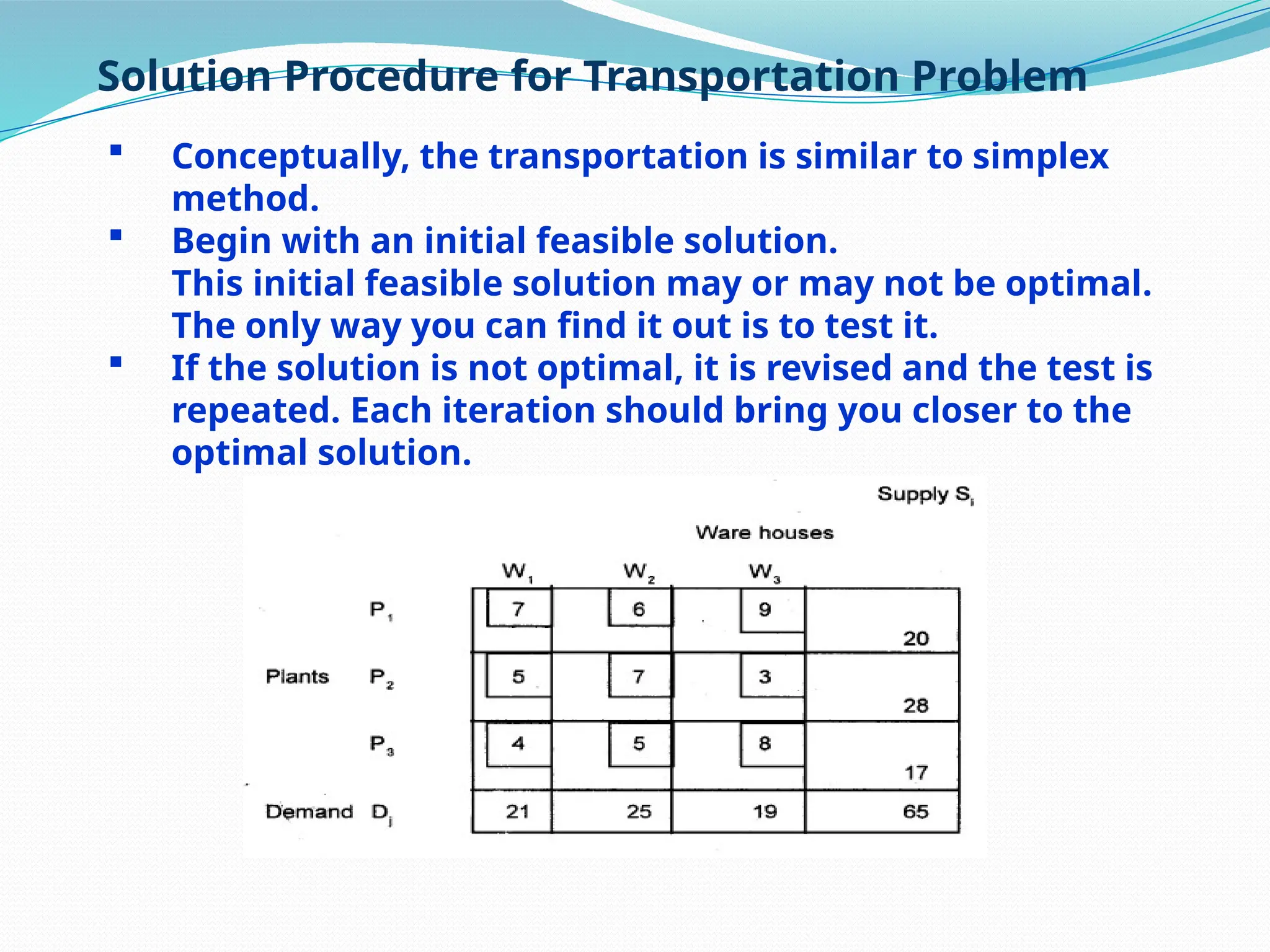
The format followed in the above table will be used throughout
the unit.
• Each row corresponds to a specific plant and each column
corresponds to a specific warehouse.
• Plant supplies are shown to the right of the table and
warehouse requirements are shown below the table.
• The larger box (also known as cells) at the intersection of a
specific row and column will contain both quantity to be
transported and per unit transportation cost.
• The quantity to be transported will be shown in the centre of
the box and will be encircled and the per unit transportation
cost is shown in the smaller rectangular box at the left hand
side corner.
Solution Procedure for Transportation Problem
Finding an Initial Feasible Solution
There are a number of methods for generating an initial feasible
solution for a transportation problem.
Consider three of the following
(i) North West Corner Method
(ii) Least Cost Method
(iii) Vogel’s Approximation Method
North West Corner Method (NWCM)
The simplest of the procedures used to generate an initial
feasible solution is NWCM. It is so called because we begin with
the North West or upper left corner cell of our transportation
table. Various steps of this method can be summarised as under.
Step 1
Select the North West (upper left-hand) corner cell of the
transportation table and allocate as many units as possible
equal to the minimum between available supply and demand
requirement i.e., min (S1, D1).
Step 2
Adjust the supply and demand numbers in the respective rows
And columns allocation.
Step 3
(a) If the supply for the first row is exhausted, then move down
to the first cell in t he second row and first column and go
to step 2.
(b) If the demand for the first column is satisfied, then move
horizontally to the next cell in the second column and first
row and go to step 2.
If for any cell, supply equals demand, then the next allocation
can be made in cell either in the next row or column.
Step 4
Step 5
Continue the procedure until the total available quantity id
fully allocated to the cells as required.
Remark 1: The quantities so allocated are circled to indicated,
the value of the corresponding variable.
Remark 2: Empty cells indicate the value of the corresponding
variable as zero, I.e., no unit is shipped to this cell.
To illustrate the NWCM,
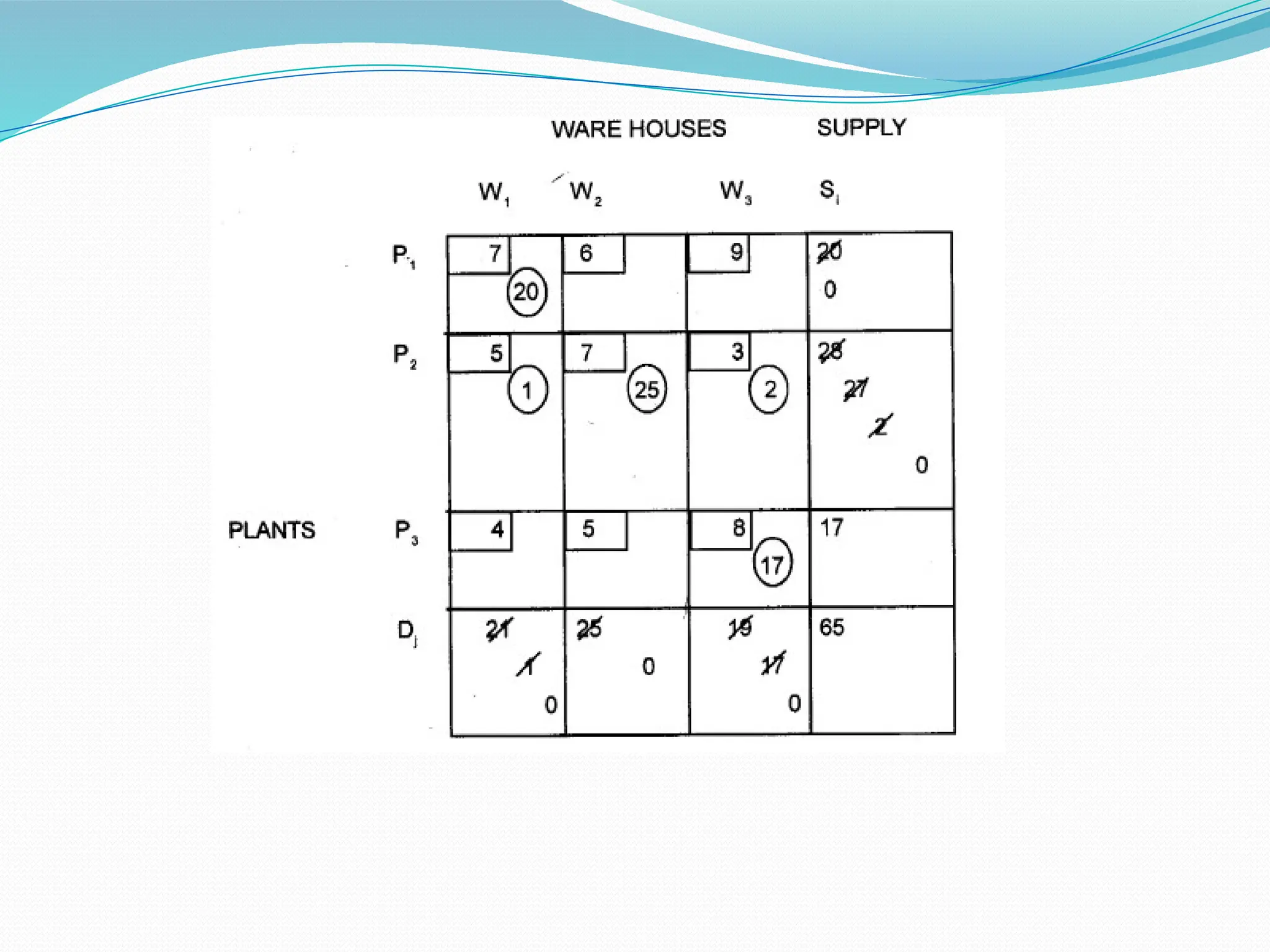
As stated in this method, we start with the cell (P1 W1) and
Allocate the min (S1, D1) = min (20,21)=20. Therefore we
allocate 20 Units this cell which completely exhausts the supply
of Plant P1 and leaves a balance of (21-20) =1 unit of demand at
warehouse W1
Now, we move vertically downward to cell (P2 W1) At this stage the largest
allocation possible is the (S2, D1 –20) =min (28, 1)= 1. This allocation of 1 unit
to the cell (P1 W2). Since the demand of warehouse W2 is 25 units while
supply available at plant P2 is 27 units, therefore, the min (27-5) = 25 units
are located to the cell (P1 W2). The demand of warehouse W2 is now satisfied
and a balance of (27-225) = 2 units of supply remain at plant P2. Moving
again horizontally, we allocated two units to the cell (P2 W3) Which
Completely exhaust the supply at plant P2 and leaves a balance of 17 units
to this cell (P3, W3).. At this, 17 Units ae availbale at plant P3 and 17 units
are required at warehouse W3. So we allocate 17 units to this cell (P3, W3).
Hence we have made all the allocation. It may be noted here that there are 5
(+3+1) allocation which are necessary to proceed further. The initial feasible
solution is shown below. The Total transportation cost for this initial solution
is
Total Cost = 20x7 +1 X 5 + 25 x 7 + 2 X 3 + 17 + 8 = Rs. 462
Least Cost Method
The allocation according to this method is very useful as it takes into
consideration the lowest cost and therefore, reduce the
computation as well as the amount of time necessary to arrive at
the optimal solution.
Step 1
(a) Select the cell with the lowest transportation cost among all the
rows or columns of the transportation table.
(b) If the minimum cost is not unique, then select arbitrarily any cell
with this minimum cost.
Step 2
Allocate as many units as possible to the cell determined in Step 1
and eliminate that row (column) in which either supply is
exhausted or demand is satisfied.
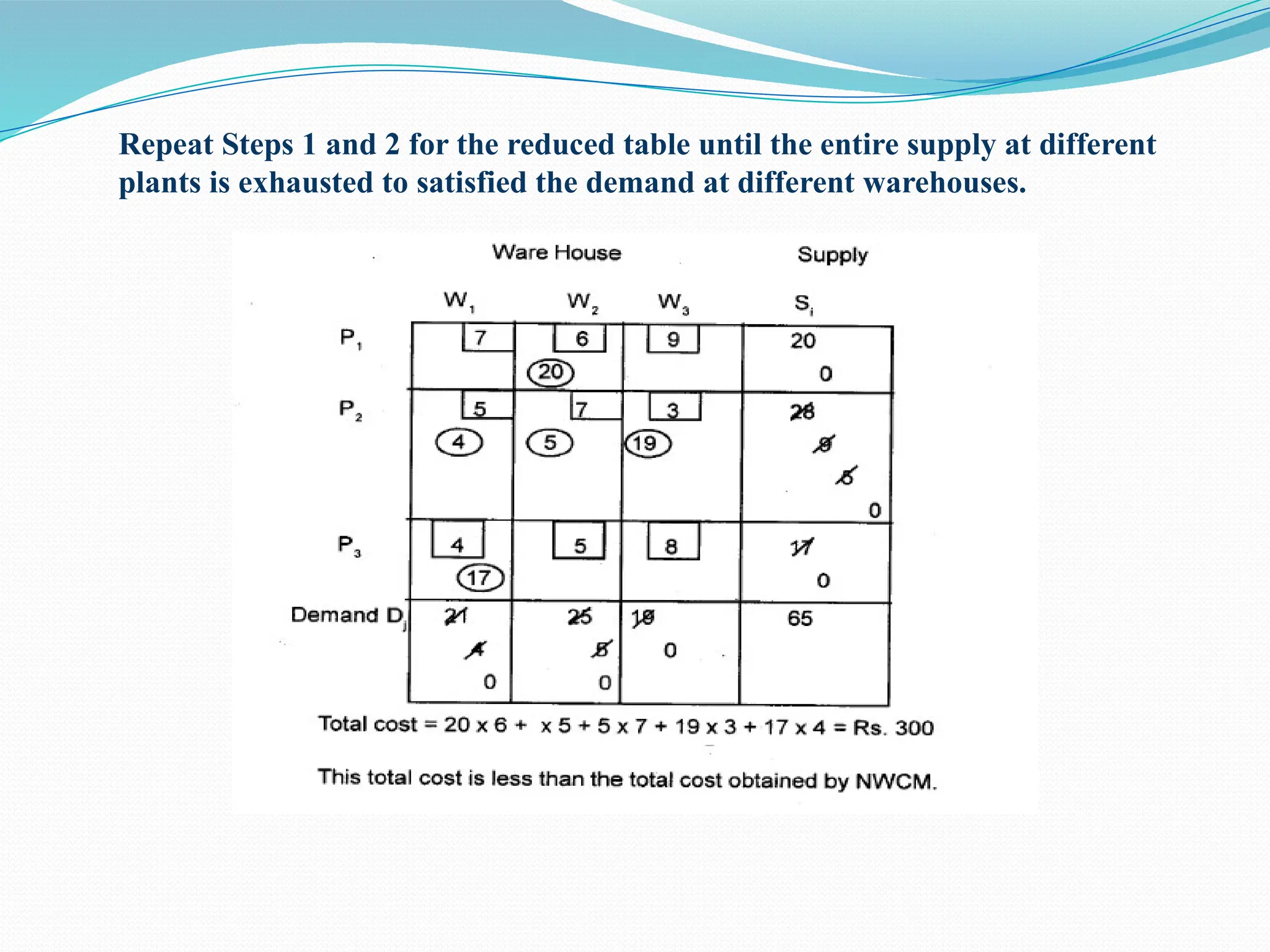
Repeat Steps 1 and 2 for the reduced table until the entire supply at different
plants is exhausted to satisfied the demand at different warehouses.
Vogel’s Approximation Method (VAM)
This method is preferred over the other two methods because the initial
feasible solution obtained is either optimal or very close to the optimal
solution.
Step 1:
Compute a penalty for each row and column in the transportation table.
Step 2:
Identify the row or column with the largest penalty.
Step 3:
Repeat steps 1 and 2 for the reduced table until entire supply at plants
are exhausted to satisfy the demand as different warehouses.
Least Cost and Vogels Approximation Method

Least Cost and Vogels Approximation Method

  • 1.
    Transportation Problems (Initial Solution) Mr.HarishG. Nemade Dept. of Mathematics Dhanaji Nana Mahavidyalaya,Faizpur
  • 2.
    Outline • Introduction • SolutionProcedure for Transportation Problem • Finding an Initial Feasible Solution • Finding the Optimal Solution • Special Cases in Transportation Problems • Maximisation in Transportation Problems • Exercises
  • 3.
    The main typicalissues in OR : Formulate the problem Build a mathematical model  Decision Variable  Objective Function  Constraints  Optimize the model Operation Research
  • 4.
    Transportation models dealcan be formulated as a standard LP problem. Typical situation shown in the manufacturer example  Manufacturer has three plants P1, P2, P3 producing same products.  From these plants, the product is transported to three warehouses W1, W2 and W3.  Each plant has a limited capacity, and each warehouse has specific demand. Each plant transport to each warehouse, but transportation cost vary for different combinations. The problem is to determine the quantity each warehouse in order to minimize total transportation costs. Introduction
  • 5.
    Solution Procedure forTransportation Problem  Conceptually, the transportation is similar to simplex method.  Begin with an initial feasible solution. This initial feasible solution may or may not be optimal. The only way you can find it out is to test it.  If the solution is not optimal, it is revised and the test is repeated. Each iteration should bring you closer to the optimal solution.
  • 6.
    The format followedin the above table will be used throughout the unit. • Each row corresponds to a specific plant and each column corresponds to a specific warehouse. • Plant supplies are shown to the right of the table and warehouse requirements are shown below the table. • The larger box (also known as cells) at the intersection of a specific row and column will contain both quantity to be transported and per unit transportation cost. • The quantity to be transported will be shown in the centre of the box and will be encircled and the per unit transportation cost is shown in the smaller rectangular box at the left hand side corner. Solution Procedure for Transportation Problem
  • 7.
    Finding an InitialFeasible Solution There are a number of methods for generating an initial feasible solution for a transportation problem. Consider three of the following (i) North West Corner Method (ii) Least Cost Method (iii) Vogel’s Approximation Method
  • 8.
    North West CornerMethod (NWCM) The simplest of the procedures used to generate an initial feasible solution is NWCM. It is so called because we begin with the North West or upper left corner cell of our transportation table. Various steps of this method can be summarised as under. Step 1 Select the North West (upper left-hand) corner cell of the transportation table and allocate as many units as possible equal to the minimum between available supply and demand requirement i.e., min (S1, D1). Step 2 Adjust the supply and demand numbers in the respective rows And columns allocation.
  • 9.
    Step 3 (a) Ifthe supply for the first row is exhausted, then move down to the first cell in t he second row and first column and go to step 2. (b) If the demand for the first column is satisfied, then move horizontally to the next cell in the second column and first row and go to step 2. If for any cell, supply equals demand, then the next allocation can be made in cell either in the next row or column. Step 4 Step 5 Continue the procedure until the total available quantity id fully allocated to the cells as required.
  • 10.
    Remark 1: Thequantities so allocated are circled to indicated, the value of the corresponding variable. Remark 2: Empty cells indicate the value of the corresponding variable as zero, I.e., no unit is shipped to this cell. To illustrate the NWCM, As stated in this method, we start with the cell (P1 W1) and Allocate the min (S1, D1) = min (20,21)=20. Therefore we allocate 20 Units this cell which completely exhausts the supply of Plant P1 and leaves a balance of (21-20) =1 unit of demand at warehouse W1
  • 11.
    Now, we movevertically downward to cell (P2 W1) At this stage the largest allocation possible is the (S2, D1 –20) =min (28, 1)= 1. This allocation of 1 unit to the cell (P1 W2). Since the demand of warehouse W2 is 25 units while supply available at plant P2 is 27 units, therefore, the min (27-5) = 25 units are located to the cell (P1 W2). The demand of warehouse W2 is now satisfied and a balance of (27-225) = 2 units of supply remain at plant P2. Moving again horizontally, we allocated two units to the cell (P2 W3) Which Completely exhaust the supply at plant P2 and leaves a balance of 17 units to this cell (P3, W3).. At this, 17 Units ae availbale at plant P3 and 17 units are required at warehouse W3. So we allocate 17 units to this cell (P3, W3). Hence we have made all the allocation. It may be noted here that there are 5 (+3+1) allocation which are necessary to proceed further. The initial feasible solution is shown below. The Total transportation cost for this initial solution is Total Cost = 20x7 +1 X 5 + 25 x 7 + 2 X 3 + 17 + 8 = Rs. 462
  • 13.
    Least Cost Method Theallocation according to this method is very useful as it takes into consideration the lowest cost and therefore, reduce the computation as well as the amount of time necessary to arrive at the optimal solution. Step 1 (a) Select the cell with the lowest transportation cost among all the rows or columns of the transportation table. (b) If the minimum cost is not unique, then select arbitrarily any cell with this minimum cost. Step 2 Allocate as many units as possible to the cell determined in Step 1 and eliminate that row (column) in which either supply is exhausted or demand is satisfied.
  • 14.
    Repeat Steps 1and 2 for the reduced table until the entire supply at different plants is exhausted to satisfied the demand at different warehouses.
  • 15.
    Vogel’s Approximation Method(VAM) This method is preferred over the other two methods because the initial feasible solution obtained is either optimal or very close to the optimal solution. Step 1: Compute a penalty for each row and column in the transportation table. Step 2: Identify the row or column with the largest penalty. Step 3: Repeat steps 1 and 2 for the reduced table until entire supply at plants are exhausted to satisfy the demand as different warehouses.