

MODI Method
(Modified Distribution Method)
Modified Distribution Method
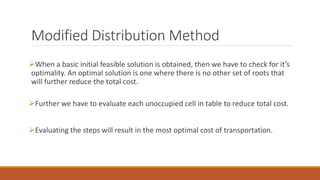
When a basic initial feasible solution is obtained, then we have to check for it’s
optimality. An optimal solution is one where there is no other set of roots that
will further reduce the total cost.
Further we have to evaluate each unoccupied cell in table to reduce total cost.
Evaluating the steps will result in the most optimal cost of transportation.
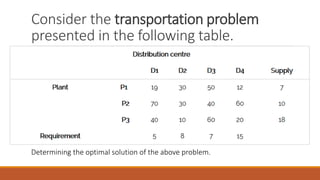
Consider the transportation problem
presented in the following table.
Determining the optimal solution of the above problem.
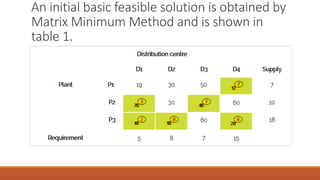
An initial basic feasible solution is obtained by
Matrix Minimum Method and is shown in
table 1.
Initial basic feasible solution
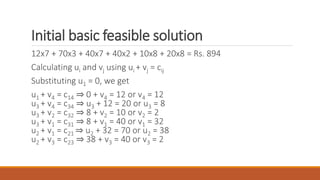
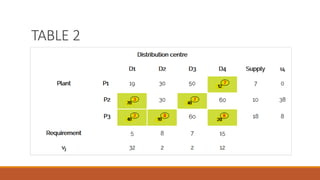
12x7 + 70x3 + 40x7 + 40x2 + 10x8 + 20x8 = Rs. 894
Calculating ui and vj using ui + vj = cij
Substituting u1 = 0, we get
u1 + v4 = c14 ⇒ 0 + v4 = 12 or v4 = 12
u3 + v4 = c34 ⇒ u3 + 12 = 20 or u3 = 8
u3 + v2 = c32 ⇒ 8 + v2 = 10 or v2 = 2
u3 + v1 = c31 ⇒ 8 + v1 = 40 or v1 = 32
u2 + v1 = c21 ⇒ u2 + 32 = 70 or u2 = 38
u2 + v3 = c23 ⇒ 38 + v3 = 40 or v3 = 2
TABLE 2
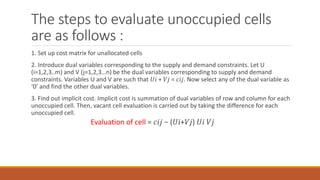
The steps to evaluate unoccupied cells
are as follows :
1. Set up cost matrix for unallocated cells
2. Introduce dual variables corresponding to the supply and demand constraints. Let U
(i=1,2,3..m) and V (j=1,2,3…n) be the dual variables corresponding to supply and demand
constraints. Variables U and V are such that 𝑈𝑖 + 𝑉𝑗 = 𝑐𝑖𝑗. Now select any of the dual variable as
‘0’ and find the other dual variables.
3. Find out implicit cost. Implicit cost is summation of dual variables of row and column for each
unoccupied cell. Then, vacant cell evaluation is carried out by taking the difference for each
unoccupied cell.
Evaluation of cell = 𝑐𝑖𝑗 − (𝑈𝑖+𝑉𝑗) 𝑈𝑖 𝑉𝑗
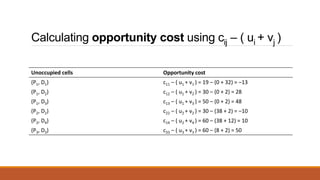
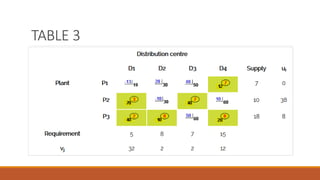
Calculating opportunity cost using cij – ( ui + vj )
Unoccupied cells Opportunity cost
(P1, D1) c11 – ( u1 + v1 ) = 19 – (0 + 32) = –13
(P1, D2) c12 – ( u1 + v2 ) = 30 – (0 + 2) = 28
(P1, D3) c13 – ( u1 + v3 ) = 50 – (0 + 2) = 48
(P2, D2) c22 – ( u2 + v2 ) = 30 – (38 + 2) = –10
(P2, D4) c14 – ( u2 + v4 ) = 60 – (38 + 12) = 10
(P3, D3) c33 – ( u3 + v3 ) = 60 – (8 + 2) = 50
TABLE 3
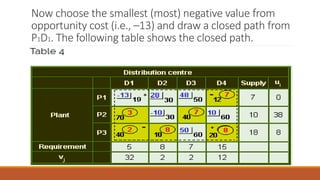
Now choose the smallest (most) negative value from
opportunity cost (i.e., –13) and draw a closed path from
P1D1. The following table shows the closed path.
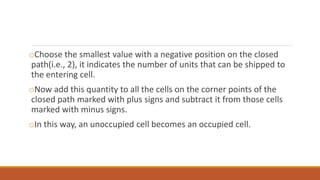
oChoose the smallest value with a negative position on the closed
path(i.e., 2), it indicates the number of units that can be shipped to
the entering cell.
oNow add this quantity to all the cells on the corner points of the
closed path marked with plus signs and subtract it from those cells
marked with minus signs.
oIn this way, an unoccupied cell becomes an occupied cell.
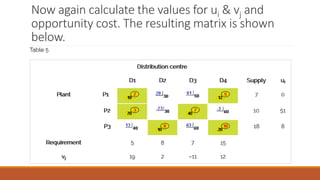
Now again calculate the values for ui & vj and
opportunity cost. The resulting matrix is shown
below.
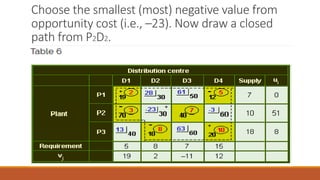
Choose the smallest (most) negative value from
opportunity cost (i.e., –23). Now draw a closed
path from P2D2.
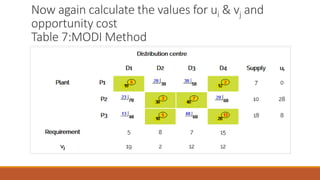
Now again calculate the values for ui & vj and
opportunity cost
Table 7:MODI Method
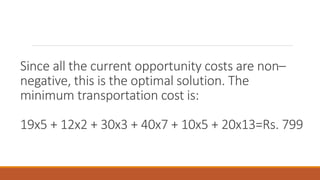
Since all the current opportunity costs are non–
negative, this is the optimal solution. The
minimum transportation cost is:
19x5 + 12x2 + 30x3 + 40x7 + 10x5 + 20x13=Rs. 799
MODI Application:
The Modified distribution method is an improvement over the
stepping stone method since; it can be applied more efficiently when
a large number of sources and destinations are involved, which
becomes quite difficult or tedious in case of stepping stone method.
Modified distribution method reduces the number of steps
involved in the evaluation of empty cells, thereby minimizes the
complexity and gives a straightforward computational scheme
through which the opportunity cost of each empty cell can be
determined.
Modified Distribution Method (MODI)

Modified Distribution Method (MODI)

  • 1.
  • 2.
    Modified Distribution Method Whena basic initial feasible solution is obtained, then we have to check for it’s optimality. An optimal solution is one where there is no other set of roots that will further reduce the total cost. Further we have to evaluate each unoccupied cell in table to reduce total cost. Evaluating the steps will result in the most optimal cost of transportation.
  • 3.
    Consider the transportationproblem presented in the following table. Determining the optimal solution of the above problem.
  • 4.
    An initial basicfeasible solution is obtained by Matrix Minimum Method and is shown in table 1.
  • 5.
    Initial basic feasiblesolution 12x7 + 70x3 + 40x7 + 40x2 + 10x8 + 20x8 = Rs. 894 Calculating ui and vj using ui + vj = cij Substituting u1 = 0, we get u1 + v4 = c14 ⇒ 0 + v4 = 12 or v4 = 12 u3 + v4 = c34 ⇒ u3 + 12 = 20 or u3 = 8 u3 + v2 = c32 ⇒ 8 + v2 = 10 or v2 = 2 u3 + v1 = c31 ⇒ 8 + v1 = 40 or v1 = 32 u2 + v1 = c21 ⇒ u2 + 32 = 70 or u2 = 38 u2 + v3 = c23 ⇒ 38 + v3 = 40 or v3 = 2
  • 6.
  • 7.
    The steps toevaluate unoccupied cells are as follows : 1. Set up cost matrix for unallocated cells 2. Introduce dual variables corresponding to the supply and demand constraints. Let U (i=1,2,3..m) and V (j=1,2,3…n) be the dual variables corresponding to supply and demand constraints. Variables U and V are such that 𝑈𝑖 + 𝑉𝑗 = 𝑐𝑖𝑗. Now select any of the dual variable as ‘0’ and find the other dual variables. 3. Find out implicit cost. Implicit cost is summation of dual variables of row and column for each unoccupied cell. Then, vacant cell evaluation is carried out by taking the difference for each unoccupied cell. Evaluation of cell = 𝑐𝑖𝑗 − (𝑈𝑖+𝑉𝑗) 𝑈𝑖 𝑉𝑗
  • 8.
    Calculating opportunity costusing cij – ( ui + vj ) Unoccupied cells Opportunity cost (P1, D1) c11 – ( u1 + v1 ) = 19 – (0 + 32) = –13 (P1, D2) c12 – ( u1 + v2 ) = 30 – (0 + 2) = 28 (P1, D3) c13 – ( u1 + v3 ) = 50 – (0 + 2) = 48 (P2, D2) c22 – ( u2 + v2 ) = 30 – (38 + 2) = –10 (P2, D4) c14 – ( u2 + v4 ) = 60 – (38 + 12) = 10 (P3, D3) c33 – ( u3 + v3 ) = 60 – (8 + 2) = 50
  • 9.
  • 10.
    Now choose thesmallest (most) negative value from opportunity cost (i.e., –13) and draw a closed path from P1D1. The following table shows the closed path.
  • 11.
    oChoose the smallestvalue with a negative position on the closed path(i.e., 2), it indicates the number of units that can be shipped to the entering cell. oNow add this quantity to all the cells on the corner points of the closed path marked with plus signs and subtract it from those cells marked with minus signs. oIn this way, an unoccupied cell becomes an occupied cell.
  • 12.
    Now again calculatethe values for ui & vj and opportunity cost. The resulting matrix is shown below.
  • 13.
    Choose the smallest(most) negative value from opportunity cost (i.e., –23). Now draw a closed path from P2D2.
  • 14.
    Now again calculatethe values for ui & vj and opportunity cost Table 7:MODI Method
  • 15.
    Since all thecurrent opportunity costs are non– negative, this is the optimal solution. The minimum transportation cost is: 19x5 + 12x2 + 30x3 + 40x7 + 10x5 + 20x13=Rs. 799
  • 16.
    MODI Application: The Modifieddistribution method is an improvement over the stepping stone method since; it can be applied more efficiently when a large number of sources and destinations are involved, which becomes quite difficult or tedious in case of stepping stone method. Modified distribution method reduces the number of steps involved in the evaluation of empty cells, thereby minimizes the complexity and gives a straightforward computational scheme through which the opportunity cost of each empty cell can be determined.