Route Optimization
Algorithm
1/12/2016 2
Group Members:
 Mazhar Nazik
 Tayyeb Mehmood
 Awais Arshad
1/12/2016 3
Route Optimization Algorithm
Definition:
Route optimization algorithms are the mathematical
formulas that solve routing problems.
1/12/2016 4
Some Types of Routing
 Vehicle Routing Problem (VRP)
 Travelling Salesman Problem (TSP)
 Ant Colony Optimization (ACO)
1/12/2016 5
INTRODUCTION
Routing optimization Algorithms basically designs for
the best routes to reduce travel cost, energy
consumption and time. Due to non-deterministic
polynomial-time hard complexity, many route
optimizations involved in real-world applications
require too much computing effort. Shortening
computing time for Routing optimization is a great
challenge for state-of-the-art local optimization
algorithms.
1/12/2016 6
Logistic Model
The applications of vehicle routing problem (VRP) are
very common in real life. It can be described by the
scenario that follows. Let consider a depot having a
fleet of vehicles with limited capacities and a set of
customers, each with a certain demand for the
merchandise or goods to be dispatched. The problem
is to determine optimal routings for each vehicle to
visit every customer exactly once in order to fulfill the
demand. The most common goal for optimization is to
minimize the overall distance travelled by the vehicles.
1/12/2016 7
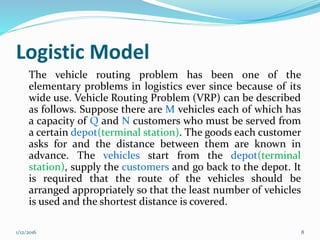
Logistic Model
The vehicle routing problem has been one of the
elementary problems in logistics ever since because of its
wide use. Vehicle Routing Problem (VRP) can be described
as follows. Suppose there are M vehicles each of which has
a capacity of Q and N customers who must be served from
a certain depot(terminal station). The goods each customer
asks for and the distance between them are known in
advance. The vehicles start from the depot(terminal
station), supply the customers and go back to the depot. It
is required that the route of the vehicles should be
arranged appropriately so that the least number of vehicles
is used and the shortest distance is covered.
1/12/2016 8
Conditions
The following conditions must be satisfied:
The total demand of any vehicle route must not exceed
the capacity of the vehicle.
Any given customer is served by one, and only one
vehicle.
Customer delivery should be done efficiently and
economically.
1/12/2016 9
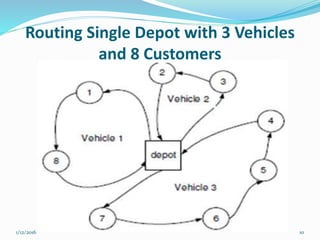
Routing Single Depot with 3 Vehicles
and 8 Customers
1/12/2016 10
Proposed Methodologies
The methodologies used to determine the best vehicle
routing for truck dispatch system (TDS) are
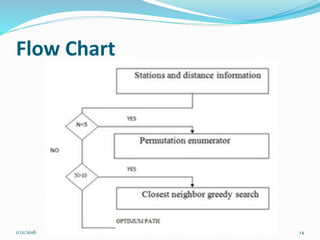
Permutation Enumerator
Greedy Search Algorithm
1/12/2016 11
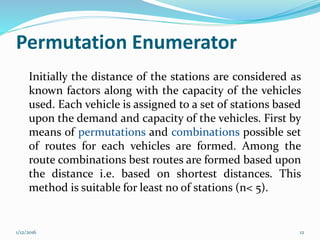
Permutation Enumerator
Initially the distance of the stations are considered as
known factors along with the capacity of the vehicles
used. Each vehicle is assigned to a set of stations based
upon the demand and capacity of the vehicles. First by
means of permutations and combinations possible set
of routes for each vehicles are formed. Among the
route combinations best routes are formed based upon
the distance i.e. based on shortest distances. This
method is suitable for least no of stations (n< 5).
1/12/2016 12
Greedy Search Algorithm
A “greedy algorithm” firstly, based on the list of nodes that
a truck is assigned to service, it starts the sequence by
choosing from the list a station that is nearest to the
terminal station. Then the next station in the sequence is
determined by choosing the station that is nearest to the
preceding station from the list of remaining stations. This
process is repeated, until all the stations have been
exhausted to form the complete sequence starting and
ending at the terminal station by knowing the distances to
be travelled by the vehicles using genetic algorithm an
optimized routing plan is formed for each set of vehicles.
This will help to reach the customers in both effective and
efficient manner.
1/12/2016 13
Flow Chart
1/12/2016 14
Shortest Route Calculations for
the Stations
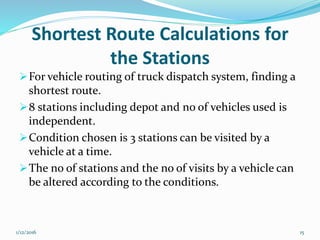
For vehicle routing of truck dispatch system, finding a
shortest route.
8 stations including depot and no of vehicles used is
independent.
Condition chosen is 3 stations can be visited by a
vehicle at a time.
The no of stations and the no of visits by a vehicle can
be altered according to the conditions.
1/12/2016 15
Shortest Route Calculations for
the Stations
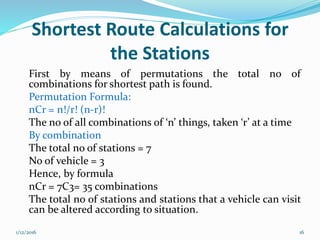
First by means of permutations the total no of
combinations for shortest path is found.
Permutation Formula:
nCr = n!/r! (n-r)!
The no of all combinations of ‘n’ things, taken ‘r’ at a time
By combination
The total no of stations = 7
No of vehicle = 3
Hence, by formula
nCr = 7C3= 35 combinations
The total no of stations and stations that a vehicle can visit
can be altered according to situation.
1/12/2016 16
1/12/2016 17
Advantages :
 Improved Methodology of Additional terminals
generation :
Stop of which service capacity in rush hours falls
between standard and can be taken as potential
terminal. In other words, a terrific signal stop system
can be potential terminal if its number of vehicles in
rush hours fall between 100 and 400.
 Competition caused by Parallel routes and rail
route
It considers the number of shared stops or
overlapping length between bus routes and rail routes.
However, in real situations, competition caused by the
parallel routes is inevitable.
1/12/2016 18
Disadvantages:
 More detailed flow analysis should be carried out at stop
level.
At the present, passenger flow analysis is mainly implemented at
the route level. If the passenger attraction can be dis-aggregated
to each top on the route so analysis will become un-accurate.
 All the Optimized vehicles routes should be evaluated and
compared.
Due to limitation of research time, evaluation after
optimization is only carried out in some important areas such as
commercial and residential zones at the individual route level.
So the distributed optimization for vehicles along with flow
analysis of passengers is not particularly considered.
1/12/2016 19
Rough Example Diagram
1/12/2016 20
Conclusions and Future Work
Vehicle routing is first initiated with number of
stations to be served and total no of vehicles employed
to serve the stations based upon permutations and
combinations. Based on permutation and
combinations routings were formed. In case of large
number of vehicles greedy search method is used to
find the distances between the stations and the vehicle
routes distances. Here vehicle routing has been done
based upon known demand and capacity of the
suppliers.
1/12/2016 21
1/12/2016 22

Route Optimization Algorithm..

  • 2.
  • 3.
    Group Members:  MazharNazik  Tayyeb Mehmood  Awais Arshad 1/12/2016 3
  • 4.
    Route Optimization Algorithm Definition: Routeoptimization algorithms are the mathematical formulas that solve routing problems. 1/12/2016 4
  • 5.
    Some Types ofRouting  Vehicle Routing Problem (VRP)  Travelling Salesman Problem (TSP)  Ant Colony Optimization (ACO) 1/12/2016 5
  • 6.
    INTRODUCTION Routing optimization Algorithmsbasically designs for the best routes to reduce travel cost, energy consumption and time. Due to non-deterministic polynomial-time hard complexity, many route optimizations involved in real-world applications require too much computing effort. Shortening computing time for Routing optimization is a great challenge for state-of-the-art local optimization algorithms. 1/12/2016 6
  • 7.
    Logistic Model The applicationsof vehicle routing problem (VRP) are very common in real life. It can be described by the scenario that follows. Let consider a depot having a fleet of vehicles with limited capacities and a set of customers, each with a certain demand for the merchandise or goods to be dispatched. The problem is to determine optimal routings for each vehicle to visit every customer exactly once in order to fulfill the demand. The most common goal for optimization is to minimize the overall distance travelled by the vehicles. 1/12/2016 7
  • 8.
    Logistic Model The vehiclerouting problem has been one of the elementary problems in logistics ever since because of its wide use. Vehicle Routing Problem (VRP) can be described as follows. Suppose there are M vehicles each of which has a capacity of Q and N customers who must be served from a certain depot(terminal station). The goods each customer asks for and the distance between them are known in advance. The vehicles start from the depot(terminal station), supply the customers and go back to the depot. It is required that the route of the vehicles should be arranged appropriately so that the least number of vehicles is used and the shortest distance is covered. 1/12/2016 8
  • 9.
    Conditions The following conditionsmust be satisfied: The total demand of any vehicle route must not exceed the capacity of the vehicle. Any given customer is served by one, and only one vehicle. Customer delivery should be done efficiently and economically. 1/12/2016 9
  • 10.
    Routing Single Depotwith 3 Vehicles and 8 Customers 1/12/2016 10
  • 11.
    Proposed Methodologies The methodologiesused to determine the best vehicle routing for truck dispatch system (TDS) are Permutation Enumerator Greedy Search Algorithm 1/12/2016 11
  • 12.
    Permutation Enumerator Initially thedistance of the stations are considered as known factors along with the capacity of the vehicles used. Each vehicle is assigned to a set of stations based upon the demand and capacity of the vehicles. First by means of permutations and combinations possible set of routes for each vehicles are formed. Among the route combinations best routes are formed based upon the distance i.e. based on shortest distances. This method is suitable for least no of stations (n< 5). 1/12/2016 12
  • 13.
    Greedy Search Algorithm A“greedy algorithm” firstly, based on the list of nodes that a truck is assigned to service, it starts the sequence by choosing from the list a station that is nearest to the terminal station. Then the next station in the sequence is determined by choosing the station that is nearest to the preceding station from the list of remaining stations. This process is repeated, until all the stations have been exhausted to form the complete sequence starting and ending at the terminal station by knowing the distances to be travelled by the vehicles using genetic algorithm an optimized routing plan is formed for each set of vehicles. This will help to reach the customers in both effective and efficient manner. 1/12/2016 13
  • 14.
  • 15.
    Shortest Route Calculationsfor the Stations For vehicle routing of truck dispatch system, finding a shortest route. 8 stations including depot and no of vehicles used is independent. Condition chosen is 3 stations can be visited by a vehicle at a time. The no of stations and the no of visits by a vehicle can be altered according to the conditions. 1/12/2016 15
  • 16.
    Shortest Route Calculationsfor the Stations First by means of permutations the total no of combinations for shortest path is found. Permutation Formula: nCr = n!/r! (n-r)! The no of all combinations of ‘n’ things, taken ‘r’ at a time By combination The total no of stations = 7 No of vehicle = 3 Hence, by formula nCr = 7C3= 35 combinations The total no of stations and stations that a vehicle can visit can be altered according to situation. 1/12/2016 16
  • 17.
  • 18.
    Advantages :  ImprovedMethodology of Additional terminals generation : Stop of which service capacity in rush hours falls between standard and can be taken as potential terminal. In other words, a terrific signal stop system can be potential terminal if its number of vehicles in rush hours fall between 100 and 400.  Competition caused by Parallel routes and rail route It considers the number of shared stops or overlapping length between bus routes and rail routes. However, in real situations, competition caused by the parallel routes is inevitable. 1/12/2016 18
  • 19.
    Disadvantages:  More detailedflow analysis should be carried out at stop level. At the present, passenger flow analysis is mainly implemented at the route level. If the passenger attraction can be dis-aggregated to each top on the route so analysis will become un-accurate.  All the Optimized vehicles routes should be evaluated and compared. Due to limitation of research time, evaluation after optimization is only carried out in some important areas such as commercial and residential zones at the individual route level. So the distributed optimization for vehicles along with flow analysis of passengers is not particularly considered. 1/12/2016 19
  • 20.
  • 21.
    Conclusions and FutureWork Vehicle routing is first initiated with number of stations to be served and total no of vehicles employed to serve the stations based upon permutations and combinations. Based on permutation and combinations routings were formed. In case of large number of vehicles greedy search method is used to find the distances between the stations and the vehicle routes distances. Here vehicle routing has been done based upon known demand and capacity of the suppliers. 1/12/2016 21
  • 22.