Transportation Electrification
in Vermont
Vermont Energy Future Initiative
AGENDA
• Transportation Emissions
• EV Market Status
• EV Economics and Incentives
• Accelerating Adoption
• Opportunities and Case Studies
2
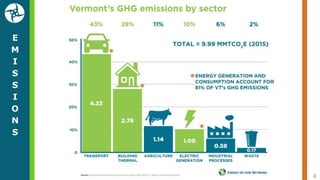
E
M
I
S
S
I
O
N
S
3
E
M
I
S
S
I
O
N
S
4
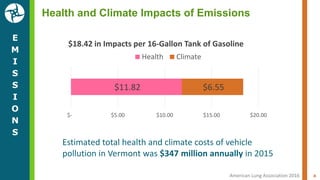
$11.82 $6.55
$- $5.00 $10.00 $15.00 $20.00
Health Climate
$18.42 in Impacts per 16-Gallon Tank of Gasoline
American Lung Association 2016
Health and Climate Impacts of Emissions
Estimated total health and climate costs of vehicle
pollution in Vermont was $347 million annually in 2015
P
A
T
H
T
O
P
A
R
I
S
5
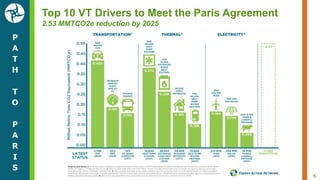
Top 10 VT Drivers to Meet the Paris Agreement
2.53 MMTCO2e reduction by 2025
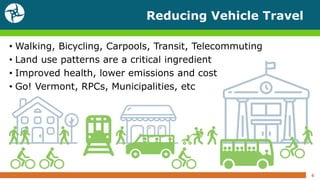
Reducing Vehicle Travel
6
• Walking, Bicycling, Carpools, Transit, Telecommuting
• Land use patterns are a critical ingredient
• Improved health, lower emissions and cost
• Go! Vermont, RPCs, Municipalities, etc
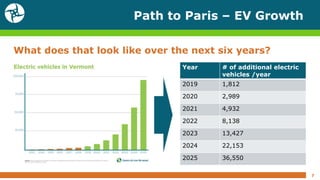
Path to Paris – EV Growth
7
What does that look like over the next six years?
Year # of additional electric
vehicles /year
2019 1,812
2020 2,989
2021 4,932
2022 8,138
2023 13,427
2024 22,153
2025 36,550
Vermont Market Conditions
8
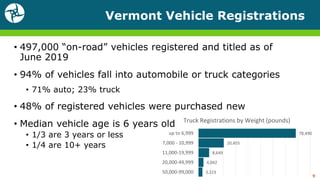
Vermont Vehicle Registrations
• 497,000 “on-road” vehicles registered and titled as of
June 2019
• 94% of vehicles fall into automobile or truck categories
• 71% auto; 23% truck
• 48% of registered vehicles were purchased new
• Median vehicle age is 6 years old
• 1/3 are 3 years or less
• 1/4 are 10+ years
9
78,490
20,455
8,649
4,042
3,223
up to 6,999
7,000 - 10,999
11,000-19,999
20,000-49,999
50,000-99,000
Truck Registrations by Weight (pounds)
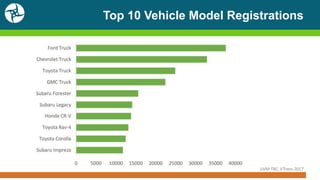
Top 10 Vehicle Model Registrations
UVM TRC, VTrans 2017
M
a
r
k
e
t
D
a
t
a
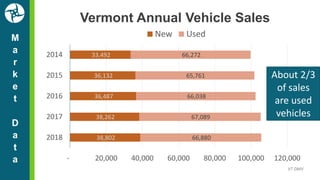
33,492
36,132
36,487
38,262
38,802
66,272
65,761
66,038
67,089
66,880
- 20,000 40,000 60,000 80,000 100,000 120,000
2014
2015
2016
2017
2018
Vermont Annual Vehicle Sales
New Used
VT DMV
About 2/3
of sales
are used
vehicles
Vermont Annual New Vehicle Sales
VT VADA
[CELLRANGE] [CELLRANGE] [CELLRANGE] [CELLRANGE]
-
5,000
10,000
15,000
20,000
25,000
30,000
35,000
40,000
45,000
2015 2016 2017 2018
Passenger Cars SUVs / Light Trucks
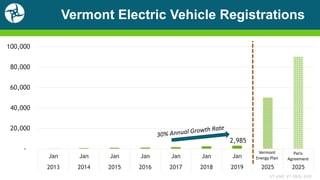
2,985
-
20,000
40,000
60,000
80,000
100,000
Jan Jan Jan Jan Jan Jan Jan
2013 2014 2015 2016 2017 2018 2019 2025 2025
Vermont Electric Vehicle Registrations
VT ANR, VT DMV, EAN
Vermont
Energy Plan
Paris
Agreement
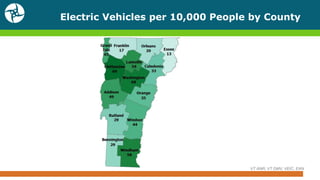
Electric Vehicles per 10,000 People by County
VT ANR, VT DMV, VEIC, EAN
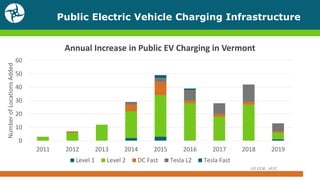
Public Electric Vehicle Charging Infrastructure
US DOE, VEIC
0
10
20
30
40
50
60
2011 2012 2013 2014 2015 2016 2017 2018 2019
NumberofLocationsAdded
Level 1 Level 2 DC Fast Tesla L2 Tesla Fast
Annual Increase in Public EV Charging in Vermont
EV Economics and Current Incentives
16
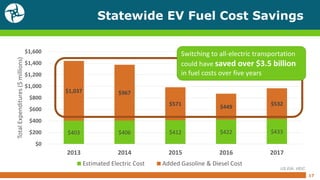
Statewide EV Fuel Cost Savings
17
$403 $406 $412 $422 $433
$1,037 $967
$571 $449
$532
$0
$200
$400
$600
$800
$1,000
$1,200
$1,400
$1,600
2013 2014 2015 2016 2017
TotalExpenditures($millions)
Estimated Electric Cost Added Gasoline & Diesel Cost
Switching to all-electric transportation
could have saved over $3.5 billion
in fuel costs over five years
US EIA, VEIC
B
E
N
E
F
I
T
S
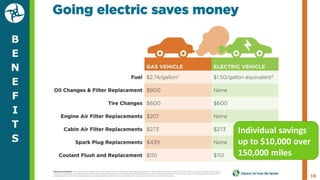
18
Individual savings
up to $10,000 over
150,000 miles
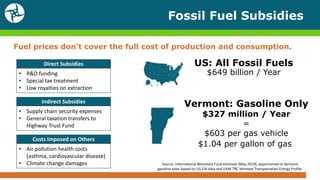
US: All Fossil Fuels
$649 billion / Year
Fossil Fuel Subsidies
Fuel prices don’t cover the full cost of production and consumption.
Direct Subsidies
• R&D funding
• Special tax treatment
• Low royalties on extraction
Indirect Subsidies
• Supply chain security expenses
• General taxation transfers to
Highway Trust Fund
Costs Imposed on Others
• Air pollution health costs
(asthma, cardiovascular disease)
• Climate change damages Source: International Monetary Fund estimate (May 2019), apportioned to Vermont
gasoline sales based on US EIA data and UVM TRC Vermont Transportation Energy Profile.
Vermont: Gasoline Only
$327 million / Year
=
$603 per gas vehicle
$1.04 per gallon of gas
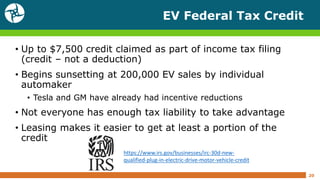
EV Federal Tax Credit
• Up to $7,500 credit claimed as part of income tax filing
(credit – not a deduction)
• Begins sunsetting at 200,000 EV sales by individual
automaker
• Tesla and GM have already had incentive reductions
• Not everyone has enough tax liability to take advantage
• Leasing makes it easier to get at least a portion of the
credit
20
https://www.irs.gov/businesses/irc-30d-new-
qualified-plug-in-electric-drive-motor-vehicle-credit
Electric Utility Incentives
http://www.driveelectricvt.com/buying-guide/purchase-incentives
See DEV website
for details
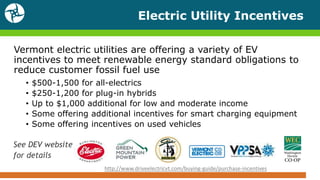
Vermont electric utilities are offering a variety of EV
incentives to meet renewable energy standard obligations to
reduce customer fossil fuel use
• $500-1,500 for all-electrics
• $250-1,200 for plug-in hybrids
• Up to $1,000 additional for low and moderate income
• Some offering additional incentives for smart charging equipment
• Some offering incentives on used vehicles
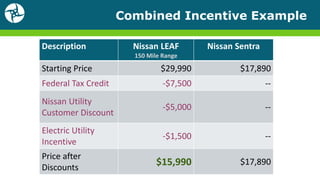
Combined Incentive Example
Description Nissan LEAF
150 Mile Range
Nissan Sentra
Starting Price $29,990 $17,890
Federal Tax Credit -$7,500 --
Nissan Utility
Customer Discount
-$5,000 --
Electric Utility
Incentive
-$1,500 --
Price after
Discounts
$15,990 $17,890
Vermont State Incentives
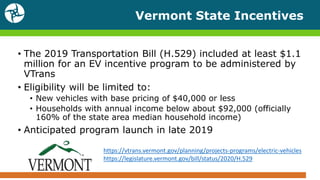
• The 2019 Transportation Bill (H.529) included at least $1.1
million for an EV incentive program to be administered by
VTrans
• Eligibility will be limited to:
• New vehicles with base pricing of $40,000 or less
• Households with annual income below about $92,000 (officially
160% of the state area median household income)
• Anticipated program launch in late 2019
https://vtrans.vermont.gov/planning/projects-programs/electric-vehicles
https://legislature.vermont.gov/bill/status/2020/H.529
EV Charging Rate Design Opportunities
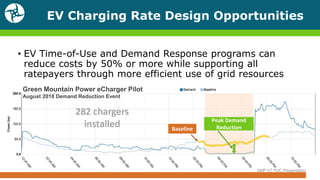
• EV Time-of-Use and Demand Response programs can
reduce costs by 50% or more while supporting all
ratepayers through more efficient use of grid resources
Baseline
Peak Demand
Reduction
Green Mountain Power eCharger Pilot
August 2018 Demand Reduction Event
GMP VT PUC Presentation
Accelerating EV Adoption
25
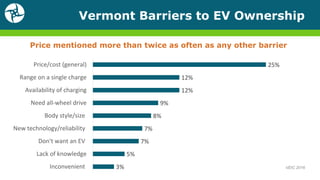
Vermont Barriers to EV Ownership
3%
5%
7%
7%
8%
9%
12%
12%
25%
Inconvenient
Lack of knowledge
Don't want an EV
New technology/reliability
Body style/size
Need all-wheel drive
Availability of charging
Range on a single charge
Price/cost (general)
Price mentioned more than twice as often as any other barrier
VEIC 2016
0% 10% 20% 30% 40% 50% 60%
<$50k
$50-100k
>$100k
Top Ranked Barrier (1) Rank 2 Barrier Rank 3 Barrier
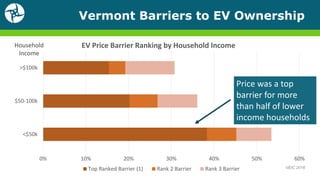
Vermont Barriers to EV Ownership
EV Price Barrier Ranking by Household Income
VEIC 2016
Price was a top
barrier for more
than half of lower
income households
Household
Income
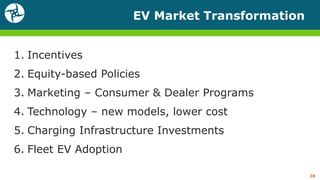
EV Market Transformation
1. Incentives
2. Equity-based Policies
3. Marketing – Consumer & Dealer Programs
4. Technology – new models, lower cost
5. Charging Infrastructure Investments
6. Fleet EV Adoption
28
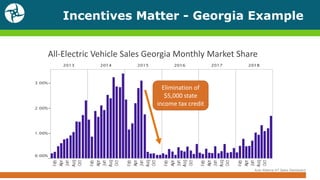
Incentives Matter - Georgia Example
All-Electric Vehicle Sales Georgia Monthly Market Share
Elimination of
$5,000 state
income tax credit
Auto Alliance AT Sales Dashboard
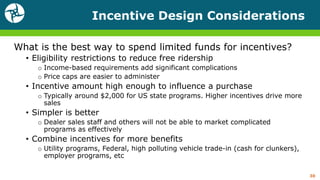
Incentive Design Considerations
What is the best way to spend limited funds for incentives?
• Eligibility restrictions to reduce free ridership
o Income-based requirements add significant complications
o Price caps are easier to administer
• Incentive amount high enough to influence a purchase
o Typically around $2,000 for US state programs. Higher incentives drive more
sales
• Simpler is better
o Dealer sales staff and others will not be able to market complicated
programs as effectively
• Combine incentives for more benefits
o Utility programs, Federal, high polluting vehicle trade-in (cash for clunkers),
employer programs, etc
30
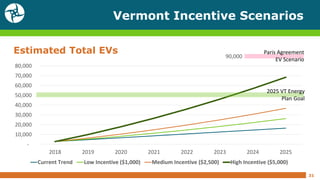
Vermont Incentive Scenarios
31
Estimated Total EVs
-
10,000
20,000
30,000
40,000
50,000
60,000
70,000
80,000
2018 2019 2020 2021 2022 2023 2024 2025
Current Trend Low Incentive ($1,000) Medium Incentive ($2,500) High Incentive ($5,000)
2025 VT Energy
Plan Goal
Paris Agreement
EV Scenario
90,000
Low & Moderate Income EV Adoption
32
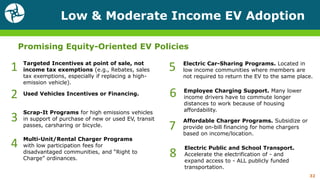
Promising Equity-Oriented EV Policies
Targeted Incentives at point of sale, not
income tax exemptions (e.g., Rebates, sales
tax exemptions, especially if replacing a high-
emission vehicle).
1
6
5
3
2
Affordable Charger Programs. Subsidize or
provide on-bill financing for home chargers
based on income/location.
Scrap-It Programs for high emissions vehicles
in support of purchase of new or used EV, transit
passes, carsharing or bicycle.
Multi-Unit/Rental Charger Programs
with low participation fees for
disadvantaged communities, and “Right to
Charge” ordinances.
Employee Charging Support. Many lower
income drivers have to commute longer
distances to work because of housing
affordability.
7
Electric Public and School Transport.
Accelerate the electrification of - and
expand access to - ALL publicly funded
transportation.
Used Vehicles Incentives or Financing.
4
Electric Car-Sharing Programs. Located in
low income communities where members are
not required to return the EV to the same place.
8
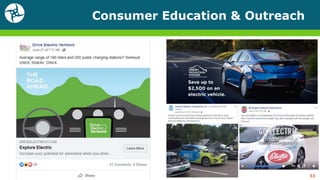
Consumer Education & Outreach
33
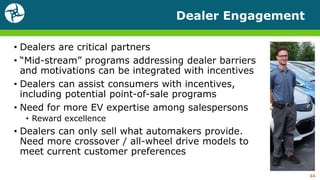
Dealer Engagement
• Dealers are critical partners
• “Mid-stream” programs addressing dealer barriers
and motivations can be integrated with incentives
• Dealers can assist consumers with incentives,
including potential point-of-sale programs
• Need for more EV expertise among salespersons
• Reward excellence
• Dealers can only sell what automakers provide.
Need more crossover / all-wheel drive models to
meet current customer preferences
34
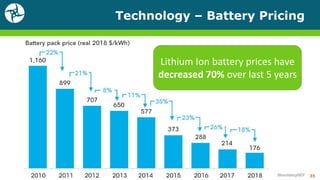
Technology – Battery Pricing
35BloombergNEF
Lithium Ion battery prices have
decreased 70% over last 5 years
Technology – Battery Lifecycle
36
US Department of Energy Lithium-Ion
Battery Recycling Prize
• Identifying innovative solutions for
collecting, sorting, storing, and
transporting spent and discarded lithium-
ion batteries
• From electric vehicle (EV), consumer
electronics, industrial, and stationary
applications — for eventual recycling and
materials recovery.
US DOE
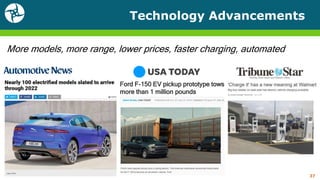
Technology Advancements
37
More models, more range, lower prices, faster charging, automated
Ford F-150 EV pickup prototype tows
more than 1 million pounds
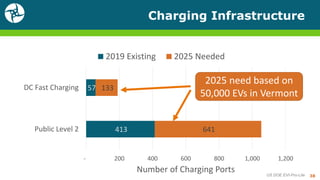
Charging Infrastructure
38US DOE EVI-Pro-Lite
413
57
641
133
- 200 400 600 800 1,000 1,200
Public Level 2
DC Fast Charging
Number of Charging Ports
2019 Existing 2025 Needed
2025 need based on
50,000 EVs in Vermont
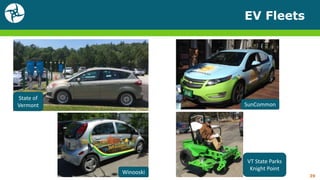
EV Fleets
39
State of
Vermont
Winooski
SunCommon
VT State Parks
Knight Point
It took 5 years to sell the first million EVs
In 2018, it only took 6 months…
Learning from Others
40
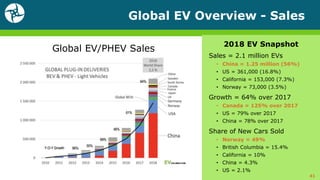
Global EV Overview - Sales
2018 EV Snapshot
Sales = 2.1 million EVs
• China = 1.25 million (56%)
• US = 361,000 (16.8%)
• California = 153,000 (7.3%)
• Norway = 73,000 (3.5%)
Growth = 64% over 2017
• Canada = 125% over 2017
• US = 79% over 2017
• China = 78% over 2017
Share of New Cars Sold
• Norway = 49%
• British Columbia = 15.4%
• California = 10%
• China = 4.3%
• US = 2.1%
41
Global EV/PHEV Sales
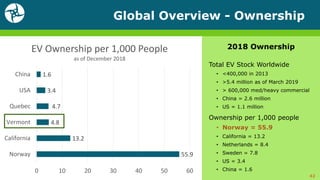
Global Overview - Ownership
2018 Ownership
Total EV Stock Worldwide
• <400,000 in 2013
• >5.4 million as of March 2019
• > 600,000 med/heavy commercial
• China = 2.6 million
• US = 1.1 million
Ownership per 1,000 people
• Norway = 55.9
• California = 13.2
• Netherlands = 8.4
• Sweden = 7.8
• US = 3.4
• China = 1.6
42
55.9
13.2
4.8
4.7
3.4
1.6
0 10 20 30 40 50 60
Norway
California
Vermont
Quebec
USA
China
EV Ownership per 1,000 People
as of December 2018
Case Studies
43
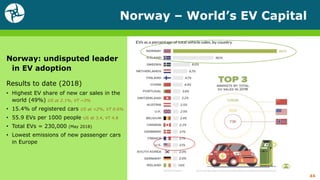
Norway – World’s EV Capital
44
Norway: undisputed leader
in EV adoption
Results to date (2018)
• Highest EV share of new car sales in the
world (49%) US at 2.1%, VT ~3%
• 15.4% of registered cars US at <2%, VT 0.6%
• 55.9 EVs per 1000 people US at 3.4, VT 4.8
• Total EVs = 230,000 (May 2018)
• Lowest emissions of new passenger cars
in Europe
Norway – Policy Goals
45
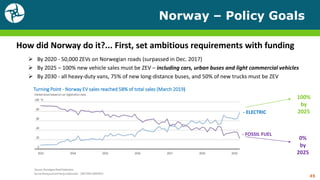
Turning Point - Norway EV sales reached 58% of total sales (March 2019)
How did Norway do it?... First, set ambitious requirements with funding
 By 2020 - 50,000 ZEVs on Norwegian roads (surpassed in Dec. 2017)
 By 2025 – 100% new vehicle sales must be ZEV – including cars, urban buses and light commercial vehicles
 By 2030 - all heavy-duty vans, 75% of new long-distance buses, and 50% of new trucks must be ZEV
- ELECTRIC
- FOSSIL FUEL
100%
by
2025
0%
by
2025
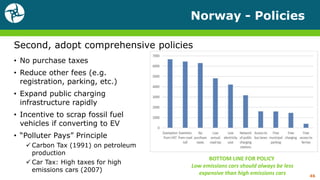
Norway - Policies
• No purchase taxes
• Reduce other fees (e.g.
registration, parking, etc.)
• Expand public charging
infrastructure rapidly
• Incentive to scrap fossil fuel
vehicles if converting to EV
• “Polluter Pays” Principle
 Carbon Tax (1991) on petroleum
production
 Car Tax: High taxes for high
emissions cars (2007)
46
BOTTOM LINE FOR POLICY
Low emissions cars should always be less
expensive than high emissions cars
Second, adopt comprehensive policies
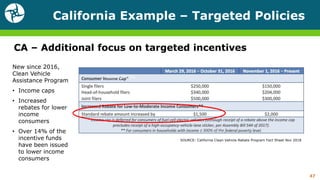
Income Criteria
SOURCE: California Clean Vehicle Rebate Program Fact Sheet Nov 2018
CA – Additional focus on targeted incentives
California Example – Targeted Policies
47
New since 2016,
Clean Vehicle
Assistance Program
• Income caps
• Increased
rebates for lower
income
consumers
• Over 14% of the
incentive funds
have been issued
to lower income
consumers
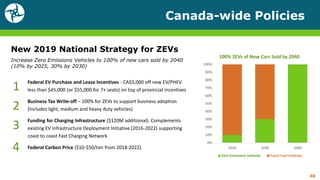
Canada-wide Policies
New 2019 National Strategy for ZEVs
Increase Zero Emissions Vehicles to 100% of new cars sold by 2040
(10% by 2025, 30% by 2030)
48
0%
10%
20%
30%
40%
50%
60%
70%
80%
90%
100%
2020 2030 2040
100% ZEVs of New Cars Sold by 2040
Zero Emissions Vehicles Fossil Fuel Vehicles
1 Federal EV Purchase and Lease Incentives - CA$5,000 off new EV/PHEV
less than $45,000 (or $55,000 for 7+ seats) on top of provincial incentives
Business Tax Write-off – 100% for ZEVs to support business adoption
(Includes light, medium and heavy duty vehicles)
Funding for Charging Infrastructure ($120M additional). Complements
existing EV Infrastructure Deployment Initiative (2016-2022) supporting
coast to coast Fast Charging Network
Federal Carbon Price ($10-$50/ton from 2018-2022).
2
3
4
49
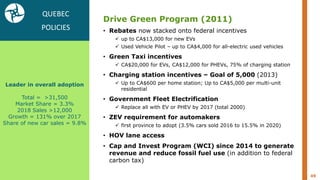
QUEBEC
POLICIES
Leader in overall adoption
Total = >31,500
Market Share = 3.3%
2018 Sales >12,000
Growth = 131% over 2017
Share of new car sales = 9.8%
Drive Green Program (2011)
• Rebates now stacked onto federal incentives
 up to CA$13,000 for new EVs
 Used Vehicle Pilot – up to CA$4,000 for all-electric used vehicles
• Green Taxi incentives
 CA$20,000 for EVs, CA$12,000 for PHEVs, 75% of charging station
• Charging station incentives – Goal of 5,000 (2013)
 Up to CA$600 per home station; Up to CA$5,000 per multi-unit
residential
• Government Fleet Electrification
 Replace all with EV or PHEV by 2017 (total 2000)
• ZEV requirement for automakers
 first province to adopt (3.5% cars sold 2016 to 15.5% in 2020)
• HOV lane access
• Cap and Invest Program (WCI) since 2014 to generate
revenue and reduce fossil fuel use (in addition to federal
carbon tax)
Lessons from Canada
50
Best Demand-Focused Policies
SOURCE: Sustainable Transportation Action Research Team. Simon Fraser University.
Financial Incentives (e.g. subsidies,
rebates, waived fees, tax exemptions)
2
1
73
6
5
4
Non-Financial Incentives (e.g. designated
parking, HOV access)
Public Charging Deployment (especially
fast charging, free parking/charging)
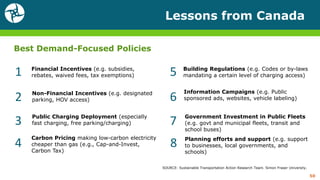
Carbon Pricing making low-carbon electricity
cheaper than gas (e.g., Cap-and-Invest,
Carbon Tax)
Building Regulations (e.g. Codes or by-laws
mandating a certain level of charging access)
Information Campaigns (e.g. Public
sponsored ads, websites, vehicle labeling)
Government Investment in Public Fleets
(e.g. govt and municipal fleets, transit and
school buses)
8 Planning efforts and support (e.g. support
to businesses, local governments, and
schools)
Lessons from Canada
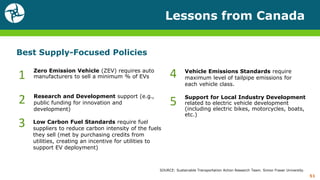
51
Best Supply-Focused Policies
Zero Emission Vehicle (ZEV) requires auto
manufacturers to sell a minimum % of EVs1
5
4
3
2 Research and Development support (e.g.,
public funding for innovation and
development)
Low Carbon Fuel Standards require fuel
suppliers to reduce carbon intensity of the fuels
they sell (met by purchasing credits from
utilities, creating an incentive for utilities to
support EV deployment)
Vehicle Emissions Standards require
maximum level of tailpipe emissions for
each vehicle class.
Support for Local Industry Development
related to electric vehicle development
(including electric bikes, motorcycles, boats,
etc.)
SOURCE: Sustainable Transportation Action Research Team. Simon Fraser University.
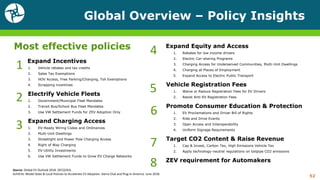
Global Overview – Policy Insights
52
Expand Incentives
1. Vehicle rebates and tax credits
2. Sales Tax Exemptions
3. HOV Access, Free Parking/Charging, Toll Exemptions
4. Scrapping incentives
Electrify Vehicle Fleets
1. Government/Municipal Fleet Mandates
2. Transit Bus/School Bus Fleet Mandates
3. Use VW Settlement Funds for ZEV Adoption Only
Expand Charging Access
1. EV-Ready Wiring Codes and Ordinances
2. Multi-Unit Dwellings
3. Streetlight and Power Pole Charging Access
4. Right of Way Charging
5. EV-Utility Investments
6. Use VW Settlement Funds to Grow EV Charge Networks
Most effective policies Expand Equity and Access
1. Rebates for low income drivers
2. Electric Car-sharing Programs
3. Charging Access for Underserved Communities, Multi-Unit Dwellings
4. Charging at Places of Employment
5. Expand Access to Electric Public Transport
Vehicle Registration Fees
1. Waive or Reduce Registration Fees for EV Drivers
2. Resist Anti-EV Registration Fees
Promote Consumer Education & Protection
1. EV Proclamations and Driver Bill of Rights
2. Ride and Drive Events
3. Open Access and Interoperability
4. Uniform Signage Requirements
Target CO2 Content & Raise Revenue
1. Cap & Invest, Carbon Tax, High Emissions Vehicle Tax
2. Apply technology-neutral regulations on tailpipe CO2 emissions
ZEV requirement for Automakers
Source: Global EV Outlook 2018. OECD/IEA.
AchiEVe: Model State & Local Policies to Accelerate EV Adoption. Sierra Club and Plug-In America. June 2018.
1
2
3
4
5
6
7
8
What’s Next?
53
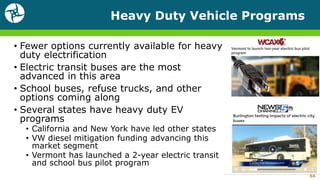
Heavy Duty Vehicle Programs
• Fewer options currently available for heavy
duty electrification
• Electric transit buses are the most
advanced in this area
• School buses, refuse trucks, and other
options coming along
• Several states have heavy duty EV
programs
• California and New York have led other states
• VW diesel mitigation funding advancing this
market segment
• Vermont has launched a 2-year electric transit
and school bus pilot program
54
Additional Resource Slides
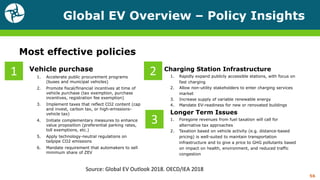
Global EV Overview – Policy Insights
56
Vehicle purchase
1. Accelerate public procurement programs
(buses and municipal vehicles)
2. Promote fiscal/financial incentives at time of
vehicle purchase (tax exemption, purchase
incentives, registration fee exemption)
3. Implement taxes that reflect CO2 content (cap
and invest, carbon tax, or high-emissions-
vehicle tax)
4. Initiate complementary measures to enhance
value proposition (preferential parking rates,
toll exemptions, etc.)
5. Apply technology-neutral regulations on
tailpipe CO2 emissions
6. Mandate requirement that automakers to sell
minimum share of ZEV
Charging Station Infrastructure
1. Rapidly expand publicly accessible stations, with focus on
fast charging
2. Allow non-utility stakeholders to enter charging services
market
3. Increase supply of variable renewable energy
4. Mandate EV-readiness for new or renovated buildings
Longer Term Issues
1. Foregone revenues from fuel taxation will call for
alternative tax approaches
2. Taxation based on vehicle activity (e.g. distance-based
pricing) is well-suited to maintain transportation
infrastructure and to give a price to GHG pollutants based
on impact on health, environment, and reduced traffic
congestion
Most effective policies
Source: Global EV Outlook 2018. OECD/IEA 2018
1 2
3
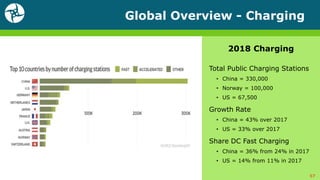
Global Overview - Charging
2018 Charging
Total Public Charging Stations
• China = 330,000
• Norway = 100,000
• US = 67,500
Growth Rate
• China = 43% over 2017
• US = 33% over 2017
Share DC Fast Charging
• China = 36% from 24% in 2017
• US = 14% from 11% in 2017
57
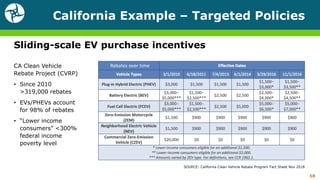
California Example – Targeted Policies
58
Sliding-scale EV purchase incentives
CA Clean Vehicle
Rebate Project (CVRP)
• Since 2010
>319,000 rebates
• EVs/PHEVs account
for 98% of rebates
• “Lower income
consumers” <300%
federal income
poverty level
SOURCE: California Clean Vehicle Rebate Program Fact Sheet Nov 2018
Rebates over time
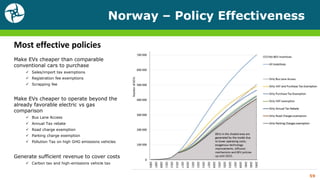
Norway – Policy Effectiveness
59
Most effective policies
Make EVs cheaper than comparable
conventional cars to purchase
 Sales/import tax exemptions
 Registration fee exemptions
 Scrapping fee
Make EVs cheaper to operate beyond the
already favorable electric vs gas
comparison
 Bus Lane Access
 Annual Tax rebate
 Road charge exemption
 Parking charge exemption
 Pollution Tax on high GHG emissions vehicles
Generate sufficient revenue to cover costs
 Carbon tax and high-emissions vehicle tax
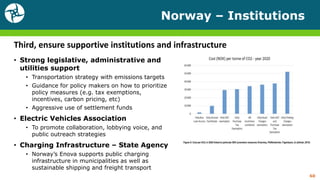
Norway – Institutions
• Strong legislative, administrative and
utilities support
• Transportation strategy with emissions targets
• Guidance for policy makers on how to prioritize
policy measures (e.g. tax exemptions,
incentives, carbon pricing, etc)
• Aggressive use of settlement funds
• Electric Vehicles Association
• To promote collaboration, lobbying voice, and
public outreach strategies
• Charging Infrastructure – State Agency
• Norway’s Enova supports public charging
infrastructure in municipalities as well as
sustainable shipping and freight transport
60
Third, ensure supportive institutions and infrastructure
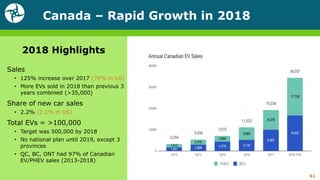
Canada – Rapid Growth in 2018
61
2018 Highlights
Sales
• 125% increase over 2017 (79% in US)
• More EVs sold in 2018 than previous 3
years combined (>35,000)
Share of new car sales
• 2.2% (2.1% in US)
Total EVs = >100,000
• Target was 500,000 by 2018
• No national plan until 2019, except 3
provinces
• QC, BC, ONT had 97% of Canadian
EV/PHEV sales (2013-2018)
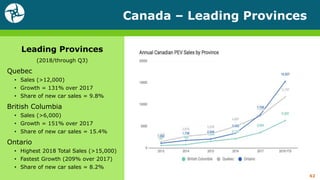
Canada – Leading Provinces
62
Leading Provinces
(2018/through Q3)
Quebec
• Sales (>12,000)
• Growth = 131% over 2017
• Share of new car sales = 9.8%
British Columbia
• Sales (>6,000)
• Growth = 151% over 2017
• Share of new car sales = 15.4%
Ontario
• Highest 2018 Total Sales (>15,000)
• Fastest Growth (209% over 2017)
• Share of new car sales = 8.2%
63
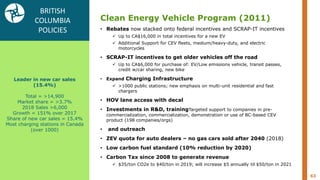
BRITISH
COLUMBIA
POLICIES
Leader in new car sales
(15.4%)
Total = >14,900
Market share = >3.7%
2018 Sales >6,000
Growth = 151% over 2017
Share of new car sales = 15.4%
Most charging stations in Canada
(over 1000)
Clean Energy Vehicle Program (2011)
• Rebates now stacked onto federal incentives and SCRAP-IT incentives
 Up to CA$16,000 in total incentives for a new EV
 Additional Support for CEV fleets, medium/heavy-duty, and electric
motorcycles
• SCRAP-IT incentives to get older vehicles off the road
 Up to CA$6,000 for purchase of: EV/Low emissions vehicle, transit passes,
credit w/car sharing, new bike
• Expand Charging Infrastructure
 >1000 public stations; new emphasis on multi-unit residential and fast
chargers
• HOV lane access with decal
• Investments in R&D, trainingTargeted support to companies in pre-
commercialization, commercialization, demonstration or use of BC-based CEV
product (198 companies/orgs)
• and outreach
• ZEV quota for auto dealers – no gas cars sold after 2040 (2018)
• Low carbon fuel standard (10% reduction by 2020)
• Carbon Tax since 2008 to generate revenue
 $35/ton CO2e to $40/ton in 2019; will increase $5 annually til $50/ton in 2021
64
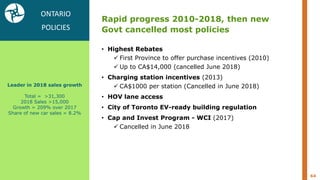
ONTARIO
POLICIES
Leader in 2018 sales growth
Total = >31,300
2018 Sales >15,000
Growth = 209% over 2017
Share of new car sales = 8.2%
Rapid progress 2010-2018, then new
Govt cancelled most policies
• Highest Rebates
 First Province to offer purchase incentives (2010)
 Up to CA$14,000 (cancelled June 2018)
• Charging station incentives (2013)
 CA$1000 per station (Cancelled in June 2018)
• HOV lane access
• City of Toronto EV-ready building regulation
• Cap and Invest Program - WCI (2017)
 Cancelled in June 2018
Funny Video – best selling models
• Evolution of US EV Sales (with GoT Music!)
65

Transportation Electrification in Vermont

  • 1.
  • 2.
    AGENDA • Transportation Emissions •EV Market Status • EV Economics and Incentives • Accelerating Adoption • Opportunities and Case Studies 2
  • 3.
  • 4.
    E M I S S I O N S 4 $11.82 $6.55 $- $5.00$10.00 $15.00 $20.00 Health Climate $18.42 in Impacts per 16-Gallon Tank of Gasoline American Lung Association 2016 Health and Climate Impacts of Emissions Estimated total health and climate costs of vehicle pollution in Vermont was $347 million annually in 2015
  • 5.
    P A T H T O P A R I S 5 Top 10 VTDrivers to Meet the Paris Agreement 2.53 MMTCO2e reduction by 2025
  • 6.
    Reducing Vehicle Travel 6 •Walking, Bicycling, Carpools, Transit, Telecommuting • Land use patterns are a critical ingredient • Improved health, lower emissions and cost • Go! Vermont, RPCs, Municipalities, etc
  • 7.
    Path to Paris– EV Growth 7 What does that look like over the next six years? Year # of additional electric vehicles /year 2019 1,812 2020 2,989 2021 4,932 2022 8,138 2023 13,427 2024 22,153 2025 36,550
  • 8.
  • 9.
    Vermont Vehicle Registrations •497,000 “on-road” vehicles registered and titled as of June 2019 • 94% of vehicles fall into automobile or truck categories • 71% auto; 23% truck • 48% of registered vehicles were purchased new • Median vehicle age is 6 years old • 1/3 are 3 years or less • 1/4 are 10+ years 9 78,490 20,455 8,649 4,042 3,223 up to 6,999 7,000 - 10,999 11,000-19,999 20,000-49,999 50,000-99,000 Truck Registrations by Weight (pounds)
  • 10.
    Top 10 VehicleModel Registrations UVM TRC, VTrans 2017
  • 11.
    M a r k e t D a t a 33,492 36,132 36,487 38,262 38,802 66,272 65,761 66,038 67,089 66,880 - 20,000 40,00060,000 80,000 100,000 120,000 2014 2015 2016 2017 2018 Vermont Annual Vehicle Sales New Used VT DMV About 2/3 of sales are used vehicles
  • 12.
    Vermont Annual NewVehicle Sales VT VADA [CELLRANGE] [CELLRANGE] [CELLRANGE] [CELLRANGE] - 5,000 10,000 15,000 20,000 25,000 30,000 35,000 40,000 45,000 2015 2016 2017 2018 Passenger Cars SUVs / Light Trucks
  • 13.
    2,985 - 20,000 40,000 60,000 80,000 100,000 Jan Jan JanJan Jan Jan Jan 2013 2014 2015 2016 2017 2018 2019 2025 2025 Vermont Electric Vehicle Registrations VT ANR, VT DMV, EAN Vermont Energy Plan Paris Agreement
  • 14.
    Electric Vehicles per10,000 People by County VT ANR, VT DMV, VEIC, EAN
  • 15.
    Public Electric VehicleCharging Infrastructure US DOE, VEIC 0 10 20 30 40 50 60 2011 2012 2013 2014 2015 2016 2017 2018 2019 NumberofLocationsAdded Level 1 Level 2 DC Fast Tesla L2 Tesla Fast Annual Increase in Public EV Charging in Vermont
  • 16.
    EV Economics andCurrent Incentives 16
  • 17.
    Statewide EV FuelCost Savings 17 $403 $406 $412 $422 $433 $1,037 $967 $571 $449 $532 $0 $200 $400 $600 $800 $1,000 $1,200 $1,400 $1,600 2013 2014 2015 2016 2017 TotalExpenditures($millions) Estimated Electric Cost Added Gasoline & Diesel Cost Switching to all-electric transportation could have saved over $3.5 billion in fuel costs over five years US EIA, VEIC
  • 18.
  • 19.
    US: All FossilFuels $649 billion / Year Fossil Fuel Subsidies Fuel prices don’t cover the full cost of production and consumption. Direct Subsidies • R&D funding • Special tax treatment • Low royalties on extraction Indirect Subsidies • Supply chain security expenses • General taxation transfers to Highway Trust Fund Costs Imposed on Others • Air pollution health costs (asthma, cardiovascular disease) • Climate change damages Source: International Monetary Fund estimate (May 2019), apportioned to Vermont gasoline sales based on US EIA data and UVM TRC Vermont Transportation Energy Profile. Vermont: Gasoline Only $327 million / Year = $603 per gas vehicle $1.04 per gallon of gas
  • 20.
    EV Federal TaxCredit • Up to $7,500 credit claimed as part of income tax filing (credit – not a deduction) • Begins sunsetting at 200,000 EV sales by individual automaker • Tesla and GM have already had incentive reductions • Not everyone has enough tax liability to take advantage • Leasing makes it easier to get at least a portion of the credit 20 https://www.irs.gov/businesses/irc-30d-new- qualified-plug-in-electric-drive-motor-vehicle-credit
  • 21.
    Electric Utility Incentives http://www.driveelectricvt.com/buying-guide/purchase-incentives SeeDEV website for details Vermont electric utilities are offering a variety of EV incentives to meet renewable energy standard obligations to reduce customer fossil fuel use • $500-1,500 for all-electrics • $250-1,200 for plug-in hybrids • Up to $1,000 additional for low and moderate income • Some offering additional incentives for smart charging equipment • Some offering incentives on used vehicles
  • 22.
    Combined Incentive Example DescriptionNissan LEAF 150 Mile Range Nissan Sentra Starting Price $29,990 $17,890 Federal Tax Credit -$7,500 -- Nissan Utility Customer Discount -$5,000 -- Electric Utility Incentive -$1,500 -- Price after Discounts $15,990 $17,890
  • 23.
    Vermont State Incentives •The 2019 Transportation Bill (H.529) included at least $1.1 million for an EV incentive program to be administered by VTrans • Eligibility will be limited to: • New vehicles with base pricing of $40,000 or less • Households with annual income below about $92,000 (officially 160% of the state area median household income) • Anticipated program launch in late 2019 https://vtrans.vermont.gov/planning/projects-programs/electric-vehicles https://legislature.vermont.gov/bill/status/2020/H.529
  • 24.
    EV Charging RateDesign Opportunities • EV Time-of-Use and Demand Response programs can reduce costs by 50% or more while supporting all ratepayers through more efficient use of grid resources Baseline Peak Demand Reduction Green Mountain Power eCharger Pilot August 2018 Demand Reduction Event GMP VT PUC Presentation
  • 25.
  • 26.
    Vermont Barriers toEV Ownership 3% 5% 7% 7% 8% 9% 12% 12% 25% Inconvenient Lack of knowledge Don't want an EV New technology/reliability Body style/size Need all-wheel drive Availability of charging Range on a single charge Price/cost (general) Price mentioned more than twice as often as any other barrier VEIC 2016
  • 27.
    0% 10% 20%30% 40% 50% 60% <$50k $50-100k >$100k Top Ranked Barrier (1) Rank 2 Barrier Rank 3 Barrier Vermont Barriers to EV Ownership EV Price Barrier Ranking by Household Income VEIC 2016 Price was a top barrier for more than half of lower income households Household Income
  • 28.
    EV Market Transformation 1.Incentives 2. Equity-based Policies 3. Marketing – Consumer & Dealer Programs 4. Technology – new models, lower cost 5. Charging Infrastructure Investments 6. Fleet EV Adoption 28
  • 29.
    Incentives Matter -Georgia Example All-Electric Vehicle Sales Georgia Monthly Market Share Elimination of $5,000 state income tax credit Auto Alliance AT Sales Dashboard
  • 30.
    Incentive Design Considerations Whatis the best way to spend limited funds for incentives? • Eligibility restrictions to reduce free ridership o Income-based requirements add significant complications o Price caps are easier to administer • Incentive amount high enough to influence a purchase o Typically around $2,000 for US state programs. Higher incentives drive more sales • Simpler is better o Dealer sales staff and others will not be able to market complicated programs as effectively • Combine incentives for more benefits o Utility programs, Federal, high polluting vehicle trade-in (cash for clunkers), employer programs, etc 30
  • 31.
    Vermont Incentive Scenarios 31 EstimatedTotal EVs - 10,000 20,000 30,000 40,000 50,000 60,000 70,000 80,000 2018 2019 2020 2021 2022 2023 2024 2025 Current Trend Low Incentive ($1,000) Medium Incentive ($2,500) High Incentive ($5,000) 2025 VT Energy Plan Goal Paris Agreement EV Scenario 90,000
  • 32.
    Low & ModerateIncome EV Adoption 32 Promising Equity-Oriented EV Policies Targeted Incentives at point of sale, not income tax exemptions (e.g., Rebates, sales tax exemptions, especially if replacing a high- emission vehicle). 1 6 5 3 2 Affordable Charger Programs. Subsidize or provide on-bill financing for home chargers based on income/location. Scrap-It Programs for high emissions vehicles in support of purchase of new or used EV, transit passes, carsharing or bicycle. Multi-Unit/Rental Charger Programs with low participation fees for disadvantaged communities, and “Right to Charge” ordinances. Employee Charging Support. Many lower income drivers have to commute longer distances to work because of housing affordability. 7 Electric Public and School Transport. Accelerate the electrification of - and expand access to - ALL publicly funded transportation. Used Vehicles Incentives or Financing. 4 Electric Car-Sharing Programs. Located in low income communities where members are not required to return the EV to the same place. 8
  • 33.
  • 34.
    Dealer Engagement • Dealersare critical partners • “Mid-stream” programs addressing dealer barriers and motivations can be integrated with incentives • Dealers can assist consumers with incentives, including potential point-of-sale programs • Need for more EV expertise among salespersons • Reward excellence • Dealers can only sell what automakers provide. Need more crossover / all-wheel drive models to meet current customer preferences 34
  • 35.
    Technology – BatteryPricing 35BloombergNEF Lithium Ion battery prices have decreased 70% over last 5 years
  • 36.
    Technology – BatteryLifecycle 36 US Department of Energy Lithium-Ion Battery Recycling Prize • Identifying innovative solutions for collecting, sorting, storing, and transporting spent and discarded lithium- ion batteries • From electric vehicle (EV), consumer electronics, industrial, and stationary applications — for eventual recycling and materials recovery. US DOE
  • 37.
    Technology Advancements 37 More models,more range, lower prices, faster charging, automated Ford F-150 EV pickup prototype tows more than 1 million pounds
  • 38.
    Charging Infrastructure 38US DOEEVI-Pro-Lite 413 57 641 133 - 200 400 600 800 1,000 1,200 Public Level 2 DC Fast Charging Number of Charging Ports 2019 Existing 2025 Needed 2025 need based on 50,000 EVs in Vermont
  • 39.
  • 40.
    It took 5years to sell the first million EVs In 2018, it only took 6 months… Learning from Others 40
  • 41.
    Global EV Overview- Sales 2018 EV Snapshot Sales = 2.1 million EVs • China = 1.25 million (56%) • US = 361,000 (16.8%) • California = 153,000 (7.3%) • Norway = 73,000 (3.5%) Growth = 64% over 2017 • Canada = 125% over 2017 • US = 79% over 2017 • China = 78% over 2017 Share of New Cars Sold • Norway = 49% • British Columbia = 15.4% • California = 10% • China = 4.3% • US = 2.1% 41 Global EV/PHEV Sales
  • 42.
    Global Overview -Ownership 2018 Ownership Total EV Stock Worldwide • <400,000 in 2013 • >5.4 million as of March 2019 • > 600,000 med/heavy commercial • China = 2.6 million • US = 1.1 million Ownership per 1,000 people • Norway = 55.9 • California = 13.2 • Netherlands = 8.4 • Sweden = 7.8 • US = 3.4 • China = 1.6 42 55.9 13.2 4.8 4.7 3.4 1.6 0 10 20 30 40 50 60 Norway California Vermont Quebec USA China EV Ownership per 1,000 People as of December 2018
  • 43.
  • 44.
    Norway – World’sEV Capital 44 Norway: undisputed leader in EV adoption Results to date (2018) • Highest EV share of new car sales in the world (49%) US at 2.1%, VT ~3% • 15.4% of registered cars US at <2%, VT 0.6% • 55.9 EVs per 1000 people US at 3.4, VT 4.8 • Total EVs = 230,000 (May 2018) • Lowest emissions of new passenger cars in Europe
  • 45.
    Norway – PolicyGoals 45 Turning Point - Norway EV sales reached 58% of total sales (March 2019) How did Norway do it?... First, set ambitious requirements with funding  By 2020 - 50,000 ZEVs on Norwegian roads (surpassed in Dec. 2017)  By 2025 – 100% new vehicle sales must be ZEV – including cars, urban buses and light commercial vehicles  By 2030 - all heavy-duty vans, 75% of new long-distance buses, and 50% of new trucks must be ZEV - ELECTRIC - FOSSIL FUEL 100% by 2025 0% by 2025
  • 46.
    Norway - Policies •No purchase taxes • Reduce other fees (e.g. registration, parking, etc.) • Expand public charging infrastructure rapidly • Incentive to scrap fossil fuel vehicles if converting to EV • “Polluter Pays” Principle  Carbon Tax (1991) on petroleum production  Car Tax: High taxes for high emissions cars (2007) 46 BOTTOM LINE FOR POLICY Low emissions cars should always be less expensive than high emissions cars Second, adopt comprehensive policies
  • 47.
    Income Criteria SOURCE: CaliforniaClean Vehicle Rebate Program Fact Sheet Nov 2018 CA – Additional focus on targeted incentives California Example – Targeted Policies 47 New since 2016, Clean Vehicle Assistance Program • Income caps • Increased rebates for lower income consumers • Over 14% of the incentive funds have been issued to lower income consumers
  • 48.
    Canada-wide Policies New 2019National Strategy for ZEVs Increase Zero Emissions Vehicles to 100% of new cars sold by 2040 (10% by 2025, 30% by 2030) 48 0% 10% 20% 30% 40% 50% 60% 70% 80% 90% 100% 2020 2030 2040 100% ZEVs of New Cars Sold by 2040 Zero Emissions Vehicles Fossil Fuel Vehicles 1 Federal EV Purchase and Lease Incentives - CA$5,000 off new EV/PHEV less than $45,000 (or $55,000 for 7+ seats) on top of provincial incentives Business Tax Write-off – 100% for ZEVs to support business adoption (Includes light, medium and heavy duty vehicles) Funding for Charging Infrastructure ($120M additional). Complements existing EV Infrastructure Deployment Initiative (2016-2022) supporting coast to coast Fast Charging Network Federal Carbon Price ($10-$50/ton from 2018-2022). 2 3 4
  • 49.
    49 QUEBEC POLICIES Leader in overalladoption Total = >31,500 Market Share = 3.3% 2018 Sales >12,000 Growth = 131% over 2017 Share of new car sales = 9.8% Drive Green Program (2011) • Rebates now stacked onto federal incentives  up to CA$13,000 for new EVs  Used Vehicle Pilot – up to CA$4,000 for all-electric used vehicles • Green Taxi incentives  CA$20,000 for EVs, CA$12,000 for PHEVs, 75% of charging station • Charging station incentives – Goal of 5,000 (2013)  Up to CA$600 per home station; Up to CA$5,000 per multi-unit residential • Government Fleet Electrification  Replace all with EV or PHEV by 2017 (total 2000) • ZEV requirement for automakers  first province to adopt (3.5% cars sold 2016 to 15.5% in 2020) • HOV lane access • Cap and Invest Program (WCI) since 2014 to generate revenue and reduce fossil fuel use (in addition to federal carbon tax)
  • 50.
    Lessons from Canada 50 BestDemand-Focused Policies SOURCE: Sustainable Transportation Action Research Team. Simon Fraser University. Financial Incentives (e.g. subsidies, rebates, waived fees, tax exemptions) 2 1 73 6 5 4 Non-Financial Incentives (e.g. designated parking, HOV access) Public Charging Deployment (especially fast charging, free parking/charging) Carbon Pricing making low-carbon electricity cheaper than gas (e.g., Cap-and-Invest, Carbon Tax) Building Regulations (e.g. Codes or by-laws mandating a certain level of charging access) Information Campaigns (e.g. Public sponsored ads, websites, vehicle labeling) Government Investment in Public Fleets (e.g. govt and municipal fleets, transit and school buses) 8 Planning efforts and support (e.g. support to businesses, local governments, and schools)
  • 51.
    Lessons from Canada 51 BestSupply-Focused Policies Zero Emission Vehicle (ZEV) requires auto manufacturers to sell a minimum % of EVs1 5 4 3 2 Research and Development support (e.g., public funding for innovation and development) Low Carbon Fuel Standards require fuel suppliers to reduce carbon intensity of the fuels they sell (met by purchasing credits from utilities, creating an incentive for utilities to support EV deployment) Vehicle Emissions Standards require maximum level of tailpipe emissions for each vehicle class. Support for Local Industry Development related to electric vehicle development (including electric bikes, motorcycles, boats, etc.) SOURCE: Sustainable Transportation Action Research Team. Simon Fraser University.
  • 52.
    Global Overview –Policy Insights 52 Expand Incentives 1. Vehicle rebates and tax credits 2. Sales Tax Exemptions 3. HOV Access, Free Parking/Charging, Toll Exemptions 4. Scrapping incentives Electrify Vehicle Fleets 1. Government/Municipal Fleet Mandates 2. Transit Bus/School Bus Fleet Mandates 3. Use VW Settlement Funds for ZEV Adoption Only Expand Charging Access 1. EV-Ready Wiring Codes and Ordinances 2. Multi-Unit Dwellings 3. Streetlight and Power Pole Charging Access 4. Right of Way Charging 5. EV-Utility Investments 6. Use VW Settlement Funds to Grow EV Charge Networks Most effective policies Expand Equity and Access 1. Rebates for low income drivers 2. Electric Car-sharing Programs 3. Charging Access for Underserved Communities, Multi-Unit Dwellings 4. Charging at Places of Employment 5. Expand Access to Electric Public Transport Vehicle Registration Fees 1. Waive or Reduce Registration Fees for EV Drivers 2. Resist Anti-EV Registration Fees Promote Consumer Education & Protection 1. EV Proclamations and Driver Bill of Rights 2. Ride and Drive Events 3. Open Access and Interoperability 4. Uniform Signage Requirements Target CO2 Content & Raise Revenue 1. Cap & Invest, Carbon Tax, High Emissions Vehicle Tax 2. Apply technology-neutral regulations on tailpipe CO2 emissions ZEV requirement for Automakers Source: Global EV Outlook 2018. OECD/IEA. AchiEVe: Model State & Local Policies to Accelerate EV Adoption. Sierra Club and Plug-In America. June 2018. 1 2 3 4 5 6 7 8
  • 53.
  • 54.
    Heavy Duty VehiclePrograms • Fewer options currently available for heavy duty electrification • Electric transit buses are the most advanced in this area • School buses, refuse trucks, and other options coming along • Several states have heavy duty EV programs • California and New York have led other states • VW diesel mitigation funding advancing this market segment • Vermont has launched a 2-year electric transit and school bus pilot program 54
  • 55.
  • 56.
    Global EV Overview– Policy Insights 56 Vehicle purchase 1. Accelerate public procurement programs (buses and municipal vehicles) 2. Promote fiscal/financial incentives at time of vehicle purchase (tax exemption, purchase incentives, registration fee exemption) 3. Implement taxes that reflect CO2 content (cap and invest, carbon tax, or high-emissions- vehicle tax) 4. Initiate complementary measures to enhance value proposition (preferential parking rates, toll exemptions, etc.) 5. Apply technology-neutral regulations on tailpipe CO2 emissions 6. Mandate requirement that automakers to sell minimum share of ZEV Charging Station Infrastructure 1. Rapidly expand publicly accessible stations, with focus on fast charging 2. Allow non-utility stakeholders to enter charging services market 3. Increase supply of variable renewable energy 4. Mandate EV-readiness for new or renovated buildings Longer Term Issues 1. Foregone revenues from fuel taxation will call for alternative tax approaches 2. Taxation based on vehicle activity (e.g. distance-based pricing) is well-suited to maintain transportation infrastructure and to give a price to GHG pollutants based on impact on health, environment, and reduced traffic congestion Most effective policies Source: Global EV Outlook 2018. OECD/IEA 2018 1 2 3
  • 57.
    Global Overview -Charging 2018 Charging Total Public Charging Stations • China = 330,000 • Norway = 100,000 • US = 67,500 Growth Rate • China = 43% over 2017 • US = 33% over 2017 Share DC Fast Charging • China = 36% from 24% in 2017 • US = 14% from 11% in 2017 57
  • 58.
    California Example –Targeted Policies 58 Sliding-scale EV purchase incentives CA Clean Vehicle Rebate Project (CVRP) • Since 2010 >319,000 rebates • EVs/PHEVs account for 98% of rebates • “Lower income consumers” <300% federal income poverty level SOURCE: California Clean Vehicle Rebate Program Fact Sheet Nov 2018 Rebates over time
  • 59.
    Norway – PolicyEffectiveness 59 Most effective policies Make EVs cheaper than comparable conventional cars to purchase  Sales/import tax exemptions  Registration fee exemptions  Scrapping fee Make EVs cheaper to operate beyond the already favorable electric vs gas comparison  Bus Lane Access  Annual Tax rebate  Road charge exemption  Parking charge exemption  Pollution Tax on high GHG emissions vehicles Generate sufficient revenue to cover costs  Carbon tax and high-emissions vehicle tax
  • 60.
    Norway – Institutions •Strong legislative, administrative and utilities support • Transportation strategy with emissions targets • Guidance for policy makers on how to prioritize policy measures (e.g. tax exemptions, incentives, carbon pricing, etc) • Aggressive use of settlement funds • Electric Vehicles Association • To promote collaboration, lobbying voice, and public outreach strategies • Charging Infrastructure – State Agency • Norway’s Enova supports public charging infrastructure in municipalities as well as sustainable shipping and freight transport 60 Third, ensure supportive institutions and infrastructure
  • 61.
    Canada – RapidGrowth in 2018 61 2018 Highlights Sales • 125% increase over 2017 (79% in US) • More EVs sold in 2018 than previous 3 years combined (>35,000) Share of new car sales • 2.2% (2.1% in US) Total EVs = >100,000 • Target was 500,000 by 2018 • No national plan until 2019, except 3 provinces • QC, BC, ONT had 97% of Canadian EV/PHEV sales (2013-2018)
  • 62.
    Canada – LeadingProvinces 62 Leading Provinces (2018/through Q3) Quebec • Sales (>12,000) • Growth = 131% over 2017 • Share of new car sales = 9.8% British Columbia • Sales (>6,000) • Growth = 151% over 2017 • Share of new car sales = 15.4% Ontario • Highest 2018 Total Sales (>15,000) • Fastest Growth (209% over 2017) • Share of new car sales = 8.2%
  • 63.
    63 BRITISH COLUMBIA POLICIES Leader in newcar sales (15.4%) Total = >14,900 Market share = >3.7% 2018 Sales >6,000 Growth = 151% over 2017 Share of new car sales = 15.4% Most charging stations in Canada (over 1000) Clean Energy Vehicle Program (2011) • Rebates now stacked onto federal incentives and SCRAP-IT incentives  Up to CA$16,000 in total incentives for a new EV  Additional Support for CEV fleets, medium/heavy-duty, and electric motorcycles • SCRAP-IT incentives to get older vehicles off the road  Up to CA$6,000 for purchase of: EV/Low emissions vehicle, transit passes, credit w/car sharing, new bike • Expand Charging Infrastructure  >1000 public stations; new emphasis on multi-unit residential and fast chargers • HOV lane access with decal • Investments in R&D, trainingTargeted support to companies in pre- commercialization, commercialization, demonstration or use of BC-based CEV product (198 companies/orgs) • and outreach • ZEV quota for auto dealers – no gas cars sold after 2040 (2018) • Low carbon fuel standard (10% reduction by 2020) • Carbon Tax since 2008 to generate revenue  $35/ton CO2e to $40/ton in 2019; will increase $5 annually til $50/ton in 2021
  • 64.
    64 ONTARIO POLICIES Leader in 2018sales growth Total = >31,300 2018 Sales >15,000 Growth = 209% over 2017 Share of new car sales = 8.2% Rapid progress 2010-2018, then new Govt cancelled most policies • Highest Rebates  First Province to offer purchase incentives (2010)  Up to CA$14,000 (cancelled June 2018) • Charging station incentives (2013)  CA$1000 per station (Cancelled in June 2018) • HOV lane access • City of Toronto EV-ready building regulation • Cap and Invest Program - WCI (2017)  Cancelled in June 2018
  • 65.
    Funny Video –best selling models • Evolution of US EV Sales (with GoT Music!) 65