









A Paradigm Shift in Funding
Energy Efficiency and
Renewable Energy Projects
Presented
By:
"An Energy Solutions Company"
PACE Financing
Reduce
Customer
Costs
Reduce
Investor
Risk
Reduce
Distributor
Hurdles
Close
More
Deals
Limited
Capital
Limited
Terms
Long Payback
Periods
The Answer?
PACE
Property Assessed
Clean Energy
Financing
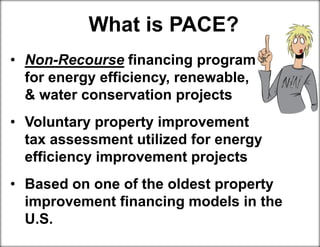
What is PACE?
• Non-Recourse financing program for
for energy efficiency, renewable, rgy
& water conservation projects
• Voluntary property improvement tax
tax assessment utilized for energy
efficiency improvement projects
• Based on one of the oldest property
improvement financing models in the
U.S.
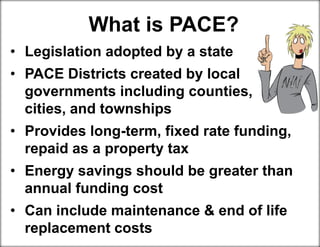
What is PACE?
• Legislation adopted by a state
• PACE Districts created by local
governments including counties,
cities, and townships
• Provides long-term, fixed rate funding,
repaid as a property tax
• Energy savings should be greater than
annual funding cost
• Can include maintenance & end of life
replacement costs
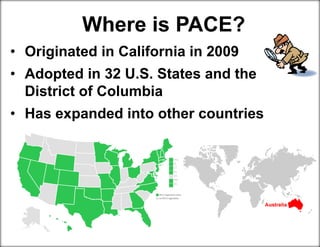
Where is PACE?
• Originated in California in 2009
• Adopted in 32 U.S. States and the
District of Columbia
• Has expanded into other countries
Where is PACE?
Information on PACE programs
in the U.S. is available through the
PACENation and DSIRE organizations
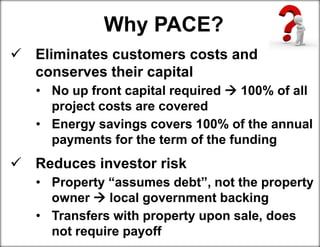
Why PACE?
 Eliminates customers costs and
conserves their capital
• No up front capital required  100% of all
project costs are covered
• Energy savings covers 100% of the annual
payments for the term of the funding
 Reduces investor risk
• Property “assumes debt”, not the property
owner  local government backing
• Transfers with property upon sale, does
not require payoff
Why PACE?
 It’s non recourse
 Some states require project to be cash
flow positive over term of funding
 Some states require a performance
guarantee
 Does not affect property owners credit
or borrowing power
 Provides long-term, fixed rate financing
through assessment  Typically 20 yrs
 Increases property value, real property
improvement not personal property
 Can be utilized multiple times on same
property
 Savings & ROI includes maintenance
and end of life replacement costs
 Covers “real property” assets including
including items like electric vehicles
 Assets must remain with the property if
if sold, can also be transferred
Why PACE?
Reduces Distributor
Hurdles
Who Funds PACE?
PACE statutes allows PACE projects to
be funded through a variety of sources
 Private Equity
 Self Funding
 Traditional Funding
 Bonds
Amount available for a PACE project is
dependent on several factors and can
range from 20% to 30% of the properties
FMV
1) Property Value
2) Mortgage LTV
3) Annual Energy Spend
4) % of Value by Lender
5) PACE District % of Value
How Much is Available?
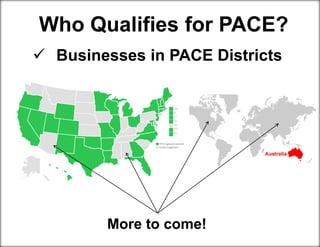
Who Qualifies for PACE?
 Businesses in PACE Districts
More to come!
 For-profit and non-profit commercial &
industrial businesses in most states
 In most states Government & Publically
owned buildings not allowed
 Business outlook is good
 Property is not leveraged
(Up to 95% LTV in some cases)
 Typically Projects >$250K but smaller
can be funded
 Don’t own it? Get permission!
Who Qualifies for PACE?
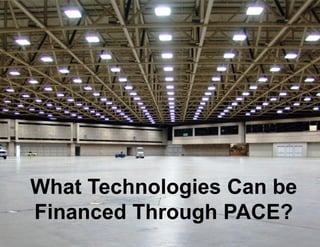
What Technologies Can be
Financed Through PACE?
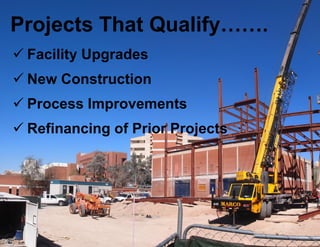
Projects That Qualify…….
 Facility Upgrades
 New Construction
 Process Improvements
 Refinancing of Prior Projects
But
Wait
There’s
More!!
f
Technology
Incentives
Tax Credits
Financing
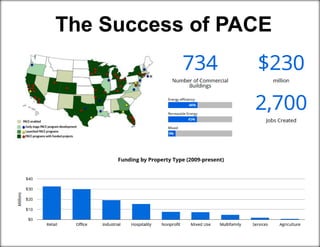
The Success of PACE
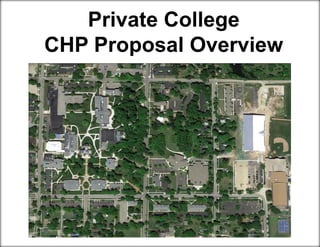
Private College
CHP Proposal Overview
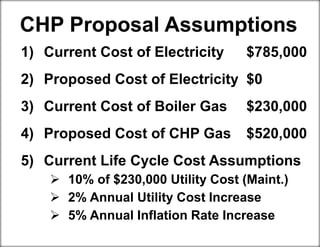
CHP Proposal Assumptions
1) Current Cost of Electricity $785,000
2) Proposed Cost of Electricity $0
3) Current Cost of Boiler Gas $230,000
4) Proposed Cost of CHP Gas $520,000
5) Current Life Cycle Cost Assumptions
 10% of $230,000 Utility Cost (Maint.)
 2% Annual Utility Cost Increase
 5% Annual Inflation Rate Increase
6) Proposed Life Cycle Cost Assumptions
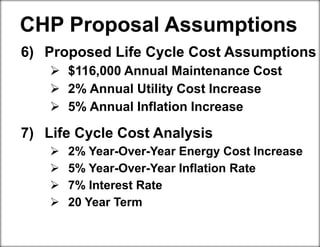
 $116,000 Annual Maintenance Cost
 2% Annual Utility Cost Increase
 5% Annual Inflation Increase
7) Life Cycle Cost Analysis
 2% Year-Over-Year Energy Cost Increase
 5% Year-Over-Year Inflation Rate
 7% Interest Rate
 20 Year Term
CHP Proposal Assumptions
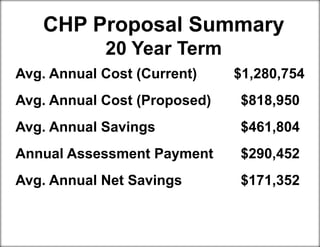
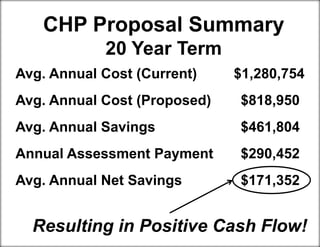
Avg. Annual Cost (Current) $1,280,754
Avg. Annual Cost (Proposed) $818,950
Avg. Annual Savings $461,804
Annual Assessment Payment $290,452
Avg. Annual Net Savings $171,352
CHP Proposal Summary
20 Year Term
Avg. Annual Cost (Current) $1,280,754
Avg. Annual Cost (Proposed) $818,950
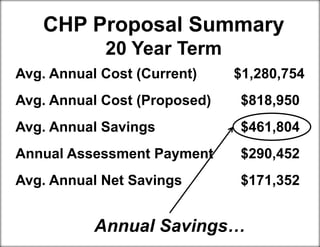
Avg. Annual Savings $461,804
Annual Assessment Payment $290,452
Avg. Annual Net Savings $171,352
CHP Proposal Summary
20 Year Term
Annual Savings…
Avg. Annual Cost (Current) $1,280,754
Avg. Annual Cost (Proposed) $818,950
Avg. Annual Savings $461,804
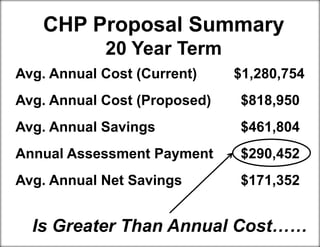
Annual Assessment Payment $290,452
Avg. Annual Net Savings $171,352
CHP Proposal Summary
20 Year Term
Is Greater Than Annual Cost……
Avg. Annual Cost (Current) $1,280,754
Avg. Annual Cost (Proposed) $818,950
Avg. Annual Savings $461,804
Annual Assessment Payment $290,452
Avg. Annual Net Savings $171,352
CHP Proposal Summary
20 Year Term
Resulting in Positive Cash Flow!
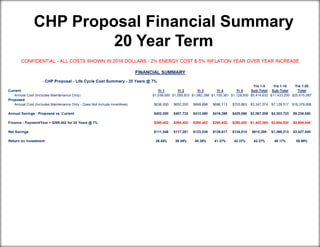
CHP Proposal Financial Summary
20 Year Term
CHP Proposal Financial Summary
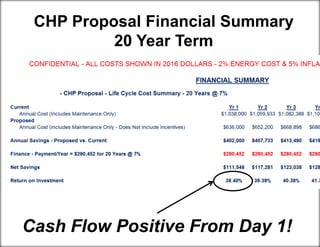
20 Year Term
Cash Flow Positive From Day 1!

Powering On-Site Energy with PACE Financing

  • 1.
    A Paradigm Shiftin Funding Energy Efficiency and Renewable Energy Projects Presented By: "An Energy Solutions Company" PACE Financing
  • 2.
  • 6.
  • 7.
  • 8.
  • 9.
  • 10.
  • 11.
    What is PACE? •Non-Recourse financing program for for energy efficiency, renewable, rgy & water conservation projects • Voluntary property improvement tax tax assessment utilized for energy efficiency improvement projects • Based on one of the oldest property improvement financing models in the U.S.
  • 12.
    What is PACE? •Legislation adopted by a state • PACE Districts created by local governments including counties, cities, and townships • Provides long-term, fixed rate funding, repaid as a property tax • Energy savings should be greater than annual funding cost • Can include maintenance & end of life replacement costs
  • 13.
    Where is PACE? •Originated in California in 2009 • Adopted in 32 U.S. States and the District of Columbia • Has expanded into other countries
  • 14.
    Where is PACE? Informationon PACE programs in the U.S. is available through the PACENation and DSIRE organizations
  • 15.
    Why PACE?  Eliminatescustomers costs and conserves their capital • No up front capital required  100% of all project costs are covered • Energy savings covers 100% of the annual payments for the term of the funding  Reduces investor risk • Property “assumes debt”, not the property owner  local government backing • Transfers with property upon sale, does not require payoff
  • 16.
    Why PACE?  It’snon recourse  Some states require project to be cash flow positive over term of funding  Some states require a performance guarantee  Does not affect property owners credit or borrowing power  Provides long-term, fixed rate financing through assessment  Typically 20 yrs
  • 17.
     Increases propertyvalue, real property improvement not personal property  Can be utilized multiple times on same property  Savings & ROI includes maintenance and end of life replacement costs  Covers “real property” assets including including items like electric vehicles  Assets must remain with the property if if sold, can also be transferred Why PACE?
  • 18.
  • 19.
    Who Funds PACE? PACEstatutes allows PACE projects to be funded through a variety of sources  Private Equity  Self Funding  Traditional Funding  Bonds
  • 20.
    Amount available fora PACE project is dependent on several factors and can range from 20% to 30% of the properties FMV 1) Property Value 2) Mortgage LTV 3) Annual Energy Spend 4) % of Value by Lender 5) PACE District % of Value How Much is Available?
  • 21.
    Who Qualifies forPACE?  Businesses in PACE Districts More to come!
  • 22.
     For-profit andnon-profit commercial & industrial businesses in most states  In most states Government & Publically owned buildings not allowed  Business outlook is good  Property is not leveraged (Up to 95% LTV in some cases)  Typically Projects >$250K but smaller can be funded  Don’t own it? Get permission! Who Qualifies for PACE?
  • 23.
    What Technologies Canbe Financed Through PACE?
  • 25.
    Projects That Qualify……. Facility Upgrades  New Construction  Process Improvements  Refinancing of Prior Projects
  • 26.
  • 27.
  • 28.
  • 29.
  • 30.
    CHP Proposal Assumptions 1)Current Cost of Electricity $785,000 2) Proposed Cost of Electricity $0 3) Current Cost of Boiler Gas $230,000 4) Proposed Cost of CHP Gas $520,000 5) Current Life Cycle Cost Assumptions  10% of $230,000 Utility Cost (Maint.)  2% Annual Utility Cost Increase  5% Annual Inflation Rate Increase
  • 31.
    6) Proposed LifeCycle Cost Assumptions  $116,000 Annual Maintenance Cost  2% Annual Utility Cost Increase  5% Annual Inflation Increase 7) Life Cycle Cost Analysis  2% Year-Over-Year Energy Cost Increase  5% Year-Over-Year Inflation Rate  7% Interest Rate  20 Year Term CHP Proposal Assumptions
  • 32.
    Avg. Annual Cost(Current) $1,280,754 Avg. Annual Cost (Proposed) $818,950 Avg. Annual Savings $461,804 Annual Assessment Payment $290,452 Avg. Annual Net Savings $171,352 CHP Proposal Summary 20 Year Term
  • 33.
    Avg. Annual Cost(Current) $1,280,754 Avg. Annual Cost (Proposed) $818,950 Avg. Annual Savings $461,804 Annual Assessment Payment $290,452 Avg. Annual Net Savings $171,352 CHP Proposal Summary 20 Year Term Annual Savings…
  • 34.
    Avg. Annual Cost(Current) $1,280,754 Avg. Annual Cost (Proposed) $818,950 Avg. Annual Savings $461,804 Annual Assessment Payment $290,452 Avg. Annual Net Savings $171,352 CHP Proposal Summary 20 Year Term Is Greater Than Annual Cost……
  • 35.
    Avg. Annual Cost(Current) $1,280,754 Avg. Annual Cost (Proposed) $818,950 Avg. Annual Savings $461,804 Annual Assessment Payment $290,452 Avg. Annual Net Savings $171,352 CHP Proposal Summary 20 Year Term Resulting in Positive Cash Flow!
  • 36.
    CHP Proposal FinancialSummary 20 Year Term
  • 37.
    CHP Proposal FinancialSummary 20 Year Term Cash Flow Positive From Day 1!