Shared Solar 
Creating Universal Access to Clean Energy 
September 2014 
1
Current residential solar market 
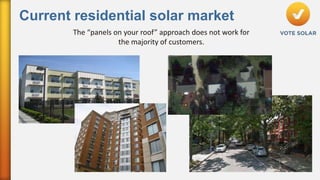
The “panels on your roof” approach does not work for 
the majority of customers.
10/2/2014 
3 
Current residential solar market
4 
How shared solar can help 
10/2/2014 
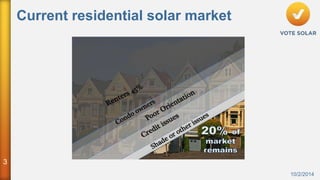
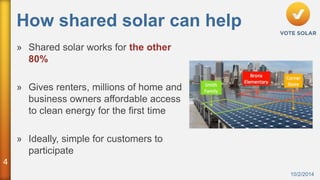
» Shared solar works for the other 
80% 
» Gives renters, millions of home and 
business owners affordable access 
to clean energy for the first time 
» Ideally, simple for customers to 
participate
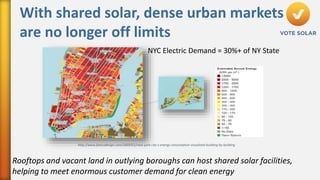
With shared solar, dense urban markets 
are no longer off limits 
NYC Electric Demand = 30%+ of NY State 
http://www.fastcodesign.com/1669351/new-york-city-s-energy-consumption-visualized-building-by-building 
Rooftops and vacant land in outlying boroughs can host shared solar facilities, 
helping to meet enormous customer demand for clean energy
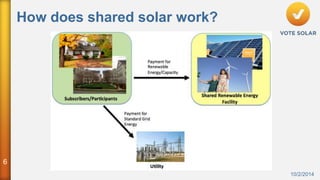
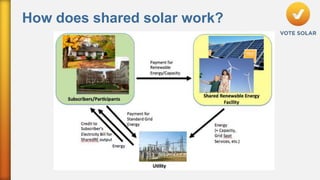
How does shared solar work? 
10/2/2014 
6
How does shared solar work?
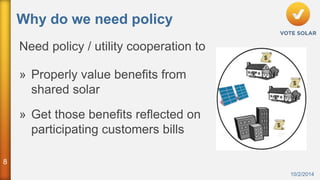
Why do we need policy 
10/2/2014 
8 
Need policy / utility cooperation to 
» Properly value benefits from 
shared solar 
» Get those benefits reflected on 
participating customers bills
10/2/2014 
9 
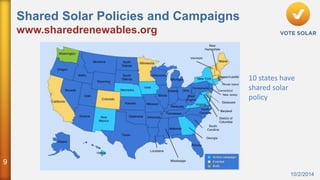
Shared Solar Policies and Campaigns 
www.sharedrenewables.org 
10 states have 
shared solar 
policy
1 
0 
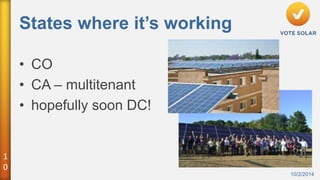
States where it’s working 
10/2/2014 
• CO 
• CA – multitenant 
• hopefully soon DC!
1 
1 
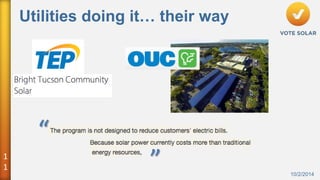
Utilities doing it… their way 
10/2/2014 
“ 
”
1 
2 
LMI-specific need 
Customer challenges 
10/2/2014 
• Likely to rent – split 
incentives 
• Likely to be transient 
• Difficult to credit qualify for 
solar financing
1 
3 
LMI-specific need 
Customer challenges 
10/2/2014 
• Likely to rent – split 
incentives 
• Likely to be transient 
• Difficult to credit qualify for 
solar financing 
Community challenges 
• Pollution, health concerns 
• Lack of jobs, training for 
21st century jobs
1 
4 
Approaches for LMI customers 
Customer benefits 
10/2/2014 
Colorado 
• 5% of energy generated 
(by program portfolio) 
must go to low income 
customers
1 
5 
Approaches for LMI customers 
Customer benefits 
10/2/2014 
Colorado 
• 5% of energy generated 
(by program portfolio) 
must go to low income 
customers 
Community benefits 
California 
• At least 1/6 of solar projects 
must be built in EJ 
communities 
• Limited to 1MW in size 
Conversely, NY proposal… 
• No more than 20% of 
projects in EJ communities
1 
6 
Approaches for LMI customers 
Customer perspective Community perspective 
10/2/2014 
» Require direct participation 
by LMI customers 
» Use of premium payments 
to support lower rate 
options for LMI 
» Jobs 
» Health benefits 
» Community pride 
» Site on community 
facilities – resiliency in 
emergencies
1 
7 
Policy considerations for LMI 
10/2/2014 
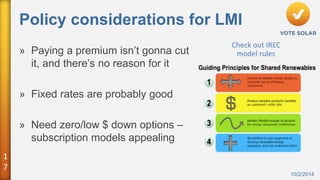
» Paying a premium isn’t gonna cut 
it, and there’s no reason for it 
» Fixed rates are probably good 
» Need zero/low $ down options – 
subscription models appealing 
Check out IREC 
model rules
1 
8 
Policy considerations for LMI 
10/2/2014 
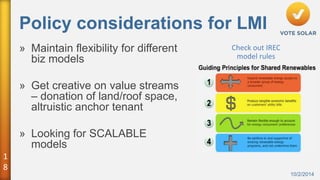
» Maintain flexibility for different 
biz models 
» Get creative on value streams 
– donation of land/roof space, 
altruistic anchor tenant 
» Looking for SCALABLE 
models 
Check out IREC 
model rules
1 
9 
Politics 
10/2/2014 
» Co-option of certain ratepayer advocates, NAACP 
chapters, etc. to advance “solar hurts low income” 
narrative 
» How to overcome?
2 
0 
The bottom line 
10/2/2014 
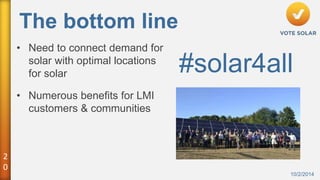
• Need to connect demand for 
solar with optimal locations 
for solar 
• Numerous benefits for LMI 
customers & communities 
#solar4all

Hannah Masterjohn | Innovation Showcase | 2014 Solar Symposium

  • 1.
    Shared Solar CreatingUniversal Access to Clean Energy September 2014 1
  • 2.
    Current residential solarmarket The “panels on your roof” approach does not work for the majority of customers.
  • 3.
    10/2/2014 3 Currentresidential solar market
  • 4.
    4 How sharedsolar can help 10/2/2014 » Shared solar works for the other 80% » Gives renters, millions of home and business owners affordable access to clean energy for the first time » Ideally, simple for customers to participate
  • 5.
    With shared solar,dense urban markets are no longer off limits NYC Electric Demand = 30%+ of NY State http://www.fastcodesign.com/1669351/new-york-city-s-energy-consumption-visualized-building-by-building Rooftops and vacant land in outlying boroughs can host shared solar facilities, helping to meet enormous customer demand for clean energy
  • 6.
    How does sharedsolar work? 10/2/2014 6
  • 7.
    How does sharedsolar work?
  • 8.
    Why do weneed policy 10/2/2014 8 Need policy / utility cooperation to » Properly value benefits from shared solar » Get those benefits reflected on participating customers bills
  • 9.
    10/2/2014 9 SharedSolar Policies and Campaigns www.sharedrenewables.org 10 states have shared solar policy
  • 10.
    1 0 Stateswhere it’s working 10/2/2014 • CO • CA – multitenant • hopefully soon DC!
  • 11.
    1 1 Utilitiesdoing it… their way 10/2/2014 “ ”
  • 12.
    1 2 LMI-specificneed Customer challenges 10/2/2014 • Likely to rent – split incentives • Likely to be transient • Difficult to credit qualify for solar financing
  • 13.
    1 3 LMI-specificneed Customer challenges 10/2/2014 • Likely to rent – split incentives • Likely to be transient • Difficult to credit qualify for solar financing Community challenges • Pollution, health concerns • Lack of jobs, training for 21st century jobs
  • 14.
    1 4 Approachesfor LMI customers Customer benefits 10/2/2014 Colorado • 5% of energy generated (by program portfolio) must go to low income customers
  • 15.
    1 5 Approachesfor LMI customers Customer benefits 10/2/2014 Colorado • 5% of energy generated (by program portfolio) must go to low income customers Community benefits California • At least 1/6 of solar projects must be built in EJ communities • Limited to 1MW in size Conversely, NY proposal… • No more than 20% of projects in EJ communities
  • 16.
    1 6 Approachesfor LMI customers Customer perspective Community perspective 10/2/2014 » Require direct participation by LMI customers » Use of premium payments to support lower rate options for LMI » Jobs » Health benefits » Community pride » Site on community facilities – resiliency in emergencies
  • 17.
    1 7 Policyconsiderations for LMI 10/2/2014 » Paying a premium isn’t gonna cut it, and there’s no reason for it » Fixed rates are probably good » Need zero/low $ down options – subscription models appealing Check out IREC model rules
  • 18.
    1 8 Policyconsiderations for LMI 10/2/2014 » Maintain flexibility for different biz models » Get creative on value streams – donation of land/roof space, altruistic anchor tenant » Looking for SCALABLE models Check out IREC model rules
  • 19.
    1 9 Politics 10/2/2014 » Co-option of certain ratepayer advocates, NAACP chapters, etc. to advance “solar hurts low income” narrative » How to overcome?
  • 20.
    2 0 Thebottom line 10/2/2014 • Need to connect demand for solar with optimal locations for solar • Numerous benefits for LMI customers & communities #solar4all

Editor's Notes

  • #5 Systems can be installed in optimal locations and achieve lower cost/Watt through economies of scale Programs/projects can be designed to enhance benefits to LMI communities
  • #6 rooftop companies, don’t worry, plenty of market out there (1.2 trillion mckinsey?)