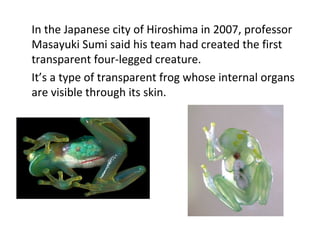
Scientists in Japan created the first transparent frog by selectively breeding frogs with clear skin over multiple generations. Only about one in sixteen frogs produced from this breeding was fully transparent from tadpole to adult stages. The internal organs of these transparent frogs are visible through their skin without dissection, allowing researchers to observe organ growth and track how medicines and toxins affect metabolism. Transparent frogs could also be used to study disease progression and evaluate treatment effectiveness by injecting illuminating proteins to light up genes of interest. Researchers hope transparent frogs may replace dissection in classrooms and provide a humane alternative for scientific study.