ADDRESS TRANSLATION
MECHANISM OF 80386
Unit 2
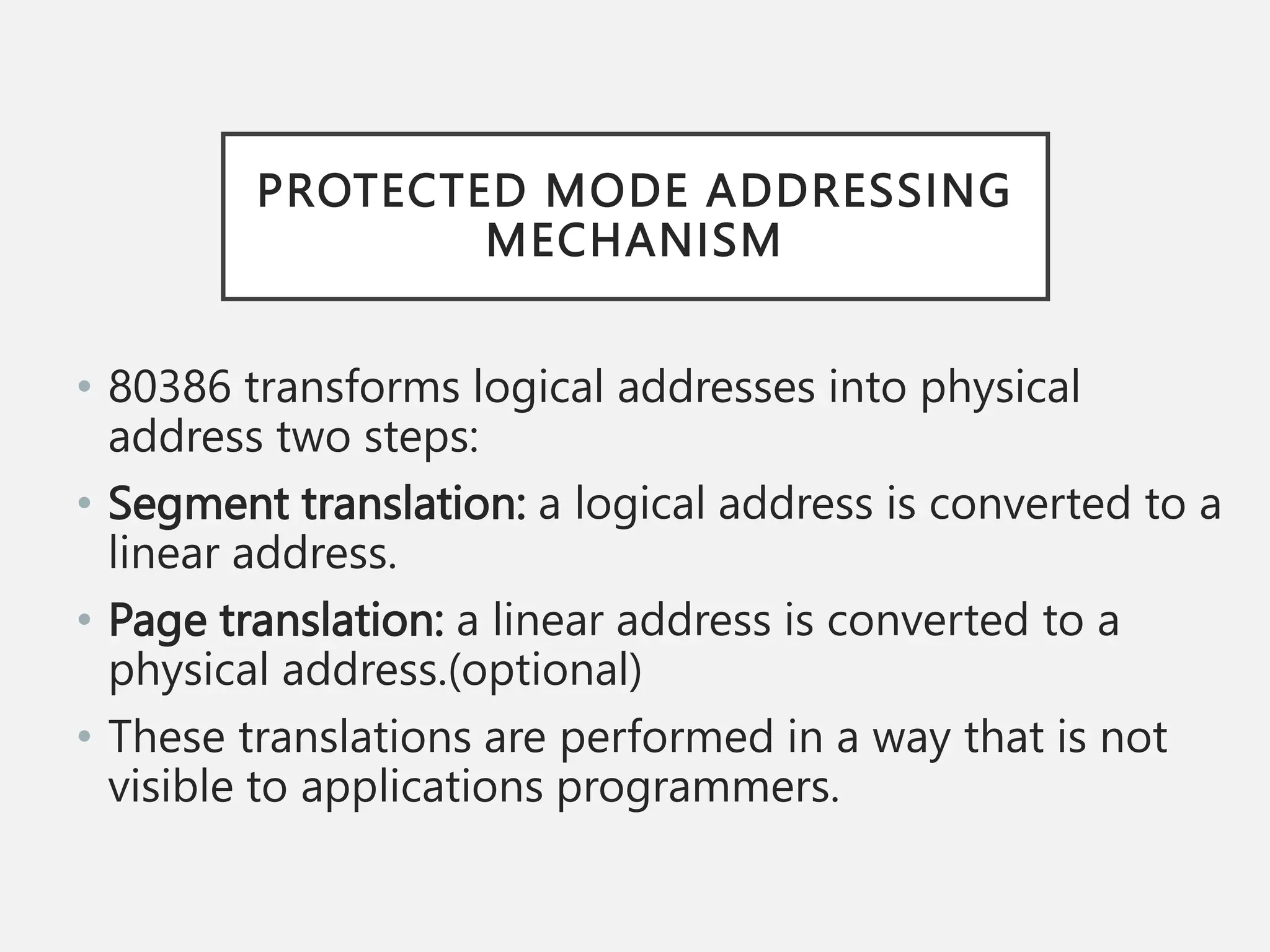
PROTECTED MODE ADDRESSING
MECHANISM
• 80386 transforms logical addresses into physical
address two steps:
• Segment translation: a logical address is converted to a
linear address.
• Page translation: a linear address is converted to a
physical address.(optional)
• These translations are performed in a way that is not
visible to applications programmers.
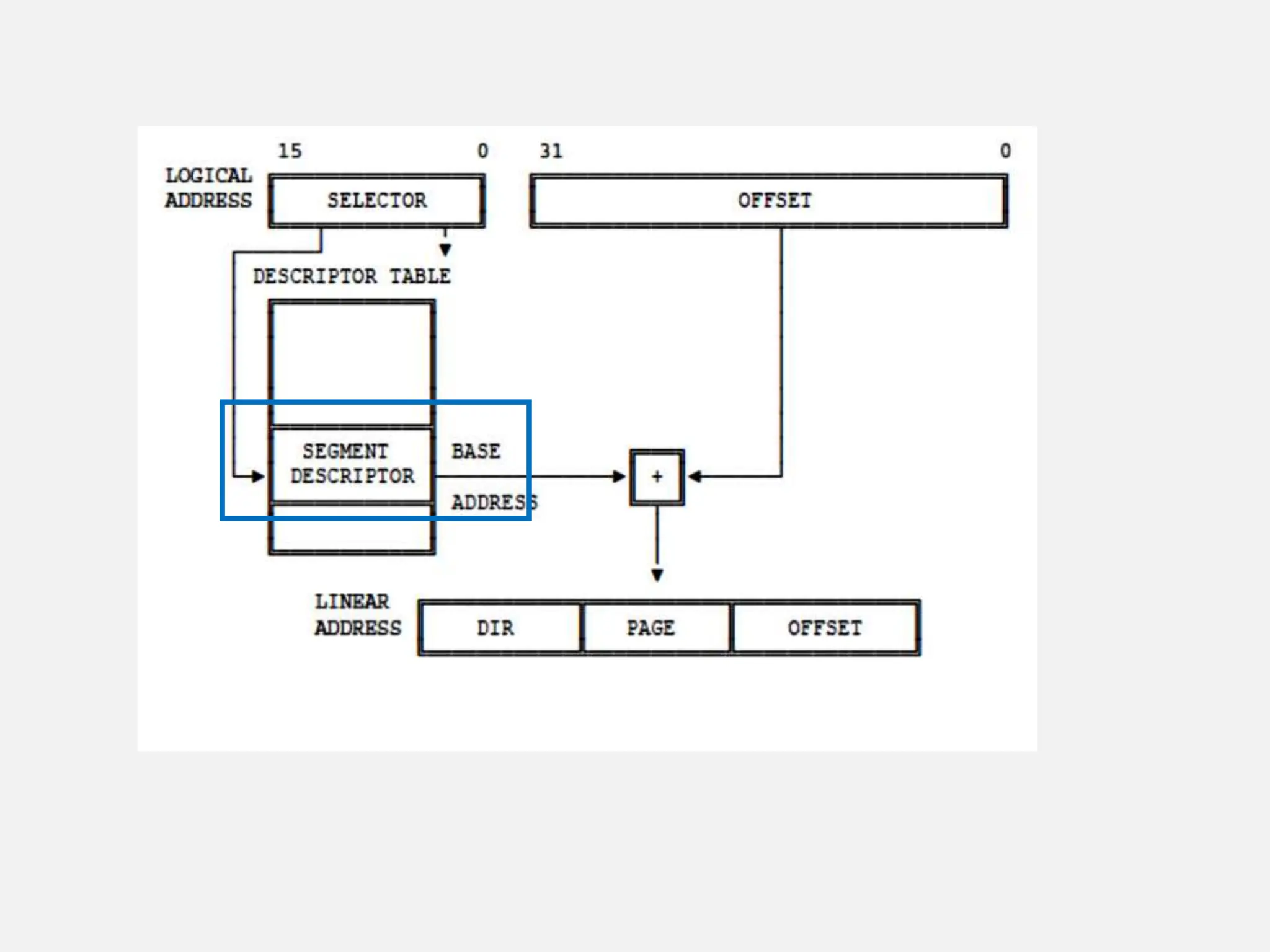
• The following figure illustrates the two
translations:
SEGMENTATION
Segmentation
Unit
Logical(Virtual)
Address
Linear Address
Base Address
in LDTR
Register
Base Address
in GDTR
Register
SEGMENT DESCRIPTOR
FOR CURRENTLY EXECUTING
TASK
FOR EACH TASK
PAGING
Paging Unit
Linear Address Physical Address
SECOND PHASE
PAGE TRANSLATION
• Mandatory if:-
Virtual 8086
Page protection
Page virtual memory
• E.g: LA 4GB mapped to 16MB PA
• Total Pages= 1,048,496 pages in PA
• Page size= 4096 bytes
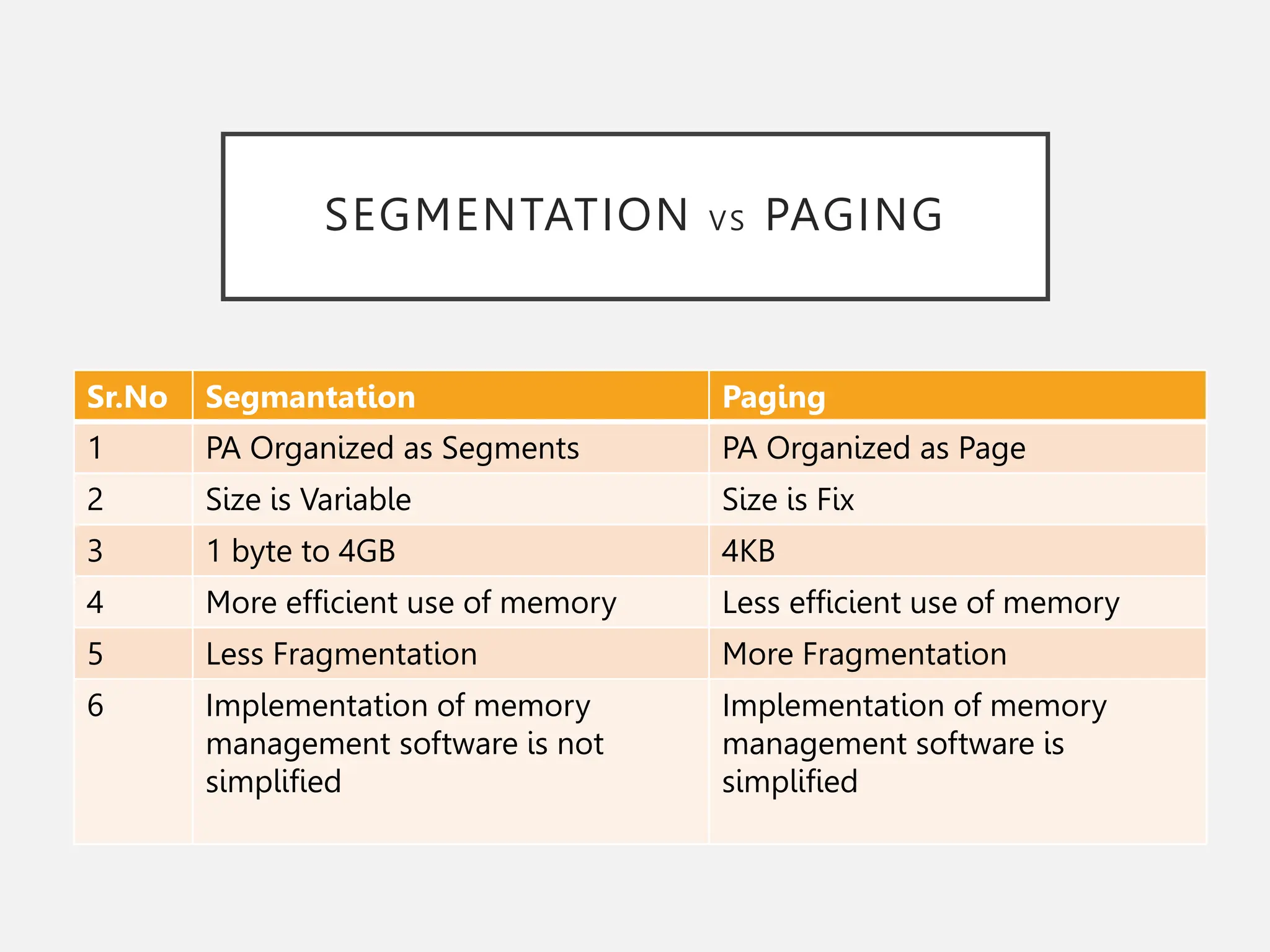
SEGMENTATION VS PAGING
Sr.No Segmantation Paging
1 PA Organized as Segments PA Organized as Page
2 Size is Variable Size is Fix
3 1 byte to 4GB 4KB
4 More efficient use of memory Less efficient use of memory
5 Less Fragmentation More Fragmentation
6 Implementation of memory
management software is not
simplified
Implementation of memory
management software is
simplified
PAGE FRAME
• A page frame is a 4K-byte unit of
contiguous addresses of physical
memory.
• Pages begin onebyte boundaries
and are fixed in size.
COMPONENTS OF PAGING
MECHANISM
• Page Directory
• Page tables
• Page frame
Tabl
e
For
m
32 bit descriptors
Total 1024
descriptors
4KB long
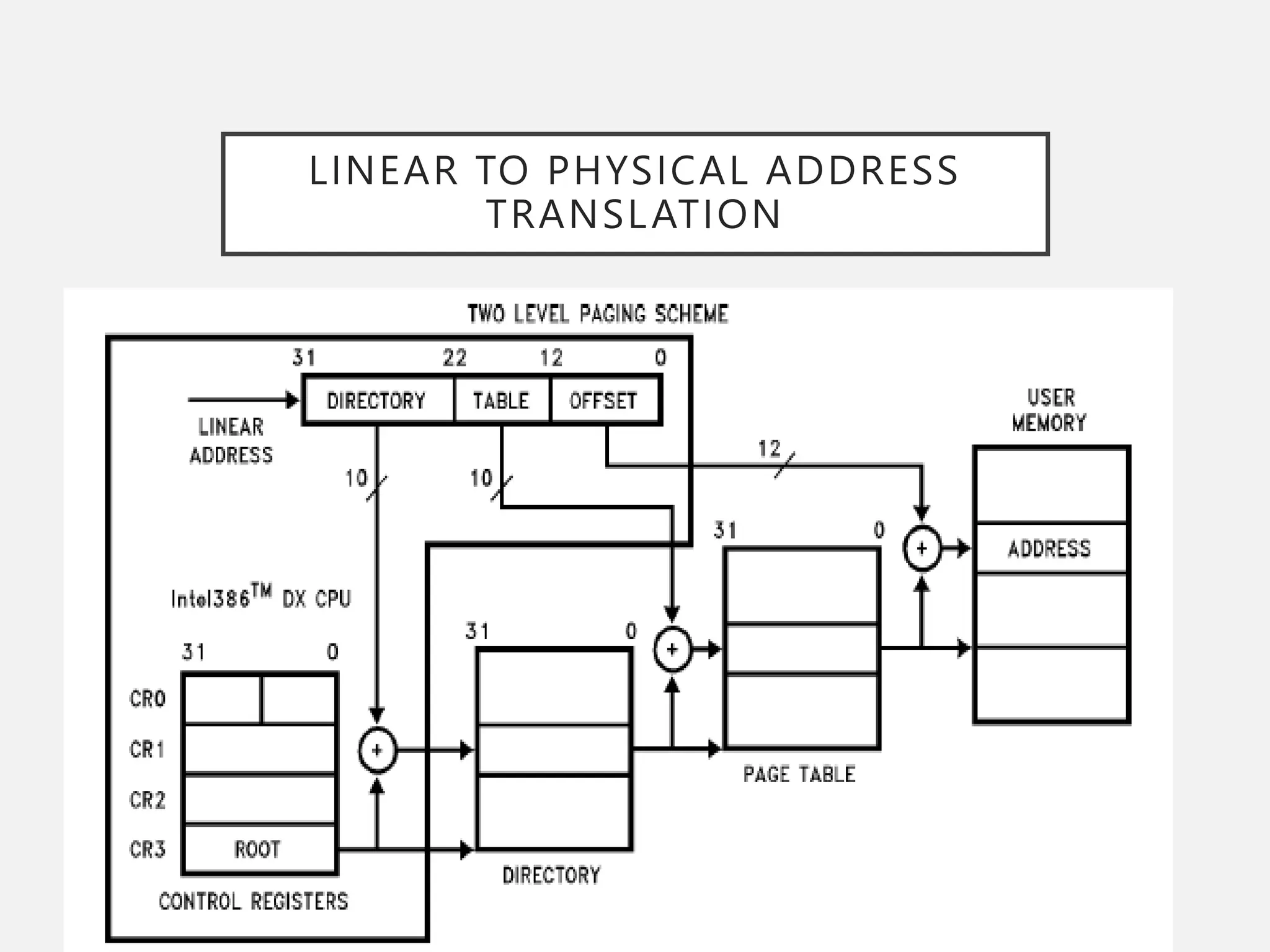
LINEAR TO PHYSICAL ADDRESS
TRANSLATION
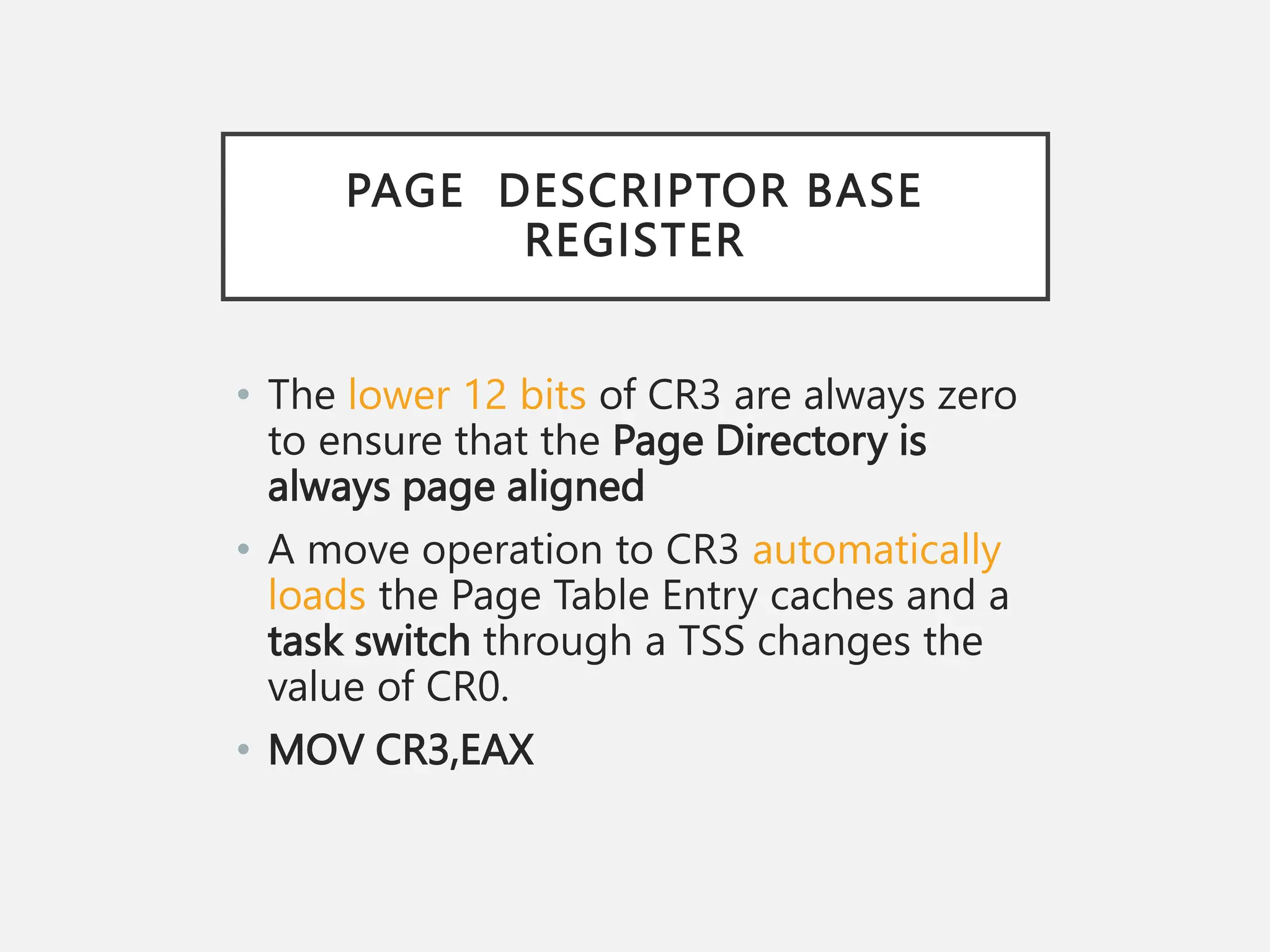
PAGE DESCRIPTOR BASE
REGISTER
• CR2 is used to store the 32-bit linear
address of page fault.
• CR3 (Page Directory Physical Base
Address Register) stores the physical
starting address of Page Directory.
PAGE DESCRIPTOR BASE
REGISTER
• The lower 12 bits of CR3 are always zero
to ensure that the Page Directory is
always page aligned
• A move operation to CR3 automatically
loads the Page Table Entry caches and a
task switch through a TSS changes the
value of CR0.
• MOV CR3,EAX
PAGE DIRECTORY
• PDE:-It is at the most 4KB in size and
allows upto 1024 entries are allowed.
• The upper 10 bits of the linear address
are used as an index to corresponding
page directory entry
• Page directory entry points to page
tables.
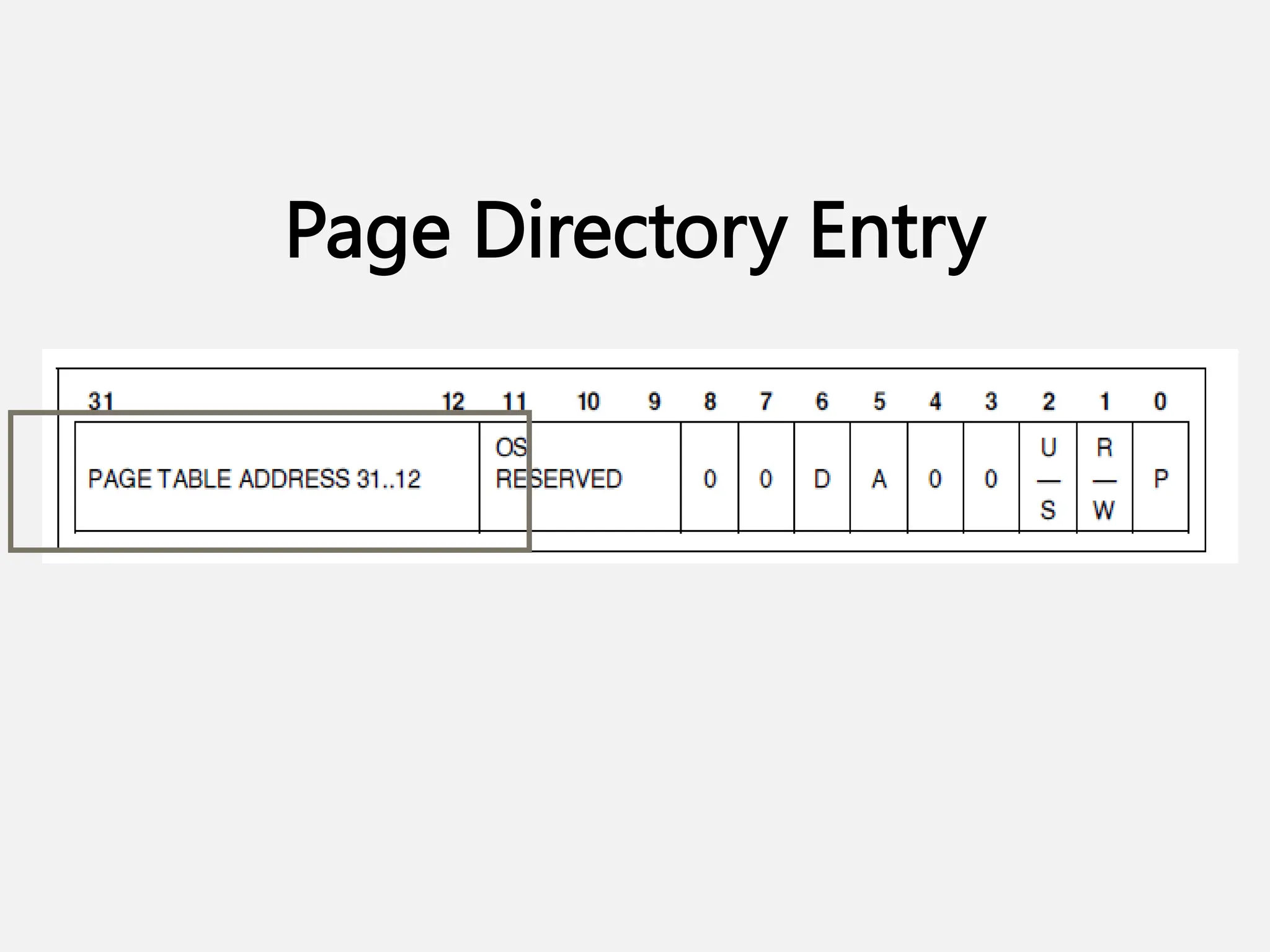
PAGE DIRECTORY ENTRY
PAGE TABLES
• PTE:-Each Page Table is 4KB and holds up to 1024 Page Table
Entries.
• PTEs contain the starting address of the page frame and
statistical information about the page.
• Upper 20 bit page frame address is concatenated with the
lower 12 bits of the linear address to form the physical
address.
• Page tables can be shared between tasks and swapped to
disks.
PAGE TABLE ENTRY
• P(Present)Bit: indicates if the entry can be used in address
translation. P-bit of the currently executed page is always
high.
• A (Accessed) Bit: It is set before any access to the page.
PAGE TABLE ENTRY
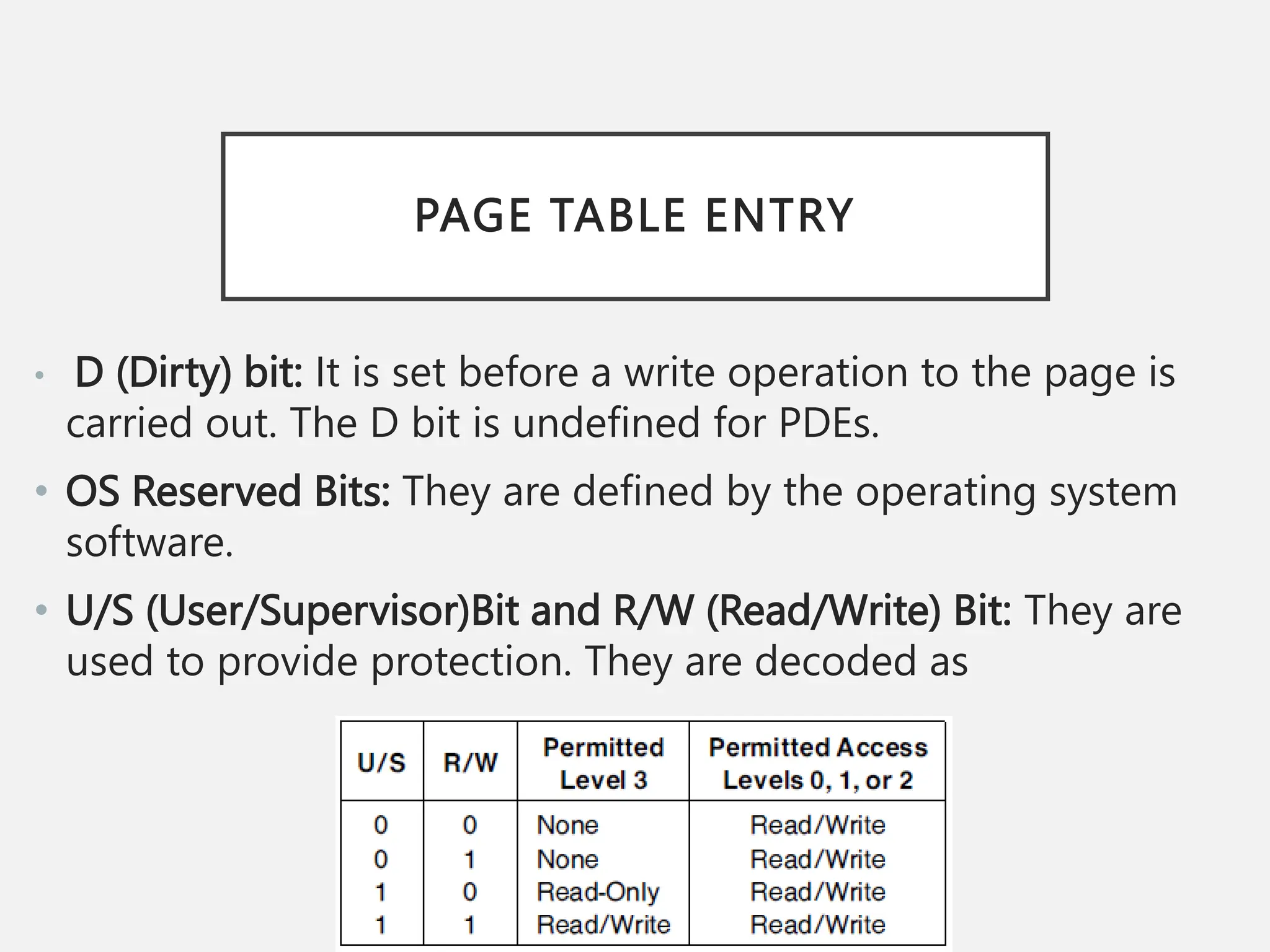
• D (Dirty) bit: It is set before a write operation to the page is
carried out. The D bit is undefined for PDEs.
• OS Reserved Bits: They are defined by the operating system
software.
• U/S (User/Supervisor)Bit and R/W (Read/Write) Bit: They are
used to provide protection. They are decoded as
EXAMPLE
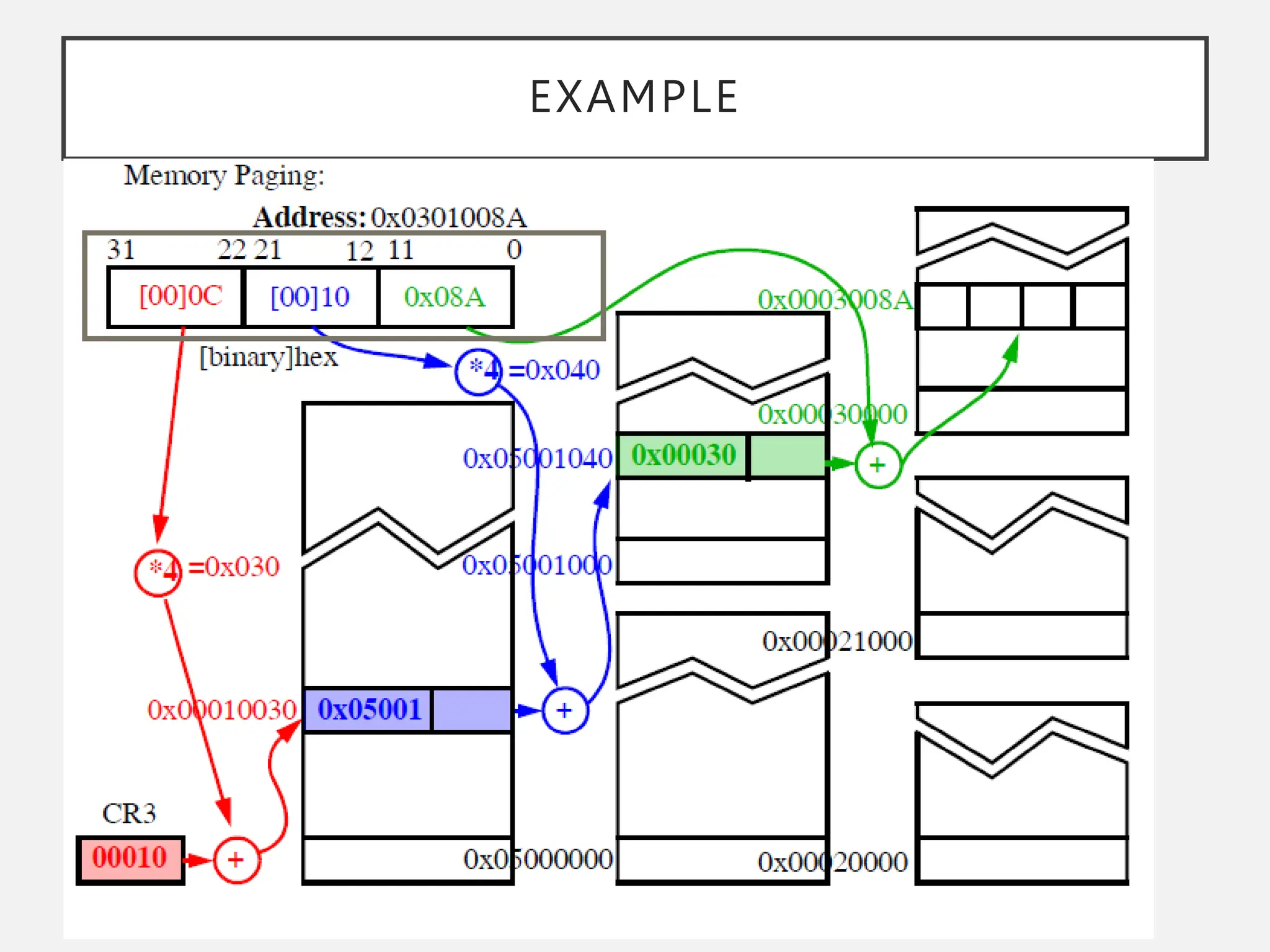
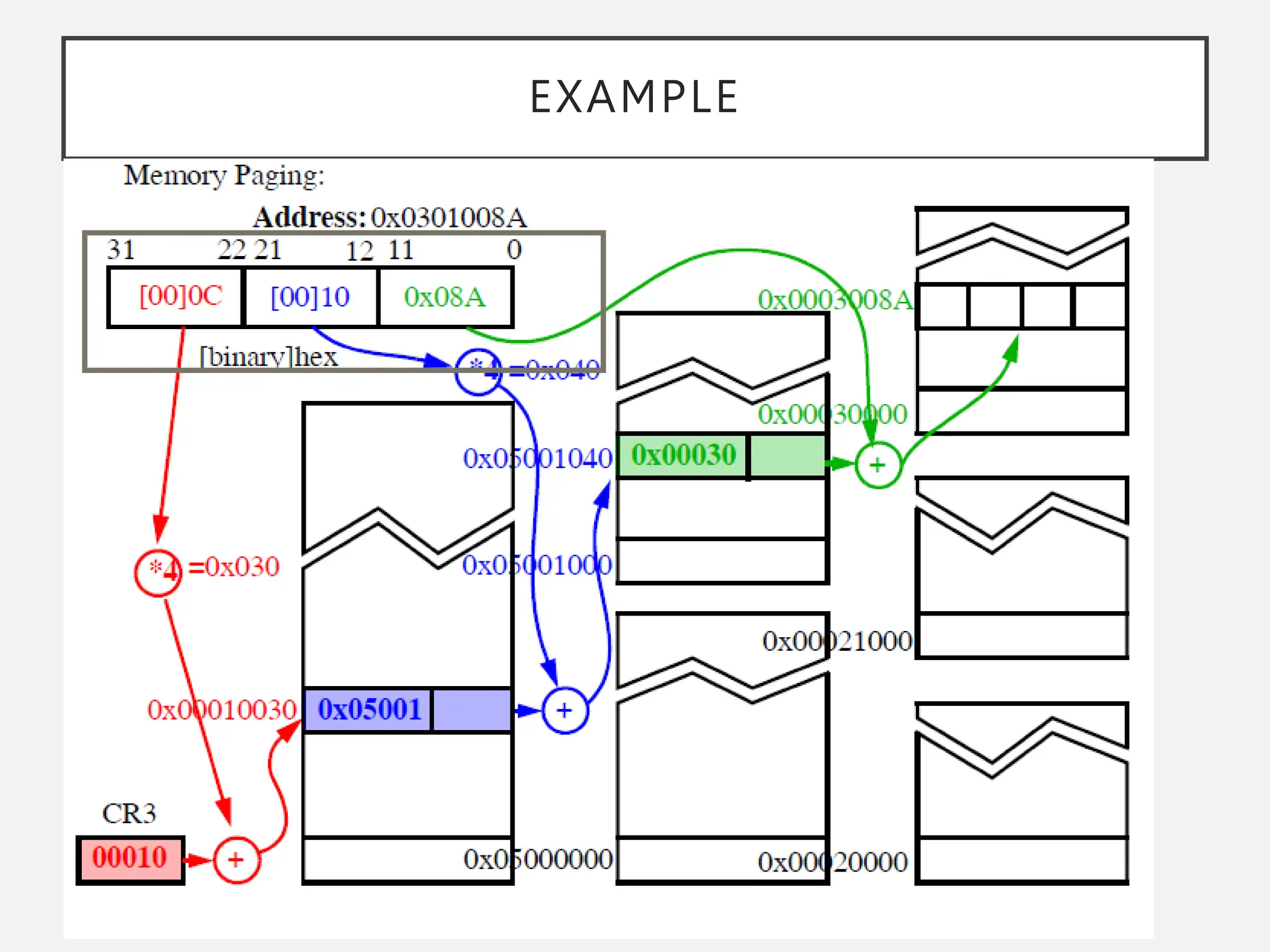
Linear Address : 0301008A
Binary 00 0000 1100
(10bits)
00 0001 0000
(10bits)
0000 1000 1010
(12bits)
Hex 00C 010 08A
0000 0011 0000 0001 0000 0000 1000 1010
EXAMPLE
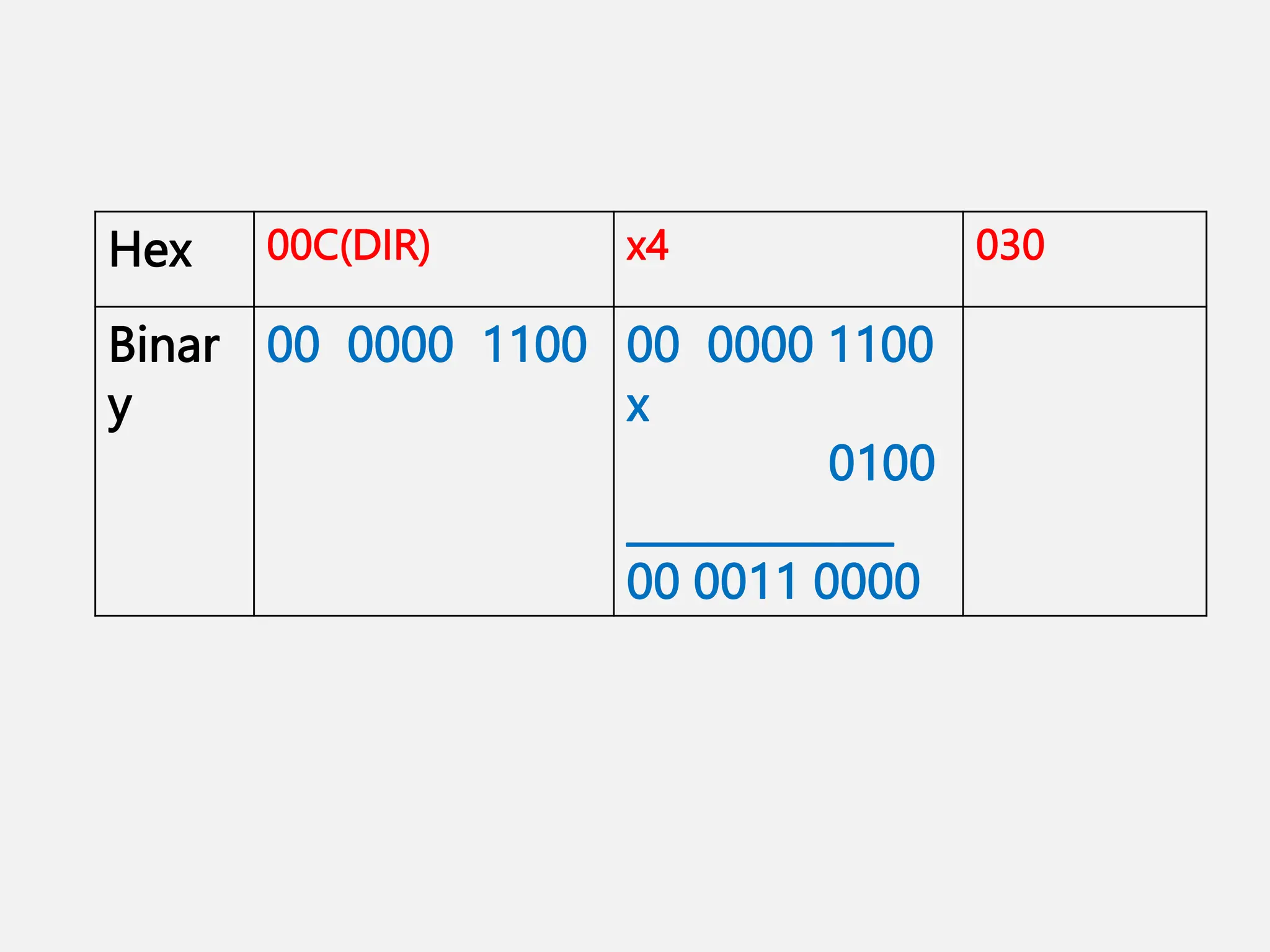
Hex 00C(DIR) x4 030
Binar
y
00 0000 1100 00 0000 1100
x
0100
_____________
00 0011 0000
CR3 + DIR*4 = Index to PDE
00010H + 030H = 00010030H
(20-bit) (12-bit)
EXAMPLE
Page Directory Entry
Hex 010(TABLE) x4 040
Binar
y
00 0001 0000 00 0001 0000
x
0100
_____________
00 0100 0000
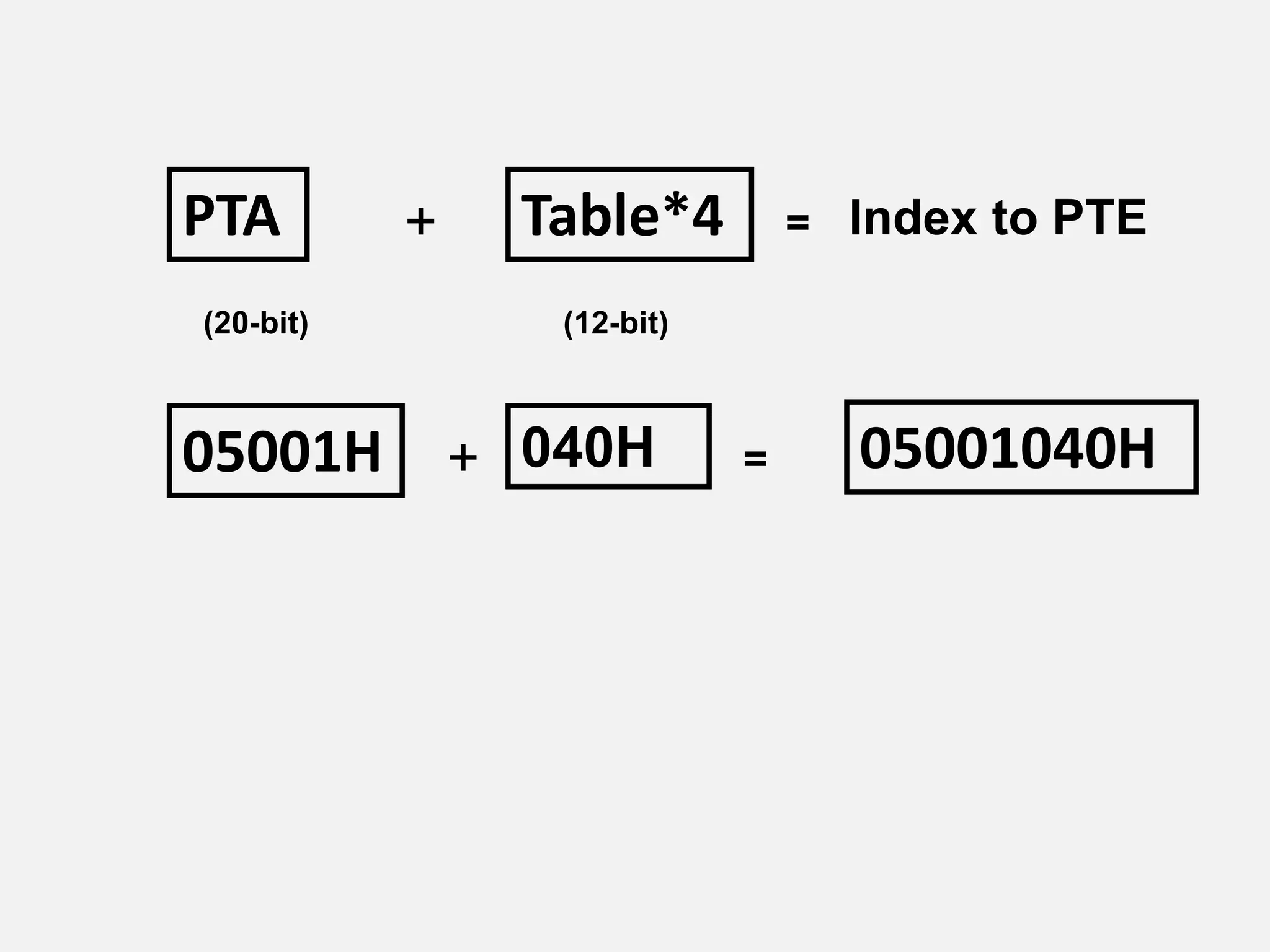
PTA + Table*4 = Index to PTE
05001H + 040H = 05001040H
(20-bit) (12-bit)
EXAMPLE
Page Table Entry
PFA + Offset = Physical Address
03000H + 08AH = 03000 08AH
(20-bit) (12-bit)
EXAMPLE
TRANSLATION LOOKASIDE
BUFFER(TLB)
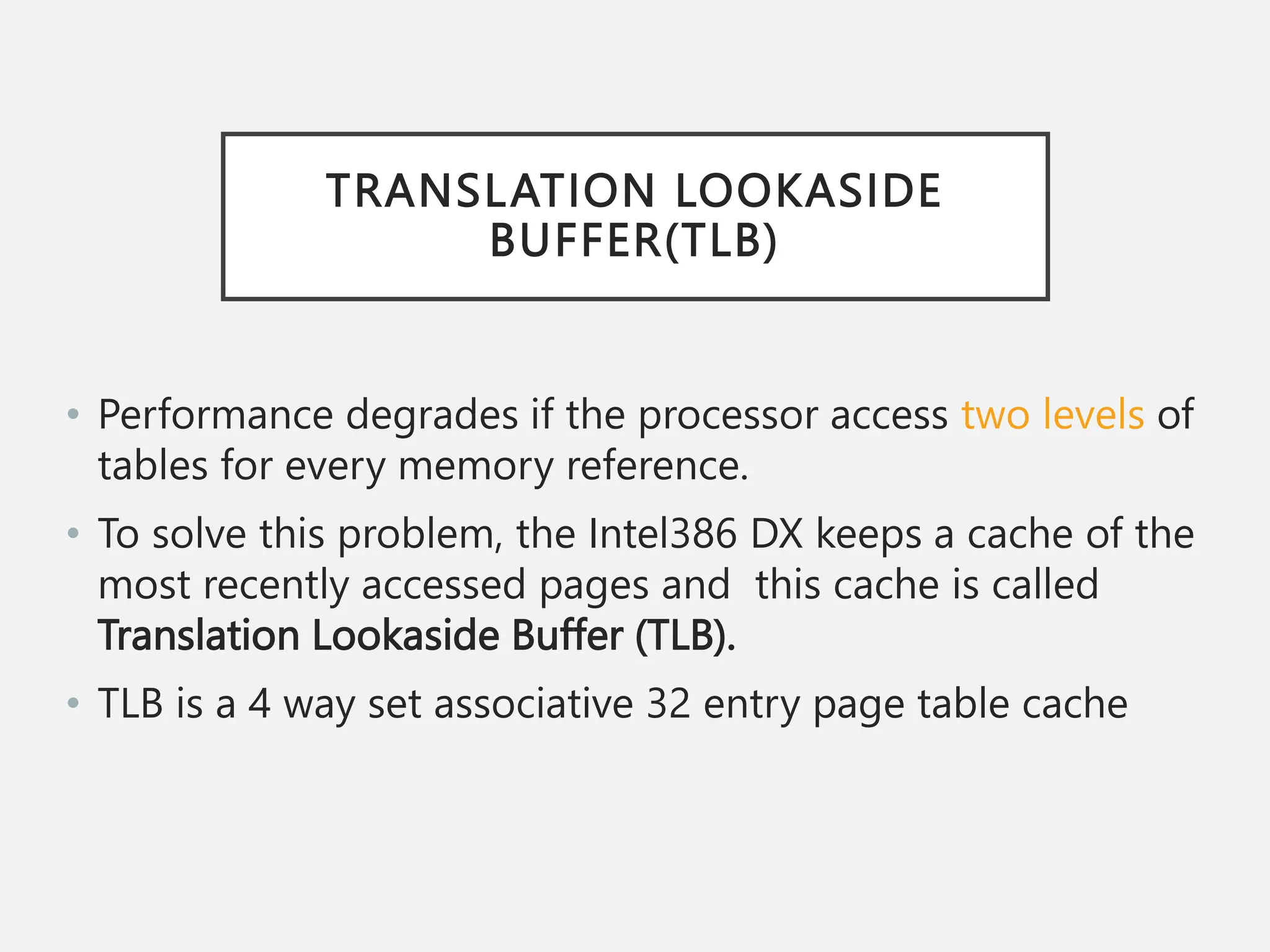
• Performance degrades if the processor access two levels of
tables for every memory reference.
• To solve this problem, the Intel386 DX keeps a cache of the
most recently accessed pages and this cache is called
Translation Lookaside Buffer (TLB).
• TLB is a 4 way set associative 32 entry page table cache
TRANSLATION LOOKASIDE
BUFFER(TLB)
TRANSLATION LOOKASIDE
BUFFER(TLB)
• TLB has 4 sets of eight entries each.
• Each entry consists of a TAG and a DATA.
• Tags are 24 bit wide. They contain 20 upper bits
of linear address, a valid bit (Validation of Entry)
and three attribute bits(D,U/S and R/W)
• Data portion of each entry contains upper 20
bits of the Physical address.
TLB ENTRY
V D U/S R/W Upper 20 bit Linear Address Upper 20-bit Physical Address
TRANSLATION LOOKASIDE
BUFFER(TLB)
• It automatically keeps the most commonly used Page
Table Entries.
• 32-entry TLB coupled with a 4K page size results in
the coverage of 128KB of memory addresses.
PAGING OPERATION
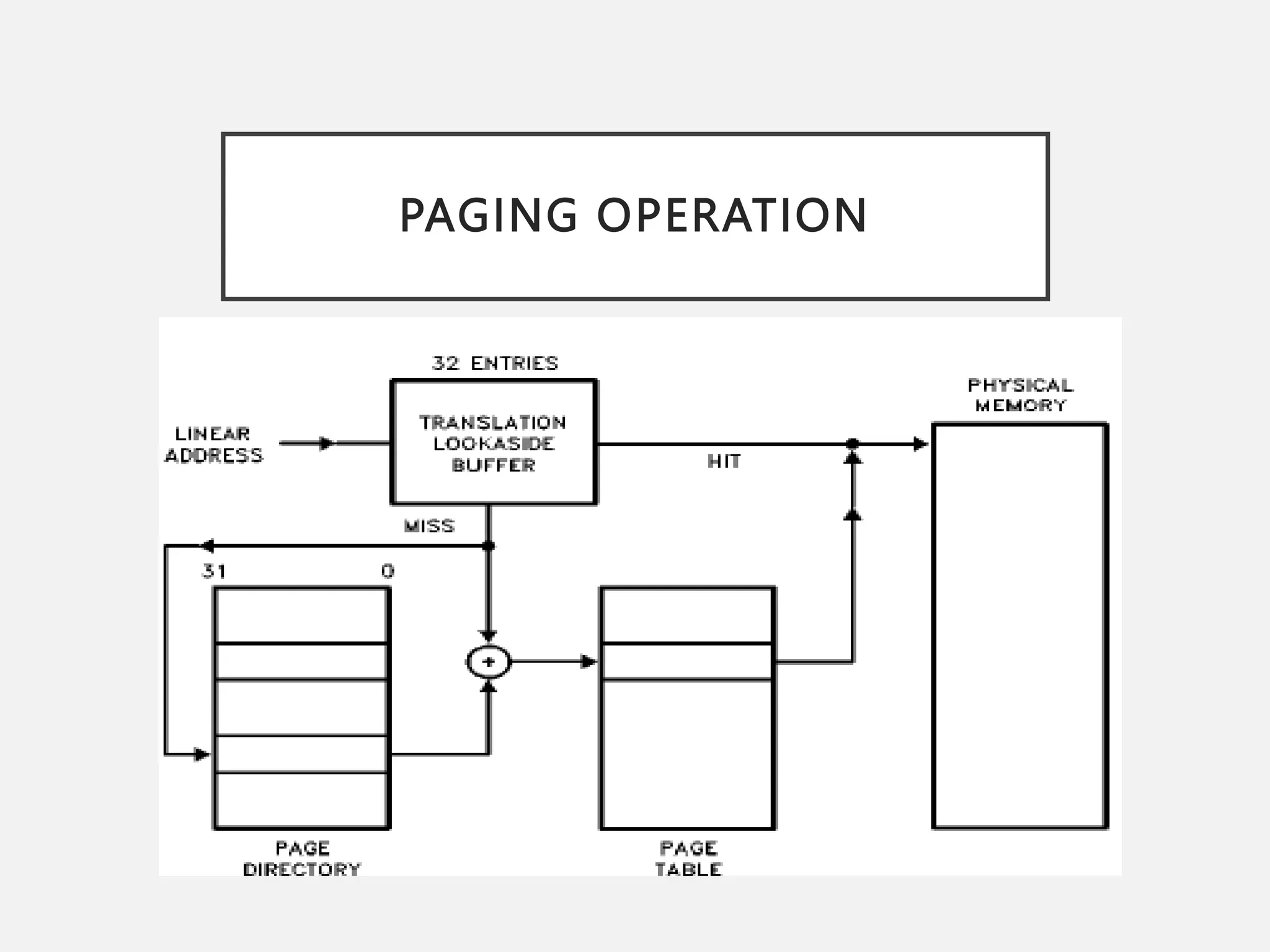
• The paging unit hardware receives a 32-bit linear address
from the segmentation unit.
• The upper 20 linear address bits are compared with all 32
entries in the TLB to determine if there is a match.
• If there is a match (i.e. a TLB hit), then the 32-bit physical
address is calculated and will be placed on the address
bus.
PAGING OPERATION
• If PTE entry is not in TLB, the 80386 DX will read the
appropriate PDE Entry.
• If P = 1 on PDE (the page table is in memory), then the
80386 DX will read the appropriate PTE and set the Access
bit.
• If P = 1 on PTE ( the page is in memory), then the
Intel386 DX will update the Access and Dirty bits as needed
and fetch the operand.
PAGING OPERATION
• The upper 20 bits of the linear address read from the
page table will be stored in the TLB for future accesses.
• If P = 0 for either PDE or PTE, then the processor will
generate a page fault exception
• This exception is also generated when protection rules are
violated and the CR2 is loaded with the page fault
address
Linear Address
Upper 20 bits
available in TLB
P=1 in PDE?
P=1 in PTE?
N
N
N
Page Fault
Exception
Y (Page Table is present in physical
memory, set access bit)
(Page is present in physical
memory but entry is not there
in TLB,set A and D(if needed) )
Y
Update TLB
Paging
Operation
Y
(Page is present in physical
memory, set A and D(if
needed))
PAGING OPERATION
PAGING
Page 0
Page 1
Page 2
. . .
Page n
Page 0
Page 1
Page 2
. . .
Page m
linear
virtual
address
space
of
Program
1
. . .
Hard Disk
Main Memory
Pages that cannot
fit in main memory
are stored on the
hard disk
Each running
program has
its own page
table
The operating
system uses
page tables to
map the pages
in the linear
virtual address
space onto
main memory
As a program is running, the processor translates the linear virtual addresses
onto real memory (called also physical) addresses
The operating
system swaps
pages between
memory and the
hard disk
linear
virtual
address
space
of
Program
2

address-translation-mechanism-of-80386 (1).ppt

  • 1.
  • 2.
    PROTECTED MODE ADDRESSING MECHANISM •80386 transforms logical addresses into physical address two steps: • Segment translation: a logical address is converted to a linear address. • Page translation: a linear address is converted to a physical address.(optional) • These translations are performed in a way that is not visible to applications programmers.
  • 3.
    • The followingfigure illustrates the two translations:
  • 4.
  • 5.
  • 7.
    Base Address in LDTR Register BaseAddress in GDTR Register
  • 10.
  • 11.
  • 12.
  • 13.
  • 14.
    Paging Unit Linear AddressPhysical Address SECOND PHASE
  • 15.
    PAGE TRANSLATION • Mandatoryif:- Virtual 8086 Page protection Page virtual memory • E.g: LA 4GB mapped to 16MB PA • Total Pages= 1,048,496 pages in PA • Page size= 4096 bytes
  • 16.
    SEGMENTATION VS PAGING Sr.NoSegmantation Paging 1 PA Organized as Segments PA Organized as Page 2 Size is Variable Size is Fix 3 1 byte to 4GB 4KB 4 More efficient use of memory Less efficient use of memory 5 Less Fragmentation More Fragmentation 6 Implementation of memory management software is not simplified Implementation of memory management software is simplified
  • 17.
    PAGE FRAME • Apage frame is a 4K-byte unit of contiguous addresses of physical memory. • Pages begin onebyte boundaries and are fixed in size.
  • 18.
    COMPONENTS OF PAGING MECHANISM •Page Directory • Page tables • Page frame Tabl e For m 32 bit descriptors Total 1024 descriptors 4KB long
  • 19.
    LINEAR TO PHYSICALADDRESS TRANSLATION
  • 20.
    PAGE DESCRIPTOR BASE REGISTER •CR2 is used to store the 32-bit linear address of page fault. • CR3 (Page Directory Physical Base Address Register) stores the physical starting address of Page Directory.
  • 21.
    PAGE DESCRIPTOR BASE REGISTER •The lower 12 bits of CR3 are always zero to ensure that the Page Directory is always page aligned • A move operation to CR3 automatically loads the Page Table Entry caches and a task switch through a TSS changes the value of CR0. • MOV CR3,EAX
  • 22.
    PAGE DIRECTORY • PDE:-Itis at the most 4KB in size and allows upto 1024 entries are allowed. • The upper 10 bits of the linear address are used as an index to corresponding page directory entry • Page directory entry points to page tables.
  • 23.
  • 24.
    PAGE TABLES • PTE:-EachPage Table is 4KB and holds up to 1024 Page Table Entries. • PTEs contain the starting address of the page frame and statistical information about the page. • Upper 20 bit page frame address is concatenated with the lower 12 bits of the linear address to form the physical address. • Page tables can be shared between tasks and swapped to disks.
  • 25.
    PAGE TABLE ENTRY •P(Present)Bit: indicates if the entry can be used in address translation. P-bit of the currently executed page is always high. • A (Accessed) Bit: It is set before any access to the page.
  • 26.
    PAGE TABLE ENTRY •D (Dirty) bit: It is set before a write operation to the page is carried out. The D bit is undefined for PDEs. • OS Reserved Bits: They are defined by the operating system software. • U/S (User/Supervisor)Bit and R/W (Read/Write) Bit: They are used to provide protection. They are decoded as
  • 27.
    EXAMPLE Linear Address :0301008A Binary 00 0000 1100 (10bits) 00 0001 0000 (10bits) 0000 1000 1010 (12bits) Hex 00C 010 08A 0000 0011 0000 0001 0000 0000 1000 1010
  • 28.
  • 29.
    Hex 00C(DIR) x4030 Binar y 00 0000 1100 00 0000 1100 x 0100 _____________ 00 0011 0000
  • 30.
    CR3 + DIR*4= Index to PDE 00010H + 030H = 00010030H (20-bit) (12-bit)
  • 31.
  • 32.
  • 33.
    Hex 010(TABLE) x4040 Binar y 00 0001 0000 00 0001 0000 x 0100 _____________ 00 0100 0000
  • 34.
    PTA + Table*4= Index to PTE 05001H + 040H = 05001040H (20-bit) (12-bit)
  • 35.
  • 36.
  • 37.
    PFA + Offset= Physical Address 03000H + 08AH = 03000 08AH (20-bit) (12-bit)
  • 38.
  • 39.
    TRANSLATION LOOKASIDE BUFFER(TLB) • Performancedegrades if the processor access two levels of tables for every memory reference. • To solve this problem, the Intel386 DX keeps a cache of the most recently accessed pages and this cache is called Translation Lookaside Buffer (TLB). • TLB is a 4 way set associative 32 entry page table cache
  • 40.
  • 41.
    TRANSLATION LOOKASIDE BUFFER(TLB) • TLBhas 4 sets of eight entries each. • Each entry consists of a TAG and a DATA. • Tags are 24 bit wide. They contain 20 upper bits of linear address, a valid bit (Validation of Entry) and three attribute bits(D,U/S and R/W) • Data portion of each entry contains upper 20 bits of the Physical address.
  • 42.
    TLB ENTRY V DU/S R/W Upper 20 bit Linear Address Upper 20-bit Physical Address
  • 43.
    TRANSLATION LOOKASIDE BUFFER(TLB) • Itautomatically keeps the most commonly used Page Table Entries. • 32-entry TLB coupled with a 4K page size results in the coverage of 128KB of memory addresses.
  • 44.
    PAGING OPERATION • Thepaging unit hardware receives a 32-bit linear address from the segmentation unit. • The upper 20 linear address bits are compared with all 32 entries in the TLB to determine if there is a match. • If there is a match (i.e. a TLB hit), then the 32-bit physical address is calculated and will be placed on the address bus.
  • 45.
    PAGING OPERATION • IfPTE entry is not in TLB, the 80386 DX will read the appropriate PDE Entry. • If P = 1 on PDE (the page table is in memory), then the 80386 DX will read the appropriate PTE and set the Access bit. • If P = 1 on PTE ( the page is in memory), then the Intel386 DX will update the Access and Dirty bits as needed and fetch the operand.
  • 46.
    PAGING OPERATION • Theupper 20 bits of the linear address read from the page table will be stored in the TLB for future accesses. • If P = 0 for either PDE or PTE, then the processor will generate a page fault exception • This exception is also generated when protection rules are violated and the CR2 is loaded with the page fault address
  • 47.
    Linear Address Upper 20bits available in TLB P=1 in PDE? P=1 in PTE? N N N Page Fault Exception Y (Page Table is present in physical memory, set access bit) (Page is present in physical memory but entry is not there in TLB,set A and D(if needed) ) Y Update TLB Paging Operation Y (Page is present in physical memory, set A and D(if needed))
  • 48.
  • 49.
    PAGING Page 0 Page 1 Page2 . . . Page n Page 0 Page 1 Page 2 . . . Page m linear virtual address space of Program 1 . . . Hard Disk Main Memory Pages that cannot fit in main memory are stored on the hard disk Each running program has its own page table The operating system uses page tables to map the pages in the linear virtual address space onto main memory As a program is running, the processor translates the linear virtual addresses onto real memory (called also physical) addresses The operating system swaps pages between memory and the hard disk linear virtual address space of Program 2