Learning & Development
 Specialist Group


Overcoming pitfalls when implementing
SFIA in L&D
Peter Leather MBA (Open), BSc., MBCS


                          Using SFIA in Education and Workplace Learning Conference, 13th June 2012   1
A bit about me

q  A well established, independent consultant specialising in developing the capability
    of IT organisations.
q  MBA qualified with over 25 years’ experience in a range of roles working with major
    IT, financial services and professional services organisations.
q  I have been using SFIA since 2003 – both operationally within a large IT
    organisation and as an accredited SFIA Consultant.
q  A member of the SFIA Council (the SFIA steering group) and leader of the on-line
    global SFIA User Forum.
Recent assignments have included:
    Ø  A global FMCG organisation; providing expert advice and implementation support in the use of SFIA in support of a
        Global IT organisation with several worldwide operating hubs (c1,500 IT Staff).
    Ø  A large provider of out-sourced IT services based in India; providing expert advice and mentoring in using SFIA to
        strengthen resource management and to assess the skills of their staff (8,000 IT staff).
    Ø  A leading professional sports organisation in the UK; working with the IT Leadership team to use SFIA to develop role
        profiles and improve objective setting, performance appraisals and professional development.
    Ø  A global software provider based in Germany; developing options and implementation strategies for a skills & competency
        framework.


 *Grundy


                                                                    Using SFIA in Education and Workplace Learning Conference, 13th June 2012
                                                                                                                                                2
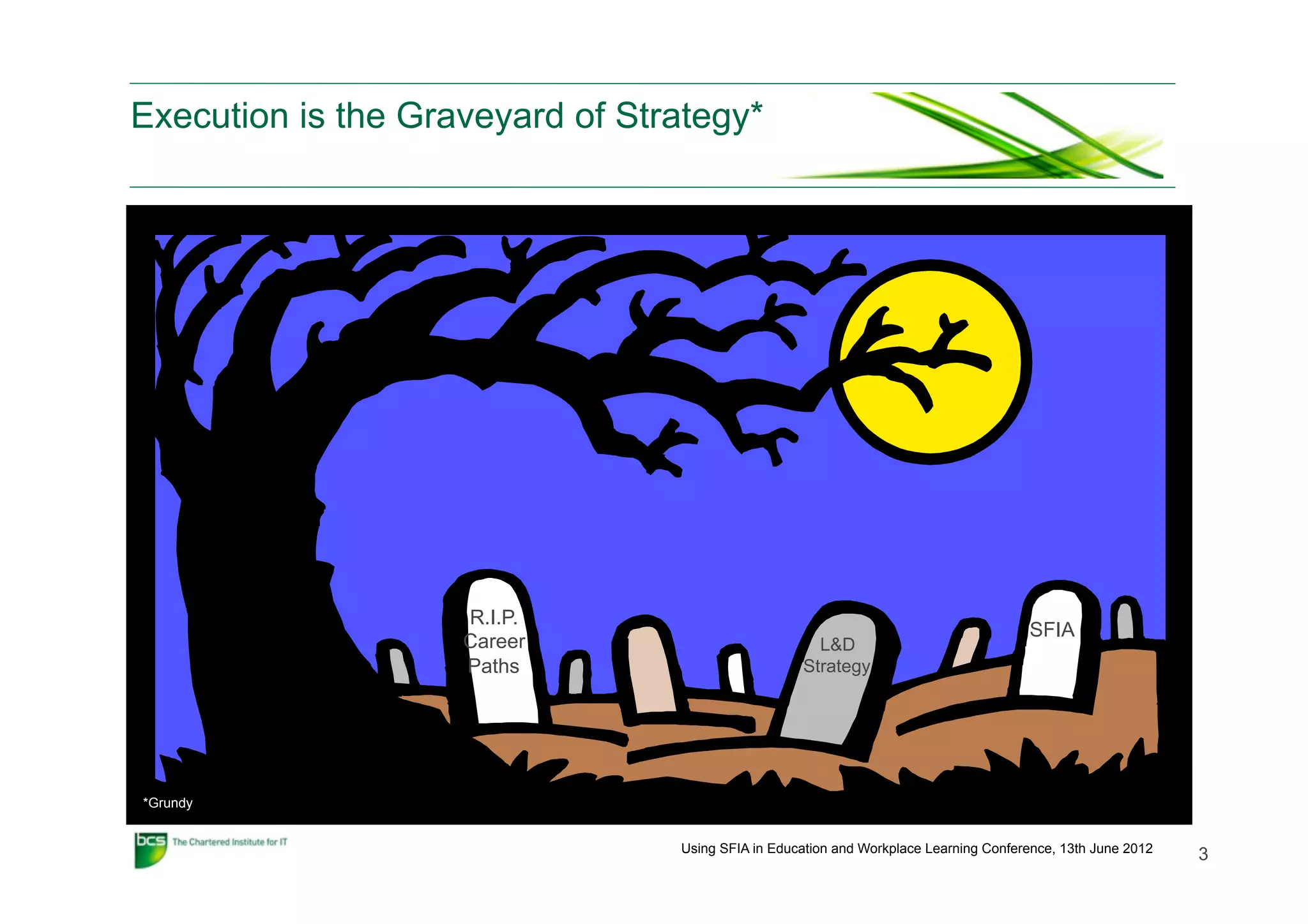
Execution is the Graveyard of Strategy*


                    R.I.P.
                                                                                      SFIA
                    Career                           L&D
                    Paths                          Strategy


*Grundy


                                 Using SFIA in Education and Workplace Learning Conference, 13th June 2012
                                                                                                             3
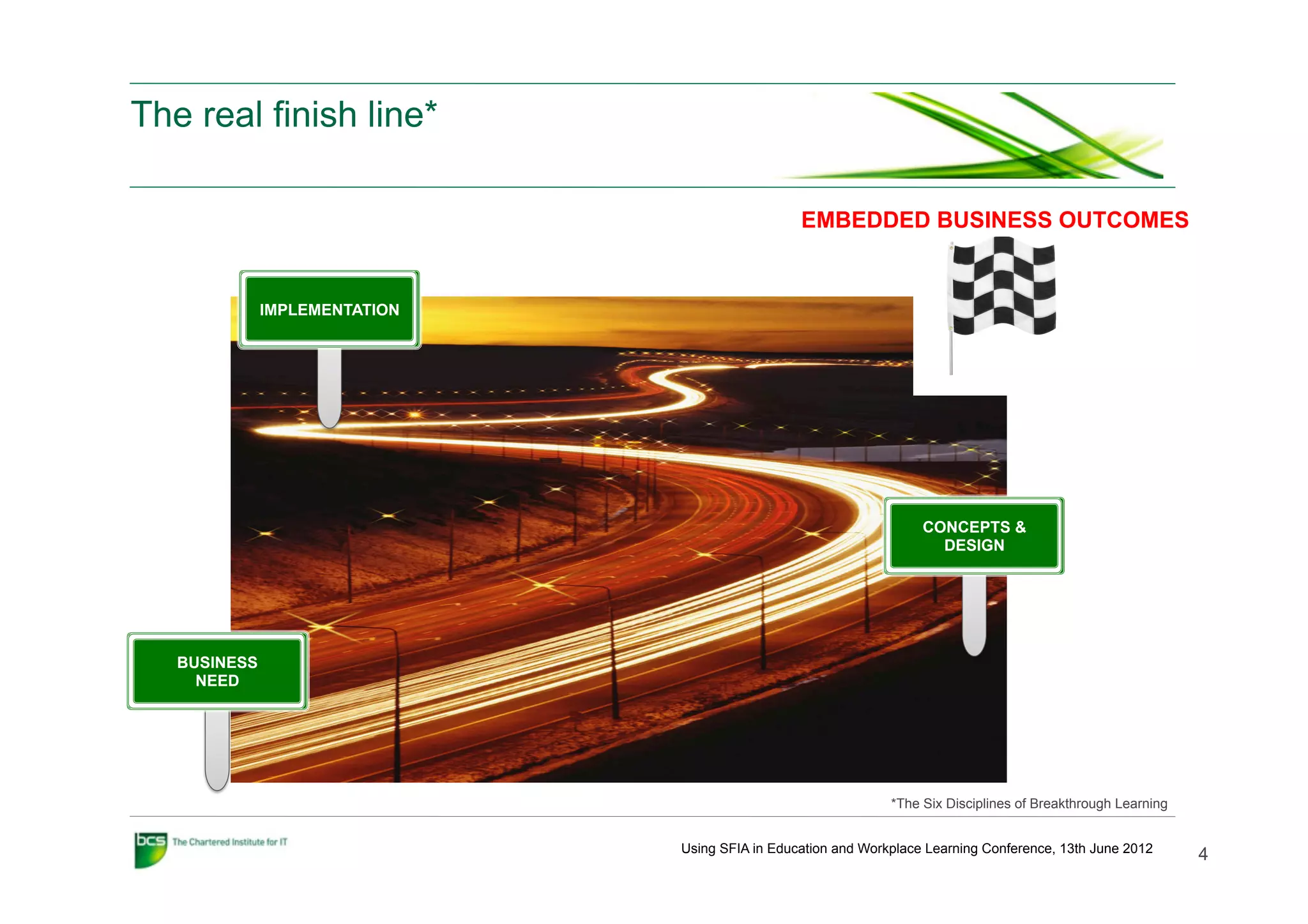
The real finish line*

                                                 EMBEDDED BUSINESS OUTCOMES


              IMPLEMENTATION


                                                                    CONCEPTS &
                                                                      DESIGN


   BUSINESS
     NEED


                                                               *The Six Disciplines of Breakthrough Learning


                               Using SFIA in Education and Workplace Learning Conference, 13th June 2012
                                                                                                               4
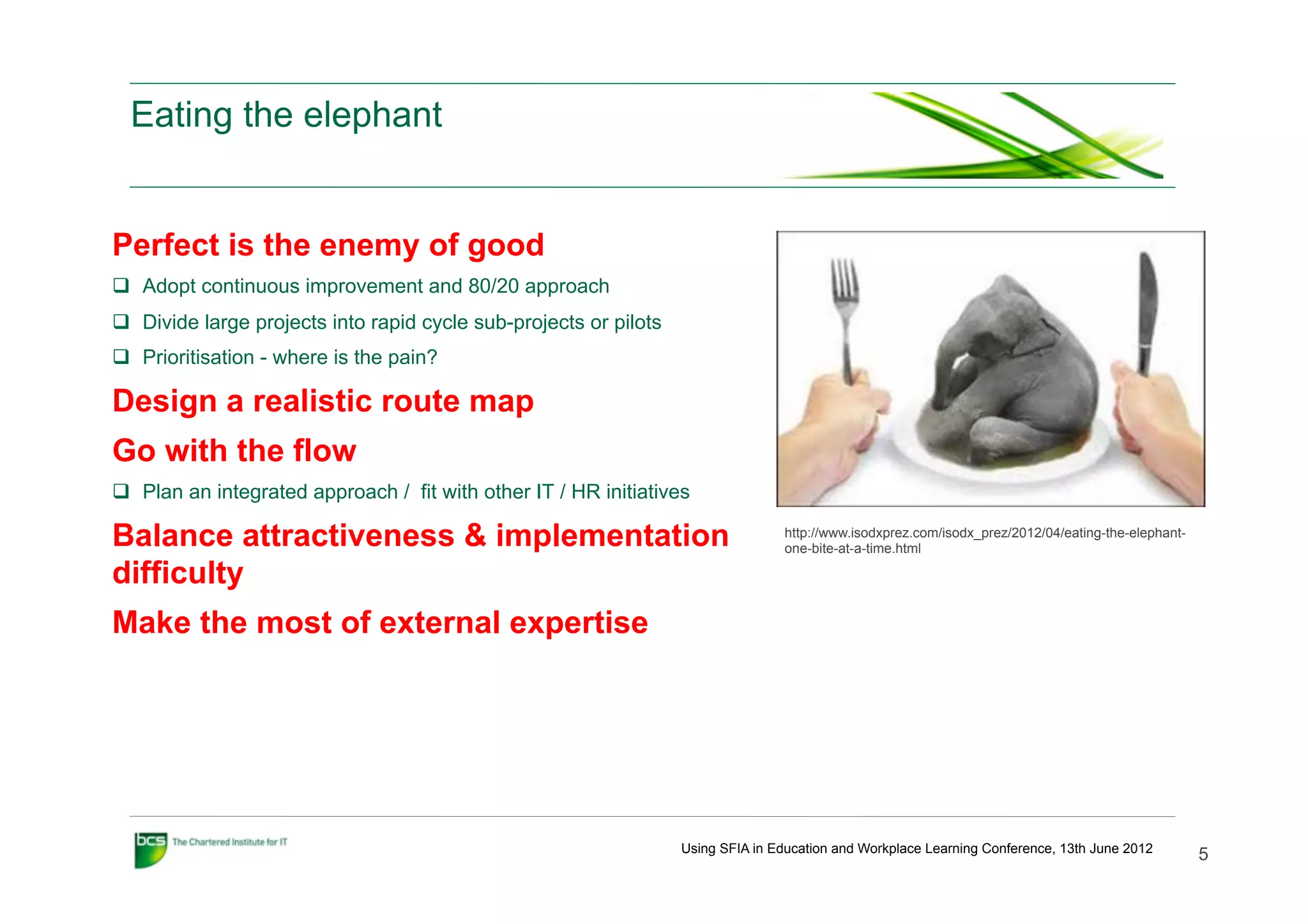
Eating the elephant


Perfect is the enemy of good
q  Adopt continuous improvement and 80/20 approach
q  Divide large projects into rapid cycle sub-projects or pilots
q  Prioritisation - where is the pain?

Design a realistic route map
Go with the flow
q  Plan an integrated approach / fit with other IT / HR initiatives

Balance attractiveness & implementation                                             http://www.isodxprez.com/isodx_prez/2012/04/eating-the-elephant-
                                                                                    one-bite-at-a-time.html

difficulty
Make the most of external expertise


                                                                    Using SFIA in Education and Workplace Learning Conference, 13th June 2012
                                                                                                                                                       5
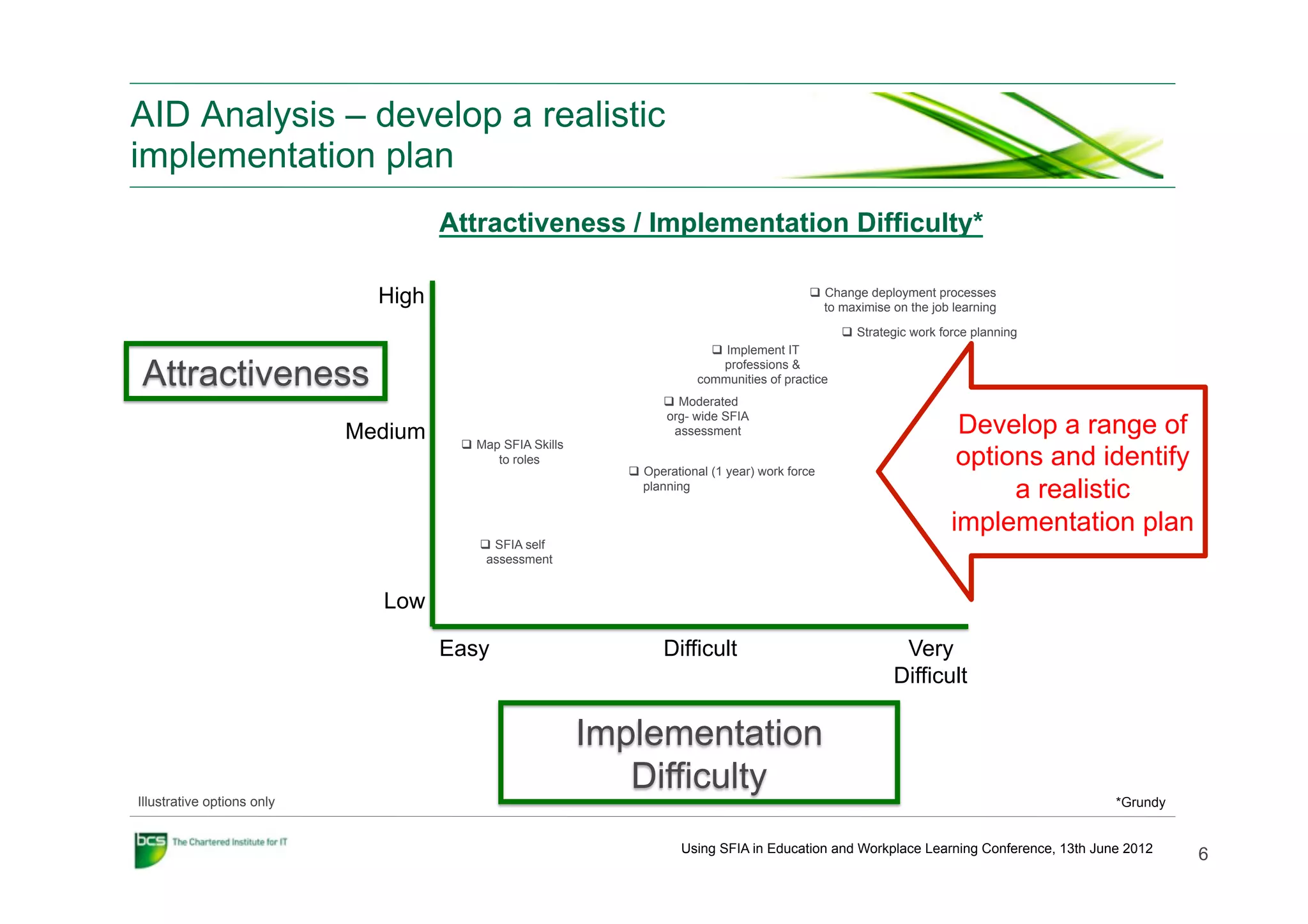
AID Analysis – develop a realistic
implementation plan
                                     Attractiveness / Implementation Difficulty*

                              High                                                             q  Change deployment processes
                                                                                                   to maximise on the job learning
                                                                                                     q  Strategic work force planning
                                                                            q  Implement IT

Attractiveness                                                                 professions &
                                                                          communities of practice
                                                                    q  Moderated

                            Medium
                                                                     org- wide SFIA
                                                                      assessment                                          Develop a range of
                                      q  Map SFIA Skills
                                             to roles
                                                              q  Operational (1 year) work force
                                                                                                                          options and identify
                                                                  planning
                                                                                                                               a realistic
                                                                                                                         implementation plan
                                         q  SFIA self
                                          assessment


                              Low

                                     Easy                           Difficult                                  Very
                                                                                                              Difficult

                                                            Implementation
                                                               Difficulty
Illustrative options only                                                                                                                 *Grundy


                                                                       Using SFIA in Education and Workplace Learning Conference, 13th June 2012
                                                                                                                                                    6
Have a route map for your use of SFIA in
  L&D

Why are we doing it?
q  What’s the business purpose?

What will it be used for?
q  What people management processes
    will you create or improve?
q  How will it be positioned

What’s in scope?
q  What outcomes and enablers will we develop & implement?
q  What benefits will we achieve?

How will we develop, implement and embed
the changes?
q  What is the process, who will be involved, how will we resource this?


                                                                Using SFIA in Education and Workplace Learning Conference, 13th June 2012
                                                                                                                                            7
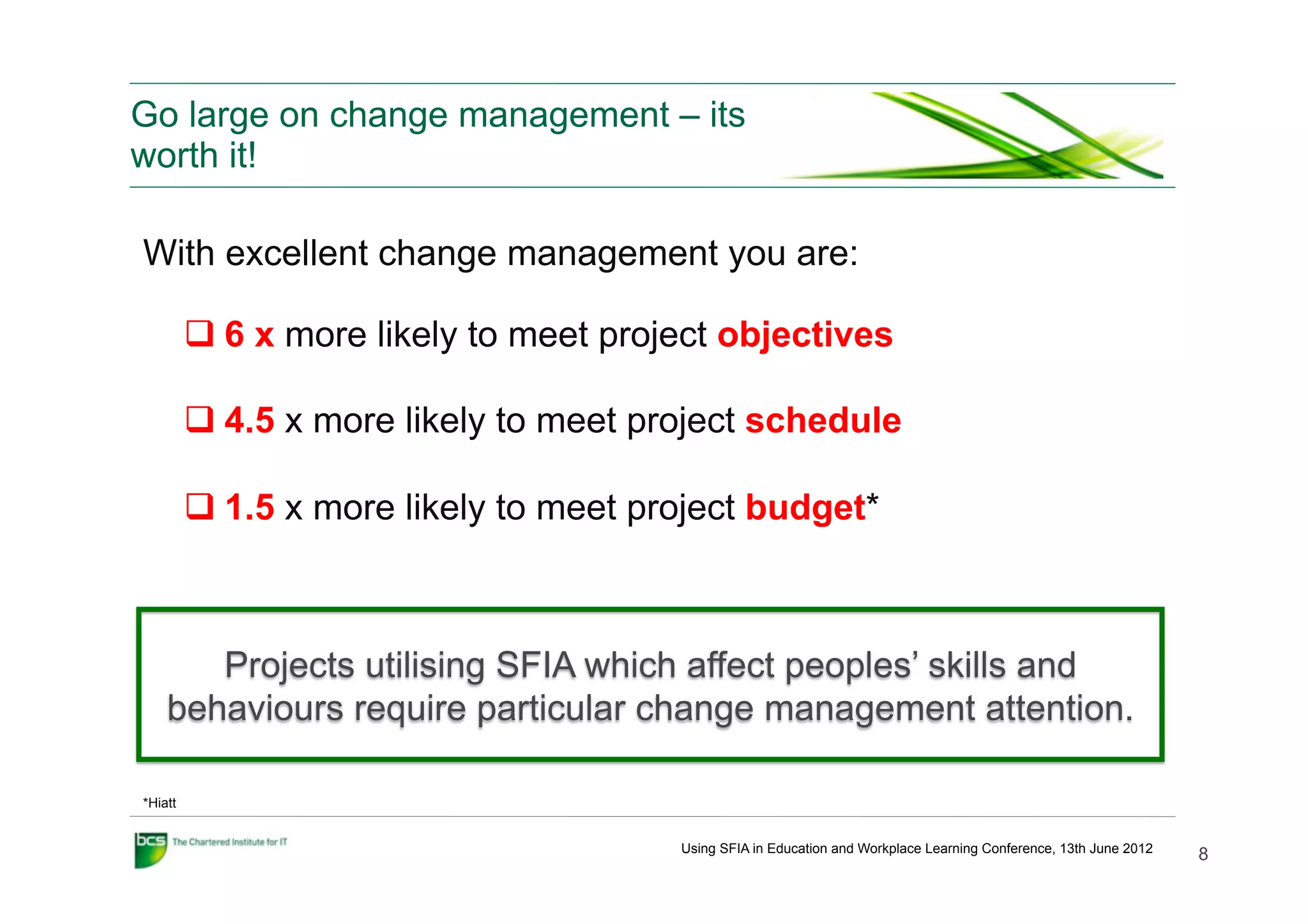
Go large on change management – its
worth it!

With excellent change management you are:

         q 6 x more likely to meet project objectives

         q 4.5 x more likely to meet project schedule

         q 1.5 x more likely to meet project budget*


       Projects utilising SFIA which affect peoples’ skills and
    behaviours require particular change management attention.

*Hiatt


                                        Using SFIA in Education and Workplace Learning Conference, 13th June 2012
                                                                                                                    8
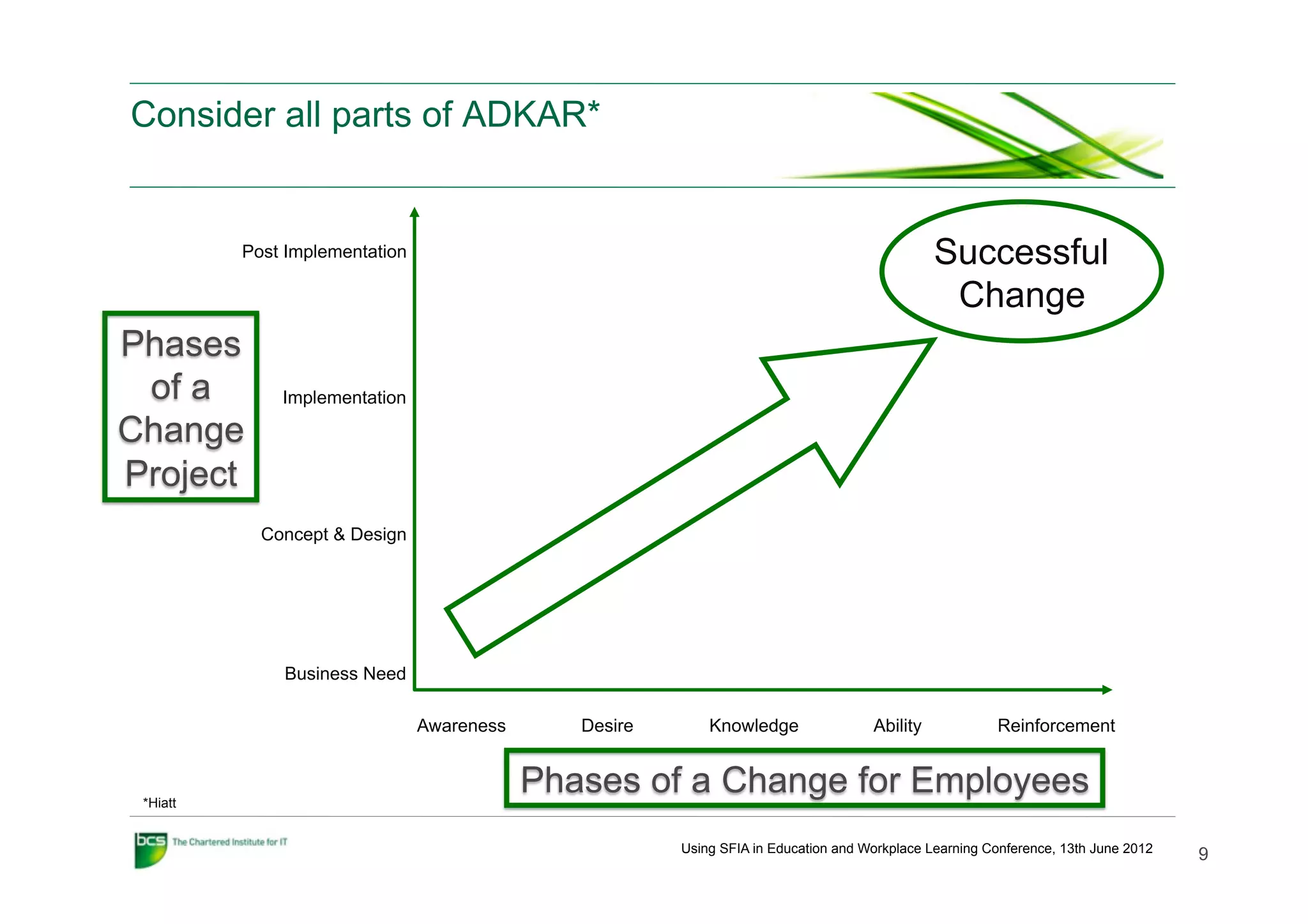
Consider all parts of ADKAR*


          Post Implementation                                                                  Successful
                                                                                                Change
Phases
 of a         Implementation

Change
Project
            Concept & Design


              Business Need

                                Awareness      Desire       Knowledge                Ability            Reinforcement


 *Hiatt
                                            Phases of a Change for Employees
                                                        Using SFIA in Education and Workplace Learning Conference, 13th June 2012
                                                                                                                                    9
SFIA Skills assessments


Start with the end in mind
q  What quality of assessment do you need?
q  What do you consider fit for purpose?
q  Will you need to calibrate and / or moderate the assessments?

Are you assessing fit for role, fit for
future or current stock of skills
q  Is SFIA all you want to assess?
q  Incremental assessments
q  Combine rigorous assessments with a free format approach

Be led by requirements and process
not by the tools and databases
q  Be wary of silver bullets
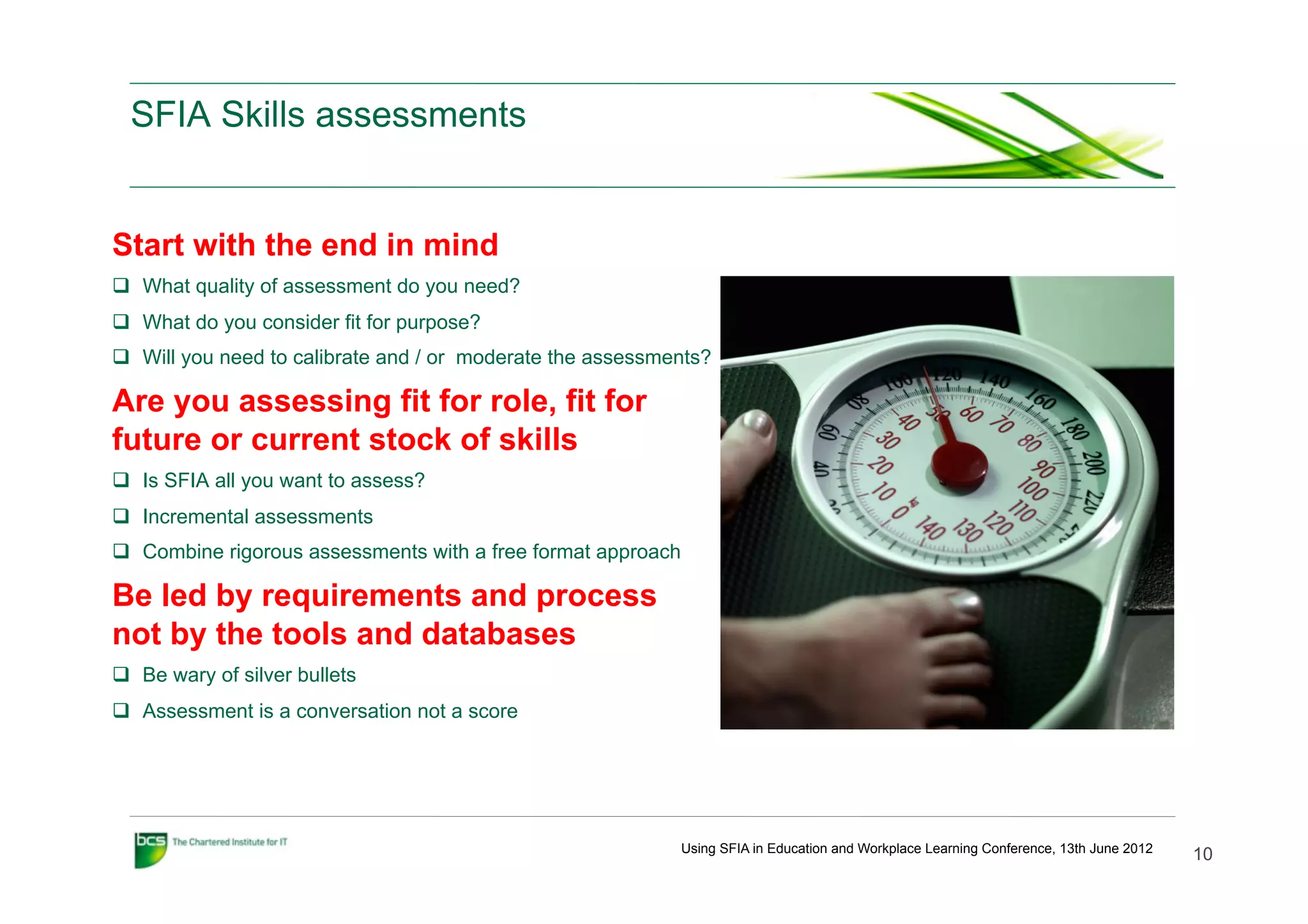
q  Assessment is a conversation not a score


                                                               Using SFIA in Education and Workplace Learning Conference, 13th June 2012
                                                                                                                                           10
Your line managers are key …


However…
q  IT line managers are typically selected for their technical
    competency, not for their people skills
q  IT line managers do not feel prepared for their management
    duties
And then …
q  Introducing SFIA and upgrading your workplace L&D
    brings increased expectations on managers


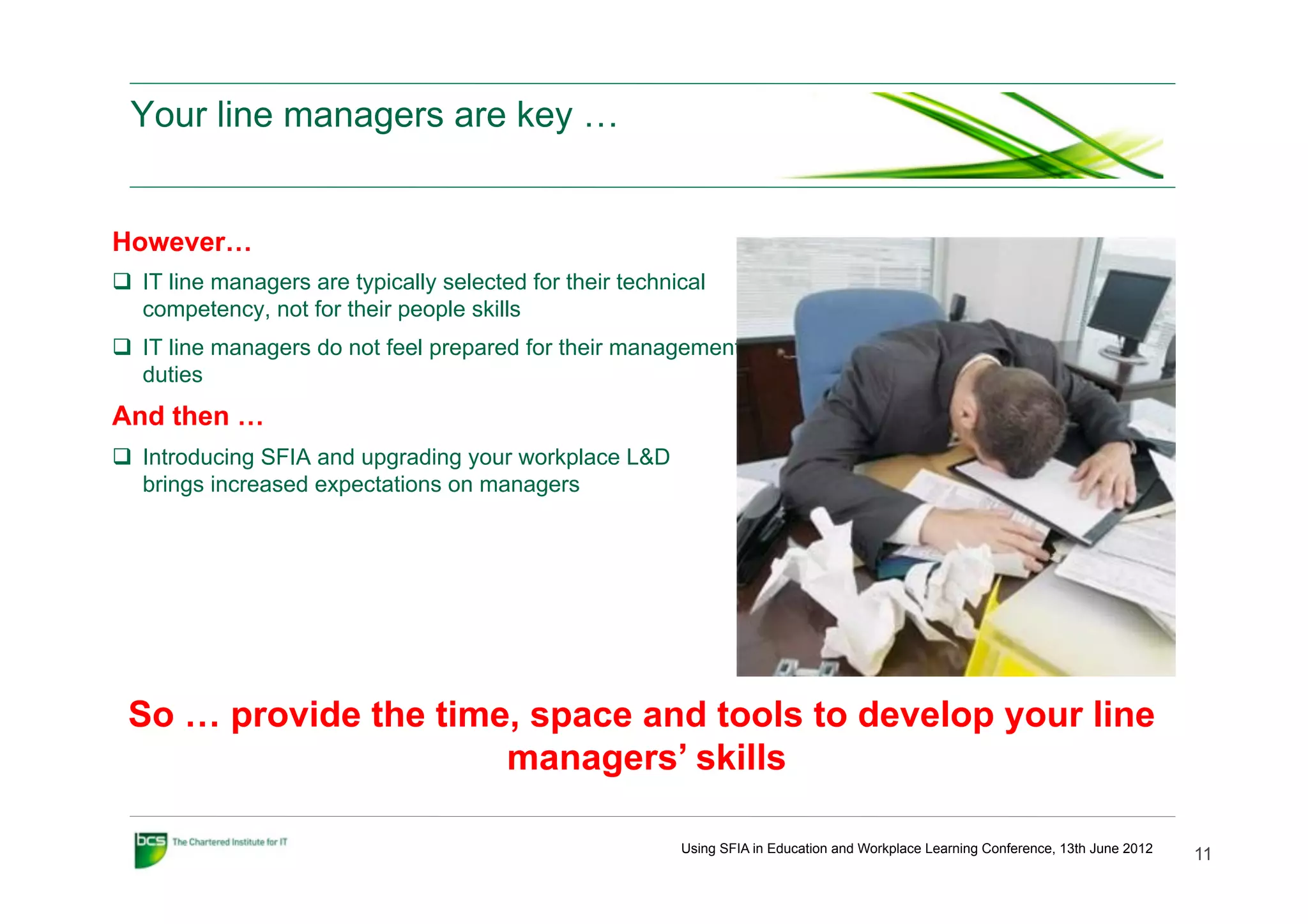
 So … provide the time, space and tools to develop your line
                      managers’ skills

                                                            Using SFIA in Education and Workplace Learning Conference, 13th June 2012
                                                                                                                                        11
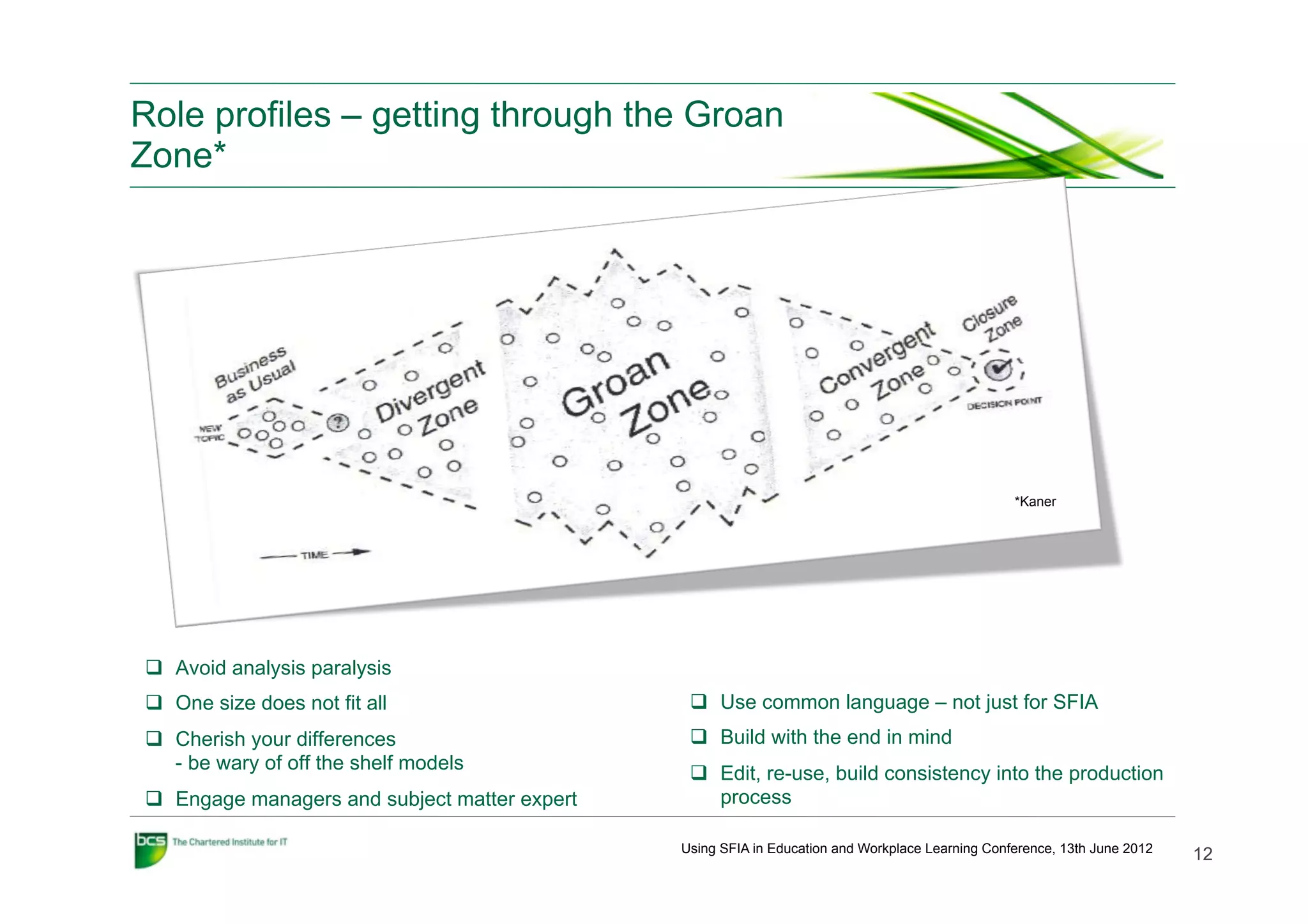
Role profiles – getting through the Groan
Zone*


                                                                                                   *Kaner


q  Avoid analysis paralysis
q  One size does not fit all                    q  Use common language – not just for SFIA
q  Cherish your differences                     q  Build with the end in mind
    - be wary of off the shelf models
                                                 q  Edit, re-use, build consistency into the production
q  Engage managers and subject matter expert        process

                                                Using SFIA in Education and Workplace Learning Conference, 13th June 2012
                                                                                                                            12
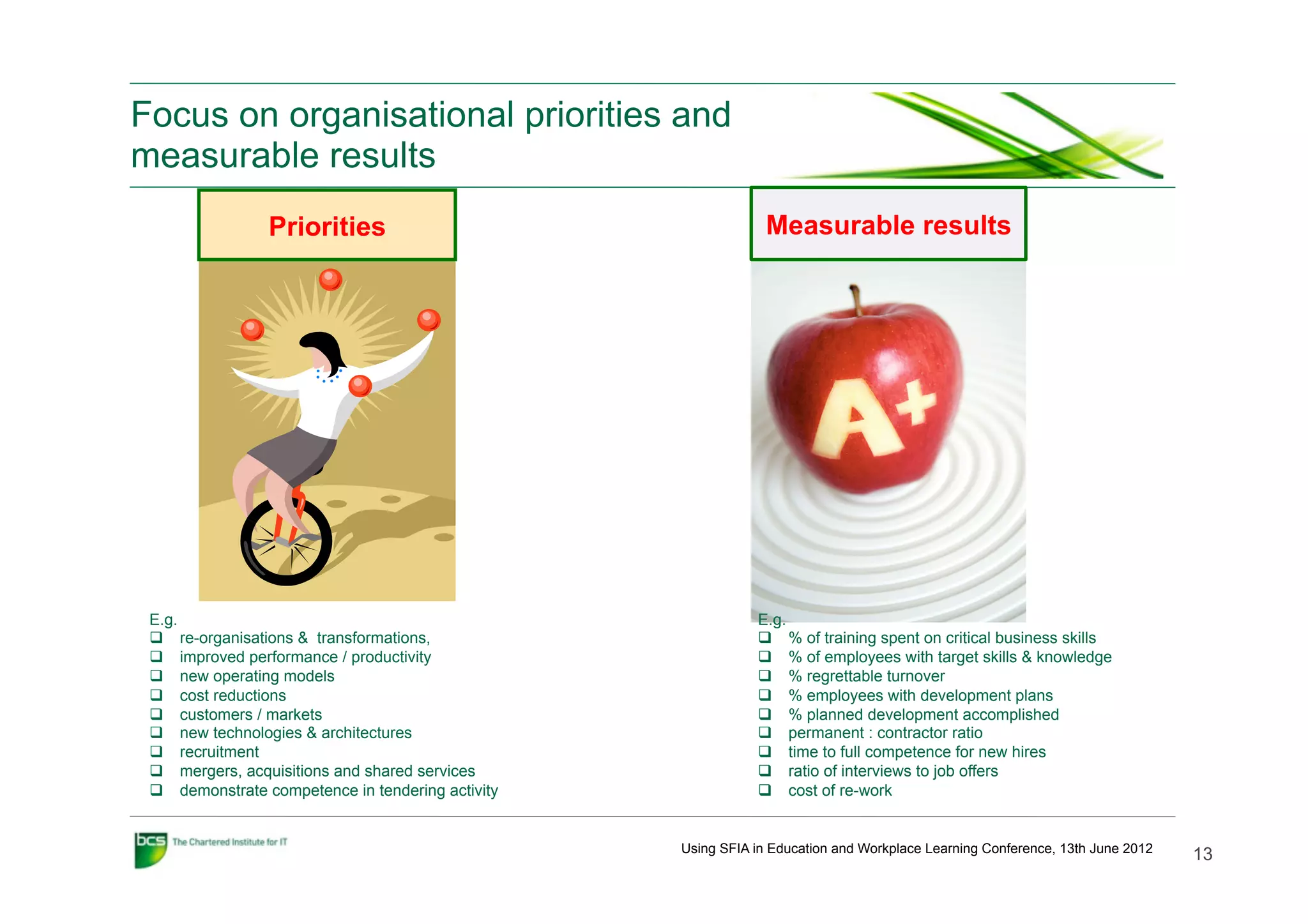
Focus on organisational priorities and
measurable results
                 Priorities                                      Measurable results


 E.g.                                                          E.g.
 q  re-organisations & transformations,                       q  % of training spent on critical business skills
 q  improved performance / productivity                       q  % of employees with target skills & knowledge
 q  new operating models                                      q  % regrettable turnover
 q  cost reductions                                           q  % employees with development plans
 q  customers / markets                                       q  % planned development accomplished
 q  new technologies & architectures                          q  permanent : contractor ratio
 q  recruitment                                               q  time to full competence for new hires
 q  mergers, acquisitions and shared services                 q  ratio of interviews to job offers
 q  demonstrate competence in tendering activity              q  cost of re-work


                                                    Using SFIA in Education and Workplace Learning Conference, 13th June 2012
                                                                                                                                13
Contact Details


Peter Leather

E-mail: peter.leather@ex-p.co.uk
Website: www.ex-p.co.uk/sfia
LinkedIn: http://uk.linkedin.com/in/peterleather

SFIA User Forum: http://sfiauser.ning.com/
LinkedIn SFIA Users: www.tinyurl.com/sfiausers-linkedin


                                                   Using SFIA in Education and Workplace Learning Conference, 13th June 2012
                                                                                                                               14
References


Grundy, T., 1998. Strategy implementation and project management. International Journal of Project Management 16 (1), 43–50
Wick, C. et al, 2010/ The Siz Disciplines of Breakthrough Learning, 2nd Edition
Hiatt, J.M., 2006. ADKAR: A model for change in Business, Government and our Community
Kaner, S., 1996. Facilitator’s Guide to Participatory Decision-Making,
http://www.isodxprez.com/isodx_prez/2012/04/eating-the-elephant-one-bite-at-a-time.html


                                                                  Using SFIA in Education and Workplace Learning Conference, 13th June 2012
                                                                                                                                              15

Peter leather overcoming sfia implementation pitfalls

  • 1.
    Learning & Development Specialist Group Overcoming pitfalls when implementing SFIA in L&D Peter Leather MBA (Open), BSc., MBCS Using SFIA in Education and Workplace Learning Conference, 13th June 2012 1
  • 2.
    A bit aboutme q  A well established, independent consultant specialising in developing the capability of IT organisations. q  MBA qualified with over 25 years’ experience in a range of roles working with major IT, financial services and professional services organisations. q  I have been using SFIA since 2003 – both operationally within a large IT organisation and as an accredited SFIA Consultant. q  A member of the SFIA Council (the SFIA steering group) and leader of the on-line global SFIA User Forum. Recent assignments have included: Ø  A global FMCG organisation; providing expert advice and implementation support in the use of SFIA in support of a Global IT organisation with several worldwide operating hubs (c1,500 IT Staff). Ø  A large provider of out-sourced IT services based in India; providing expert advice and mentoring in using SFIA to strengthen resource management and to assess the skills of their staff (8,000 IT staff). Ø  A leading professional sports organisation in the UK; working with the IT Leadership team to use SFIA to develop role profiles and improve objective setting, performance appraisals and professional development. Ø  A global software provider based in Germany; developing options and implementation strategies for a skills & competency framework. *Grundy Using SFIA in Education and Workplace Learning Conference, 13th June 2012 2
  • 3.
    Execution is theGraveyard of Strategy* R.I.P. SFIA Career L&D Paths Strategy *Grundy Using SFIA in Education and Workplace Learning Conference, 13th June 2012 3
  • 4.
    The real finishline* EMBEDDED BUSINESS OUTCOMES IMPLEMENTATION CONCEPTS & DESIGN BUSINESS NEED *The Six Disciplines of Breakthrough Learning Using SFIA in Education and Workplace Learning Conference, 13th June 2012 4
  • 5.
    Eating the elephant Perfectis the enemy of good q  Adopt continuous improvement and 80/20 approach q  Divide large projects into rapid cycle sub-projects or pilots q  Prioritisation - where is the pain? Design a realistic route map Go with the flow q  Plan an integrated approach / fit with other IT / HR initiatives Balance attractiveness & implementation http://www.isodxprez.com/isodx_prez/2012/04/eating-the-elephant- one-bite-at-a-time.html difficulty Make the most of external expertise Using SFIA in Education and Workplace Learning Conference, 13th June 2012 5
  • 6.
    AID Analysis –develop a realistic implementation plan Attractiveness / Implementation Difficulty* High q  Change deployment processes to maximise on the job learning q  Strategic work force planning q  Implement IT Attractiveness professions & communities of practice q  Moderated Medium org- wide SFIA assessment Develop a range of q  Map SFIA Skills to roles q  Operational (1 year) work force options and identify planning a realistic implementation plan q  SFIA self assessment Low Easy Difficult Very Difficult Implementation Difficulty Illustrative options only *Grundy Using SFIA in Education and Workplace Learning Conference, 13th June 2012 6
  • 7.
    Have a routemap for your use of SFIA in L&D Why are we doing it? q  What’s the business purpose? What will it be used for? q  What people management processes will you create or improve? q  How will it be positioned What’s in scope? q  What outcomes and enablers will we develop & implement? q  What benefits will we achieve? How will we develop, implement and embed the changes? q  What is the process, who will be involved, how will we resource this? Using SFIA in Education and Workplace Learning Conference, 13th June 2012 7
  • 8.
    Go large onchange management – its worth it! With excellent change management you are: q 6 x more likely to meet project objectives q 4.5 x more likely to meet project schedule q 1.5 x more likely to meet project budget* Projects utilising SFIA which affect peoples’ skills and behaviours require particular change management attention. *Hiatt Using SFIA in Education and Workplace Learning Conference, 13th June 2012 8
  • 9.
    Consider all partsof ADKAR* Post Implementation Successful Change Phases of a Implementation Change Project Concept & Design Business Need Awareness Desire Knowledge Ability Reinforcement *Hiatt Phases of a Change for Employees Using SFIA in Education and Workplace Learning Conference, 13th June 2012 9
  • 10.
    SFIA Skills assessments Startwith the end in mind q  What quality of assessment do you need? q  What do you consider fit for purpose? q  Will you need to calibrate and / or moderate the assessments? Are you assessing fit for role, fit for future or current stock of skills q  Is SFIA all you want to assess? q  Incremental assessments q  Combine rigorous assessments with a free format approach Be led by requirements and process not by the tools and databases q  Be wary of silver bullets q  Assessment is a conversation not a score Using SFIA in Education and Workplace Learning Conference, 13th June 2012 10
  • 11.
    Your line managersare key … However… q  IT line managers are typically selected for their technical competency, not for their people skills q  IT line managers do not feel prepared for their management duties And then … q  Introducing SFIA and upgrading your workplace L&D brings increased expectations on managers So … provide the time, space and tools to develop your line managers’ skills Using SFIA in Education and Workplace Learning Conference, 13th June 2012 11
  • 12.
    Role profiles –getting through the Groan Zone* *Kaner q  Avoid analysis paralysis q  One size does not fit all q  Use common language – not just for SFIA q  Cherish your differences q  Build with the end in mind - be wary of off the shelf models q  Edit, re-use, build consistency into the production q  Engage managers and subject matter expert process Using SFIA in Education and Workplace Learning Conference, 13th June 2012 12
  • 13.
    Focus on organisationalpriorities and measurable results Priorities Measurable results E.g. E.g. q  re-organisations & transformations, q  % of training spent on critical business skills q  improved performance / productivity q  % of employees with target skills & knowledge q  new operating models q  % regrettable turnover q  cost reductions q  % employees with development plans q  customers / markets q  % planned development accomplished q  new technologies & architectures q  permanent : contractor ratio q  recruitment q  time to full competence for new hires q  mergers, acquisitions and shared services q  ratio of interviews to job offers q  demonstrate competence in tendering activity q  cost of re-work Using SFIA in Education and Workplace Learning Conference, 13th June 2012 13
  • 14.
    Contact Details Peter Leather E-mail:peter.leather@ex-p.co.uk Website: www.ex-p.co.uk/sfia LinkedIn: http://uk.linkedin.com/in/peterleather SFIA User Forum: http://sfiauser.ning.com/ LinkedIn SFIA Users: www.tinyurl.com/sfiausers-linkedin Using SFIA in Education and Workplace Learning Conference, 13th June 2012 14
  • 15.
    References Grundy, T., 1998.Strategy implementation and project management. International Journal of Project Management 16 (1), 43–50 Wick, C. et al, 2010/ The Siz Disciplines of Breakthrough Learning, 2nd Edition Hiatt, J.M., 2006. ADKAR: A model for change in Business, Government and our Community Kaner, S., 1996. Facilitator’s Guide to Participatory Decision-Making, http://www.isodxprez.com/isodx_prez/2012/04/eating-the-elephant-one-bite-at-a-time.html Using SFIA in Education and Workplace Learning Conference, 13th June 2012 15