TRANSFORMERS
EQUIVALENT CIRCUIT OF
TRANSFORMERS
OBJECTIVE
 Why to find equivalent circuit of transformer.
 How to find equivalent circuit of transformer.
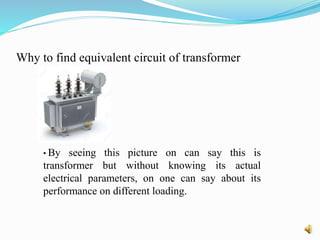
Why to find equivalent circuit of transformer
• By seeing this picture on can say this is
transformer but without knowing its actual
electrical parameters, on one can say about its
performance on different loading.
 What is meant by performance of transformer?
There must be no voltage drop in the transformer winding during
no load and full load. No power loss should occur in transformer. Based
on these two condition we can decide the performance of transformer.
By knowing Regulation and Efficiency of transformer we can
know the performance of transformer.
 How can we say transformer has better regulation?
If no load voltage of secondary terminal and full load voltage of
secondary terminal are same then we can say our transformer have
good regulation.(0 percentage) {condition 1}
 How can we say transformer has better efficiency?
If input and output of the transformer are equal then we can say
our transformer have good efficiency. { condition 2}
 If we have only practical transformer, then we need to apply different load
on transformer to find regulation and efficiency.
 If we are in position to model a practical transformer into a electrical circuit
using resistor and inductor, then we can easily apply mesh and nodal
analysis to find no load and full load secondary terminal voltage and losses
for different loading.
But above two condition will not be possible for
practical transformer.
Then how to know what is the value of regulation and
efficiency of the transformer
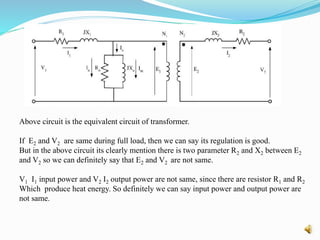
Above circuit is the equivalent circuit of transformer.
If E2 and V2 are same during full load, then we can say its regulation is good.
But in the above circuit its clearly mention there is two parameter R2 and X2 between E2
and V2 so we can definitely say that E2 and V2 are not same.
V1 I1 input power and V2 I2 output power are not same, since there are resistor R1 and R2
Which produce heat energy. So definitely we can say input power and output power are
not same.
KEY POINT:
 To analysis the performance of transformer for
different type of loading (lagging, leading, unity
powerfactor)
 To get efficiency of different loading
 To get regulation percentage for different loading
How to find R0, X0, R1,X1, R2 &X2 ……???
 This is why we are doing open circuit test and short
circuit test in machine
 By doing open circuit test we can calculate R0 and X0.
 By doing Short circuit test we can calculate equivalent
circuit of Resistance and Inductance of winding (R01 &
X01 ) or (R02 & X02 )
THANK YOU
MADHAN N

Transformer equivalent ckt

  • 1.
  • 2.
    OBJECTIVE  Why tofind equivalent circuit of transformer.  How to find equivalent circuit of transformer.
  • 3.
    Why to findequivalent circuit of transformer • By seeing this picture on can say this is transformer but without knowing its actual electrical parameters, on one can say about its performance on different loading.
  • 4.
     What ismeant by performance of transformer? There must be no voltage drop in the transformer winding during no load and full load. No power loss should occur in transformer. Based on these two condition we can decide the performance of transformer. By knowing Regulation and Efficiency of transformer we can know the performance of transformer.  How can we say transformer has better regulation? If no load voltage of secondary terminal and full load voltage of secondary terminal are same then we can say our transformer have good regulation.(0 percentage) {condition 1}  How can we say transformer has better efficiency? If input and output of the transformer are equal then we can say our transformer have good efficiency. { condition 2}
  • 5.
     If wehave only practical transformer, then we need to apply different load on transformer to find regulation and efficiency.  If we are in position to model a practical transformer into a electrical circuit using resistor and inductor, then we can easily apply mesh and nodal analysis to find no load and full load secondary terminal voltage and losses for different loading. But above two condition will not be possible for practical transformer. Then how to know what is the value of regulation and efficiency of the transformer
  • 6.
    Above circuit isthe equivalent circuit of transformer. If E2 and V2 are same during full load, then we can say its regulation is good. But in the above circuit its clearly mention there is two parameter R2 and X2 between E2 and V2 so we can definitely say that E2 and V2 are not same. V1 I1 input power and V2 I2 output power are not same, since there are resistor R1 and R2 Which produce heat energy. So definitely we can say input power and output power are not same.
  • 7.
    KEY POINT:  Toanalysis the performance of transformer for different type of loading (lagging, leading, unity powerfactor)  To get efficiency of different loading  To get regulation percentage for different loading
  • 8.
    How to findR0, X0, R1,X1, R2 &X2 ……???  This is why we are doing open circuit test and short circuit test in machine  By doing open circuit test we can calculate R0 and X0.  By doing Short circuit test we can calculate equivalent circuit of Resistance and Inductance of winding (R01 & X01 ) or (R02 & X02 )
  • 9.