TRAMADOL
Dr. Darendrajit MD
Senior Resident
Department of PMR
AIIMS, BBSR
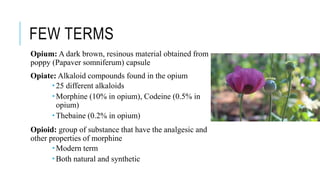
FEW TERMS
Opium: A dark brown, resinous material obtained from
poppy (Papaver somniferum) capsule
Opiate: Alkaloid compounds found in the opium
 25 different alkaloids
 Morphine (10% in opium), Codeine (0.5% in
opium)
 Thebaine (0.2% in opium)
Opioid: group of substance that have the analgesic and
other properties of morphine
 Modern term
 Both natural and synthetic
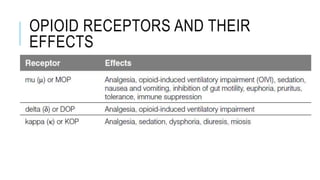
OPIOID RECEPTORS AND THEIR
EFFECTS
TRAMADOL
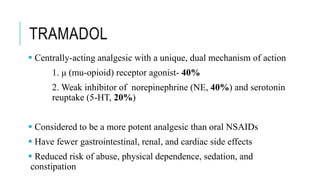
 Centrally-acting analgesic with a unique, dual mechanism of action
1. μ (mu-opioid) receptor agonist- 40%
2. Weak inhibitor of norepinephrine (NE, 40%) and serotonin
reuptake (5-HT, 20%)
 Considered to be a more potent analgesic than oral NSAIDs
 Have fewer gastrointestinal, renal, and cardiac side effects
 Reduced risk of abuse, physical dependence, sedation, and
constipation
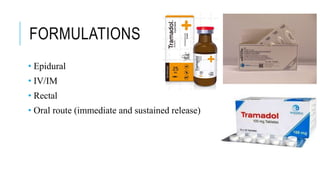
FORMULATIONS
• Epidural
• IV/IM
• Rectal
• Oral route (immediate and sustained release)
MECHANISM OF
ACTION/PHARMACODYNAMICS
Dual mode of action:
1. Binds weakly to the μ-opioid receptor sites
 Affinity for the μ-opioid receptor is 1/6000 that of
morphine and 1/10 that of codeine
2. Inhibits the reuptake of norepinephrine and serotonin
Supported by the findings that analgesia is partially blocked by
naloxone, α2-adrenoceptor antagonist (yohimbine), ondansetron
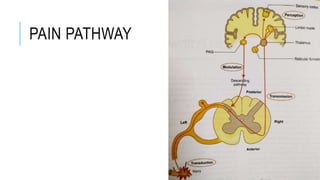
PAIN PATHWAY
MECHANISM OF
ACTION/PHARMACODYNAMICS
 Tramadol is a synthetic 4-phenyl-piperidine analogue of
codeine
Chemical name is cis-2-[(dimethylamino)methyl]-1-(3-
methoxyphenyl) cyclohexanol hydrochloride
 Parent compound is a racemic drug, and both its (+) and
(−) forms play an important role in its mechanism
 The (+) enantiomer has a higher affinity for the μ-receptor
and increases serotonin levels
 The (−) enantiomer increases norepinephrine levels
(1R,2R)- & (1S,2S)-Tramadol
Enantiomers
MECHANISM OF
ACTION/PHARMACODYNAMICS
 Extensively metabolized by the liver, with the major pathways
being: N- and O-demethylation (phase 1) and glucuronidation or
sulfation
 Eliminated primarily through the kidneys, with 30% being
excreted unchanged
.
MECHANISM OF
ACTION/PHARMACODYNAMICS
 23 identified metabolites, 11 are phase 1 and 12 are conjugates
 M1 metabolite shown to play a significant role in tramadol’s
analgesic properties
 M1 metabolite is the O-demethylated form of tramadol with the
(+) form having the greater potential for analgesic effect
MECHANISM OF
ACTION/PHARMACODYNAMICS
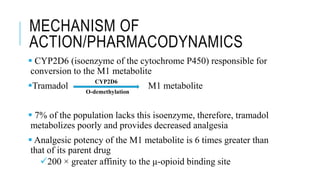
 CYP2D6 (isoenzyme of the cytochrome P450) responsible for
conversion to the M1 metabolite
Tramadol M1 metabolite
 7% of the population lacks this isoenzyme, therefore, tramadol
metabolizes poorly and provides decreased analgesia
 Analgesic potency of the M1 metabolite is 6 times greater than
that of its parent drug
200 × greater affinity to the μ-opioid binding site
CYP2D6
O-demethylation
MECHANISM OF
ACTION/PHARMACODYNAMICS
 Bioavailability after oral administration is 75%, with only 20%
binding to plasma proteins
DOSAGE
 Average dose for a healthy adult is 50–100 mg every 6 h
 Peak plasma levels after a single 100-mg dose are 1.6 h for the
parent drug and 3 h for the M1 metabolite
 Half-life levels after a single 100-mg dose are 6.3 h for the parent
drug and 7.4 h for the M1 metabolite
 Analgesic benefit peaks at 2 h after the initial dose and lasts
approximately 6 h, with steady state occurring after 48 h
DOSAGE
 When given with food, % absorbed and peak plasma conc. are
unaffected, but the time to peak plasma conc. increases by 35 min
 Dosage adjustment is recommended in the elderly and in patients
with renal and liver disease
 Dose recommended is 400 mg in a 24-h period secondary to the
increased risk of side effects with higher doses
DOSAGE
 Ondansetron, a serotonin 5HT-3 receptor antagonist, inhibits the
analgesic effects of tramadol
 Synergistic effect with other sedating medication, which may
necessitate a dosage adjustment
SPECIAL POPULATIONS
 Elderly and/or patients with liver or renal disease require an
adjustment in the usual dosage of tramadol
 Due to the increased elimination time of the drug in the elderly
(75 years and older), the dosage should not exceed 300 mg/d
 Advanced liver disease prolongs the drug’s half-life and requires
dosage reduction to 50 mg every 12 h (max daily dose 100 mg/d)
 Ultracet is not recommended for patients with liver disease
SPECIAL POPULATIONS
 Excretion: primarily through the kidneys
Rate and extent of excretion will be significantly reduced in
patients with a creatinine clearance of less than 30 mL/min
Require a dosage adjustment of 50–100 mg every 12 h
(maximum daily dose 200 mg/d)
For Ultracet, the recommendation in these patients is two
tablets every 12 h
 Only 7% of tramadol and its metabolites is cleared by a 4-h
dialysis. Dialysis patients can receive their dose on dialysis day
SPECIAL POPULATIONS
 Safety in pediatric population, during pregnancy, and in nursing
mothers: Not established
 For acute pain in children as young as one-month-old
consistently report that a 1–2 mg/kg single dose is safe and
effective
 Classified as pregnancy risk factor C
1% of the dose transferred via the placenta
0.1% of the dose can be found in breast milk
 During labor it provides adequate maternal analgesia with no
significant respiratory depression in the newborn
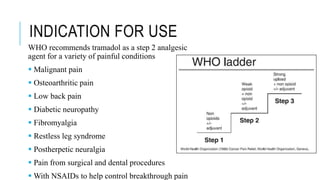
INDICATION FOR USE
WHO recommends tramadol as a step 2 analgesic
agent for a variety of painful conditions
 Malignant pain
 Osteoarthritic pain
 Low back pain
 Diabetic neuropathy
 Fibromyalgia
 Restless leg syndrome
 Postherpetic neuralgia
 Pain from surgical and dental procedures
 With NSAIDs to help control breakthrough pain
SIDE EFFECT PROFILE
 Intolerable side effects cause 20–30% of patients to discontinue
tramadol
 Dizziness, lethargy, nausea, vomiting, and constipation are
common complaints after the first week of usage.
 Complaints of nausea and vomiting may decrease with continued
usage, but the incidence of other side effects such as dizziness,
lethargy, headache, and constipation may fail to improve
significantly
 The incidence of side effects may appear daunting, but it is
similar to that of many opioids
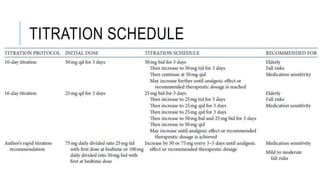
TITRATION SCHEDULE
 A slow titration schedule improves tolerance for the medication
 Useful in chronic pain having a history of poor tolerance for
medication or who is at increased risk for falls
 Balance must be struck between maximizing tolerance to the drug
and achieving timely pain relief
TITRATION SCHEDULE
DRUG–DRUG INTERACTIONS
 Two most striking side effects are seizures and the serotonin
syndrome
SEIZURES
 Seizures occurred in less than 1% of tramadol users
 Risk of seizures is increased with tramadol overdosage and as the
number and dosage of other psychoactive medications are
increased
Antidepressant agents (MAOI,TCAs, and SSRI), the
neuroleptics, and other opioids
 Patients with spontaneous seizures with tramadol alone may be
poor metabolizers of the drug
SEIZURES
 Avoid co-administration of tramadol with any medication that
may lower the seizure threshold
 Avoid in pts with h/o seizures/epilepsy, head trauma, alcohol and
drug withdrawal, and any other insult to the CNS
 Protective effect of co-administration of anticonvulsant
medication with tramadol has not been established
 A seizure associated with tramadol should be treated with BZDs
or barbiturates
TRAMADOL OVERDOSE
 Respiratory depression started at 500 mg
 Coma occurs at 800 mg
 The use of naloxone merely reversed some of the
cardiorespiratory effects of tramadol and was associated with an
increased risk of seizure activity
SEROTONIN SYNDROME
 Occur in co-administration with SSRI and the MAOI, that can
increase CNS serotonin levels
 Serotonin syndrome should be suspected in any patient who
develops
 an abrupt change in mental status accompanied by autonomic
symptoms (eg, fever, shivering, diaphoresis, nausea, vomiting, and
diarrhea)
other neurological changes (eg, an increase in muscle tone,
myoclonus, tremor, ataxia, agitation, hypomania, and hallucinations)
SEROTONIN SYNDROME
 Treatment:
•Cessation of the medication
•Symptom management
•Administration of antiserotonergic drugs such as
cyproheptadine
WHY USE (OR AVOID) TRAMADOL
 Benefits of using tramadol instead of traditional opioids:
Lower abuse potential and physical dependence
Reduced side effects, such as constipation, respiratory
depression, and sedation
 Rate of abuse with tramadol: less than 1/100,000 patients
 97% had a history of alcohol or drug dependence: caution in this
patient population
WHY USE (OR AVOID) TRAMADOL
 Abstinence syndrome: When the drug is withdrawn abruptly,
but the rate is reported at 1 per month per 100,000 cases
 Treated by reinstituting tramadol and gradually titrating the dose
downward
 Methadone is effective in treating abstinence syndrome
secondary to abrupt discontinuation of tramadol
 Patients with a true allergic reaction to codeine or morphine
should use tramadol with caution
SUMMARY
 Mechanism not completely understood
 Works both at the μ-opioid receptors and by inhibiting the reuptake of
norepinephrine and serotonin in the CNS
 Proven effectiveness for moderate to moderately severe pain
 Does not affect the prostaglandin cycle as do NSAIDs
SUMMARY
 Lower incidence of dependence and physical abuse than
traditional opioids
 One-fifth as potent as oral morphine
 While the efficacy of morphine and tramadol increases with the
size of the dose, dose-related toxicity limits the maximum
potential of tramadol
T
H
A
N
K
Y
O
U

Tramadol

  • 1.
    TRAMADOL Dr. Darendrajit MD SeniorResident Department of PMR AIIMS, BBSR
  • 2.
    FEW TERMS Opium: Adark brown, resinous material obtained from poppy (Papaver somniferum) capsule Opiate: Alkaloid compounds found in the opium  25 different alkaloids  Morphine (10% in opium), Codeine (0.5% in opium)  Thebaine (0.2% in opium) Opioid: group of substance that have the analgesic and other properties of morphine  Modern term  Both natural and synthetic
  • 3.
    OPIOID RECEPTORS ANDTHEIR EFFECTS
  • 4.
    TRAMADOL  Centrally-acting analgesicwith a unique, dual mechanism of action 1. μ (mu-opioid) receptor agonist- 40% 2. Weak inhibitor of norepinephrine (NE, 40%) and serotonin reuptake (5-HT, 20%)  Considered to be a more potent analgesic than oral NSAIDs  Have fewer gastrointestinal, renal, and cardiac side effects  Reduced risk of abuse, physical dependence, sedation, and constipation
  • 5.
    FORMULATIONS • Epidural • IV/IM •Rectal • Oral route (immediate and sustained release)
  • 6.
    MECHANISM OF ACTION/PHARMACODYNAMICS Dual modeof action: 1. Binds weakly to the μ-opioid receptor sites  Affinity for the μ-opioid receptor is 1/6000 that of morphine and 1/10 that of codeine 2. Inhibits the reuptake of norepinephrine and serotonin Supported by the findings that analgesia is partially blocked by naloxone, α2-adrenoceptor antagonist (yohimbine), ondansetron
  • 7.
  • 8.
    MECHANISM OF ACTION/PHARMACODYNAMICS  Tramadolis a synthetic 4-phenyl-piperidine analogue of codeine Chemical name is cis-2-[(dimethylamino)methyl]-1-(3- methoxyphenyl) cyclohexanol hydrochloride  Parent compound is a racemic drug, and both its (+) and (−) forms play an important role in its mechanism  The (+) enantiomer has a higher affinity for the μ-receptor and increases serotonin levels  The (−) enantiomer increases norepinephrine levels (1R,2R)- & (1S,2S)-Tramadol Enantiomers
  • 9.
    MECHANISM OF ACTION/PHARMACODYNAMICS  Extensivelymetabolized by the liver, with the major pathways being: N- and O-demethylation (phase 1) and glucuronidation or sulfation  Eliminated primarily through the kidneys, with 30% being excreted unchanged .
  • 10.
    MECHANISM OF ACTION/PHARMACODYNAMICS  23identified metabolites, 11 are phase 1 and 12 are conjugates  M1 metabolite shown to play a significant role in tramadol’s analgesic properties  M1 metabolite is the O-demethylated form of tramadol with the (+) form having the greater potential for analgesic effect
  • 11.
    MECHANISM OF ACTION/PHARMACODYNAMICS  CYP2D6(isoenzyme of the cytochrome P450) responsible for conversion to the M1 metabolite Tramadol M1 metabolite  7% of the population lacks this isoenzyme, therefore, tramadol metabolizes poorly and provides decreased analgesia  Analgesic potency of the M1 metabolite is 6 times greater than that of its parent drug 200 × greater affinity to the μ-opioid binding site CYP2D6 O-demethylation
  • 12.
    MECHANISM OF ACTION/PHARMACODYNAMICS  Bioavailabilityafter oral administration is 75%, with only 20% binding to plasma proteins
  • 13.
    DOSAGE  Average dosefor a healthy adult is 50–100 mg every 6 h  Peak plasma levels after a single 100-mg dose are 1.6 h for the parent drug and 3 h for the M1 metabolite  Half-life levels after a single 100-mg dose are 6.3 h for the parent drug and 7.4 h for the M1 metabolite  Analgesic benefit peaks at 2 h after the initial dose and lasts approximately 6 h, with steady state occurring after 48 h
  • 14.
    DOSAGE  When givenwith food, % absorbed and peak plasma conc. are unaffected, but the time to peak plasma conc. increases by 35 min  Dosage adjustment is recommended in the elderly and in patients with renal and liver disease  Dose recommended is 400 mg in a 24-h period secondary to the increased risk of side effects with higher doses
  • 15.
    DOSAGE  Ondansetron, aserotonin 5HT-3 receptor antagonist, inhibits the analgesic effects of tramadol  Synergistic effect with other sedating medication, which may necessitate a dosage adjustment
  • 16.
    SPECIAL POPULATIONS  Elderlyand/or patients with liver or renal disease require an adjustment in the usual dosage of tramadol  Due to the increased elimination time of the drug in the elderly (75 years and older), the dosage should not exceed 300 mg/d  Advanced liver disease prolongs the drug’s half-life and requires dosage reduction to 50 mg every 12 h (max daily dose 100 mg/d)  Ultracet is not recommended for patients with liver disease
  • 17.
    SPECIAL POPULATIONS  Excretion:primarily through the kidneys Rate and extent of excretion will be significantly reduced in patients with a creatinine clearance of less than 30 mL/min Require a dosage adjustment of 50–100 mg every 12 h (maximum daily dose 200 mg/d) For Ultracet, the recommendation in these patients is two tablets every 12 h  Only 7% of tramadol and its metabolites is cleared by a 4-h dialysis. Dialysis patients can receive their dose on dialysis day
  • 18.
    SPECIAL POPULATIONS  Safetyin pediatric population, during pregnancy, and in nursing mothers: Not established  For acute pain in children as young as one-month-old consistently report that a 1–2 mg/kg single dose is safe and effective  Classified as pregnancy risk factor C 1% of the dose transferred via the placenta 0.1% of the dose can be found in breast milk  During labor it provides adequate maternal analgesia with no significant respiratory depression in the newborn
  • 19.
    INDICATION FOR USE WHOrecommends tramadol as a step 2 analgesic agent for a variety of painful conditions  Malignant pain  Osteoarthritic pain  Low back pain  Diabetic neuropathy  Fibromyalgia  Restless leg syndrome  Postherpetic neuralgia  Pain from surgical and dental procedures  With NSAIDs to help control breakthrough pain
  • 20.
    SIDE EFFECT PROFILE Intolerable side effects cause 20–30% of patients to discontinue tramadol  Dizziness, lethargy, nausea, vomiting, and constipation are common complaints after the first week of usage.  Complaints of nausea and vomiting may decrease with continued usage, but the incidence of other side effects such as dizziness, lethargy, headache, and constipation may fail to improve significantly  The incidence of side effects may appear daunting, but it is similar to that of many opioids
  • 21.
    TITRATION SCHEDULE  Aslow titration schedule improves tolerance for the medication  Useful in chronic pain having a history of poor tolerance for medication or who is at increased risk for falls  Balance must be struck between maximizing tolerance to the drug and achieving timely pain relief
  • 22.
  • 23.
    DRUG–DRUG INTERACTIONS  Twomost striking side effects are seizures and the serotonin syndrome
  • 24.
    SEIZURES  Seizures occurredin less than 1% of tramadol users  Risk of seizures is increased with tramadol overdosage and as the number and dosage of other psychoactive medications are increased Antidepressant agents (MAOI,TCAs, and SSRI), the neuroleptics, and other opioids  Patients with spontaneous seizures with tramadol alone may be poor metabolizers of the drug
  • 25.
    SEIZURES  Avoid co-administrationof tramadol with any medication that may lower the seizure threshold  Avoid in pts with h/o seizures/epilepsy, head trauma, alcohol and drug withdrawal, and any other insult to the CNS  Protective effect of co-administration of anticonvulsant medication with tramadol has not been established  A seizure associated with tramadol should be treated with BZDs or barbiturates
  • 26.
    TRAMADOL OVERDOSE  Respiratorydepression started at 500 mg  Coma occurs at 800 mg  The use of naloxone merely reversed some of the cardiorespiratory effects of tramadol and was associated with an increased risk of seizure activity
  • 27.
    SEROTONIN SYNDROME  Occurin co-administration with SSRI and the MAOI, that can increase CNS serotonin levels  Serotonin syndrome should be suspected in any patient who develops  an abrupt change in mental status accompanied by autonomic symptoms (eg, fever, shivering, diaphoresis, nausea, vomiting, and diarrhea) other neurological changes (eg, an increase in muscle tone, myoclonus, tremor, ataxia, agitation, hypomania, and hallucinations)
  • 28.
    SEROTONIN SYNDROME  Treatment: •Cessationof the medication •Symptom management •Administration of antiserotonergic drugs such as cyproheptadine
  • 29.
    WHY USE (ORAVOID) TRAMADOL  Benefits of using tramadol instead of traditional opioids: Lower abuse potential and physical dependence Reduced side effects, such as constipation, respiratory depression, and sedation  Rate of abuse with tramadol: less than 1/100,000 patients  97% had a history of alcohol or drug dependence: caution in this patient population
  • 30.
    WHY USE (ORAVOID) TRAMADOL  Abstinence syndrome: When the drug is withdrawn abruptly, but the rate is reported at 1 per month per 100,000 cases  Treated by reinstituting tramadol and gradually titrating the dose downward  Methadone is effective in treating abstinence syndrome secondary to abrupt discontinuation of tramadol  Patients with a true allergic reaction to codeine or morphine should use tramadol with caution
  • 31.
    SUMMARY  Mechanism notcompletely understood  Works both at the μ-opioid receptors and by inhibiting the reuptake of norepinephrine and serotonin in the CNS  Proven effectiveness for moderate to moderately severe pain  Does not affect the prostaglandin cycle as do NSAIDs
  • 32.
    SUMMARY  Lower incidenceof dependence and physical abuse than traditional opioids  One-fifth as potent as oral morphine  While the efficacy of morphine and tramadol increases with the size of the dose, dose-related toxicity limits the maximum potential of tramadol
  • 33.