Training Program Proposal: An Overview
Workforce Development Options
Brenna Supplee
HR Intern
bsupplee@PortofVirginia.com
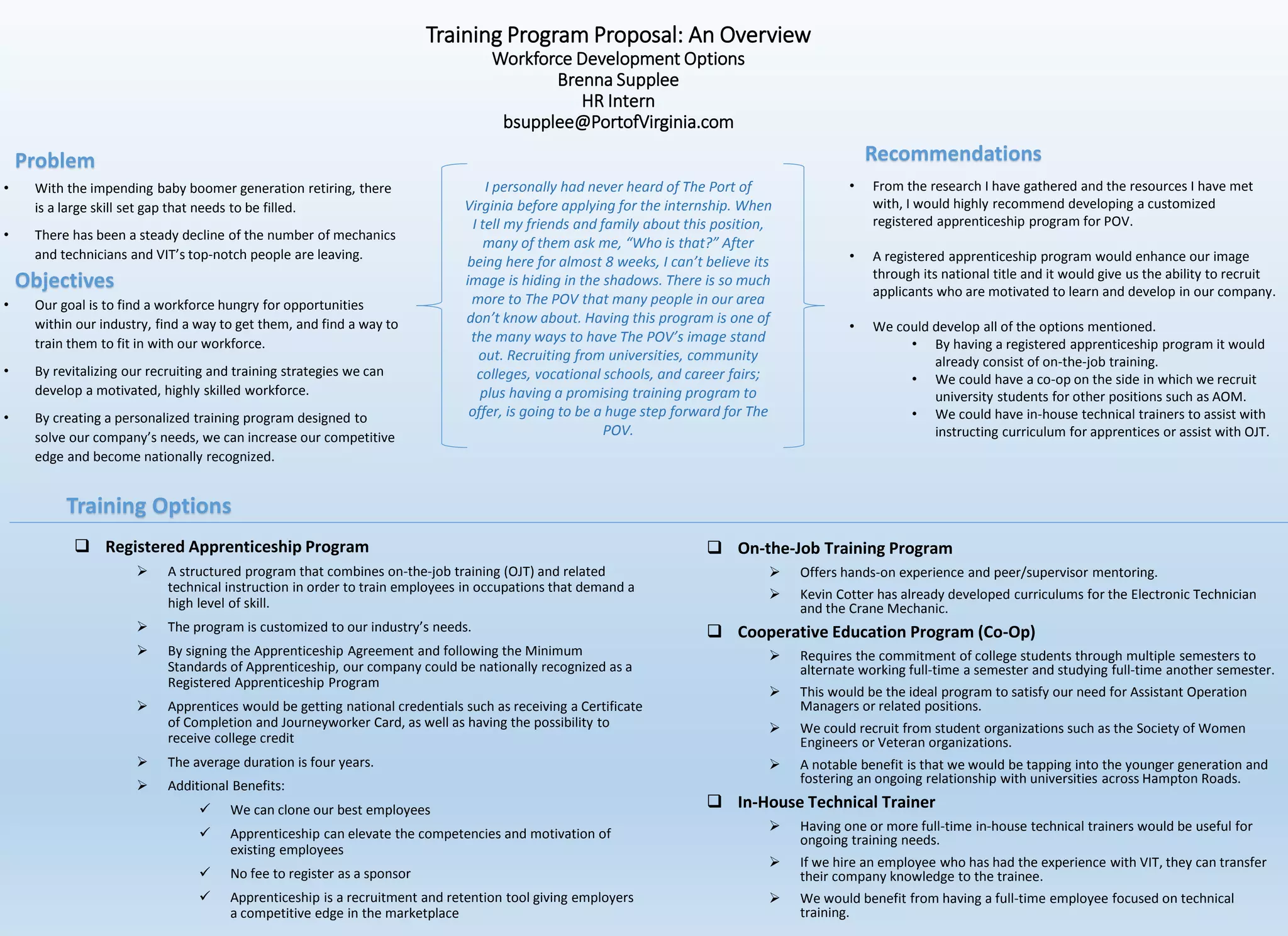
• With the impending baby boomer generation retiring, there
is a large skill set gap that needs to be filled.
• There has been a steady decline of the number of mechanics
and technicians and VIT’s top-notch people are leaving.
• Our goal is to find a workforce hungry for opportunities
within our industry, find a way to get them, and find a way to
train them to fit in with our workforce.
• By revitalizing our recruiting and training strategies we can
develop a motivated, highly skilled workforce.
• By creating a personalized training program designed to
solve our company’s needs, we can increase our competitive
edge and become nationally recognized.
 Registered Apprenticeship Program
 A structured program that combines on-the-job training (OJT) and related
technical instruction in order to train employees in occupations that demand a
high level of skill.
 The program is customized to our industry’s needs.
 By signing the Apprenticeship Agreement and following the Minimum
Standards of Apprenticeship, our company could be nationally recognized as a
Registered Apprenticeship Program
 Apprentices would be getting national credentials such as receiving a Certificate
of Completion and Journeyworker Card, as well as having the possibility to
receive college credit
 The average duration is four years.
 Additional Benefits:
 We can clone our best employees
 Apprenticeship can elevate the competencies and motivation of
existing employees
 No fee to register as a sponsor
 Apprenticeship is a recruitment and retention tool giving employers
a competitive edge in the marketplace
 On-the-Job Training Program
 Offers hands-on experience and peer/supervisor mentoring.
 Kevin Cotter has already developed curriculums for the Electronic Technician
and the Crane Mechanic.
 Cooperative Education Program (Co-Op)
 Requires the commitment of college students through multiple semesters to
alternate working full-time a semester and studying full-time another semester.
 This would be the ideal program to satisfy our need for Assistant Operation
Managers or related positions.
 We could recruit from student organizations such as the Society of Women
Engineers or Veteran organizations.
 A notable benefit is that we would be tapping into the younger generation and
fostering an ongoing relationship with universities across Hampton Roads.
 In-House Technical Trainer
 Having one or more full-time in-house technical trainers would be useful for
ongoing training needs.
 If we hire an employee who has had the experience with VIT, they can transfer
their company knowledge to the trainee.
 We would benefit from having a full-time employee focused on technical
training.
• From the research I have gathered and the resources I have met
with, I would highly recommend developing a customized
registered apprenticeship program for POV.
• A registered apprenticeship program would enhance our image
through its national title and it would give us the ability to recruit
applicants who are motivated to learn and develop in our company.
• We could develop all of the options mentioned.
• By having a registered apprenticeship program it would
already consist of on-the-job training.
• We could have a co-op on the side in which we recruit
university students for other positions such as AOM.
• We could have in-house technical trainers to assist with
instructing curriculum for apprentices or assist with OJT.
I personally had never heard of The Port of
Virginia before applying for the internship. When
I tell my friends and family about this position,
many of them ask me, “Who is that?” After
being here for almost 8 weeks, I can’t believe its
image is hiding in the shadows. There is so much
more to The POV that many people in our area
don’t know about. Having this program is one of
the many ways to have The POV’s image stand
out. Recruiting from universities, community
colleges, vocational schools, and career fairs;
plus having a promising training program to
offer, is going to be a huge step forward for The
POV.
Training Options
RecommendationsProblem
Objectives
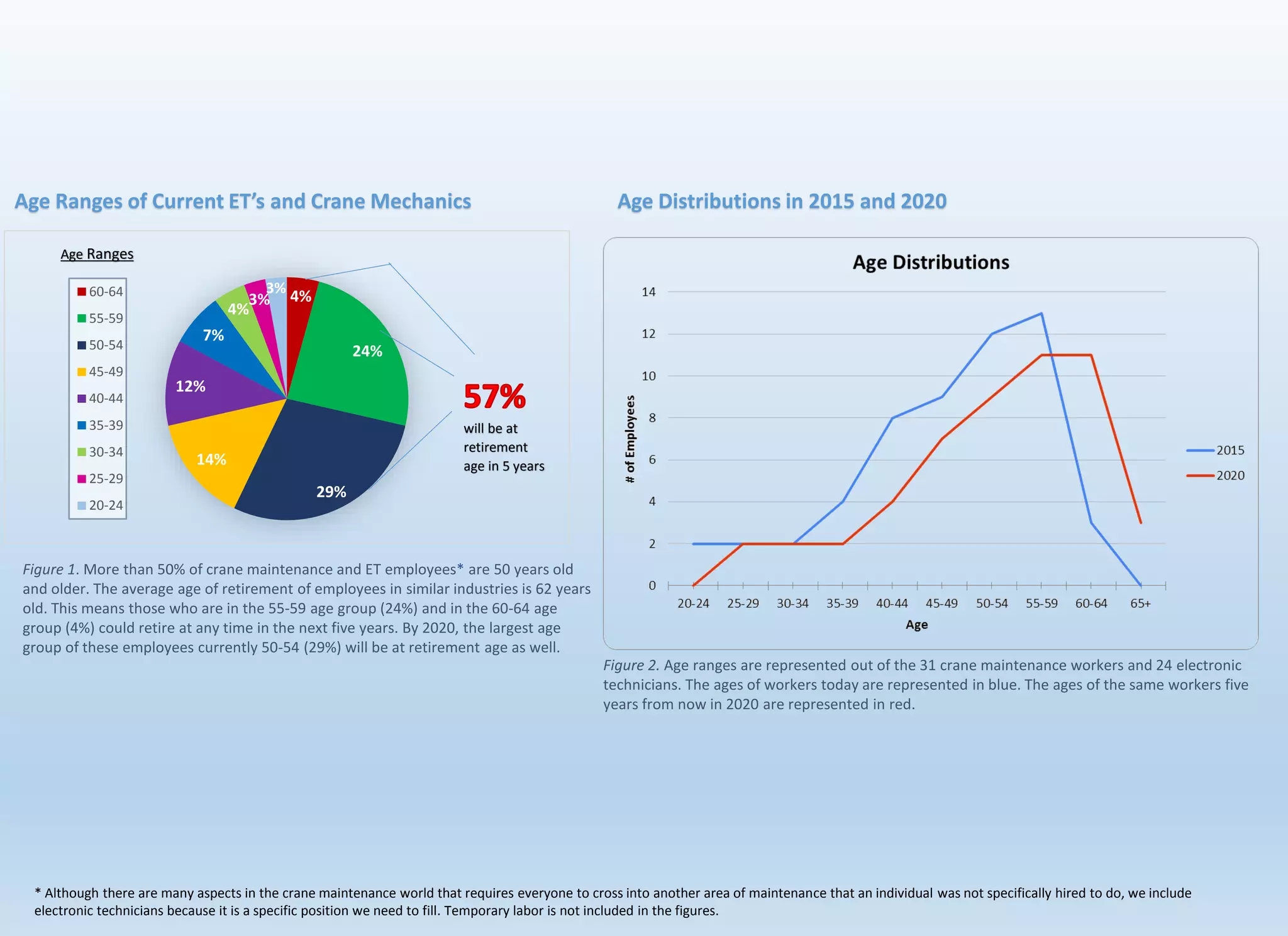
Age Ranges of Current ET’s and Crane Mechanics
4%
24%
29%
14%
12%
7%
4%
3%
3%60-64
55-59
50-54
45-49
40-44
35-39
30-34
25-29
20-24
will be at
retirement
age in 5 years
Age Ranges
Age Distributions in 2015 and 2020
Figure 2. Age ranges are represented out of the 31 crane maintenance workers and 24 electronic
technicians. The ages of workers today are represented in blue. The ages of the same workers five
years from now in 2020 are represented in red.
Figure 1. More than 50% of crane maintenance and ET employees* are 50 years old
and older. The average age of retirement of employees in similar industries is 62 years
old. This means those who are in the 55-59 age group (24%) and in the 60-64 age
group (4%) could retire at any time in the next five years. By 2020, the largest age
group of these employees currently 50-54 (29%) will be at retirement age as well.
* Although there are many aspects in the crane maintenance world that requires everyone to cross into another area of maintenance that an individual was not specifically hired to do, we include
electronic technicians because it is a specific position we need to fill. Temporary labor is not included in the figures.

Training Proposal Overview

  • 1.
    Training Program Proposal:An Overview Workforce Development Options Brenna Supplee HR Intern bsupplee@PortofVirginia.com • With the impending baby boomer generation retiring, there is a large skill set gap that needs to be filled. • There has been a steady decline of the number of mechanics and technicians and VIT’s top-notch people are leaving. • Our goal is to find a workforce hungry for opportunities within our industry, find a way to get them, and find a way to train them to fit in with our workforce. • By revitalizing our recruiting and training strategies we can develop a motivated, highly skilled workforce. • By creating a personalized training program designed to solve our company’s needs, we can increase our competitive edge and become nationally recognized.  Registered Apprenticeship Program  A structured program that combines on-the-job training (OJT) and related technical instruction in order to train employees in occupations that demand a high level of skill.  The program is customized to our industry’s needs.  By signing the Apprenticeship Agreement and following the Minimum Standards of Apprenticeship, our company could be nationally recognized as a Registered Apprenticeship Program  Apprentices would be getting national credentials such as receiving a Certificate of Completion and Journeyworker Card, as well as having the possibility to receive college credit  The average duration is four years.  Additional Benefits:  We can clone our best employees  Apprenticeship can elevate the competencies and motivation of existing employees  No fee to register as a sponsor  Apprenticeship is a recruitment and retention tool giving employers a competitive edge in the marketplace  On-the-Job Training Program  Offers hands-on experience and peer/supervisor mentoring.  Kevin Cotter has already developed curriculums for the Electronic Technician and the Crane Mechanic.  Cooperative Education Program (Co-Op)  Requires the commitment of college students through multiple semesters to alternate working full-time a semester and studying full-time another semester.  This would be the ideal program to satisfy our need for Assistant Operation Managers or related positions.  We could recruit from student organizations such as the Society of Women Engineers or Veteran organizations.  A notable benefit is that we would be tapping into the younger generation and fostering an ongoing relationship with universities across Hampton Roads.  In-House Technical Trainer  Having one or more full-time in-house technical trainers would be useful for ongoing training needs.  If we hire an employee who has had the experience with VIT, they can transfer their company knowledge to the trainee.  We would benefit from having a full-time employee focused on technical training. • From the research I have gathered and the resources I have met with, I would highly recommend developing a customized registered apprenticeship program for POV. • A registered apprenticeship program would enhance our image through its national title and it would give us the ability to recruit applicants who are motivated to learn and develop in our company. • We could develop all of the options mentioned. • By having a registered apprenticeship program it would already consist of on-the-job training. • We could have a co-op on the side in which we recruit university students for other positions such as AOM. • We could have in-house technical trainers to assist with instructing curriculum for apprentices or assist with OJT. I personally had never heard of The Port of Virginia before applying for the internship. When I tell my friends and family about this position, many of them ask me, “Who is that?” After being here for almost 8 weeks, I can’t believe its image is hiding in the shadows. There is so much more to The POV that many people in our area don’t know about. Having this program is one of the many ways to have The POV’s image stand out. Recruiting from universities, community colleges, vocational schools, and career fairs; plus having a promising training program to offer, is going to be a huge step forward for The POV. Training Options RecommendationsProblem Objectives
  • 2.
    Age Ranges ofCurrent ET’s and Crane Mechanics 4% 24% 29% 14% 12% 7% 4% 3% 3%60-64 55-59 50-54 45-49 40-44 35-39 30-34 25-29 20-24 will be at retirement age in 5 years Age Ranges Age Distributions in 2015 and 2020 Figure 2. Age ranges are represented out of the 31 crane maintenance workers and 24 electronic technicians. The ages of workers today are represented in blue. The ages of the same workers five years from now in 2020 are represented in red. Figure 1. More than 50% of crane maintenance and ET employees* are 50 years old and older. The average age of retirement of employees in similar industries is 62 years old. This means those who are in the 55-59 age group (24%) and in the 60-64 age group (4%) could retire at any time in the next five years. By 2020, the largest age group of these employees currently 50-54 (29%) will be at retirement age as well. * Although there are many aspects in the crane maintenance world that requires everyone to cross into another area of maintenance that an individual was not specifically hired to do, we include electronic technicians because it is a specific position we need to fill. Temporary labor is not included in the figures.