OUR
TRAINING APPROACH
Training Models – Level 1 from Balasubramanian
balasubramanianr@outlook.com/8939948971
Doing the Real Thing
Simulating the Real Experience
Doing a Dramatic Presentation
Giving a Talk
Participating in a Discussion
Seeing It Done on Location
Watching a Demonstration
Looking at an Exhibit
Watching a Movie
Looking at Pictures
Hearing Words
Reading
Nature of
Involvement
Passive
Active
Receiving/
Participating
Doing
Visual Receiving
Verbal Receiving
After 2 weeks
we tend to remember...
10% of what we read
20% of what we hear
30% of what we see
50% of what we
hear and see
70% of what
we say
90% of
what we
say and
do
Edgar Dale, Audio-Visual Methods in Teaching (3rd Edn.), Holt, Rinehart, and Winston (1969).
Dale’s Cone Experience
Effective way of Training
 There is no single way to do the training effectively.
 It has to be mix and match based on the maturity level of the
audience (school, colleges and corporates)
 There are several modes of training models/methods available.
 Primarily everything could be put together inside VAK & NLP Models
 The Training has to happen with several considerations:
 Students’ and Teacher’s Personality
 Students’ and Teacher’s Brain Dominance
 Students’ and Teacher’s Learning Style
 Students’ and Teacher’s Intelligences
Models
Training Model Combinations
VAK Model – What is it?
 V-Visual – People who learn Best by Seeing
 A – Auditory – People who learn Best by Hearing
 K – People who learn best by doing or feeling (including touching),
Experiential Learning
Visual
 Use Colors to learn quickly. Hence teacher should use colors while
teaching to make the student understand, bright colors in particular
 Through diagrams, Charts , graphs, pictures and cartoons
 Use Body Languages and facial expressions to teach.
 Usage of flash cards
 Little visual distractions
 Effective with Video CDs and movies
Auditory
 Lots of Lectures, discussions, Seminars, Public speaking, Brain
storming to hear the information
 Requires quite environment
 Can be taught with audio cds
 Music is effective
Kinesthetic
 Requires physical actions to learn or study.
 Requires to feel at times
 Use senses to learn. Hence touch may be effective, particularly for
Children and people with Autism
 Use Body Language & Games
 Avoid monotony
VAK Combination
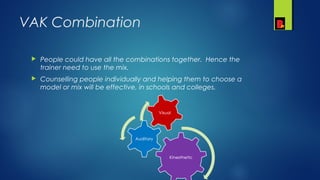
 People could have all the combinations together. Hence the
trainer need to use the mix.
 Counselling people individually and helping them to choose a
model or mix will be effective, in schools and colleges.
NLP – Whats is NLP
 Language is influenced buy the way you perceive the world
and can be used to influence others.
 Neuro-Linguistic Programming is the study of how the
interaction of your brain (NEURO), your language (LINGUISTIC)
and body produces patterns of behavior (PROGRAMMING).
 NLP was devised by Richard Bandler and John Grinder in
1975 and is based on studying people who displayed excellence
in fields including Professional Communication, Psychotherapy,
Hypnosis, Law and Education.
 Understanding the influence of language on the brain allows
you to use it deliberately to communicate more effectively, since people
think in the language they used to communicate. Hence the words and
sentences influences our behavior and actions.
NLP Way
 Our model is updated through our senses. We each take in information
through a natural preferred combination of senses (called modalities) such
as Visual, Auditory, Kinesthetic, Smell and taste.
 Embedded with VAK Model and Dramatization.
 Enhanced teaching
 Observe the body language of the students including their eye accessing
cues and Micro Muscle movement
 Trainer can easily create rapport with the class
 Trainer can change the flow of the topic easily and gets support from the
students
 Easy to coach even a difficult student (including corporate CEO)
 Can be used for better achievement and high performance for the
individuals as well as the group.
Eye Accessing Cues – NLP Way
VISUAL
RECALL
VISUAL
CONSTRUCTED
AUDITORY
DIGITAL
AUDITORY
RECALL
AUDITORY
CONSTRUCTED
KINESTHETIC
Rapport Building – NLP Way
 When people are naturally in rapport with each other
they have the same posture, breathing, etc.
 You can gain rapport rapidly by adopting this state.
 Matching & Pacing
 Body - posture, crossing legs, small changes : blinking.
 Head and Shoulders
 Voice -Tone, speed, volume, intonation
 Words - Visual / Auditory / Kinesthetic
 Facial Expressions
 Gestures - position of hands
 Breathing
Training using Modalities – NLP Way
 When the trainer trains the students, invoking different NLP Modalities to
make the students to learn it quickly and the learning permanent.
 The trainer can create scenarios involving the five senses with the
dramatization will make the learner to remember the course for longer
period, even for 30 or 40 years.
 The trainer can include some power words like positive phrases or highly
negative phrases (with caution), which will make the unconscious mind
to react and make the learning to be retained at the unconscious level.
 Using Associative conditioning like narrating an incident or a story and
associate the training subject like leadership skills will make the learner
to remember the story and the corresponding subject for the longer
duration. The learner will recollect the story whenever he faces the
situation and will be able to react accordingly as what is taught in the
particular situation
Dramatization
 Dramatization will help people to learn quickly. Dramatization technique like role
play, games, story telling with extroverted body language, animated voice will
make the receiver to learn quickly.
 Our Indian culture is surviving for ages because of the Epic stories like Ramayana
and Mahabharata, which contains heavy subjects like administration, law,
judgement, moral, Human Values and Relationships, etc.
 Helps the class to be more active ,filled with fun and vibrant.
 Helps to win the audience and make them very happy. If exercised properly, will
win lot of new customers.
 Can be used in many place like schools, colleges and corporates.
 Most of the people loves to hear stories and play games. Hence a quick success
 To be exercised with caution since introverts may object to certain stories and
games.
Technology Based Training
 Recent developments in education industry has changed the way the
training is done.
 The classes could be conducted through webinar. No requirement for
the trainer to travel.
 One trainer can take the session through webinar to multiple
organizations.
 Video based training session can be used. In this case, training cd
which is already available in the market with the particular role play
scenario like Negotiation skills can be played. The trainer need not be
an expert in the field. He can just organize the session instead of doing
the entire training. Hence, even a novice trainer can be used for
training.
 3D Multimedia based cartoon character also can be used in the session
which conducts the entire session and the trainer is only an organizer.
Market Focus
Training for Educational Institutions
 Schools
 For Students (Duration can be from 4 Hrs to 5 days)
 Workshops on social etiquette’s
 Workshop on interpersonal skills
 Workshop on Stress Management for Exams (NLP Way)
 Workshop on achieving peak performance (NLP Way)
 Workshop on Confidence Building
 Workshop on Future Adult
 Technology Workshops (Computers & Software like MS Office, Database, Cloud, etc.)
 For Teachers
 Image Management
 Etiquettes
 Soft Skills
 Rapport Building
 Teaching through Technology
 Interpersonal Skills
 Stress Management
 Focus and Concentration
Training for Educational Institutions
 Colleges
 For Students (Duration can be from 1 Day to 5 days)
 Social etiquette’s
 Interpersonal skills
 Stress Management for Exams (NLP Way)
 Achieving peak performance (NLP Way)
 Confidence Building
 Corporate Culture, Interview Schools & Importance of Goals & Achievement of Goals
 Technology Workshops (Computers & Software like MS Office, Database, Cloud, etc.)
 Career Skills
 Future Leaders (Leadership Workshops)
Training for Educational Institutions
 Colleges
 For Teachers
 Image Management
 Etiquettes
 Soft Skills
 Rapport Building
 Teaching through Technology
 Interpersonal Skills
 Stress Management
 Focus and Concentration
 Leadership in Educational Institution
 NLP for Training Excellence ( 3 Day workshop)
Training for Educational Institutions
 Colleges
 For Teachers
 Image Management
 Etiquettes
 Soft Skills
 Rapport Building
 Teaching through Technology
 Interpersonal Skills
 Stress Management
 Focus and Concentration
Training for Offices
 Government & NGO
 Image Management
 Business Etiquettes
 interpersonal skills
 Stress Management for Exams (NLP Way)
 Achieving peak performance (NLP Way)
 Confidence Building
 Technology Workshops (Computers & Software like MS Office, Database, Cloud,
etc.)
 Customer Engagement
 Self Motivation
 Leadership Skills
 Life Skills
Training for Offices - COntinued
 For Corporates ( 1 day Workshop)
 What is your Image Quotient? (Workshop on Image Management
 Business Etiquettes
 Soft Skills
 Rapport Building for Sales, Business Excellence
 Interpersonal Skills
 Stress Management
 Focus and Concentration
 Self Motivation
 Team Motivation
 Team Work
 Interview Skills
 Crisis Management
 Positive Mind set
 Engaging Customer
 Achieving Goal
 Leadership Coaching
 Executive Coaching
Benefits
 Even though there are several models available in this world, this
model would take care even of the complex training requirements
 Since the model believes in the experiential learning also, the
contents of the session can be retained by the students for longer
duration and can transform the students.
 Since there is a positive impact on the students, the sessions will be
more valued in the market.
 This model can be used in schools, colleges or workplace of any
sort.
 Can make the students glued to the program and induce high level
of popularity.
Thank You.

Training approach

  • 1.
    OUR TRAINING APPROACH Training Models– Level 1 from Balasubramanian balasubramanianr@outlook.com/8939948971
  • 2.
    Doing the RealThing Simulating the Real Experience Doing a Dramatic Presentation Giving a Talk Participating in a Discussion Seeing It Done on Location Watching a Demonstration Looking at an Exhibit Watching a Movie Looking at Pictures Hearing Words Reading Nature of Involvement Passive Active Receiving/ Participating Doing Visual Receiving Verbal Receiving After 2 weeks we tend to remember... 10% of what we read 20% of what we hear 30% of what we see 50% of what we hear and see 70% of what we say 90% of what we say and do Edgar Dale, Audio-Visual Methods in Teaching (3rd Edn.), Holt, Rinehart, and Winston (1969). Dale’s Cone Experience
  • 3.
    Effective way ofTraining  There is no single way to do the training effectively.  It has to be mix and match based on the maturity level of the audience (school, colleges and corporates)  There are several modes of training models/methods available.  Primarily everything could be put together inside VAK & NLP Models  The Training has to happen with several considerations:  Students’ and Teacher’s Personality  Students’ and Teacher’s Brain Dominance  Students’ and Teacher’s Learning Style  Students’ and Teacher’s Intelligences
  • 4.
  • 5.
  • 6.
    VAK Model –What is it?  V-Visual – People who learn Best by Seeing  A – Auditory – People who learn Best by Hearing  K – People who learn best by doing or feeling (including touching), Experiential Learning
  • 7.
    Visual  Use Colorsto learn quickly. Hence teacher should use colors while teaching to make the student understand, bright colors in particular  Through diagrams, Charts , graphs, pictures and cartoons  Use Body Languages and facial expressions to teach.  Usage of flash cards  Little visual distractions  Effective with Video CDs and movies
  • 8.
    Auditory  Lots ofLectures, discussions, Seminars, Public speaking, Brain storming to hear the information  Requires quite environment  Can be taught with audio cds  Music is effective
  • 9.
    Kinesthetic  Requires physicalactions to learn or study.  Requires to feel at times  Use senses to learn. Hence touch may be effective, particularly for Children and people with Autism  Use Body Language & Games  Avoid monotony
  • 10.
    VAK Combination  Peoplecould have all the combinations together. Hence the trainer need to use the mix.  Counselling people individually and helping them to choose a model or mix will be effective, in schools and colleges.
  • 11.
    NLP – Whatsis NLP  Language is influenced buy the way you perceive the world and can be used to influence others.  Neuro-Linguistic Programming is the study of how the interaction of your brain (NEURO), your language (LINGUISTIC) and body produces patterns of behavior (PROGRAMMING).  NLP was devised by Richard Bandler and John Grinder in 1975 and is based on studying people who displayed excellence in fields including Professional Communication, Psychotherapy, Hypnosis, Law and Education.  Understanding the influence of language on the brain allows you to use it deliberately to communicate more effectively, since people think in the language they used to communicate. Hence the words and sentences influences our behavior and actions.
  • 12.
    NLP Way  Ourmodel is updated through our senses. We each take in information through a natural preferred combination of senses (called modalities) such as Visual, Auditory, Kinesthetic, Smell and taste.  Embedded with VAK Model and Dramatization.  Enhanced teaching  Observe the body language of the students including their eye accessing cues and Micro Muscle movement  Trainer can easily create rapport with the class  Trainer can change the flow of the topic easily and gets support from the students  Easy to coach even a difficult student (including corporate CEO)  Can be used for better achievement and high performance for the individuals as well as the group.
  • 13.
    Eye Accessing Cues– NLP Way VISUAL RECALL VISUAL CONSTRUCTED AUDITORY DIGITAL AUDITORY RECALL AUDITORY CONSTRUCTED KINESTHETIC
  • 14.
    Rapport Building –NLP Way  When people are naturally in rapport with each other they have the same posture, breathing, etc.  You can gain rapport rapidly by adopting this state.  Matching & Pacing  Body - posture, crossing legs, small changes : blinking.  Head and Shoulders  Voice -Tone, speed, volume, intonation  Words - Visual / Auditory / Kinesthetic  Facial Expressions  Gestures - position of hands  Breathing
  • 15.
    Training using Modalities– NLP Way  When the trainer trains the students, invoking different NLP Modalities to make the students to learn it quickly and the learning permanent.  The trainer can create scenarios involving the five senses with the dramatization will make the learner to remember the course for longer period, even for 30 or 40 years.  The trainer can include some power words like positive phrases or highly negative phrases (with caution), which will make the unconscious mind to react and make the learning to be retained at the unconscious level.  Using Associative conditioning like narrating an incident or a story and associate the training subject like leadership skills will make the learner to remember the story and the corresponding subject for the longer duration. The learner will recollect the story whenever he faces the situation and will be able to react accordingly as what is taught in the particular situation
  • 16.
    Dramatization  Dramatization willhelp people to learn quickly. Dramatization technique like role play, games, story telling with extroverted body language, animated voice will make the receiver to learn quickly.  Our Indian culture is surviving for ages because of the Epic stories like Ramayana and Mahabharata, which contains heavy subjects like administration, law, judgement, moral, Human Values and Relationships, etc.  Helps the class to be more active ,filled with fun and vibrant.  Helps to win the audience and make them very happy. If exercised properly, will win lot of new customers.  Can be used in many place like schools, colleges and corporates.  Most of the people loves to hear stories and play games. Hence a quick success  To be exercised with caution since introverts may object to certain stories and games.
  • 17.
    Technology Based Training Recent developments in education industry has changed the way the training is done.  The classes could be conducted through webinar. No requirement for the trainer to travel.  One trainer can take the session through webinar to multiple organizations.  Video based training session can be used. In this case, training cd which is already available in the market with the particular role play scenario like Negotiation skills can be played. The trainer need not be an expert in the field. He can just organize the session instead of doing the entire training. Hence, even a novice trainer can be used for training.  3D Multimedia based cartoon character also can be used in the session which conducts the entire session and the trainer is only an organizer.
  • 18.
  • 19.
    Training for EducationalInstitutions  Schools  For Students (Duration can be from 4 Hrs to 5 days)  Workshops on social etiquette’s  Workshop on interpersonal skills  Workshop on Stress Management for Exams (NLP Way)  Workshop on achieving peak performance (NLP Way)  Workshop on Confidence Building  Workshop on Future Adult  Technology Workshops (Computers & Software like MS Office, Database, Cloud, etc.)  For Teachers  Image Management  Etiquettes  Soft Skills  Rapport Building  Teaching through Technology  Interpersonal Skills  Stress Management  Focus and Concentration
  • 20.
    Training for EducationalInstitutions  Colleges  For Students (Duration can be from 1 Day to 5 days)  Social etiquette’s  Interpersonal skills  Stress Management for Exams (NLP Way)  Achieving peak performance (NLP Way)  Confidence Building  Corporate Culture, Interview Schools & Importance of Goals & Achievement of Goals  Technology Workshops (Computers & Software like MS Office, Database, Cloud, etc.)  Career Skills  Future Leaders (Leadership Workshops)
  • 21.
    Training for EducationalInstitutions  Colleges  For Teachers  Image Management  Etiquettes  Soft Skills  Rapport Building  Teaching through Technology  Interpersonal Skills  Stress Management  Focus and Concentration  Leadership in Educational Institution  NLP for Training Excellence ( 3 Day workshop)
  • 22.
    Training for EducationalInstitutions  Colleges  For Teachers  Image Management  Etiquettes  Soft Skills  Rapport Building  Teaching through Technology  Interpersonal Skills  Stress Management  Focus and Concentration
  • 23.
    Training for Offices Government & NGO  Image Management  Business Etiquettes  interpersonal skills  Stress Management for Exams (NLP Way)  Achieving peak performance (NLP Way)  Confidence Building  Technology Workshops (Computers & Software like MS Office, Database, Cloud, etc.)  Customer Engagement  Self Motivation  Leadership Skills  Life Skills
  • 24.
    Training for Offices- COntinued  For Corporates ( 1 day Workshop)  What is your Image Quotient? (Workshop on Image Management  Business Etiquettes  Soft Skills  Rapport Building for Sales, Business Excellence  Interpersonal Skills  Stress Management  Focus and Concentration  Self Motivation  Team Motivation  Team Work  Interview Skills  Crisis Management  Positive Mind set  Engaging Customer  Achieving Goal  Leadership Coaching  Executive Coaching
  • 25.
    Benefits  Even thoughthere are several models available in this world, this model would take care even of the complex training requirements  Since the model believes in the experiential learning also, the contents of the session can be retained by the students for longer duration and can transform the students.  Since there is a positive impact on the students, the sessions will be more valued in the market.  This model can be used in schools, colleges or workplace of any sort.  Can make the students glued to the program and induce high level of popularity.
  • 26.