
REGIONAL CONFERENCE
TRAIN THE TRAINERS
INTRODUCTION
TRAM TRAN
Danang | 12th -13th 2014
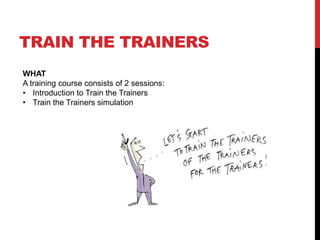
TRAIN THE TRAINERS
WHAT
A training course consists of 2 sessions:
• Introduction to Train the Trainers
• Train the Trainers simulation
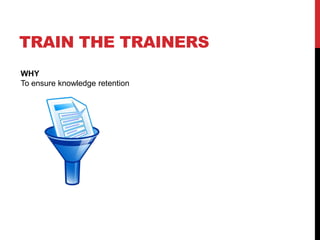
TRAIN THE TRAINERS
WHY
To ensure knowledge retention
Let's clarify some
terms first!
TRAINER VS. FACILITATOR. PRESENTER
What is the difference?
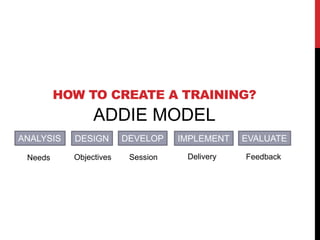
HOW TO CREATE A TRAINING?
ADDIE MODEL
ANALYSIS DESIGN DEVELOP IMPLEMENT EVALUATE
Needs Objectives Session Delivery Feedback
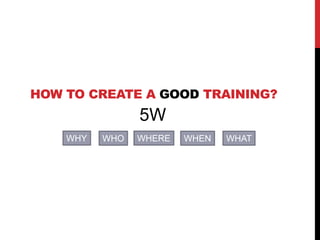
HOW TO CREATE A GOOD TRAINING?
5W
WHY WHO WHERE WHEN WHAT
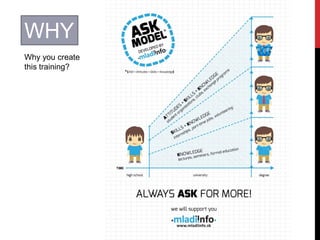
WHY
Why you create
this training?
WHO
Who you create
the training for?
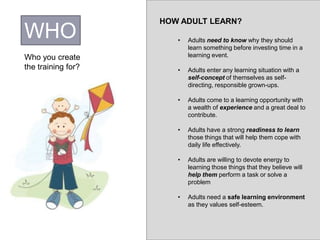
HOW ADULT LEARN?
• Adults need to know why they should
learn something before investing time in a
learning event.
• Adults enter any learning situation with a
self-concept of themselves as self-
directing, responsible grown-ups.
• Adults come to a learning opportunity with
a wealth of experience and a great deal to
contribute.
• Adults have a strong readiness to learn
those things that will help them cope with
daily life effectively.
• Adults are willing to devote energy to
learning those things that they believe will
help them perform a task or solve a
problem
• Adults need a safe learning environment
as they values self-esteem.
WHO
Who you create
the training for?
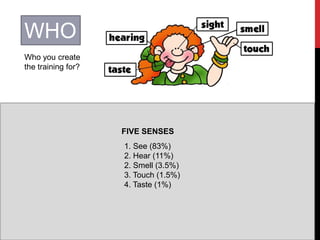
FIVE SENSES
1. See (83%)
2. Hear (11%)
2. Smell (3.5%)
3. Touch (1.5%)
4. Taste (1%)
WHO
Who you create
the training for?
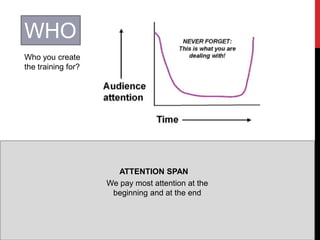
ATTENTION SPAN
We pay most attention at the
beginning and at the end
WHO
Who you create
the training for?
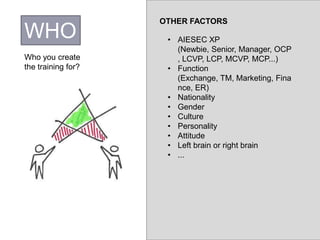
OTHER FACTORS
• AIESEC XP
(Newbie, Senior, Manager, OCP
, LCVP, LCP, MCVP, MCP...)
• Function
(Exchange, TM, Marketing, Fina
nce, ER)
• Nationality
• Gender
• Culture
• Personality
• Attitude
• Left brain or right brain
• ...
WHO
Who you create
the training for?
GROUP DYNAMICS
What types of
groups/individuals are there
in a session?
WHO
Who you create
the training for?
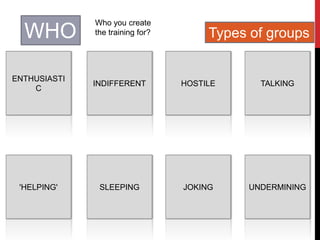
ENTHUSIASTI
C
Types of groups
TALKINGHOSTILEINDIFFERENT
'HELPING' UNDERMININGJOKINGSLEEPING
WHO
Who you create
the training for?
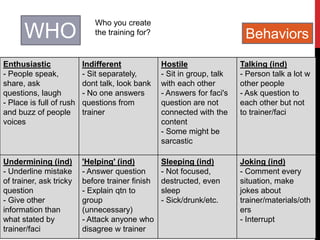
Enthusiastic
- People speak,
share, ask
questions, laugh
- Place is full of rush
and buzz of people
voices
Indifferent
- Sit separately,
dont talk, look bank
- No one answers
questions from
trainer
Hostile
- Sit in group, talk
with each other
- Answers for faci's
question are not
connected with the
content
- Some might be
sarcastic
Talking (ind)
- Person talk a lot w
other people
- Ask question to
each other but not
to trainer/faci
Undermining (ind)
- Underline mistake
of trainer, ask tricky
question
- Give other
information than
what stated by
trainer/faci
'Helping' (ind)
- Answer question
before trainer finish
- Explain qtn to
group
(unnecessary)
- Attack anyone who
disagree w trainer
Sleeping (ind)
- Not focused,
destructed, even
sleep
- Sick/drunk/etc.
Joking (ind)
- Comment every
situation, make
jokes about
trainer/materials/oth
ers
- Interrupt
Behaviors
WHO
Who you create
the training for?
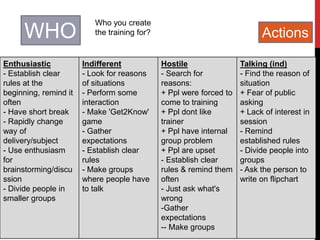
Enthusiastic
- Establish clear
rules at the
beginning, remind it
often
- Have short break
- Rapidly change
way of
delivery/subject
- Use enthusiasm
for
brainstorming/discu
ssion
- Divide people in
smaller groups
Indifferent
- Look for reasons
of situations
- Perform some
interaction
- Make 'Get2Know'
game
- Gather
expectations
- Establish clear
rules
- Make groups
where people have
to talk
Hostile
- Search for
reasons:
+ Ppl were forced to
come to training
+ Ppl dont like
trainer
+ Ppl have internal
group problem
+ Ppl are upset
- Establish clear
rules & remind them
often
- Just ask what's
wrong
-Gather
expectations
-- Make groups
Talking (ind)
- Find the reason of
situation
+ Fear of public
asking
+ Lack of interest in
session
- Remind
established rules
- Divide people into
groups
- Ask the person to
write on flipchart
Actions
WHO
Who you create
the training for?
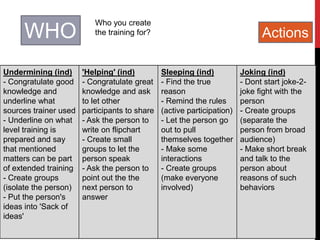
Undermining (ind)
- Congratulate good
knowledge and
underline what
sources trainer used
- Underline on what
level training is
prepared and say
that mentioned
matters can be part
of extended training
- Create groups
(isolate the person)
- Put the person's
ideas into 'Sack of
ideas'
'Helping' (ind)
- Congratulate great
knowledge and ask
to let other
participants to share
- Ask the person to
write on flipchart
- Create small
groups to let the
person speak
- Ask the person to
point out the the
next person to
answer
Sleeping (ind)
- Find the true
reason
- Remind the rules
(active participation)
- Let the person go
out to pull
themselves together
- Make some
interactions
- Create groups
(make everyone
involved)
Joking (ind)
- Dont start joke-2-
joke fight with the
person
- Create groups
(separate the
person from broad
audience)
- Make short break
and talk to the
person about
reasons of such
behaviors
Actions
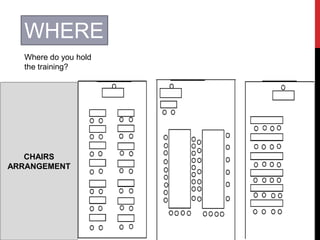
WHERE
Where do you hold
the training?
CHAIRS
ARRANGEMENT
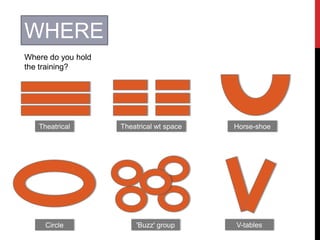
WHERE
Where do you hold
the training?
Theatrical Theatrical wt space Horse-shoe
Circle 'Buzz' group V-tables
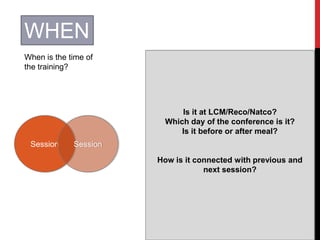
WHEN
When is the time of
the training?
Is it at LCM/Reco/Natco?
Which day of the conference is it?
Is it before or after meal?
How is it connected with previous and
next session?
Session Session
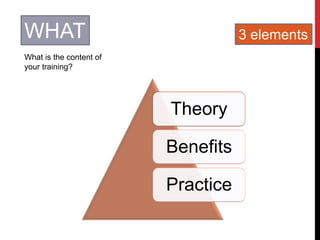
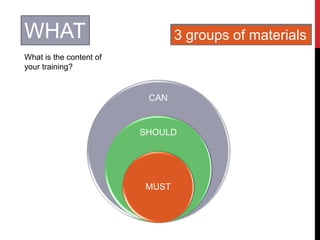
WHAT
What is the content of
your training?
Theory
Benefits
Practice
3 elements
WHAT
What is the content of
your training?
3 groups of materials
CAN
SHOULD
MUST
HOW TO CREATE AN EVEN BETTER TRAINING?
Presenter like a Pro
WHAT THEY HEAR WHAT THEY SEE
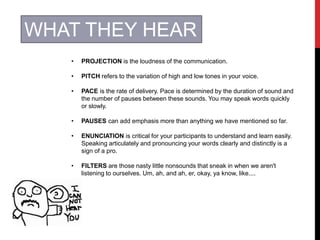
WHAT THEY HEAR
• PROJECTION is the loudness of the communication.
• PITCH refers to the variation of high and low tones in your voice.
• PACE is the rate of delivery. Pace is determined by the duration of sound and
the number of pauses between these sounds. You may speak words quickly
or slowly.
• PAUSES can add emphasis more than anything we have mentioned so far.
• ENUNCIATION is critical for your participants to understand and learn easily.
Speaking articulately and pronouncing your words clearly and distinctly is a
sign of a pro.
• FILTERS are those nasty little nonsounds that sneak in when we aren't
listening to ourselves. Um, ah, and ah, er, okay, ya know, like....
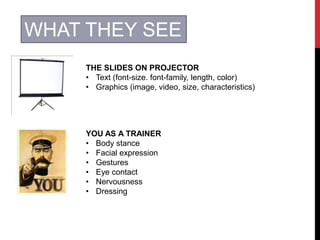
WHAT THEY SEE
THE SLIDES ON PROJECTOR
• Text (font-size. font-family, length, color)
• Graphics (image, video, size, characteristics)
YOU AS A TRAINER
• Body stance
• Facial expression
• Gestures
• Eye contact
• Nervousness
• Dressing
WHAT'S NEXT?
Train The Trainers Simulation

Train The Trainer

  • 1.
    REGIONAL CONFERENCE TRAIN THETRAINERS INTRODUCTION TRAM TRAN Danang | 12th -13th 2014
  • 2.
    TRAIN THE TRAINERS WHAT Atraining course consists of 2 sessions: • Introduction to Train the Trainers • Train the Trainers simulation
  • 3.
    TRAIN THE TRAINERS WHY Toensure knowledge retention
  • 4.
  • 5.
    TRAINER VS. FACILITATOR.PRESENTER What is the difference?
  • 6.
    HOW TO CREATEA TRAINING? ADDIE MODEL ANALYSIS DESIGN DEVELOP IMPLEMENT EVALUATE Needs Objectives Session Delivery Feedback
  • 7.
    HOW TO CREATEA GOOD TRAINING? 5W WHY WHO WHERE WHEN WHAT
  • 8.
  • 9.
    WHO Who you create thetraining for? HOW ADULT LEARN? • Adults need to know why they should learn something before investing time in a learning event. • Adults enter any learning situation with a self-concept of themselves as self- directing, responsible grown-ups. • Adults come to a learning opportunity with a wealth of experience and a great deal to contribute. • Adults have a strong readiness to learn those things that will help them cope with daily life effectively. • Adults are willing to devote energy to learning those things that they believe will help them perform a task or solve a problem • Adults need a safe learning environment as they values self-esteem.
  • 10.
    WHO Who you create thetraining for? FIVE SENSES 1. See (83%) 2. Hear (11%) 2. Smell (3.5%) 3. Touch (1.5%) 4. Taste (1%)
  • 11.
    WHO Who you create thetraining for? ATTENTION SPAN We pay most attention at the beginning and at the end
  • 12.
    WHO Who you create thetraining for? OTHER FACTORS • AIESEC XP (Newbie, Senior, Manager, OCP , LCVP, LCP, MCVP, MCP...) • Function (Exchange, TM, Marketing, Fina nce, ER) • Nationality • Gender • Culture • Personality • Attitude • Left brain or right brain • ...
  • 13.
    WHO Who you create thetraining for? GROUP DYNAMICS What types of groups/individuals are there in a session?
  • 14.
    WHO Who you create thetraining for? ENTHUSIASTI C Types of groups TALKINGHOSTILEINDIFFERENT 'HELPING' UNDERMININGJOKINGSLEEPING
  • 15.
    WHO Who you create thetraining for? Enthusiastic - People speak, share, ask questions, laugh - Place is full of rush and buzz of people voices Indifferent - Sit separately, dont talk, look bank - No one answers questions from trainer Hostile - Sit in group, talk with each other - Answers for faci's question are not connected with the content - Some might be sarcastic Talking (ind) - Person talk a lot w other people - Ask question to each other but not to trainer/faci Undermining (ind) - Underline mistake of trainer, ask tricky question - Give other information than what stated by trainer/faci 'Helping' (ind) - Answer question before trainer finish - Explain qtn to group (unnecessary) - Attack anyone who disagree w trainer Sleeping (ind) - Not focused, destructed, even sleep - Sick/drunk/etc. Joking (ind) - Comment every situation, make jokes about trainer/materials/oth ers - Interrupt Behaviors
  • 16.
    WHO Who you create thetraining for? Enthusiastic - Establish clear rules at the beginning, remind it often - Have short break - Rapidly change way of delivery/subject - Use enthusiasm for brainstorming/discu ssion - Divide people in smaller groups Indifferent - Look for reasons of situations - Perform some interaction - Make 'Get2Know' game - Gather expectations - Establish clear rules - Make groups where people have to talk Hostile - Search for reasons: + Ppl were forced to come to training + Ppl dont like trainer + Ppl have internal group problem + Ppl are upset - Establish clear rules & remind them often - Just ask what's wrong -Gather expectations -- Make groups Talking (ind) - Find the reason of situation + Fear of public asking + Lack of interest in session - Remind established rules - Divide people into groups - Ask the person to write on flipchart Actions
  • 17.
    WHO Who you create thetraining for? Undermining (ind) - Congratulate good knowledge and underline what sources trainer used - Underline on what level training is prepared and say that mentioned matters can be part of extended training - Create groups (isolate the person) - Put the person's ideas into 'Sack of ideas' 'Helping' (ind) - Congratulate great knowledge and ask to let other participants to share - Ask the person to write on flipchart - Create small groups to let the person speak - Ask the person to point out the the next person to answer Sleeping (ind) - Find the true reason - Remind the rules (active participation) - Let the person go out to pull themselves together - Make some interactions - Create groups (make everyone involved) Joking (ind) - Dont start joke-2- joke fight with the person - Create groups (separate the person from broad audience) - Make short break and talk to the person about reasons of such behaviors Actions
  • 18.
    WHERE Where do youhold the training? CHAIRS ARRANGEMENT
  • 19.
    WHERE Where do youhold the training? Theatrical Theatrical wt space Horse-shoe Circle 'Buzz' group V-tables
  • 20.
    WHEN When is thetime of the training? Is it at LCM/Reco/Natco? Which day of the conference is it? Is it before or after meal? How is it connected with previous and next session? Session Session
  • 21.
    WHAT What is thecontent of your training? Theory Benefits Practice 3 elements
  • 22.
    WHAT What is thecontent of your training? 3 groups of materials CAN SHOULD MUST
  • 23.
    HOW TO CREATEAN EVEN BETTER TRAINING? Presenter like a Pro WHAT THEY HEAR WHAT THEY SEE
  • 24.
    WHAT THEY HEAR •PROJECTION is the loudness of the communication. • PITCH refers to the variation of high and low tones in your voice. • PACE is the rate of delivery. Pace is determined by the duration of sound and the number of pauses between these sounds. You may speak words quickly or slowly. • PAUSES can add emphasis more than anything we have mentioned so far. • ENUNCIATION is critical for your participants to understand and learn easily. Speaking articulately and pronouncing your words clearly and distinctly is a sign of a pro. • FILTERS are those nasty little nonsounds that sneak in when we aren't listening to ourselves. Um, ah, and ah, er, okay, ya know, like....
  • 25.
    WHAT THEY SEE THESLIDES ON PROJECTOR • Text (font-size. font-family, length, color) • Graphics (image, video, size, characteristics) YOU AS A TRAINER • Body stance • Facial expression • Gestures • Eye contact • Nervousness • Dressing
  • 26.
    WHAT'S NEXT? Train TheTrainers Simulation