Trailer Exhibition Research
Emma Marshall
Purpose?
The purpose of a trailer is to give an introduction to the
characters, themes and story of a film.
How and where can audiences watch them? What
platforms are used?
Audiences can watch trailers online and on social
networking sites. For example, on Facebook, Twitter or
YouTube. They are also available to watch on TV during
ad breaks or during the adverts before a film at the
cinema.
How do audiences engage with trailers?
Audiences can engage with trailers by sharing
them amongst friends and people they know
(largely on social media). Trailers will usually
have their social networking at the end, allowing
for the audience to find them online, discover
more information and interact with them.
Are there relationships between exhibition platforms for
trailers and their audience?
For films which are targeted at children, the trailers are
more likely to appear on TV on children’s channels or during
the ads during children-friendly shows. In the cinema, they
would be shown before films rated U or PG.
Films targeting more teenagers and adults would appear a
lot more on social media, for example on Facebook and
Twitter. The trailers for films targeted at this audience are
going to appear before 12A, 15 and 18 rated films at the
cinema. As well as this, you might see them during the ad
breaks on TV after children’s TV has come to an end.
(Usually past 9pm).
How do institutions
encourage audiences to
‘investigate’ and find out
more about a film’s details?
Again, this is done largely
through social media, by
placing their social
networking at the end of the
trailer. Often, institutions will
hold competitions, draws and
games on their websites and
their social networking to
encourage audiences to
engage more. This also leads
to more talk and ‘hype’ about
the film itself.
Explain the role of social media for film trailers…
Social media can be an amazing way of advertisement for a
film. By uploading a trailer to YouTube or Vimeo, it can be
easily shared with the entire world at a click of a button.
This is a great advantage of social media for the promotion
of trailers as it can be distributed to a wider audience (a
mass audience). It’s also a brilliant way to get the audience
to interact with the institution and the film.
However, there are disadvantages too. For example, it
becomes a lot easier for criticism to be given to a trailer.
Some people could be discouraged to watch a film if the
trailer got a bad review on ‘Rotten Tomatoes’ or if they read
something negative online. Also, not everybody uses social
media, so you are still not capturing everyone.
If trailers could not be accessed by social media, what
impact would this have on audiences and institutions?
Overall, this would have a negative impact, as although
there are disadvantages to using social media, the
advantaged outweigh them. The product, in this case a
trailer, wouldn’t be able to reach a global audience as
easily. Also, audiences would be a lot less likely to
engage with the film and the institution, therefore,
affecting them negatively. They would become reliant
on audience’s promotion via word of mouth, which is
not always a reliable way of promotion at all.
Has trailer exhibition changed much over time?
Trailer exhibition has changed hugely!
There is much more access to trailers now, through
cinema, home, and even on the go (like on tablets and
mobiles). Before, exhibition was a lot more limited,
only using platforms such as TV and in the actual
cinema itself.
Now that social media exists and it is a huge part of
most people’s lives, the change in exhibition has made
it a lot easier for audiences to access them any time
and anywhere.
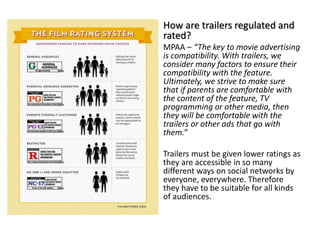
How are trailers regulated and
rated?
MPAA – “The key to movie advertising
is compatibility. With trailers, we
consider many factors to ensure their
compatibility with the feature.
Ultimately, we strive to make sure
that if parents are comfortable with
the content of the feature, TV
programming or other media, then
they will be comfortable with the
trailers or other ads that go with
them.”
Trailers must be given lower ratings as
they are accessible in so many
different ways on social networks by
everyone, everywhere. Therefore
they have to be suitable for all kinds
of audiences.
Does the rating of a film trailer affect audiences?
Yes, the rating may affect a range of audiences. Certain
groups of people may find one thing inappropriate to
show, while others may think it perfectly fine .
This can be negative and positive. Minority groups
might be against homosexuality for example, and
would not want any images of homosexuality to not be
seen, or not to be seen by their children for example at
a young age.
On the other hand, it can allow children to not be
exposed to dangerous things such as violence.

Trailer exhibition research

  • 1.
  • 2.
    Purpose? The purpose ofa trailer is to give an introduction to the characters, themes and story of a film. How and where can audiences watch them? What platforms are used? Audiences can watch trailers online and on social networking sites. For example, on Facebook, Twitter or YouTube. They are also available to watch on TV during ad breaks or during the adverts before a film at the cinema.
  • 3.
    How do audiencesengage with trailers? Audiences can engage with trailers by sharing them amongst friends and people they know (largely on social media). Trailers will usually have their social networking at the end, allowing for the audience to find them online, discover more information and interact with them.
  • 4.
    Are there relationshipsbetween exhibition platforms for trailers and their audience? For films which are targeted at children, the trailers are more likely to appear on TV on children’s channels or during the ads during children-friendly shows. In the cinema, they would be shown before films rated U or PG. Films targeting more teenagers and adults would appear a lot more on social media, for example on Facebook and Twitter. The trailers for films targeted at this audience are going to appear before 12A, 15 and 18 rated films at the cinema. As well as this, you might see them during the ad breaks on TV after children’s TV has come to an end. (Usually past 9pm).
  • 5.
    How do institutions encourageaudiences to ‘investigate’ and find out more about a film’s details? Again, this is done largely through social media, by placing their social networking at the end of the trailer. Often, institutions will hold competitions, draws and games on their websites and their social networking to encourage audiences to engage more. This also leads to more talk and ‘hype’ about the film itself.
  • 6.
    Explain the roleof social media for film trailers… Social media can be an amazing way of advertisement for a film. By uploading a trailer to YouTube or Vimeo, it can be easily shared with the entire world at a click of a button. This is a great advantage of social media for the promotion of trailers as it can be distributed to a wider audience (a mass audience). It’s also a brilliant way to get the audience to interact with the institution and the film. However, there are disadvantages too. For example, it becomes a lot easier for criticism to be given to a trailer. Some people could be discouraged to watch a film if the trailer got a bad review on ‘Rotten Tomatoes’ or if they read something negative online. Also, not everybody uses social media, so you are still not capturing everyone.
  • 7.
    If trailers couldnot be accessed by social media, what impact would this have on audiences and institutions? Overall, this would have a negative impact, as although there are disadvantages to using social media, the advantaged outweigh them. The product, in this case a trailer, wouldn’t be able to reach a global audience as easily. Also, audiences would be a lot less likely to engage with the film and the institution, therefore, affecting them negatively. They would become reliant on audience’s promotion via word of mouth, which is not always a reliable way of promotion at all.
  • 8.
    Has trailer exhibitionchanged much over time? Trailer exhibition has changed hugely! There is much more access to trailers now, through cinema, home, and even on the go (like on tablets and mobiles). Before, exhibition was a lot more limited, only using platforms such as TV and in the actual cinema itself. Now that social media exists and it is a huge part of most people’s lives, the change in exhibition has made it a lot easier for audiences to access them any time and anywhere.
  • 9.
    How are trailersregulated and rated? MPAA – “The key to movie advertising is compatibility. With trailers, we consider many factors to ensure their compatibility with the feature. Ultimately, we strive to make sure that if parents are comfortable with the content of the feature, TV programming or other media, then they will be comfortable with the trailers or other ads that go with them.” Trailers must be given lower ratings as they are accessible in so many different ways on social networks by everyone, everywhere. Therefore they have to be suitable for all kinds of audiences.
  • 10.
    Does the ratingof a film trailer affect audiences? Yes, the rating may affect a range of audiences. Certain groups of people may find one thing inappropriate to show, while others may think it perfectly fine . This can be negative and positive. Minority groups might be against homosexuality for example, and would not want any images of homosexuality to not be seen, or not to be seen by their children for example at a young age. On the other hand, it can allow children to not be exposed to dangerous things such as violence.