Features of a trailer
Why is it important for a trailer to show us the
     genre and how is this established?

 When an audience go to the cinema and see a collection of trailers
 feeds them information about the film, who the main stars are, the
 narrative, and what type of genre it is. The genre is what the
 audience “decode” from watching it themselves, this involves
 seeing celebrities that are commonly known for their continuously
 appearance in a specific genre eg: jack black in comical films, this is
 backed up with the bright lighting, the friendly atmosphere and
 bright visual colours, these are all examples of conventions that are
 thought about depending on what genre the film is. Genre is an
 important key in film marketing as it targets certain audiences, for
 example: if a person prefers horror films then they will
 automatically be interested in a trailer about horror. However
 sometimes a genre isn’t clear from the beginning of the trailer as a
 film will be a hybrid of one of more different genres combined
 together this makes the audience want to see what happens if the
 film has a certain twist.
How does the trailer show that a film is worth
                going to see?

Films need to stand out and be unique from one another, especially if
   they are realised at the same time and are targeting the same
   audience and consist of the same genre then the marketing
   campaign have to compete with their rivals for the target
   audience, this is why a unique selling point is majorly advertised in
   the marketing campaign. A thing that is commonly used to make
   each trailer different is a unique selling point, this could a unique
   twist, a character playing a role they are not famous for, and the
   use of special effects or the narrative varies. Common conventions
   also help indicate to the audience why a film is worth going to
   see, if the actors are well known, if there is a lot of action, lots of
   blood and drama and if the sub genre appeals to the audience.
What types of trailers are there?
 A distribution company have the power to decide how many trailers are
released of a certain film depending on if the film itself it’s a big production
with a substantial budget for marketing. To gain the interest of the audience,
a “teaser” trailer is made and is realised online or played at the cinema in the
early stages of the promotional campaign. A teaser trailer is shorter than the
actual trailer; this is suggested in the name “teaser” and is done to leave the
audience wanting more. The distribution company tries to reach the target
audience in many ways, after a “teaser” trailer is viewed people begin to tell
their friends and family, thus creating a word of mouth campaign as news of
the trailer is spread via mouth, phone, social networking and other media
platforms. This is a very popular approach used by the distribution company
as it a immensely cheap as they themselves are not wasting time and money
as the audience are the ones spreading the information not knowing
subconsciously what they are doing. Once a buzz is created due to the effect
of the teaser trailer, an full length clip of the trailer is released in cinemas
three to four weeks before the film is due to be released. Trailers are also
shown on TV and are known as “TV Spots”, however air time is very
expensive therefore not a lot is shown, but enough to engage the audience.
Examples:
• Teaser trailers:
  http://www.youtube.com/watch?v=dSn72h_6
  I9Q
• Theatrical Trailer
http://www.youtube.com/watch?v=pIy7EdmVQ
  no
• “TV Spot” Trailer
• http://www.youtube.com/watch?v=nyhaOrot
  DWs
How are trailers chosen to preview before
                certain films:
Trailers that preview the main film are shown in cinemas; however
 certain trailers are shown to a certain audience. The exhibitor
 (cinema manager) uses their marketing knowledge to target a
 certain audience and select trailers which are aimed at the same
 target audience of that of the main film. For example: if the
 audience come to watch a comedy film, then the exhibitor shows
 other comedy trailers, making the audience want to come back
 again, this process is repeated continuously until a regular audience
 is established. Classifications are also taken in consideration when
 showing trailers, some film have certain age restrictions, therefore a
 trailer for a 15 certificate film will not be played before a PG film is
 shown as language and scenes maybe inappropriate for the younger
 audience. However the cinema manager is aware that adults
 accompany the younger audience, therefore films that have a
 certain age restriction are edited to make them suitable or the
 younger audience as it is indirectly appealing to the adults, making
 them want to come back alone to see the film.
Location:

  As times have now evolved, there are different ways in which trailers can
  be viewed, the internet is a new found tool in film marketing. Different
  forms of media platforms allow trailers to be viewed, web 2.0 and
  websites such as apple movie trailers and official websites for film titles
  show trailers, however this trailers are cut and edited to make them
  suitable for a general audience this is done because age restrictions can be
  very difficult to enforce online in comparison to the cinema. The same film
  can have different trailers with different names and edited in many
  different ways as different audiences can view it, media platforms such as
  social networking allow users to engage and create interest in the trailer
  as comments can be shared, the more good reviews, the more people will
  want to see it, therefore creating more money.

http://trailers.apple.com/trailers/
www.youtube.com
www.traileraddict.com
What are the features of a trailer?

Trailers are viewed everywhere, however they are not “mini
films”, trailers have a genre of their own and have stereotypical
conventions that follow. Trailers consist of a selection f various
shots from the film, since the purpose of the trailer is to attract an
audience; these chosen shots are usually drawn from the most
exciting parts of the film and are designed to capture the attention
of the audience for a limited amount of minutes. They create a
certain mood and enigma, creating interest and anticipation of
what the film is about. In a trailer important facts are given, some
information about the plot, characters within in the film and the
subgenre. Trailers follow a certain structure, the information and
scenes are often fast moving with a lot of footage which requires
our attention, creating roller coaster effect as tension builds up and
then drops and the trailer finishes.
Conventions:

•   “best bits” are highlighted
•   Showcases the stars
•   Visual images are not shown for long
•   Conversations between characters=one liners
•   Dramatic camera angels
•   Action interrupted by credits
•   Voiceovers to tell the story and give more information
•   Title may not appear until the end
•   Trailer builds up to the climax where it ends
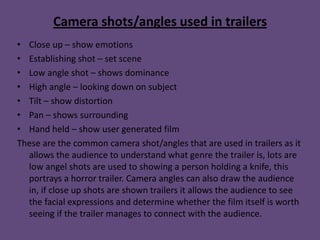
Camera shots/angles used in trailers
• Close up – show emotions
• Establishing shot – set scene
• Low angle shot – shows dominance
• High angle – looking down on subject
• Tilt – show distortion
• Pan – shows surrounding
• Hand held – show user generated film
These are the common camera shot/angles that are used in trailers as it
  allows the audience to understand what genre the trailer is, lots are
  low angel shots are used to showing a person holding a knife, this
  portrays a horror trailer. Camera angles can also draw the audience
  in, if close up shots are shown trailers it allows the audience to see
  the facial expressions and determine whether the film itself is worth
  seeing if the trailer manages to connect with the audience.

Features of a trailer

  • 1.
  • 2.
    Why is itimportant for a trailer to show us the genre and how is this established? When an audience go to the cinema and see a collection of trailers feeds them information about the film, who the main stars are, the narrative, and what type of genre it is. The genre is what the audience “decode” from watching it themselves, this involves seeing celebrities that are commonly known for their continuously appearance in a specific genre eg: jack black in comical films, this is backed up with the bright lighting, the friendly atmosphere and bright visual colours, these are all examples of conventions that are thought about depending on what genre the film is. Genre is an important key in film marketing as it targets certain audiences, for example: if a person prefers horror films then they will automatically be interested in a trailer about horror. However sometimes a genre isn’t clear from the beginning of the trailer as a film will be a hybrid of one of more different genres combined together this makes the audience want to see what happens if the film has a certain twist.
  • 3.
    How does thetrailer show that a film is worth going to see? Films need to stand out and be unique from one another, especially if they are realised at the same time and are targeting the same audience and consist of the same genre then the marketing campaign have to compete with their rivals for the target audience, this is why a unique selling point is majorly advertised in the marketing campaign. A thing that is commonly used to make each trailer different is a unique selling point, this could a unique twist, a character playing a role they are not famous for, and the use of special effects or the narrative varies. Common conventions also help indicate to the audience why a film is worth going to see, if the actors are well known, if there is a lot of action, lots of blood and drama and if the sub genre appeals to the audience.
  • 4.
    What types oftrailers are there? A distribution company have the power to decide how many trailers are released of a certain film depending on if the film itself it’s a big production with a substantial budget for marketing. To gain the interest of the audience, a “teaser” trailer is made and is realised online or played at the cinema in the early stages of the promotional campaign. A teaser trailer is shorter than the actual trailer; this is suggested in the name “teaser” and is done to leave the audience wanting more. The distribution company tries to reach the target audience in many ways, after a “teaser” trailer is viewed people begin to tell their friends and family, thus creating a word of mouth campaign as news of the trailer is spread via mouth, phone, social networking and other media platforms. This is a very popular approach used by the distribution company as it a immensely cheap as they themselves are not wasting time and money as the audience are the ones spreading the information not knowing subconsciously what they are doing. Once a buzz is created due to the effect of the teaser trailer, an full length clip of the trailer is released in cinemas three to four weeks before the film is due to be released. Trailers are also shown on TV and are known as “TV Spots”, however air time is very expensive therefore not a lot is shown, but enough to engage the audience.
  • 5.
    Examples: • Teaser trailers: http://www.youtube.com/watch?v=dSn72h_6 I9Q • Theatrical Trailer http://www.youtube.com/watch?v=pIy7EdmVQ no • “TV Spot” Trailer • http://www.youtube.com/watch?v=nyhaOrot DWs
  • 6.
    How are trailerschosen to preview before certain films: Trailers that preview the main film are shown in cinemas; however certain trailers are shown to a certain audience. The exhibitor (cinema manager) uses their marketing knowledge to target a certain audience and select trailers which are aimed at the same target audience of that of the main film. For example: if the audience come to watch a comedy film, then the exhibitor shows other comedy trailers, making the audience want to come back again, this process is repeated continuously until a regular audience is established. Classifications are also taken in consideration when showing trailers, some film have certain age restrictions, therefore a trailer for a 15 certificate film will not be played before a PG film is shown as language and scenes maybe inappropriate for the younger audience. However the cinema manager is aware that adults accompany the younger audience, therefore films that have a certain age restriction are edited to make them suitable or the younger audience as it is indirectly appealing to the adults, making them want to come back alone to see the film.
  • 7.
    Location: Astimes have now evolved, there are different ways in which trailers can be viewed, the internet is a new found tool in film marketing. Different forms of media platforms allow trailers to be viewed, web 2.0 and websites such as apple movie trailers and official websites for film titles show trailers, however this trailers are cut and edited to make them suitable for a general audience this is done because age restrictions can be very difficult to enforce online in comparison to the cinema. The same film can have different trailers with different names and edited in many different ways as different audiences can view it, media platforms such as social networking allow users to engage and create interest in the trailer as comments can be shared, the more good reviews, the more people will want to see it, therefore creating more money. http://trailers.apple.com/trailers/ www.youtube.com www.traileraddict.com
  • 8.
    What are thefeatures of a trailer? Trailers are viewed everywhere, however they are not “mini films”, trailers have a genre of their own and have stereotypical conventions that follow. Trailers consist of a selection f various shots from the film, since the purpose of the trailer is to attract an audience; these chosen shots are usually drawn from the most exciting parts of the film and are designed to capture the attention of the audience for a limited amount of minutes. They create a certain mood and enigma, creating interest and anticipation of what the film is about. In a trailer important facts are given, some information about the plot, characters within in the film and the subgenre. Trailers follow a certain structure, the information and scenes are often fast moving with a lot of footage which requires our attention, creating roller coaster effect as tension builds up and then drops and the trailer finishes.
  • 9.
    Conventions: • “best bits” are highlighted • Showcases the stars • Visual images are not shown for long • Conversations between characters=one liners • Dramatic camera angels • Action interrupted by credits • Voiceovers to tell the story and give more information • Title may not appear until the end • Trailer builds up to the climax where it ends
  • 10.
    Camera shots/angles usedin trailers • Close up – show emotions • Establishing shot – set scene • Low angle shot – shows dominance • High angle – looking down on subject • Tilt – show distortion • Pan – shows surrounding • Hand held – show user generated film These are the common camera shot/angles that are used in trailers as it allows the audience to understand what genre the trailer is, lots are low angel shots are used to showing a person holding a knife, this portrays a horror trailer. Camera angles can also draw the audience in, if close up shots are shown trailers it allows the audience to see the facial expressions and determine whether the film itself is worth seeing if the trailer manages to connect with the audience.