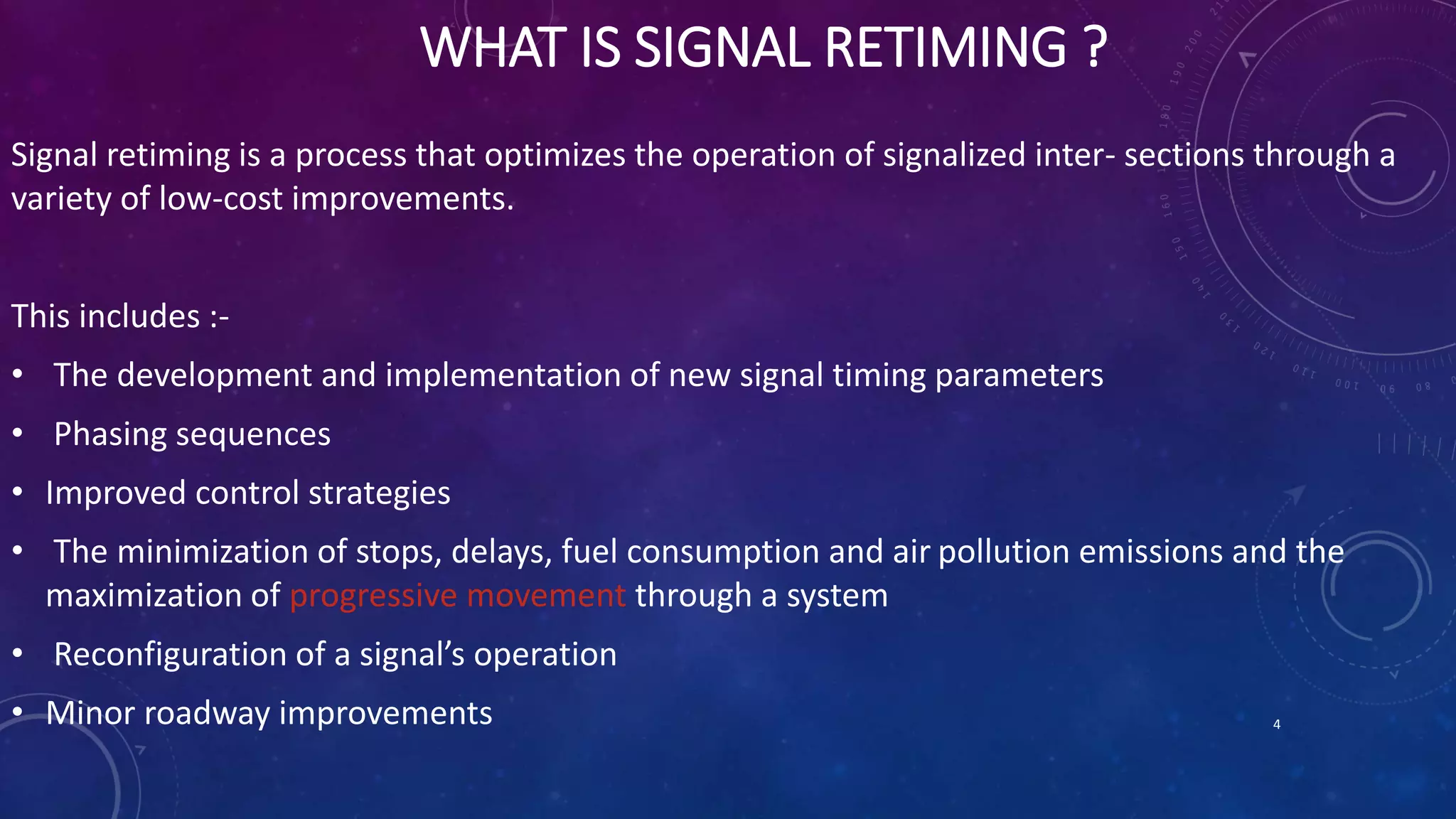
SIGNAL RETIMING 
BY-ALOK 
KUMAR TRIPATHI 
131109037 
1 
TRAFFIC AND TRANSPORT PLANNING 
MAULANA AZAD NATIONAL INSTITUTE OF TECHNOLOGY ,BHOPAL
STRUCTURE OF THE PRESENTATION 
• AIM & OBJECTIVE 
• WHAT IS SIGNAL RETIMING ? 
• PARAMETERS 
• WHY IS SIGNAL RETIMING CONDUCTED? 
• HOW IS SIGNAL RETIMING CONDUCTED? 
• WHO RETIMES TRAFFIC SIGNALS? 
• CONSTRAINTS OF OPTIMIZING AND OPERATING TRAFFIC SIGNALS? 
• HOW OFTEN SHOULD SIGNAL RETIMING BE CONDUCTED? 
• WHAT IS THE COST OF RETIMING TRAFFIC SIGNALS? 
• BENEFITS OF RETIMING TRAFFIC SIGNALS 
• TESTIMONIALS 
2
• AIM :- TO UNDERSTAND SIGNAL RETIMING AND ITS BENEFITS . 
• OBJECTIVE :- 
SIGNAL RETIMING - 
WHAT 
 WHY 
 HOW 
 WHO RETIMES 
 CONSTRAINTS 
 BENEFITS 
3
WHAT IS SIGNAL RETIMING ? 
Signal retiming is a process that optimizes the operation of signalized inter- sections through a 
variety of low-cost improvements. 
This includes :- 
• The development and implementation of new signal timing parameters 
• Phasing sequences 
• Improved control strategies 
• The minimization of stops, delays, fuel consumption and air pollution emissions and the 
maximization of progressive movement through a system 
• Reconfiguration of a signal’s operation 
• Minor roadway improvements 4
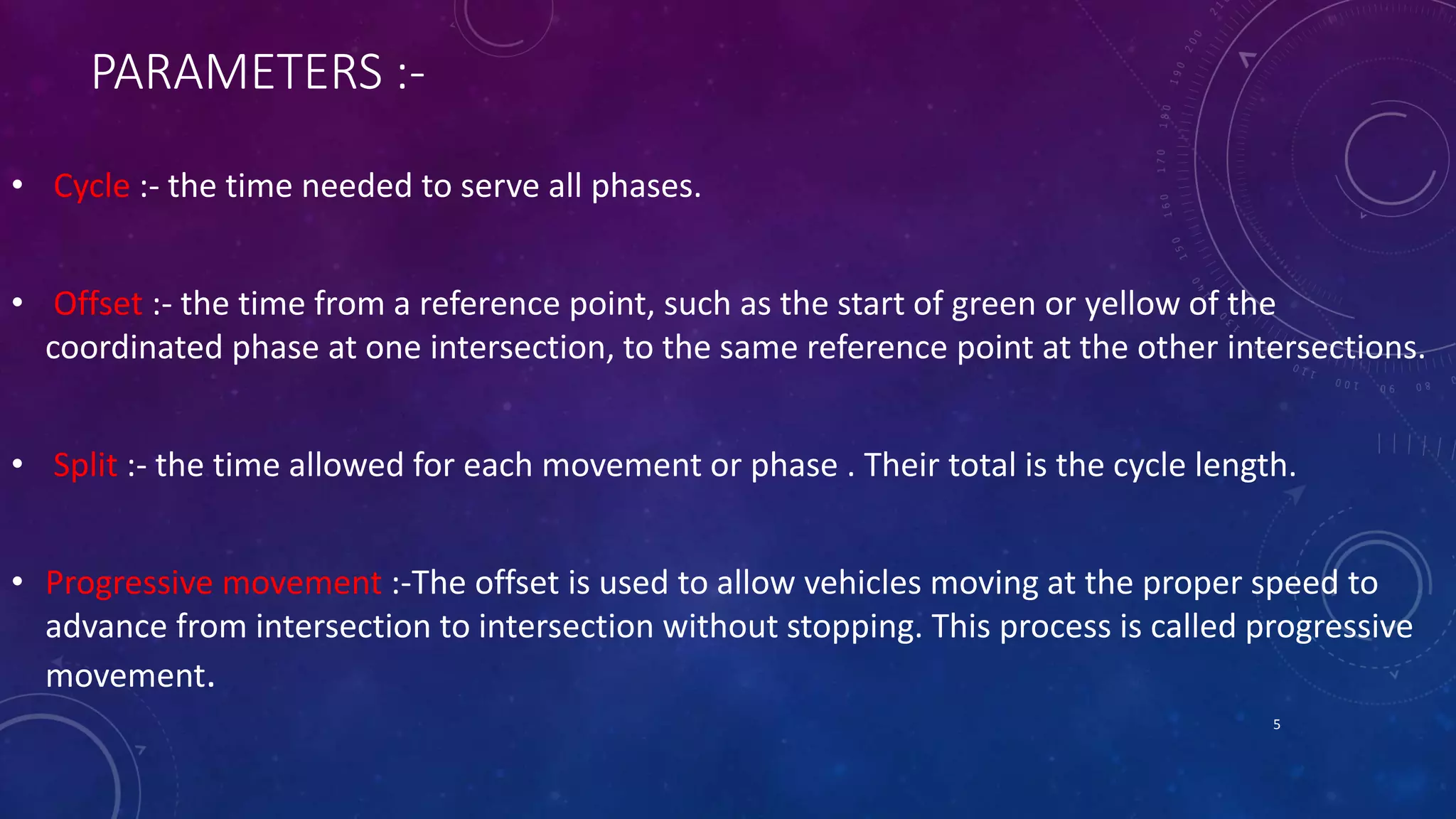
PARAMETERS :- 
• Cycle :- the time needed to serve all phases. 
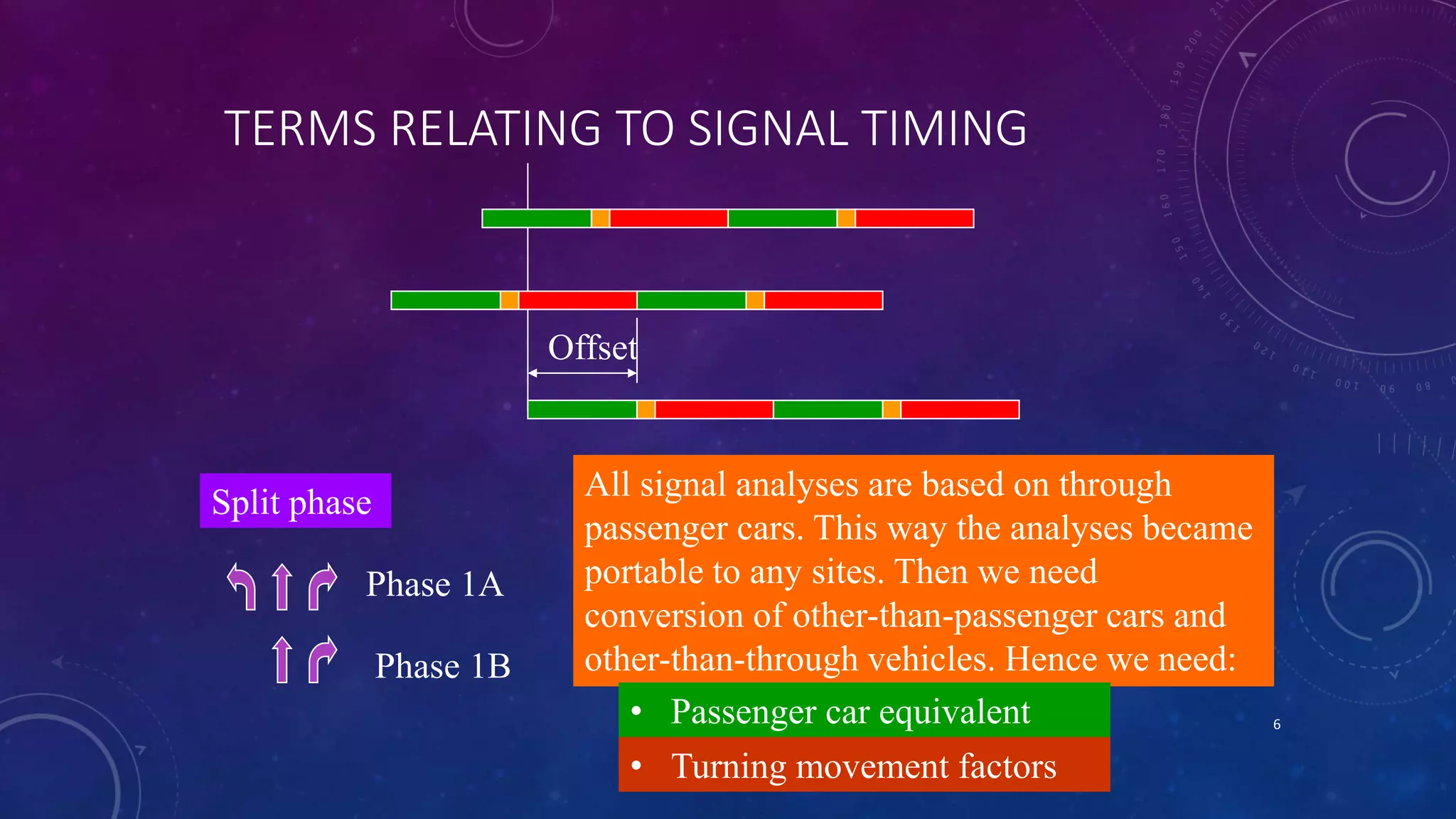
• Offset :- the time from a reference point, such as the start of green or yellow of the 
coordinated phase at one intersection, to the same reference point at the other intersections. 
• Split :- the time allowed for each movement or phase . Their total is the cycle length. 
• Progressive movement :-The offset is used to allow vehicles moving at the proper speed to 
advance from intersection to intersection without stopping. This process is called progressive 
movement. 
5
TERMS RELATING TO SIGNAL TIMING 
Offset 
Split phase 
Phase 1A 
Phase 1B 
All signal analyses are based on through 
passenger cars. This way the analyses became 
portable to any sites. Then we need 
conversion of other-than-passenger cars and 
other-than-through vehicles. Hence we need: 
• Passenger car equivalent 
• (TPuCrnEi)ng movement factors 
6
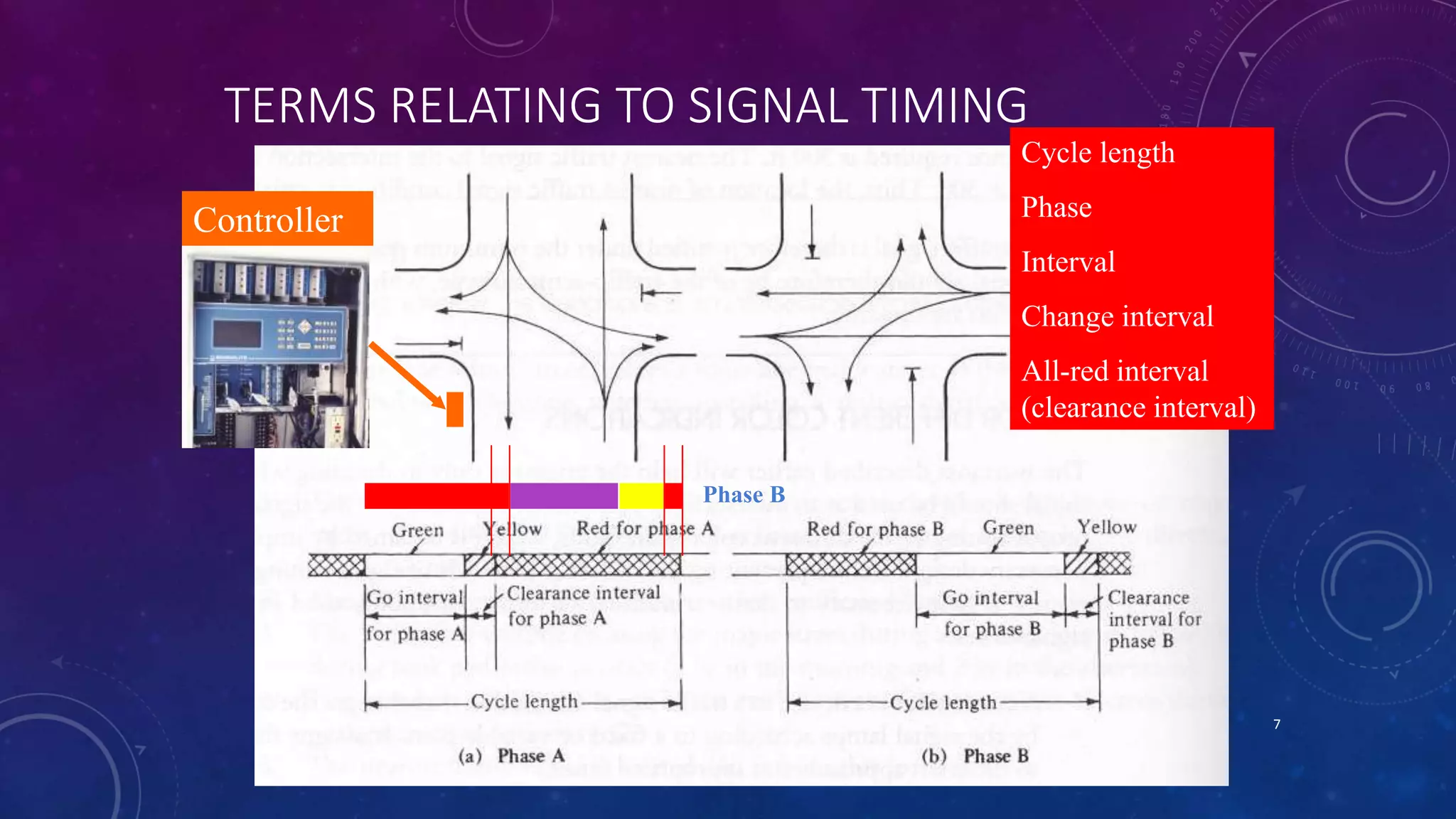
TERMS RELATING TO SIGNAL TIMING 
Cycle length 
Phase 
Interval 
Change interval 
All-red interval 
(clearance interval) 
Controller 
Phase B 
7
WHY IS SIGNAL RETIMING CONDUCTED? 
• Increase in traffic with the addition of new homes or stores 
• Reduced delay time on the approach to an intersection 
• Postpone or eliminate need for additional capacity 
• Maximizes the benefits of the existing infrastructure 
• Reduces aggressive driving behavior, red light running 
8
• Saves time for commercial vehicles, emergency vehicles, buses and the public 
• Safety – reduce accidents by providing smoother traffic flow with fewer stops 
• Accommodation of traffic flow for different times of day or days of the week 
• Improved pedestrian flow, side-street movements 
• Municipal cost and energy savings 
• Cost effective: cost ratios of 40:1 
9
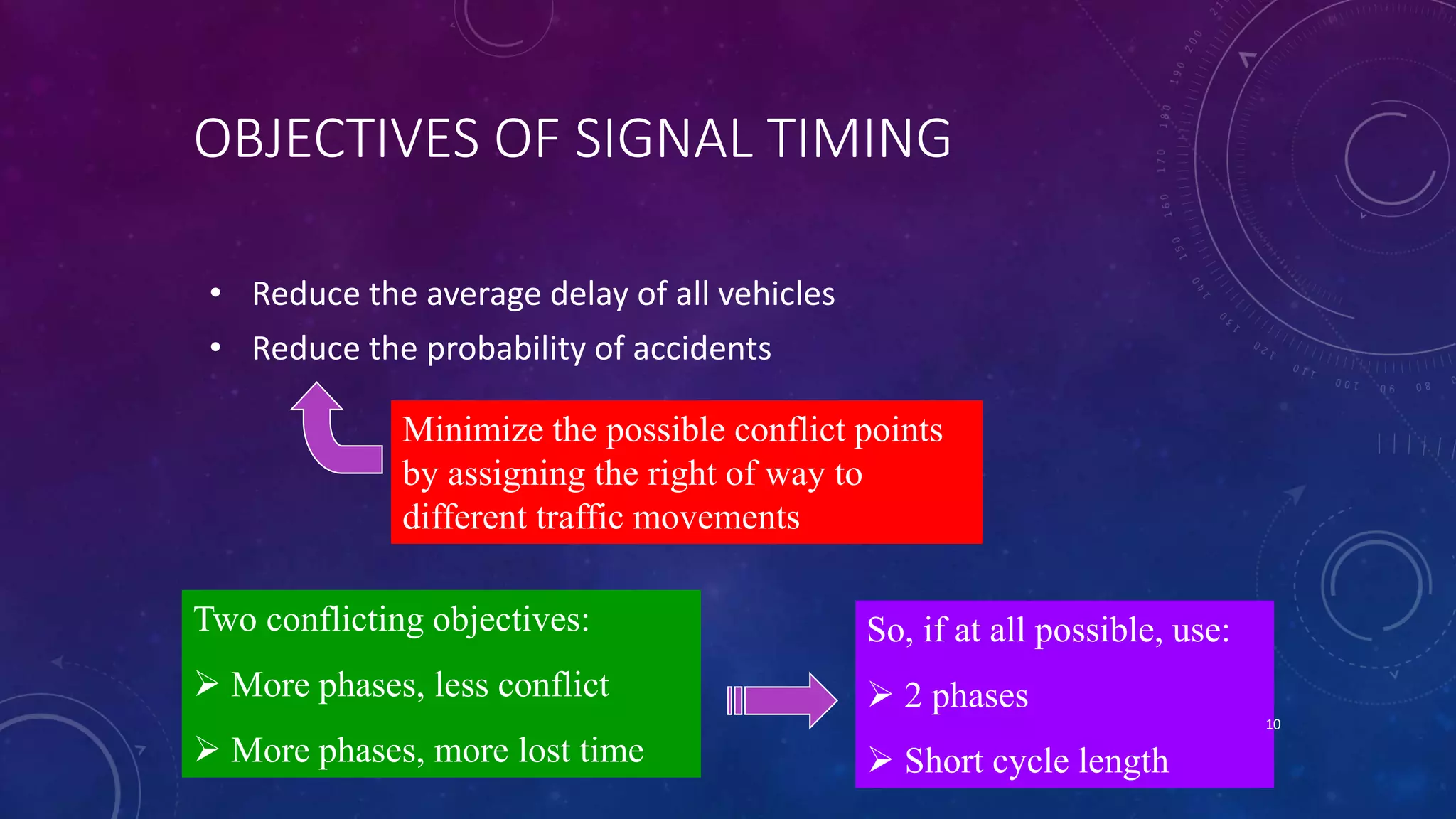
OBJECTIVES OF SIGNAL TIMING 
• Reduce the average delay of all vehicles 
• Reduce the probability of accidents 
Minimize the possible conflict points 
by assigning the right of way to 
different traffic movements 
Two conflicting objectives: 
 More phases, less conflict 
 More phases, more lost time 
So, if at all possible, use: 
 2 phases 
 Short cycle length 
10
HOW IS SIGNAL RETIMING CONDUCTED? 
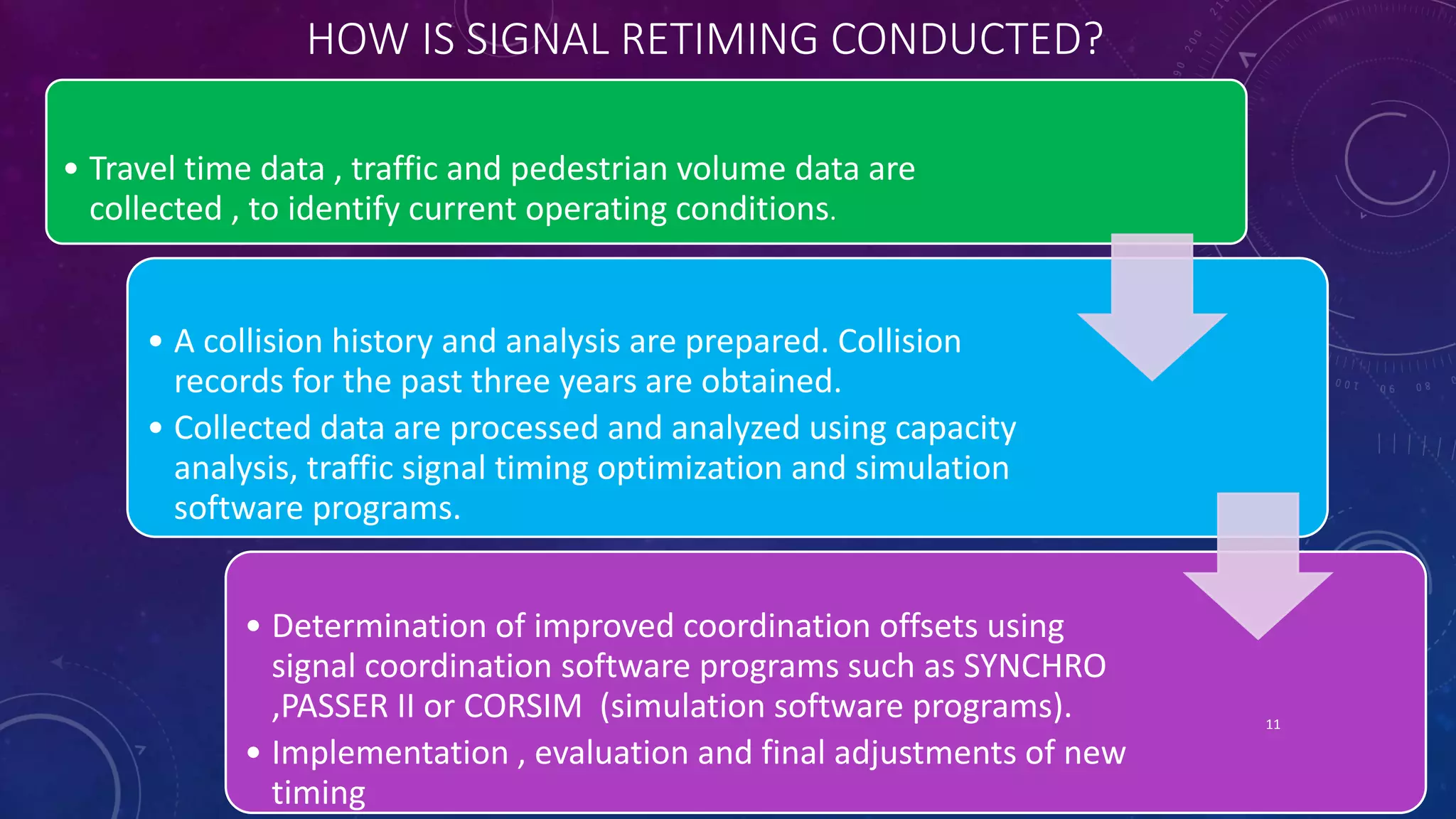
• Travel time data , traffic and pedestrian volume data are 
collected , to identify current operating conditions. 
• A collision history and analysis are prepared. Collision 
records for the past three years are obtained. 
• Collected data are processed and analyzed using capacity 
analysis, traffic signal timing optimization and simulation 
software programs. 
• Determination of improved coordination offsets using 
signal coordination software programs such as SYNCHRO 
,PASSER II or CORSIM (simulation software programs). 
• Implementation , evaluation and final adjustments of new 
timing 
11
WHO RETIMES TRAFFIC SIGNALS? 
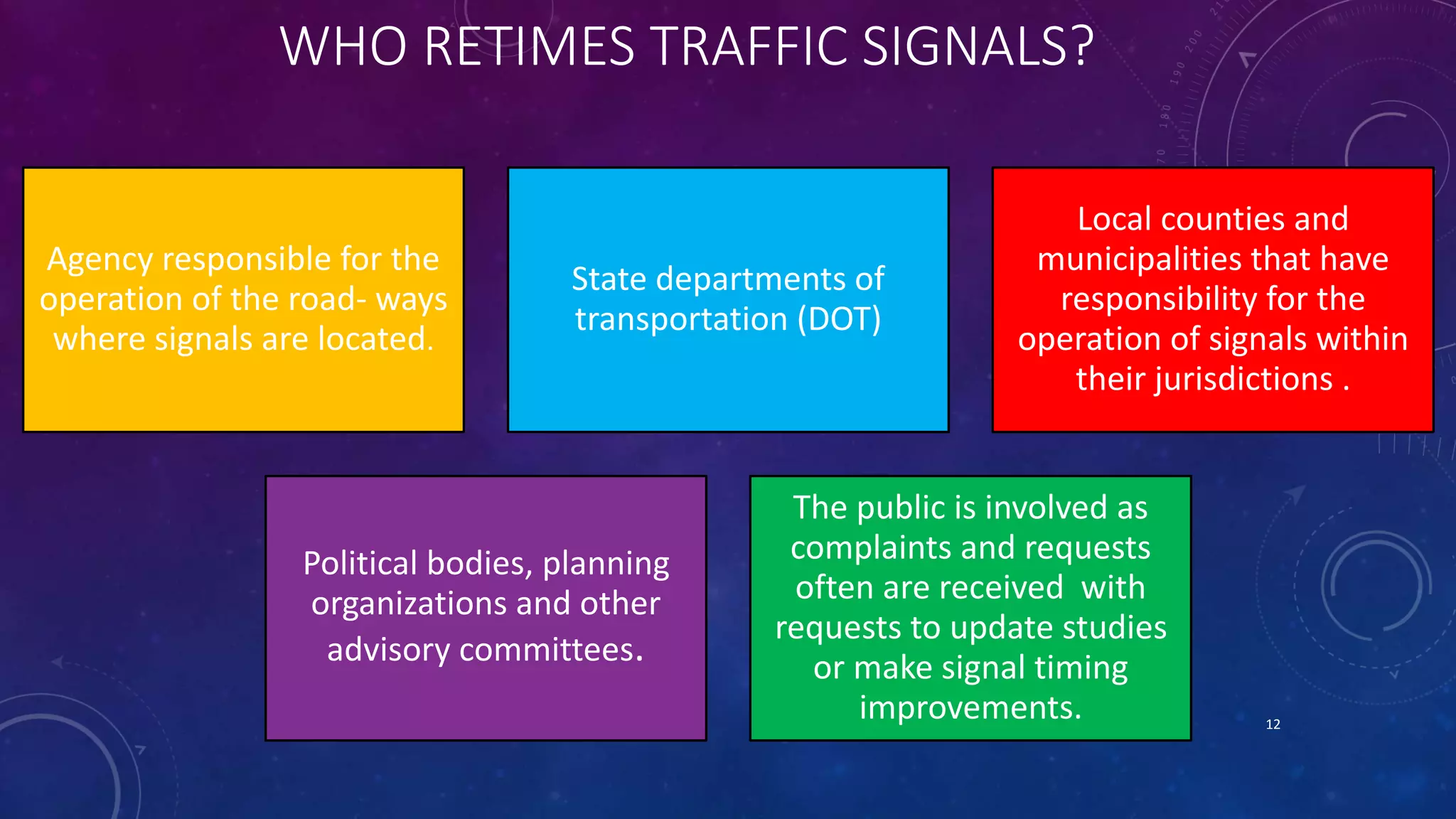
Agency responsible for the 
operation of the road- ways 
where signals are located. 
State departments of 
transportation (DOT) 
Local counties and 
municipalities that have 
responsibility for the 
operation of signals within 
their jurisdictions . 
Political bodies, planning 
organizations and other 
advisory committees. 
The public is involved as 
complaints and requests 
often are received with 
requests to update studies 
or make signal timing 
improvements. 12
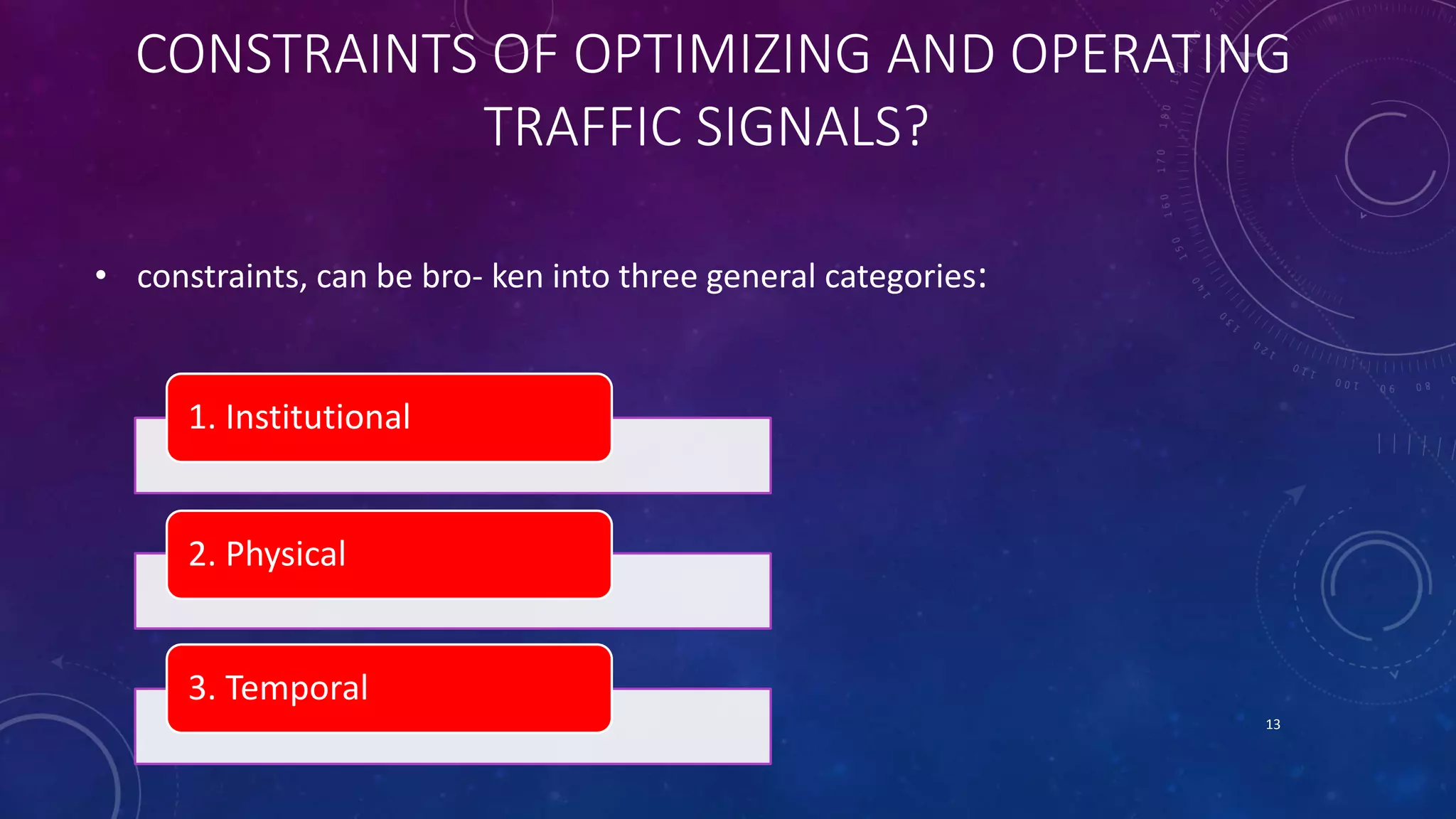
CONSTRAINTS OF OPTIMIZING AND OPERATING 
TRAFFIC SIGNALS? 
• constraints, can be bro- ken into three general categories: 
1. Institutional 
2. Physical 
3. Temporal 
13
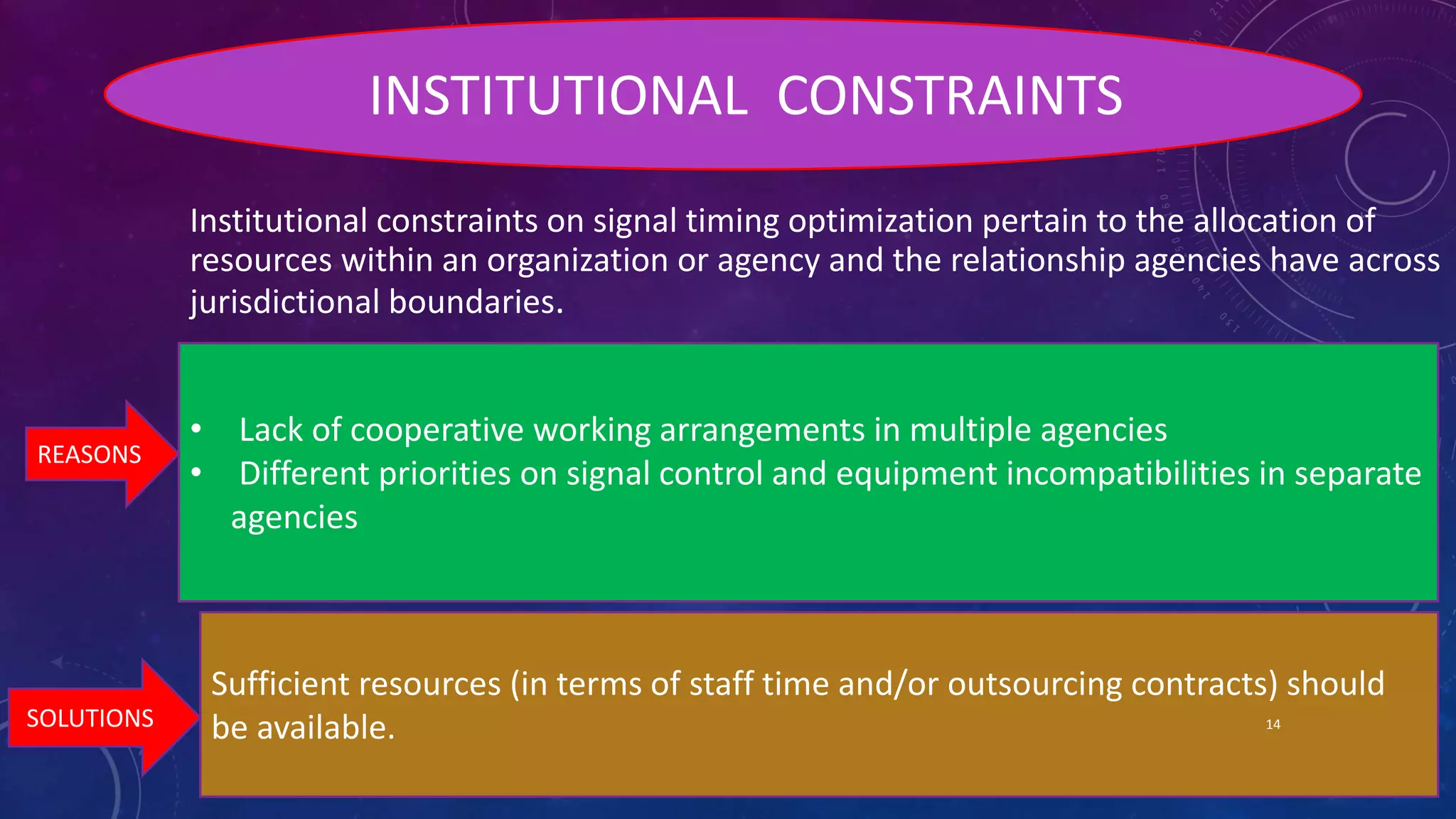
Institutional constraints on signal timing optimization pertain to the allocation of 
resources within an organization or agency and the relationship agencies have across 
jurisdictional boundaries. 
• Lack of cooperative working arrangements in multiple agencies 
• Different priorities on signal control and equipment incompatibilities in separate 
agencies 
INSTITUTIONAL CONSTRAINTS 
REASONS 
SOLUTIONS 
Sufficient resources (in terms of staff time and/or outsourcing contracts) should 
be available. 14
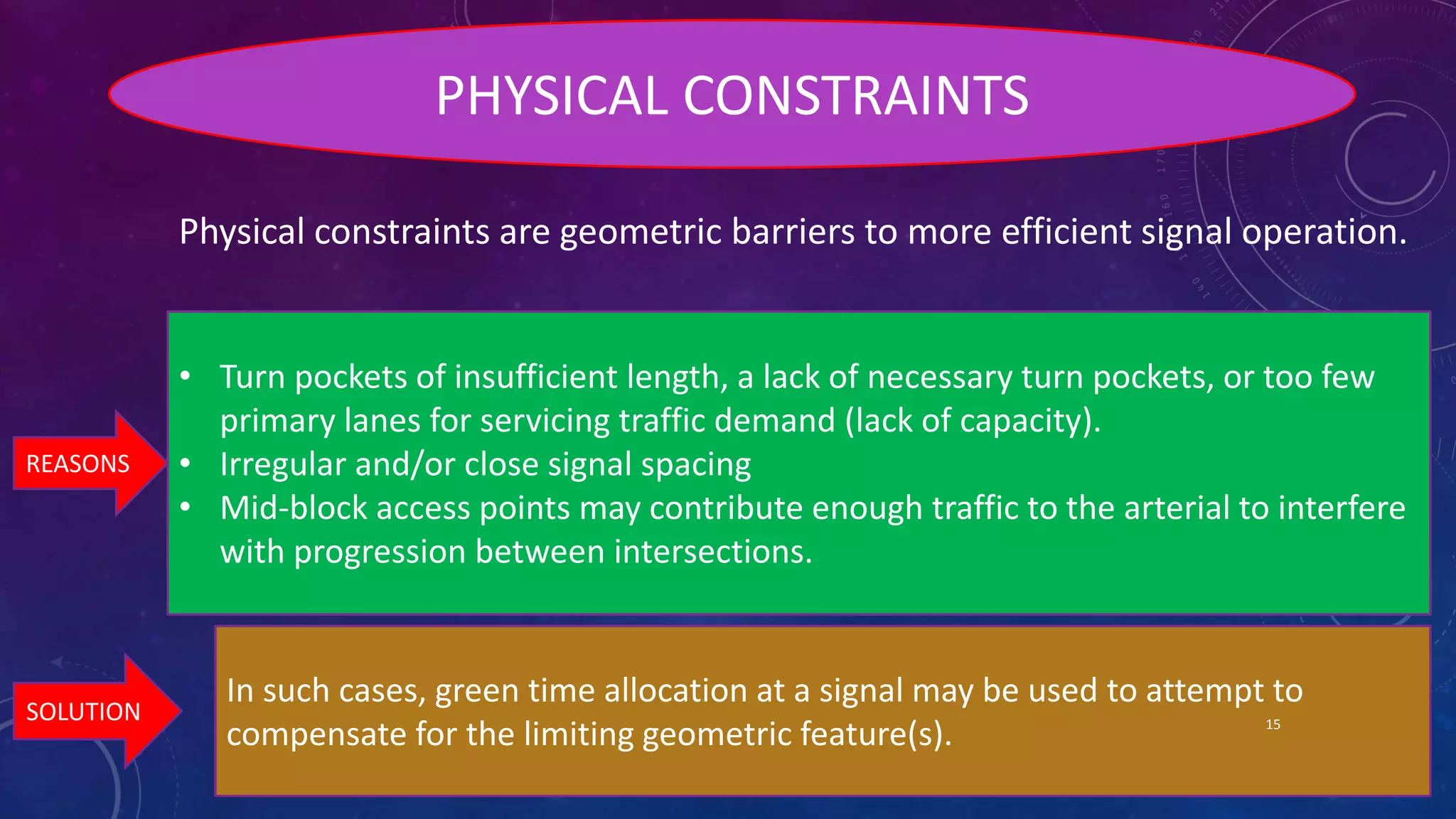
PHYSICAL CONSTRAINTS 
Physical constraints are geometric barriers to more efficient signal operation. 
• Turn pockets of insufficient length, a lack of necessary turn pockets, or too few 
primary lanes for servicing traffic demand (lack of capacity). 
• Irregular and/or close signal spacing 
• Mid-block access points may contribute enough traffic to the arterial to interfere 
with progression between intersections. 
REASONS 
SOLUTION 
In such cases, green time allocation at a signal may be used to attempt to 
compensate for the limiting geometric feature(s). 15
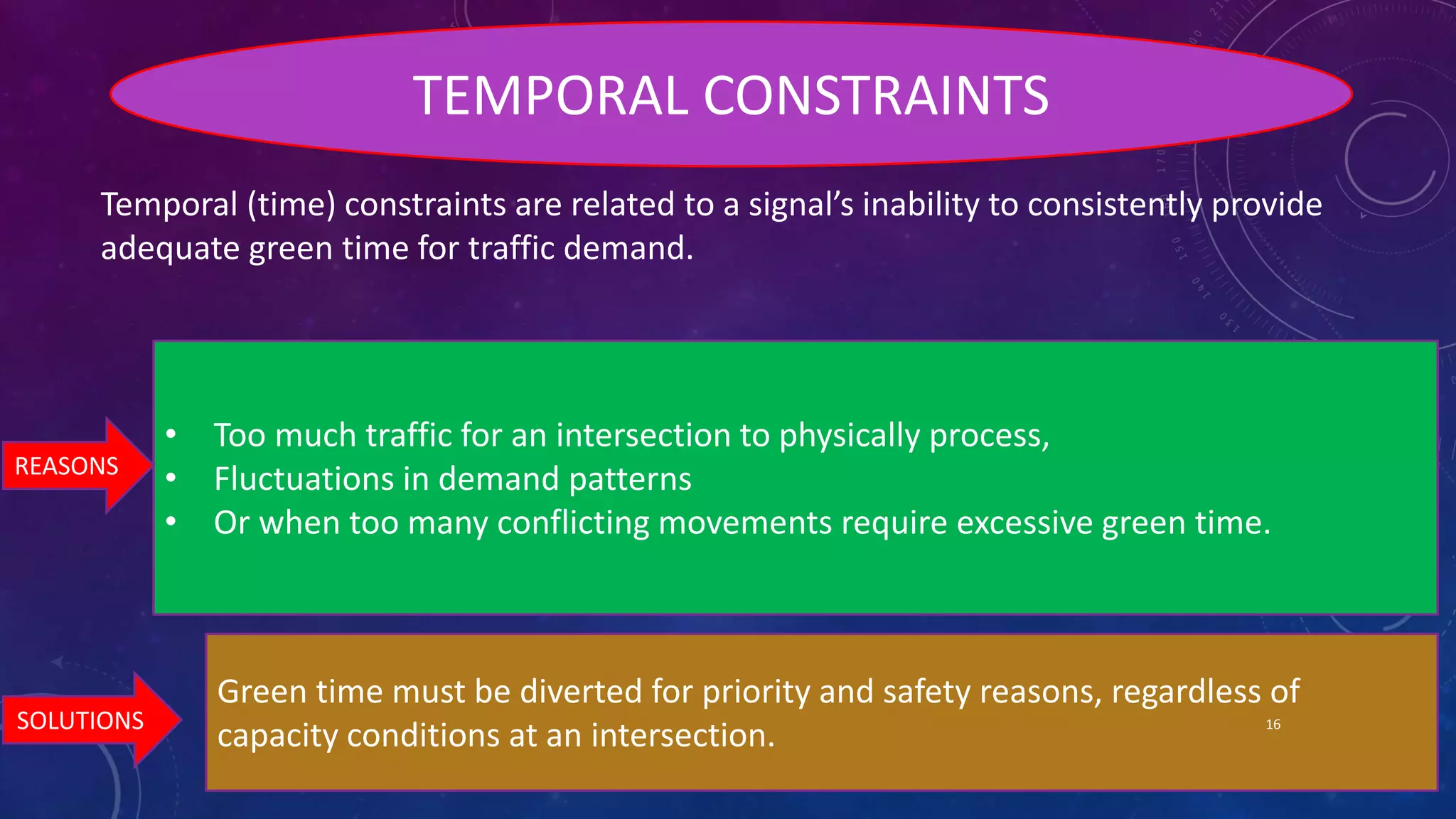
TEMPORAL CONSTRAINTS 
Temporal (time) constraints are related to a signal’s inability to consistently provide 
adequate green time for traffic demand. 
• Too much traffic for an intersection to physically process, 
• Fluctuations in demand patterns 
• Or when too many conflicting movements require excessive green time. 
REASONS 
Green time must be diverted for priority and safety reasons, regardless of 
capacity conditions at an intersection. SOLUTIONS 16
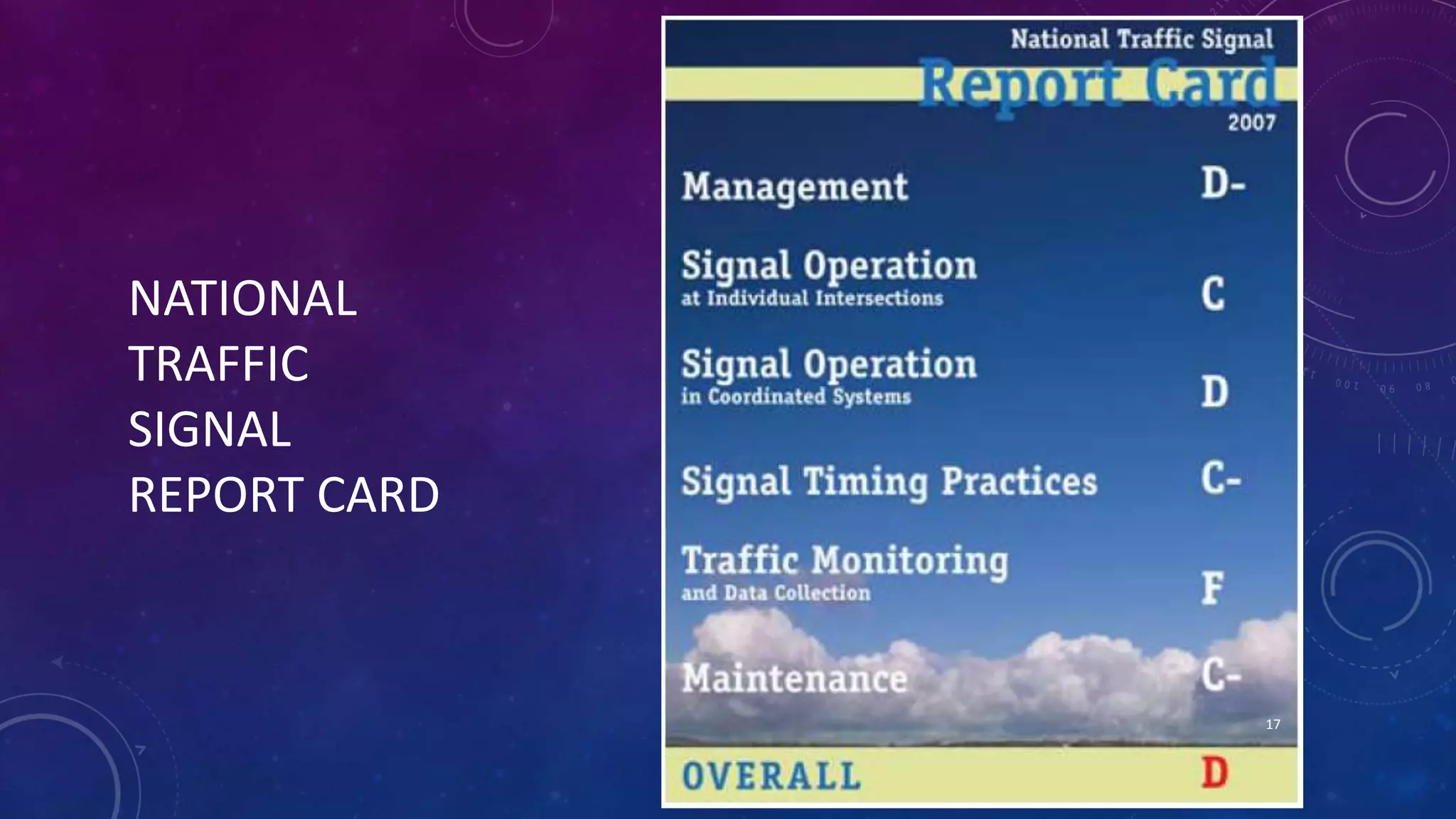
NATIONAL 
TRAFFIC 
SIGNAL 
REPORT CARD 
17
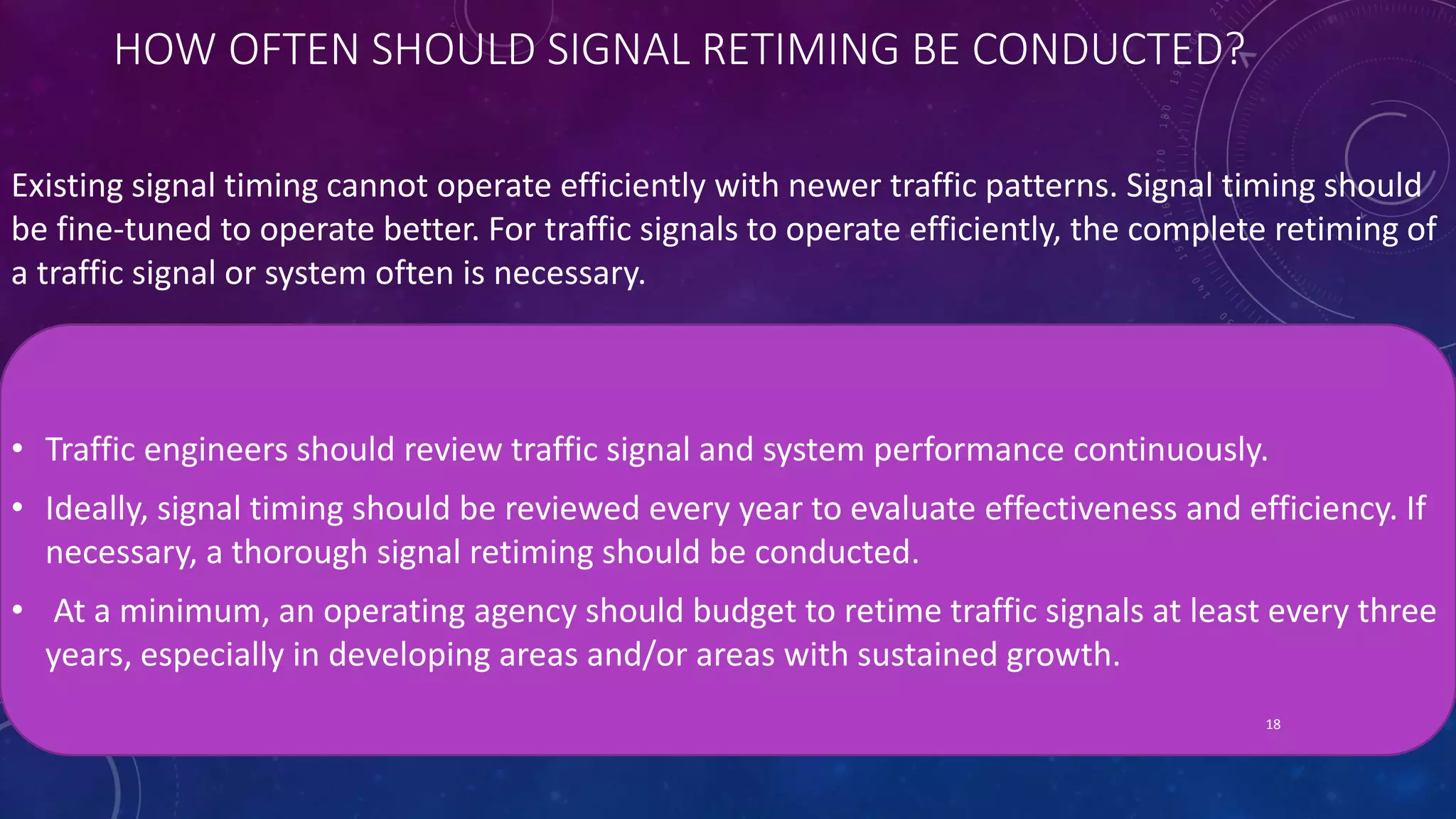
HOW OFTEN SHOULD SIGNAL RETIMING BE CONDUCTED? 
Existing signal timing cannot operate efficiently with newer traffic patterns. Signal timing should 
be fine-tuned to operate better. For traffic signals to operate efficiently, the complete retiming of 
a traffic signal or system often is necessary. 
• Traffic engineers should review traffic signal and system performance continuously. 
• Ideally, signal timing should be reviewed every year to evaluate effectiveness and efficiency. If 
necessary, a thorough signal retiming should be conducted. 
• At a minimum, an operating agency should budget to retime traffic signals at least every three 
years, especially in developing areas and/or areas with sustained growth. 
18
WHAT IS THE COST OF RETIMING TRAFFIC SIGNALS? 
Signal retiming often is postponed or ignored due to an agency’s financial or staffing 
constraints. Given the need for field data collection, data analysis, signal timing optimization, 
testing and implementation, the overall signal timing process can be expensive and time 
consuming. However, as discussed earlier, retiming traffic signals is necessary to maintain 
efficient traffic operations. 
• Estimates of the time required vary according to available expertise and equipment. On 
average, it is estimated that generating four timing plans (for a.m. peak, noon peak, p.m. 
peak and off-peak conditions) takes 25 to 30 hours per intersection. 
• The cost of signal retiming is roughly $2,500 per intersection, including the four typical 
timing plans. 
19
BENEFITS OF RETIMING TRAFFIC SIGNALS 
There are three types of benefits : 
DIRECT BENEFITS 
SIDE BENEFITS 
INDIRECT BENEFITS 
20
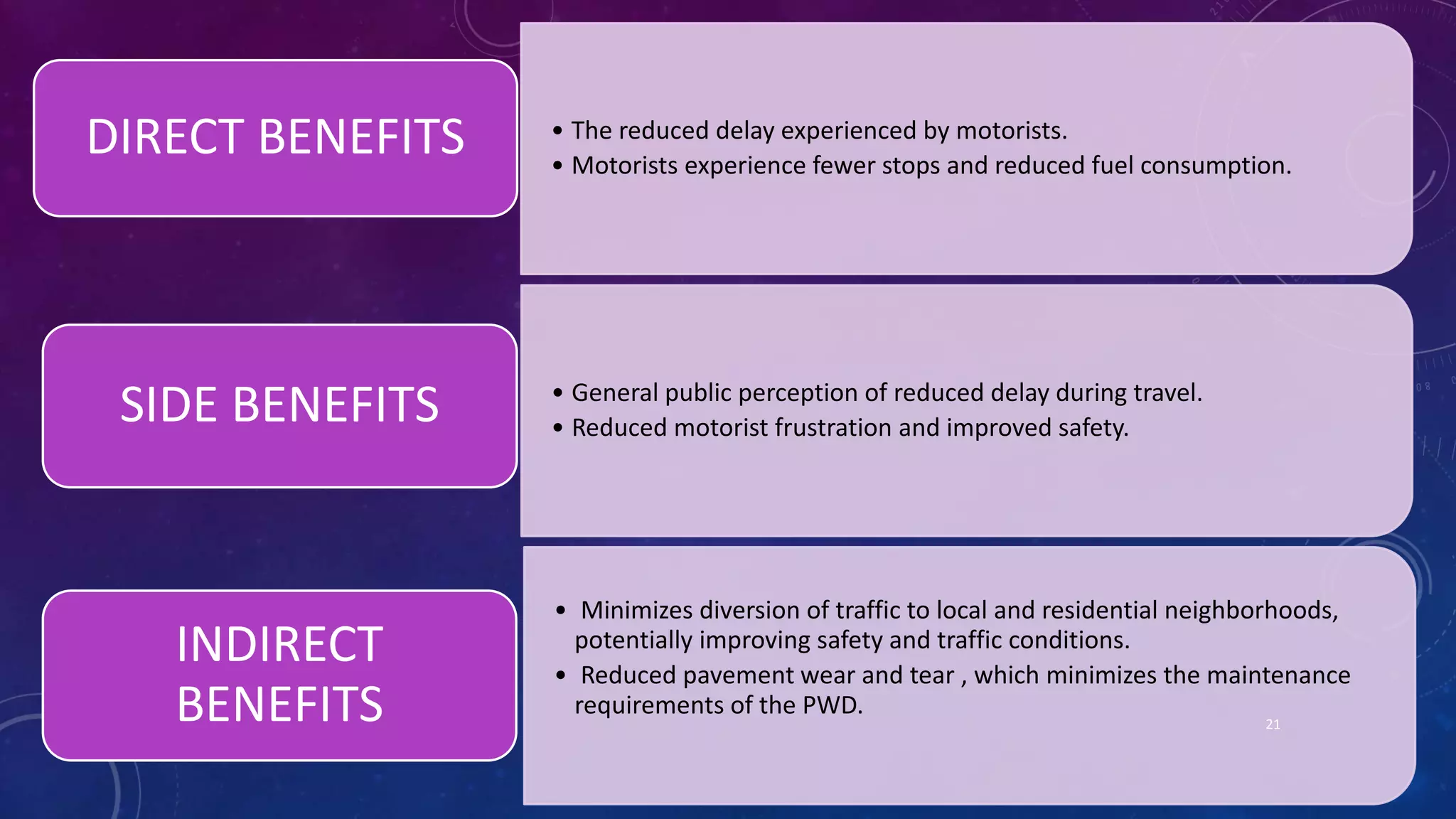
• The reduced delay experienced by motorists. 
• Motorists experience fewer stops and reduced fuel consumption. DIRECT BENEFITS 
• General public perception of reduced delay during travel. 
• Reduced motorist frustration and improved safety. SIDE BENEFITS 
• Minimizes diversion of traffic to local and residential neighborhoods, 
potentially improving safety and traffic conditions. 
• Reduced pavement wear and tear , which minimizes the maintenance 
requirements of the PWD. 
INDIRECT 
BENEFITS 21
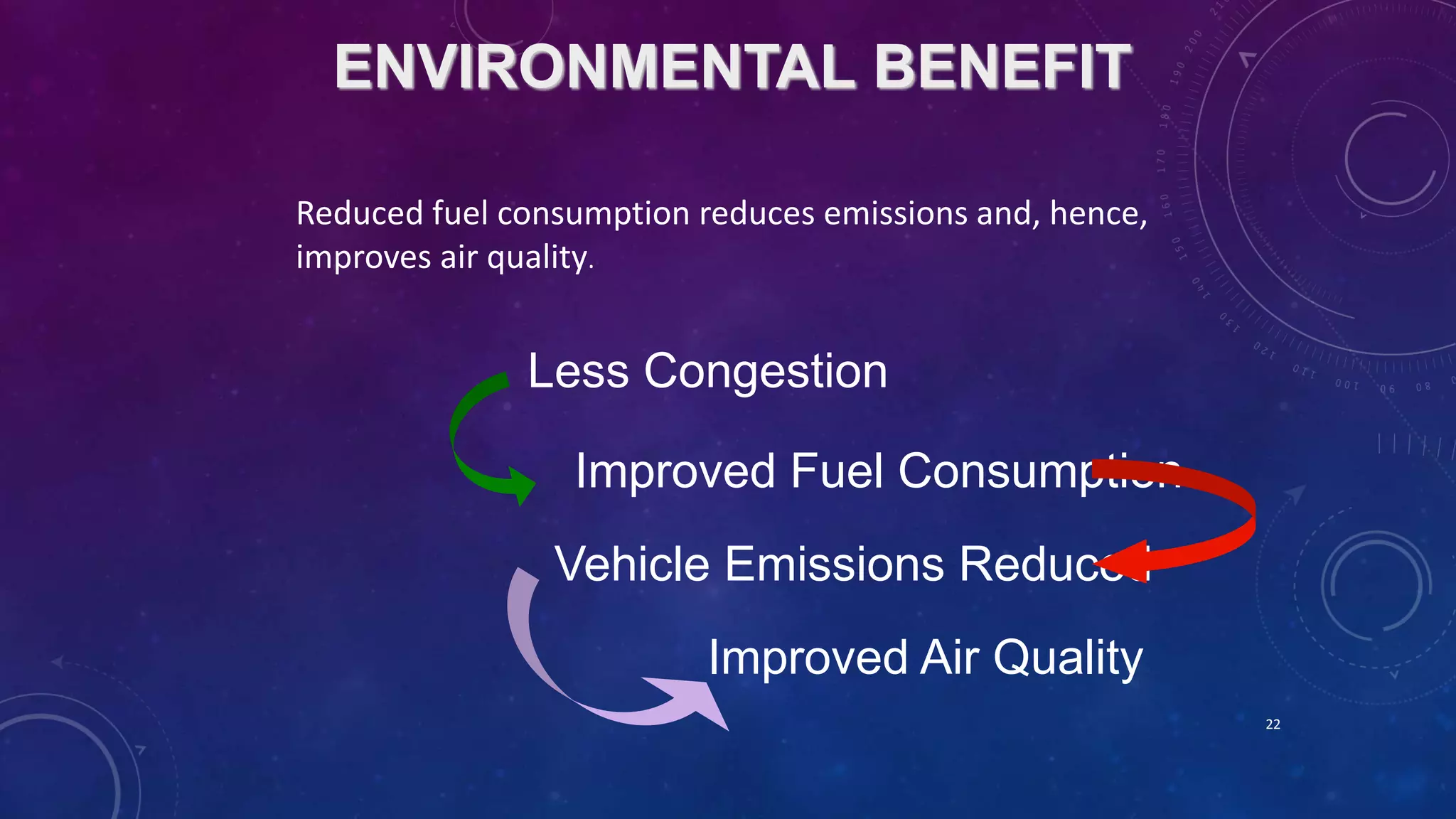
ENVIRONMENTAL BENEFIT 
Reduced fuel consumption reduces emissions and, hence, 
improves air quality. 
Less Congestion 
Improved Fuel Consumption 
Vehicle Emissions Reduced 
Improved Air Quality 
22
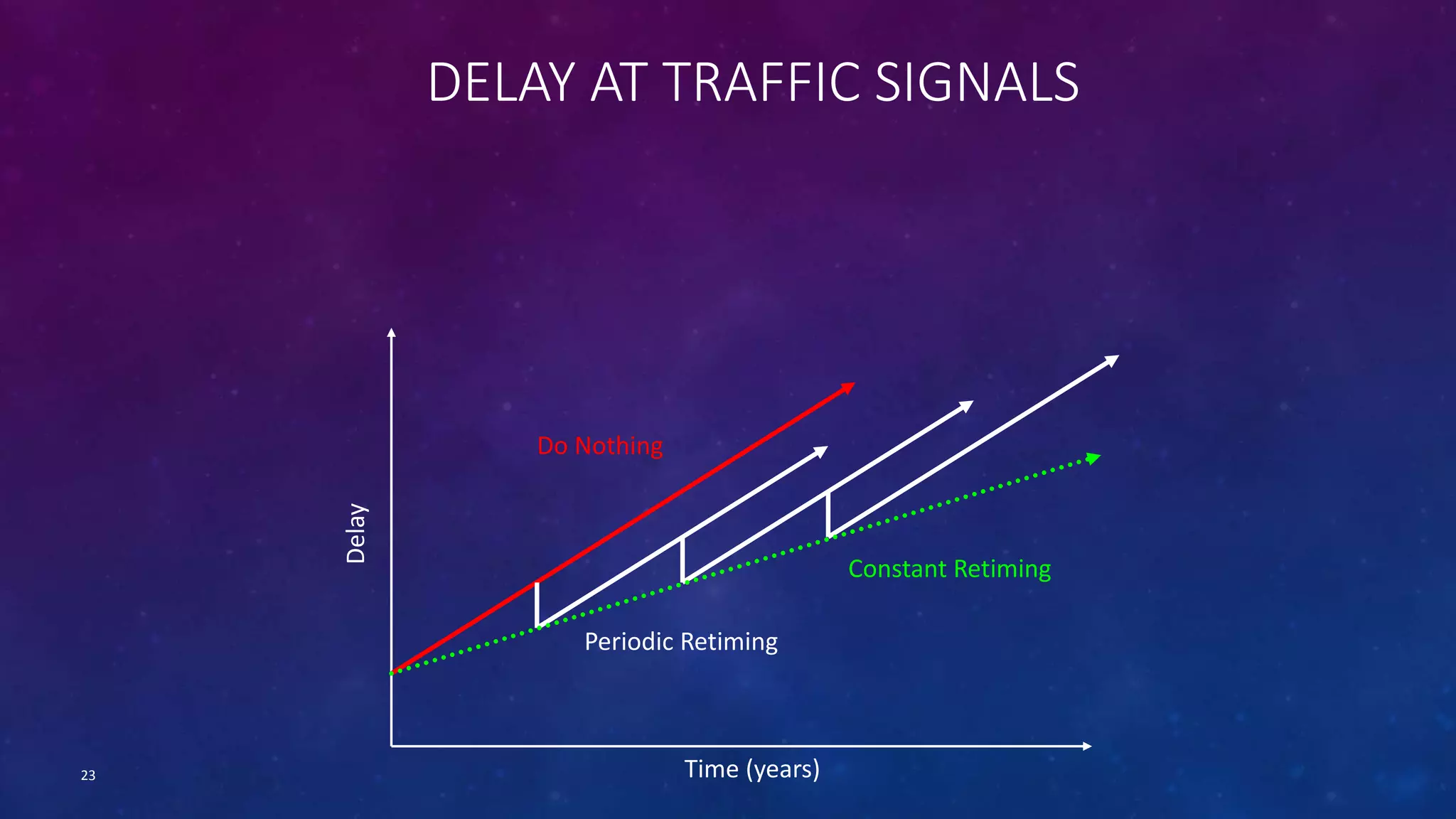
DELAY AT TRAFFIC SIGNALS 
Time (years) 
Delay 
Do Nothing 
Periodic Retiming 
Constant Retiming 
23
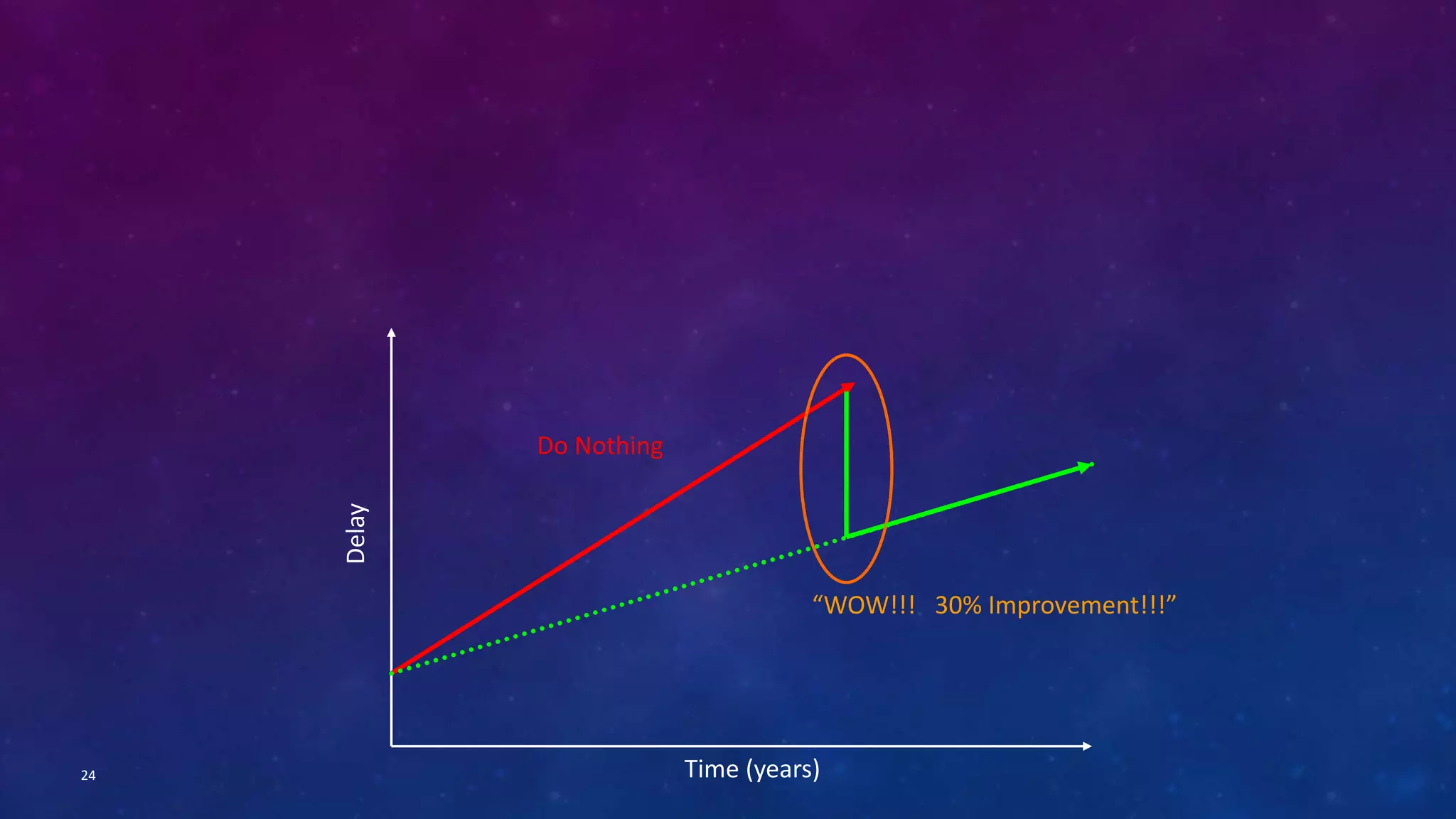
Time (years) 
Delay 
“WOW!!! 30% Improvement!!!” 
Do Nothing 
24
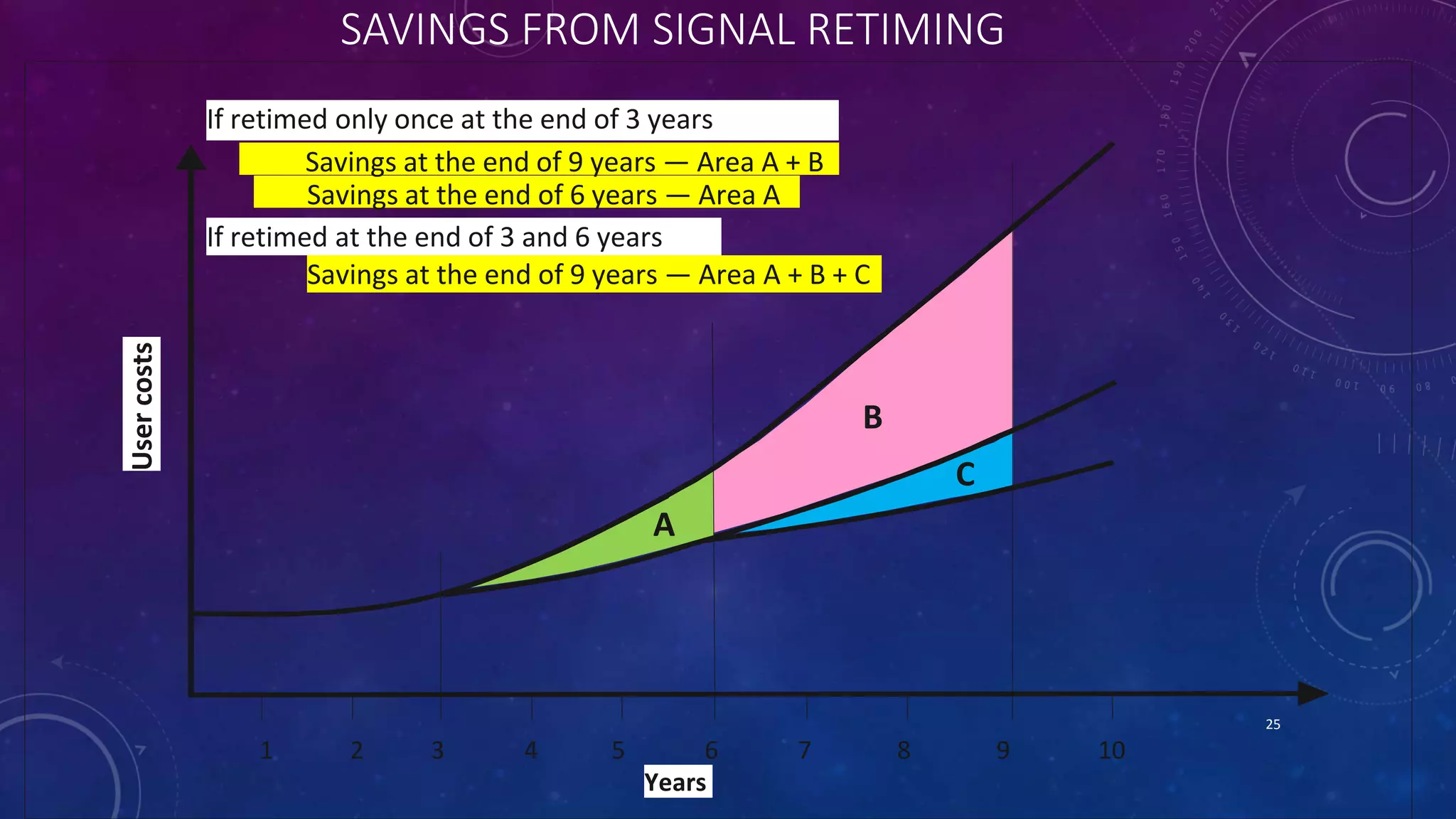
SAVINGS FROM SIGNAL RETIMING 
Savings at the end of 9 years — Area A + B 
A 
B 
C 
1 2 3 4 5 6 7 8 9 10 
Years 
User costs 
If retimed only once at the end of 3 years 
Savings at the end of 6 years — Area A 
If retimed at the end of 3 and 6 years 
Savings at the end of 9 years — Area A + B + C 
25
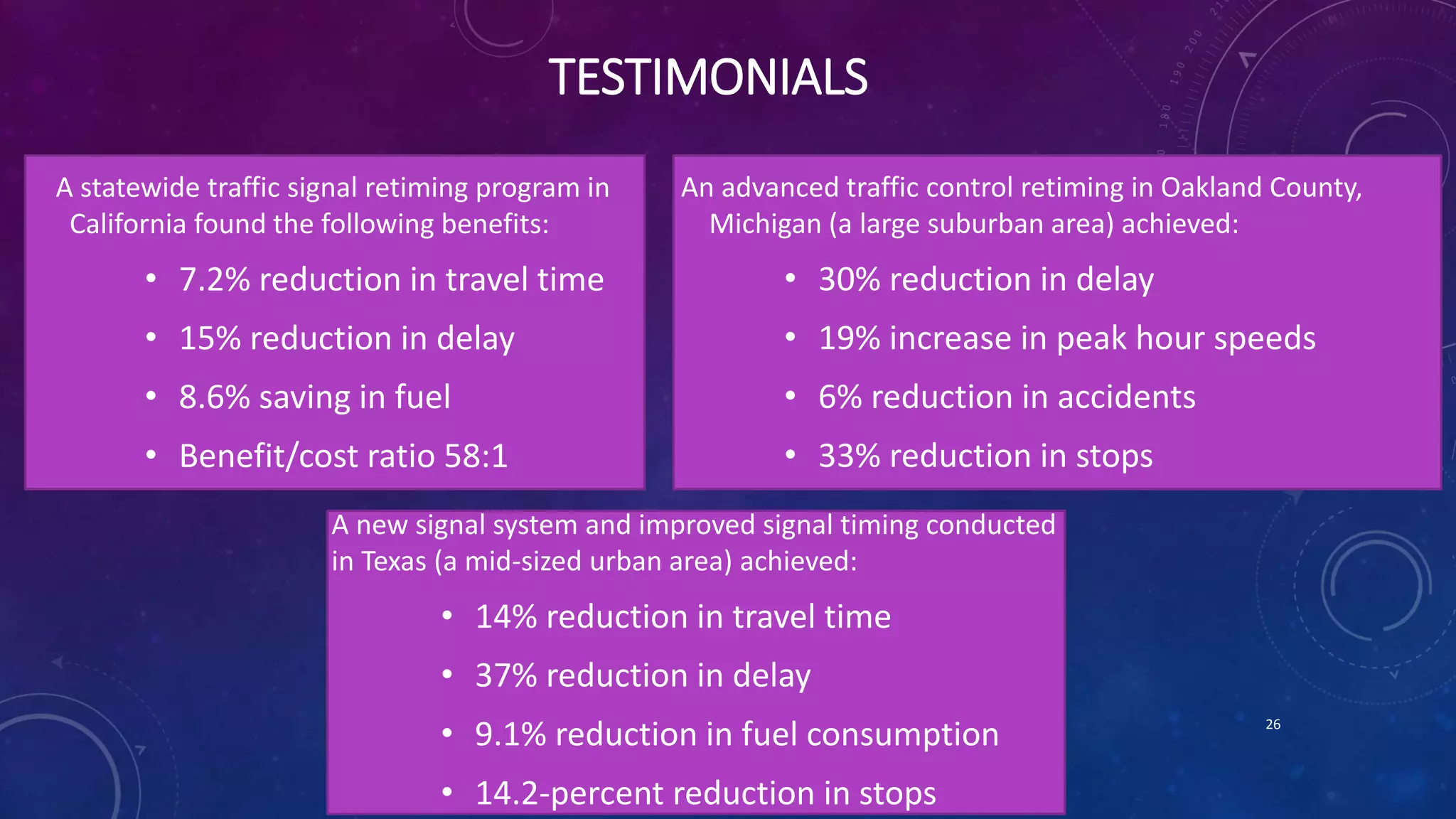
TESTIMONIALS 
A statewide traffic signal retiming program in 
California found the following benefits: 
• 7.2% reduction in travel time 
• 15% reduction in delay 
• 8.6% saving in fuel 
• Benefit/cost ratio 58:1 
An advanced traffic control retiming in Oakland County, 
Michigan (a large suburban area) achieved: 
• 30% reduction in delay 
• 19% increase in peak hour speeds 
• 6% reduction in accidents 
• 33% reduction in stops 
A new signal system and improved signal timing conducted 
in Texas (a mid-sized urban area) achieved: 
• 14% reduction in travel time 
• 37% reduction in delay 
• 9.1% reduction in fuel consumption 
• 14.2-percent reduction in stops 
26
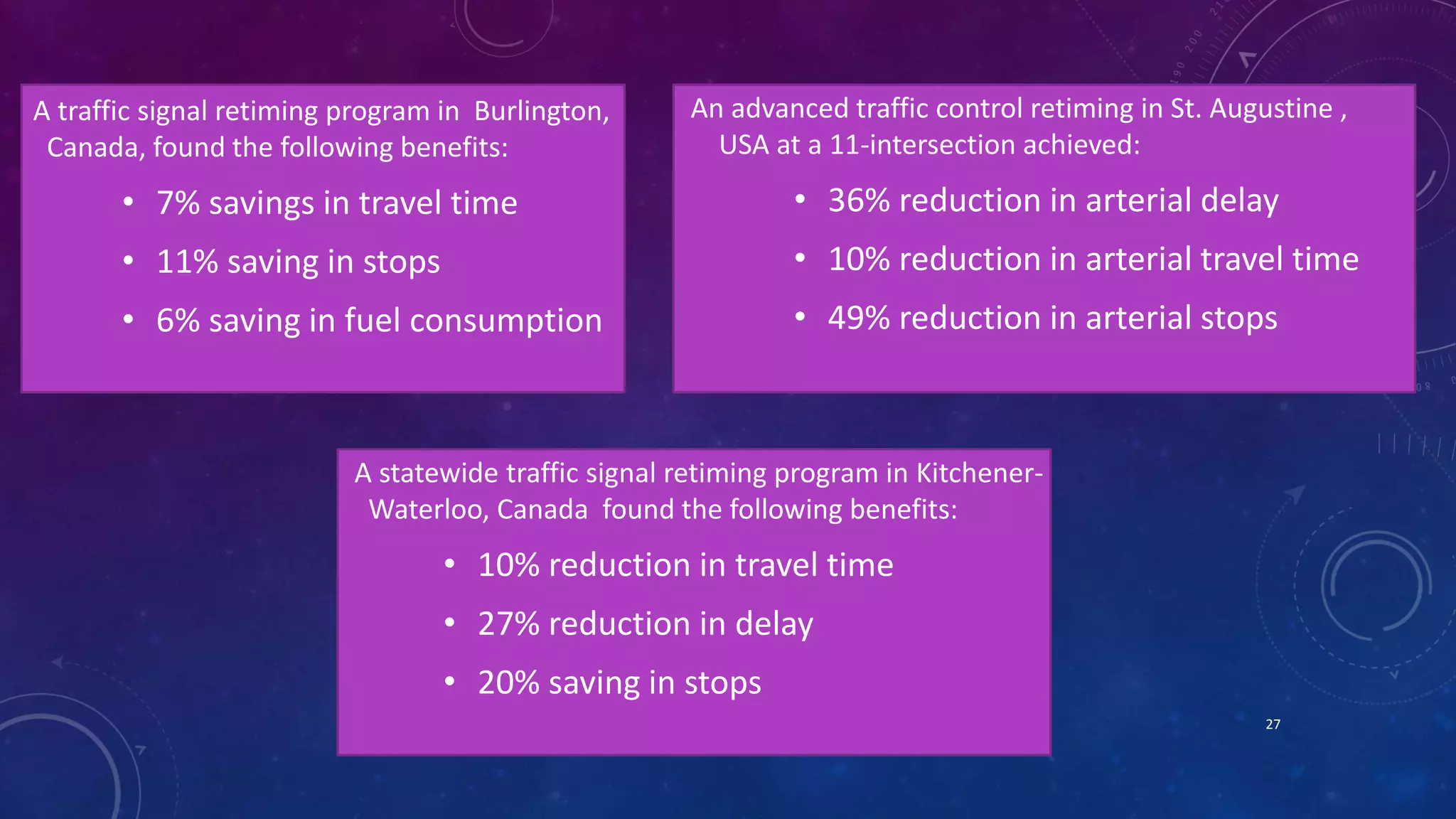
A traffic signal retiming program in Burlington, 
Canada, found the following benefits: 
• 7% savings in travel time 
• 11% saving in stops 
• 6% saving in fuel consumption 
An advanced traffic control retiming in St. Augustine , 
USA at a 11-intersection achieved: 
• 36% reduction in arterial delay 
• 10% reduction in arterial travel time 
• 49% reduction in arterial stops 
A statewide traffic signal retiming program in Kitchener- 
Waterloo, Canada found the following benefits: 
• 10% reduction in travel time 
• 27% reduction in delay 
• 20% saving in stops 
27
REFERENCES 
 ITE JOURNAL / APRIL 2004 
 GOOGLE 
 GOOGLE IMAGES 
28
29 
THANK YOU ....... 

Traffic signal

  • 1.
    SIGNAL RETIMING BY-ALOK KUMAR TRIPATHI 131109037 1 TRAFFIC AND TRANSPORT PLANNING MAULANA AZAD NATIONAL INSTITUTE OF TECHNOLOGY ,BHOPAL
  • 2.
    STRUCTURE OF THEPRESENTATION • AIM & OBJECTIVE • WHAT IS SIGNAL RETIMING ? • PARAMETERS • WHY IS SIGNAL RETIMING CONDUCTED? • HOW IS SIGNAL RETIMING CONDUCTED? • WHO RETIMES TRAFFIC SIGNALS? • CONSTRAINTS OF OPTIMIZING AND OPERATING TRAFFIC SIGNALS? • HOW OFTEN SHOULD SIGNAL RETIMING BE CONDUCTED? • WHAT IS THE COST OF RETIMING TRAFFIC SIGNALS? • BENEFITS OF RETIMING TRAFFIC SIGNALS • TESTIMONIALS 2
  • 3.
    • AIM :-TO UNDERSTAND SIGNAL RETIMING AND ITS BENEFITS . • OBJECTIVE :- SIGNAL RETIMING - WHAT  WHY  HOW  WHO RETIMES  CONSTRAINTS  BENEFITS 3
  • 4.
    WHAT IS SIGNALRETIMING ? Signal retiming is a process that optimizes the operation of signalized inter- sections through a variety of low-cost improvements. This includes :- • The development and implementation of new signal timing parameters • Phasing sequences • Improved control strategies • The minimization of stops, delays, fuel consumption and air pollution emissions and the maximization of progressive movement through a system • Reconfiguration of a signal’s operation • Minor roadway improvements 4
  • 5.
    PARAMETERS :- •Cycle :- the time needed to serve all phases. • Offset :- the time from a reference point, such as the start of green or yellow of the coordinated phase at one intersection, to the same reference point at the other intersections. • Split :- the time allowed for each movement or phase . Their total is the cycle length. • Progressive movement :-The offset is used to allow vehicles moving at the proper speed to advance from intersection to intersection without stopping. This process is called progressive movement. 5
  • 6.
    TERMS RELATING TOSIGNAL TIMING Offset Split phase Phase 1A Phase 1B All signal analyses are based on through passenger cars. This way the analyses became portable to any sites. Then we need conversion of other-than-passenger cars and other-than-through vehicles. Hence we need: • Passenger car equivalent • (TPuCrnEi)ng movement factors 6
  • 7.
    TERMS RELATING TOSIGNAL TIMING Cycle length Phase Interval Change interval All-red interval (clearance interval) Controller Phase B 7
  • 8.
    WHY IS SIGNALRETIMING CONDUCTED? • Increase in traffic with the addition of new homes or stores • Reduced delay time on the approach to an intersection • Postpone or eliminate need for additional capacity • Maximizes the benefits of the existing infrastructure • Reduces aggressive driving behavior, red light running 8
  • 9.
    • Saves timefor commercial vehicles, emergency vehicles, buses and the public • Safety – reduce accidents by providing smoother traffic flow with fewer stops • Accommodation of traffic flow for different times of day or days of the week • Improved pedestrian flow, side-street movements • Municipal cost and energy savings • Cost effective: cost ratios of 40:1 9
  • 10.
    OBJECTIVES OF SIGNALTIMING • Reduce the average delay of all vehicles • Reduce the probability of accidents Minimize the possible conflict points by assigning the right of way to different traffic movements Two conflicting objectives:  More phases, less conflict  More phases, more lost time So, if at all possible, use:  2 phases  Short cycle length 10
  • 11.
    HOW IS SIGNALRETIMING CONDUCTED? • Travel time data , traffic and pedestrian volume data are collected , to identify current operating conditions. • A collision history and analysis are prepared. Collision records for the past three years are obtained. • Collected data are processed and analyzed using capacity analysis, traffic signal timing optimization and simulation software programs. • Determination of improved coordination offsets using signal coordination software programs such as SYNCHRO ,PASSER II or CORSIM (simulation software programs). • Implementation , evaluation and final adjustments of new timing 11
  • 12.
    WHO RETIMES TRAFFICSIGNALS? Agency responsible for the operation of the road- ways where signals are located. State departments of transportation (DOT) Local counties and municipalities that have responsibility for the operation of signals within their jurisdictions . Political bodies, planning organizations and other advisory committees. The public is involved as complaints and requests often are received with requests to update studies or make signal timing improvements. 12
  • 13.
    CONSTRAINTS OF OPTIMIZINGAND OPERATING TRAFFIC SIGNALS? • constraints, can be bro- ken into three general categories: 1. Institutional 2. Physical 3. Temporal 13
  • 14.
    Institutional constraints onsignal timing optimization pertain to the allocation of resources within an organization or agency and the relationship agencies have across jurisdictional boundaries. • Lack of cooperative working arrangements in multiple agencies • Different priorities on signal control and equipment incompatibilities in separate agencies INSTITUTIONAL CONSTRAINTS REASONS SOLUTIONS Sufficient resources (in terms of staff time and/or outsourcing contracts) should be available. 14
  • 15.
    PHYSICAL CONSTRAINTS Physicalconstraints are geometric barriers to more efficient signal operation. • Turn pockets of insufficient length, a lack of necessary turn pockets, or too few primary lanes for servicing traffic demand (lack of capacity). • Irregular and/or close signal spacing • Mid-block access points may contribute enough traffic to the arterial to interfere with progression between intersections. REASONS SOLUTION In such cases, green time allocation at a signal may be used to attempt to compensate for the limiting geometric feature(s). 15
  • 16.
    TEMPORAL CONSTRAINTS Temporal(time) constraints are related to a signal’s inability to consistently provide adequate green time for traffic demand. • Too much traffic for an intersection to physically process, • Fluctuations in demand patterns • Or when too many conflicting movements require excessive green time. REASONS Green time must be diverted for priority and safety reasons, regardless of capacity conditions at an intersection. SOLUTIONS 16
  • 17.
    NATIONAL TRAFFIC SIGNAL REPORT CARD 17
  • 18.
    HOW OFTEN SHOULDSIGNAL RETIMING BE CONDUCTED? Existing signal timing cannot operate efficiently with newer traffic patterns. Signal timing should be fine-tuned to operate better. For traffic signals to operate efficiently, the complete retiming of a traffic signal or system often is necessary. • Traffic engineers should review traffic signal and system performance continuously. • Ideally, signal timing should be reviewed every year to evaluate effectiveness and efficiency. If necessary, a thorough signal retiming should be conducted. • At a minimum, an operating agency should budget to retime traffic signals at least every three years, especially in developing areas and/or areas with sustained growth. 18
  • 19.
    WHAT IS THECOST OF RETIMING TRAFFIC SIGNALS? Signal retiming often is postponed or ignored due to an agency’s financial or staffing constraints. Given the need for field data collection, data analysis, signal timing optimization, testing and implementation, the overall signal timing process can be expensive and time consuming. However, as discussed earlier, retiming traffic signals is necessary to maintain efficient traffic operations. • Estimates of the time required vary according to available expertise and equipment. On average, it is estimated that generating four timing plans (for a.m. peak, noon peak, p.m. peak and off-peak conditions) takes 25 to 30 hours per intersection. • The cost of signal retiming is roughly $2,500 per intersection, including the four typical timing plans. 19
  • 20.
    BENEFITS OF RETIMINGTRAFFIC SIGNALS There are three types of benefits : DIRECT BENEFITS SIDE BENEFITS INDIRECT BENEFITS 20
  • 21.
    • The reduceddelay experienced by motorists. • Motorists experience fewer stops and reduced fuel consumption. DIRECT BENEFITS • General public perception of reduced delay during travel. • Reduced motorist frustration and improved safety. SIDE BENEFITS • Minimizes diversion of traffic to local and residential neighborhoods, potentially improving safety and traffic conditions. • Reduced pavement wear and tear , which minimizes the maintenance requirements of the PWD. INDIRECT BENEFITS 21
  • 22.
    ENVIRONMENTAL BENEFIT Reducedfuel consumption reduces emissions and, hence, improves air quality. Less Congestion Improved Fuel Consumption Vehicle Emissions Reduced Improved Air Quality 22
  • 23.
    DELAY AT TRAFFICSIGNALS Time (years) Delay Do Nothing Periodic Retiming Constant Retiming 23
  • 24.
    Time (years) Delay “WOW!!! 30% Improvement!!!” Do Nothing 24
  • 25.
    SAVINGS FROM SIGNALRETIMING Savings at the end of 9 years — Area A + B A B C 1 2 3 4 5 6 7 8 9 10 Years User costs If retimed only once at the end of 3 years Savings at the end of 6 years — Area A If retimed at the end of 3 and 6 years Savings at the end of 9 years — Area A + B + C 25
  • 26.
    TESTIMONIALS A statewidetraffic signal retiming program in California found the following benefits: • 7.2% reduction in travel time • 15% reduction in delay • 8.6% saving in fuel • Benefit/cost ratio 58:1 An advanced traffic control retiming in Oakland County, Michigan (a large suburban area) achieved: • 30% reduction in delay • 19% increase in peak hour speeds • 6% reduction in accidents • 33% reduction in stops A new signal system and improved signal timing conducted in Texas (a mid-sized urban area) achieved: • 14% reduction in travel time • 37% reduction in delay • 9.1% reduction in fuel consumption • 14.2-percent reduction in stops 26
  • 27.
    A traffic signalretiming program in Burlington, Canada, found the following benefits: • 7% savings in travel time • 11% saving in stops • 6% saving in fuel consumption An advanced traffic control retiming in St. Augustine , USA at a 11-intersection achieved: • 36% reduction in arterial delay • 10% reduction in arterial travel time • 49% reduction in arterial stops A statewide traffic signal retiming program in Kitchener- Waterloo, Canada found the following benefits: • 10% reduction in travel time • 27% reduction in delay • 20% saving in stops 27
  • 28.
    REFERENCES  ITEJOURNAL / APRIL 2004  GOOGLE  GOOGLE IMAGES 28
  • 29.
    29 THANK YOU....... 