A presentation on
QUEUEING ANALYSIS USING VISSIM
SOFTWARE
Under the guidance of
Internal guides :
Rahul L Kadam
Assistant professor
Dept. of Civil Engineering, RITM, Bengaluru.
by
Ramkrishna P Jagali
USN : 1RE14CTE12
P S Reddy
P.G Coordinator
Dept. of Civil Engineering, RITM,
Bengaluru.
1
Contents
• Introduction
• Methodology
• Literature review
• Study location
• Data collection
• Data analysis
• Results
• Conclusions
• References
2
Introduction
The growth in urban traffic has been recognized as serious problem
in metropolitan areas in the country, with significant effect on
economy, travel behavior, land use and cause of discomfort for
millions of motorists.
Bangalore today is obviously one of the most sought after cities in
the country what with the rapid growth in the IT industry and the
rise in the number of job opportunities in the city.
With the rising population there is also a corresponding increase in
number of vehicles in the city and huge increase in the demand in
land.
What adds to the traffic pressure in Bangalore in particular is that
there is very little scope for expansion of roads and the need to use
existing roads for smooth movement of vehicles is even more
pronounced.
3
Continued..
 It thus becomes mandatory for the administration to ensure better
parking facilities.
According to BTRAC-2010 website rapid population growth
because of IT and other associated industries in Bangalore has led
to an increase in the vehicular population to about 1.5 million,
with an annual growth rate of 7-10%.With the increase in
population and the expansion of the city, the problem of
connectivity of the populace has arisen.
 Quite obviously personalized modes of transport have grown at a
tremendous rate and two wheelers along with the cars almost
comprise 90% of the total registered vehicular population in the
city. Two wheelers constitute more than 70% of the total volume,
while cars comprise 15%, autos 4% and the remaining 8%
includes other vehicles such as buses, vans and tempos.
4
V/C ratios of different roads of Bangalore (Source: BTRAC
website)
5
Composition of vehicles in Bangalore City (Upto 31-12-2009)
In peak hours, travel speed will be below 15 kmph.
On street parking is more because lack of parking space.
Immense increase of Private Vehicles on road, reducing the space
for Public Vehicles.
6
Objectives
 To obtain the PCU values at selected intersections.
 To Understand the driver behavior by measuring the Discharge
speed in the field
 To measure saturation flow of the approaches.
 To compare the delays obtained using micro simulation software,
VISSIM with the observed field delays.
7
Methodology
Intersection
geometry study
Signal cycle
study
Volume
study
Driver
behavior
study
Delay study
8
Literature review
 Sarna and Malhotra (1967) have developed the relationship
between the saturation flow and the approach road width at
signalised intersection. The results had showed that the
saturation flow increases with the increase in approach
volume.
 Gopal patil et.al (2007) have developed regression models in
his study to estimate saturation flow at signalized intersections.
The model was developed and validated on the basis of data
collected from Mumbai, India. They remarked that PCU
calculation is uneven at the selected intersections.
 Shuguo Yang et.al (2014) have sets up the queuing model,
analyses the traffic flow of Shenzhen intersection through
analyzing the queuing theory deeply, and uses the model to
analyze the settings of the lane that based on the certain degree
of accuracy. 9
Study Location
Signalized intersections are important crossing
points in transportation network and their
productivity of operation greatly influences the
entire transportation network performance.
Following are the intersection selected for the
study;
Vijayanagar TTMC Intersection
Attiguppe Metro Station Intersection
10
Intersection at Vijayanagar TTMC
11
Intersection at Attiguppe Metro Station
12
Data collection
Types of surveys conducted
Road inventory survey
Road width, carriageway width, footpath width
No of Lanes, Lane width, Approach width
Traffic survey
Classified volume count
Spot speed study
Traffic signal survey
13
Classified volume count
Video camera was used to do the classified traffic
volume count on the field. Video based method
minimizes the human errors and overcomes the
difficulties in collecting traffic information.
Advantages of Video graphic method;
 It is unobtrusive and requires small labour power
 It produces permanent, complete record of the
traffic scene
 Recording may be re-analysed at any stage
14
Spot speed study
Stop watch method is used.
15
Data analysis
Geometric and signal cycle details
Intersection Study Approaches Area type Carriagew
ay width
(m)
Cycle time (sec) Green excluding
amber (sec)
Vijayanagar TTMC
Intersection
From Vijayanagar CBD 7.5 167 45
From Attiguppe
Metro Station
CBD 7.5 167 35
From RPC Layout CBD 6.0 167 20
From Marenahalli CBD 6.0 167 25
From TTMC CBD 7.0 167 27
Attiguppe Metro
Station
From Vijayanagar CBD 7.5 120 40
From
Deepanjalinagar
CBD 7.5 120 40
From Chandra
Layout
CBD 7.0 120 95
16
Signal Phase details at Vijayanagar TTMC
intersection
Phase
Study Approach 1 2 3 4 5 Cycle
time
From Vijayanagar R L S
167
From Attiguppe Metro
Station
R L S
From RPC Layout R L S
From Marenahalli R L S
From TTMC R S
27 25 45 35 20
17
Signal Phase details at Attiguppe Metro
Station intersection
Phase
Study Approach 1 2 3 Cycle time
From Vijayanagar R L S
120
From Deepanjalinagar R L S
From Chandra Layout R L S
40 40 31
18
Vehicle composition and turning movements at
Vijayanagar TTMC intersection
19
Vehicle composition and turning movements
at Attiguppe Metro Station intersection
20
Estimated PCU Values
TYPE OF
VEHICLE
MEAN SPEED
(kmph) Vs
Vs/Vi As/Ai PCU PCU
Car 41.43 1 1 1 1
Two wheelers 35.04 1.182363014 4.491666667 0.263234808 0.3
Truck 37.78 1.096611964 0.305902384 3.584842821 3.6
Bus 38.94 1.06394453 0.217865804 4.883485654 4.9
LCV 33.47 1.237824918 0.420765027 2.941843636 2.9
Auto 32.56 1.272420147 1.203125 1.057595967 1.1
Cycle 13.32 3.11036036 6.341176471 0.490502098 0.5
Mini Bus 35.23 1.175986375 0.331081081 3.551958848 3.621
Vehicle dimensions Considered for PCU
Calculation
Category of vehicle Average dimensions (m)
Projected area on
ground (m2)
Length width
Car 3.72 1.44 5.39
Two wheelers 1.87 0.64 1.2
Truck 7.5 2.35 17.62
Bus 10.1 2.43 24.74
LCV 6.1 2.1 12.81
Auto 3.2 1.4 4.48
Cycle 1.9 0.45 0.85
Mini Bus 7.4 2.2 16.28
22
Queue delay
23
24
Saturation flow
25
Continued..
26
Saturation flow measured flow
Name of Intersection Lane Group Average
Saturation
Flow in
veh/hr
Width in m Volume in
veh/hr
Vijayanagar TTMC
intersection
From Vijayanagar
3196
7.5 3292
From Attiguppe Metro Station 3196 27277.5 3256
From RPC Layout 2604 6.0 525
From Marenahalli
2692
6.0 527
From TTMC
104
7.0 76
Attiguppe Metro Station
intersection
From Vijayanagar
2966
7.5 2611
From Deepanjalinagar
2978
7.5 2649
From Chandra Layout
2890
7.0 2150
27
VISSIM Inputs
Geometric features of road
Vehicle category
Traffic volume
Vehicle routing
Vehicle composition
Signal time
28
Signal time
29
Results
Vijayanagar TTMC Intersection - Existing
30
Vijayanagar TTMC Intersection – Proposal
31
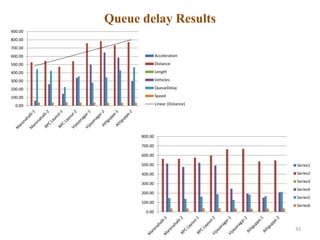
Queue delay Results
Count
Time
Interval
Data Collection
Measurement
Accelera
tion
Distance Length
Queue
Delay
Speed
Queue
Delay
Speed
1 0-3600 Marenahalli-1 0.11 527.08 4.42 442.36 38.07 146.92 36.41
1 0-3600 Marenahalli-2 0.09 544.66 2.96 423.81 38.73 138.85 36.59
1 0-3600 RPC Layout-1 0.15 473.04 7.86 226.22 42.76 161.51 38.22
1 0-3600 RPC Layout-2 0.13 539.98 3.68 357.51 38.56 188.34 38.36
1 0-3600 Vijayanagar-1 0.54 758.84 5.83 278.48 38.21 127.72 36.36
1 0-3600 Vijayanagar-2 0.42 784.80 3.02 346.43 34.07 182.90 32.84
1 0-3600 Attiguppe-1 0.40 735.95 2.83 429.81 34.99 166.49 36.02
1 0-3600 Attiguppe-2 0.60 771.38 3.93 467.33 35.98 213.35 36.17
32
Queue delay Results
0.00
100.00
200.00
300.00
400.00
500.00
600.00
700.00
800.00
900.00
Acceleration
Distance
Length
Vehicles
QueueDelay
Speed
Linear (Distance)
0.00
100.00
200.00
300.00
400.00
500.00
600.00
700.00
800.00
Series1
Series2
Series3
Series4
Series5
Series6
33
Queue length results
Table 4.8 TTMC Intersection Existing – Queue length results
Count Time Interval Queue Counter Queue
Length
Queue Length
Max
Queue
Length
Queue
Length
Max
1 0-3600 Attiguppe 314.09 355.49 54.49 161.68
1 0-3600 Vijayanagar 424.71 476.63 118.63 255.48
1 0-3600 TTMC 54.57 152.22 12.95 67.69
34
Queue length results
0
500
1000
1500
2000
2500
3000
1: Attiguppe 2: Vijayanagar 3: TTMC
Q_Length
Q_LengthMax
Q_Stops
0
500
1000
1500
2000
2500
3000
3500
4000
4500
5000
Attiguppe Vijayanagar TTMC
Q_Length
Q_LengthMax
Q_Stops
35
Travel time results
Table 4.9 Vijayanagar TTMC Intersection Existing – Travel time results
Coun
t
Name Distance (m) Distance
Travel Time
(sec)
Speed (m/s)
Travel Time
(sec)
Speed (m/s)
1 0-3600 Attiguppe BX 343.13 435.40 0.79 135.21 2.54
1 0-3600 Attiguppe AX 465.06 76.79 6.06 67.66 6.90
1 0-3600 Vijayanagar BX 466.52 603.85 0.77 311.89 1.49
1 0-3600 Vijayanagar AX 345.12 53.22 6.49 45.71 7.55
36
Travel time results
0.00
50.00
100.00
150.00
200.00
250.00
300.00
350.00
400.00
450.00
500.00
Attiguppe BX Attiguppe AX Vijanagar BX Vijayanagar
AX
Distance
TravelTime (sec)
Speed (m/s)
0.00
100.00
200.00
300.00
400.00
500.00
600.00
700.00
Attiguppe BX Attiguppe AX Vijayanagar BXVijayanagar AX
Distance
TravelTime (sec)
Speed (m/s)
37
Attiguppe Metro Station Intersection – Existing
38
Attiguppe Metro Station Intersection - Proposal
39
Queue delay results
Coun
t
Time
Interval
Data Collection
Measurement
Acceleration Distance Length
Queue
Delay
Speed
Queue
Delay
Speed
1 0-3600 Chandra Layout-1 0.593372 538.8475 2.676744 171.84 32.00 173.46 31.99
1 0-3600 Chandra Layout-2 0.534684 493.5409 2.649289 168.14 31.88 166.52 31.85
1 0-3600 Deepanjalinagar-1 0.515374 499.4688 2.819426 153.93 32.46 153.05 32.49
1 0-3600 Deepanjalinagar-2 0.529792 659.033 2.915383 180.59 32.15 0.01 46.47
1 0-3600 Vijayanagar-1 0.511549 665.4033 2.553224 172.77 32.04 0.24 32.04
1 0-3600 Vijayanagar-2 0.5496 528.4226 2.986568 163.71 31.49 161.48 31.49
40
Queue delay results
0
200
400
600
800
1000
1200
1400
1600
1800
2000
Acceleration
Distance
Length
Vehicles
QueueDelay
Speed
0
100
200
300
400
500
600
700
Acceleration
Distance
Length
Vehicles
QueueDelay
Speed
41
Queue length results
Count Time Interval Queue Counter Queue
Length
Queue Length
Max
Queue
Length
Queue
Length
Max
1 0-3600 Vijayanagar 258.68 316.03 0.23 74.39
1 0-3600 Deepanjalinagar 284.96 342.69 0.00 0.00
42
Queue length results
0
10
20
30
40
50
60
70
80
Vijayangar Deepnajalinagar
Q_Length
Q_LengthMax
Q_Stops
0
200
400
600
800
1000
1200
1400
1600
1800
2000
Vijayangar Deepnajalinagar
Q_Length
Q_LengthMax
Q_Stops
43
Travel time results
Count Name Distance (m) Distance Travel Time (sec) Speed (m/s)
Travel Time
(sec)
Speed (m/s)
1 0-3600
Deepanjalinagar
BX 303.61 229.43 1.32 66.53 4.56
1 0-3600
Deepanjalinagar
AX 332.73 57.88 5.75 60.95 5.46
1 0-3600 Vijayanagar BX 331.09 244.14 1.36 37.40 8.85
1 0-3600 Vijayanagar AX 302.90 52.41 5.78 33.04 9.17
44
Travel time results
0
50
100
150
200
250
300
350
Deepanjali BX Deepnajali AX Vijayanagar BX Vijayanagar AX
Distance
TravelTime (sec)
Speed (m/s)
0
50
100
150
200
250
300
350
Deepanjali BX Deepnajali AX Vijayanagar BX Vijayanagar
AX
Distance
TravelTime (sec)
Speed (m/s)
45
Conclusions
 The field delay measured shows that all the approaches
considered for the present study have a level of service F.
The v/c ratios of the approaches are also less than one
and good progression is observed during green cycle.
 The field delay measured shows that all the approaches
considered for the present study have a level of service B.
The v/c ratios of the approaches are also less than one
and good progression is observed during green cycle.
 Queue delay, Queue length and Travel time have been
reduced and level of service also increased from F to B.
46
References
• Shuguo Yang, Xiaoyan Yang., “The Application of the Queuing
Theory in the Traffic Flow of Intersection”, World Academy of
Science, Engineering and Technology International Journal of
Mathematical, Computational, Physical, Electrical and Computer
Engineering Vol:8, No:6, 2014
• Anusha, C. S., Ashish Verma, and G. Kavitha. "Effects of Two-
Wheelers on Saturation Flowat Signalized Intersections in
Developing Countries", Journal of Transportation Engineering,
2013.
• Ahmad Sadegh and A. Essam Radwan, (1988) “Comparative
Assessment Of 1985 Hcm Delay Model” Journal of
Transportation Engineering, Vol. 114, No. 2, March, 1988.
• Ragab M. Mousa (2002), “Accuracy of Stopped Delay Measured
by Stopped-Vehicle Counts Method” Journal of Transportation
Engineering, Vol. 128, No. 5, September 1, 2002. ©ASCE.
47

Traffic Queueing analysis using VISSIM Software by RK

  • 1.
    A presentation on QUEUEINGANALYSIS USING VISSIM SOFTWARE Under the guidance of Internal guides : Rahul L Kadam Assistant professor Dept. of Civil Engineering, RITM, Bengaluru. by Ramkrishna P Jagali USN : 1RE14CTE12 P S Reddy P.G Coordinator Dept. of Civil Engineering, RITM, Bengaluru. 1
  • 2.
    Contents • Introduction • Methodology •Literature review • Study location • Data collection • Data analysis • Results • Conclusions • References 2
  • 3.
    Introduction The growth inurban traffic has been recognized as serious problem in metropolitan areas in the country, with significant effect on economy, travel behavior, land use and cause of discomfort for millions of motorists. Bangalore today is obviously one of the most sought after cities in the country what with the rapid growth in the IT industry and the rise in the number of job opportunities in the city. With the rising population there is also a corresponding increase in number of vehicles in the city and huge increase in the demand in land. What adds to the traffic pressure in Bangalore in particular is that there is very little scope for expansion of roads and the need to use existing roads for smooth movement of vehicles is even more pronounced. 3
  • 4.
    Continued..  It thusbecomes mandatory for the administration to ensure better parking facilities. According to BTRAC-2010 website rapid population growth because of IT and other associated industries in Bangalore has led to an increase in the vehicular population to about 1.5 million, with an annual growth rate of 7-10%.With the increase in population and the expansion of the city, the problem of connectivity of the populace has arisen.  Quite obviously personalized modes of transport have grown at a tremendous rate and two wheelers along with the cars almost comprise 90% of the total registered vehicular population in the city. Two wheelers constitute more than 70% of the total volume, while cars comprise 15%, autos 4% and the remaining 8% includes other vehicles such as buses, vans and tempos. 4
  • 5.
    V/C ratios ofdifferent roads of Bangalore (Source: BTRAC website) 5
  • 6.
    Composition of vehiclesin Bangalore City (Upto 31-12-2009) In peak hours, travel speed will be below 15 kmph. On street parking is more because lack of parking space. Immense increase of Private Vehicles on road, reducing the space for Public Vehicles. 6
  • 7.
    Objectives  To obtainthe PCU values at selected intersections.  To Understand the driver behavior by measuring the Discharge speed in the field  To measure saturation flow of the approaches.  To compare the delays obtained using micro simulation software, VISSIM with the observed field delays. 7
  • 8.
  • 9.
    Literature review  Sarnaand Malhotra (1967) have developed the relationship between the saturation flow and the approach road width at signalised intersection. The results had showed that the saturation flow increases with the increase in approach volume.  Gopal patil et.al (2007) have developed regression models in his study to estimate saturation flow at signalized intersections. The model was developed and validated on the basis of data collected from Mumbai, India. They remarked that PCU calculation is uneven at the selected intersections.  Shuguo Yang et.al (2014) have sets up the queuing model, analyses the traffic flow of Shenzhen intersection through analyzing the queuing theory deeply, and uses the model to analyze the settings of the lane that based on the certain degree of accuracy. 9
  • 10.
    Study Location Signalized intersectionsare important crossing points in transportation network and their productivity of operation greatly influences the entire transportation network performance. Following are the intersection selected for the study; Vijayanagar TTMC Intersection Attiguppe Metro Station Intersection 10
  • 11.
  • 12.
    Intersection at AttiguppeMetro Station 12
  • 13.
    Data collection Types ofsurveys conducted Road inventory survey Road width, carriageway width, footpath width No of Lanes, Lane width, Approach width Traffic survey Classified volume count Spot speed study Traffic signal survey 13
  • 14.
    Classified volume count Videocamera was used to do the classified traffic volume count on the field. Video based method minimizes the human errors and overcomes the difficulties in collecting traffic information. Advantages of Video graphic method;  It is unobtrusive and requires small labour power  It produces permanent, complete record of the traffic scene  Recording may be re-analysed at any stage 14
  • 15.
    Spot speed study Stopwatch method is used. 15
  • 16.
    Data analysis Geometric andsignal cycle details Intersection Study Approaches Area type Carriagew ay width (m) Cycle time (sec) Green excluding amber (sec) Vijayanagar TTMC Intersection From Vijayanagar CBD 7.5 167 45 From Attiguppe Metro Station CBD 7.5 167 35 From RPC Layout CBD 6.0 167 20 From Marenahalli CBD 6.0 167 25 From TTMC CBD 7.0 167 27 Attiguppe Metro Station From Vijayanagar CBD 7.5 120 40 From Deepanjalinagar CBD 7.5 120 40 From Chandra Layout CBD 7.0 120 95 16
  • 17.
    Signal Phase detailsat Vijayanagar TTMC intersection Phase Study Approach 1 2 3 4 5 Cycle time From Vijayanagar R L S 167 From Attiguppe Metro Station R L S From RPC Layout R L S From Marenahalli R L S From TTMC R S 27 25 45 35 20 17
  • 18.
    Signal Phase detailsat Attiguppe Metro Station intersection Phase Study Approach 1 2 3 Cycle time From Vijayanagar R L S 120 From Deepanjalinagar R L S From Chandra Layout R L S 40 40 31 18
  • 19.
    Vehicle composition andturning movements at Vijayanagar TTMC intersection 19
  • 20.
    Vehicle composition andturning movements at Attiguppe Metro Station intersection 20
  • 21.
    Estimated PCU Values TYPEOF VEHICLE MEAN SPEED (kmph) Vs Vs/Vi As/Ai PCU PCU Car 41.43 1 1 1 1 Two wheelers 35.04 1.182363014 4.491666667 0.263234808 0.3 Truck 37.78 1.096611964 0.305902384 3.584842821 3.6 Bus 38.94 1.06394453 0.217865804 4.883485654 4.9 LCV 33.47 1.237824918 0.420765027 2.941843636 2.9 Auto 32.56 1.272420147 1.203125 1.057595967 1.1 Cycle 13.32 3.11036036 6.341176471 0.490502098 0.5 Mini Bus 35.23 1.175986375 0.331081081 3.551958848 3.621
  • 22.
    Vehicle dimensions Consideredfor PCU Calculation Category of vehicle Average dimensions (m) Projected area on ground (m2) Length width Car 3.72 1.44 5.39 Two wheelers 1.87 0.64 1.2 Truck 7.5 2.35 17.62 Bus 10.1 2.43 24.74 LCV 6.1 2.1 12.81 Auto 3.2 1.4 4.48 Cycle 1.9 0.45 0.85 Mini Bus 7.4 2.2 16.28 22
  • 23.
  • 24.
  • 25.
  • 26.
  • 27.
    Saturation flow measuredflow Name of Intersection Lane Group Average Saturation Flow in veh/hr Width in m Volume in veh/hr Vijayanagar TTMC intersection From Vijayanagar 3196 7.5 3292 From Attiguppe Metro Station 3196 27277.5 3256 From RPC Layout 2604 6.0 525 From Marenahalli 2692 6.0 527 From TTMC 104 7.0 76 Attiguppe Metro Station intersection From Vijayanagar 2966 7.5 2611 From Deepanjalinagar 2978 7.5 2649 From Chandra Layout 2890 7.0 2150 27
  • 28.
    VISSIM Inputs Geometric featuresof road Vehicle category Traffic volume Vehicle routing Vehicle composition Signal time 28
  • 29.
  • 30.
  • 31.
  • 32.
    Queue delay Results Count Time Interval DataCollection Measurement Accelera tion Distance Length Queue Delay Speed Queue Delay Speed 1 0-3600 Marenahalli-1 0.11 527.08 4.42 442.36 38.07 146.92 36.41 1 0-3600 Marenahalli-2 0.09 544.66 2.96 423.81 38.73 138.85 36.59 1 0-3600 RPC Layout-1 0.15 473.04 7.86 226.22 42.76 161.51 38.22 1 0-3600 RPC Layout-2 0.13 539.98 3.68 357.51 38.56 188.34 38.36 1 0-3600 Vijayanagar-1 0.54 758.84 5.83 278.48 38.21 127.72 36.36 1 0-3600 Vijayanagar-2 0.42 784.80 3.02 346.43 34.07 182.90 32.84 1 0-3600 Attiguppe-1 0.40 735.95 2.83 429.81 34.99 166.49 36.02 1 0-3600 Attiguppe-2 0.60 771.38 3.93 467.33 35.98 213.35 36.17 32
  • 33.
    Queue delay Results 0.00 100.00 200.00 300.00 400.00 500.00 600.00 700.00 800.00 900.00 Acceleration Distance Length Vehicles QueueDelay Speed Linear(Distance) 0.00 100.00 200.00 300.00 400.00 500.00 600.00 700.00 800.00 Series1 Series2 Series3 Series4 Series5 Series6 33
  • 34.
    Queue length results Table4.8 TTMC Intersection Existing – Queue length results Count Time Interval Queue Counter Queue Length Queue Length Max Queue Length Queue Length Max 1 0-3600 Attiguppe 314.09 355.49 54.49 161.68 1 0-3600 Vijayanagar 424.71 476.63 118.63 255.48 1 0-3600 TTMC 54.57 152.22 12.95 67.69 34
  • 35.
    Queue length results 0 500 1000 1500 2000 2500 3000 1:Attiguppe 2: Vijayanagar 3: TTMC Q_Length Q_LengthMax Q_Stops 0 500 1000 1500 2000 2500 3000 3500 4000 4500 5000 Attiguppe Vijayanagar TTMC Q_Length Q_LengthMax Q_Stops 35
  • 36.
    Travel time results Table4.9 Vijayanagar TTMC Intersection Existing – Travel time results Coun t Name Distance (m) Distance Travel Time (sec) Speed (m/s) Travel Time (sec) Speed (m/s) 1 0-3600 Attiguppe BX 343.13 435.40 0.79 135.21 2.54 1 0-3600 Attiguppe AX 465.06 76.79 6.06 67.66 6.90 1 0-3600 Vijayanagar BX 466.52 603.85 0.77 311.89 1.49 1 0-3600 Vijayanagar AX 345.12 53.22 6.49 45.71 7.55 36
  • 37.
    Travel time results 0.00 50.00 100.00 150.00 200.00 250.00 300.00 350.00 400.00 450.00 500.00 AttiguppeBX Attiguppe AX Vijanagar BX Vijayanagar AX Distance TravelTime (sec) Speed (m/s) 0.00 100.00 200.00 300.00 400.00 500.00 600.00 700.00 Attiguppe BX Attiguppe AX Vijayanagar BXVijayanagar AX Distance TravelTime (sec) Speed (m/s) 37
  • 38.
    Attiguppe Metro StationIntersection – Existing 38
  • 39.
    Attiguppe Metro StationIntersection - Proposal 39
  • 40.
    Queue delay results Coun t Time Interval DataCollection Measurement Acceleration Distance Length Queue Delay Speed Queue Delay Speed 1 0-3600 Chandra Layout-1 0.593372 538.8475 2.676744 171.84 32.00 173.46 31.99 1 0-3600 Chandra Layout-2 0.534684 493.5409 2.649289 168.14 31.88 166.52 31.85 1 0-3600 Deepanjalinagar-1 0.515374 499.4688 2.819426 153.93 32.46 153.05 32.49 1 0-3600 Deepanjalinagar-2 0.529792 659.033 2.915383 180.59 32.15 0.01 46.47 1 0-3600 Vijayanagar-1 0.511549 665.4033 2.553224 172.77 32.04 0.24 32.04 1 0-3600 Vijayanagar-2 0.5496 528.4226 2.986568 163.71 31.49 161.48 31.49 40
  • 41.
  • 42.
    Queue length results CountTime Interval Queue Counter Queue Length Queue Length Max Queue Length Queue Length Max 1 0-3600 Vijayanagar 258.68 316.03 0.23 74.39 1 0-3600 Deepanjalinagar 284.96 342.69 0.00 0.00 42
  • 43.
    Queue length results 0 10 20 30 40 50 60 70 80 VijayangarDeepnajalinagar Q_Length Q_LengthMax Q_Stops 0 200 400 600 800 1000 1200 1400 1600 1800 2000 Vijayangar Deepnajalinagar Q_Length Q_LengthMax Q_Stops 43
  • 44.
    Travel time results CountName Distance (m) Distance Travel Time (sec) Speed (m/s) Travel Time (sec) Speed (m/s) 1 0-3600 Deepanjalinagar BX 303.61 229.43 1.32 66.53 4.56 1 0-3600 Deepanjalinagar AX 332.73 57.88 5.75 60.95 5.46 1 0-3600 Vijayanagar BX 331.09 244.14 1.36 37.40 8.85 1 0-3600 Vijayanagar AX 302.90 52.41 5.78 33.04 9.17 44
  • 45.
    Travel time results 0 50 100 150 200 250 300 350 DeepanjaliBX Deepnajali AX Vijayanagar BX Vijayanagar AX Distance TravelTime (sec) Speed (m/s) 0 50 100 150 200 250 300 350 Deepanjali BX Deepnajali AX Vijayanagar BX Vijayanagar AX Distance TravelTime (sec) Speed (m/s) 45
  • 46.
    Conclusions  The fielddelay measured shows that all the approaches considered for the present study have a level of service F. The v/c ratios of the approaches are also less than one and good progression is observed during green cycle.  The field delay measured shows that all the approaches considered for the present study have a level of service B. The v/c ratios of the approaches are also less than one and good progression is observed during green cycle.  Queue delay, Queue length and Travel time have been reduced and level of service also increased from F to B. 46
  • 47.
    References • Shuguo Yang,Xiaoyan Yang., “The Application of the Queuing Theory in the Traffic Flow of Intersection”, World Academy of Science, Engineering and Technology International Journal of Mathematical, Computational, Physical, Electrical and Computer Engineering Vol:8, No:6, 2014 • Anusha, C. S., Ashish Verma, and G. Kavitha. "Effects of Two- Wheelers on Saturation Flowat Signalized Intersections in Developing Countries", Journal of Transportation Engineering, 2013. • Ahmad Sadegh and A. Essam Radwan, (1988) “Comparative Assessment Of 1985 Hcm Delay Model” Journal of Transportation Engineering, Vol. 114, No. 2, March, 1988. • Ragab M. Mousa (2002), “Accuracy of Stopped Delay Measured by Stopped-Vehicle Counts Method” Journal of Transportation Engineering, Vol. 128, No. 5, September 1, 2002. ©ASCE. 47