

Submitted by Submitted to
Dharmendra Kumar Dr. S.K. Biswas
Ph.D.(Ag) Economics ( Head of the Department)
I.D.-CA- 12385/22
Content
 Meaning and Definition of Trade Cycle
 Nature of Trade Cycle
 Phases of trade Cycle
 Causes of Trade Cycle
 Effect of trade cycle
 Case Study
 Fact and figure
 Measure Tools Trade Cycle
 Controlling tools of trade cycle
 Conclusion
Meaning of Trade Cycle
The trade cycle, also known as the business cycle,
is a term used to describe the fluctuations in
economic activity over time. It encompasses
periods of expansion and contraction in an
economy, affecting production, employment,
investment, and prices . The trade cycle refer to
the ups and down in the level of economic activity
which extends over a period of serval years. If we
examine the past statistical record of the business
condition ,we will find that business has never run
smoothly for ever there many fluctuation in the
period .
Definition
Prof . Keynes says : “ A trade cycle is composed of
period of bad trade characterized prices and high
unemployment percentage while a period of good
trade is characterized by rising prices and high
employment.
Prof. G. Haberler:- “Business cycle in the general sense may be
defined as an alternation of period of prosperity and depression of
good and bad Trade.”
Nature of trade cycle
Cyclical Nature:- The
trade cycle consists of
recurring periods of
economic expansion
and contraction. These
cycle are inherent to
market economies and
reflect changes in
business conditions,
consumer confidence
,and other economic
indicators.
Irregularity:- While
trade cycle are
recurring , they do not
have a fixed duration or
intensity. The length
and severity of each
phase can vary greatly
, making it difficult to
predict the exact timing
of the next cycle.
Synchronicity:-
Economic fluctuation
tend to be synchronized
across different sector
of the economy .When
one sector experiences
growth or decline, it
often leads to similar
trend trends in other
sector due to
interconnected
economic activity.
Cumulative Effects:-
Each phases of the
trade cycle tends to
reinforce itself. For
Example , an increase
in demand during the
expansion phase can
lead to more investment
and employment ,which
future stimulate
economic growth.
International Impact:-
Trade cycle can have a
global reach, as
economic condition in
one country can
influence trade partners
and the international
market . This
interconnectedness
means that a recession
in a major economy can
have worldwide
repercussions.
Phases of trade cycle
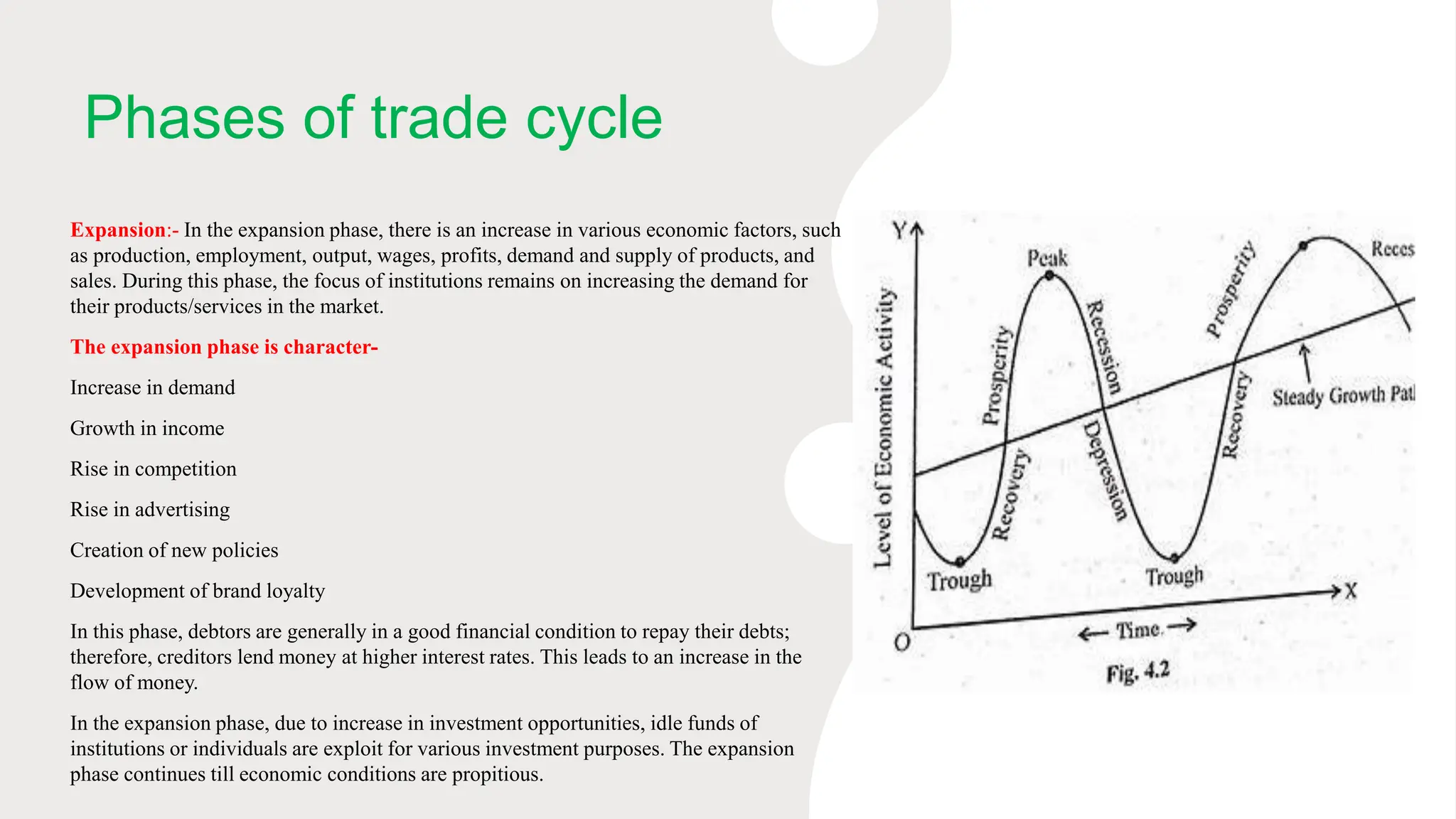
Expansion:- In the expansion phase, there is an increase in various economic factors, such
as production, employment, output, wages, profits, demand and supply of products, and
sales. During this phase, the focus of institutions remains on increasing the demand for
their products/services in the market.
The expansion phase is character-
Increase in demand
Growth in income
Rise in competition
Rise in advertising
Creation of new policies
Development of brand loyalty
In this phase, debtors are generally in a good financial condition to repay their debts;
therefore, creditors lend money at higher interest rates. This leads to an increase in the
flow of money.
In the expansion phase, due to increase in investment opportunities, idle funds of
institutions or individuals are exploit for various investment purposes. The expansion
phase continues till economic conditions are propitious.
Continue
Peak:- Peak is the next phase after expansion. In this phase, a business
reaches at the highest level and the profits are stable. Moreover, company
make plans for further expansion.
Peak phase is marked by the following -
High demand and supply
High revenue and market share
Reduced advertising
Strong brand image
In the peak phase, the economic factors, such as production, profit, sales,
and employment, are higher but do not increase further
Continue………..
Contraction:-An organization after being at the peak for a
period of time begins to decline and enters the phase of
contraction. This phase is also known as a recession. An
organisation can be in this phase due to various reasons, such as a
change in government policies, rise in the level of competition,
disadvantageous economic conditions, and labour problems. Due
to these problems, the organisation begins to experience a loss of
market share.
The important features of the contraction phase are:
Reduced demand
Loss in sales and revenue
Reduced market share
Increased competition
Continue………
Trough:- In Trough phase, an organisation suffers heavy losses and falls at
the lowest point. At this stage, both profits and demand reduce. The
organisation also loses its competitive position.
The main features of this phase are:
Lowest income
Loss of customers
Adoption of measures for cost-cutting and reduction
Heavy fall in market share
In this phase, the growth rate of an economy becomes negative. In addition,
in trough phase, there is a rapid decline in national income and expenditure.
Causes of trade cycle (Internal cause)
Underconsumption:- There
is too much saving during
boom which reduces the level
of consumption. The price
goes on increasing but wages
lag behind The profit of rich
increase at higher rates but
income of the poor does not
increase as compared to price
level. The result is that
demand for consumption
gods decrease.
Unsold stock:- Trade
cycle occurs due to
unsold stock. There is
excess supply of goods
and services but people
are unable to buy goods
of their own choice. The
unsold to buy in
depression.
Import:- The imports
increase the supply of
goods in the economy.
If the total stock of
goods is more than its
demand there is
depression.
Money supply:- The change is
money and credit supply has a
major effect upon the level of
economic activity. An
expansion money and credit
supply. Stimulates economic
activity and its contraction
brings down economic variables
over period of time.
Over investment:-
Excessive investment
in capital goods
industries brings
upswing and a fall in
investment brings
downswing in
economic activity.
Aggregate market:- The
business cycle can also be
caused by changes in
aggregate demand and change
in aggregate supply. The
contraction phase of the
business cycle is caused by
decline in aggregate demand
and expansion phase by
increase in aggregate demand.
Continue
(External
causes)
War:- During war the resources are used for the production of armaments.
As such the output of capital and consumer goods greatly falls. The fall in
output, income, profit etc , causes contraction in economic activity.
Population:- The population increases aggregate demand. The investment,
employment and income go up. There is tendency towards boom. High rate
of inflation will make the bankers nerves. They will take back loan due to
which investment level will shrink.
Science and technology:- The discovery of new material, machines, and
methods helps to produce more at low cost. The invention leads to high
level of competition in the economy. There is big investment in the
economy. There is tendency towards boom.
Government policies:- Govt. polices at home an abroad bring
changes in total spending and hence in the level of economic
activity.
Surplus exports and foreign aid:- Surplus exports and foreign
aid raise the level of consumption and investment spending. The
output income and employment are boosted.
Whether:- The good and bad weather affect the production in agriculture
sector. When weather conditions are bad threes low production in
agriculture, as well as low production in industrial sector. The demand is
the same but output is low so price level goes up.
Effect of trade cycle
Unemployment:- During recession, unemployment tent to rise sharply due to demand – deficient condition.
Inflation:- Inflation rate generally fall during a recession , while rapid economic growth can lead to demand –pull inflation.
Balance of payment:- Rapid economic growth and consumer spending can lead to increase to import, worsening the current
account balance.
Government finances:- recession typically result in deteriorating government finance and larger budget deficits due to reduced
tax revenue and increased welfare payment.
Business confidence:- Economic growth boost consumer and business confidence leading to increase investment and spending.
Interest rate:- Central bank may adjust interest rates in response to economic growth to control inflation which can have a
cooling effect on the economy.
Technological Innovation:- Technological advancements can stimulate economic growth, while a lack of innovation may slow it
down.
Political influence:- political decision can influence economic cycle such as attempts to induces a boom before election.
Historical Example ( Casa
Study) of trade cycle
•A notable historical example of a trade cycle is the Great Depression of the 1930s,
which was a severe worldwide economic downturn. It began after the stock market
crash of 1929 and lasted until the late 1930. This period was marked by significant
decline in industrial production, international trade, and employment , as well as
deflation in almost every country. Real GDP fell 29% from 1929 to 1933.
The unemployment rate reached a peak of 25% in 1933.
Consumer prices fell 25%; wholesale prices plummeted 32%.
Some 7,000 banks, nearly a third of the banking system, failed between 1930 and 1933.
Another example is post -world war II economic expansion, also known as the
Golden Age of Capitalism, which was a period of strong economic growth and
prosperity that lasted from the end of world war II until the early 1970s. This cycle
show high rate of growth in GDP, income and employment, and was driven by factors
such as technological innovation, and expansion of consumer goods, production and
reconstruction of war-torn economies.
Fact and figure
13 million people became unemployed. In 1932, 34 million people belonged to
families with no regular full-time wage earner.
Industrial production fell by nearly 45% between 1929 and 1932.
Homebuilding dropped by 80% between the years 1929 and 1932.
In the 1920s, the banking system in the U.S. was about $50 billion, which was
about 50% of GDP.
From 1929 to 1932, about 5,000 banks went out of business . By 1933, 11,000
of US 25,000 banks had failed.
Between 1929 and 1933, U.S. GDP fell around 30%; the stock market lost
almost 90% of its value.
In 1929, the unemployment rate averaged 3%.
Over one million families lost their farms between 1930 and 1934.
Corporate profits dropped from $10 billion in 1929 to $1 billion in 1932.
Between 1929 and 1932, the income of the average American family was
reduced by 40%.
Sources:- Wikipedia.
Continue…………..
Nine million savings accounts were wiped out between 1930 and 1933.
273,000 families were evicted from their homes in 1932.
There were two million homeless people migrating around the country.
Over 60% of Americans were categorized as poor by the federal government in 1933.
In 1932 deflation was 10.7 percent and real interest rate was 11.49 percent.
New York social workers reported that 25% of all schoolchildren were malnourished . In the
mining counties of West Virginia, Illinois, Kentucky, and Pennsylvania, the proportion of
malnourished children was perhaps as high as 90%.
Many people became ill with diseases such as tuberculosis.
The 1930 U.S. Census determined the U.S. population to be 122,775,046. About 40% of the
population was under 20 years old.
Suicide rates increased; however, life expectancy increased from about 57 years in 1929 to
63 in 1933.
Measures trade cycle
Economic Indicators:- Analysis use indicators like
GDP , unemployment rate ,CPI, and industrial
production figures to measure trade cycle.
Phases:- Recognizing the different phases of trade
cycle –depression, recovery, prosperity and recession is
key to understanding its progression.
Cycle Analysis tools:- tools like the Detrended Price
Oscillator (DPO) and Moving Average Convergence
Divergence (MACD) can help identify cycle highs,
lows, and potential trend reversals.
Controlling Trade Cycles:
Monetary Policy:- Adjustment the supply of money and credit , using tools like Bank rate and open
market operation, can help mitigate the severity of recession and depression.
Bank rate:- The central bank can increase bank rate when there is prosperity. The bank rate can be
reduced in case of depression the borrowing and lending is make according depression the borrowing and
lending is made according to bank rate. The commercial banks help the central bank to control trade
cycle.
Market operation:- The central bank can buy and sell bills and government securities. When money
supply is less as compared to its demand the central bank buy the securities and vice versa. For the
purpose of regulate supply.
Reserve ratio:- The central bank can increase or decrease the reserve ratio. The ratio of reserve is
decreased during depression and increase in expansion.
Continue….
Fiscal policy:- government spending ,taxation and borrowing can be adjusted
to influence economic activity. For example, reducing taxes during recession
can solve leave more money for spending and investment.
Public work:- The government can start public words program during
depression and stop construction of various projects during good trade period.
Public works program help to control trade cycle.
Budget:- The government can prepare surplus budget during boom period.
There is need of deficit budget during deflation. The government can use
budgetary measure along with other methods to control trade cycle.
Public debt:- The government must take loans during depression to meet
various needs. In case of boom the debt should be repaid. The government can
overcome the difficulties of low business activity through public debt.
Import:- The government can allow import of goods, which are needed by
public. During depression there is no need to import the items, but when there is
boom period the supply of goods can be maintained through imports.
Continue….
Investment :- The government may allow
investment in an area where there is low investment.
Excess investment in any sector may lead towards
depression. There is need for balanced investment in
all economic sectors.
Anti-Cyclical Budgeting:- This involves planning
government budget to counteract fluctuations, sch as
increasing spending during and investment.
Automatic stabilization:- These are built in
mechanism, like progressive taxation and welfare
benefits, that automatically adjust to economic
condition without new legislation.
Conclusion
The overall solution to trade cycles involves a
combination of measures aimed at economic
stabilization, price stability, and sustainable growth.
Implementing measures requires careful coordination and
timing to effectively smooth out the fluctuations in economic
activity that characterize trade cycles.
Fluctuations in the trade cycle should be observed from time to
time. And the appropriate combination of tools should be used
as soon as indicated. Otherwise, we may get trapped again in a
situation like the Great Depression and inflation, which can
lead to economic crisis as well as overall destabilization
and high inflation.
Trade cycle or business cycle  with case study

Trade cycle or business cycle with case study

  • 2.
    Submitted by Submittedto Dharmendra Kumar Dr. S.K. Biswas Ph.D.(Ag) Economics ( Head of the Department) I.D.-CA- 12385/22
  • 3.
    Content  Meaning andDefinition of Trade Cycle  Nature of Trade Cycle  Phases of trade Cycle  Causes of Trade Cycle  Effect of trade cycle  Case Study  Fact and figure  Measure Tools Trade Cycle  Controlling tools of trade cycle  Conclusion
  • 4.
    Meaning of TradeCycle The trade cycle, also known as the business cycle, is a term used to describe the fluctuations in economic activity over time. It encompasses periods of expansion and contraction in an economy, affecting production, employment, investment, and prices . The trade cycle refer to the ups and down in the level of economic activity which extends over a period of serval years. If we examine the past statistical record of the business condition ,we will find that business has never run smoothly for ever there many fluctuation in the period .
  • 5.
    Definition Prof . Keynessays : “ A trade cycle is composed of period of bad trade characterized prices and high unemployment percentage while a period of good trade is characterized by rising prices and high employment. Prof. G. Haberler:- “Business cycle in the general sense may be defined as an alternation of period of prosperity and depression of good and bad Trade.”
  • 6.
    Nature of tradecycle Cyclical Nature:- The trade cycle consists of recurring periods of economic expansion and contraction. These cycle are inherent to market economies and reflect changes in business conditions, consumer confidence ,and other economic indicators. Irregularity:- While trade cycle are recurring , they do not have a fixed duration or intensity. The length and severity of each phase can vary greatly , making it difficult to predict the exact timing of the next cycle. Synchronicity:- Economic fluctuation tend to be synchronized across different sector of the economy .When one sector experiences growth or decline, it often leads to similar trend trends in other sector due to interconnected economic activity. Cumulative Effects:- Each phases of the trade cycle tends to reinforce itself. For Example , an increase in demand during the expansion phase can lead to more investment and employment ,which future stimulate economic growth. International Impact:- Trade cycle can have a global reach, as economic condition in one country can influence trade partners and the international market . This interconnectedness means that a recession in a major economy can have worldwide repercussions.
  • 7.
    Phases of tradecycle Expansion:- In the expansion phase, there is an increase in various economic factors, such as production, employment, output, wages, profits, demand and supply of products, and sales. During this phase, the focus of institutions remains on increasing the demand for their products/services in the market. The expansion phase is character- Increase in demand Growth in income Rise in competition Rise in advertising Creation of new policies Development of brand loyalty In this phase, debtors are generally in a good financial condition to repay their debts; therefore, creditors lend money at higher interest rates. This leads to an increase in the flow of money. In the expansion phase, due to increase in investment opportunities, idle funds of institutions or individuals are exploit for various investment purposes. The expansion phase continues till economic conditions are propitious.
  • 8.
    Continue Peak:- Peak isthe next phase after expansion. In this phase, a business reaches at the highest level and the profits are stable. Moreover, company make plans for further expansion. Peak phase is marked by the following - High demand and supply High revenue and market share Reduced advertising Strong brand image In the peak phase, the economic factors, such as production, profit, sales, and employment, are higher but do not increase further
  • 9.
    Continue……….. Contraction:-An organization afterbeing at the peak for a period of time begins to decline and enters the phase of contraction. This phase is also known as a recession. An organisation can be in this phase due to various reasons, such as a change in government policies, rise in the level of competition, disadvantageous economic conditions, and labour problems. Due to these problems, the organisation begins to experience a loss of market share. The important features of the contraction phase are: Reduced demand Loss in sales and revenue Reduced market share Increased competition
  • 10.
    Continue……… Trough:- In Troughphase, an organisation suffers heavy losses and falls at the lowest point. At this stage, both profits and demand reduce. The organisation also loses its competitive position. The main features of this phase are: Lowest income Loss of customers Adoption of measures for cost-cutting and reduction Heavy fall in market share In this phase, the growth rate of an economy becomes negative. In addition, in trough phase, there is a rapid decline in national income and expenditure.
  • 11.
    Causes of tradecycle (Internal cause) Underconsumption:- There is too much saving during boom which reduces the level of consumption. The price goes on increasing but wages lag behind The profit of rich increase at higher rates but income of the poor does not increase as compared to price level. The result is that demand for consumption gods decrease. Unsold stock:- Trade cycle occurs due to unsold stock. There is excess supply of goods and services but people are unable to buy goods of their own choice. The unsold to buy in depression. Import:- The imports increase the supply of goods in the economy. If the total stock of goods is more than its demand there is depression. Money supply:- The change is money and credit supply has a major effect upon the level of economic activity. An expansion money and credit supply. Stimulates economic activity and its contraction brings down economic variables over period of time. Over investment:- Excessive investment in capital goods industries brings upswing and a fall in investment brings downswing in economic activity. Aggregate market:- The business cycle can also be caused by changes in aggregate demand and change in aggregate supply. The contraction phase of the business cycle is caused by decline in aggregate demand and expansion phase by increase in aggregate demand.
  • 12.
    Continue (External causes) War:- During warthe resources are used for the production of armaments. As such the output of capital and consumer goods greatly falls. The fall in output, income, profit etc , causes contraction in economic activity. Population:- The population increases aggregate demand. The investment, employment and income go up. There is tendency towards boom. High rate of inflation will make the bankers nerves. They will take back loan due to which investment level will shrink. Science and technology:- The discovery of new material, machines, and methods helps to produce more at low cost. The invention leads to high level of competition in the economy. There is big investment in the economy. There is tendency towards boom. Government policies:- Govt. polices at home an abroad bring changes in total spending and hence in the level of economic activity. Surplus exports and foreign aid:- Surplus exports and foreign aid raise the level of consumption and investment spending. The output income and employment are boosted. Whether:- The good and bad weather affect the production in agriculture sector. When weather conditions are bad threes low production in agriculture, as well as low production in industrial sector. The demand is the same but output is low so price level goes up.
  • 13.
    Effect of tradecycle Unemployment:- During recession, unemployment tent to rise sharply due to demand – deficient condition. Inflation:- Inflation rate generally fall during a recession , while rapid economic growth can lead to demand –pull inflation. Balance of payment:- Rapid economic growth and consumer spending can lead to increase to import, worsening the current account balance. Government finances:- recession typically result in deteriorating government finance and larger budget deficits due to reduced tax revenue and increased welfare payment. Business confidence:- Economic growth boost consumer and business confidence leading to increase investment and spending. Interest rate:- Central bank may adjust interest rates in response to economic growth to control inflation which can have a cooling effect on the economy. Technological Innovation:- Technological advancements can stimulate economic growth, while a lack of innovation may slow it down. Political influence:- political decision can influence economic cycle such as attempts to induces a boom before election.
  • 14.
    Historical Example (Casa Study) of trade cycle •A notable historical example of a trade cycle is the Great Depression of the 1930s, which was a severe worldwide economic downturn. It began after the stock market crash of 1929 and lasted until the late 1930. This period was marked by significant decline in industrial production, international trade, and employment , as well as deflation in almost every country. Real GDP fell 29% from 1929 to 1933. The unemployment rate reached a peak of 25% in 1933. Consumer prices fell 25%; wholesale prices plummeted 32%. Some 7,000 banks, nearly a third of the banking system, failed between 1930 and 1933. Another example is post -world war II economic expansion, also known as the Golden Age of Capitalism, which was a period of strong economic growth and prosperity that lasted from the end of world war II until the early 1970s. This cycle show high rate of growth in GDP, income and employment, and was driven by factors such as technological innovation, and expansion of consumer goods, production and reconstruction of war-torn economies.
  • 15.
    Fact and figure 13million people became unemployed. In 1932, 34 million people belonged to families with no regular full-time wage earner. Industrial production fell by nearly 45% between 1929 and 1932. Homebuilding dropped by 80% between the years 1929 and 1932. In the 1920s, the banking system in the U.S. was about $50 billion, which was about 50% of GDP. From 1929 to 1932, about 5,000 banks went out of business . By 1933, 11,000 of US 25,000 banks had failed. Between 1929 and 1933, U.S. GDP fell around 30%; the stock market lost almost 90% of its value. In 1929, the unemployment rate averaged 3%. Over one million families lost their farms between 1930 and 1934. Corporate profits dropped from $10 billion in 1929 to $1 billion in 1932. Between 1929 and 1932, the income of the average American family was reduced by 40%. Sources:- Wikipedia.
  • 16.
    Continue………….. Nine million savingsaccounts were wiped out between 1930 and 1933. 273,000 families were evicted from their homes in 1932. There were two million homeless people migrating around the country. Over 60% of Americans were categorized as poor by the federal government in 1933. In 1932 deflation was 10.7 percent and real interest rate was 11.49 percent. New York social workers reported that 25% of all schoolchildren were malnourished . In the mining counties of West Virginia, Illinois, Kentucky, and Pennsylvania, the proportion of malnourished children was perhaps as high as 90%. Many people became ill with diseases such as tuberculosis. The 1930 U.S. Census determined the U.S. population to be 122,775,046. About 40% of the population was under 20 years old. Suicide rates increased; however, life expectancy increased from about 57 years in 1929 to 63 in 1933.
  • 17.
    Measures trade cycle EconomicIndicators:- Analysis use indicators like GDP , unemployment rate ,CPI, and industrial production figures to measure trade cycle. Phases:- Recognizing the different phases of trade cycle –depression, recovery, prosperity and recession is key to understanding its progression. Cycle Analysis tools:- tools like the Detrended Price Oscillator (DPO) and Moving Average Convergence Divergence (MACD) can help identify cycle highs, lows, and potential trend reversals.
  • 18.
    Controlling Trade Cycles: MonetaryPolicy:- Adjustment the supply of money and credit , using tools like Bank rate and open market operation, can help mitigate the severity of recession and depression. Bank rate:- The central bank can increase bank rate when there is prosperity. The bank rate can be reduced in case of depression the borrowing and lending is make according depression the borrowing and lending is made according to bank rate. The commercial banks help the central bank to control trade cycle. Market operation:- The central bank can buy and sell bills and government securities. When money supply is less as compared to its demand the central bank buy the securities and vice versa. For the purpose of regulate supply. Reserve ratio:- The central bank can increase or decrease the reserve ratio. The ratio of reserve is decreased during depression and increase in expansion.
  • 19.
    Continue…. Fiscal policy:- governmentspending ,taxation and borrowing can be adjusted to influence economic activity. For example, reducing taxes during recession can solve leave more money for spending and investment. Public work:- The government can start public words program during depression and stop construction of various projects during good trade period. Public works program help to control trade cycle. Budget:- The government can prepare surplus budget during boom period. There is need of deficit budget during deflation. The government can use budgetary measure along with other methods to control trade cycle. Public debt:- The government must take loans during depression to meet various needs. In case of boom the debt should be repaid. The government can overcome the difficulties of low business activity through public debt. Import:- The government can allow import of goods, which are needed by public. During depression there is no need to import the items, but when there is boom period the supply of goods can be maintained through imports.
  • 20.
    Continue…. Investment :- Thegovernment may allow investment in an area where there is low investment. Excess investment in any sector may lead towards depression. There is need for balanced investment in all economic sectors. Anti-Cyclical Budgeting:- This involves planning government budget to counteract fluctuations, sch as increasing spending during and investment. Automatic stabilization:- These are built in mechanism, like progressive taxation and welfare benefits, that automatically adjust to economic condition without new legislation.
  • 21.
    Conclusion The overall solutionto trade cycles involves a combination of measures aimed at economic stabilization, price stability, and sustainable growth. Implementing measures requires careful coordination and timing to effectively smooth out the fluctuations in economic activity that characterize trade cycles. Fluctuations in the trade cycle should be observed from time to time. And the appropriate combination of tools should be used as soon as indicated. Otherwise, we may get trapped again in a situation like the Great Depression and inflation, which can lead to economic crisis as well as overall destabilization and high inflation.