11
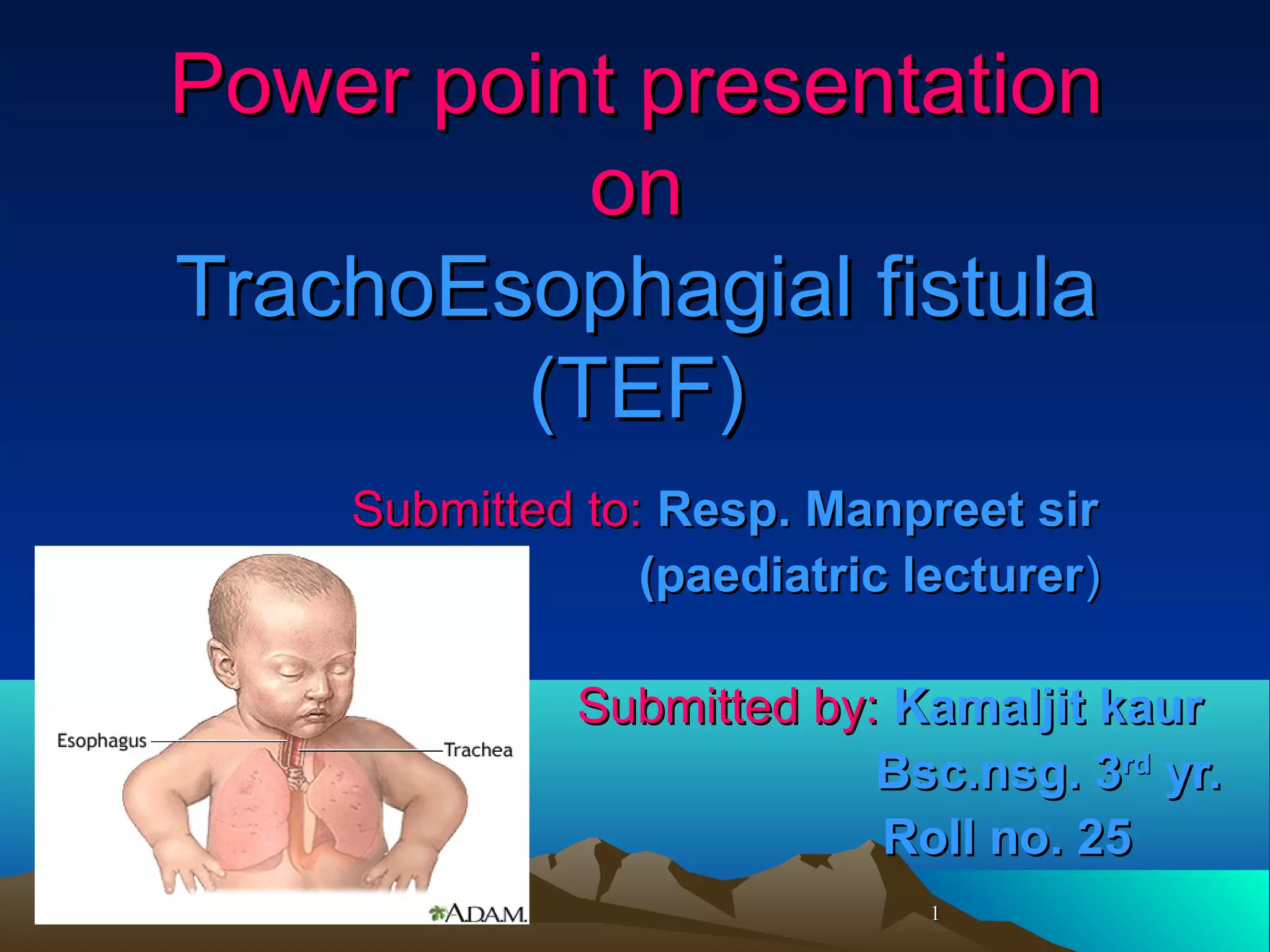
Power point presentationPower point presentation
onon
TrachoEsophagial fistulaTrachoEsophagial fistula
(TEF)(TEF)
Submitted to:Submitted to: Resp. Manpreet sirResp. Manpreet sir
(paediatric lecturer(paediatric lecturer))
Submitted by:Submitted by: Kamaljit kaurKamaljit kaur
Bsc.nsg. 3Bsc.nsg. 3rdrd
yr.yr.
Roll no. 25Roll no. 25
2
Learning objective:Learning objective:
• Definition
• Etiology
• Pathophysiology
• classification
• Clinical manifestation
• Diagnostic studies
• Complication
• Management
• Nursing management
3
DefinitionDefinition
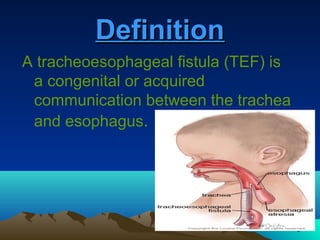
A tracheoesophageal fistula (TEF) is
a congenital or acquired
communication between the trachea
and esophagus.
4
EtiologyEtiology
• Exact cause is unknown
• Some etiological factors include:
 Genetic factor
Teratogenic stimuli
Intrauterine environment
• These anomalies may develop due to deviation
of the septum bw oesophagus and tracheao or
altered growth of septum bw them.
5
PathophysiologyPathophysiology
Etiological factors
Accumulation of saliva or feeds
in upper oesophageal pouch
Gastric secretions may
regurgitate through distal
fistula
6
Abdominal distension occur due to air
entering the lower oesophagus through
fistula and passing into the stomach
during crying
Respiratory distress
7
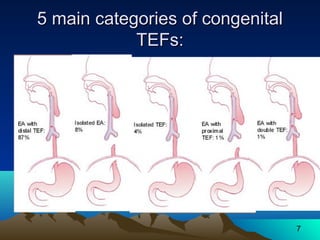
5 main categories of congenital5 main categories of congenital
TEFs:TEFs:
8
ClassificationClassification
Type 1: EA without fistula. There is no
connection between esophagus to
traechea. The upper segment and lower
segment of esophagus is blind.
Type 2: EA with TEF(upper). Upper
segment of esophagus open into traechea
by fistula
Type 3:EA With TEF(lower). The distal
lower segment of esophagus connects
into trachea by fistula
9
Type 4: EA with TEF both upper and lower
segment. There is EA with fistula bw both
proximal and distal ends of trachea and
esophagus
Type 5: H type TEF. Both proximal/ upper
and distal/ lower segment of esophagus
open into trachea by fistula. No EA
present
10
Clinical featuresClinical features
• Excessive salivation
• Contant drooling
• Large amt. of secretion from nose
• coughing, gagging , choking and cyanosis
• Laryngospasm
• Difficulty in breathing
• Poor feeding
11
Diagnosis of TEFDiagnosis of TEF
• Physical examination :Presence of air in
the gastrointestinal lumen with Percussion.
• Absence of gas in the abdomen suggests that
the patient has either atresia without a fistula or
atresia with a proximal fistula only
. Some clinicians prefer direct visualization by
flexible esophagoscopy or bronchoscopy
and assess its exact location prior to surgery.
12
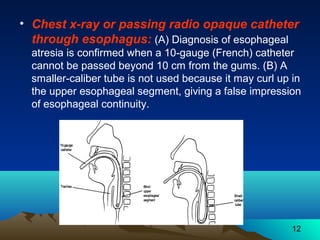
• Chest x-ray or passing radio opaque catheter
through esophagus: (A) Diagnosis of esophageal
atresia is confirmed when a 10-gauge (French) catheter
cannot be passed beyond 10 cm from the gums. (B) A
smaller-caliber tube is not used because it may curl up in
the upper esophageal segment, giving a false impression
of esophageal continuity.
13
• USG: Prenatal 3D ultrasounds after 24
weeks may reveal polyhydramnios,
absence of fluid-filled stomach, small
abdomen, and a distended esophageal
pouch
• Bronchoscopy can also help to detect
the abnormalities.
• ECG or echocardiogram can be done to
detect associated cardiac anomalies.
14
ComplicationComplication
Recurrent TEF( tracheomalacia)
Stenosis
Gastroesophagial reflux
Recurrent pneumonia
Airway hyperactivity
15
ManagementManagement
Immediate management:
1) Attention to ventilation
2) Determine appropriate time for surgery.
3) For ↓ aspiration risk:
 Elevate neonate’s head at least 30º
 Suctioning can be done frequently to prevent aspiration.
 Gastrostomy is done to decompress the stomach &
afterwards to feed the the infant.
4) Supportive care include maintance of nutritional
requirements and warmth, preventions of infections,
antibiotic therapy, chest physiotherapy.
16
Surgical management
• Thoractomy
• Gastrostomy
• Other surgical intervention include:
cervical oesophagostomy,
esophagocoloplasty,
esophagogastroplasty
17
Nursing management:
Pre-operative care:
Prevent aspiration by positioning,
suctioning, thus reduce chance of
respiratory infection.
Monitor vital signs
Maintain fluids balance and intake output
chart
Provide emotional support to the parents.
18
Post-operative care:
Maintain clear airway
Provide adequate feeding by IV or gastrostomy
feeding
Provide comfort measures to reduce pain
Maintain chest tube drainage with precautions.
Maintain hygiene
Monitors child’s conditions
Provide health edu. to the parents.
19
Thank for your attentionThank for your attention

Tracho oesophagial fistula

  • 1.
    11 Power point presentationPowerpoint presentation onon TrachoEsophagial fistulaTrachoEsophagial fistula (TEF)(TEF) Submitted to:Submitted to: Resp. Manpreet sirResp. Manpreet sir (paediatric lecturer(paediatric lecturer)) Submitted by:Submitted by: Kamaljit kaurKamaljit kaur Bsc.nsg. 3Bsc.nsg. 3rdrd yr.yr. Roll no. 25Roll no. 25
  • 2.
    2 Learning objective:Learning objective: •Definition • Etiology • Pathophysiology • classification • Clinical manifestation • Diagnostic studies • Complication • Management • Nursing management
  • 3.
    3 DefinitionDefinition A tracheoesophageal fistula(TEF) is a congenital or acquired communication between the trachea and esophagus.
  • 4.
    4 EtiologyEtiology • Exact causeis unknown • Some etiological factors include:  Genetic factor Teratogenic stimuli Intrauterine environment • These anomalies may develop due to deviation of the septum bw oesophagus and tracheao or altered growth of septum bw them.
  • 5.
    5 PathophysiologyPathophysiology Etiological factors Accumulation ofsaliva or feeds in upper oesophageal pouch Gastric secretions may regurgitate through distal fistula
  • 6.
    6 Abdominal distension occurdue to air entering the lower oesophagus through fistula and passing into the stomach during crying Respiratory distress
  • 7.
    7 5 main categoriesof congenital5 main categories of congenital TEFs:TEFs:
  • 8.
    8 ClassificationClassification Type 1: EAwithout fistula. There is no connection between esophagus to traechea. The upper segment and lower segment of esophagus is blind. Type 2: EA with TEF(upper). Upper segment of esophagus open into traechea by fistula Type 3:EA With TEF(lower). The distal lower segment of esophagus connects into trachea by fistula
  • 9.
    9 Type 4: EAwith TEF both upper and lower segment. There is EA with fistula bw both proximal and distal ends of trachea and esophagus Type 5: H type TEF. Both proximal/ upper and distal/ lower segment of esophagus open into trachea by fistula. No EA present
  • 10.
    10 Clinical featuresClinical features •Excessive salivation • Contant drooling • Large amt. of secretion from nose • coughing, gagging , choking and cyanosis • Laryngospasm • Difficulty in breathing • Poor feeding
  • 11.
    11 Diagnosis of TEFDiagnosisof TEF • Physical examination :Presence of air in the gastrointestinal lumen with Percussion. • Absence of gas in the abdomen suggests that the patient has either atresia without a fistula or atresia with a proximal fistula only . Some clinicians prefer direct visualization by flexible esophagoscopy or bronchoscopy and assess its exact location prior to surgery.
  • 12.
    12 • Chest x-rayor passing radio opaque catheter through esophagus: (A) Diagnosis of esophageal atresia is confirmed when a 10-gauge (French) catheter cannot be passed beyond 10 cm from the gums. (B) A smaller-caliber tube is not used because it may curl up in the upper esophageal segment, giving a false impression of esophageal continuity.
  • 13.
    13 • USG: Prenatal3D ultrasounds after 24 weeks may reveal polyhydramnios, absence of fluid-filled stomach, small abdomen, and a distended esophageal pouch • Bronchoscopy can also help to detect the abnormalities. • ECG or echocardiogram can be done to detect associated cardiac anomalies.
  • 14.
  • 15.
    15 ManagementManagement Immediate management: 1) Attentionto ventilation 2) Determine appropriate time for surgery. 3) For ↓ aspiration risk:  Elevate neonate’s head at least 30º  Suctioning can be done frequently to prevent aspiration.  Gastrostomy is done to decompress the stomach & afterwards to feed the the infant. 4) Supportive care include maintance of nutritional requirements and warmth, preventions of infections, antibiotic therapy, chest physiotherapy.
  • 16.
    16 Surgical management • Thoractomy •Gastrostomy • Other surgical intervention include: cervical oesophagostomy, esophagocoloplasty, esophagogastroplasty
  • 17.
    17 Nursing management: Pre-operative care: Preventaspiration by positioning, suctioning, thus reduce chance of respiratory infection. Monitor vital signs Maintain fluids balance and intake output chart Provide emotional support to the parents.
  • 18.
    18 Post-operative care: Maintain clearairway Provide adequate feeding by IV or gastrostomy feeding Provide comfort measures to reduce pain Maintain chest tube drainage with precautions. Maintain hygiene Monitors child’s conditions Provide health edu. to the parents.
  • 19.
    19 Thank for yourattentionThank for your attention