Group Member
           Wajahat Ali
             Mudassar Iqbal
             Ata Makhdoom
             Muhammad Qaswar
             TanveerAhmad
Contents
   Introduction
   Vision, mission and values
   Key factors
   Ways to raise fund
   Business operation
    Competitors
    Social responsible
    Stores Layout
   Advertisement/Marketing
    Distinguishing aspect
    Company Indicators
   Situational Analysis
   Swot Analysis
   IFE,EFE,CPM and BCG
   Problem Found in Situational and   Environmental
    Analysis
   Conclusion
   Recommendation
   References
Introduction
   1937- Vernon Rudolph bought secret yeast recipe from a
    French chef in New Orleans
   Expanded from local store to nation wide chain of stores
   Headquartered in Winston Salem, North Carolina
   1940s – Small chain of stores, family owned.
    Development of first distribution system.
   1950s – Improving and automating the doughnut
    making equipment.
   1960s – Steady growth throughout the Southeast.
    Consistent store designs.
   1973 – Founder Vemon Rudolph dies.
Introduction (cont)
   1976 – Company sold to Beatrice Foods and growth
    slowed.
   1982 – Franchisees bought company back.
   1996 - Expands outside the Southeast region, first store
    in New York.
   1999 – Other store in California, national expansion
    underway.
   December 2001 – First international store in Canada.
   October 2003 – First store in Europe at England
    (London).
.
Introduction (cont)
   In 2003, a pilot project in Mountain View, California, to
    sell doughnuts through car windows and sunroofs at a
    busy intersection (with wireless payment) failed.
   As of January 2008, the trans-fat content of all Krispy
    Kreme doughnuts was reduced to 0.5 of a gram or less.
    In 2007 company total revenue is $461195 which is
    decrease to $31876 in 2008
    And also In 2009 the company revenue decrease to
    45335 .
Introduction (cont)


   In 2009 yahoo finance published a list of 15 firms that
    have a high probability of going bankrupt during the
    year. kkd was on the list.
   650 stores worldwide in 18 countries
   93 company owned and 430 franchisees
   4500 full time employees
Vision and Mission


                       Our Vision

   To be the global leader in doughnuts and
    complementary products, while creating magic moments
    worldwide.
Mission statement

   We create the tastes for good times and warm memories
    for everyone, everywhere. With our Original Glazed
    doughnut as our signature and standard, we will
    continually improve our customer's experience through:
   Innovative ideas
   Highest quality, and
   Caring service
Our Values
                         Our Values
   (with acknowledgement to Founder, Vernon Rudolph)
    we believe...
   Consumers are our lifeblood, the center of the doughnut
   There is no substitute for quality in our service to
    consumers
   We must produce a collaborative team effort that is
    unexcelled
   We must cast the best possible image in all that we do
   We must never settle for "second best"; we deliver on
    our commitments
Key Factors


 Customers
 Supplies
 Whole seller
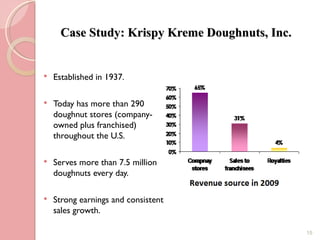
Case Study: Krispy Kreme Doughnuts, Inc.


   Established in 1937.

   Today has more than 290
    doughnut stores (company-
    owned plus franchised)
    throughout the U.S.

   Serves more than 7.5 million
    doughnuts every day.

   Strong earnings and consistent
    sales growth.

                                                 15
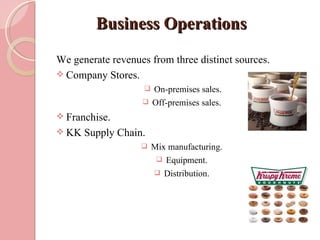
Business Operations
We generate revenues from three distinct sources.
 Company Stores.
                    On-premises sales.
                    Off-premises sales.

 Franchise.
 KK   Supply Chain.
                       Mix manufacturing.
                          Equipment.
                         Distribution.
4 WAYS TO RAISE FUNDS

   Traditional Doughnut Sales
   Certificates
   Partnership Cards
   Coffee
Krispy Kreme U.S.
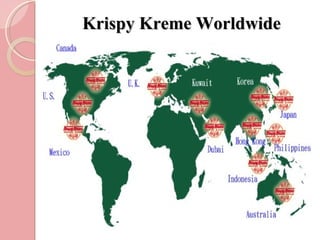
Krispy Kreme Worldwide
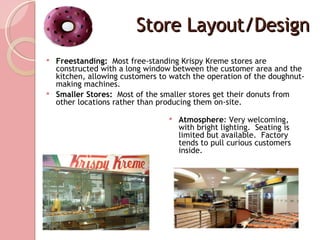
Store Layout/Design
 Freestanding: Most free-standing Krispy Kreme stores are
  constructed with a long window between the customer area and the
  kitchen, allowing customers to watch the operation of the doughnut-
  making machines.
 Smaller Stores: Most of the smaller stores get their donuts from
  other locations rather than producing them on-site.

                                   Atmosphere: Very welcoming,
                                    with bright lighting. Seating is
                                    limited but available. Factory
                                    tends to pull curious customers
                                    inside.
Advertisement / Marketing
   Free doughnut strategy – “Hot Now”; free doughnut while waiting
    in line.

   TV ad campaign

   Gifts/Accessories – shirts, sweatshirts, hats, boxers, coffee, mugs,
    toys.

   Fundraising – helped schools raise over $30 million last year
    (selling doughnuts, coffee, certificates, and partnership cards).
Distinguishing Aspects
  Store Layout: Factory inside the store where you can watch
   how the donuts are made.
  Reputation: Krispy Kreme has always been known as and
   has had a reputation of being the best.
  Hot Now: When the Hot Now sign outside the store is lit you
   can get hot and fresh original glazed donuts.
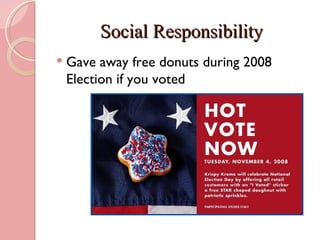
Social Responsibility
   Gave away free donuts during 2008
    Election if you voted
Competitors
   Dunkin Donuts- Privately owned
   Starbucks- coffee shop with 8,800 worldwide
    locations
    ◦ Over expanded- downsizing and consolidating
    ◦ Current products are too expensive for consumers
   Tim Hortons- fast food restaurant in USA and
    Canada
    ◦ Saturated market in Canada with 3,015 stores
    ◦ Expansion in US faces tough competition
Dunkin Donuts
              to be                          themarketingguy.wordpress.com


                   ◦ Claims to be the “world’s largest
                     coffee and baked goods chain.””
                   ◦ Serving 2.7 million customers per day
                   ◦ 5,769 U.S. locations
                   ◦ 20 countries
                  Wholly owned private subsidiary


dunkindonuts.com
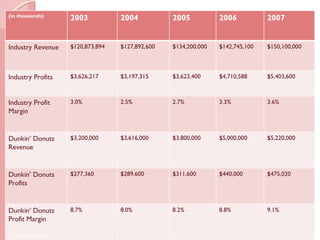
(in thousands)      2003           2004           2005           2006           2007


Industry Revenue    $120,873,894   $127,892,600   $134,200,000   $142,745,100   $150,100,000


Industry Profits    $3,626,217     $3,197,315     $3,623,400     $4,710,588     $5,403,600


Industry Profit     3.0%           2.5%           2.7%           3.3%           3.6%
Margin


Dunkin’ Donuts      $3,200,000     $3,616,000     $3,800,000     $5,000,000     $5,220,000
Revenue


Dunkin’ Donuts      $277,360       $289,600       $311,600       $440,000       $475,020
Profits


Dunkin’ Donuts      8.7%           8.0%           8.2%           8.8%           9.1%
Profit Margin

 dunkindonuts.com
Gourmet Coffee sales, 2008
Starbucks
   World premier roaster and retailer
    of specialty coffee

    ◦ 8812 own stores
    ◦ 7852 license stores in more than 50 countries
    ◦ Annual sale $10 million in 2010
Tim Hortons
 Tim Hortons was founded in 1964
 Quick service industry – Coffee and
  baked goods
 3204 locations throughout Canada and
  the United States
Company Indicators
   Sells over 20 types of doughnuts. Produces 5 million
    doughnuts a day and 1.8 billion a year.
   Profit Margin: 7.67 % (2006)
   Revenue Growth: 35.40 % (2006)
   Earnings Growth: 70.50 % (2006)
   Sales Growth: 35.4% (2006)
   Sales (mil.): $665.6 (2006)
   Net Income (mil): $57.1 (2006)
   Net Income Growth: 70.4 % (2006)
   Total Employees: 6982 (2006)
   Employee Growth: 78.4 % (2006)
   CEO: Scott Livengood, paid $791.00 K (2006)
Situational Analysis

 Environment
 The Organization
 The Marketing Strategy

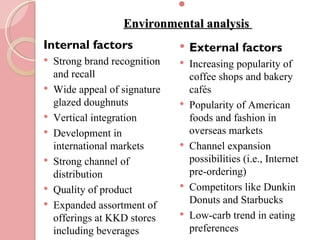
                   Environmental analysis
Internal factors                  External factors
   Strong brand recognition      Increasing popularity of
    and recall                     coffee shops and bakery
   Wide appeal of signature       cafés
    glazed doughnuts              Popularity of American
   Vertical integration           foods and fashion in
   Development in                 overseas markets
    international markets         Channel expansion
   Strong channel of              possibilities (i.e., Internet
    distribution                   pre-ordering)
   Quality of product            Competitors like Dunkin
                                   Donuts and Starbucks
   Expanded assortment of
    offerings at KKD stores       Low-carb trend in eating
    including beverages            preferences
Organization Analysis

   Strategy is focused on revenue
   organizational structure
    In 2001, cash flow return on equity investment for
    franchises was at 91%,
    In 2003, the company’s business strategy was to add
    enough new stores
   strategies do not appear to be capable of maintaining a
    competitive advantage
   July 2004 launching an inquiry into the company’s
    accounting practices.
   December 2004, they announced still more “accounting
    errors”
Marketing Strategies

   little evidence of market research.
   Company spent very little on advertising.
    This strategy seems to still work well but would not be
    sufficient to generate continuing business
   New stores are opening, close to the older stores within
    the same market.
   Their training, facilities management and franchise
    management is good strength of kk.
Marketing Strategies (cont)

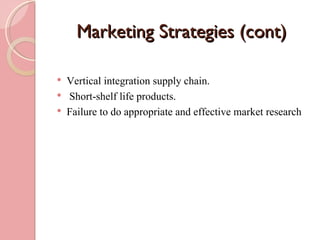
   Vertical integration supply chain.
   Short-shelf life products.
   Failure to do appropriate and effective market research
S.W.O.T Analysis

Strengths
 Affordable, high-quality doughnuts with strong visual
  appeal and "one-of-a-kind" taste
 Neon "Hot Doughnuts Now" sign encourages people
  outside the store to make an impulse purchase
 Market research shows appeal extends to all major
  demographic groups including age and income
 Hot shop" stores save money while keeping KKD
  customer experience intact
Strengths (cont)

 Vertical integration helps ensure high
  quality product
 Consistent expansion; now in 16 countries
 Product sold at thousands of
  supermarkets, convenience stores, and
  retail outlets through U.S.
Weaknesses

    Return on equity, assets, and investments all negative in
    the trailing twelve months; skill of mgmt. is
    questionable
    Shareholders have not received dividends recently, and
    are not expected to in near future; stock price in state of
    flux
   Closing stores when stores should be opening globally
    at steady rate to keep up with competitors' growth
    Management states in recent 10-K that it is struggling
    with how to make stores profitable
Weaknesses (cont)

   Product line slow to expand with nothing outside "sweet
    treats" to draw in health-conscious customers
   Advertising not aggressive enough to appeal to areas
    outside southeast of U.S. where most stores are
    Revenues down, net losses in each of past three years
   Opportunities

   Development into diversified product markets
   Detection of the problem occurring in the management
    of the business and thus the fall in business and
    profitability

   Develop the social outreach programs to promote the
    doughnuts and to promote the customer based objectives
    and mission of the organization

   Reaching the market to really know what the customers
    want and then to develop the marketing and strategic
    policy in accordance to that.
Opportunities (cont)

   Asians love sweets and are open to trying foreign foods
   Starbucks lacks a diversified and distinctive pastry line
   Dunkin' Donuts does not have hot doughnuts to sell
   Many children love sweet treats
Threats

   Tough competition and increasing global recognition of
    Starbucks and Dunkin Donuts.
   Global presence of the competitors
   More health conscious customer base
   Development of organic markets
   Starbucks has approximately 25 times the amount of
    stores worldwide that Krispy Kreme Donut has
Threats (cont)
Restricted cash flow from banks and
 massive layoffs have stifled the world
 economy, decreasing discretionary
 income
 Europeans prefer their local brands of
 doughnuts
 Shareholders may sell KKD stock for
 lack of returns and dividends compared to
 other similar firms in the industry
I.F.E
E.F.E
C.P.M
(BCG)
Problems Found in Situational,
          Environmental Analysis


   the lack of a cohesive marketing structure within or a
    strategic marketing plan for the organization.
   Flawed or absent marketing research has resulted in
    store closings and or expansions that were not backed
    up by market data or evidence that this investment
    would be feasible.
   The company spent very little on advertising depending
    largely on word of mouth, and local publicity.
   As a result, Krispy Kreme acquired a company in 2007
    that by the end of fiscal year 2008, had lost $25 million
    dollars.
   The second problem is using a vertically integrated
    supply chain
Conclusion
   The food industry has been affected by a recent trend
    toward quick eating habits. Krispy Kreme has
    capitalized on this trend by positioning doughnuts as a
    popular, on-the-go food.
    Krispy Kreme’s success has hinged on consistency
    throughout its locations and by delivering a high quality
    product.Future growth opportunities include expanding
    franchises as well as penetrating alternate distribution
    channels.
    As Krispy Kreme analyzes potential growth
    opportunities within alternate distribution channels
    such as convenience stores and grocery chains, it must
    determine whether doing so will sacrifice brand equity
    and product quality.
   It is believe that Krispy Kreme can be successful in
    launching its product in new markets without establishing
    physical locations. Alternative channel distribution will
    help bring the Krispy Kreme product to millions of
    potential customers who have yet to experience the taste
    of America’s best doughnut.
Recommendations
Reduce operating expenses
 Change entire manufacturing and distribution strategy
  –Implement par baked manufacturing operation.
 to allow individual stores to decrease in size, thus
  lowering per store operating costs to a more appropriate
  level for sales volume
 Increased efficiency – smaller workforce per store, par-
  bake allows for minimal waste – inventory as needed
  (important b/c fresh goods – low shelf life
 Par bake will allow for “hot doughnuts now” all of the
  time.
 Implications of transition to par bake operation
Recommendation (cont)
   New Plant Equipment – freezers, production equipment,
    freezer trucks for distribution/delivery.
   Store Equipment – freezers, oven for various par baked
    goods, fryers for doughnuts.
   R&D for unique par bake operation
Recommendations (cont)

2- Develop stronger relations and control
 of franchisees
   Short-term period of one year – postpone new franchise
    agreements/new store openings
   Implement Franchise Support Systems
   Communication – between corporate and franchisees
   Support – training, advertising
   Utilize recommendation #1 in order to lower operating
    expenses for franchisees.
Implement Marketing Strategies
 Advertising – national television and radio advertising
  campaign based on “hot doughnuts now”.
 Marketing research – periodic research to stay abreast of
  trends.
 R&D – product development


Strengthen Competitive Advantage
 Strengthen Competitive Advantage through differentiation
  in products and services.
 Continue to utilize “hot doughnuts now”
 Expand product line
References


   www.krispykreme.com
   en.wikipedia.org/wiki/Krispy_Kreme
   www.krispykreme.co.uk/store-locator/
   www.youtube.com/user/KrispyKremeDoughnuts
   Strategic management 13 edition
Krispy kreme doughtnuts (kkd)

Krispy kreme doughtnuts (kkd)

  • 2.
    Group Member Wajahat Ali Mudassar Iqbal Ata Makhdoom Muhammad Qaswar TanveerAhmad
  • 3.
    Contents  Introduction  Vision, mission and values  Key factors  Ways to raise fund  Business operation  Competitors  Social responsible  Stores Layout  Advertisement/Marketing  Distinguishing aspect  Company Indicators
  • 4.
    Situational Analysis  Swot Analysis  IFE,EFE,CPM and BCG  Problem Found in Situational and Environmental Analysis  Conclusion  Recommendation  References
  • 6.
    Introduction  1937- Vernon Rudolph bought secret yeast recipe from a French chef in New Orleans  Expanded from local store to nation wide chain of stores  Headquartered in Winston Salem, North Carolina  1940s – Small chain of stores, family owned. Development of first distribution system.  1950s – Improving and automating the doughnut making equipment.  1960s – Steady growth throughout the Southeast. Consistent store designs.  1973 – Founder Vemon Rudolph dies.
  • 7.
    Introduction (cont)  1976 – Company sold to Beatrice Foods and growth slowed.  1982 – Franchisees bought company back.  1996 - Expands outside the Southeast region, first store in New York.  1999 – Other store in California, national expansion underway.  December 2001 – First international store in Canada.  October 2003 – First store in Europe at England (London). .
  • 8.
    Introduction (cont)  In 2003, a pilot project in Mountain View, California, to sell doughnuts through car windows and sunroofs at a busy intersection (with wireless payment) failed.  As of January 2008, the trans-fat content of all Krispy Kreme doughnuts was reduced to 0.5 of a gram or less.  In 2007 company total revenue is $461195 which is decrease to $31876 in 2008  And also In 2009 the company revenue decrease to 45335 .
  • 9.
    Introduction (cont)  In 2009 yahoo finance published a list of 15 firms that have a high probability of going bankrupt during the year. kkd was on the list.  650 stores worldwide in 18 countries  93 company owned and 430 franchisees  4500 full time employees
  • 11.
    Vision and Mission Our Vision  To be the global leader in doughnuts and complementary products, while creating magic moments worldwide.
  • 12.
    Mission statement  We create the tastes for good times and warm memories for everyone, everywhere. With our Original Glazed doughnut as our signature and standard, we will continually improve our customer's experience through:  Innovative ideas  Highest quality, and  Caring service
  • 13.
    Our Values Our Values  (with acknowledgement to Founder, Vernon Rudolph) we believe...  Consumers are our lifeblood, the center of the doughnut  There is no substitute for quality in our service to consumers  We must produce a collaborative team effort that is unexcelled  We must cast the best possible image in all that we do  We must never settle for "second best"; we deliver on our commitments
  • 14.
    Key Factors  Customers Supplies  Whole seller
  • 15.
    Case Study: KrispyKreme Doughnuts, Inc.  Established in 1937.  Today has more than 290 doughnut stores (company- owned plus franchised) throughout the U.S.  Serves more than 7.5 million doughnuts every day.  Strong earnings and consistent sales growth. 15
  • 16.
    Business Operations We generaterevenues from three distinct sources.  Company Stores. On-premises sales.  Off-premises sales.  Franchise.  KK Supply Chain.  Mix manufacturing.  Equipment.  Distribution.
  • 17.
    4 WAYS TORAISE FUNDS  Traditional Doughnut Sales  Certificates  Partnership Cards  Coffee
  • 18.
  • 19.
  • 20.
    Store Layout/Design  Freestanding:Most free-standing Krispy Kreme stores are constructed with a long window between the customer area and the kitchen, allowing customers to watch the operation of the doughnut- making machines.  Smaller Stores: Most of the smaller stores get their donuts from other locations rather than producing them on-site.  Atmosphere: Very welcoming, with bright lighting. Seating is limited but available. Factory tends to pull curious customers inside.
  • 21.
    Advertisement / Marketing  Free doughnut strategy – “Hot Now”; free doughnut while waiting in line.  TV ad campaign  Gifts/Accessories – shirts, sweatshirts, hats, boxers, coffee, mugs, toys.  Fundraising – helped schools raise over $30 million last year (selling doughnuts, coffee, certificates, and partnership cards).
  • 22.
    Distinguishing Aspects Store Layout: Factory inside the store where you can watch how the donuts are made.  Reputation: Krispy Kreme has always been known as and has had a reputation of being the best.  Hot Now: When the Hot Now sign outside the store is lit you can get hot and fresh original glazed donuts.
  • 23.
    Social Responsibility  Gave away free donuts during 2008 Election if you voted
  • 24.
    Competitors  Dunkin Donuts- Privately owned  Starbucks- coffee shop with 8,800 worldwide locations ◦ Over expanded- downsizing and consolidating ◦ Current products are too expensive for consumers  Tim Hortons- fast food restaurant in USA and Canada ◦ Saturated market in Canada with 3,015 stores ◦ Expansion in US faces tough competition
  • 25.
    Dunkin Donuts to be themarketingguy.wordpress.com ◦ Claims to be the “world’s largest coffee and baked goods chain.”” ◦ Serving 2.7 million customers per day ◦ 5,769 U.S. locations ◦ 20 countries  Wholly owned private subsidiary dunkindonuts.com
  • 26.
    (in thousands) 2003 2004 2005 2006 2007 Industry Revenue $120,873,894 $127,892,600 $134,200,000 $142,745,100 $150,100,000 Industry Profits $3,626,217 $3,197,315 $3,623,400 $4,710,588 $5,403,600 Industry Profit 3.0% 2.5% 2.7% 3.3% 3.6% Margin Dunkin’ Donuts $3,200,000 $3,616,000 $3,800,000 $5,000,000 $5,220,000 Revenue Dunkin’ Donuts $277,360 $289,600 $311,600 $440,000 $475,020 Profits Dunkin’ Donuts 8.7% 8.0% 8.2% 8.8% 9.1% Profit Margin dunkindonuts.com
  • 27.
  • 28.
    Starbucks  World premier roaster and retailer of specialty coffee ◦ 8812 own stores ◦ 7852 license stores in more than 50 countries ◦ Annual sale $10 million in 2010
  • 29.
    Tim Hortons  TimHortons was founded in 1964  Quick service industry – Coffee and baked goods  3204 locations throughout Canada and the United States
  • 30.
    Company Indicators  Sells over 20 types of doughnuts. Produces 5 million doughnuts a day and 1.8 billion a year.  Profit Margin: 7.67 % (2006)  Revenue Growth: 35.40 % (2006)  Earnings Growth: 70.50 % (2006)  Sales Growth: 35.4% (2006)  Sales (mil.): $665.6 (2006)  Net Income (mil): $57.1 (2006)  Net Income Growth: 70.4 % (2006)  Total Employees: 6982 (2006)  Employee Growth: 78.4 % (2006)  CEO: Scott Livengood, paid $791.00 K (2006)
  • 32.
    Situational Analysis  Environment The Organization  The Marketing Strategy
  • 33.
    Environmental analysis Internal factors  External factors  Strong brand recognition  Increasing popularity of and recall coffee shops and bakery  Wide appeal of signature cafés glazed doughnuts  Popularity of American  Vertical integration foods and fashion in  Development in overseas markets international markets  Channel expansion  Strong channel of possibilities (i.e., Internet distribution pre-ordering)  Quality of product  Competitors like Dunkin Donuts and Starbucks  Expanded assortment of offerings at KKD stores  Low-carb trend in eating including beverages preferences
  • 34.
    Organization Analysis  Strategy is focused on revenue  organizational structure  In 2001, cash flow return on equity investment for franchises was at 91%,  In 2003, the company’s business strategy was to add enough new stores  strategies do not appear to be capable of maintaining a competitive advantage  July 2004 launching an inquiry into the company’s accounting practices.  December 2004, they announced still more “accounting errors”
  • 35.
    Marketing Strategies  little evidence of market research.  Company spent very little on advertising.  This strategy seems to still work well but would not be sufficient to generate continuing business  New stores are opening, close to the older stores within the same market.  Their training, facilities management and franchise management is good strength of kk.
  • 36.
    Marketing Strategies (cont)  Vertical integration supply chain.  Short-shelf life products.  Failure to do appropriate and effective market research
  • 37.
    S.W.O.T Analysis Strengths  Affordable,high-quality doughnuts with strong visual appeal and "one-of-a-kind" taste  Neon "Hot Doughnuts Now" sign encourages people outside the store to make an impulse purchase  Market research shows appeal extends to all major demographic groups including age and income  Hot shop" stores save money while keeping KKD customer experience intact
  • 38.
    Strengths (cont)  Verticalintegration helps ensure high quality product  Consistent expansion; now in 16 countries  Product sold at thousands of supermarkets, convenience stores, and retail outlets through U.S.
  • 39.
    Weaknesses  Return on equity, assets, and investments all negative in the trailing twelve months; skill of mgmt. is questionable  Shareholders have not received dividends recently, and are not expected to in near future; stock price in state of flux  Closing stores when stores should be opening globally at steady rate to keep up with competitors' growth  Management states in recent 10-K that it is struggling with how to make stores profitable
  • 40.
    Weaknesses (cont)  Product line slow to expand with nothing outside "sweet treats" to draw in health-conscious customers  Advertising not aggressive enough to appeal to areas outside southeast of U.S. where most stores are  Revenues down, net losses in each of past three years
  • 41.
    Opportunities  Development into diversified product markets  Detection of the problem occurring in the management of the business and thus the fall in business and profitability  Develop the social outreach programs to promote the doughnuts and to promote the customer based objectives and mission of the organization  Reaching the market to really know what the customers want and then to develop the marketing and strategic policy in accordance to that.
  • 42.
    Opportunities (cont)  Asians love sweets and are open to trying foreign foods  Starbucks lacks a diversified and distinctive pastry line  Dunkin' Donuts does not have hot doughnuts to sell  Many children love sweet treats
  • 43.
    Threats  Tough competition and increasing global recognition of Starbucks and Dunkin Donuts.  Global presence of the competitors  More health conscious customer base  Development of organic markets  Starbucks has approximately 25 times the amount of stores worldwide that Krispy Kreme Donut has
  • 44.
    Threats (cont) Restricted cashflow from banks and massive layoffs have stifled the world economy, decreasing discretionary income  Europeans prefer their local brands of doughnuts  Shareholders may sell KKD stock for lack of returns and dividends compared to other similar firms in the industry
  • 45.
  • 46.
  • 47.
  • 48.
  • 49.
    Problems Found inSituational, Environmental Analysis  the lack of a cohesive marketing structure within or a strategic marketing plan for the organization.  Flawed or absent marketing research has resulted in store closings and or expansions that were not backed up by market data or evidence that this investment would be feasible.  The company spent very little on advertising depending largely on word of mouth, and local publicity.
  • 50.
    As a result, Krispy Kreme acquired a company in 2007 that by the end of fiscal year 2008, had lost $25 million dollars.  The second problem is using a vertically integrated supply chain
  • 52.
    Conclusion  The food industry has been affected by a recent trend toward quick eating habits. Krispy Kreme has capitalized on this trend by positioning doughnuts as a popular, on-the-go food.  Krispy Kreme’s success has hinged on consistency throughout its locations and by delivering a high quality product.Future growth opportunities include expanding franchises as well as penetrating alternate distribution channels.  As Krispy Kreme analyzes potential growth opportunities within alternate distribution channels such as convenience stores and grocery chains, it must determine whether doing so will sacrifice brand equity and product quality.
  • 53.
    It is believe that Krispy Kreme can be successful in launching its product in new markets without establishing physical locations. Alternative channel distribution will help bring the Krispy Kreme product to millions of potential customers who have yet to experience the taste of America’s best doughnut.
  • 54.
    Recommendations Reduce operating expenses Change entire manufacturing and distribution strategy –Implement par baked manufacturing operation.  to allow individual stores to decrease in size, thus lowering per store operating costs to a more appropriate level for sales volume  Increased efficiency – smaller workforce per store, par- bake allows for minimal waste – inventory as needed (important b/c fresh goods – low shelf life  Par bake will allow for “hot doughnuts now” all of the time.  Implications of transition to par bake operation
  • 55.
    Recommendation (cont)  New Plant Equipment – freezers, production equipment, freezer trucks for distribution/delivery.  Store Equipment – freezers, oven for various par baked goods, fryers for doughnuts.  R&D for unique par bake operation
  • 56.
    Recommendations (cont) 2- Developstronger relations and control of franchisees  Short-term period of one year – postpone new franchise agreements/new store openings  Implement Franchise Support Systems  Communication – between corporate and franchisees  Support – training, advertising  Utilize recommendation #1 in order to lower operating expenses for franchisees.
  • 57.
    Implement Marketing Strategies Advertising – national television and radio advertising campaign based on “hot doughnuts now”.  Marketing research – periodic research to stay abreast of trends.  R&D – product development Strengthen Competitive Advantage  Strengthen Competitive Advantage through differentiation in products and services.  Continue to utilize “hot doughnuts now”  Expand product line
  • 59.
    References  www.krispykreme.com  en.wikipedia.org/wiki/Krispy_Kreme  www.krispykreme.co.uk/store-locator/  www.youtube.com/user/KrispyKremeDoughnuts  Strategic management 13 edition