Tracheo -
esophageal
Fistula
Introduction
 Esophageal atresia is a congenital
interruption or discontinuity of the
esophagus resulting in esophageal
obstruction.
 Tracheo- esophageal fistula is an
abnormal communication between the
esophagus and trachea .
History
 William durston described EA in 1670
 Thomes Gibson described EA with TOF in
1697
 William ladd 1939 first to operated a case of
EA with TOF in multi staged procedure &
Patient survied.
 Comeron Haight 1941 first to operated the
Patient of EA with TOF in one stage
procedure and patient survied.
Epidemiology
 The incidence of EA is about 1 in 2500-4500 birth
(2.84 per 10,000 births).
 It is more common in male , male to female ratio
is 1: 1.26
 There is an increased risk of EA with a first
pregnancy.
 There is a slight increasing trends in the rate of
EA with increasing maternal age.
 It is more common in twin pregnancy and
twining increased EA about 6% cases.
 Cromosomal anomaly also increased the
risk of EA, about 6.6% cases . trisomy 13
and 18.
Etiology
(A) EA with TOF has no specific aetiology
but some drugs which increase the risk
of this, when taken at the time of
pregnancy these are.
- OCP - Progesterone
- Estrogen - Thalidomide
 (B) Patient who has diabetes at the time of
pregnancy increase the risk of EA with TOF.
 (C) Increase the risk of this anomaly in next
offspring when the first child affected about
0.5 to 2%.
 (D) When more than one child affected with
this anomaly increase about 20% risk in
next offspring
 The median pharyngeal groove develops in the
ventral aspect of foregut at day 22 of gestation.
 This tissue develops into the respiratory and
digestive tubes
Embryology
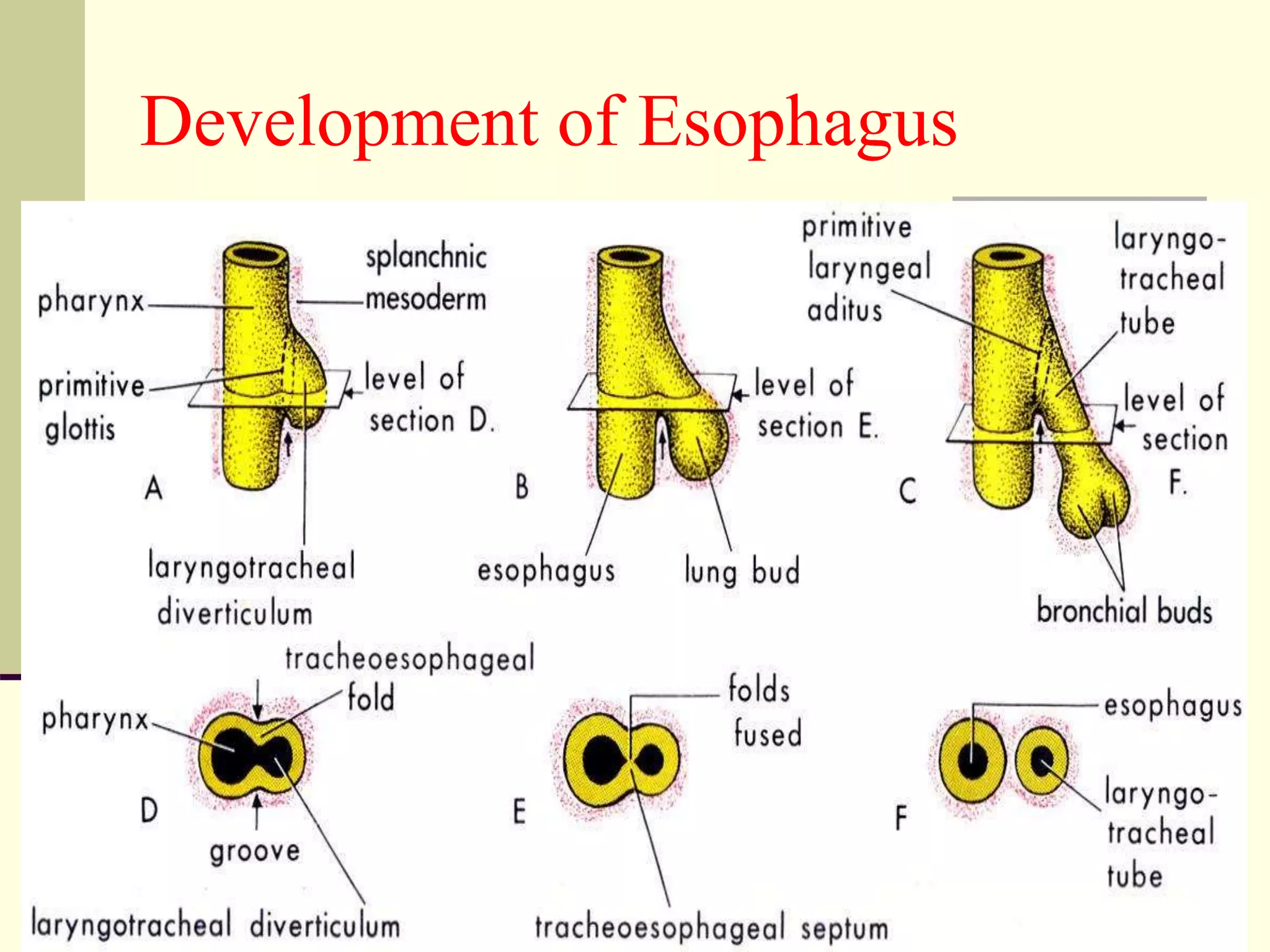
 Esophagus and tracheal originate from the
median ventral diverticulum of the forgut,
separated by esophagotracheal septum
 Normally, mesenchyme proliferating between
the respiratory and digestive tubes separates
the tubes.
 Development of an abnormal epithelial-lined
connection between the two tubes results in
the creation of a TEF .
Development of Esophagus
Anatomy
 In a full term neonate the esophagus is 9 to
10 cm in length and has a lumen of
around 3-4 mm.
 The upper esophageal pouch varies in
length but usually reaches within 1 cm of the
level of the azygus vein.
 The lower pouch commences from the
post. wall of the trachea and arises usually
around 0.5- 1.0cm proximal to the carina.
 As compared to the thick, hypertrophied upper
pouch, the lower pouch is thin and has a smaller
caliber ., the lower pouch can be identified at
the thoracotomy by
1. looking for it just below the arch of azygos vein.
2.Observing it getting distended with air during
assisted ventilation.
Arterial Supply
The cervical esophagus is supplied by the
inferior thyroid artery .
Thoracic esophagus is supplied by segmental
branches from aorta.
The distal esophagus is supplied by the ascending
branches of the left gastric artery.
Inferiorphernic artery
Bronchial artery
 VENOUS DRAINAGE
 Upper-Brachiocephaic vein
 Middle-Azygos vein
 Lower- left gastric vein
 LYMPHATIC DRAINAGE
 Upper-Deep cervical LN
 Middle-Post. Mediastinal LN
 Lower- left gastric LN
NERVE SUPPLY
PARASYMPATHETIC-
 Upper half -Reccurrent laryngeal N
 Lower half -plexus formed by both vagus
 Sensory ,motar & secretomotor supply
SYMPATHETIC
 Upper half- Middle cervical ganglion
 Lower half-Upper 4 thoracic ganglion
 Vasomotar supply
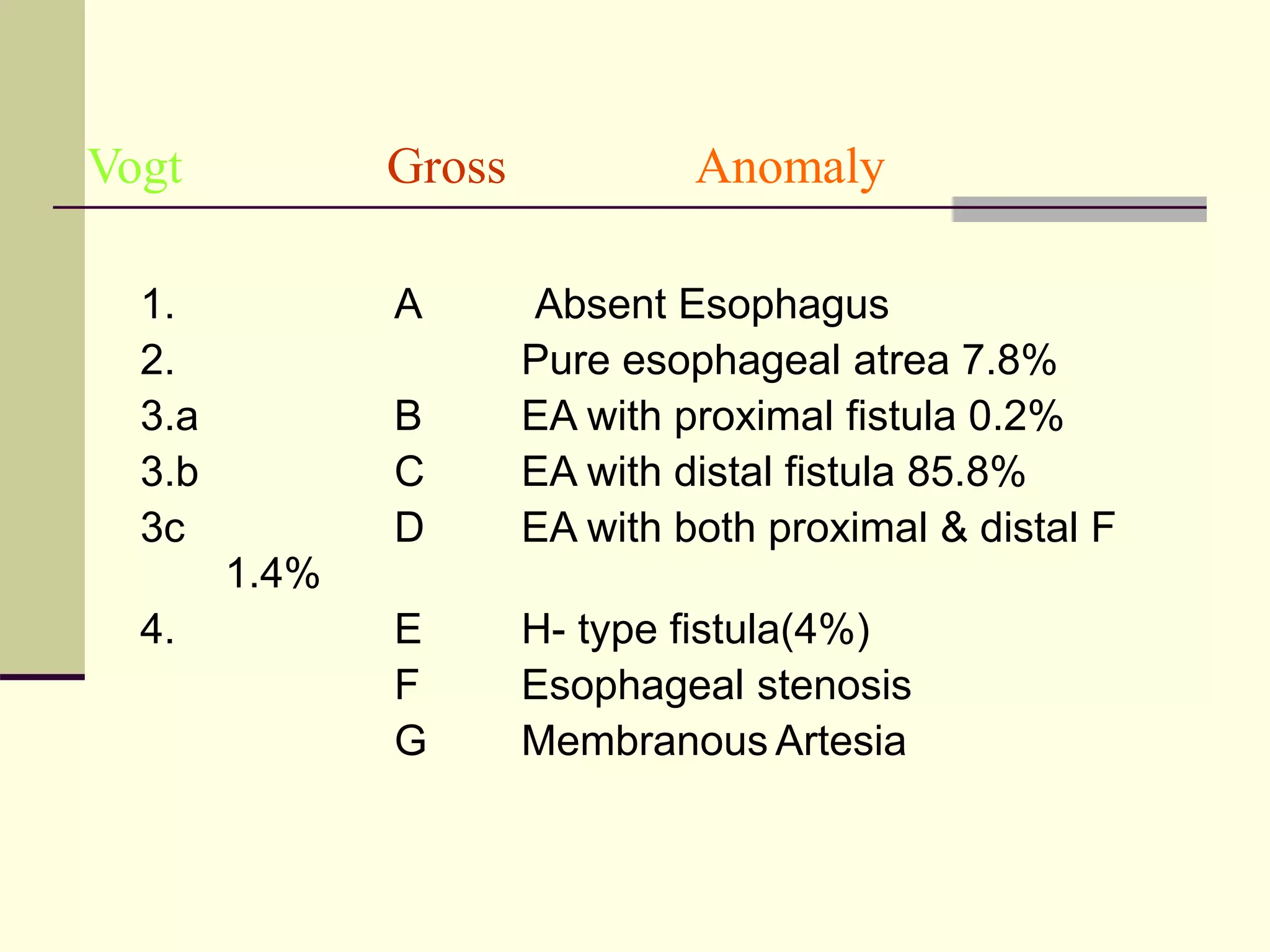
Classification
1. E.C Vogt 1929 -he was classify EA in
4 type, & number 3 in three Sub type
2. Gross 1953 – he was classify EA in 7
type in alphabetic word (A-to G)
Vogt Gross Anomaly
1. A Absent Esophagus
2. Pure esophageal atrea 7.8%
3.a B EA with proximal fistula 0.2%
3.b C EA with distal fistula 85.8%
3c D EA with both proximal & distal F
1.4%
4. E H- type fistula(4%)
F Esophageal stenosis
G Membranous Artesia
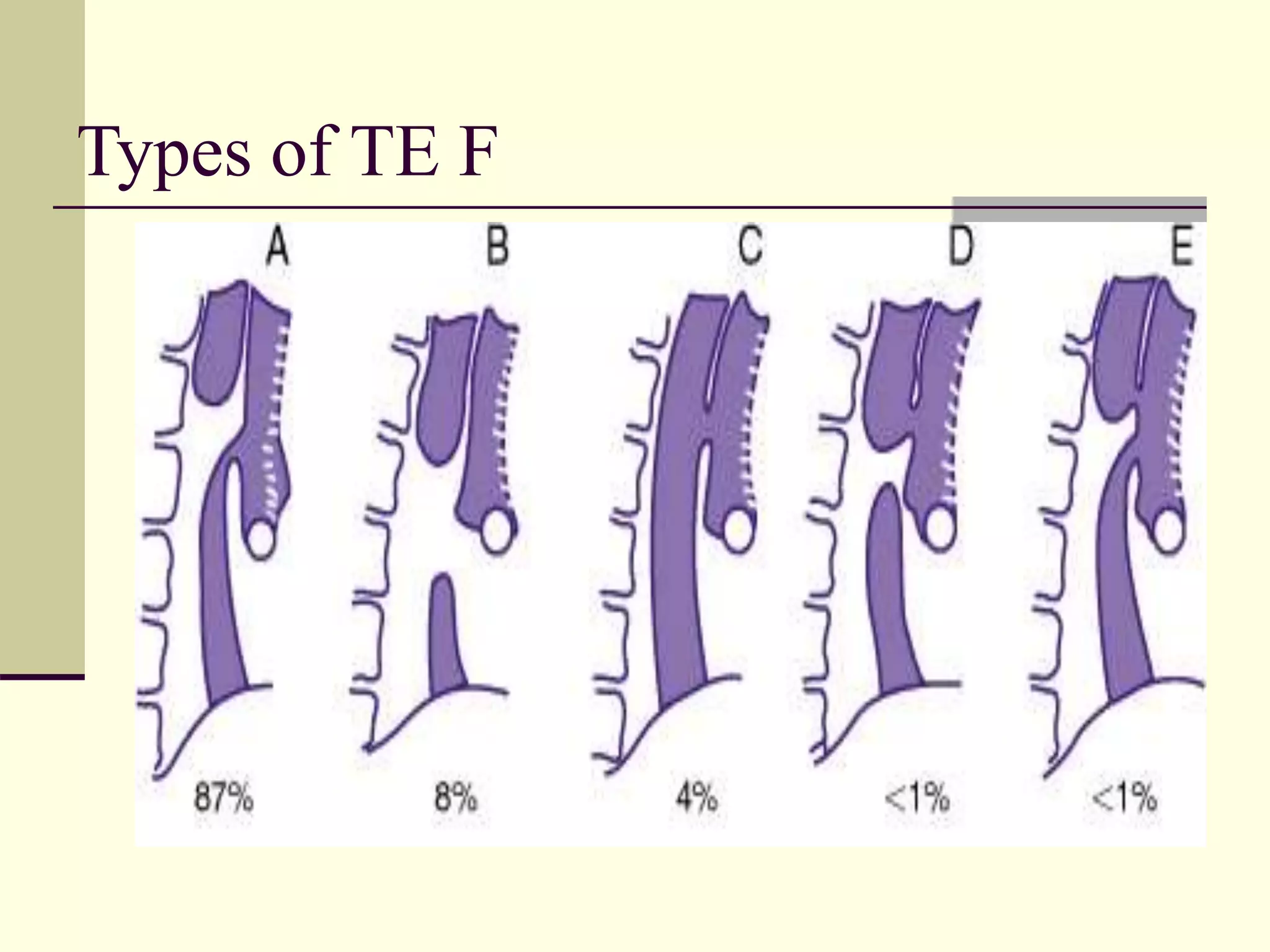
Types of TE F
Associated anomalies
The early disturbance in organogenisis
which result in EA leads to other
associated anomalies.
The incidence of which varies
between 40-55%.
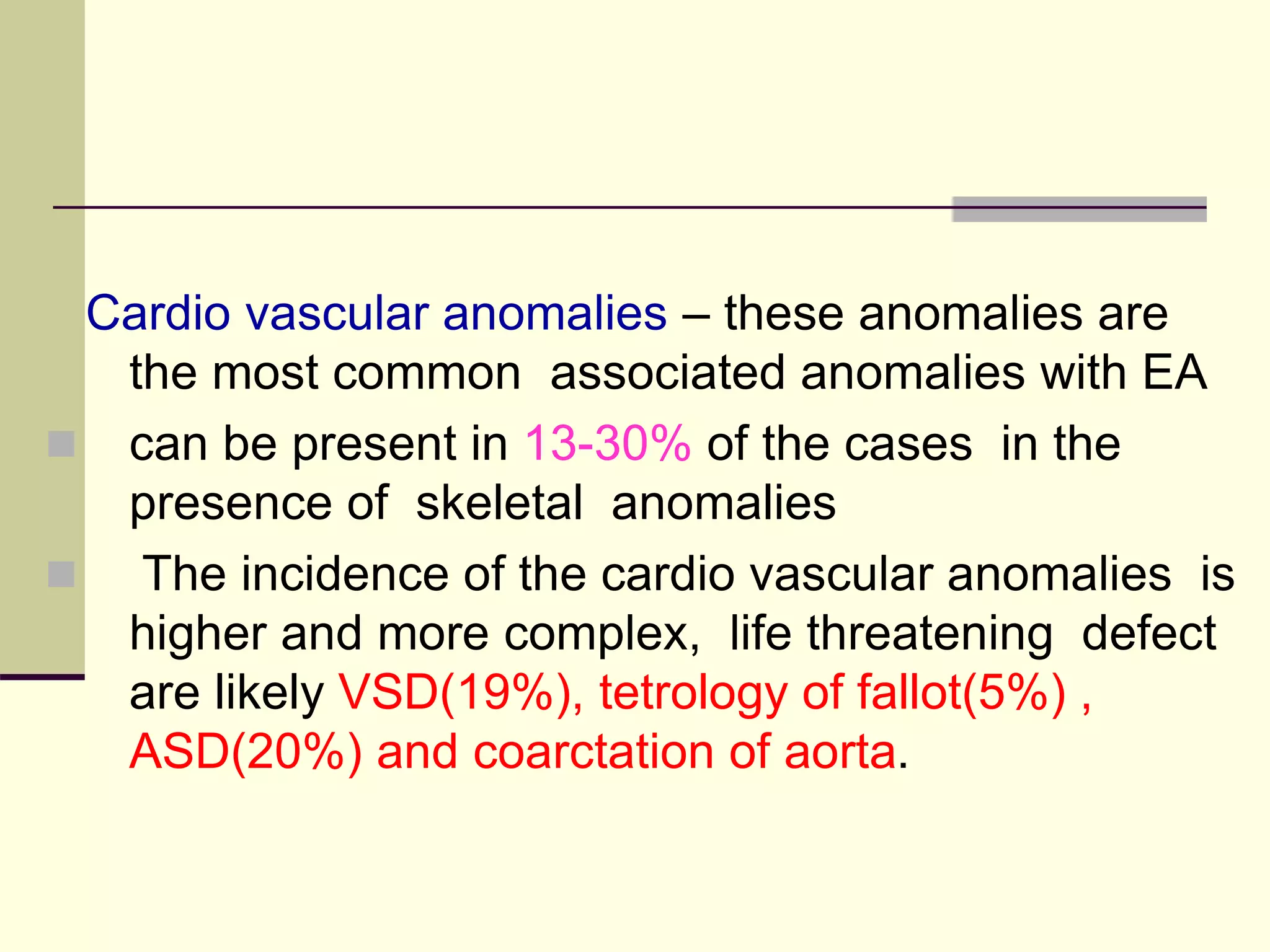
Cardio vascular anomalies – these anomalies are
the most common associated anomalies with EA
 can be present in 13-30% of the cases in the
presence of skeletal anomalies
 The incidence of the cardio vascular anomalies is
higher and more complex, life threatening defect
are likely VSD(19%), tetrology of fallot(5%) ,
ASD(20%) and coarctation of aorta.
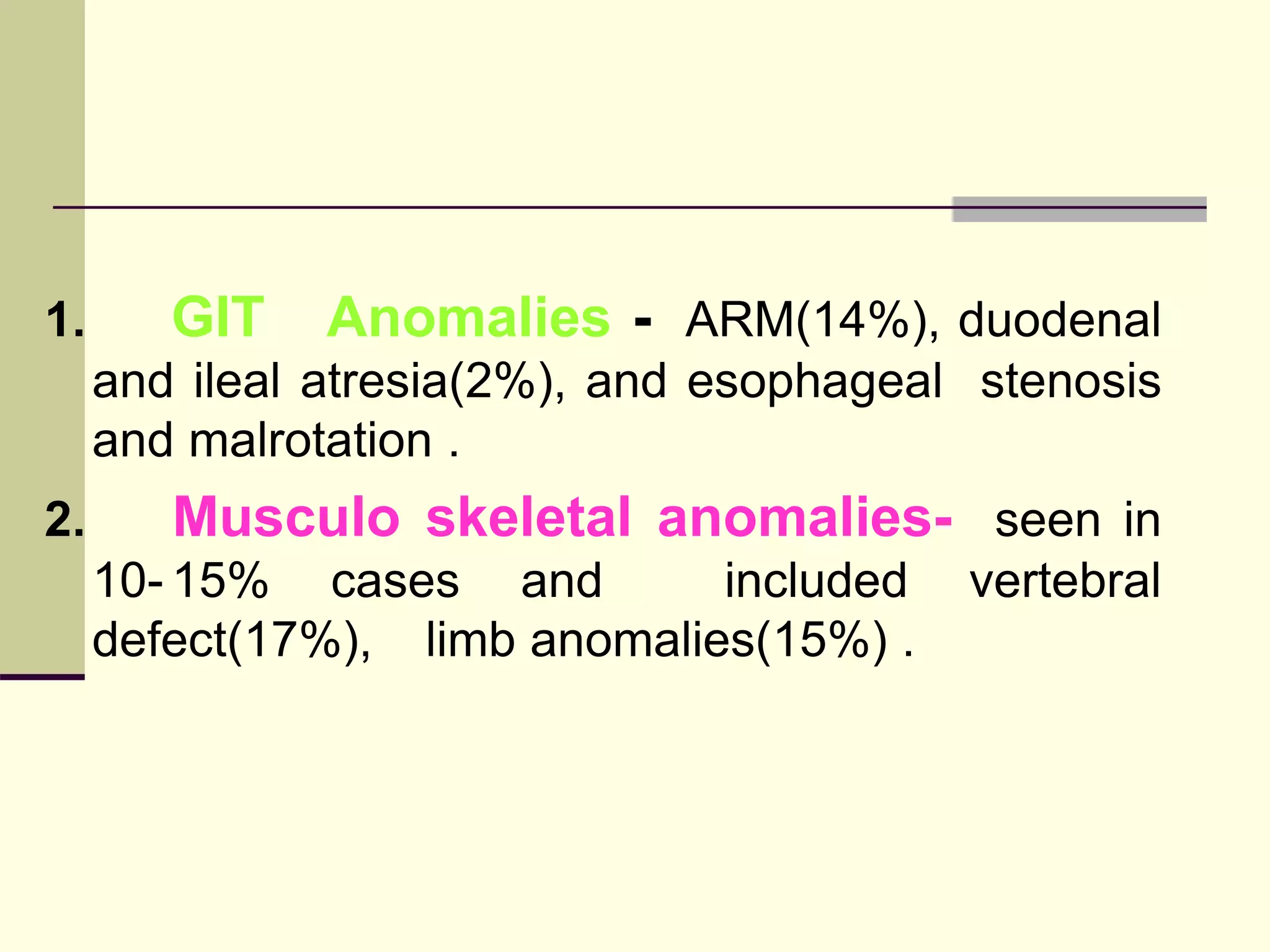
1. GIT Anomalies - ARM(14%), duodenal
and ileal atresia(2%), and esophageal stenosis
and malrotation .
2. Musculo skeletal anomalies- seen in
10- 15% cases and included vertebral
defect(17%), limb anomalies(15%) .
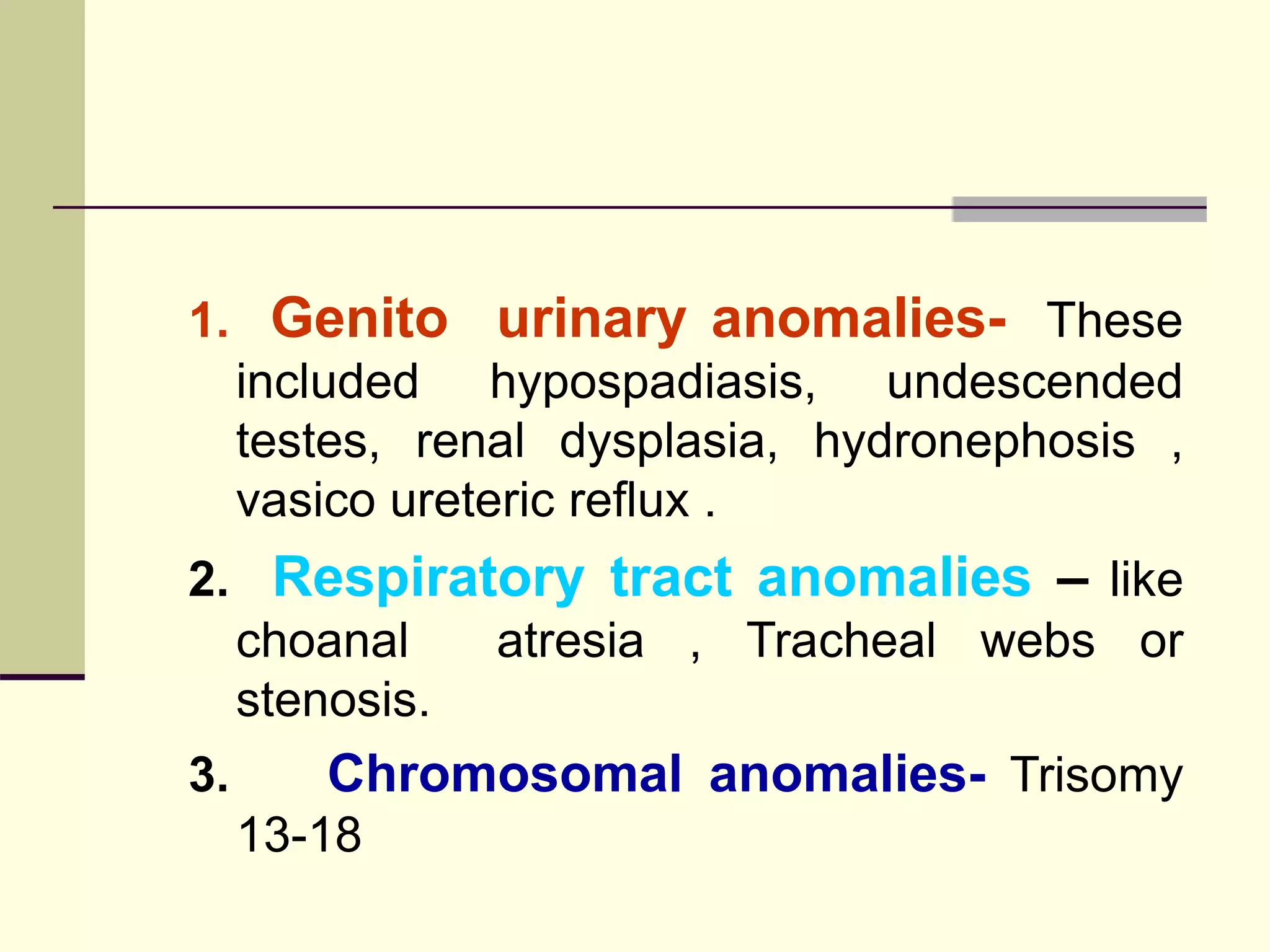
1. Genito urinary anomalies- These
included hypospadiasis, undescended
testes, renal dysplasia, hydronephosis ,
vasico ureteric reflux .
2. Respiratory tract anomalies – like
choanal atresia , Tracheal webs or
stenosis.
3. Chromosomal anomalies- Trisomy
13-18
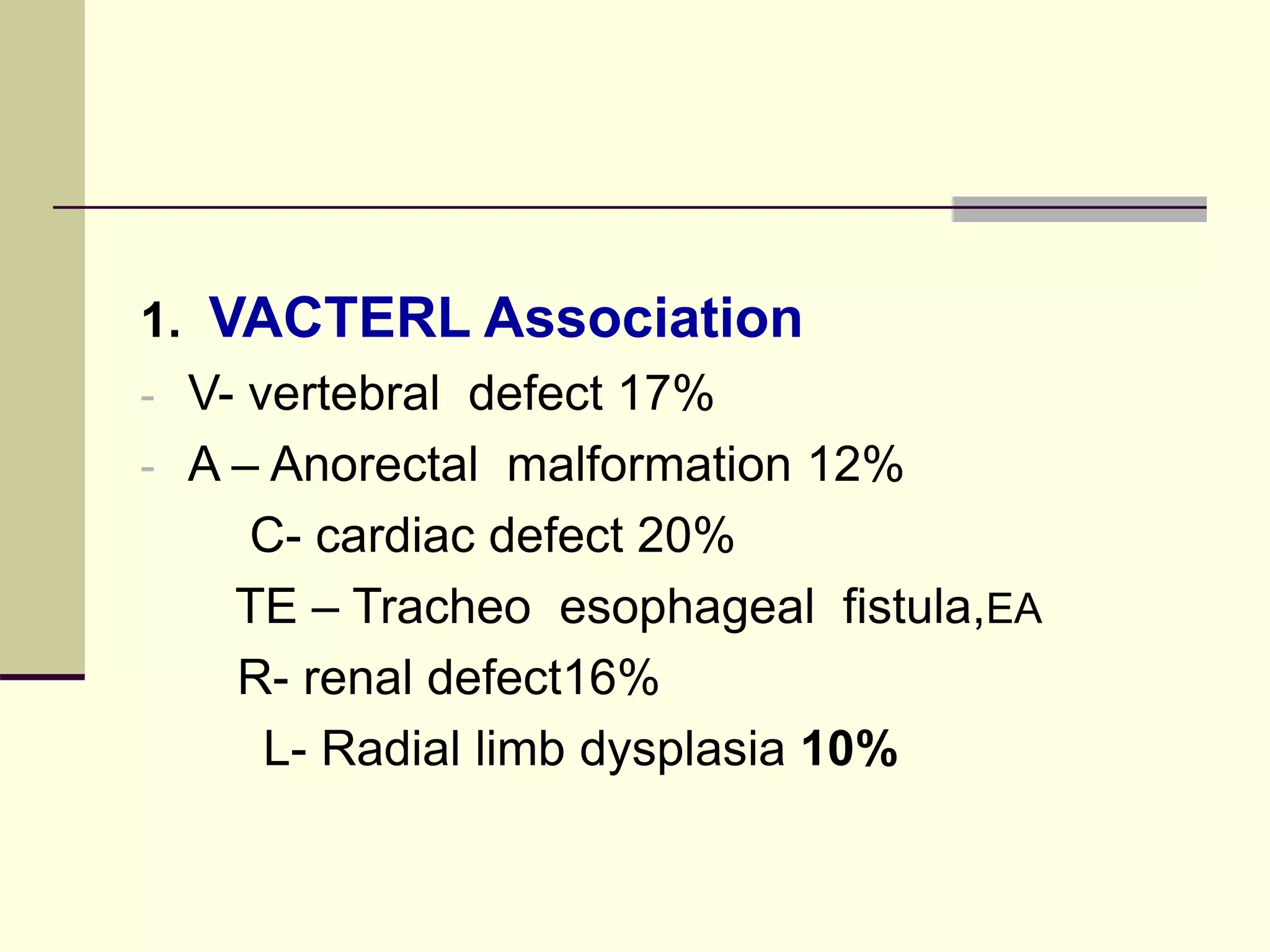
1. VACTERL Association
- V- vertebral defect 17%
- A – Anorectal malformation 12%
C- cardiac defect 20%
TE – Tracheo esophageal fistula,EA
R- renal defect16%
L- Radial limb dysplasia 10%
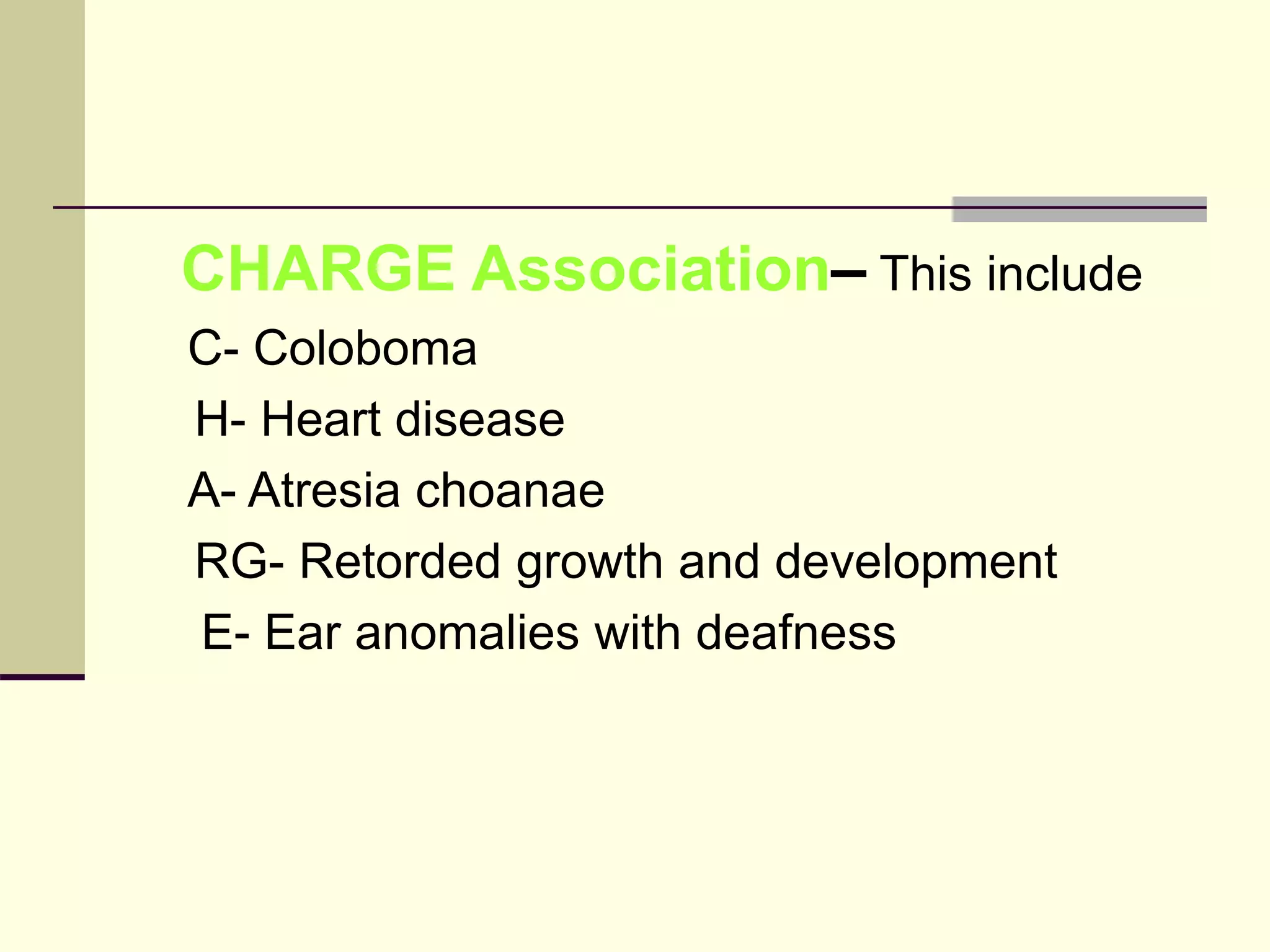
CHARGE Association– This include
C- Coloboma
H- Heart disease
A- Atresia choanae
RG- Retorded growth and development
E- Ear anomalies with deafness
SYMPTOMS
 Frothy white bubbles in the mouth.
 Coughing or choking when feeding.
 Vomiting.
 Blue color of the skin, especially when the
baby is feeding.
 Difficulty breathing.
 Very round, full abdomen
 Fever, tachycadia, lethargy suggested
pneumonitis.
 Abdominal distention in patent distal fistula.
 Inability to pass a tube through the mouth and
nose in to stomach.
 The history of polyhydroamonios in pregnancy
Diagnosis - Antenatal
(a) by USG abdomen
(1) Poly hydroamnios
(2) Failure to demonstrate the fetal stomach in
presence of normal or increased amniotic
fluid ( Normally stomach seen after 14th
week of gestation )
(b) High resolution real time scanning it show
fetal swallowing of amniotic fluid and
distention of upper pouch
(c) In X-Ray abdomen – The presence of
VACTERL Associated anomalies are seen.
(d) Chromosomal study.
(e) Raised amniotic fluid acetyl choline esterase
(B) Post natal
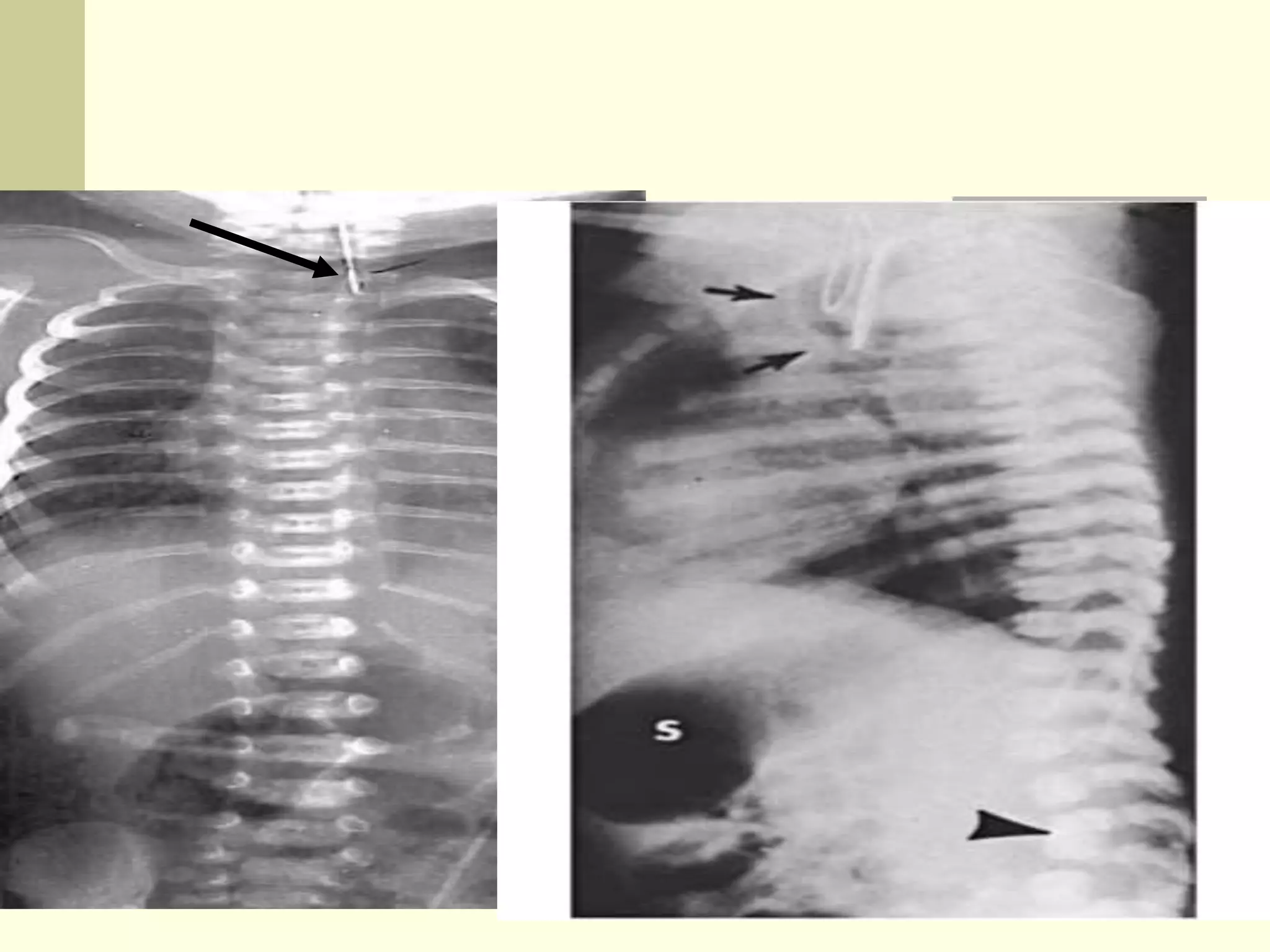
1) Plain AP – Lat radiograph
with
stiff red rubber catheter in situ
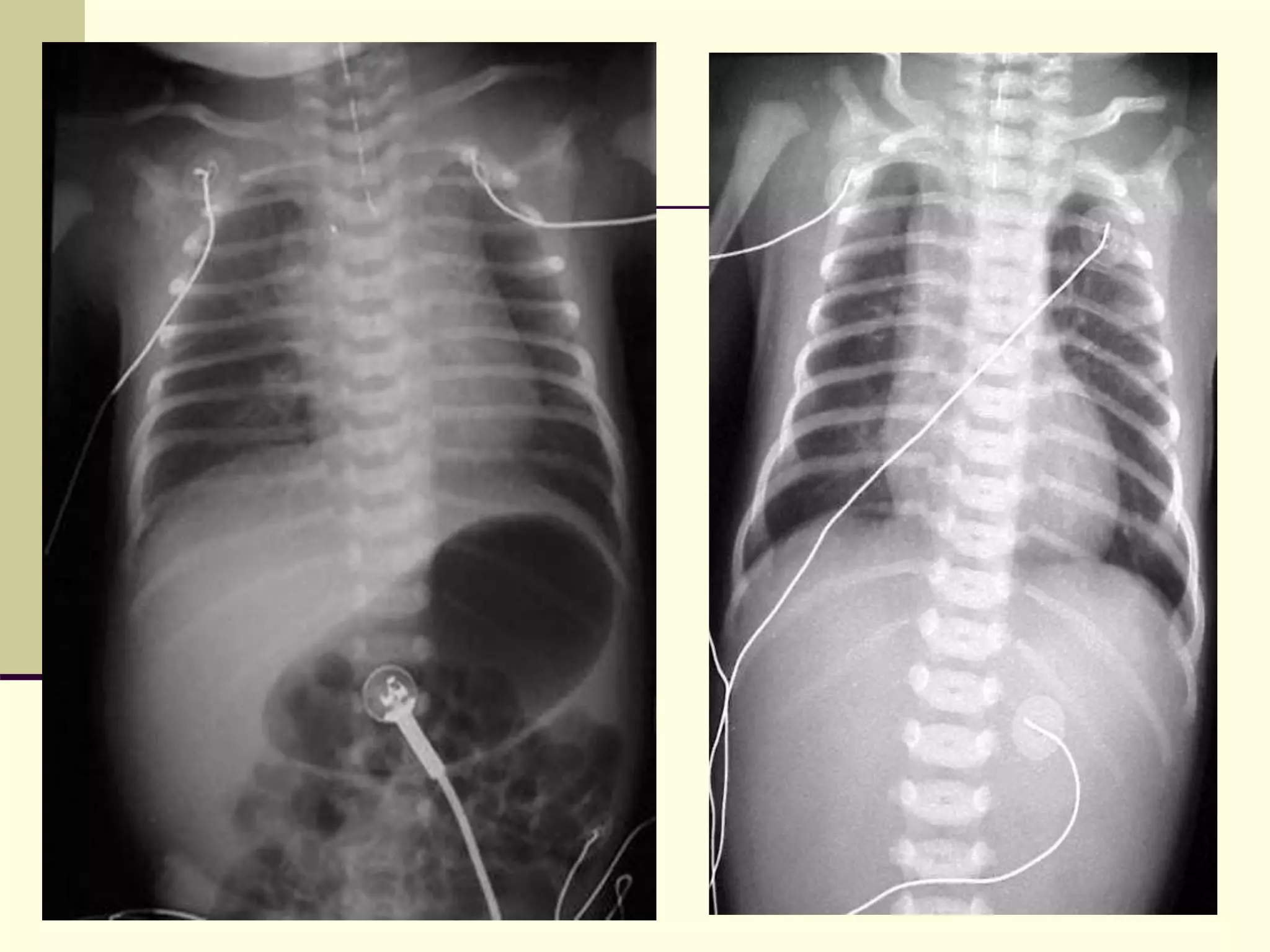
 Frontal view of the
chest and abdomen of
a neonate
demonstrates a tube
in the proximal pouch
in this patient with EA.
The presence of bowel
gas implies the
presence of a distal
TEF.
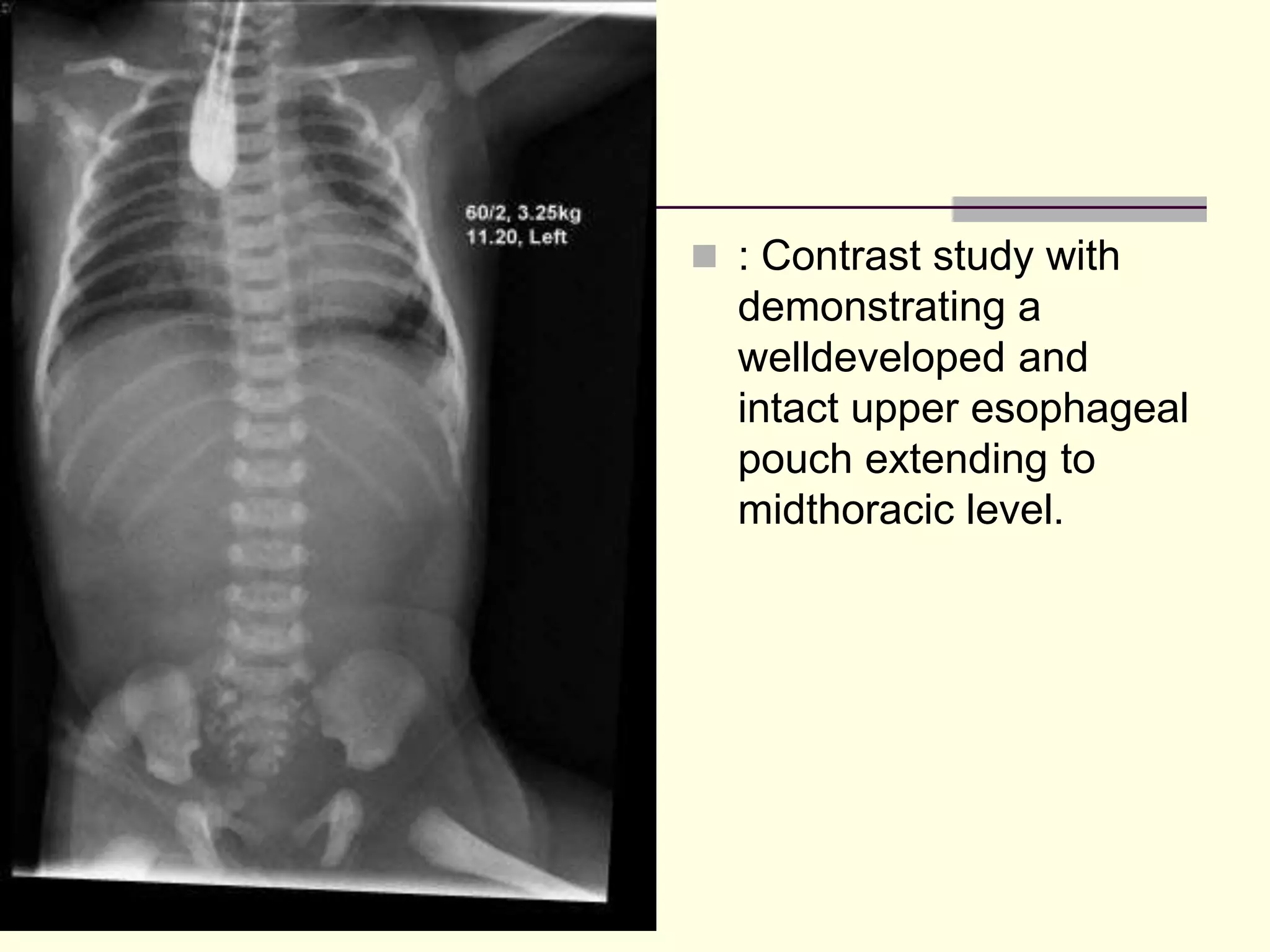
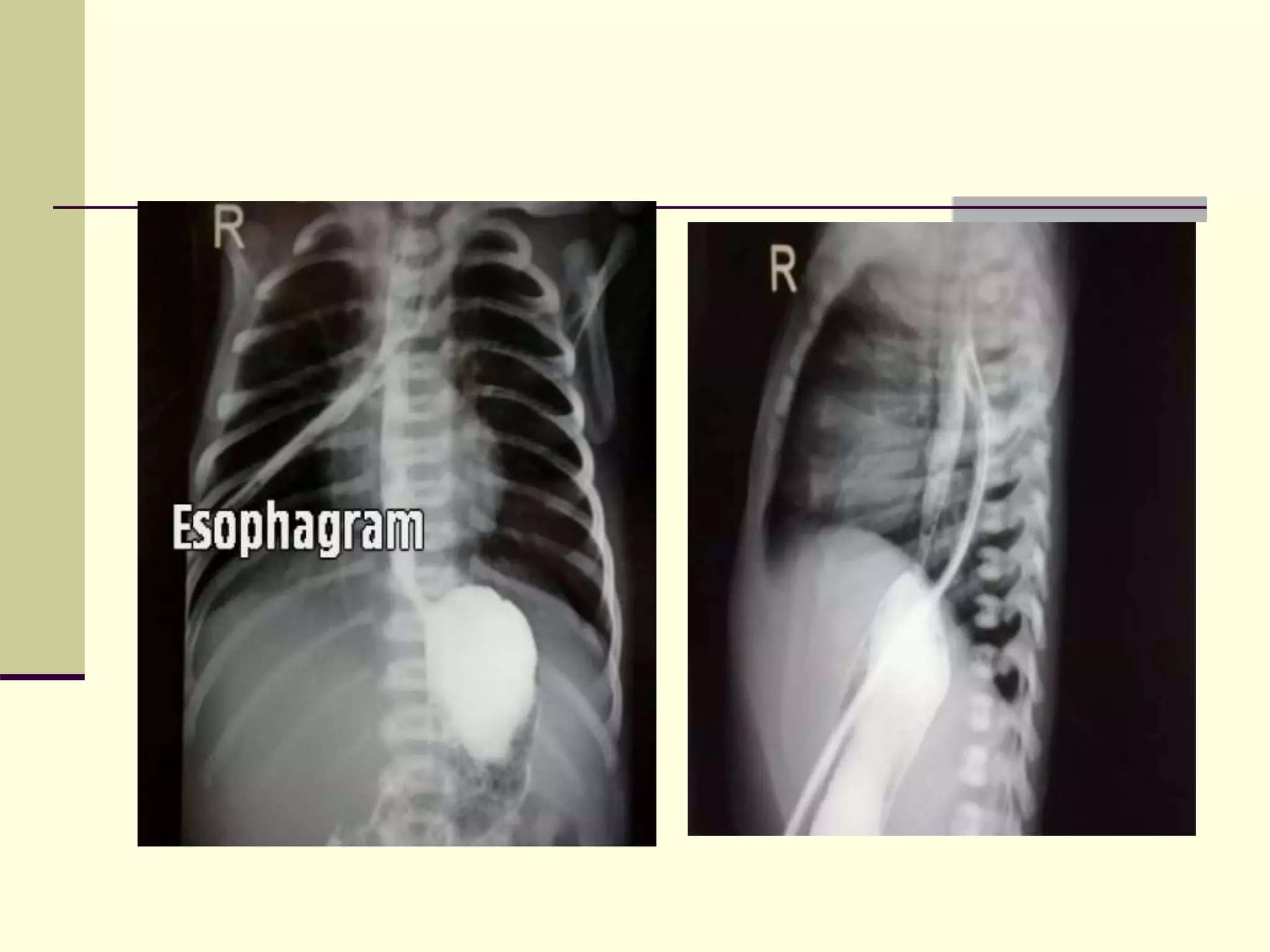
 : Contrast study with
demonstrating a
welldeveloped and
intact upper esophageal
pouch extending to
midthoracic level.
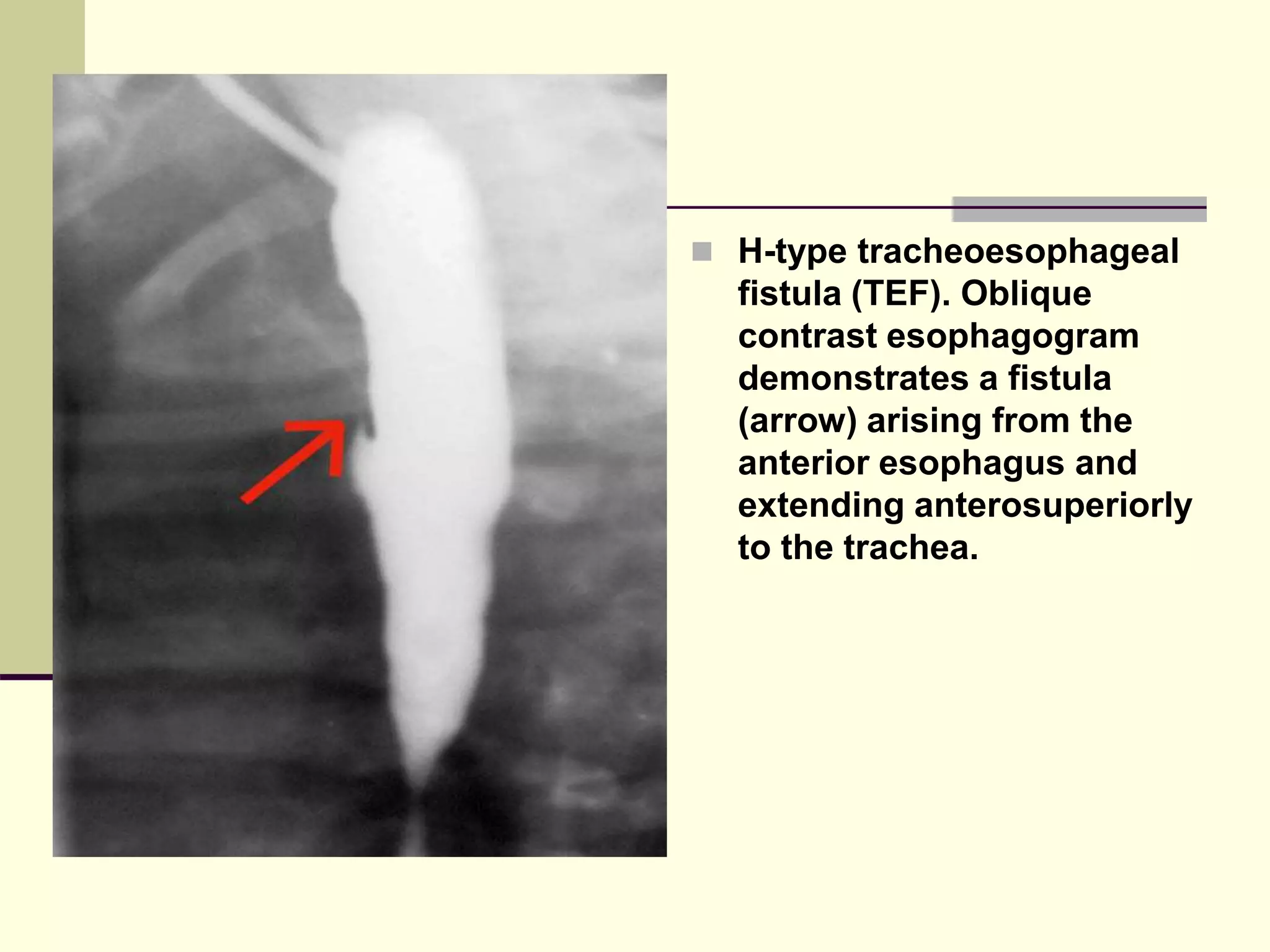
 H-type tracheoesophageal
fistula (TEF). Oblique
contrast esophagogram
demonstrates a fistula
(arrow) arising from the
anterior esophagus and
extending anterosuperiorly
to the trachea.
 Conform the level of atresia ( upper pouch)
in term of thoracic vertebra.
 Check the presence of abdominal gas to rule
out the pure esophageal atrisia
 Asses the pulmonary shadow to rule out
pneumonia or Pneumonitis
 Assess the cardiac shadow and calculate the
C.P ratio to suspect cardiac anomalies
(2) Echocardio graphy – for cardiac anomalies.
(3) USG Abdomen for renal anomalies.
(4) Bronchoscopy.
(5) Esophagoscopy.
(6) Chromosomal study.
(7) cine- esophagogram- H type
(8) preoperative base line investigation
D.J.Waterston 1962- developed a
classification system related to risk
factor among infant with EA.
PROGNOSIS
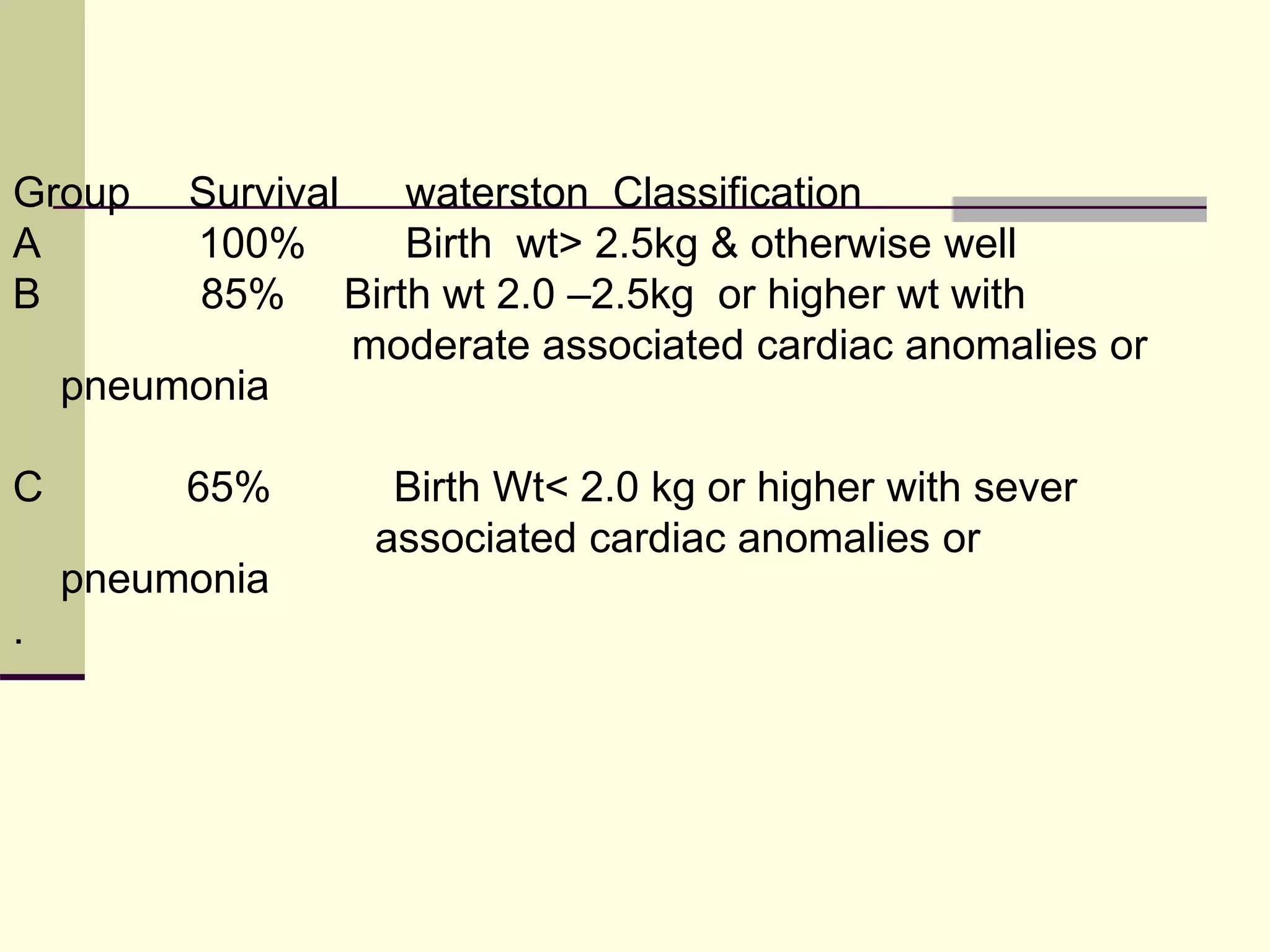
Group Survival waterston Classification
A 100% Birth wt> 2.5kg & otherwise well
B 85% Birth wt 2.0 –2.5kg or higher wt with
moderate associated cardiac anomalies or
pneumonia
C 65% Birth Wt< 2.0 kg or higher with sever
associated cardiac anomalies or
pneumonia
.
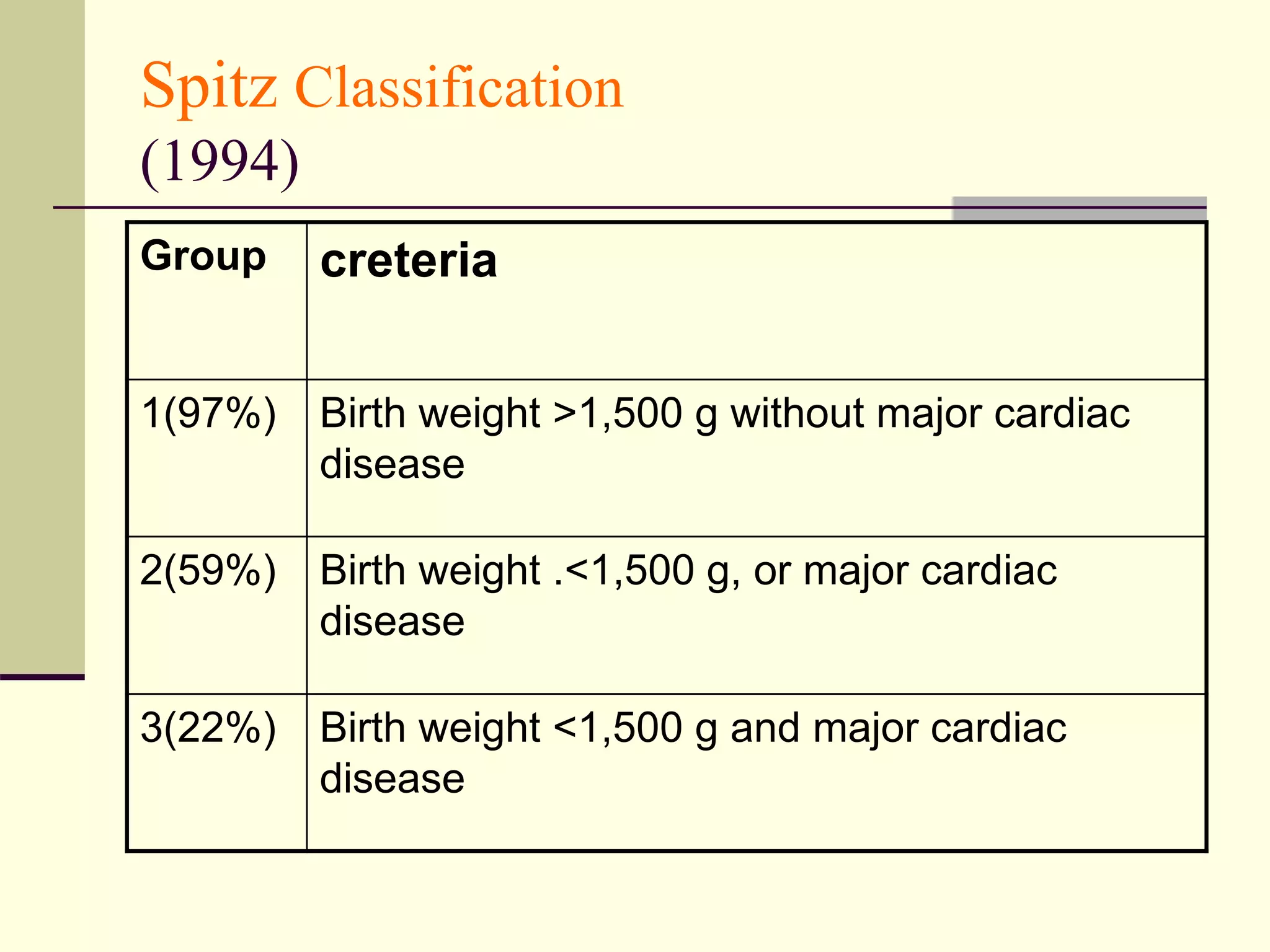
Spitz Classification
(1994)
Group creteria
1(97%) Birth weight >1,500 g without major cardiac
disease
2(59%) Birth weight .<1,500 g, or major cardiac
disease
3(22%) Birth weight <1,500 g and major cardiac
disease

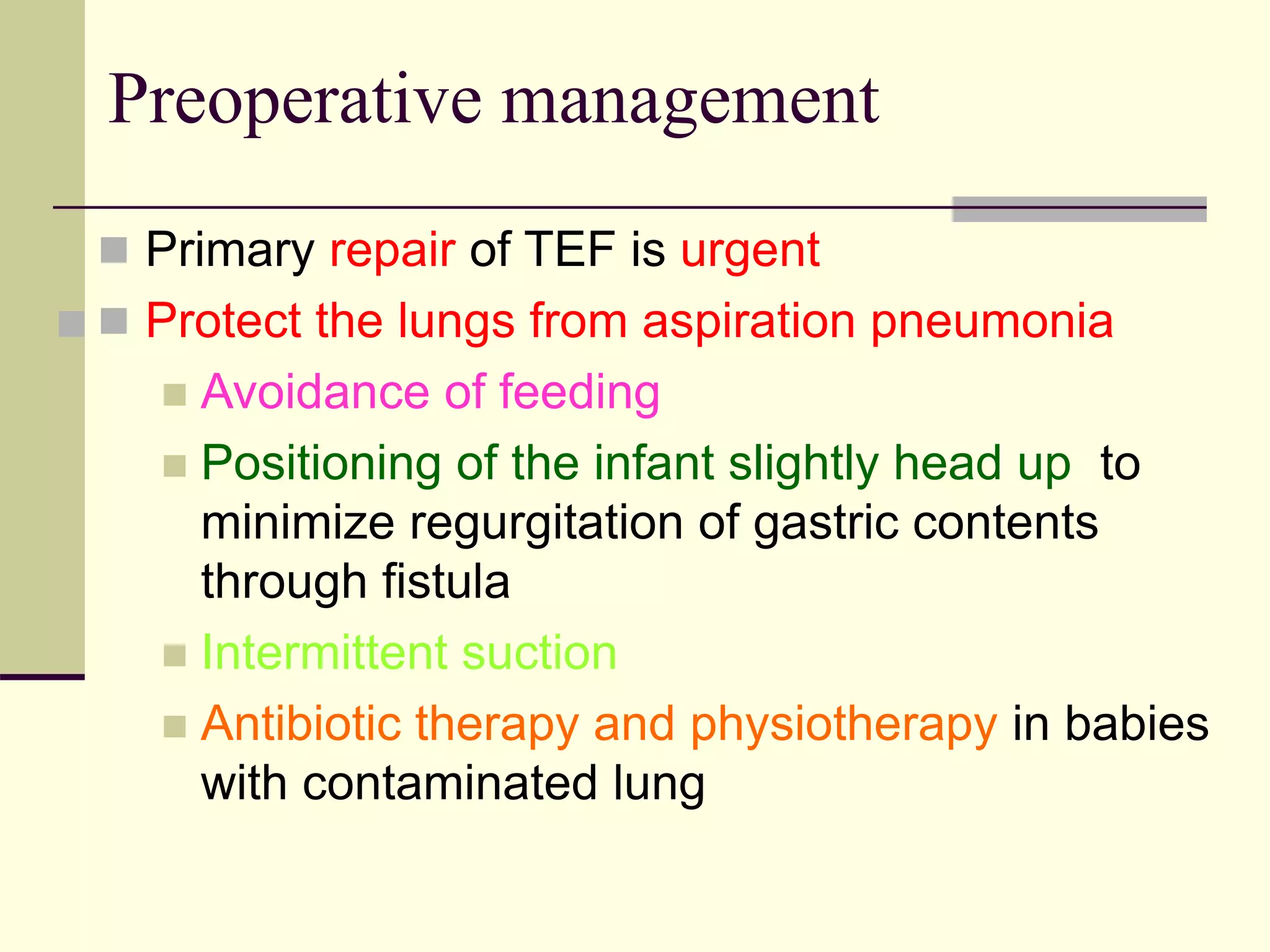
 Primary repair of TEF is urgent
 Protect the lungs from aspiration pneumonia
 Avoidance of feeding
 Positioning of the infant slightly head up to
minimize regurgitation of gastric contents
through fistula
 Intermittent suction
 Antibiotic therapy and physiotherapy in babies
with contaminated lung
Preoperative management
 The Resp.Rate and saturation are monitored
along with blood gas parameter to asses the
need for supplement oxygen and ventilation .
 I V line are established to take sample and
to start fluid and antibiotic.
 Inj vit K

Surgical management
 One stage repair: optimal surgical management
 Fistula is ligated, proximal and distal ends of the
esophagus are anastomosed
 Right posterolateral extrapleural thoracotomy
 Left thoracotomy if the p’t has right aortic arch
 Gastrostomy:
 High risk infants unable to withstand a thoracotomy
 Decompress the stomach and prevent regurgitation
via fistula into the lungs.
 Definitive repair
 24-72 hours later, when infant can
withstand both surgery and anesthesia
 Method: right thoracotomy using a
posterolateral extrapleural approach
 Fistula is ligated, esophageal segments
are anastomosed
 If distal esophagus is too short
 Fistula is ligated
 exteriorization of the upper pouch
through an esophagostomy is performed
Operative procedure
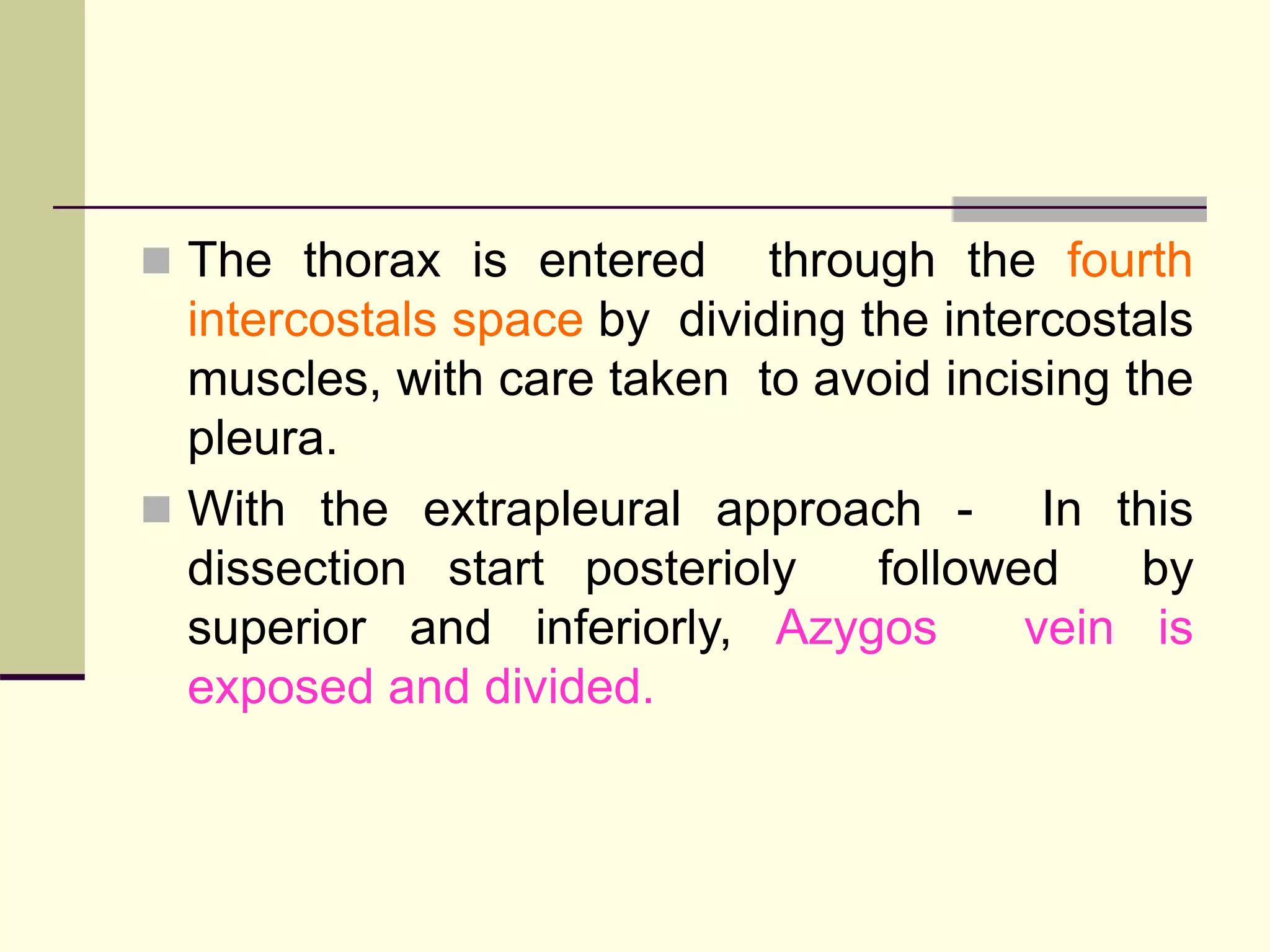
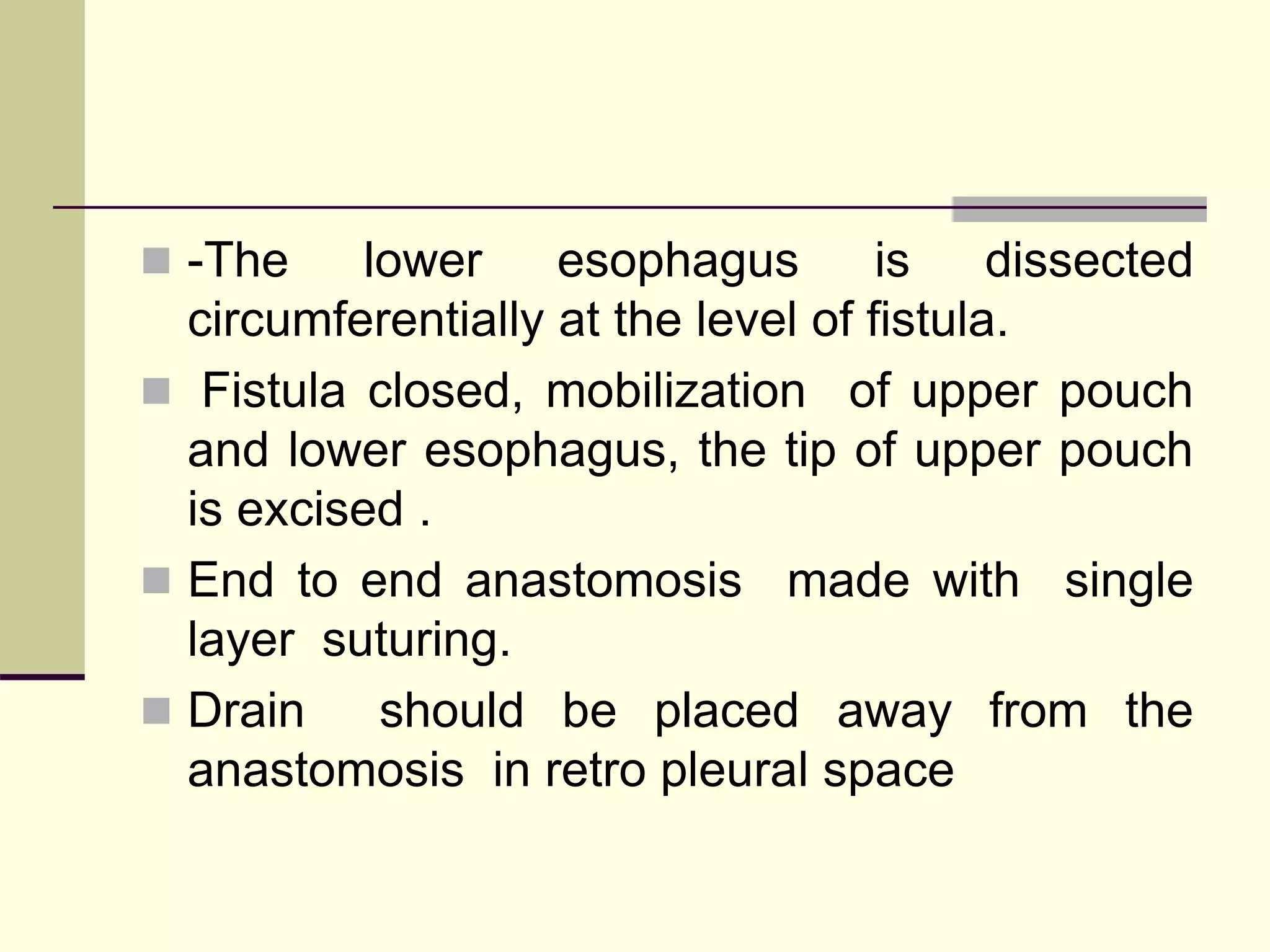
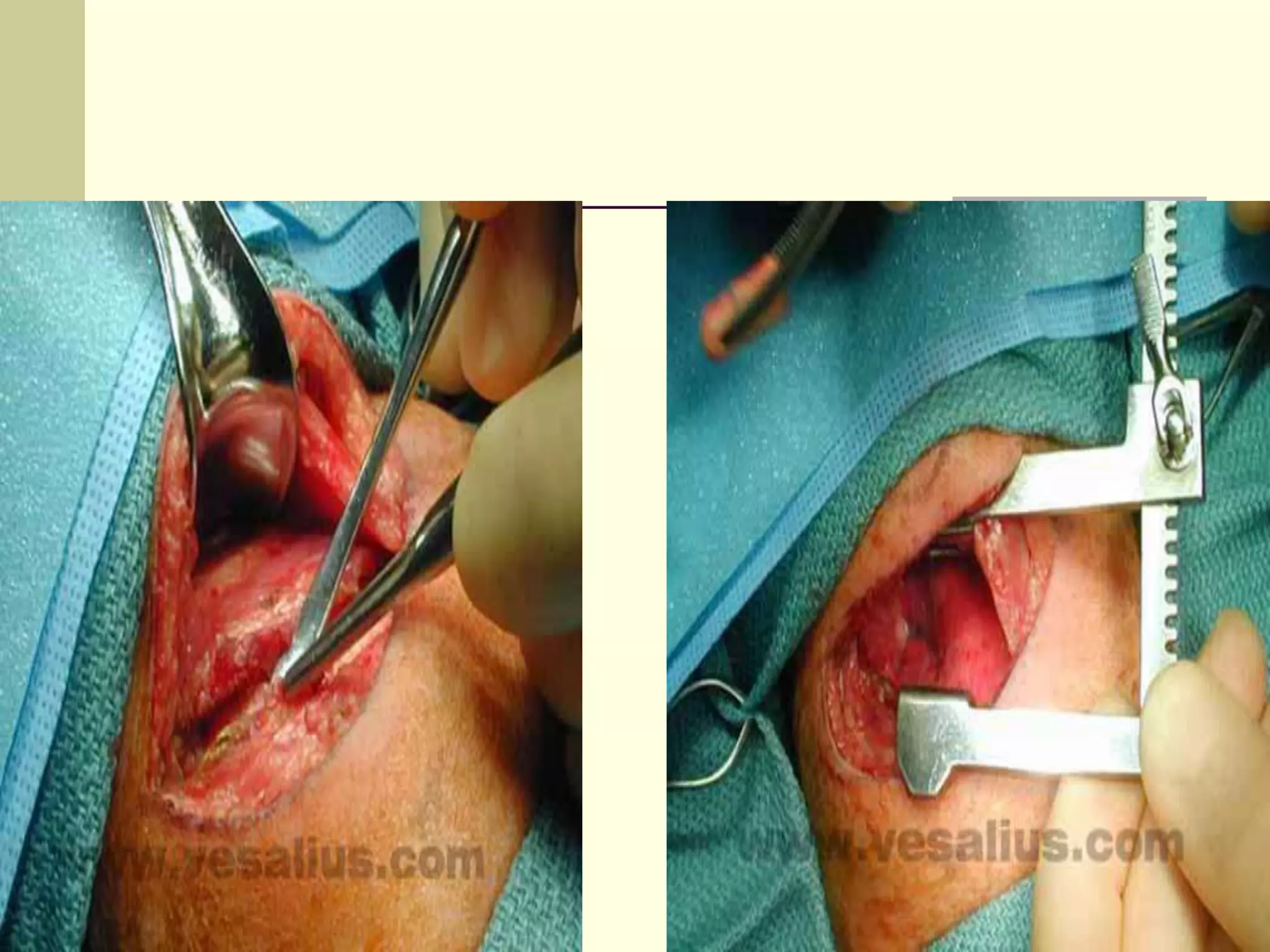
 The infant is typically positioned for a
standard Rt posterolateral thoracotomy, with
the right arm extended above the head and
the head slightly flexed.
 A curved skin incision is made around the
lower border of the scapula, extending from
the anterior axillary line posteriorly to the
paravertebral region.
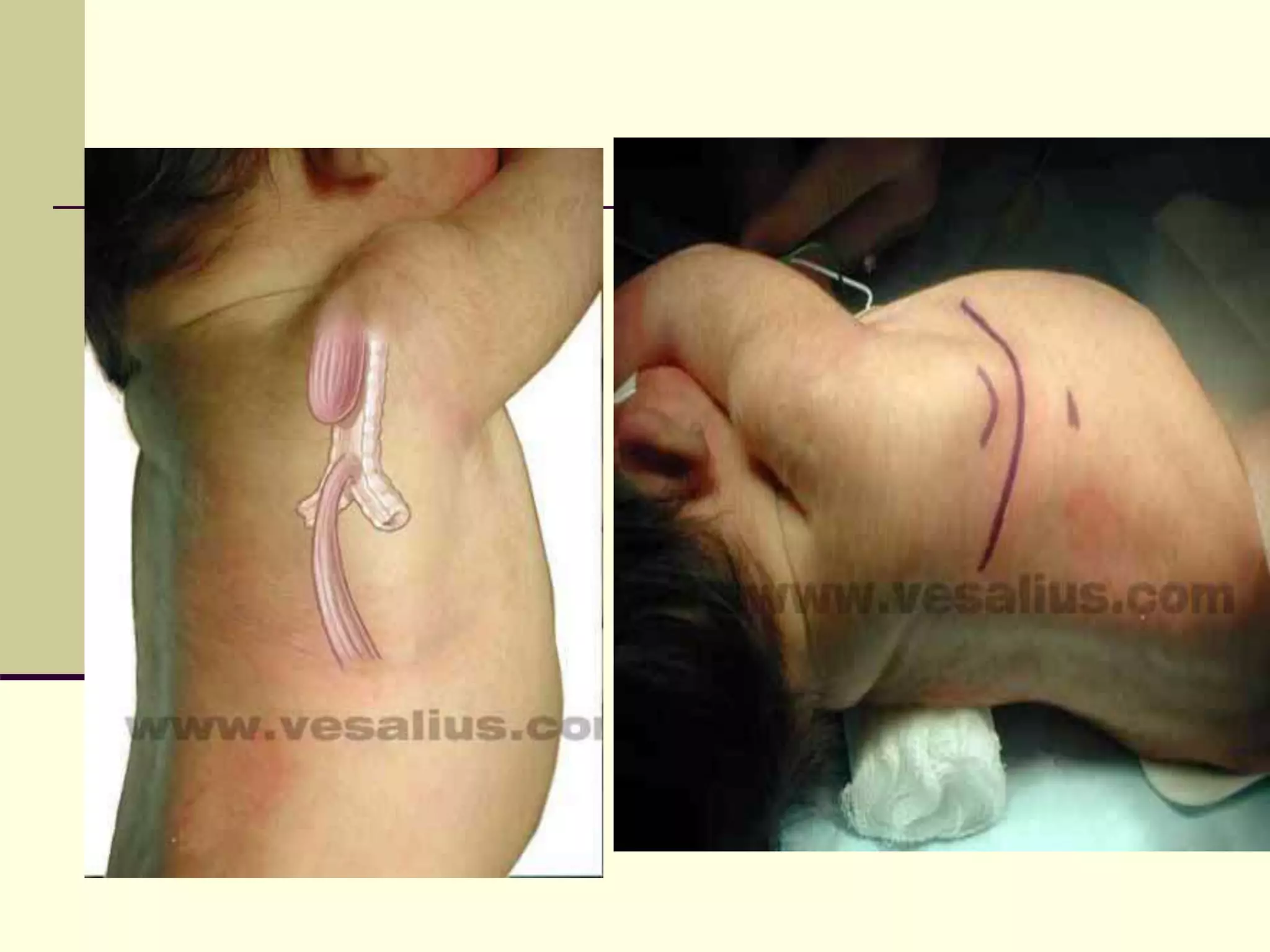
 The thorax is entered through the fourth
intercostals space by dividing the intercostals
muscles, with care taken to avoid incising the
pleura.
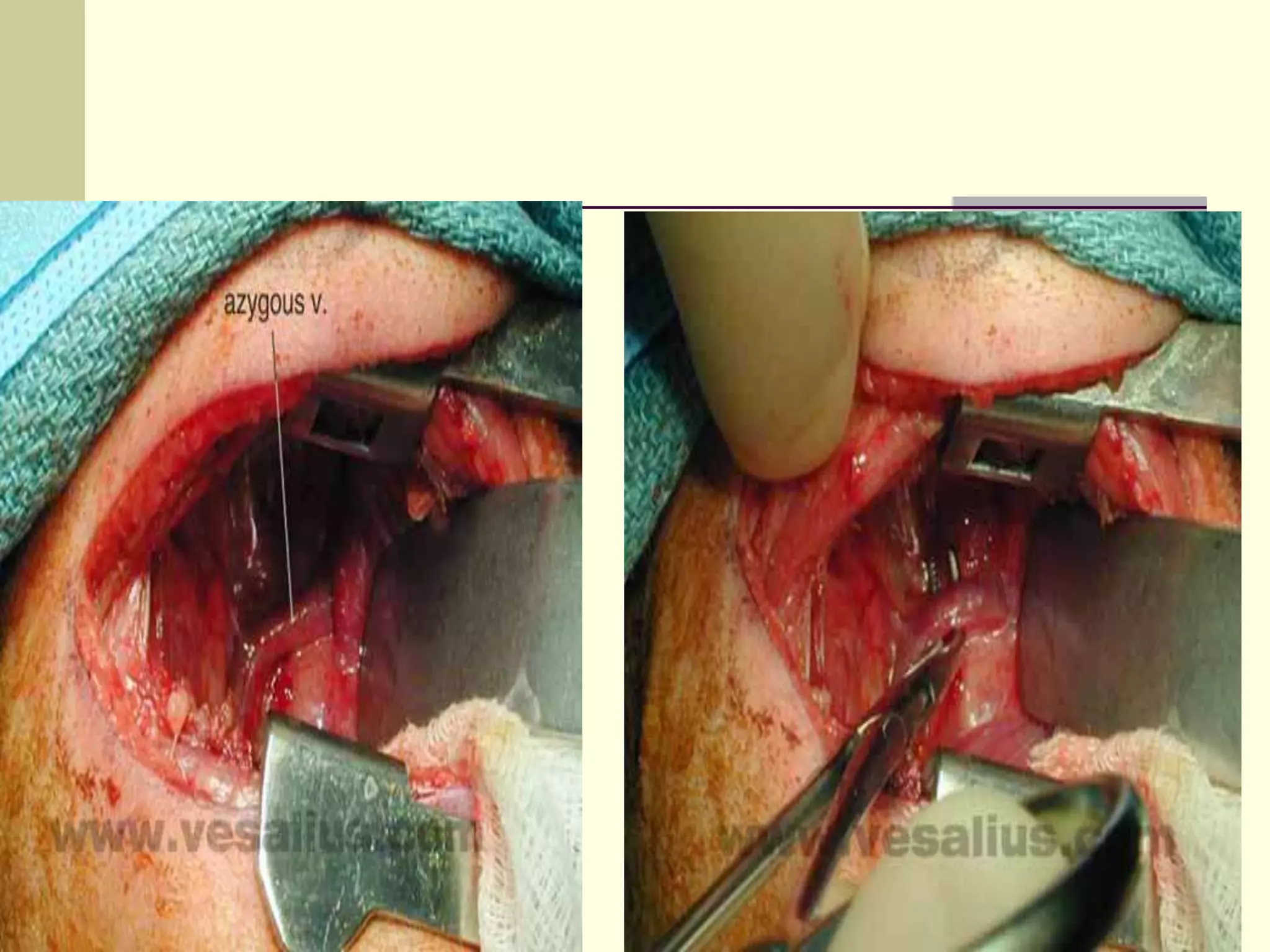
 With the extrapleural approach - In this
dissection start posterioly followed by
superior and inferiorly, Azygos vein is
exposed and divided.
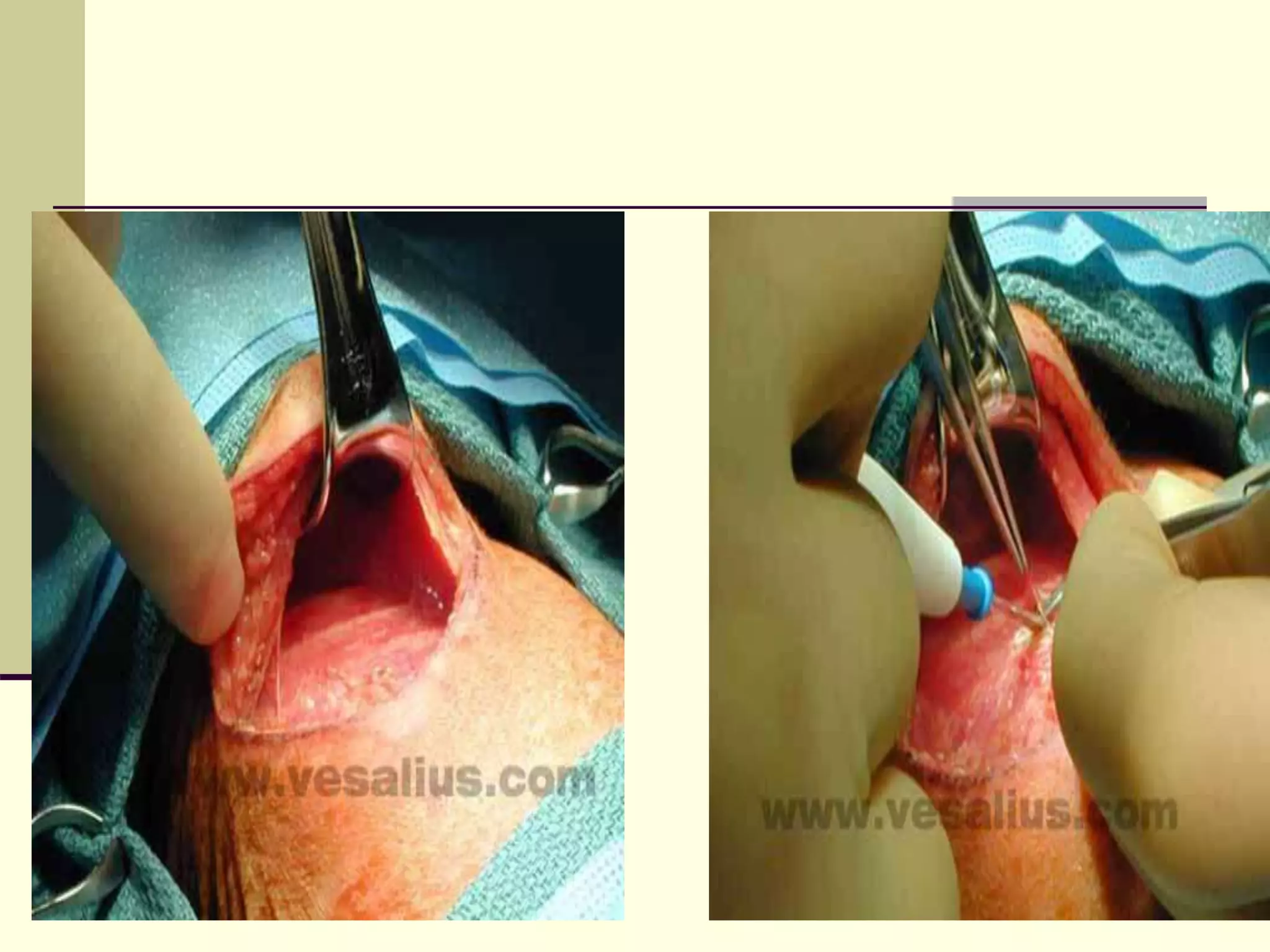
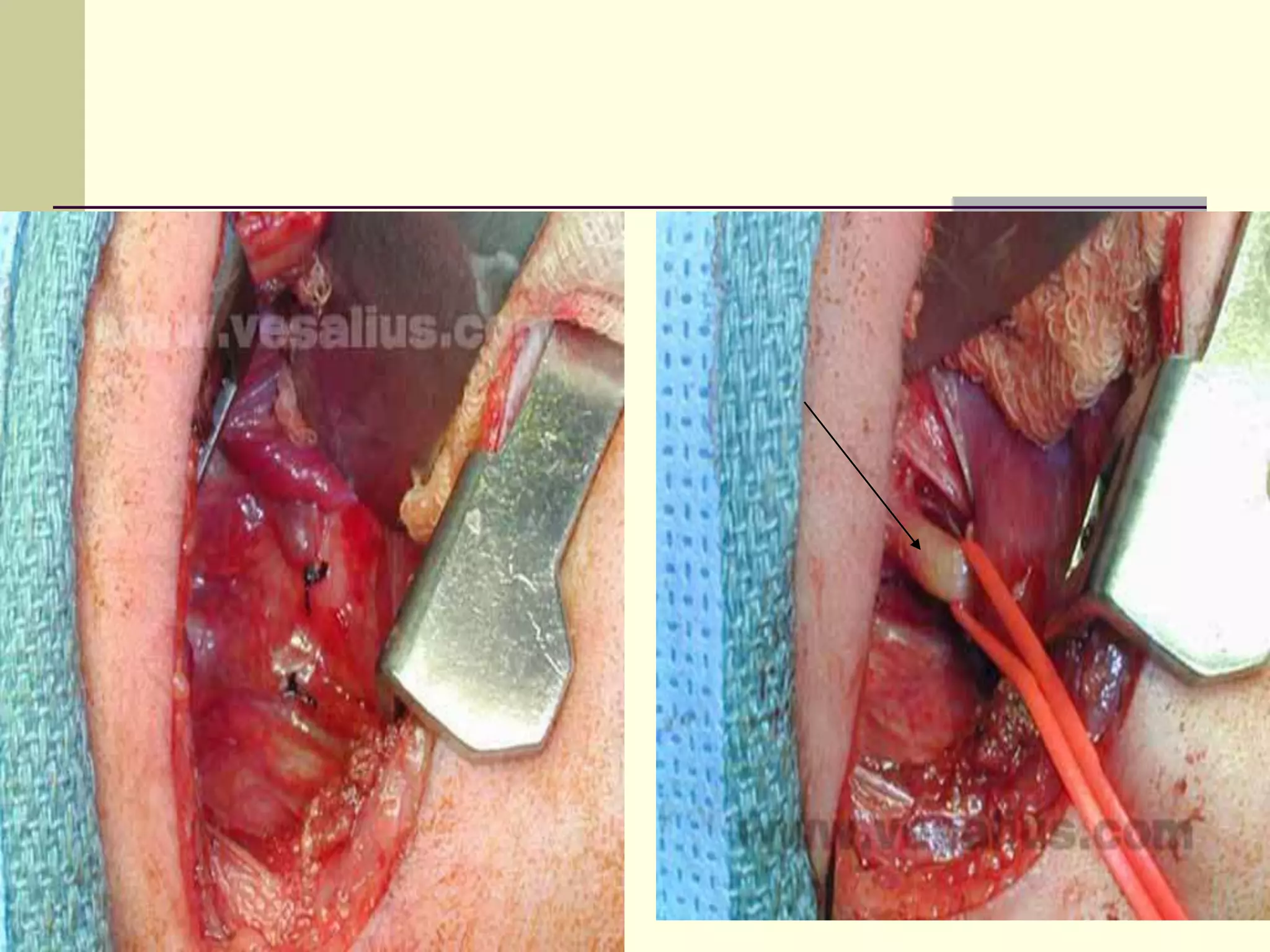
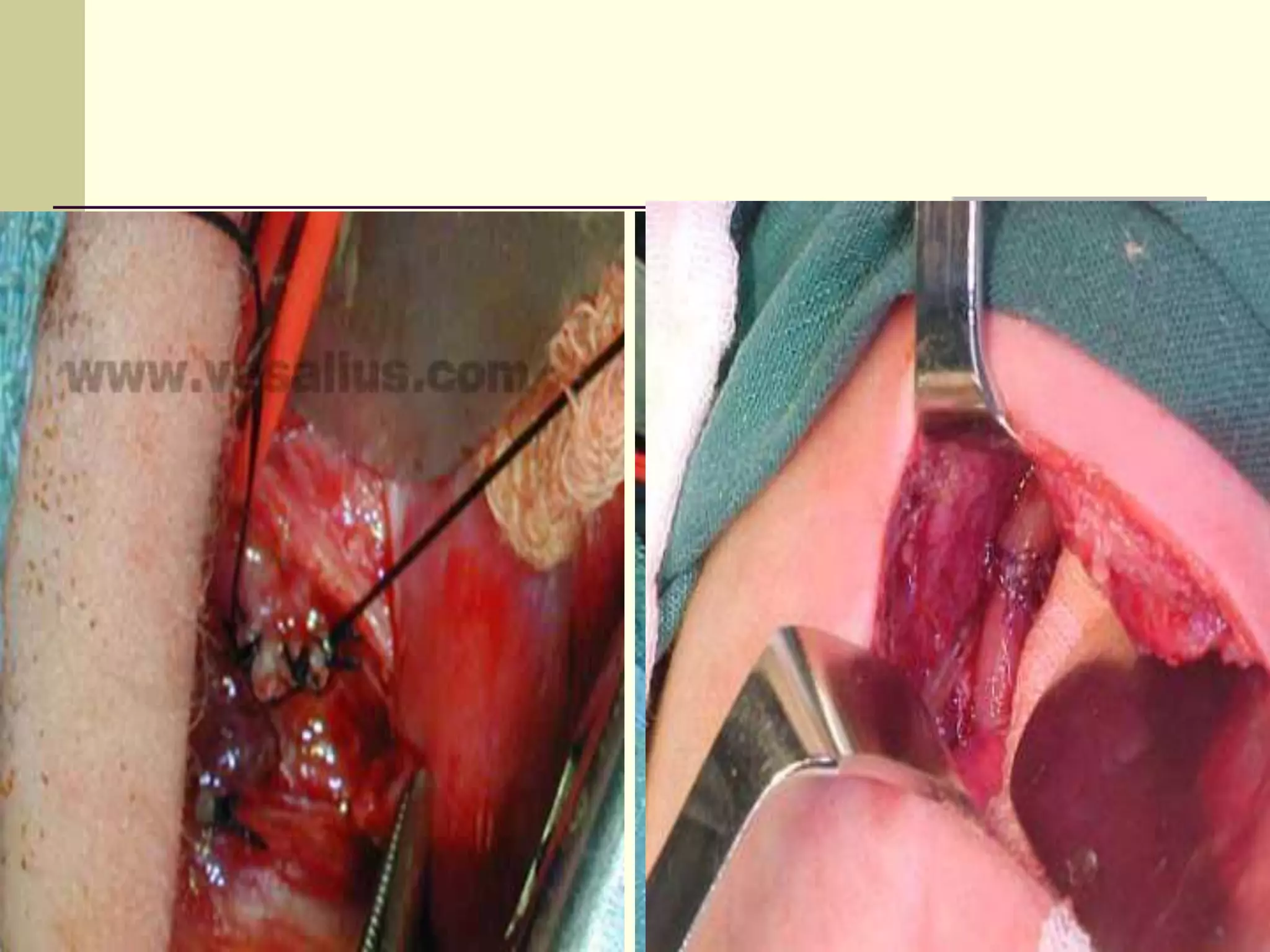
 -The lower esophagus is dissected
circumferentially at the level of fistula.
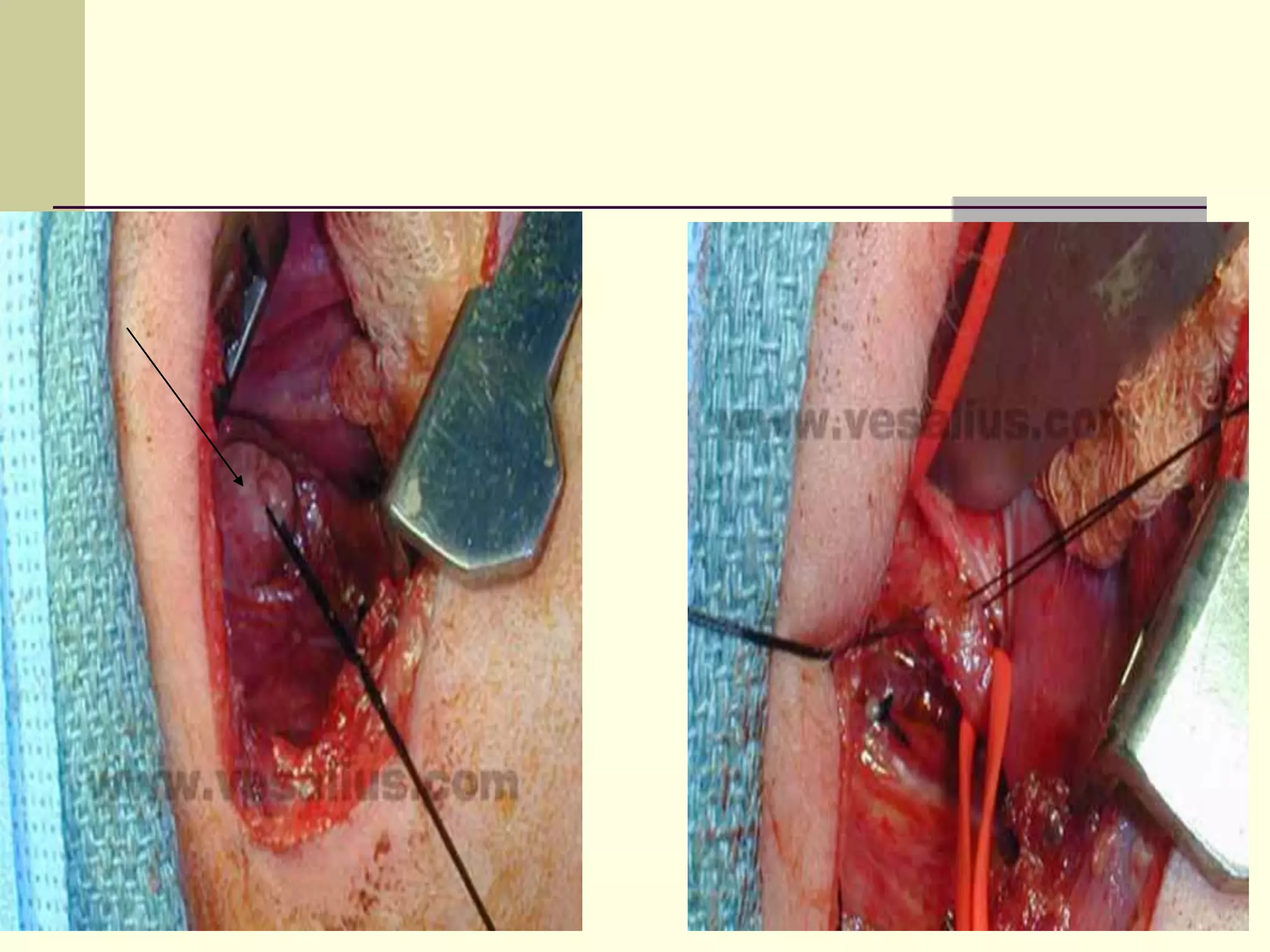
 Fistula closed, mobilization of upper pouch
and lower esophagus, the tip of upper pouch
is excised .
 End to end anastomosis made with single
layer suturing.
 Drain should be placed away from the
anastomosis in retro pleural space
POST OPERATIVE COMPLICATION
A) Early complication
(i) Anasto motic leak – 14-16%
a. Incidental :- Incidental leak are generally
radiological leak, have no symptoms
Minor leakage :- Saliva in chest drain but
infant clinically well.
 Minor leaks are managed conservatively
with parenteral nutrition, upper pouch
suctioning, antibiotics and ensuring adequate
drainage of the extrapleural space by the in
situ chest tube)
Major leakage :- Mediastinitis or abscess.
-Tension pneumothorex
- Empyema
 Reanastomosis following a major leak is
usually always unsuccessful and in such
cases diversion in the from an
esophagostomy and gastrostomy may be life
saving)
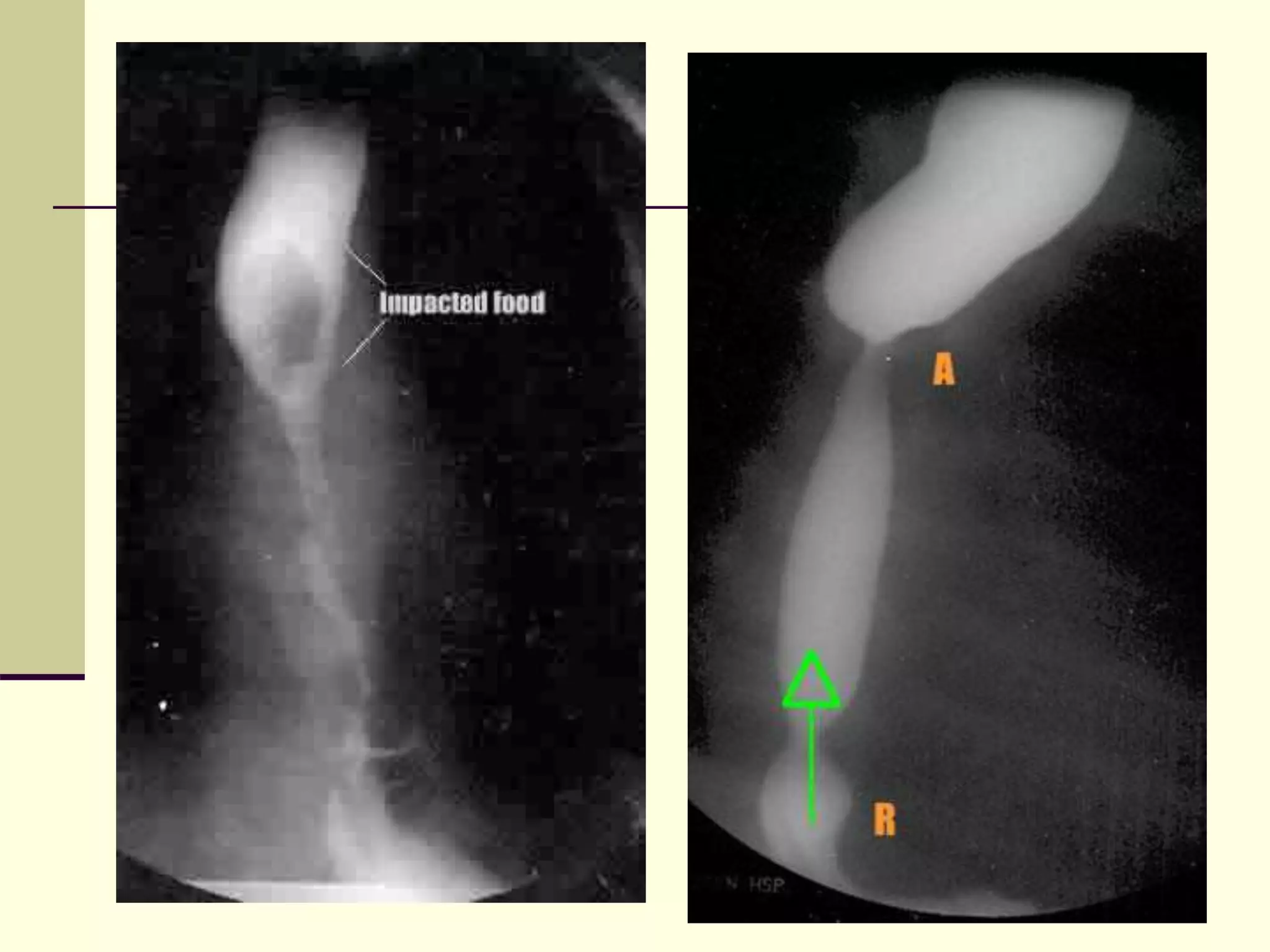
(ii) Anastomotic stricture :- The factors
that have been implicated in the pathogenisis
of esophegal stricture include poor
anstomotic technique, Gastroesophageal
reflux, Anastomosis under tension and
ischemia of esophageal ends.
 Balloon dilatation under fluoroscopic
guidance is the preferred treatment for
anastomitic strictures.
Recurrent tracheo esophageal fistula(3-14%) :-
Improper closure of the fistula, end to side
esophageal anastomosis with fistula ligation and
anastomotic leak with local abscess formation can
lead to a recurrent TOF.
 The classic approach for management of recurrent
tracheosophageal fustula is a repeat right
thoracotomy , transpleural repair of the fistula and
interposition of an intercostals muscle or
pericardial flap after repair of the defect.
(B) Late complication :-
1. Gastro esophageal reflux.
2. Tracheomalacia 10-20%
3. Disordered peristalsis
4. Chest Wall Deformity
Gastro esophageal reflux
 GERD is extremely common occurring in up
to 35 to 58% of children.
 GERD appears to be due to intrinsic motor
dysfunction of the esophagus, and shortened
intraabdominal segment of the esophagus
due to anastomotic tension .
 GERD may lead to esophageal strictures,
aspiration leading to pneumonia, bronchial
hyperreactivity, and permanent airway or lung
parenchymal damage.
 Tracheal inflammation, assessed by biopsy.
 Esophageal biopsy specimens showed
severe inflammation in 20% of cases, and
Barrett esophagus in 6%.
 65%percent of patients with EA/TEF and
GERD may respond to medical therapy, with
the remainder requiring antireflux surgery
 The indication for surgical correction of
gastroesophageal reflux is failure of medical
management .
 evidenced by persistent reflux esophagitis or
Barrett esophagus, failure to thrive,
anastomotic stricture.
 The usual surgical treatment is a Nissen
fundoplication.
 Timing of fundoplication within 6 months of
the initial surgery to 21 months of age.
Tracheomalacia
 Tracheomalacia is present clinically significant in 10
to 20% of patients.
 Tracheomalacia is usually found at or just above level
of the original EA/TEF.
 The site of collapse is most prominent in the distal
one-third trachea in 60% of cases, and in the middle
one third in 30%.
 The soft trachea is easily compressed between the
aorta and the frequently dilated former esophageal
pouch.
 Bulging of the posterior wall is evident at
brochoscopy.
 In most patients, the manifestations of
tracheomalacia are limited to a brassy
(barking) cough.
 Episodes generally began after 2 to 3
months of age.
 The event typically occurs during or just after
feeding, or during crying or coughing, and is
followed by cyanosis progressing rapidly to
apnea, bradycardia, and cardiac arrest.
 Treatment for tracheomalacia is generally
reserved for patients with dying spells or
recurrent pneumonia.
 Aortopexy involves suturing the aorta to the
posterior surface of the sternum
 Tracheopexy
 Airway stent
 Tracheostomy
Disordered peristalsis
 Esophageal peristalsis, assessed by
manometry, is abnormal in 75 to 100% of
children with a history of EA.
 An immotile segment or small, discoordinate
contractions is most commonly observed.
 Many children with repaired EA/TEF need to
eat slowly.
 In severe cases, failure to thrive or aspiration
 This may require myotomy for treatment.
Chest Wall Deformity
 Chest wall deformities may be common in
individuals with a history of EA/TEF.
 Scoliosis is more common in patients .
 Progressive scoliosis requiring surgical
correction.
Mortality-early
 Inadequate Upper pouch suctioning
 Oral feeds before diagnosis
 Aspiration Pneumonitis
 Hypothermia.
 Related to surgery
 Recurrent TEF
 Anastomotic leaks – sepsis
 Poor nutrition.
Mortality -
Late
The causes of mortality in the first year of the
life are
- Congenital heart disease
- Recurrent pneumonia
- Tracheomalacia
Survival rate - 85-95%
long-gap oesophageal atresia
 The distance between esophageal ends that
constitutes a long-gap EA lacks a strict numerical
definition.
 gap intervals measuring greater than 2 cm, or greater
than two vertebral bodies as constituting along-gap
EA
 3.5 cm ‘‘ultra-long’’ gap or6 vertbral bodies.
 Thus, long-gap EA can be defined as any distance
between the esophageal ends in a new born that is
too wide for the surgeon to perform primary
anastomosis of the proximal and distal esophagus
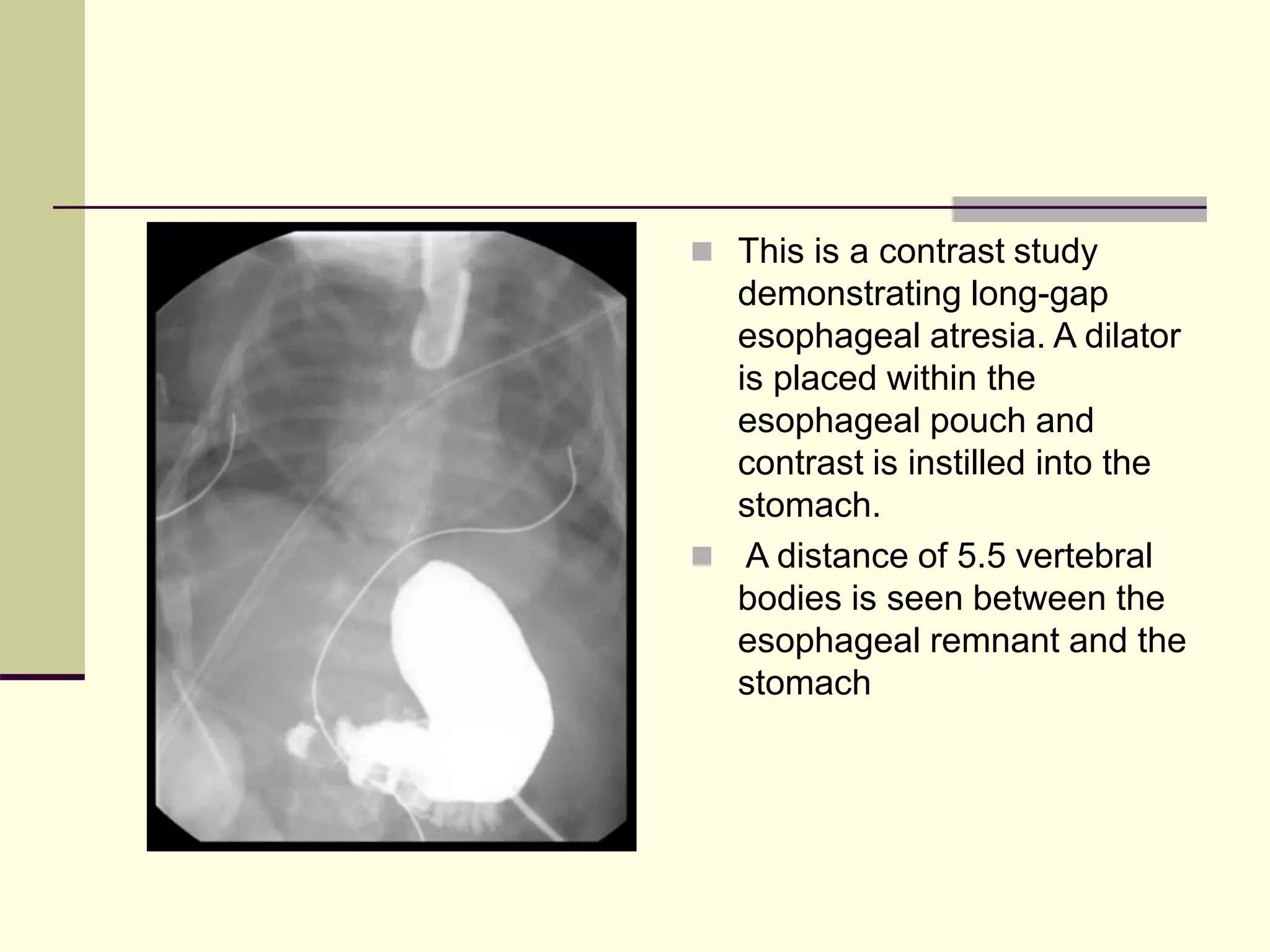
 This is a contrast study
demonstrating long-gap
esophageal atresia. A dilator
is placed within the
esophageal pouch and
contrast is instilled into the
stomach.
 A distance of 5.5 vertebral
bodies is seen between the
esophageal remnant and the
stomach
Operative manoeuvres in long-gap
oesophageal atresia
 At the initial procedure
1. anastomosis under tension
2. tension-relieving procedures
3. flap technique
4. suture fistula
 Delayed primary anastomosis
1. with bouginage - proximal , proximal and
distal, magnetic
2. without bouginage
3. oesophageal lenghtening techniques,flap ,
myotomy , gastric division .
Transmediastinal "thread"
 1. with and without "olives"
 Oesophageal replacement
 1. colonic interposition
 2. gastric tube
 3. jejunum
 4. gastric transposition
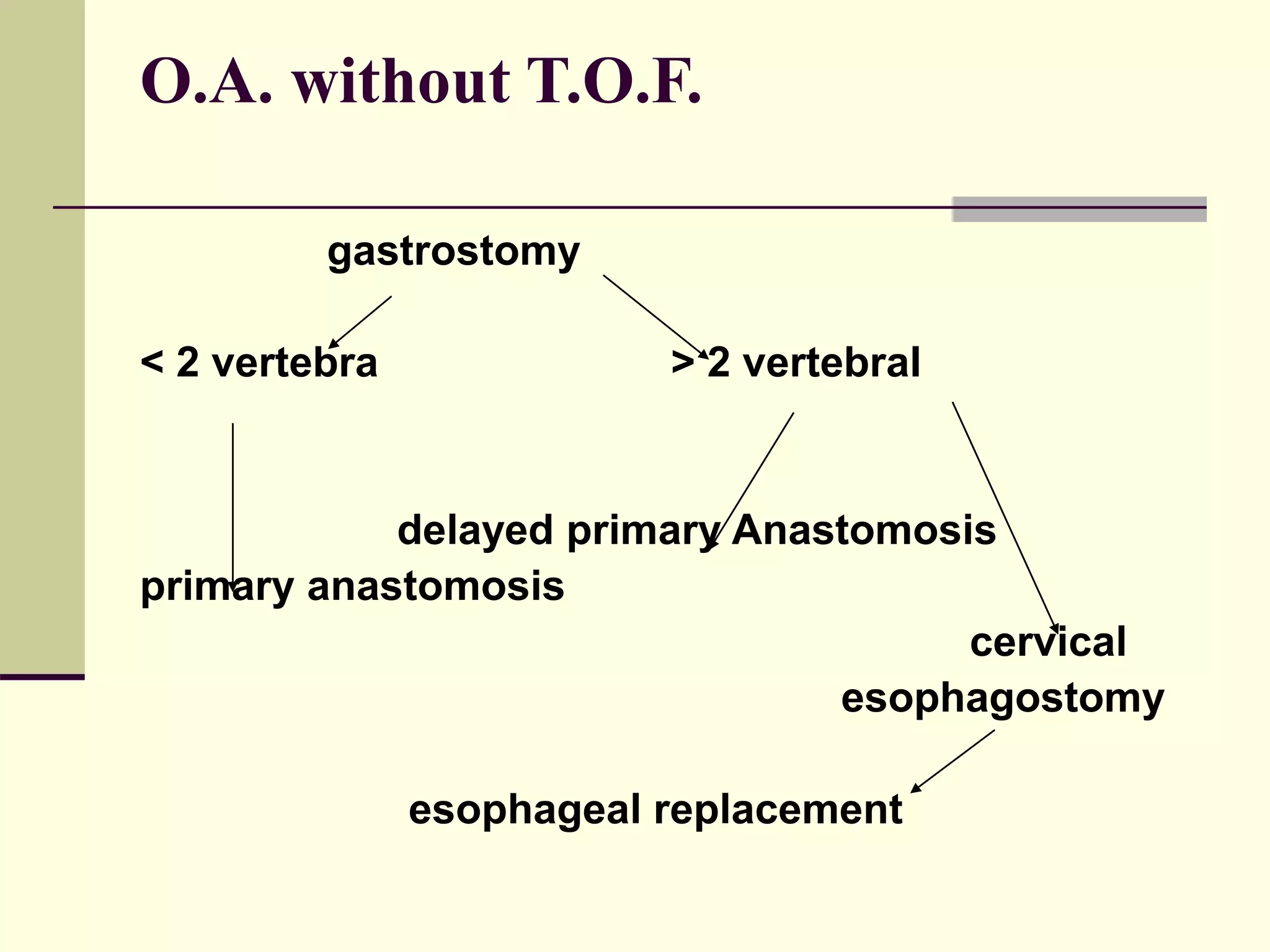
O.A. without T.O.F.
gastrostomy
< 2 vertebra > 2 vertebraI
delayed primary Anastomosis
primary anastomosis
cervical
esophagostomy
esophageal replacement
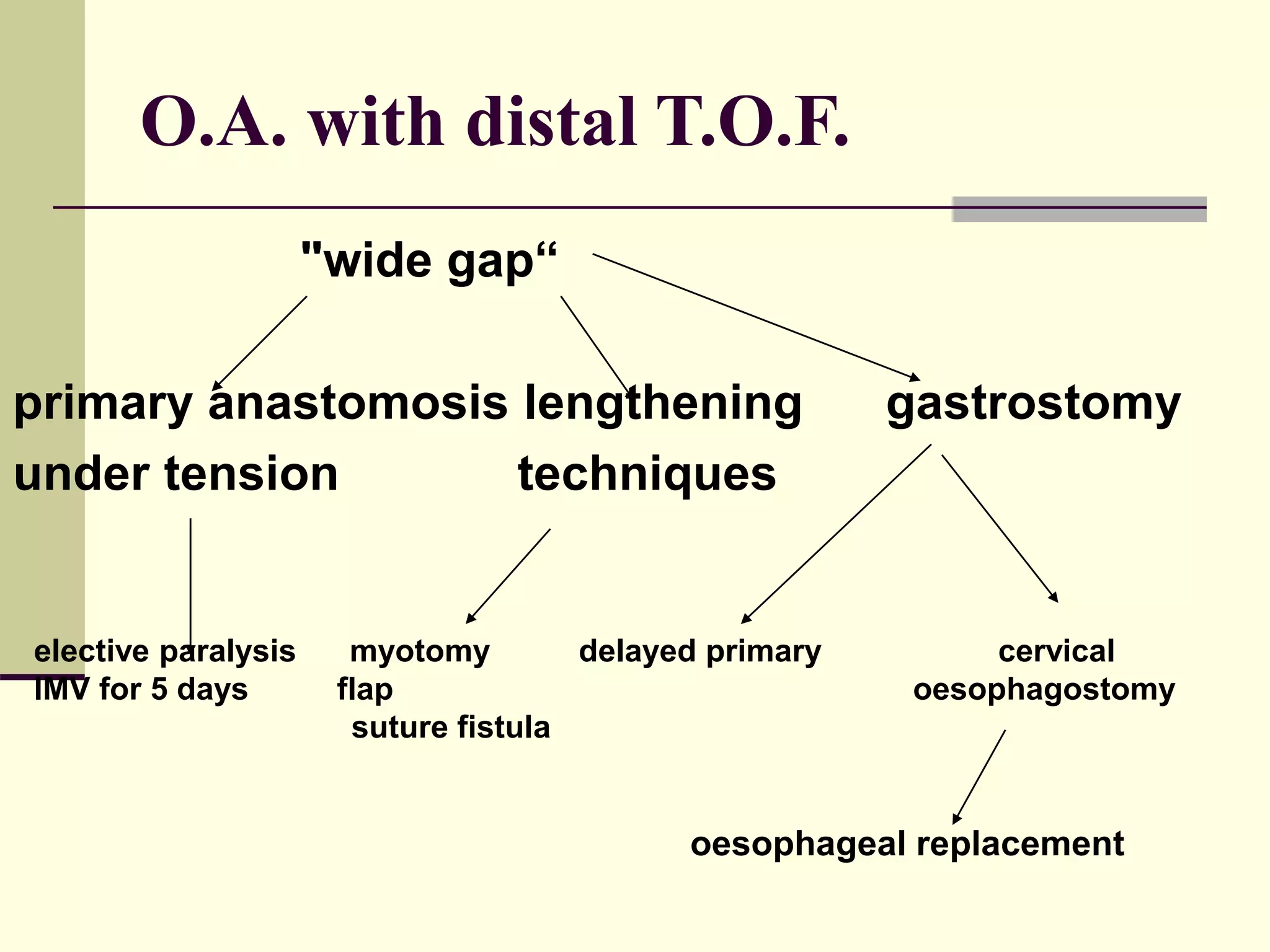
O.A. with distal T.O.F.
"wide gap“
primary anastomosis lengthening gastrostomy
under tension techniques
elective paralysis myotomy delayed primary cervical
IMV for 5 days flap oesophagostomy
suture fistula
oesophageal replacement
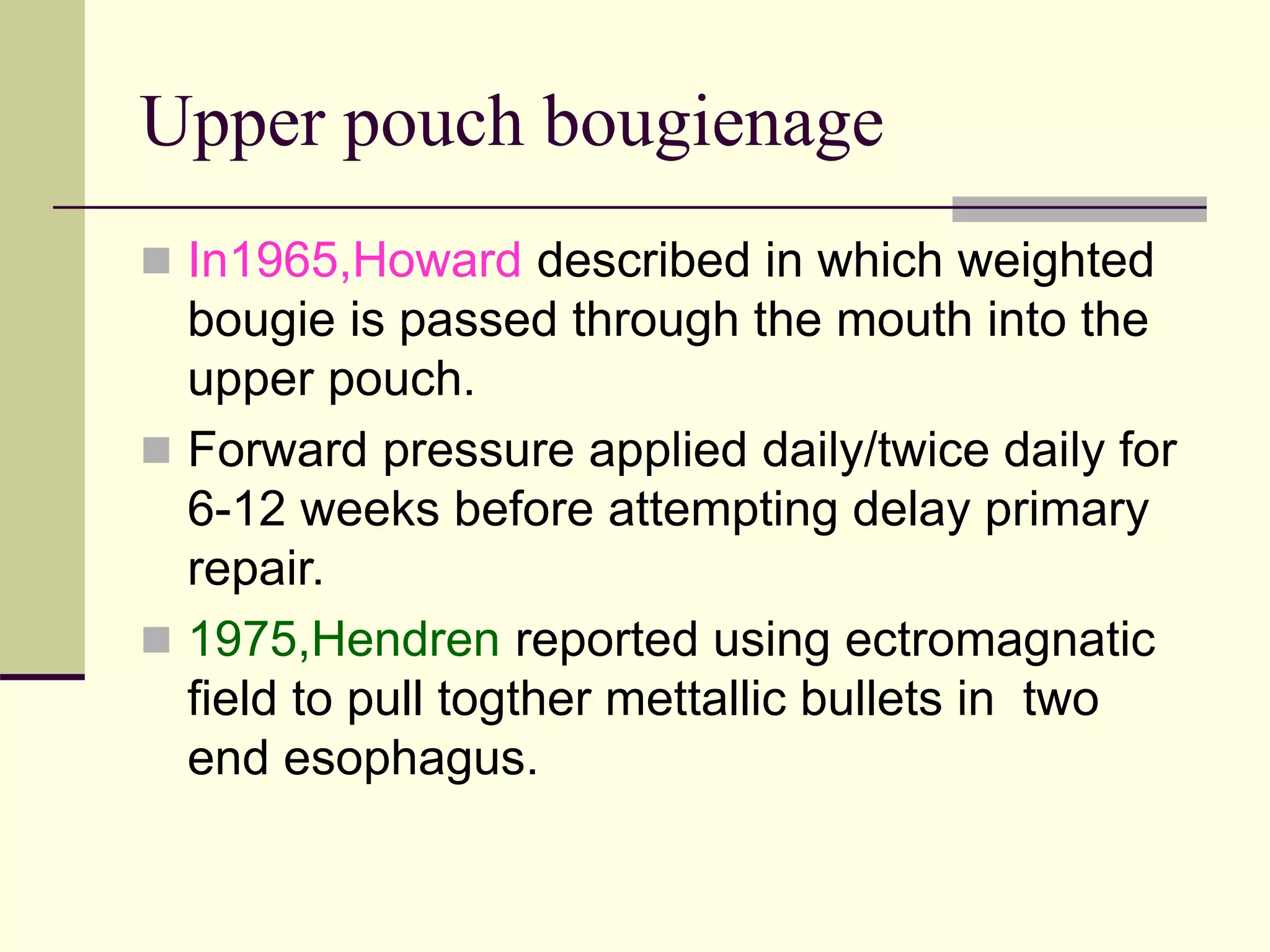
Upper pouch bougienage
 In1965,Howard described in which weighted
bougie is passed through the mouth into the
upper pouch.
 Forward pressure applied daily/twice daily for
6-12 weeks before attempting delay primary
repair.
 1975,Hendren reported using ectromagnatic
field to pull togther mettallic bullets in two
end esophagus.
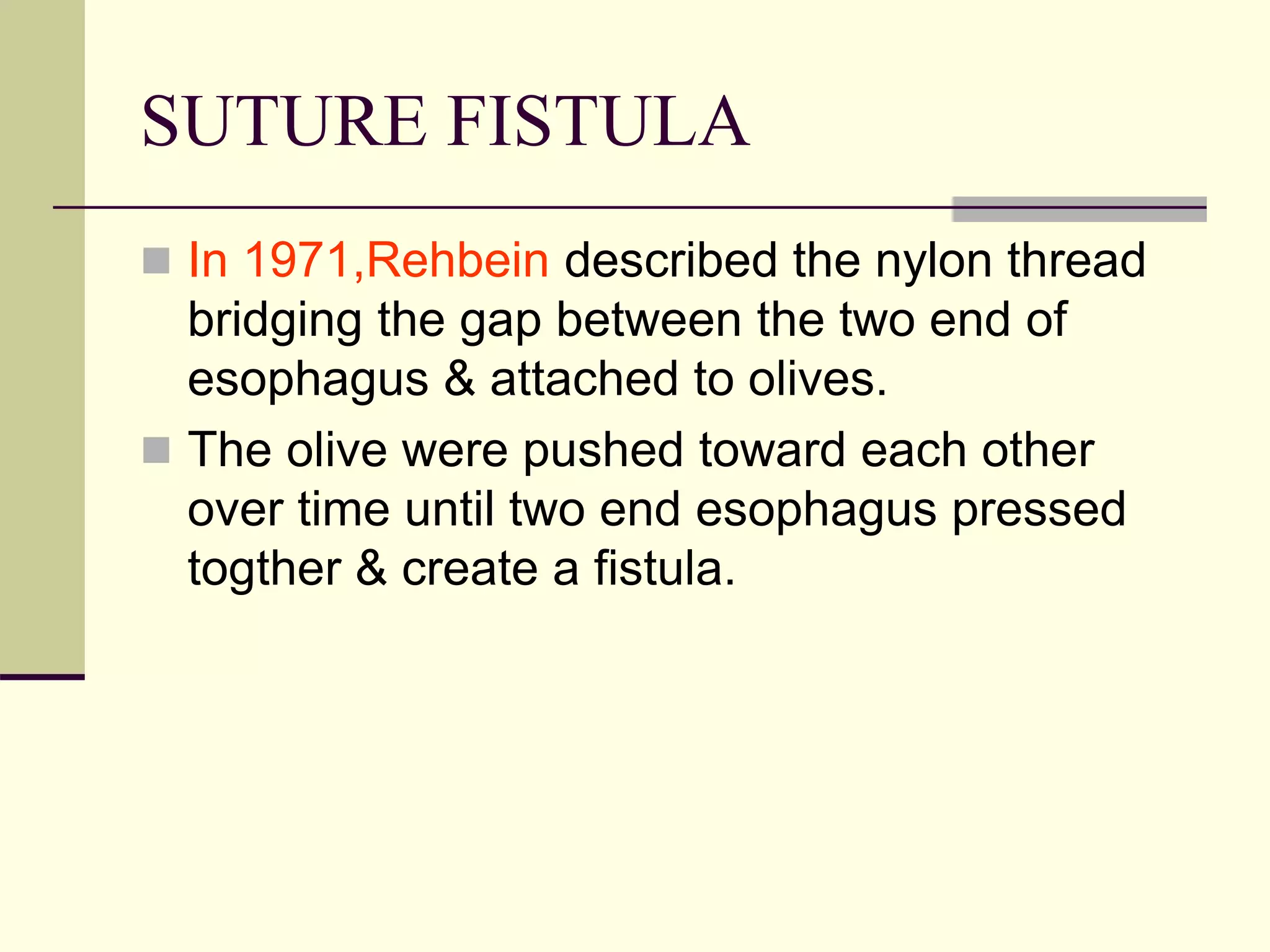
SUTURE FISTULA
 In 1971,Rehbein described the nylon thread
bridging the gap between the two end of
esophagus & attached to olives.
 The olive were pushed toward each other
over time until two end esophagus pressed
togther & create a fistula.
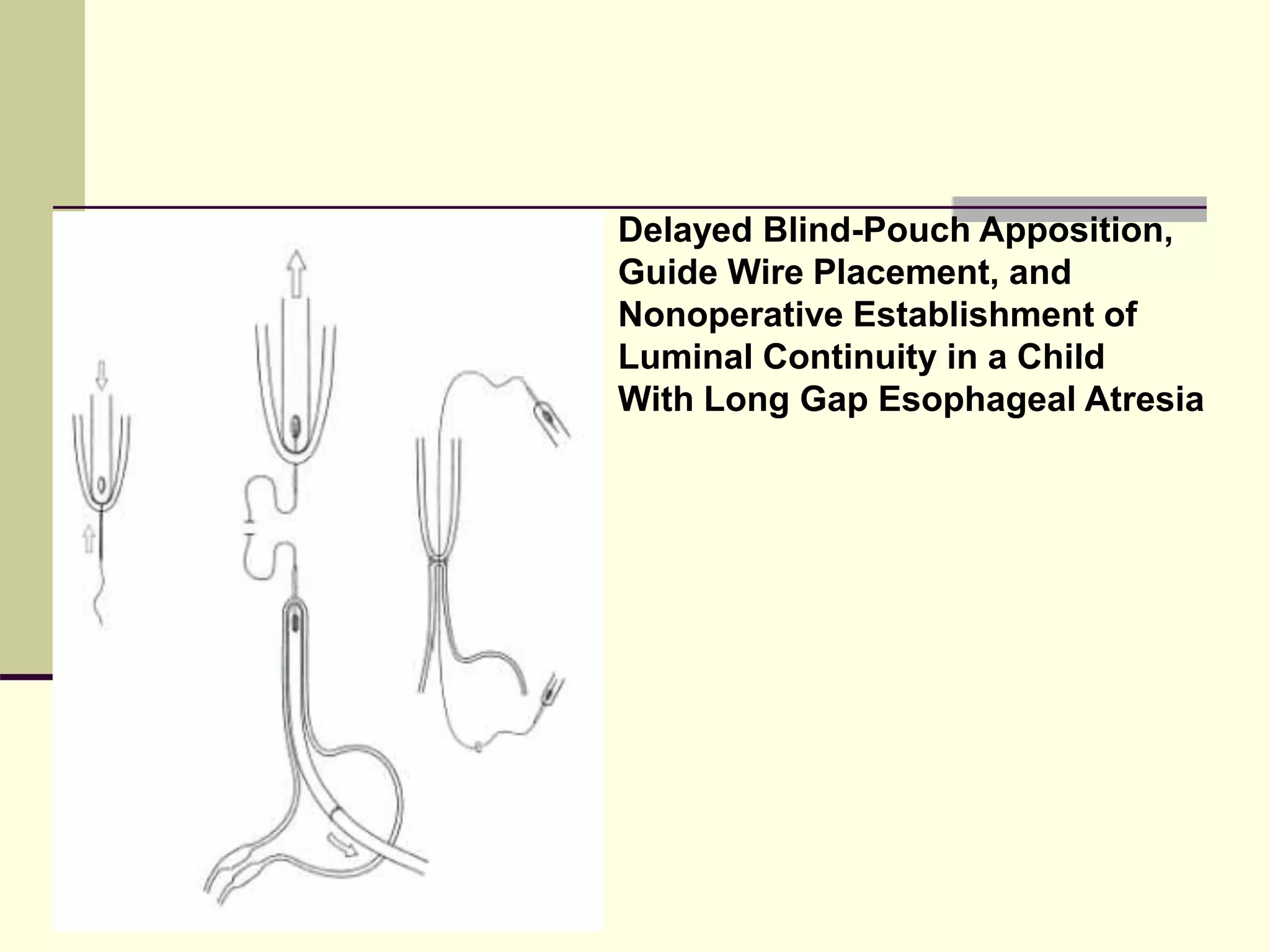
Delayed Blind-Pouch Apposition,
Guide Wire Placement, and
Nonoperative Establishment of
Luminal Continuity in a Child
With Long Gap Esophageal Atresia
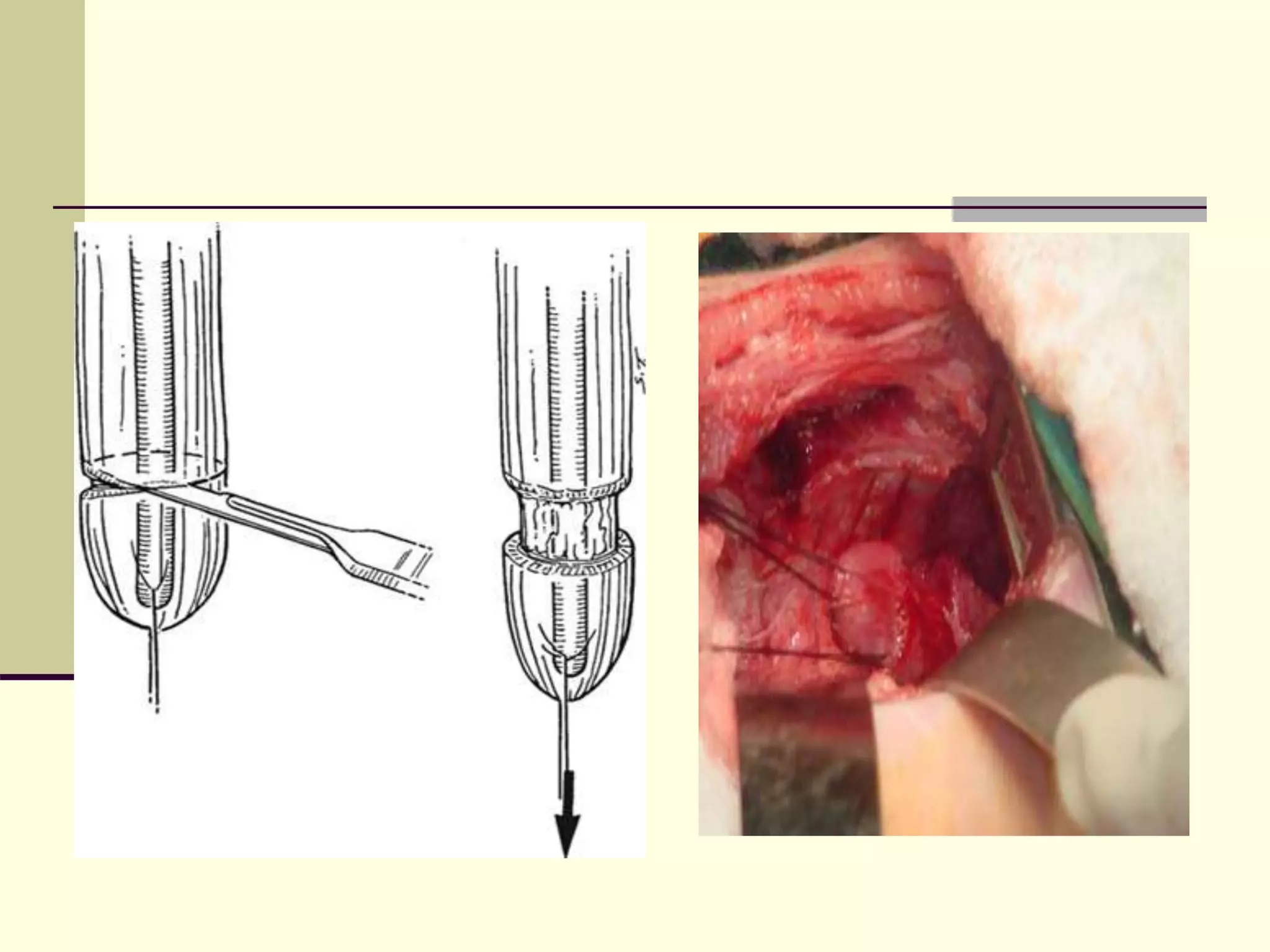
myotomy
 In some instances, the two ends of the
esophagus are too far apart (>2.0 cm) for a
safe primary anastomosis.
 A circular myotomy, as described by Livaditis,
can lengthen the proximal or distal end .
 The myotomy is performed approximately 2.0
cm above the blind proximal atretic end to
divide the longitudinal and circular smooth
muscle.
 This increases the length of the proximal
esophagus by approximately 1.0 cm and often
facilitates a primary anastomosis without
tension.
 Occasionally, a second myotomy may be
required at a more proximal level .
 A proximal spiral myotomy has been described
 Step ladder myotomy
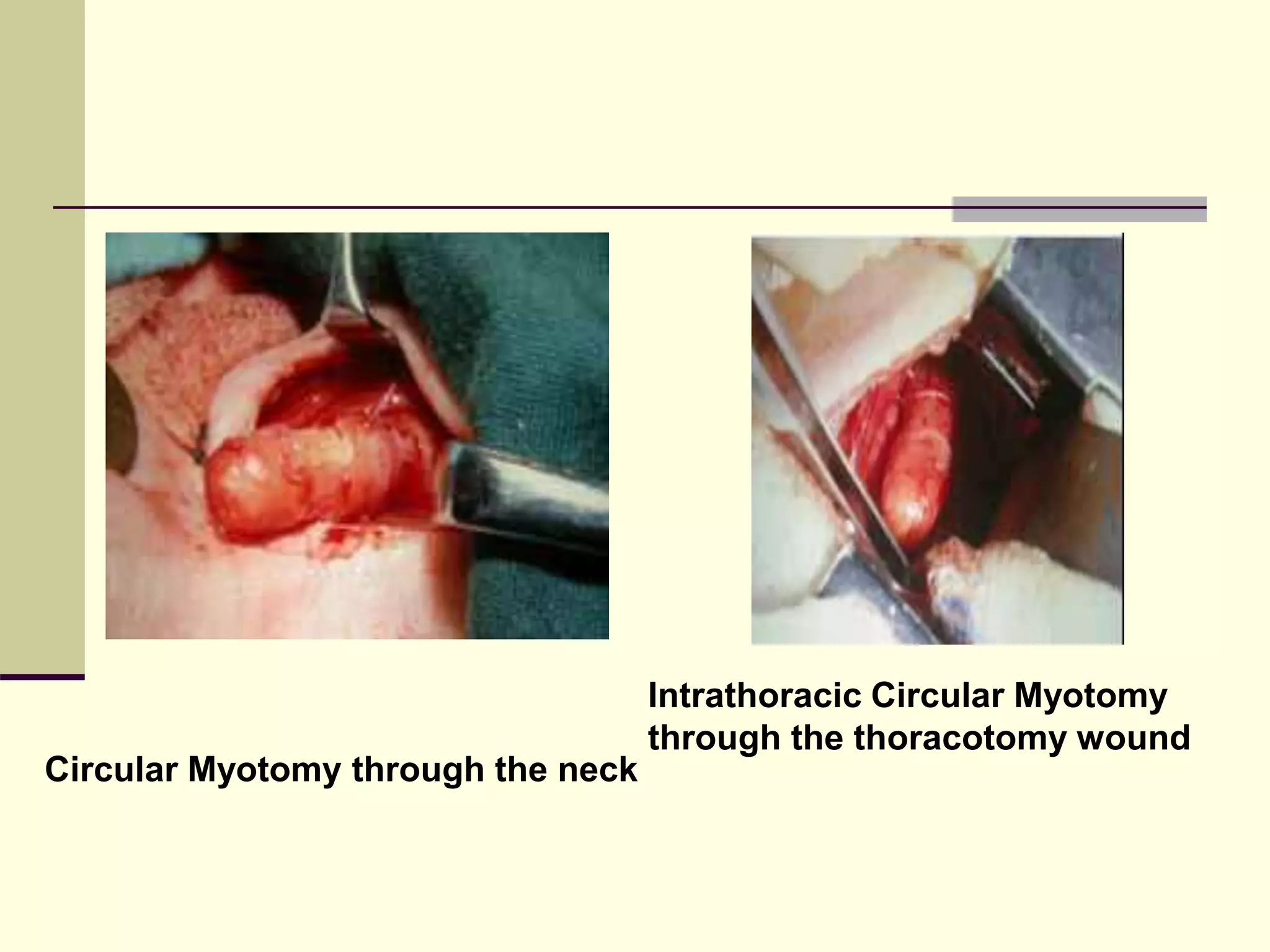
Circular Myotomy through the neck
Intrathoracic Circular Myotomy
through the thoracotomy wound
flap technique
 Gough popularized theanterior upper pouch
flap.
 An inverted full thicness pouch is created &
rotated down.
 The length of the flap should be less than
three times the breath.
 It increases length about 1.5 cm.
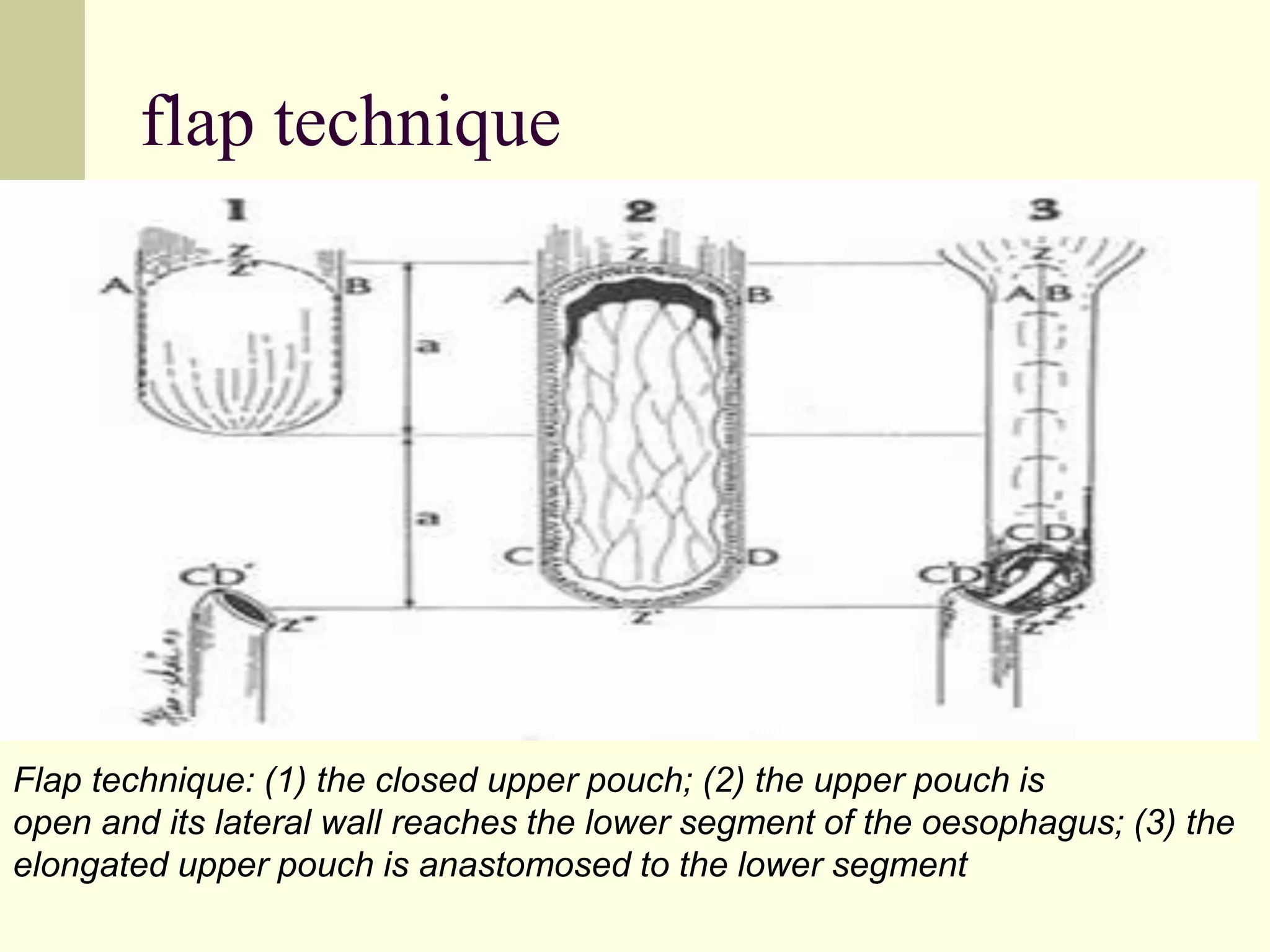
flap technique
Flap technique: (1) the closed upper pouch; (2) the upper pouch is
open and its lateral wall reaches the lower segment of the oesophagus; (3) the
elongated upper pouch is anastomosed to the lower segment
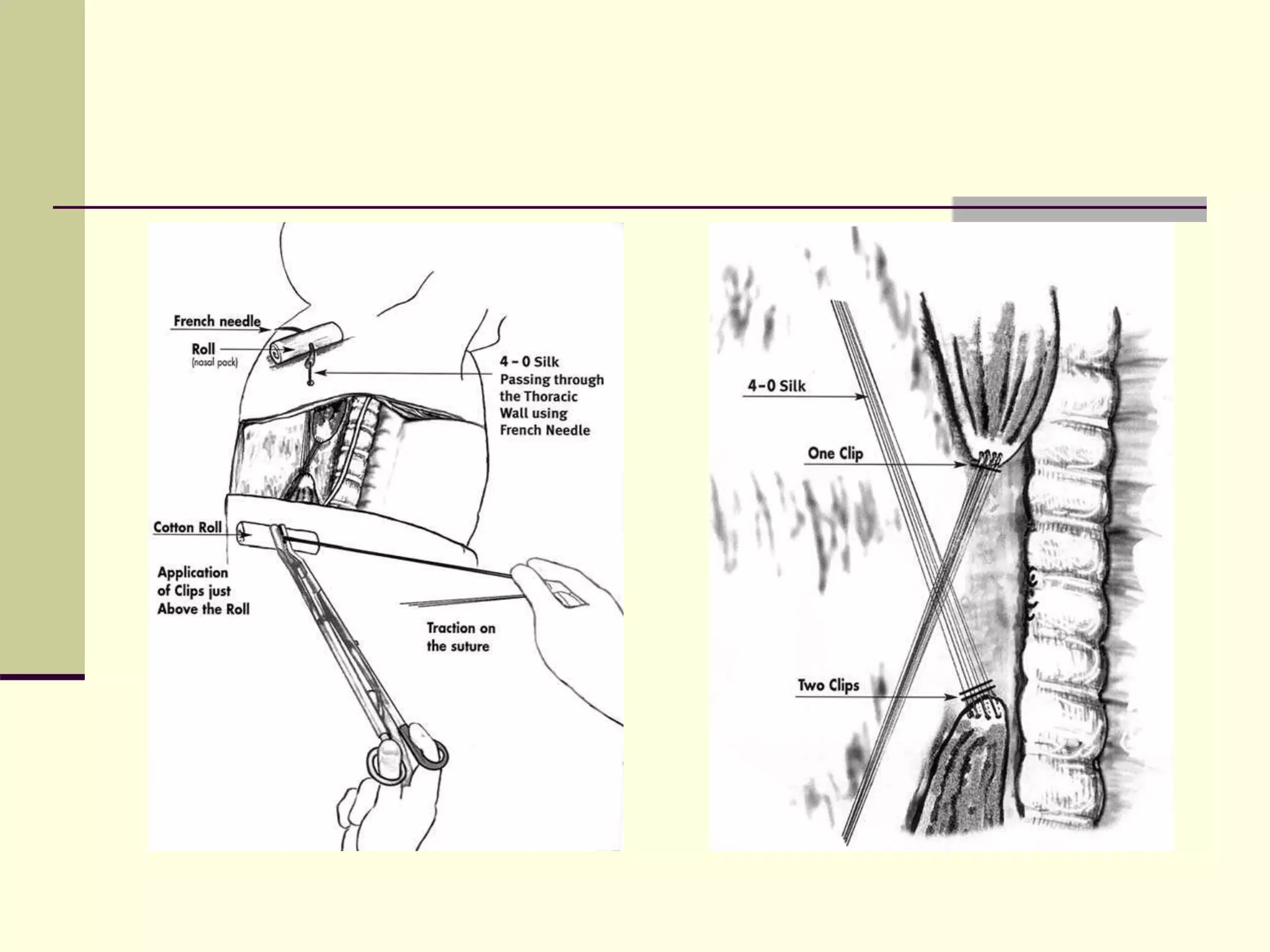
Fokker technique
 long gap esophageal atresias we used an
esophageal lengthening technique originally
described by Dr John E. Foker.
 This technique consists of the placement of traction
sutures into the ends of the proximal and distal
esophageal pouches.
 after full mobilization and bringing these sutures
together through the thoracic wall under slight
tension.
 Postoperatively, these sutures are pulled1 to 2 mm
daily.
 Once the 2 ends of the esophagus are in proximity,
esophageal anastomosis is performed.
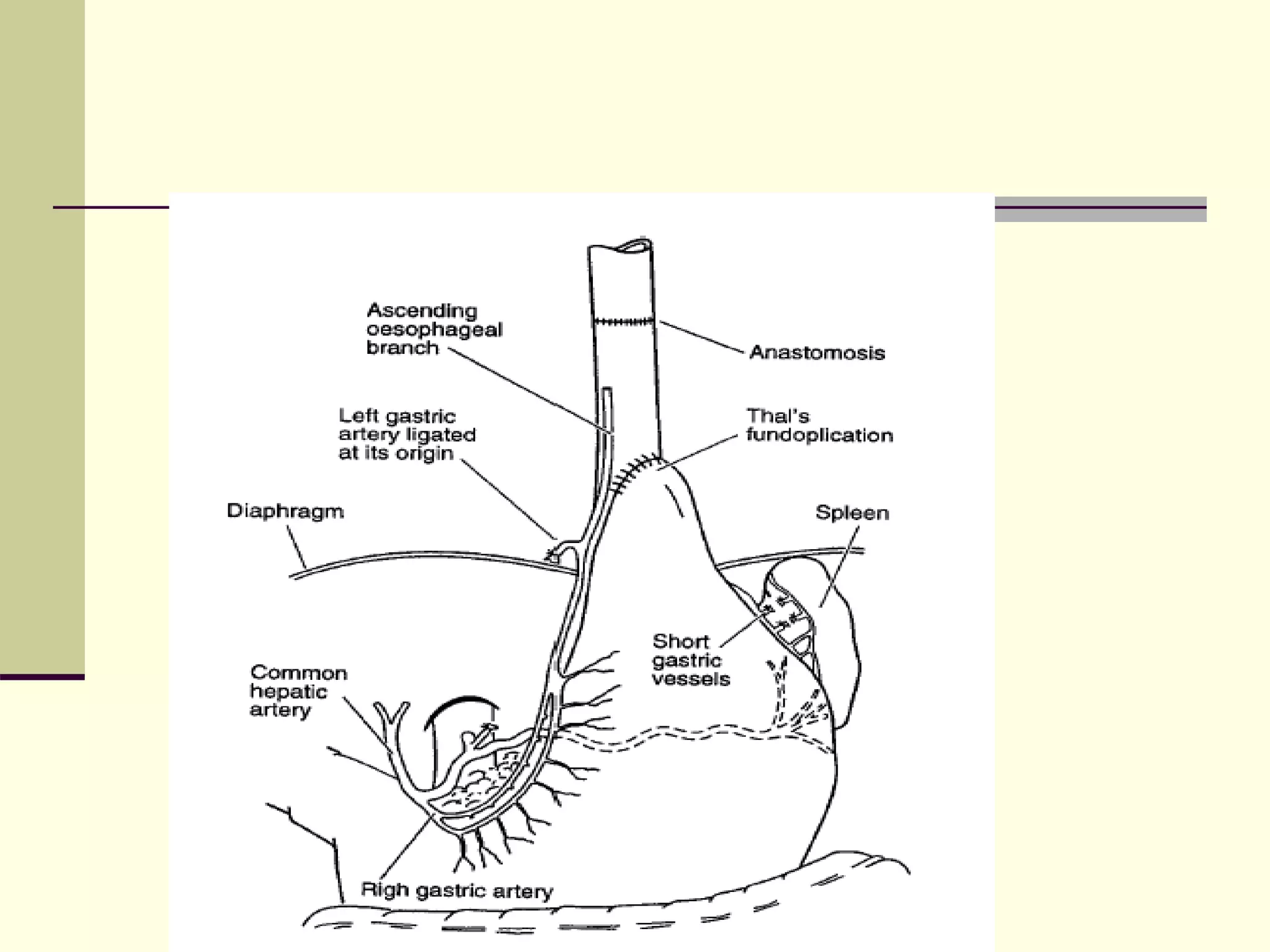
Scharli lesser curve elongation
 Scharli describe a comman abdominal &
thoracic procedure in which adequate
vacularity of distal esophagus was insured by
dividing the left gastric artery.
 Diagonal division of lesser curvature of
stomach with GIA stapler.
 Mobilization of gastric cardia & fundus into
the chest to achieve anastomosis with partial
fundoplication.
ESOPHAGEAL REPLACEMENT
Creteria for ideal conduit
 An efficient conduit from mouth to stomach to
satisfy nutriional needs.
 Conduit should grow with child
 Gastric acid reflux into conduit must be
mimimum.
 Conduit should not impair respiratory or
cardiac function.
 Surgical techanique should be simple
 Conduit should not produce any cosmatic
deformity.
 Post operative complications should be
minimum & manageable
ROUTES.
 Retro sternal
 Trans pleural
 Post.mediastinum
 AGE- 9month-1year
GASTRIC TUBE OPHAGOPLASTY
 The right gastroepiploic vessels are divided
approximately 2.0 cm proximal to the pylorus, and the
greater omentum is divided up to the splenic hilum,
preserving the gastric arcade.
 The reversed gastric tube is fashioned along the
greater curvature of the stomach based upon left
gastroepiploic artery.
 After the stomach is incised inferiorly, a No. 18 to 24
French chest tube is placed in the distal stomach
opening and passed superiorly along the greater
curvature of the stomach.
 The medial portion of the stomach is then divided
from below upwards using a GIA autostapler to
fashion the tube.
 An elliptical cervical incision is made around the
proximal esophagostomy site and then carefully
mobilized to avoid injury to the vagus and recurrent
laryngeal nerves.
 Retrostrenal tunnel is created or A thoracotomy
incision is made over the sixth interspace.
 The reverse gastric tube is brought up through the
hiatus into the chest behind the hilum of the lung and
then into the neck, where an end-to-end anastomosis
is performed with the proximal esophagus.
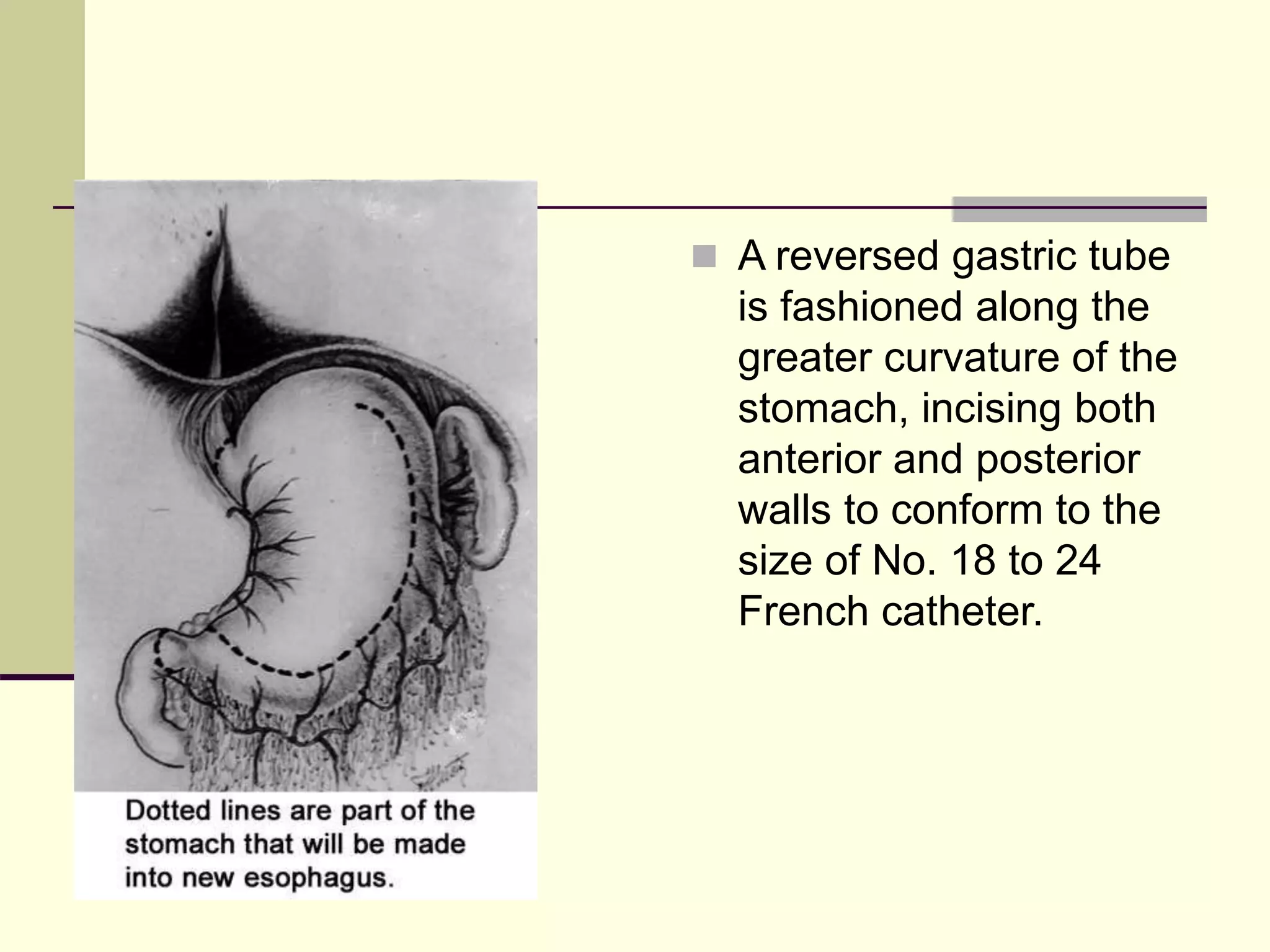
 A reversed gastric tube
is fashioned along the
greater curvature of the
stomach, incising both
anterior and posterior
walls to conform to the
size of No. 18 to 24
French catheter.
 Gastric tube reversed and anastomosed to
cervical part of
 esophagus
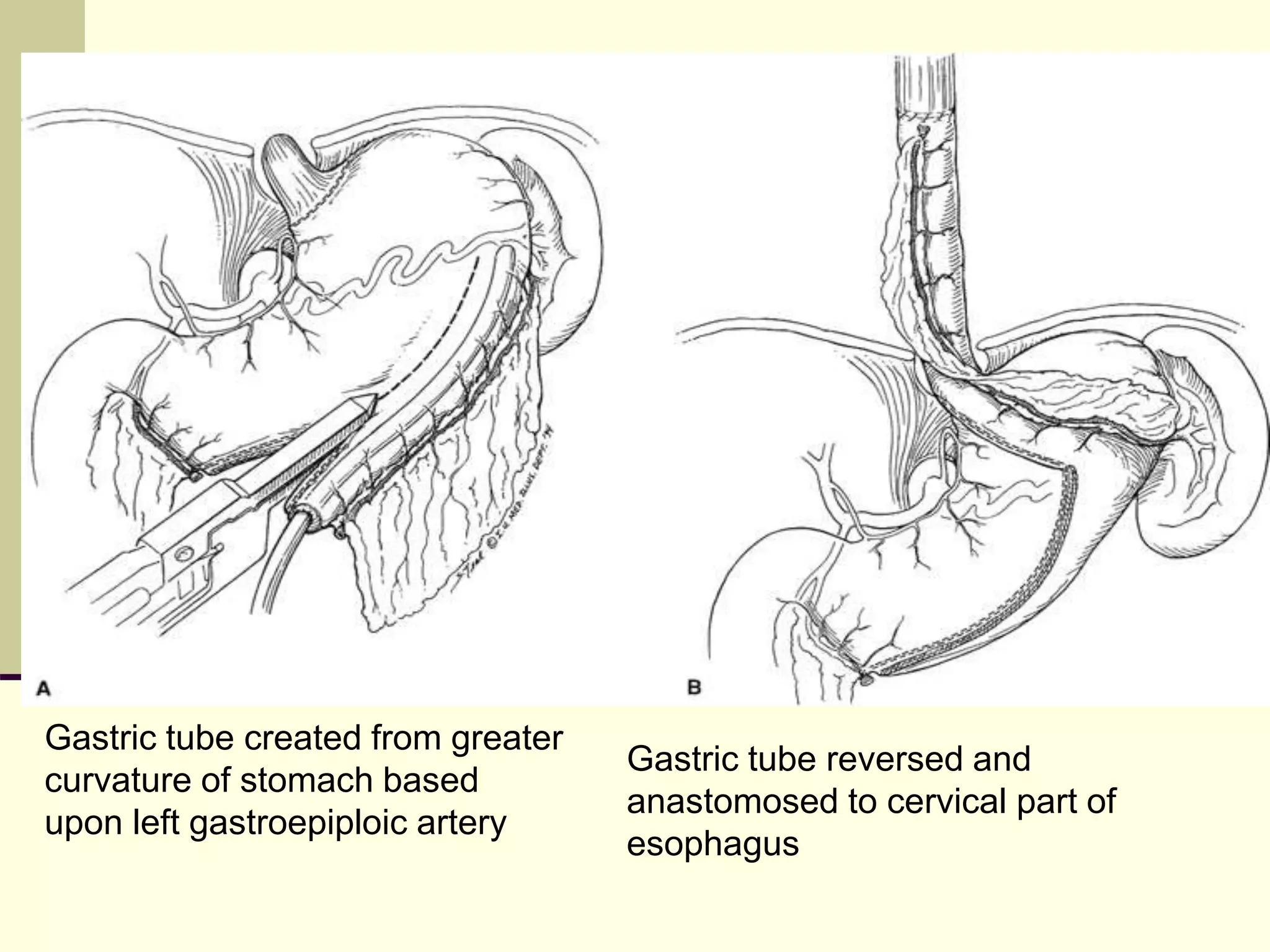
Gastric tube created from greater
curvature of stomach based
upon left gastroepiploic artery
Gastric tube reversed and
anastomosed to cervical part of
esophagus
Complications
 Gastric acid Reflux
 Peptic ulceration
 Nocturnal cough
 Leak & stricture- cervical site
 Perforation of gastric tube
 Absent peristalasis
 Long suture line
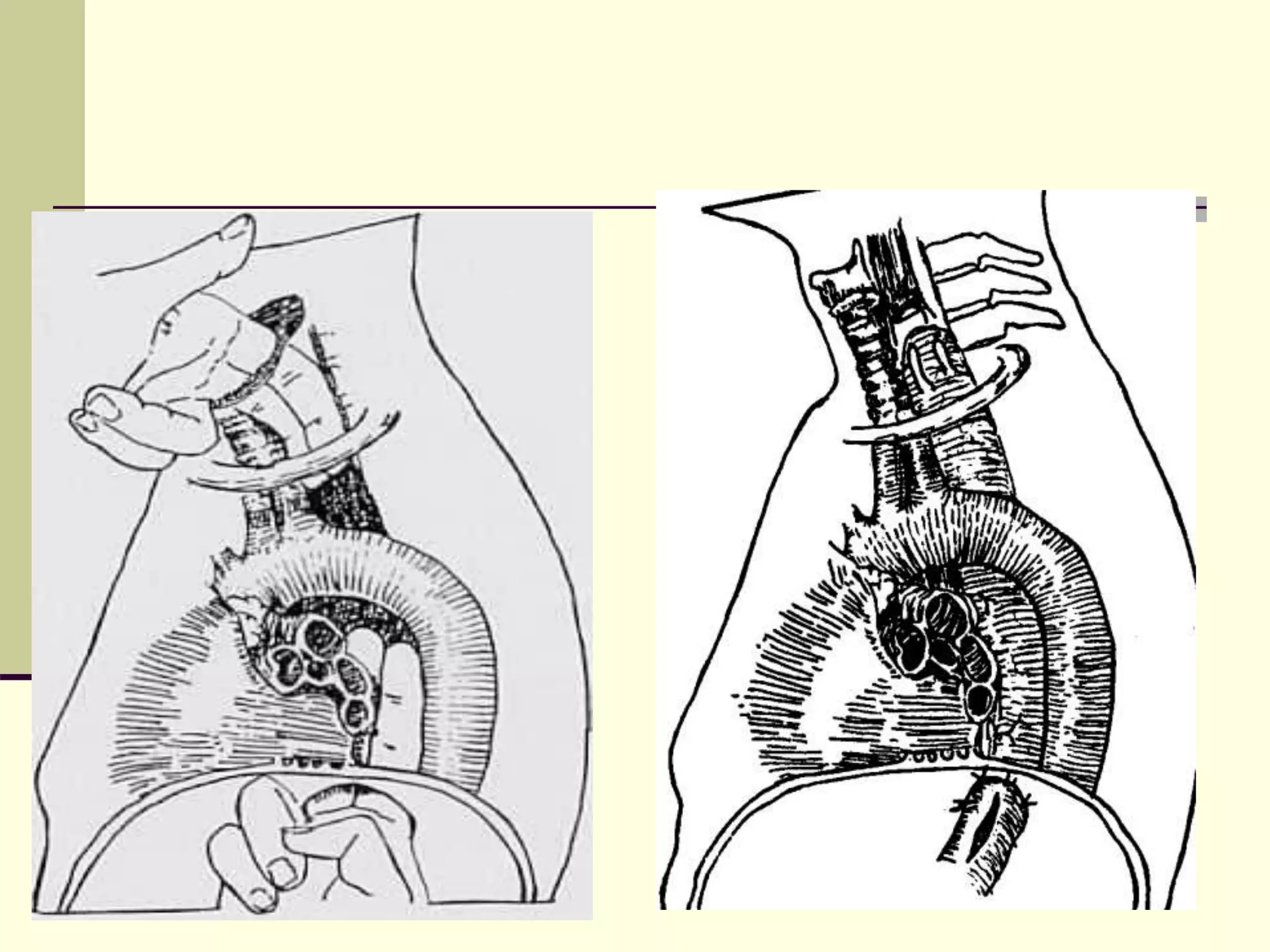
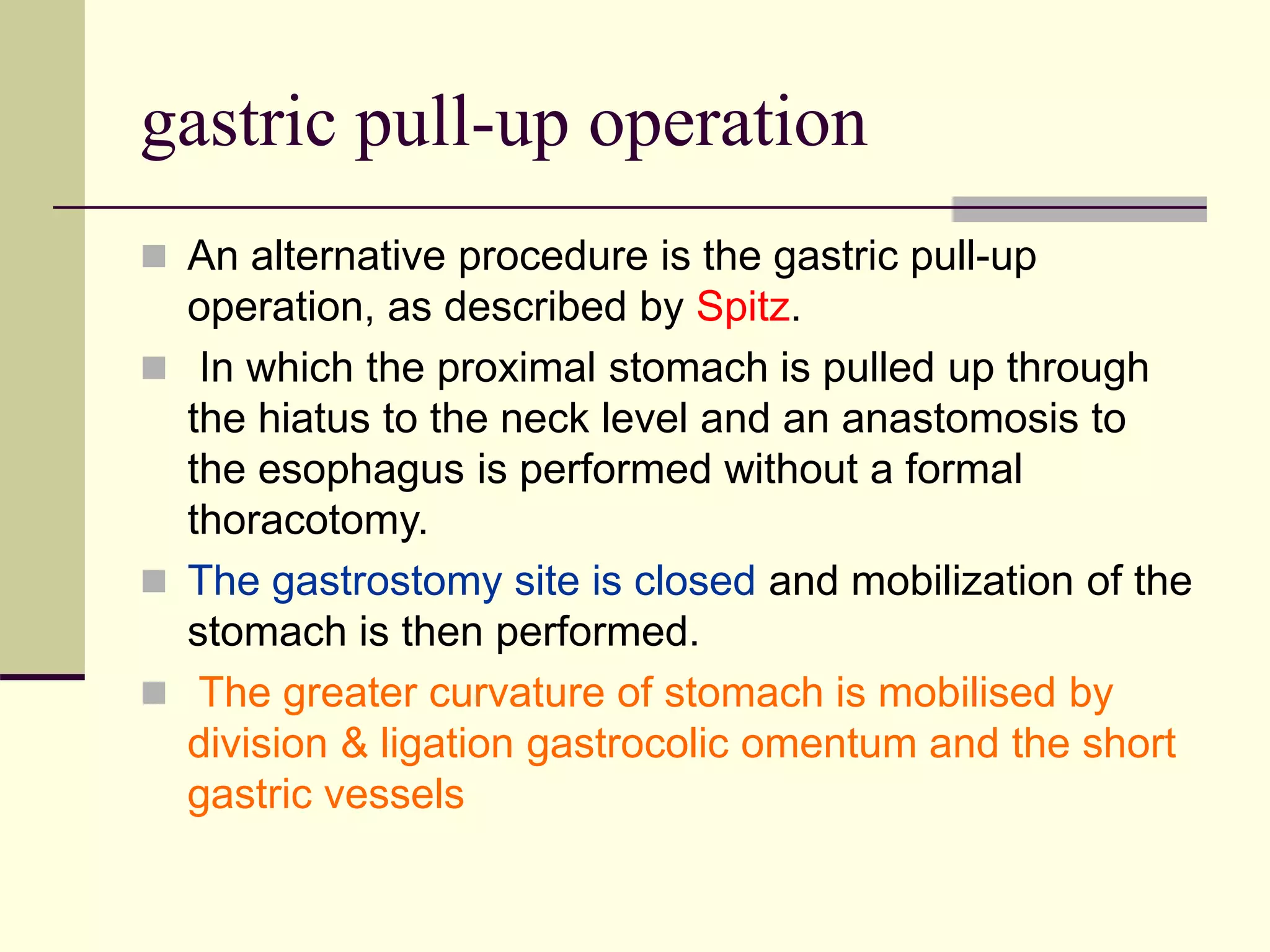
gastric pull-up operation
 An alternative procedure is the gastric pull-up
operation, as described by Spitz.
 In which the proximal stomach is pulled up through
the hiatus to the neck level and an anastomosis to
the esophagus is performed without a formal
thoracotomy.
 The gastrostomy site is closed and mobilization of the
stomach is then performed.
 The greater curvature of stomach is mobilised by
division & ligation gastrocolic omentum and the short
gastric vessels
 The right gastric artery is preserved and the
left gastric vessels are sacrificed.
 The distal esophageal stump is resected and
closed.
 A pyloroplasty is performed and mobilization
of the duodenum is completed.
 highest portion of the fundus of the stomach
Is identified & stay suture of different material
are inserted to avoid torsion of stomach as it
drawn through post. mediastinum.
 The upward passage of the stomach is
accomplished through a space prepared
through the hiatus into the posterior
mediastinum.
 The cervical incision site is developed and a
plane is noted between the posterior surface
of the trachea and the prevertebral fascia .
 A tunnel is created in the line of the normal
esophagus and continuity is established with
the lower abdominal hiatal dissection post. to
heart & ant. to prevertebral region
 The fundus is brought up into the neck
incision, orientation maintained (no twist), and
an anastomosis is then completed between
the native upper esophagus and the fundus
of the stomach.
 A cervical drain is left in place.
 A large calibar nasogstric tube is inserted.
 A fine bore feeding jejunostomy for providing
feeding
Advantages
 Excellent blood supply.
 Incidence of leakage and strictures both
reduced to 6% of patients.
 Relatively simple procedure.
Disadvantages
 Poor gastric emptying.
 Bulk of the stomach is in the chest;.
 Reflux.
Jejunal interposition
 The jejunum was transected about 10 cm
from the ligament of Treitz .
 About 20 cm of distal jejunum was mobilized,
keeping the vascular supply intact.
 The first and, when needed, the second
major branch of the superior mesenteric
vessels was ligated and transected close to
the base of the mesentery.
 A well-vascularized jejunal segment with
along pedicle was obtained.
 The graft was brought up behind the pancreas and
stomach and through the posterior portion of the
hiatus.
 The route was made sufficiently wide using Hegar
dilators in order to allow free passage of the graft and
its blood supply.
 The pedicle was regularly checked to make sure that
no twisting or kinking had occurred.
 Small bowel continuity was restored anterior to the
vascular pedicle of the graft by jejunojejuno
anstomosis.
 The thoracotomy perform and the jejunal graft
was interposed between the both esophageal
ends.
 The graft lay stretched in the posterior
mediastinum after preserving the blood
supply.
 Free jejunal graft interpostion with micro
vascular anstomosis may performed
 Advantage-preserved peristalatic activity
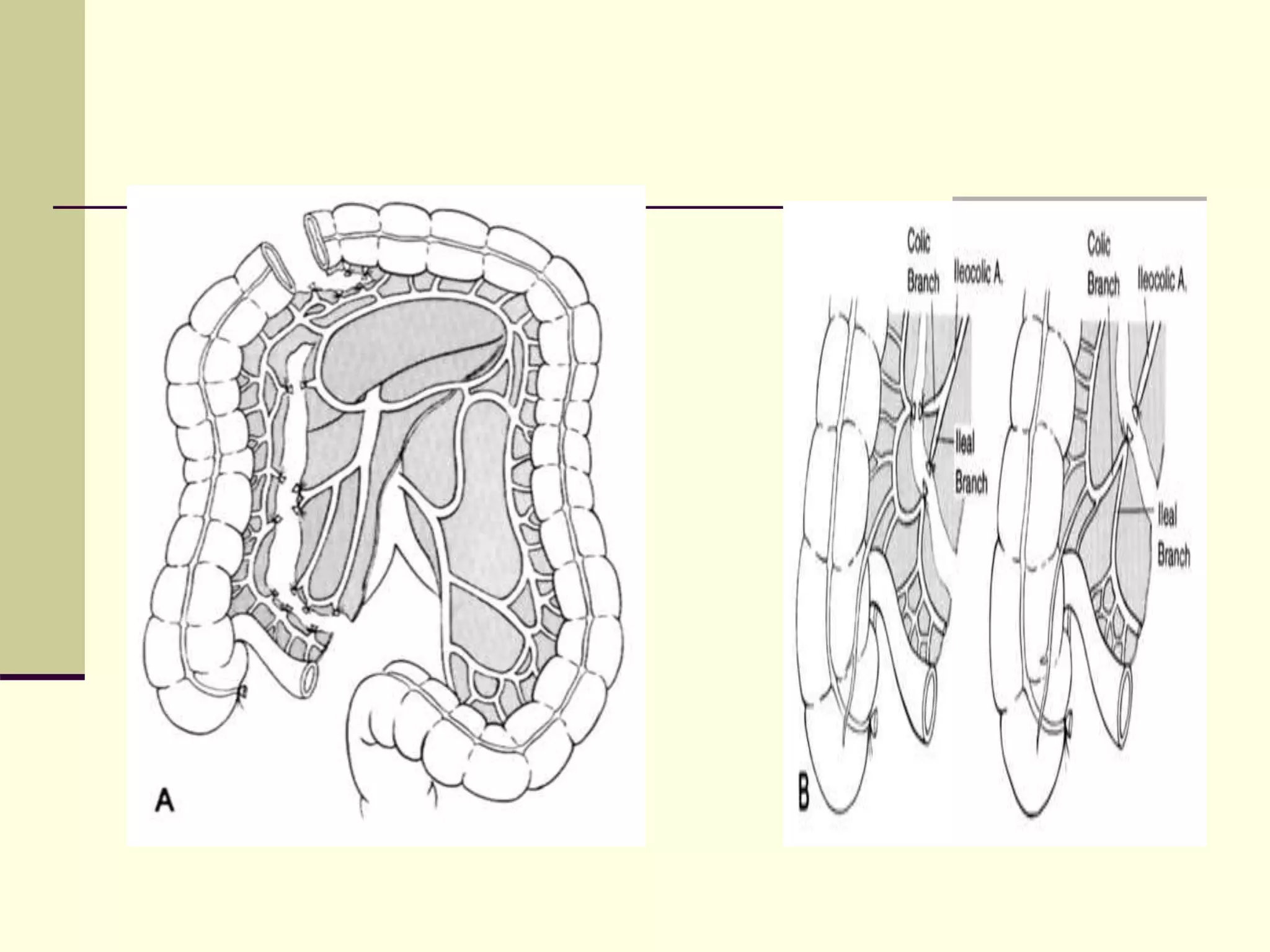
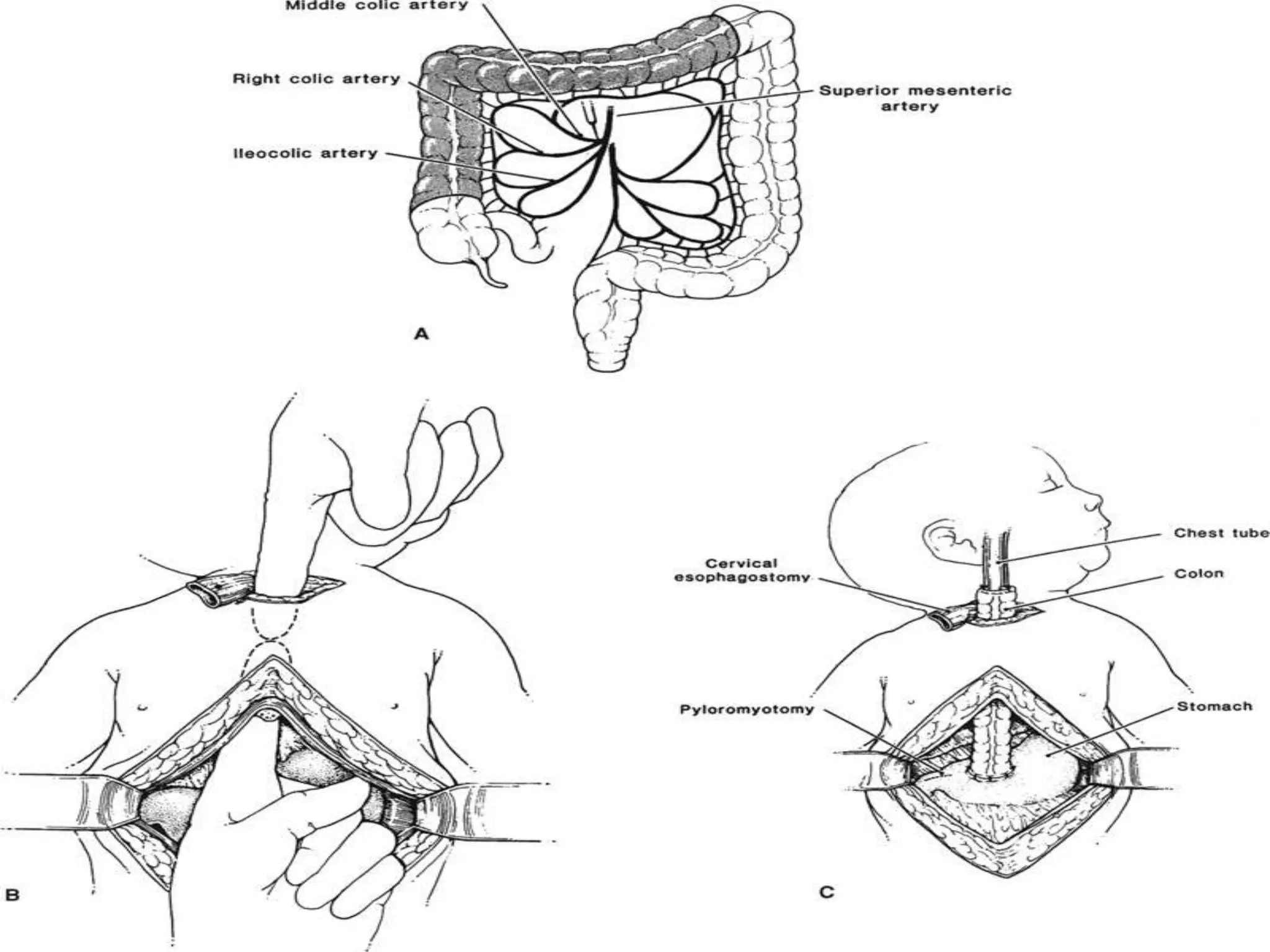
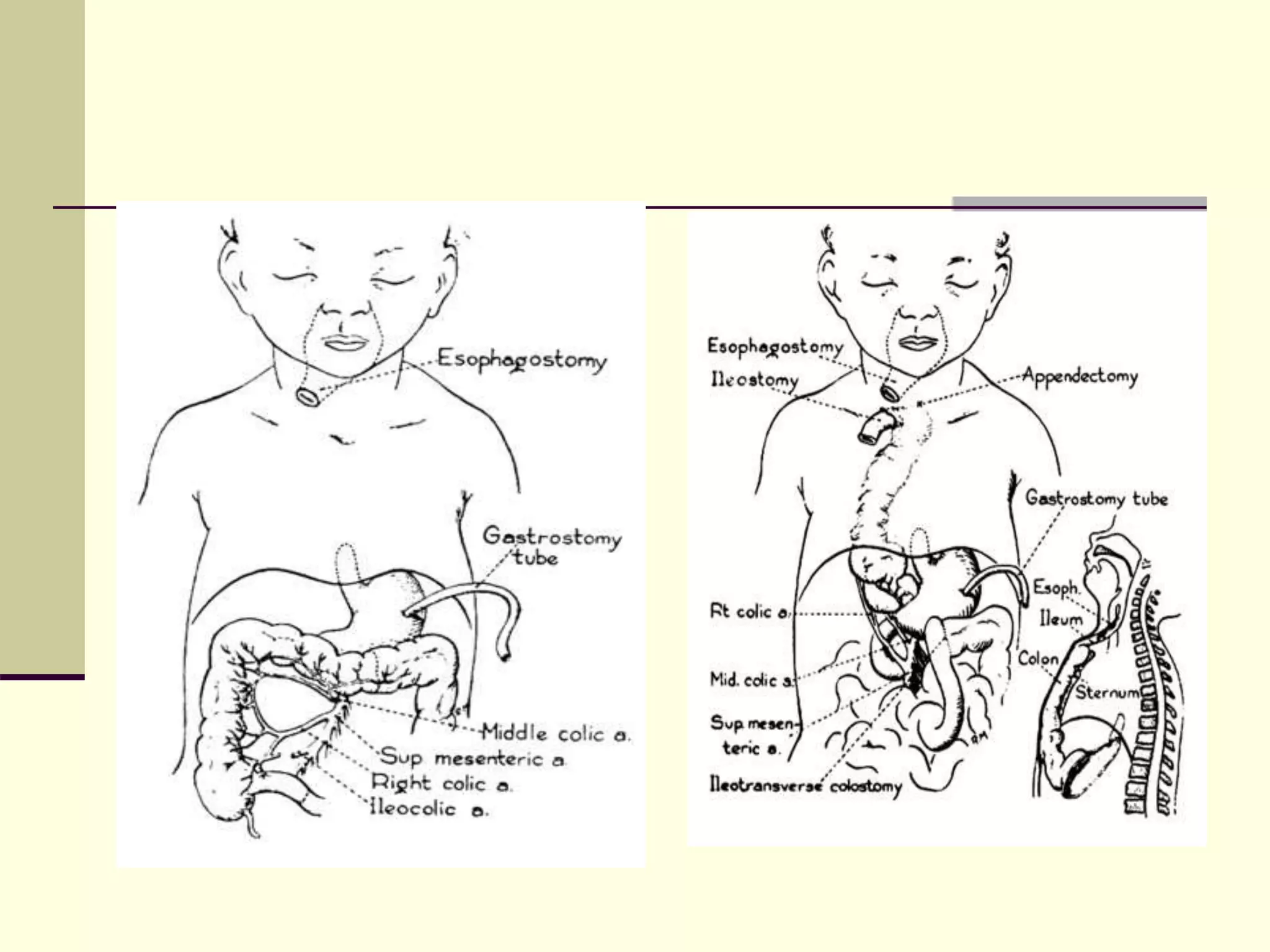
Technique of ileocolic substernal
interposition
 The first use of the colon for total esophageal
replacement in a child was described by Lundblad
in1921.
 Waterston performed his first successful intrathoracic
colon interposition in 1954.
 Javid reported the technique of presternal ileocolic
interposition for esophageal atresia in 1954
 the posterior mediastinal and substernal routes that
use the right or left colon remain the most popular
approaches today.
 The patient is placed in the supine position
with the head turned to the right and the neck
extended.
 The neck, chest, and abdomen are prepared
for operation and draped.
 The peritoneal cavity is entered through a
midline incision extending from the xiphoid to
below the umbilicus.
 The gastrostomy is taken down, the right
colon mobilized, and the appendix removed.
 The marginal artery and vein supplying the distal 10
cm of the terminal ileum and the entire right colon
distal to the middle colic vessel is isolated by
preserving the tertiary arcades of the mesoileum and
the terminal branches of the ileocolic vessels
 Intestinal continuity is restored with a single-layer
ileocolic anastomosis.
 Thereafter, the ileocolic pedicle is brought behind the
lesser sac and stomach and through the
gastrohepatic ligament.
 A gastrocolic anastomosis is made close to the
antrum near the greater curvature with a single layer
of interrupted sutures
 The diaphragmatic attachments to the xiphoid are
divided and a retrosternal tunnel created by blunt
finger dissection.
 The cervical esophagostomy is taken down and the
esophagus mobilized to gain adequate length.
 The retrosternal space is entered from below the
sternocleidomastoid muscle and the superior portion
of the tunnel enlarged enough to prevent
compression of the ileocolic pedicle in the
mediastinum or at the thoracic inlet.
 The esophagoileal anastomosis is constructed with a
single layer of interrupted Vicryl sutures. The neck
and anterior mediastinum are drained with a drain
through a separate stab incision.
 The sternocleidomastoid and platysma muscles are
reapproximated over the anastomosis and the skin
closed.
 The gastrostomy tube is replaced proximal to the
cologastrostomy and brought out through the original
stab wound site in the abdominal wall.
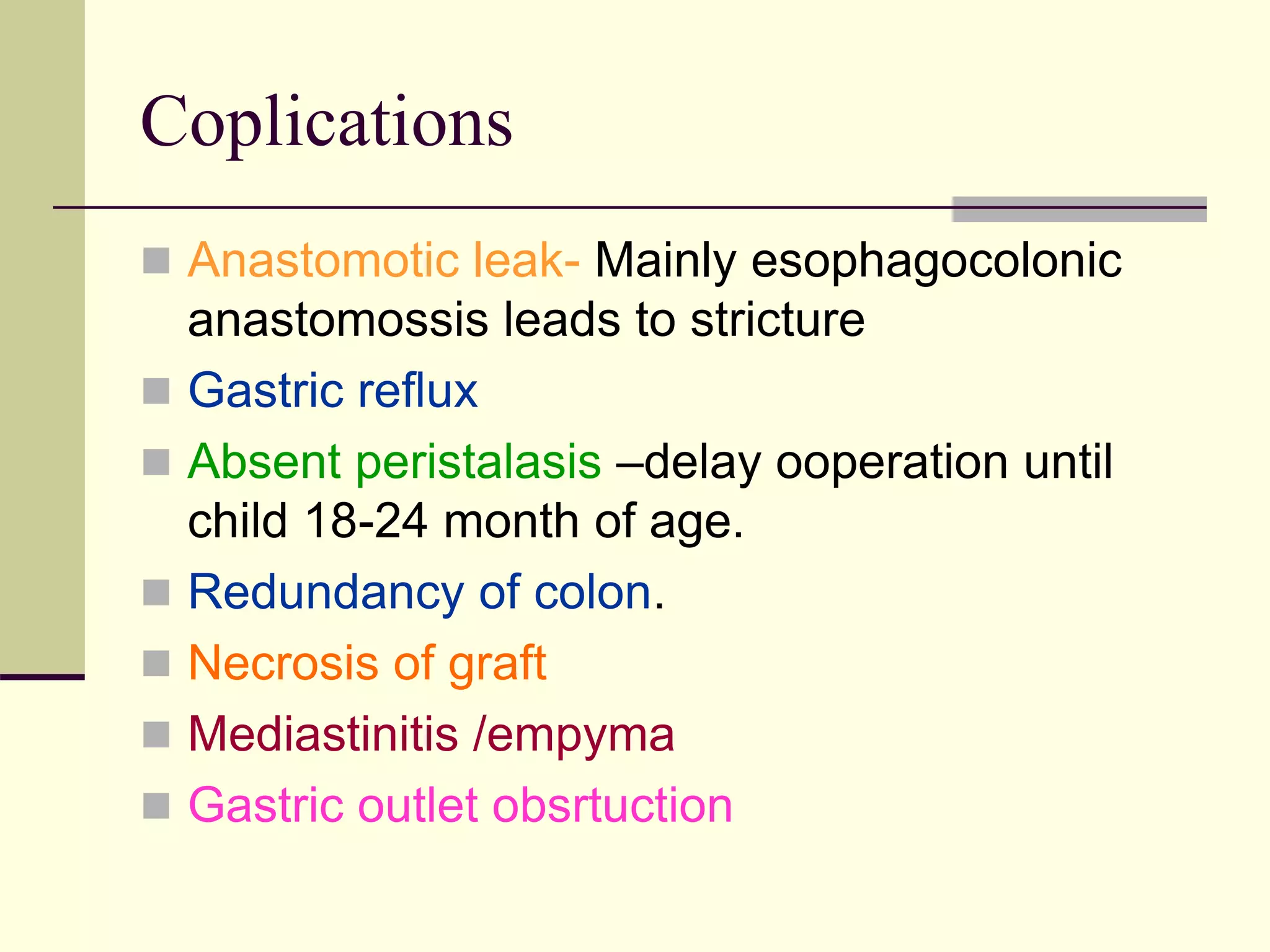
Coplications
 Anastomotic leak- Mainly esophagocolonic
anastomossis leads to stricture
 Gastric reflux
 Absent peristalasis –delay ooperation until
child 18-24 month of age.
 Redundancy of colon.
 Necrosis of graft
 Mediastinitis /empyma
 Gastric outlet obsrtuction
EA - Copy - Copy.ppt

EA - Copy - Copy.ppt

  • 1.
  • 2.
    Introduction  Esophageal atresiais a congenital interruption or discontinuity of the esophagus resulting in esophageal obstruction.  Tracheo- esophageal fistula is an abnormal communication between the esophagus and trachea .
  • 3.
    History  William durstondescribed EA in 1670  Thomes Gibson described EA with TOF in 1697  William ladd 1939 first to operated a case of EA with TOF in multi staged procedure & Patient survied.  Comeron Haight 1941 first to operated the Patient of EA with TOF in one stage procedure and patient survied.
  • 4.
    Epidemiology  The incidenceof EA is about 1 in 2500-4500 birth (2.84 per 10,000 births).  It is more common in male , male to female ratio is 1: 1.26  There is an increased risk of EA with a first pregnancy.  There is a slight increasing trends in the rate of EA with increasing maternal age.
  • 5.
     It ismore common in twin pregnancy and twining increased EA about 6% cases.  Cromosomal anomaly also increased the risk of EA, about 6.6% cases . trisomy 13 and 18.
  • 6.
    Etiology (A) EA withTOF has no specific aetiology but some drugs which increase the risk of this, when taken at the time of pregnancy these are. - OCP - Progesterone - Estrogen - Thalidomide
  • 7.
     (B) Patientwho has diabetes at the time of pregnancy increase the risk of EA with TOF.  (C) Increase the risk of this anomaly in next offspring when the first child affected about 0.5 to 2%.  (D) When more than one child affected with this anomaly increase about 20% risk in next offspring
  • 8.
     The medianpharyngeal groove develops in the ventral aspect of foregut at day 22 of gestation.  This tissue develops into the respiratory and digestive tubes Embryology  Esophagus and tracheal originate from the median ventral diverticulum of the forgut, separated by esophagotracheal septum
  • 9.
     Normally, mesenchymeproliferating between the respiratory and digestive tubes separates the tubes.  Development of an abnormal epithelial-lined connection between the two tubes results in the creation of a TEF .
  • 10.
  • 11.
    Anatomy  In afull term neonate the esophagus is 9 to 10 cm in length and has a lumen of around 3-4 mm.  The upper esophageal pouch varies in length but usually reaches within 1 cm of the level of the azygus vein.  The lower pouch commences from the post. wall of the trachea and arises usually around 0.5- 1.0cm proximal to the carina.
  • 12.
     As comparedto the thick, hypertrophied upper pouch, the lower pouch is thin and has a smaller caliber ., the lower pouch can be identified at the thoracotomy by 1. looking for it just below the arch of azygos vein. 2.Observing it getting distended with air during assisted ventilation.
  • 13.
    Arterial Supply The cervicalesophagus is supplied by the inferior thyroid artery . Thoracic esophagus is supplied by segmental branches from aorta. The distal esophagus is supplied by the ascending branches of the left gastric artery. Inferiorphernic artery Bronchial artery
  • 14.
     VENOUS DRAINAGE Upper-Brachiocephaic vein  Middle-Azygos vein  Lower- left gastric vein  LYMPHATIC DRAINAGE  Upper-Deep cervical LN  Middle-Post. Mediastinal LN  Lower- left gastric LN
  • 15.
    NERVE SUPPLY PARASYMPATHETIC-  Upperhalf -Reccurrent laryngeal N  Lower half -plexus formed by both vagus  Sensory ,motar & secretomotor supply SYMPATHETIC  Upper half- Middle cervical ganglion  Lower half-Upper 4 thoracic ganglion  Vasomotar supply
  • 16.
    Classification 1. E.C Vogt1929 -he was classify EA in 4 type, & number 3 in three Sub type 2. Gross 1953 – he was classify EA in 7 type in alphabetic word (A-to G)
  • 17.
    Vogt Gross Anomaly 1.A Absent Esophagus 2. Pure esophageal atrea 7.8% 3.a B EA with proximal fistula 0.2% 3.b C EA with distal fistula 85.8% 3c D EA with both proximal & distal F 1.4% 4. E H- type fistula(4%) F Esophageal stenosis G Membranous Artesia
  • 18.
  • 19.
    Associated anomalies The earlydisturbance in organogenisis which result in EA leads to other associated anomalies. The incidence of which varies between 40-55%.
  • 20.
    Cardio vascular anomalies– these anomalies are the most common associated anomalies with EA  can be present in 13-30% of the cases in the presence of skeletal anomalies  The incidence of the cardio vascular anomalies is higher and more complex, life threatening defect are likely VSD(19%), tetrology of fallot(5%) , ASD(20%) and coarctation of aorta.
  • 21.
    1. GIT Anomalies- ARM(14%), duodenal and ileal atresia(2%), and esophageal stenosis and malrotation . 2. Musculo skeletal anomalies- seen in 10- 15% cases and included vertebral defect(17%), limb anomalies(15%) .
  • 22.
    1. Genito urinaryanomalies- These included hypospadiasis, undescended testes, renal dysplasia, hydronephosis , vasico ureteric reflux . 2. Respiratory tract anomalies – like choanal atresia , Tracheal webs or stenosis. 3. Chromosomal anomalies- Trisomy 13-18
  • 23.
    1. VACTERL Association -V- vertebral defect 17% - A – Anorectal malformation 12% C- cardiac defect 20% TE – Tracheo esophageal fistula,EA R- renal defect16% L- Radial limb dysplasia 10%
  • 24.
    CHARGE Association– Thisinclude C- Coloboma H- Heart disease A- Atresia choanae RG- Retorded growth and development E- Ear anomalies with deafness
  • 25.
    SYMPTOMS  Frothy whitebubbles in the mouth.  Coughing or choking when feeding.  Vomiting.  Blue color of the skin, especially when the baby is feeding.  Difficulty breathing.  Very round, full abdomen
  • 26.
     Fever, tachycadia,lethargy suggested pneumonitis.  Abdominal distention in patent distal fistula.  Inability to pass a tube through the mouth and nose in to stomach.  The history of polyhydroamonios in pregnancy
  • 27.
    Diagnosis - Antenatal (a)by USG abdomen (1) Poly hydroamnios (2) Failure to demonstrate the fetal stomach in presence of normal or increased amniotic fluid ( Normally stomach seen after 14th week of gestation )
  • 28.
    (b) High resolutionreal time scanning it show fetal swallowing of amniotic fluid and distention of upper pouch (c) In X-Ray abdomen – The presence of VACTERL Associated anomalies are seen. (d) Chromosomal study. (e) Raised amniotic fluid acetyl choline esterase
  • 29.
    (B) Post natal 1)Plain AP – Lat radiograph with stiff red rubber catheter in situ
  • 30.
     Frontal viewof the chest and abdomen of a neonate demonstrates a tube in the proximal pouch in this patient with EA. The presence of bowel gas implies the presence of a distal TEF.
  • 32.
     : Contraststudy with demonstrating a welldeveloped and intact upper esophageal pouch extending to midthoracic level.
  • 33.
     H-type tracheoesophageal fistula(TEF). Oblique contrast esophagogram demonstrates a fistula (arrow) arising from the anterior esophagus and extending anterosuperiorly to the trachea.
  • 34.
     Conform thelevel of atresia ( upper pouch) in term of thoracic vertebra.  Check the presence of abdominal gas to rule out the pure esophageal atrisia  Asses the pulmonary shadow to rule out pneumonia or Pneumonitis  Assess the cardiac shadow and calculate the C.P ratio to suspect cardiac anomalies
  • 35.
    (2) Echocardio graphy– for cardiac anomalies. (3) USG Abdomen for renal anomalies. (4) Bronchoscopy. (5) Esophagoscopy. (6) Chromosomal study. (7) cine- esophagogram- H type (8) preoperative base line investigation
  • 36.
    D.J.Waterston 1962- developeda classification system related to risk factor among infant with EA. PROGNOSIS
  • 37.
    Group Survival waterstonClassification A 100% Birth wt> 2.5kg & otherwise well B 85% Birth wt 2.0 –2.5kg or higher wt with moderate associated cardiac anomalies or pneumonia C 65% Birth Wt< 2.0 kg or higher with sever associated cardiac anomalies or pneumonia .
  • 38.
    Spitz Classification (1994) Group creteria 1(97%)Birth weight >1,500 g without major cardiac disease 2(59%) Birth weight .<1,500 g, or major cardiac disease 3(22%) Birth weight <1,500 g and major cardiac disease
  • 39.
      Primary repairof TEF is urgent  Protect the lungs from aspiration pneumonia  Avoidance of feeding  Positioning of the infant slightly head up to minimize regurgitation of gastric contents through fistula  Intermittent suction  Antibiotic therapy and physiotherapy in babies with contaminated lung Preoperative management
  • 40.
     The Resp.Rateand saturation are monitored along with blood gas parameter to asses the need for supplement oxygen and ventilation .  I V line are established to take sample and to start fluid and antibiotic.  Inj vit K
  • 41.
     Surgical management  Onestage repair: optimal surgical management  Fistula is ligated, proximal and distal ends of the esophagus are anastomosed  Right posterolateral extrapleural thoracotomy  Left thoracotomy if the p’t has right aortic arch  Gastrostomy:  High risk infants unable to withstand a thoracotomy  Decompress the stomach and prevent regurgitation via fistula into the lungs.
  • 42.
     Definitive repair 24-72 hours later, when infant can withstand both surgery and anesthesia  Method: right thoracotomy using a posterolateral extrapleural approach  Fistula is ligated, esophageal segments are anastomosed  If distal esophagus is too short  Fistula is ligated  exteriorization of the upper pouch through an esophagostomy is performed
  • 43.
    Operative procedure  Theinfant is typically positioned for a standard Rt posterolateral thoracotomy, with the right arm extended above the head and the head slightly flexed.  A curved skin incision is made around the lower border of the scapula, extending from the anterior axillary line posteriorly to the paravertebral region.
  • 44.
     The thoraxis entered through the fourth intercostals space by dividing the intercostals muscles, with care taken to avoid incising the pleura.  With the extrapleural approach - In this dissection start posterioly followed by superior and inferiorly, Azygos vein is exposed and divided.
  • 45.
     -The loweresophagus is dissected circumferentially at the level of fistula.  Fistula closed, mobilization of upper pouch and lower esophagus, the tip of upper pouch is excised .  End to end anastomosis made with single layer suturing.  Drain should be placed away from the anastomosis in retro pleural space
  • 53.
    POST OPERATIVE COMPLICATION A)Early complication (i) Anasto motic leak – 14-16% a. Incidental :- Incidental leak are generally radiological leak, have no symptoms
  • 54.
    Minor leakage :-Saliva in chest drain but infant clinically well.  Minor leaks are managed conservatively with parenteral nutrition, upper pouch suctioning, antibiotics and ensuring adequate drainage of the extrapleural space by the in situ chest tube)
  • 56.
    Major leakage :-Mediastinitis or abscess. -Tension pneumothorex - Empyema  Reanastomosis following a major leak is usually always unsuccessful and in such cases diversion in the from an esophagostomy and gastrostomy may be life saving)
  • 57.
    (ii) Anastomotic stricture:- The factors that have been implicated in the pathogenisis of esophegal stricture include poor anstomotic technique, Gastroesophageal reflux, Anastomosis under tension and ischemia of esophageal ends.  Balloon dilatation under fluoroscopic guidance is the preferred treatment for anastomitic strictures.
  • 59.
    Recurrent tracheo esophagealfistula(3-14%) :- Improper closure of the fistula, end to side esophageal anastomosis with fistula ligation and anastomotic leak with local abscess formation can lead to a recurrent TOF.  The classic approach for management of recurrent tracheosophageal fustula is a repeat right thoracotomy , transpleural repair of the fistula and interposition of an intercostals muscle or pericardial flap after repair of the defect.
  • 60.
    (B) Late complication:- 1. Gastro esophageal reflux. 2. Tracheomalacia 10-20% 3. Disordered peristalsis 4. Chest Wall Deformity
  • 61.
    Gastro esophageal reflux GERD is extremely common occurring in up to 35 to 58% of children.  GERD appears to be due to intrinsic motor dysfunction of the esophagus, and shortened intraabdominal segment of the esophagus due to anastomotic tension .  GERD may lead to esophageal strictures, aspiration leading to pneumonia, bronchial hyperreactivity, and permanent airway or lung parenchymal damage.
  • 62.
     Tracheal inflammation,assessed by biopsy.  Esophageal biopsy specimens showed severe inflammation in 20% of cases, and Barrett esophagus in 6%.  65%percent of patients with EA/TEF and GERD may respond to medical therapy, with the remainder requiring antireflux surgery
  • 63.
     The indicationfor surgical correction of gastroesophageal reflux is failure of medical management .  evidenced by persistent reflux esophagitis or Barrett esophagus, failure to thrive, anastomotic stricture.  The usual surgical treatment is a Nissen fundoplication.  Timing of fundoplication within 6 months of the initial surgery to 21 months of age.
  • 64.
    Tracheomalacia  Tracheomalacia ispresent clinically significant in 10 to 20% of patients.  Tracheomalacia is usually found at or just above level of the original EA/TEF.  The site of collapse is most prominent in the distal one-third trachea in 60% of cases, and in the middle one third in 30%.  The soft trachea is easily compressed between the aorta and the frequently dilated former esophageal pouch.  Bulging of the posterior wall is evident at brochoscopy.
  • 65.
     In mostpatients, the manifestations of tracheomalacia are limited to a brassy (barking) cough.  Episodes generally began after 2 to 3 months of age.  The event typically occurs during or just after feeding, or during crying or coughing, and is followed by cyanosis progressing rapidly to apnea, bradycardia, and cardiac arrest.
  • 66.
     Treatment fortracheomalacia is generally reserved for patients with dying spells or recurrent pneumonia.  Aortopexy involves suturing the aorta to the posterior surface of the sternum  Tracheopexy  Airway stent  Tracheostomy
  • 67.
    Disordered peristalsis  Esophagealperistalsis, assessed by manometry, is abnormal in 75 to 100% of children with a history of EA.  An immotile segment or small, discoordinate contractions is most commonly observed.  Many children with repaired EA/TEF need to eat slowly.  In severe cases, failure to thrive or aspiration  This may require myotomy for treatment.
  • 68.
    Chest Wall Deformity Chest wall deformities may be common in individuals with a history of EA/TEF.  Scoliosis is more common in patients .  Progressive scoliosis requiring surgical correction.
  • 69.
    Mortality-early  Inadequate Upperpouch suctioning  Oral feeds before diagnosis  Aspiration Pneumonitis  Hypothermia.  Related to surgery  Recurrent TEF  Anastomotic leaks – sepsis  Poor nutrition.
  • 70.
    Mortality - Late The causesof mortality in the first year of the life are - Congenital heart disease - Recurrent pneumonia - Tracheomalacia Survival rate - 85-95%
  • 71.
    long-gap oesophageal atresia The distance between esophageal ends that constitutes a long-gap EA lacks a strict numerical definition.  gap intervals measuring greater than 2 cm, or greater than two vertebral bodies as constituting along-gap EA  3.5 cm ‘‘ultra-long’’ gap or6 vertbral bodies.  Thus, long-gap EA can be defined as any distance between the esophageal ends in a new born that is too wide for the surgeon to perform primary anastomosis of the proximal and distal esophagus
  • 72.
     This isa contrast study demonstrating long-gap esophageal atresia. A dilator is placed within the esophageal pouch and contrast is instilled into the stomach.  A distance of 5.5 vertebral bodies is seen between the esophageal remnant and the stomach
  • 73.
    Operative manoeuvres inlong-gap oesophageal atresia  At the initial procedure 1. anastomosis under tension 2. tension-relieving procedures 3. flap technique 4. suture fistula
  • 74.
     Delayed primaryanastomosis 1. with bouginage - proximal , proximal and distal, magnetic 2. without bouginage 3. oesophageal lenghtening techniques,flap , myotomy , gastric division . Transmediastinal "thread"  1. with and without "olives"
  • 75.
     Oesophageal replacement 1. colonic interposition  2. gastric tube  3. jejunum  4. gastric transposition
  • 76.
    O.A. without T.O.F. gastrostomy <2 vertebra > 2 vertebraI delayed primary Anastomosis primary anastomosis cervical esophagostomy esophageal replacement
  • 77.
    O.A. with distalT.O.F. "wide gap“ primary anastomosis lengthening gastrostomy under tension techniques elective paralysis myotomy delayed primary cervical IMV for 5 days flap oesophagostomy suture fistula oesophageal replacement
  • 78.
    Upper pouch bougienage In1965,Howard described in which weighted bougie is passed through the mouth into the upper pouch.  Forward pressure applied daily/twice daily for 6-12 weeks before attempting delay primary repair.  1975,Hendren reported using ectromagnatic field to pull togther mettallic bullets in two end esophagus.
  • 79.
    SUTURE FISTULA  In1971,Rehbein described the nylon thread bridging the gap between the two end of esophagus & attached to olives.  The olive were pushed toward each other over time until two end esophagus pressed togther & create a fistula.
  • 80.
    Delayed Blind-Pouch Apposition, GuideWire Placement, and Nonoperative Establishment of Luminal Continuity in a Child With Long Gap Esophageal Atresia
  • 81.
    myotomy  In someinstances, the two ends of the esophagus are too far apart (>2.0 cm) for a safe primary anastomosis.  A circular myotomy, as described by Livaditis, can lengthen the proximal or distal end .  The myotomy is performed approximately 2.0 cm above the blind proximal atretic end to divide the longitudinal and circular smooth muscle.
  • 82.
     This increasesthe length of the proximal esophagus by approximately 1.0 cm and often facilitates a primary anastomosis without tension.  Occasionally, a second myotomy may be required at a more proximal level .  A proximal spiral myotomy has been described  Step ladder myotomy
  • 84.
    Circular Myotomy throughthe neck Intrathoracic Circular Myotomy through the thoracotomy wound
  • 85.
    flap technique  Goughpopularized theanterior upper pouch flap.  An inverted full thicness pouch is created & rotated down.  The length of the flap should be less than three times the breath.  It increases length about 1.5 cm.
  • 86.
    flap technique Flap technique:(1) the closed upper pouch; (2) the upper pouch is open and its lateral wall reaches the lower segment of the oesophagus; (3) the elongated upper pouch is anastomosed to the lower segment
  • 87.
    Fokker technique  longgap esophageal atresias we used an esophageal lengthening technique originally described by Dr John E. Foker.  This technique consists of the placement of traction sutures into the ends of the proximal and distal esophageal pouches.  after full mobilization and bringing these sutures together through the thoracic wall under slight tension.  Postoperatively, these sutures are pulled1 to 2 mm daily.  Once the 2 ends of the esophagus are in proximity, esophageal anastomosis is performed.
  • 89.
    Scharli lesser curveelongation  Scharli describe a comman abdominal & thoracic procedure in which adequate vacularity of distal esophagus was insured by dividing the left gastric artery.  Diagonal division of lesser curvature of stomach with GIA stapler.  Mobilization of gastric cardia & fundus into the chest to achieve anastomosis with partial fundoplication.
  • 90.
    ESOPHAGEAL REPLACEMENT Creteria forideal conduit  An efficient conduit from mouth to stomach to satisfy nutriional needs.  Conduit should grow with child  Gastric acid reflux into conduit must be mimimum.  Conduit should not impair respiratory or cardiac function.  Surgical techanique should be simple
  • 91.
     Conduit shouldnot produce any cosmatic deformity.  Post operative complications should be minimum & manageable ROUTES.  Retro sternal  Trans pleural  Post.mediastinum  AGE- 9month-1year
  • 92.
    GASTRIC TUBE OPHAGOPLASTY The right gastroepiploic vessels are divided approximately 2.0 cm proximal to the pylorus, and the greater omentum is divided up to the splenic hilum, preserving the gastric arcade.  The reversed gastric tube is fashioned along the greater curvature of the stomach based upon left gastroepiploic artery.  After the stomach is incised inferiorly, a No. 18 to 24 French chest tube is placed in the distal stomach opening and passed superiorly along the greater curvature of the stomach.
  • 93.
     The medialportion of the stomach is then divided from below upwards using a GIA autostapler to fashion the tube.  An elliptical cervical incision is made around the proximal esophagostomy site and then carefully mobilized to avoid injury to the vagus and recurrent laryngeal nerves.  Retrostrenal tunnel is created or A thoracotomy incision is made over the sixth interspace.  The reverse gastric tube is brought up through the hiatus into the chest behind the hilum of the lung and then into the neck, where an end-to-end anastomosis is performed with the proximal esophagus.
  • 94.
     A reversedgastric tube is fashioned along the greater curvature of the stomach, incising both anterior and posterior walls to conform to the size of No. 18 to 24 French catheter.
  • 95.
     Gastric tubereversed and anastomosed to cervical part of  esophagus Gastric tube created from greater curvature of stomach based upon left gastroepiploic artery Gastric tube reversed and anastomosed to cervical part of esophagus
  • 96.
    Complications  Gastric acidReflux  Peptic ulceration  Nocturnal cough  Leak & stricture- cervical site  Perforation of gastric tube  Absent peristalasis  Long suture line
  • 97.
    gastric pull-up operation An alternative procedure is the gastric pull-up operation, as described by Spitz.  In which the proximal stomach is pulled up through the hiatus to the neck level and an anastomosis to the esophagus is performed without a formal thoracotomy.  The gastrostomy site is closed and mobilization of the stomach is then performed.  The greater curvature of stomach is mobilised by division & ligation gastrocolic omentum and the short gastric vessels
  • 98.
     The rightgastric artery is preserved and the left gastric vessels are sacrificed.  The distal esophageal stump is resected and closed.  A pyloroplasty is performed and mobilization of the duodenum is completed.  highest portion of the fundus of the stomach Is identified & stay suture of different material are inserted to avoid torsion of stomach as it drawn through post. mediastinum.
  • 99.
     The upwardpassage of the stomach is accomplished through a space prepared through the hiatus into the posterior mediastinum.  The cervical incision site is developed and a plane is noted between the posterior surface of the trachea and the prevertebral fascia .  A tunnel is created in the line of the normal esophagus and continuity is established with the lower abdominal hiatal dissection post. to heart & ant. to prevertebral region
  • 100.
     The fundusis brought up into the neck incision, orientation maintained (no twist), and an anastomosis is then completed between the native upper esophagus and the fundus of the stomach.  A cervical drain is left in place.  A large calibar nasogstric tube is inserted.  A fine bore feeding jejunostomy for providing feeding
  • 103.
    Advantages  Excellent bloodsupply.  Incidence of leakage and strictures both reduced to 6% of patients.  Relatively simple procedure. Disadvantages  Poor gastric emptying.  Bulk of the stomach is in the chest;.  Reflux.
  • 104.
    Jejunal interposition  Thejejunum was transected about 10 cm from the ligament of Treitz .  About 20 cm of distal jejunum was mobilized, keeping the vascular supply intact.  The first and, when needed, the second major branch of the superior mesenteric vessels was ligated and transected close to the base of the mesentery.  A well-vascularized jejunal segment with along pedicle was obtained.
  • 105.
     The graftwas brought up behind the pancreas and stomach and through the posterior portion of the hiatus.  The route was made sufficiently wide using Hegar dilators in order to allow free passage of the graft and its blood supply.  The pedicle was regularly checked to make sure that no twisting or kinking had occurred.  Small bowel continuity was restored anterior to the vascular pedicle of the graft by jejunojejuno anstomosis.
  • 106.
     The thoracotomyperform and the jejunal graft was interposed between the both esophageal ends.  The graft lay stretched in the posterior mediastinum after preserving the blood supply.  Free jejunal graft interpostion with micro vascular anstomosis may performed  Advantage-preserved peristalatic activity
  • 107.
    Technique of ileocolicsubsternal interposition  The first use of the colon for total esophageal replacement in a child was described by Lundblad in1921.  Waterston performed his first successful intrathoracic colon interposition in 1954.  Javid reported the technique of presternal ileocolic interposition for esophageal atresia in 1954  the posterior mediastinal and substernal routes that use the right or left colon remain the most popular approaches today.
  • 108.
     The patientis placed in the supine position with the head turned to the right and the neck extended.  The neck, chest, and abdomen are prepared for operation and draped.  The peritoneal cavity is entered through a midline incision extending from the xiphoid to below the umbilicus.  The gastrostomy is taken down, the right colon mobilized, and the appendix removed.
  • 109.
     The marginalartery and vein supplying the distal 10 cm of the terminal ileum and the entire right colon distal to the middle colic vessel is isolated by preserving the tertiary arcades of the mesoileum and the terminal branches of the ileocolic vessels  Intestinal continuity is restored with a single-layer ileocolic anastomosis.  Thereafter, the ileocolic pedicle is brought behind the lesser sac and stomach and through the gastrohepatic ligament.  A gastrocolic anastomosis is made close to the antrum near the greater curvature with a single layer of interrupted sutures
  • 110.
     The diaphragmaticattachments to the xiphoid are divided and a retrosternal tunnel created by blunt finger dissection.  The cervical esophagostomy is taken down and the esophagus mobilized to gain adequate length.  The retrosternal space is entered from below the sternocleidomastoid muscle and the superior portion of the tunnel enlarged enough to prevent compression of the ileocolic pedicle in the mediastinum or at the thoracic inlet.
  • 111.
     The esophagoilealanastomosis is constructed with a single layer of interrupted Vicryl sutures. The neck and anterior mediastinum are drained with a drain through a separate stab incision.  The sternocleidomastoid and platysma muscles are reapproximated over the anastomosis and the skin closed.  The gastrostomy tube is replaced proximal to the cologastrostomy and brought out through the original stab wound site in the abdominal wall.
  • 115.
    Coplications  Anastomotic leak-Mainly esophagocolonic anastomossis leads to stricture  Gastric reflux  Absent peristalasis –delay ooperation until child 18-24 month of age.  Redundancy of colon.  Necrosis of graft  Mediastinitis /empyma  Gastric outlet obsrtuction