QUALITY
THE TOTALITY OF FEATURES AND
CHARACTERISTICS OF A PRODUCT OR
SERVICE THAT BEARS ON ITS ABILITY
TO SATISFY GIVEN NEEDS
Value to Customer
• Economic Value
• Safety
• Reliability
• Maintainability
QUALITY
 It is defined as conformance to requirement, Not goodness.
 The system for achieving quality is prevention, Not appraisal.
 The performance standard is “Zero Defect” Not that is close enough.
 The measurement of quality is the price of nonconformance, Not indexes.
QUALITY IMPROVEMENT
 Inspection is never the answer to quality improvement nor the policing.
 Involvement of & Leadership by top management are essential to the
necessary culture of commitment to quality.
 A program for quality requires organization-wide effort and long term
commitment accompanied by the necessary investment in training.
 Quality is First and schedules are necessary.
Quality & Business Performance
Quality drives market share and when superior quality & large market share
both present, profitability is virtually guaranteed .
REWARDS
• Greater Customer Loyalty
• Market Share Improvement
• Higher Stock Prices
• Reduced service calls
• Higher Prices
• Greater Productivity
INDICATORS
• Defects
• Scrap
• Rework
• Inspection
• Returns
• Warranty Costs
• Quality Assurance
Quality Assurance (QA)
Quality Assurance refers to the processes ad procedures that systematically
monitor different aspects of a service, process or facility to detect, correct
and ensure that quality standards are being met.
Example : Quality Assurance helped us to eliminate defective products and
increase customer satisfaction.
QA is the process of managing for quality.
Quality Control (QC)
Quality Control is a process by which entities review the quality of all factors
involved in Production.
QC is used to verify the quality of the output.
SERVICE QUALITY
 Intangible Output.
 Inability to store the output.
 Behavior of delivery person.
 Image of the organization.
 The measure of output is difficult to define.
 Acceptance and Variance ranges may not apply.
 The customer is present during production and performing the final
inspection.
 Adjusting the control system if the customer is present.
AQL = 99%
In the US alone :
 At least 200,000 wrong drug prescription each year!
 More than 30,000 newborn babies accidentally
dropped by doctors / nurses each year!
 Unsafe drinking water at least 4 days each year!
 No electricity, water, heat for about 15 minutes each
day!
 Newspapers not delivered 4 times each year!
 At least one misspelled word on every page of a
book!
Total Quality Management (TQM)
Total Quality Management (TQM) is the integration of
all functions and processes within an organization in
order to achieve continuous improvement of the
quality of goods and services. The goal is customer
satisfaction.
TQM Terminologies
The Cost of Quality:
 It is measure of Non quality (not meeting customer
requirements).
 It is a measure of the progress of quality process.
Cultural Change:
 Appreciation of the primary need to meet customer
requirements
 Implementing managerial philosophy that acknowledges
this emphasis.
 Encouraging employee involvement.
 Embracing the ethic of continuous improvement.
TQM Terminologies
Enabling Mechanism of Change
Programs for
 Training & Education
 Communication
 Recognition
 Management Behavior
 Team Work
 Customer Satisfaction
Implementing TQM
 Define Mission
 Identify Output
 Indentify Customers
 Negotiate Customer Requirements
 Develop Supplier Specification that details customer objectives
 Determining activities required to fill objectives
TQM Terminologies
Management Behavior
 Acting as Role Model
 Use of quality processes & tools
 Encouraging Communication
 Sponsoring feedback activities
 Fostering & providing supporting environment
TQM & Traditional
Management Practices
 Process Focus
 Role of People
 Goals & Objectives
 Knowledge
 Measurement System
 Reward System
 Management Role
 Union Management Relation
 Organization Structure
 Supplier Relationships
 Control
 Customers
 Responsibility
 Motivation
 Competition
 Quality Definition
DEMING’s Universal 14 Points
1. Create consistency of purpose with a plan
2. Adopt the new philosophy of quality
3. Cease dependence on mass inspection
4. End the practice of choosing suppliers based solely on price
5. Identify the problems & work continuously to improve the
system.
6. Adopt modern methods of training on the job.
7. Changing the focus from production numbers (quantity) to
quality.
8. Drive out fear
9. Breakdown barriers between departments
10. Stop requesting improved productivity without providing
methods to achieve it
11. Eliminate work standards that prescribe numerical quotas
12. Remove barriers to pride of workmanship
13. Institute vigorous education and retraining
14. Create a structure in top management that will emphasize
the preceding thirteen points every day.
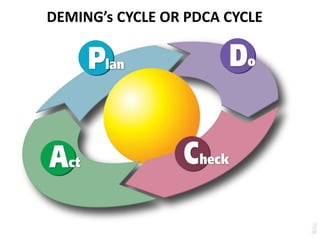
DEMING’s CYCLE OR PDCA CYCLE
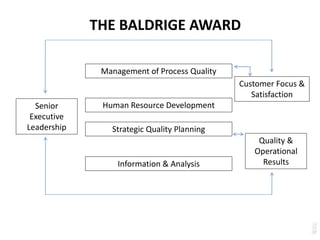
THE BALDRIGE AWARD
 Leadership 95
Senior executive’s personal leadership & involvement in creating
and sustaining customer focus
 Information & Analysis 75
The Scope, Validity, Analysis, Management and use of Data &
information to drive quality.
 Strategic Quality Planning 60
The planning process and how all key quality
requirements are integrated into overall business
planning.
THE BALDRIGE AWARD
 Human Resource Development &
Management: 150
The key elements of the workforce is enabled to develop its full
potential to pursue the company quality & operational performance
objective.
 Management of Process Quality 140
Systematic processes that company uses
 Quality & Operational Results 180
Company’s quality levels & improvement trends in
quality, Operational performance & supplier quality,
Levels relative to competitor.
 Customer Focus & Satisfaction 300
THE BALDRIGE AWARD
Management of Process Quality
Human Resource Development
Strategic Quality Planning
Information & Analysis
Customer Focus &
Satisfaction
Quality &
Operational
Results
Senior
Executive
Leadership
JURAN 10 POINTS
1. Build awareness of opportunities to improve
2. Set goals for improvements
3. Organize to reach goals
4. Provide training
5. Carryout projects to solve problems
6. Report progress
7. Give recognition
8. Communication results
9. Keep Score
10. Maintain momentum by making annual improvement part of
the system and processes of the company.
CROSBY’s 14 POINTS
1. Management Commitment
2. Quality Improvement Team
3. Quality Measurement
4. Cost of Quality
5. Zero Defect Planning
6. Corrective Action
7. Quality Awareness
8. Supervisory Training
9. Zero Defect Day
10. Goal Setting
11. Error Cause Removal
12. Recognition
13. Quality Council
14. Do it all over again
CROSBY’s 14 POINTS
1. Management Commitment
Top management must become convinced of the need for quality and must
clearly communicate this to the entire company by written policy, stating that
each person is expected to perform according to the requirement to be officially
change to what the company and the customers really need.
2. Quality Improvement Team
Form a team composed of department heads to oversee improvements in their
departments and in the company as a whole.
3. Quality Measurement
Establish measurements appropriate to every activity in order to identify areas in
need of improvement.
4. Cost of Quality
Estimate the costs of quality in order to identify areas where improvement would
be profitable.
CROSBY’s 14 POINTS
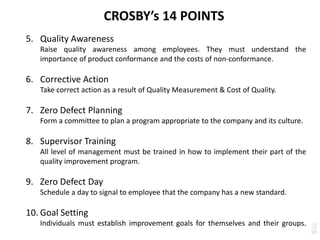
5. Quality Awareness
Raise quality awareness among employees. They must understand the
importance of product conformance and the costs of non-conformance.
6. Corrective Action
Take correct action as a result of Quality Measurement & Cost of Quality.
7. Zero Defect Planning
Form a committee to plan a program appropriate to the company and its culture.
8. Supervisor Training
All level of management must be trained in how to implement their part of the
quality improvement program.
9. Zero Defect Day
Schedule a day to signal to employee that the company has a new standard.
10. Goal Setting
Individuals must establish improvement goals for themselves and their groups.
CROSBY’s 14 POINTS
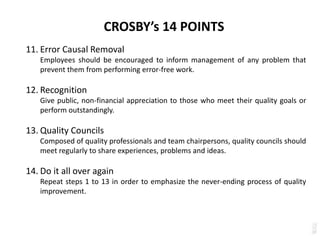
11. Error Causal Removal
Employees should be encouraged to inform management of any problem that
prevent them from performing error-free work.
12. Recognition
Give public, non-financial appreciation to those who meet their quality goals or
perform outstandingly.
13. Quality Councils
Composed of quality professionals and team chairpersons, quality councils should
meet regularly to share experiences, problems and ideas.
14. Do it all over again
Repeat steps 1 to 13 in order to emphasize the never-ending process of quality
improvement.
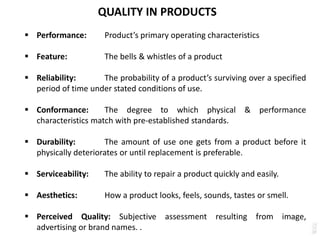
QUALITY IN PRODUCTS
 Performance: Product’s primary operating characteristics
 Feature: The bells & whistles of a product
 Reliability: The probability of a product’s surviving over a specified
period of time under stated conditions of use.
 Conformance: The degree to which physical & performance
characteristics match with pre-established standards.
 Durability: The amount of use one gets from a product before it
physically deteriorates or until replacement is preferable.
 Serviceability: The ability to repair a product quickly and easily.
 Aesthetics: How a product looks, feels, sounds, tastes or smell.
 Perceived Quality: Subjective assessment resulting from image,
advertising or brand names. .
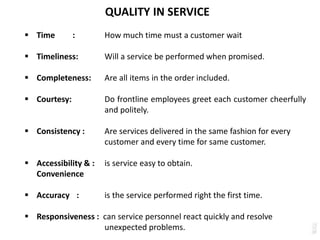
QUALITY IN SERVICE
 Time : How much time must a customer wait
 Timeliness: Will a service be performed when promised.
 Completeness: Are all items in the order included.
 Courtesy: Do frontline employees greet each customer cheerfully
and politely.
 Consistency : Are services delivered in the same fashion for every
customer and every time for same customer.
 Accessibility & : is service easy to obtain.
Convenience
 Accuracy : is the service performed right the first time.
 Responsiveness : can service personnel react quickly and resolve
unexpected problems.
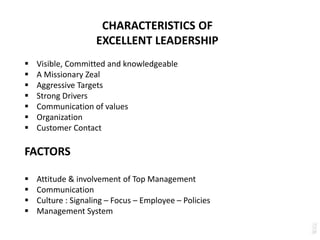
CHARACTERISTICS OF
EXCELLENT LEADERSHIP
 Visible, Committed and knowledgeable
 A Missionary Zeal
 Aggressive Targets
 Strong Drivers
 Communication of values
 Organization
 Customer Contact
FACTORS
 Attitude & involvement of Top Management
 Communication
 Culture : Signaling – Focus – Employee – Policies
 Management System
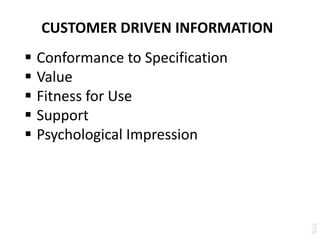
CUSTOMER DRIVEN INFORMATION
 Conformance to Specification
 Value
 Fitness for Use
 Support
 Psychological Impression

TQM chapter # 1 - Joel E Ross

  • 1.
    QUALITY THE TOTALITY OFFEATURES AND CHARACTERISTICS OF A PRODUCT OR SERVICE THAT BEARS ON ITS ABILITY TO SATISFY GIVEN NEEDS Value to Customer • Economic Value • Safety • Reliability • Maintainability
  • 2.
    QUALITY  It isdefined as conformance to requirement, Not goodness.  The system for achieving quality is prevention, Not appraisal.  The performance standard is “Zero Defect” Not that is close enough.  The measurement of quality is the price of nonconformance, Not indexes. QUALITY IMPROVEMENT  Inspection is never the answer to quality improvement nor the policing.  Involvement of & Leadership by top management are essential to the necessary culture of commitment to quality.  A program for quality requires organization-wide effort and long term commitment accompanied by the necessary investment in training.  Quality is First and schedules are necessary.
  • 3.
    Quality & BusinessPerformance Quality drives market share and when superior quality & large market share both present, profitability is virtually guaranteed . REWARDS • Greater Customer Loyalty • Market Share Improvement • Higher Stock Prices • Reduced service calls • Higher Prices • Greater Productivity
  • 4.
    INDICATORS • Defects • Scrap •Rework • Inspection • Returns • Warranty Costs • Quality Assurance
  • 5.
    Quality Assurance (QA) QualityAssurance refers to the processes ad procedures that systematically monitor different aspects of a service, process or facility to detect, correct and ensure that quality standards are being met. Example : Quality Assurance helped us to eliminate defective products and increase customer satisfaction. QA is the process of managing for quality. Quality Control (QC) Quality Control is a process by which entities review the quality of all factors involved in Production. QC is used to verify the quality of the output.
  • 6.
    SERVICE QUALITY  IntangibleOutput.  Inability to store the output.  Behavior of delivery person.  Image of the organization.  The measure of output is difficult to define.  Acceptance and Variance ranges may not apply.  The customer is present during production and performing the final inspection.  Adjusting the control system if the customer is present.
  • 7.
    AQL = 99% Inthe US alone :  At least 200,000 wrong drug prescription each year!  More than 30,000 newborn babies accidentally dropped by doctors / nurses each year!  Unsafe drinking water at least 4 days each year!  No electricity, water, heat for about 15 minutes each day!  Newspapers not delivered 4 times each year!  At least one misspelled word on every page of a book!
  • 8.
    Total Quality Management(TQM) Total Quality Management (TQM) is the integration of all functions and processes within an organization in order to achieve continuous improvement of the quality of goods and services. The goal is customer satisfaction.
  • 9.
    TQM Terminologies The Costof Quality:  It is measure of Non quality (not meeting customer requirements).  It is a measure of the progress of quality process. Cultural Change:  Appreciation of the primary need to meet customer requirements  Implementing managerial philosophy that acknowledges this emphasis.  Encouraging employee involvement.  Embracing the ethic of continuous improvement.
  • 10.
    TQM Terminologies Enabling Mechanismof Change Programs for  Training & Education  Communication  Recognition  Management Behavior  Team Work  Customer Satisfaction Implementing TQM  Define Mission  Identify Output  Indentify Customers  Negotiate Customer Requirements  Develop Supplier Specification that details customer objectives  Determining activities required to fill objectives
  • 11.
    TQM Terminologies Management Behavior Acting as Role Model  Use of quality processes & tools  Encouraging Communication  Sponsoring feedback activities  Fostering & providing supporting environment
  • 12.
    TQM & Traditional ManagementPractices  Process Focus  Role of People  Goals & Objectives  Knowledge  Measurement System  Reward System  Management Role  Union Management Relation  Organization Structure  Supplier Relationships  Control  Customers  Responsibility  Motivation  Competition  Quality Definition
  • 13.
    DEMING’s Universal 14Points 1. Create consistency of purpose with a plan 2. Adopt the new philosophy of quality 3. Cease dependence on mass inspection 4. End the practice of choosing suppliers based solely on price 5. Identify the problems & work continuously to improve the system. 6. Adopt modern methods of training on the job. 7. Changing the focus from production numbers (quantity) to quality. 8. Drive out fear 9. Breakdown barriers between departments 10. Stop requesting improved productivity without providing methods to achieve it 11. Eliminate work standards that prescribe numerical quotas 12. Remove barriers to pride of workmanship 13. Institute vigorous education and retraining 14. Create a structure in top management that will emphasize the preceding thirteen points every day.
  • 14.
  • 15.
    THE BALDRIGE AWARD Leadership 95 Senior executive’s personal leadership & involvement in creating and sustaining customer focus  Information & Analysis 75 The Scope, Validity, Analysis, Management and use of Data & information to drive quality.  Strategic Quality Planning 60 The planning process and how all key quality requirements are integrated into overall business planning.
  • 16.
    THE BALDRIGE AWARD Human Resource Development & Management: 150 The key elements of the workforce is enabled to develop its full potential to pursue the company quality & operational performance objective.  Management of Process Quality 140 Systematic processes that company uses  Quality & Operational Results 180 Company’s quality levels & improvement trends in quality, Operational performance & supplier quality, Levels relative to competitor.  Customer Focus & Satisfaction 300
  • 17.
    THE BALDRIGE AWARD Managementof Process Quality Human Resource Development Strategic Quality Planning Information & Analysis Customer Focus & Satisfaction Quality & Operational Results Senior Executive Leadership
  • 18.
    JURAN 10 POINTS 1.Build awareness of opportunities to improve 2. Set goals for improvements 3. Organize to reach goals 4. Provide training 5. Carryout projects to solve problems 6. Report progress 7. Give recognition 8. Communication results 9. Keep Score 10. Maintain momentum by making annual improvement part of the system and processes of the company.
  • 19.
    CROSBY’s 14 POINTS 1.Management Commitment 2. Quality Improvement Team 3. Quality Measurement 4. Cost of Quality 5. Zero Defect Planning 6. Corrective Action 7. Quality Awareness 8. Supervisory Training 9. Zero Defect Day 10. Goal Setting 11. Error Cause Removal 12. Recognition 13. Quality Council 14. Do it all over again
  • 20.
    CROSBY’s 14 POINTS 1.Management Commitment Top management must become convinced of the need for quality and must clearly communicate this to the entire company by written policy, stating that each person is expected to perform according to the requirement to be officially change to what the company and the customers really need. 2. Quality Improvement Team Form a team composed of department heads to oversee improvements in their departments and in the company as a whole. 3. Quality Measurement Establish measurements appropriate to every activity in order to identify areas in need of improvement. 4. Cost of Quality Estimate the costs of quality in order to identify areas where improvement would be profitable.
  • 21.
    CROSBY’s 14 POINTS 5.Quality Awareness Raise quality awareness among employees. They must understand the importance of product conformance and the costs of non-conformance. 6. Corrective Action Take correct action as a result of Quality Measurement & Cost of Quality. 7. Zero Defect Planning Form a committee to plan a program appropriate to the company and its culture. 8. Supervisor Training All level of management must be trained in how to implement their part of the quality improvement program. 9. Zero Defect Day Schedule a day to signal to employee that the company has a new standard. 10. Goal Setting Individuals must establish improvement goals for themselves and their groups.
  • 22.
    CROSBY’s 14 POINTS 11.Error Causal Removal Employees should be encouraged to inform management of any problem that prevent them from performing error-free work. 12. Recognition Give public, non-financial appreciation to those who meet their quality goals or perform outstandingly. 13. Quality Councils Composed of quality professionals and team chairpersons, quality councils should meet regularly to share experiences, problems and ideas. 14. Do it all over again Repeat steps 1 to 13 in order to emphasize the never-ending process of quality improvement.
  • 23.
    QUALITY IN PRODUCTS Performance: Product’s primary operating characteristics  Feature: The bells & whistles of a product  Reliability: The probability of a product’s surviving over a specified period of time under stated conditions of use.  Conformance: The degree to which physical & performance characteristics match with pre-established standards.  Durability: The amount of use one gets from a product before it physically deteriorates or until replacement is preferable.  Serviceability: The ability to repair a product quickly and easily.  Aesthetics: How a product looks, feels, sounds, tastes or smell.  Perceived Quality: Subjective assessment resulting from image, advertising or brand names. .
  • 24.
    QUALITY IN SERVICE Time : How much time must a customer wait  Timeliness: Will a service be performed when promised.  Completeness: Are all items in the order included.  Courtesy: Do frontline employees greet each customer cheerfully and politely.  Consistency : Are services delivered in the same fashion for every customer and every time for same customer.  Accessibility & : is service easy to obtain. Convenience  Accuracy : is the service performed right the first time.  Responsiveness : can service personnel react quickly and resolve unexpected problems.
  • 25.
    CHARACTERISTICS OF EXCELLENT LEADERSHIP Visible, Committed and knowledgeable  A Missionary Zeal  Aggressive Targets  Strong Drivers  Communication of values  Organization  Customer Contact FACTORS  Attitude & involvement of Top Management  Communication  Culture : Signaling – Focus – Employee – Policies  Management System
  • 26.
    CUSTOMER DRIVEN INFORMATION Conformance to Specification  Value  Fitness for Use  Support  Psychological Impression