OPERATION MANAGEMENT 2 (OM 2)
OM2: QUALITY TOOLKIT FOR
MANAGERS
Prof. Harish Kutemate
SYLLABUS
1 .Introduction to Quality Concepts:
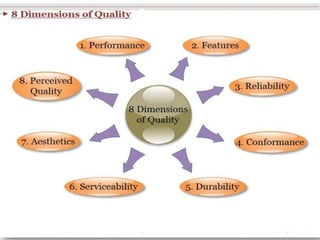
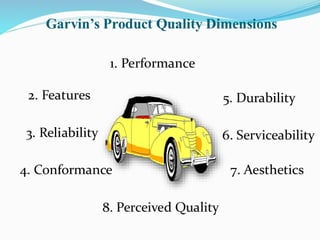
• Dimensions of Quality,
• Cost of Quality,
• Quality Philosophies,
• Quality Systems,
• Contribution of Quality gurus.
Total Quality Management, Text and Cases (Chapter 1 and 3)
By K. Shridhara Bhat,
Himalaya Publishing House
Quality Management (Chapter 7)
By Kanishka Bedi,
Oxford
SYLLABUS
2.Quality Assurance and Control –
• Concepts of Quality Assurance & Objectives
• Quality Manual, Specification and Design Control,
• Process Control, Inspection and Testing,
• Quality Assurance in Services
Quality Management (Chapter 13)
By Kanishka Bedi,
Oxford
SYLLABUS
3.Statistical Process Control (SPC):
• 7 Tools of Quality
• Control Charts for Variable and Attributes
• Control Chart Techniques
• X bar, R bar Correlation
• Pareto Diagrams
• Cause and Effect Diagrams
• Scatter Diagrams, Run Charts, Histograms and Flow Charts
Production and Operations Management (Chapter 17)
By K.Aswathappa and K. Shridhara Bhat
Himalaya Publidhing House
Operations Management, Theory and Practice (Chapter 8)
By. B.Mahadevan
Pearson Publication
SYLLABUS
4.TQM tools:
• TQM Frame Work
• Benchmarking / Benchmarking Process
• QFD (Quality Function Deployment)
• TPM (Total Productive Maintenance)
• FMEA (Failure More and Effects Analysis).
Total Quality Management, Text and Cases
By K. Shridhara Bhat,
Himalaya Publishing House
Quality Management
By Kanishka Bedi,
Oxford
SYLLABUS
5.Quality Improvement Techniques:
• KAIZEN, Six Sigma, ISO, 5S, QC
• Poka-Yoke
• Lean Manufacturing
• Service Quality
Production and Operations Management (Chapter 20)
By R. Paneerselvam (Third Edition),
Eastern Economy Edition
Operations Management (Chapter 5,Page 171)
By B Mahadevan
Pearson Publication
What is quality?
“Meeting the customer requirements”.
Quality is also defined as excellence in the
product or service that fulfills or exceeds the
expectations of the customer.
Quality is totality of features and characteristics of
product (goods and services) that bears on its ability to
satisfy given needs”
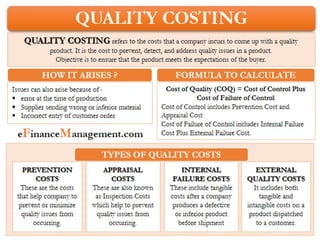
Cost of Quality
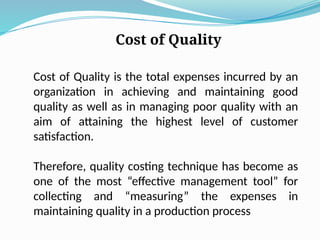
Cost of Quality is the total expenses incurred by an
organization in achieving and maintaining good
quality as well as in managing poor quality with an
aim of attaining the highest level of customer
satisfaction.
Therefore, quality costing technique has become as
one of the most “effective management tool” for
collecting and “measuring” the expenses in
maintaining quality in a production process
QUALITY COSTING- HOW
IT ARISES?
• Quality issues can come up in any company,
and these issue result in quality costing.
The problem may be due to a problem or
an error by one or more departments.
• For example: a flaw in product designing
would render the whole process useless.
Cost of Prevention
Associated with preventing defects before they happen
and to do the job right the first time.
Prevention costs may include …
• Costs of verifications
• Costs of redesigning the product to make it simpler
to produce
• Cost of redesigning the process to remove causes of
poor quality
• Cost of training employees in the methods of
continuous improvement
These are planned before actual operation and money is
all spent before the product is actually built.
Appraisal Costs
Associated with measuring and monitoring activities
related to quality.
They could include…
• Verification: Checking of incoming material, process
setup, and products against agreed specifications
• Quality Audits: Confirmation that the quality system
is functioning correctly
Internal Failure Costs
Internal failure costs are incurred to remedy defects
discovered before the product or service is delivered to
the customer.
These costs occur when the results of work fail to reach
design quality standards and are detected before they
are transferred to the customer.
They could include…
Scrap, defective product or material that cannot be
repaired, used, rework or rectification correction of
defective material or errors
External Failure Costs
Incurred to remedy defects discovered by the customers
They could include…
• Repairs and Servicing: of both returned products and
those in the field
• Warranty claims: Failed products that are replaced or
services that are re-performed under a guarantee
• Complaints: All work and costs associated with
handling and servicing customers’ complaints
• Returns: Handling and investigation of rejected or
recalled products, including transport cost.
Quality Guru’s & Philosophies
1) Deming 2) Juran
3) Crosby 4) Feigenbaum
5) Ishikawa 6) Garvin
7) Shingo 8) Taguchi
Despite there are Eight gurus in assessing Total Quality
Management (TQM), but there are differences in their
opinions…
• Dr. W. Edwards Deming, Dr. Joseph Juran and Phillip B.
Crosby are regarded as the management gurus in the
quality revolution.
• These three quality gurus together with other
individuals who have helped to shape current thinking
in quality management
Deming `s 14 points for management
1) Create a Constant Purpose towards Improvement of Product
and Service
2) Adopt the New Philosophy for Economic Stability
3) Institute Training on the Job
4) Eliminate Fear
5) Eliminate the Use of Unclear Slogans, Posters
6) Remove Barriers to Pride of Workmanship
7) Stop Depending on Inspections
Deming `s 14 points for management
8) Use Single Supplier for any One Item
9) Improve Constantly & Forever
10) Implement Leadership
11) Breakdown Barriers Between Department
12) Eliminate Management by Objectives
13) Implement Education & Self-Improvement
14) Make Transformation in Everyone’s Job
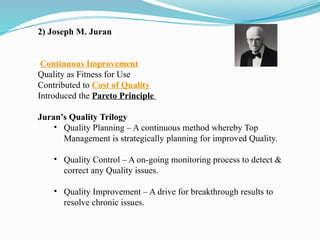
2) Joseph M. Juran
Continuous Improvement
Quality as Fitness for Use
Contributed to Cost of Quality
Introduced the Pareto Principle
Juran’s Quality Trilogy
• Quality Planning – A continuous method whereby Top
Management is strategically planning for improved Quality.
• Quality Control – A on-going monitoring process to detect &
correct any Quality issues.
• Quality Improvement – A drive for breakthrough results to
resolve chronic issues.
Philip B. Crosby
• Quality is Conformance to Requirements
• Stressed Senior Management
Involvement & Continuous Improvement
• Contributed to the Cost of Quality
Concept (Quality is Free)
• 4 Absolutes of Quality Management
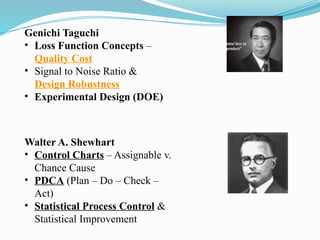
Genichi Taguchi
• Loss Function Concepts –
Quality Cost
• Signal to Noise Ratio &
Design Robustness
• Experimental Design (DOE)
Walter A. Shewhart
• Control Charts – Assignable v.
Chance Cause
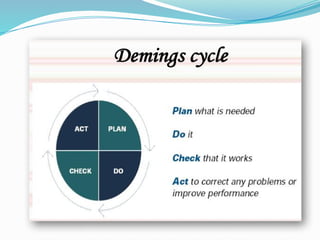
• PDCA (Plan – Do – Check –
Act)
• Statistical Process Control &
Statistical Improvement

OM2 QTM Unit-1.pptx operation management

  • 1.
    OPERATION MANAGEMENT 2(OM 2) OM2: QUALITY TOOLKIT FOR MANAGERS Prof. Harish Kutemate
  • 2.
    SYLLABUS 1 .Introduction toQuality Concepts: • Dimensions of Quality, • Cost of Quality, • Quality Philosophies, • Quality Systems, • Contribution of Quality gurus. Total Quality Management, Text and Cases (Chapter 1 and 3) By K. Shridhara Bhat, Himalaya Publishing House Quality Management (Chapter 7) By Kanishka Bedi, Oxford
  • 3.
    SYLLABUS 2.Quality Assurance andControl – • Concepts of Quality Assurance & Objectives • Quality Manual, Specification and Design Control, • Process Control, Inspection and Testing, • Quality Assurance in Services Quality Management (Chapter 13) By Kanishka Bedi, Oxford
  • 4.
    SYLLABUS 3.Statistical Process Control(SPC): • 7 Tools of Quality • Control Charts for Variable and Attributes • Control Chart Techniques • X bar, R bar Correlation • Pareto Diagrams • Cause and Effect Diagrams • Scatter Diagrams, Run Charts, Histograms and Flow Charts Production and Operations Management (Chapter 17) By K.Aswathappa and K. Shridhara Bhat Himalaya Publidhing House Operations Management, Theory and Practice (Chapter 8) By. B.Mahadevan Pearson Publication
  • 5.
    SYLLABUS 4.TQM tools: • TQMFrame Work • Benchmarking / Benchmarking Process • QFD (Quality Function Deployment) • TPM (Total Productive Maintenance) • FMEA (Failure More and Effects Analysis). Total Quality Management, Text and Cases By K. Shridhara Bhat, Himalaya Publishing House Quality Management By Kanishka Bedi, Oxford
  • 6.
    SYLLABUS 5.Quality Improvement Techniques: •KAIZEN, Six Sigma, ISO, 5S, QC • Poka-Yoke • Lean Manufacturing • Service Quality Production and Operations Management (Chapter 20) By R. Paneerselvam (Third Edition), Eastern Economy Edition Operations Management (Chapter 5,Page 171) By B Mahadevan Pearson Publication
  • 7.
    What is quality? “Meetingthe customer requirements”. Quality is also defined as excellence in the product or service that fulfills or exceeds the expectations of the customer.
  • 8.
    Quality is totalityof features and characteristics of product (goods and services) that bears on its ability to satisfy given needs”
  • 17.
    Cost of Quality Costof Quality is the total expenses incurred by an organization in achieving and maintaining good quality as well as in managing poor quality with an aim of attaining the highest level of customer satisfaction. Therefore, quality costing technique has become as one of the most “effective management tool” for collecting and “measuring” the expenses in maintaining quality in a production process
  • 18.
    QUALITY COSTING- HOW ITARISES? • Quality issues can come up in any company, and these issue result in quality costing. The problem may be due to a problem or an error by one or more departments. • For example: a flaw in product designing would render the whole process useless.
  • 19.
    Cost of Prevention Associatedwith preventing defects before they happen and to do the job right the first time. Prevention costs may include … • Costs of verifications • Costs of redesigning the product to make it simpler to produce • Cost of redesigning the process to remove causes of poor quality
  • 20.
    • Cost oftraining employees in the methods of continuous improvement These are planned before actual operation and money is all spent before the product is actually built.
  • 21.
    Appraisal Costs Associated withmeasuring and monitoring activities related to quality. They could include… • Verification: Checking of incoming material, process setup, and products against agreed specifications • Quality Audits: Confirmation that the quality system is functioning correctly
  • 22.
    Internal Failure Costs Internalfailure costs are incurred to remedy defects discovered before the product or service is delivered to the customer. These costs occur when the results of work fail to reach design quality standards and are detected before they are transferred to the customer. They could include… Scrap, defective product or material that cannot be repaired, used, rework or rectification correction of defective material or errors
  • 23.
    External Failure Costs Incurredto remedy defects discovered by the customers They could include… • Repairs and Servicing: of both returned products and those in the field • Warranty claims: Failed products that are replaced or services that are re-performed under a guarantee • Complaints: All work and costs associated with handling and servicing customers’ complaints • Returns: Handling and investigation of rejected or recalled products, including transport cost.
  • 25.
    Quality Guru’s &Philosophies 1) Deming 2) Juran 3) Crosby 4) Feigenbaum 5) Ishikawa 6) Garvin 7) Shingo 8) Taguchi Despite there are Eight gurus in assessing Total Quality Management (TQM), but there are differences in their opinions…
  • 26.
    • Dr. W.Edwards Deming, Dr. Joseph Juran and Phillip B. Crosby are regarded as the management gurus in the quality revolution. • These three quality gurus together with other individuals who have helped to shape current thinking in quality management
  • 30.
    Deming `s 14points for management 1) Create a Constant Purpose towards Improvement of Product and Service 2) Adopt the New Philosophy for Economic Stability 3) Institute Training on the Job 4) Eliminate Fear 5) Eliminate the Use of Unclear Slogans, Posters 6) Remove Barriers to Pride of Workmanship 7) Stop Depending on Inspections
  • 31.
    Deming `s 14points for management 8) Use Single Supplier for any One Item 9) Improve Constantly & Forever 10) Implement Leadership 11) Breakdown Barriers Between Department 12) Eliminate Management by Objectives 13) Implement Education & Self-Improvement 14) Make Transformation in Everyone’s Job
  • 33.
    2) Joseph M.Juran Continuous Improvement Quality as Fitness for Use Contributed to Cost of Quality Introduced the Pareto Principle Juran’s Quality Trilogy • Quality Planning – A continuous method whereby Top Management is strategically planning for improved Quality. • Quality Control – A on-going monitoring process to detect & correct any Quality issues. • Quality Improvement – A drive for breakthrough results to resolve chronic issues.
  • 34.
    Philip B. Crosby •Quality is Conformance to Requirements • Stressed Senior Management Involvement & Continuous Improvement • Contributed to the Cost of Quality Concept (Quality is Free) • 4 Absolutes of Quality Management
  • 35.
    Genichi Taguchi • LossFunction Concepts – Quality Cost • Signal to Noise Ratio & Design Robustness • Experimental Design (DOE) Walter A. Shewhart • Control Charts – Assignable v. Chance Cause • PDCA (Plan – Do – Check – Act) • Statistical Process Control & Statistical Improvement