WHAT IS THE JAPANESE-STYLE HUMAN
RESOURCE MANAGEMENT?
JONGWON WOO
PART 1
TYPICAL PRACTICES OF JAPAN
A FACTORY IN CHINA:
ON THE WALL, THERE IS A SHEET TO
ANNOUNCE SOMETHING TO WORKERS.
A FACTORY IN JAPAN:
ON THE WALL, THERE IS A SHEET TO SHOW
SOMETHING TO WORKERS.
WHAT IS THE “SKILL MATRIX” SHOWING?
able to do the job
with support
able to do the job
without support
able to teach
the job
able to do
problem solving
TOYOTA PRODUCTION SYSTEM (TPS)
OR TOYOTA WAY (TW)
http://www.toyota-
global.com/investors/financial_data/high-
light.html
LEAD TIME OF PRODUCT DEVELOPMENT
 The read time of Japanese automakers is the shortest.
 They cleverly make use of simultaneous engineering.
http://ocw.u-
tokyo.ac.jp/lecture_files/eco_02/9/notes/ja/J
_ba2_9.pdf#search='%E9%96%8B%E7%99
%BA+%E3%83%AA%E3%83%BC%E3%83
%89%E3%82%BF%E3%82%A4%E3%83%
A0+%E6%AF%94%E8%BC%83'
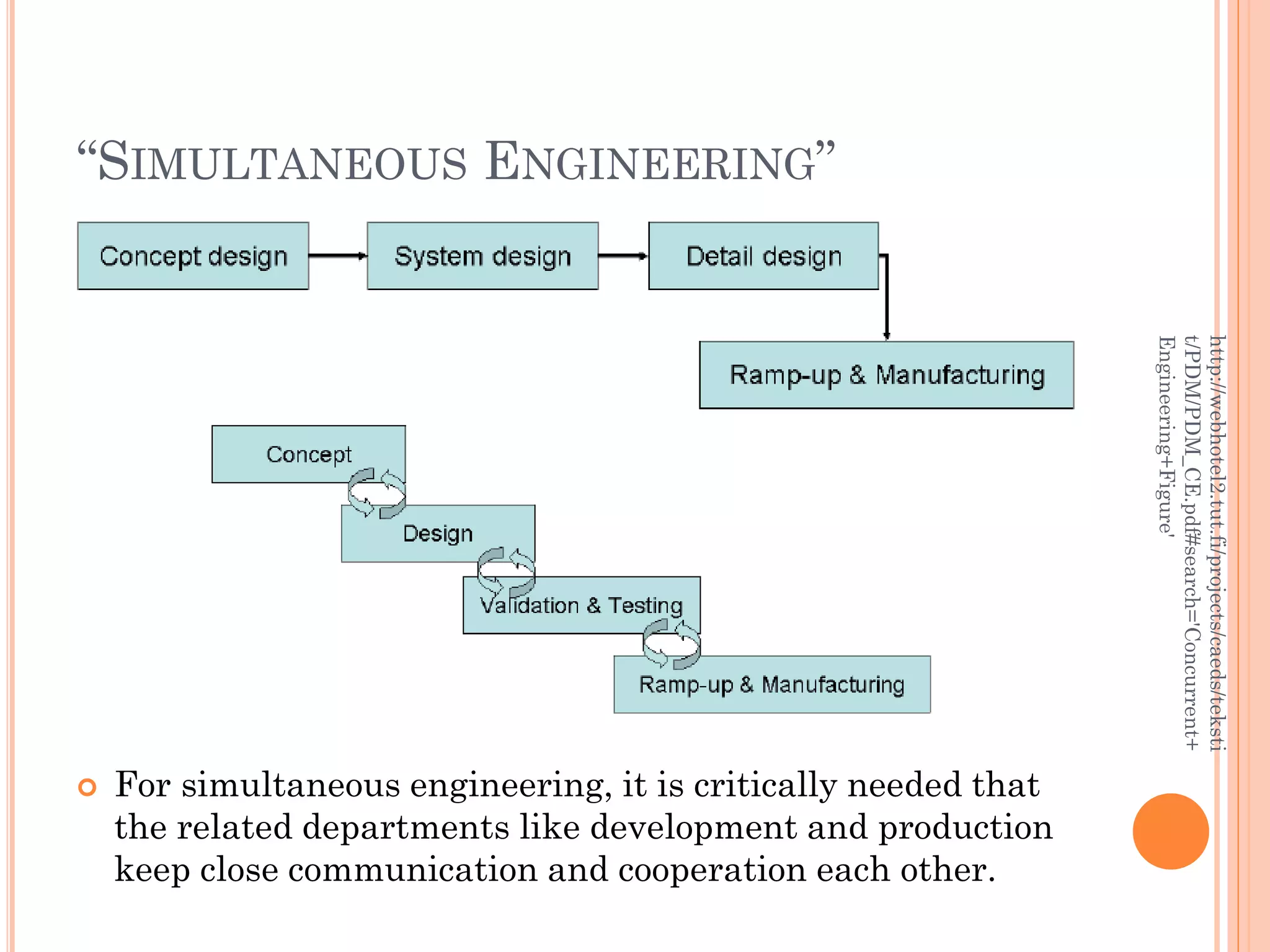
“SIMULTANEOUS ENGINEERING”
 For simultaneous engineering, it is critically needed that
the related departments like development and production
keep close communication and cooperation each other.
http://webhotel2.tut.fi/projects/caeds/teksti
t/PDM/PDM_CE.pdf#search='Concurrent+
Engineering+Figure'
ROLE OF SKILLED WORKERS IS CRITICAL
Foremen at every
workplaces shorten the
operation time and
rewrite the operation
standard sheets.
Not only foremen but
also seniors at every
workplaces tackle the
operational problems
and accomplish the
Kaizen.
THE ECONOMIC EFFECT OF KAIZEN IN
TOYOTA:
TOTAL EFFECT IS 1,670 BILLION YEN
DURING 12 YEARS FROM 1992 TO 2003
WAGE SYSTEM AT TOYOTA
 The total amount of compensation depends on the “ability”.
 White collar workers are granted from 7 to 1 ability grade,
and blue collar workers are granted from 9 to 1 ability
grade, respectively.
White collor workers Blue collar workers
Individual wage
based on ability (50%)
Basic wage based on
ability (50%)
Individual wage
based on ability (30%)
Basic wage based on
ability (30%)
Wage based on
productivity (20%)
Wage based on
seniority (20%)
SUGIYAMA,Naoshi[2014]
JIT (JUST IN TIME) NOT ONLY IN THE
PRODUCTION BUT ALSO IN THE SUPPLY CHAIN
Provided by “lot”:
A few parts are in stock.
Provided in the “order”:
Suppliers deliver parts
in sequence.
THE STRONG POINTS OF TOYOTA
[PRODUCT]
 Speedy and flexible development of new product
 “Lean Production”: continuous Kaizen of QCD (Quality, Cost,
and Delivery)
[ORGANIZATION]
 Flexible work organization
 Close cooperation between sections
 Smooth communication between engineers and operators
[HUMAN RESOURCES]
 Flexible placement of employees
 All round skilled workers
 Strong commitment to the growth of company
PART 2
WHAT KIND OF HRM SUPPORTS THE
COMPETITIVENESS OF JAPANESE
FIRMS?
LONG-TERM EMPLOYMENT SUPPORTS THE
EMPLOYEES’ COMMITMENT TO THE COMPANY
AND THEIR ‘FIRM-SPECIFIC’ SKILLS
 As of the length of service year, the average of Japan is
about 12 years, longer than that of USA or that of Great
Britain.
 However, no longer than those of some European countries
like Germany, France, and Italy.
JILPT(2014)"DatabookofInternational
LabourStatistics"
THE PRACTICE OF HIRING NEW GRADUATES AND
TRAINING THEM SUPPORTS EMPLOYEES’ STRONG
COMMITMENT TO THE COMPANY AND THEIR FLEXIBLE
PLACEMENT
 As of unemployment rate of 15-24 years old,
Japan is one of the countries where it is the least.
 This is related with the hiring practice of
Japanese firms.
JILPT(2014)"DatabookofInternational
LabourStatistics"
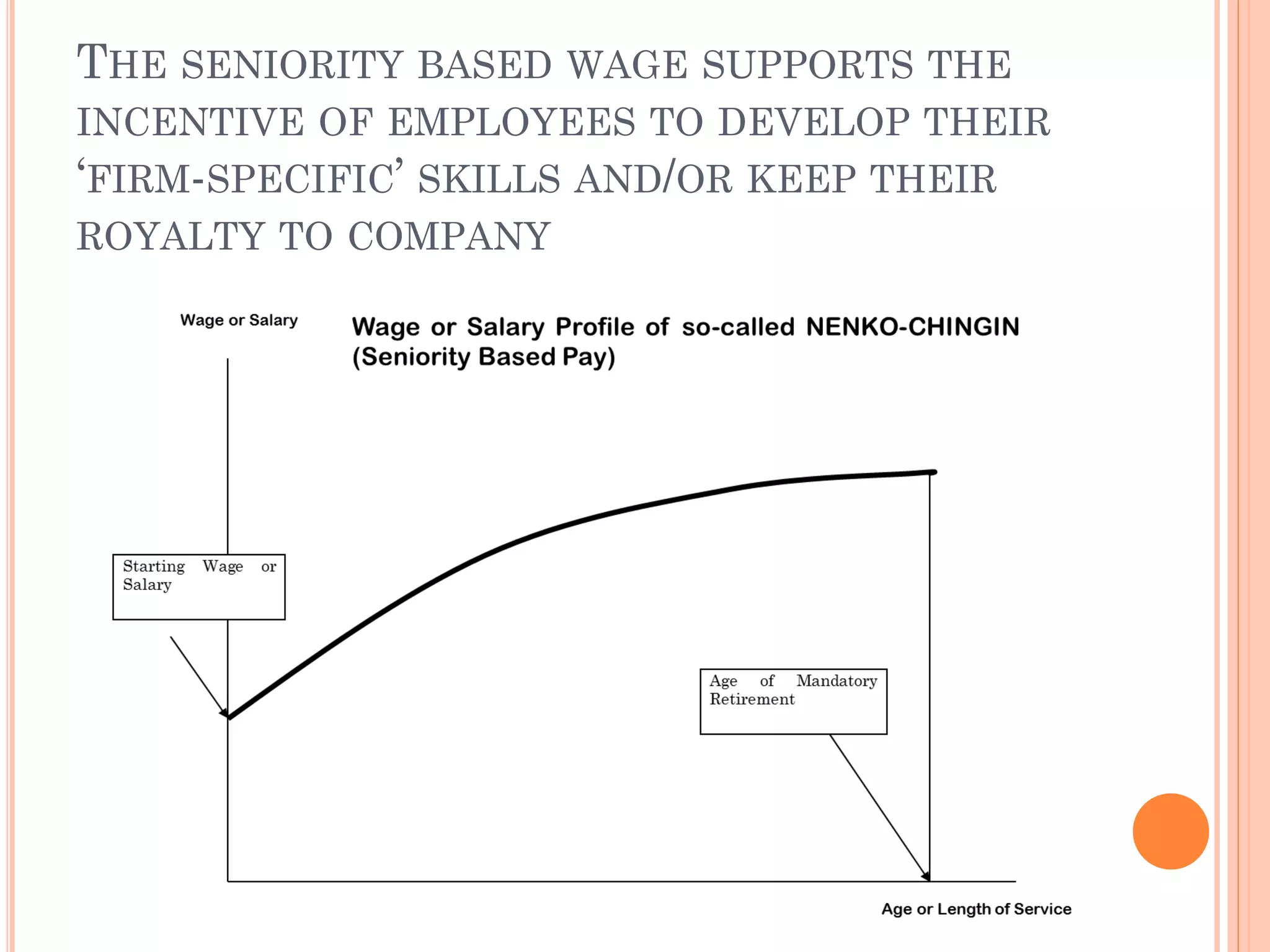
THE SENIORITY BASED WAGE SUPPORTS THE
INCENTIVE OF EMPLOYEES TO DEVELOP THEIR
‘FIRM-SPECIFIC’ SKILLS AND/OR KEEP THEIR
ROYALTY TO COMPANY
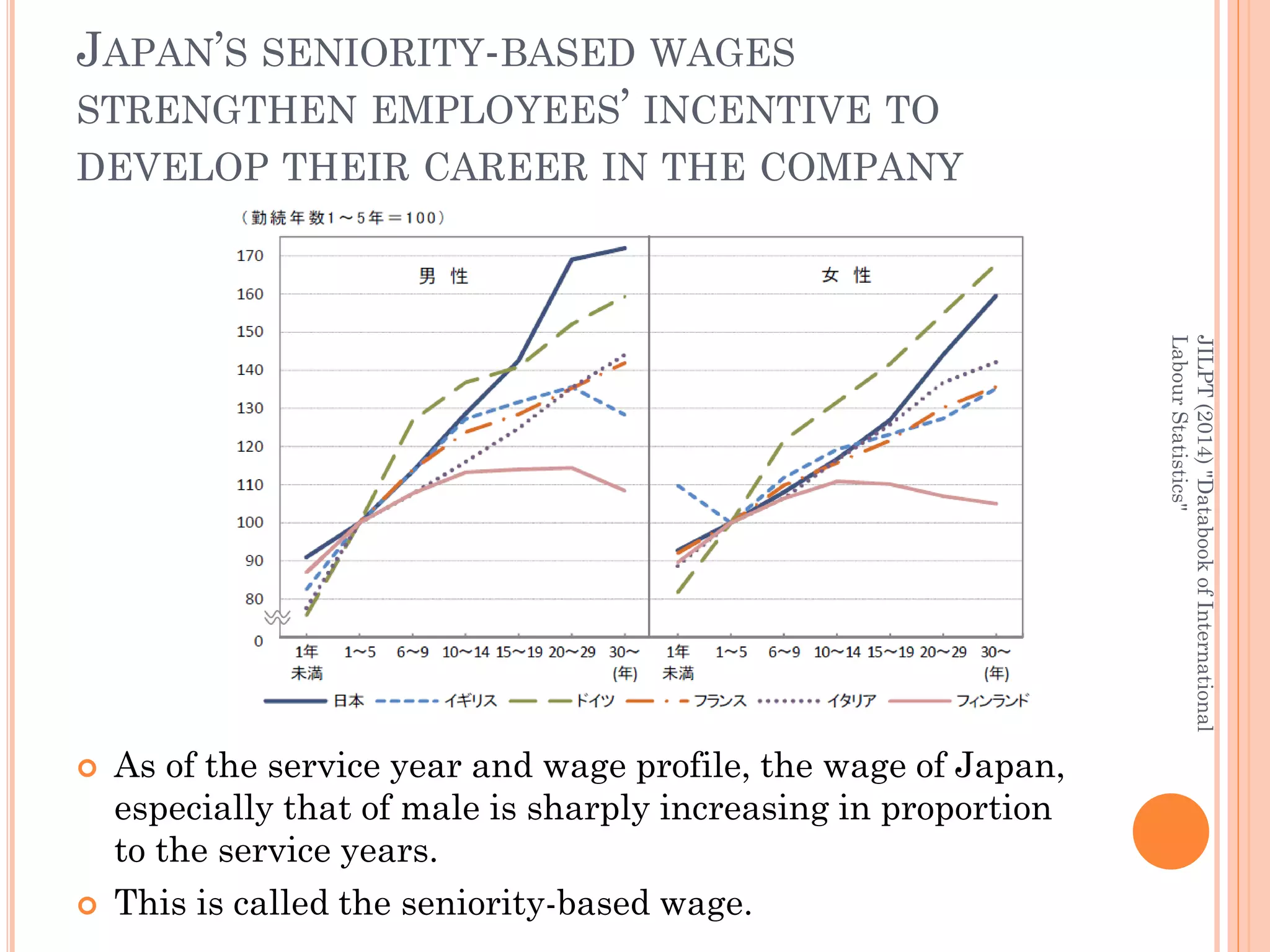
JAPAN’S SENIORITY-BASED WAGES
STRENGTHEN EMPLOYEES’ INCENTIVE TO
DEVELOP THEIR CAREER IN THE COMPANY
 As of the service year and wage profile, the wage of Japan,
especially that of male is sharply increasing in proportion
to the service years.
 This is called the seniority-based wage.
JILPT(2014)"DatabookofInternational
LabourStatistics"
INTERNAL TRAINING, ESPECIALLY “OJT” IS
SUPPORTING JAPANESE WORKERS INTERNAL
CAREER
 Q) (Asking firms) What type of training do you
think important?
 A) 73.5% of firms answer OJT is important.
MLHW(2014)"SurveyonAbility
Development"
TO MAINTAIN THE INCENTIVE OF EMPLOYEES,
JAPANESE FIRMS RESTRAIN THE
IMPLEMENTATION OF “FAST TRACK”
 There is not so many “fast tracks” in Japan as in the US or
in Germany.
 The chances of promotion are granted to the majority of
employees.
ProvidesbyProf.TeiichSekiguchi
Existence of Fast Track
5.4
38.4 28.2
89.9
49.5 51.9
0%
10%
20%
30%
40%
50%
60%
70%
80%
90%
100%
Japan US Germany
N. A.
No Fast Track
After Several Years
Experience
From the Entry Level
THE “SLOW PROMOTION” SUPPORTS
EMPLOYEES’ MOTIVATION ON ONE HAND, THEIR
COOPERATION ON THE OTHER HAND
Timing of Promotion
(Average Length of Service at the Promotion to the Current Positions
Ocuurered)
0
5
10
15
20
25
30
HRM - Dept.
Head
(BUCHYOU)
HRM - Section
Chief
(KACHOU)
Sales - Dept.
Head
(BUCHYOU)
Sales -
Section Chief
(KACHOU)
Accoounting -
Dept. Head
(BUCHYOU)
Accounting -
Sectrion Chief
(KACHOU)
US
JAPAN
 The length of service necessary for the promotion
to the department/section chief in Japan is
almost double of that in the US.
ProvidesbyProf.TeiichSekiguchi
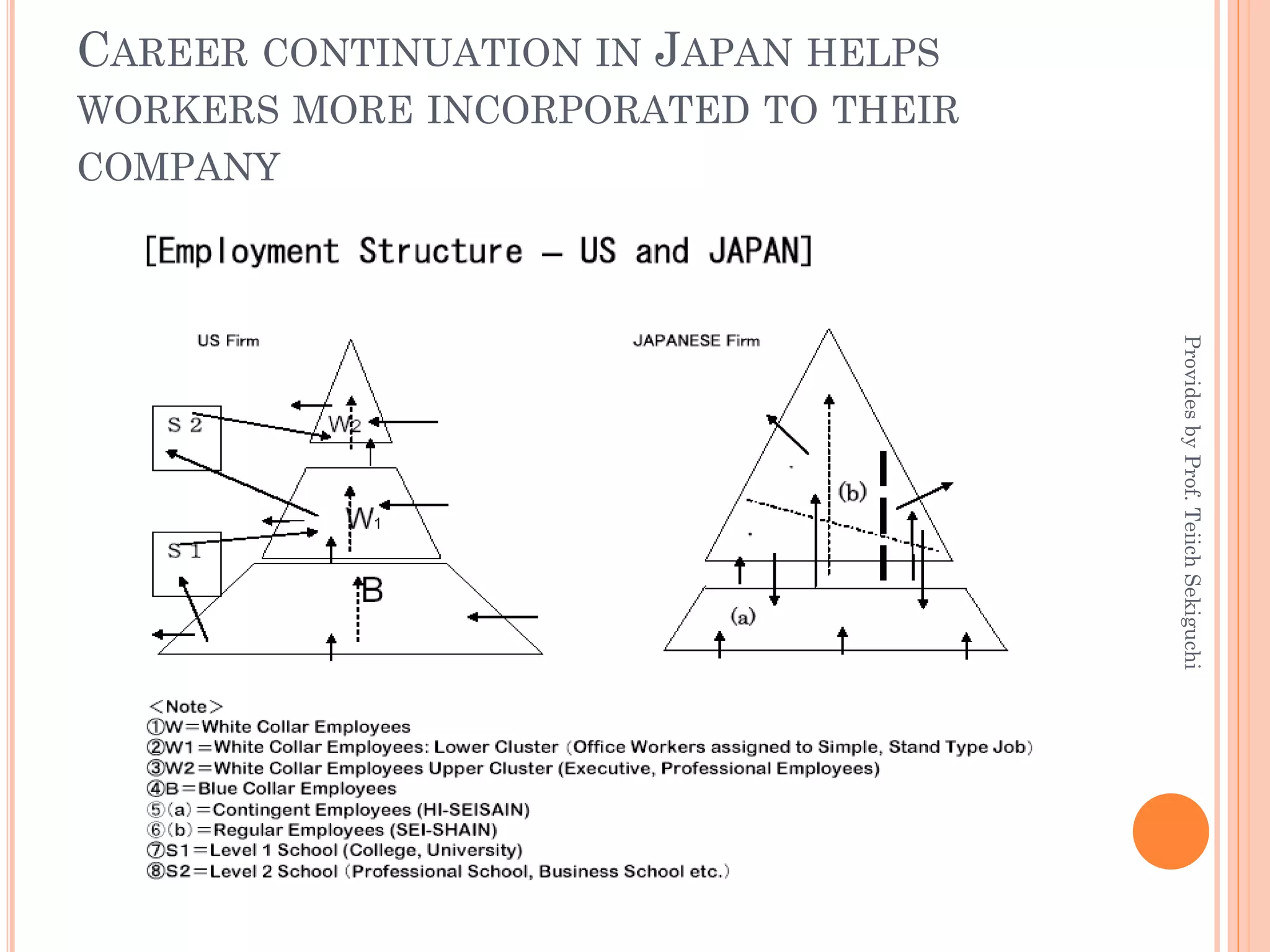
CAREER CONTINUATION IN JAPAN HELPS
WORKERS MORE INCORPORATED TO THEIR
COMPANY
ProvidesbyProf.TeiichSekiguchi
NO COLLAR LINES BETWEEN REGULAR
MEMBERS IN A FIRM
 There is no formal collar line within regular
employees. The same compensation and appraisal
system and rules have been applied to both white
collar and blue collar employees, regardless of their
current job assignment or specialty.
 The difference of annual earning levels of top level
white collar workers and lowest level blue collar
workers is far smaller in Japan than firms in the
Western countries.
RANKING SYSTEM BASED ON “ABILITY” SUPPORTS ALL
OF THE JAPANESE HRM: AN EMPLOYEE CAN BE
PROMOTED EVEN IF THERE IS NOT A JOB VACANCY
 In this case of Nippon steel corporation, employees are
graded according to the “job” on one hand (left side), and to
the “ability” on the other hand (right side).
TAGUCHI,Kazuo[2004]
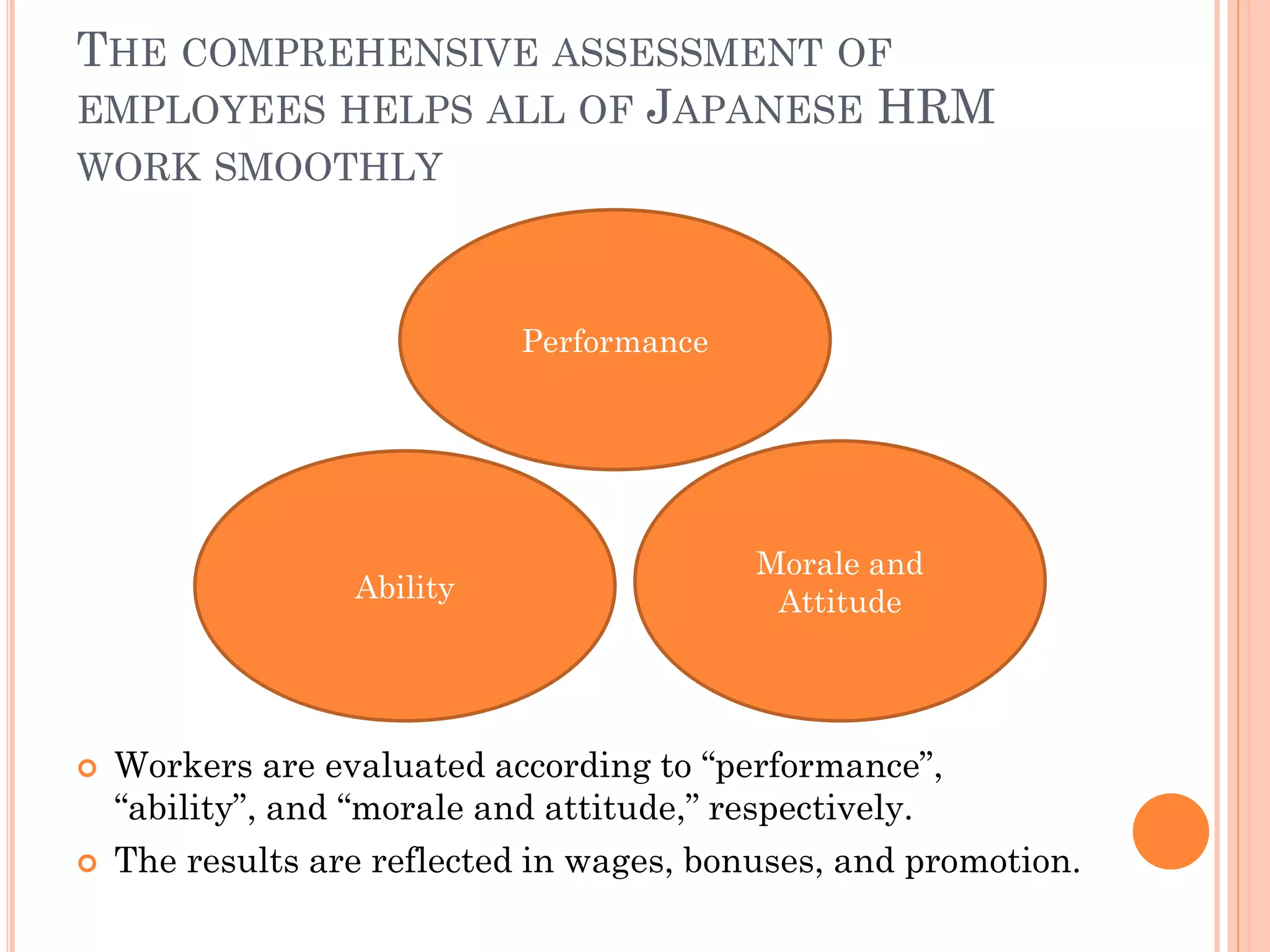
THE COMPREHENSIVE ASSESSMENT OF
EMPLOYEES HELPS ALL OF JAPANESE HRM
WORK SMOOTHLY
 Workers are evaluated according to “performance”,
“ability”, and “morale and attitude,” respectively.
 The results are reflected in wages, bonuses, and promotion.
Ability
Morale and
Attitude
Performance
NOT INDUSTRIAL UNION BUT ENTERPRISE
UNION MORE HELPS EMPLOYEES COMMIT TO
HIS/HER COMPANY
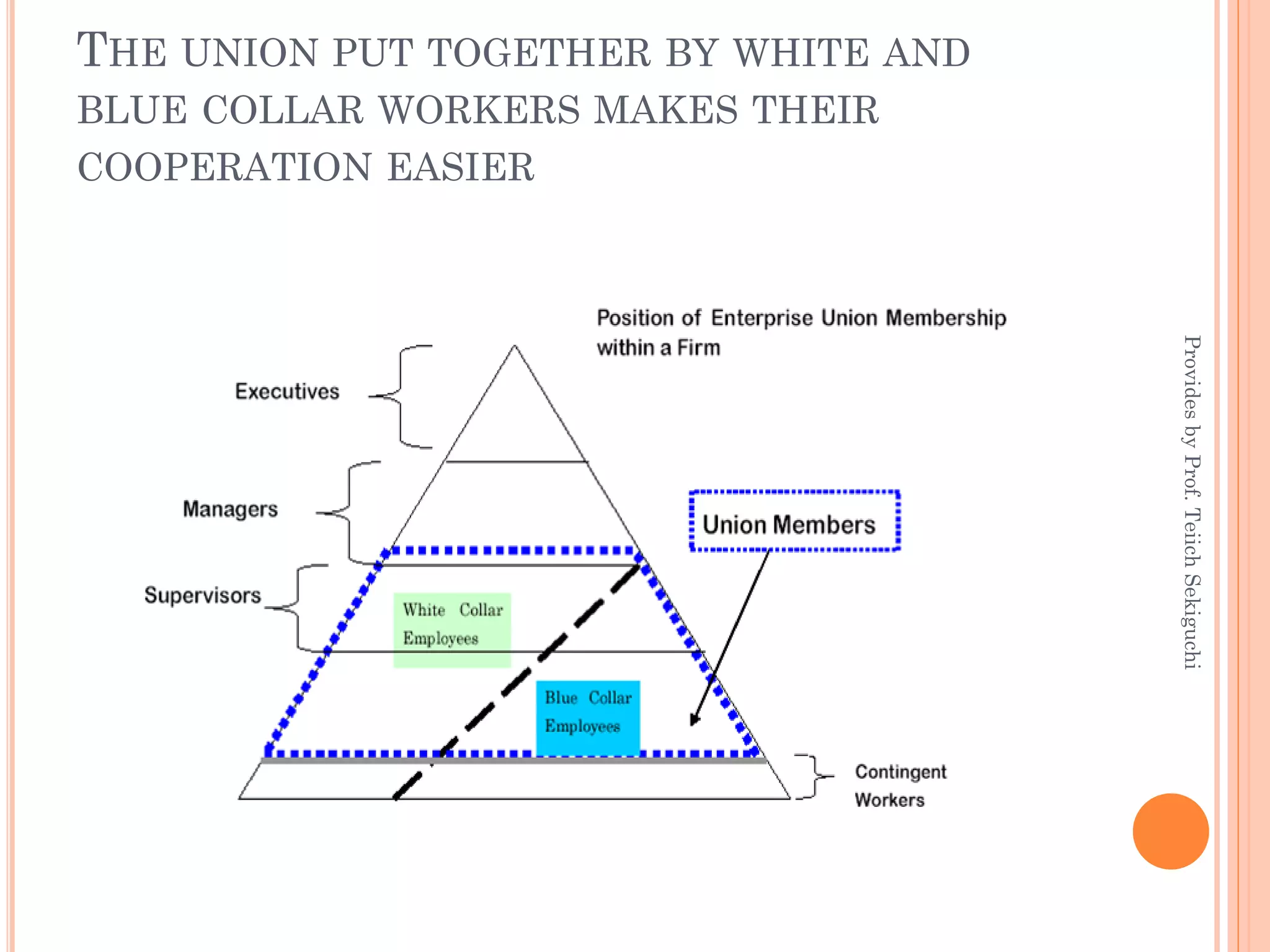
ProvidesbyProf.TeiichSekiguchi
THE UNION PUT TOGETHER BY WHITE AND
BLUE COLLAR WORKERS MAKES THEIR
COOPERATION EASIER
ProvidesbyProf.TeiichSekiguchi
ENTERPRISE UNIONS SUPPORT THE
COOPERATIVE RELATIONS BETWEEN LABOR
AND MANAGEMENT
 As for the number of days not worked because of labor dispute,
they are very small in Japan.
 It shows that the relationship between labor and management in
Japan is very peaceful.
 This is related with the characteristics of enterprise unions.
JILPT(2014)"DatabookofInternational
LabourStatistics"
“WHITE-COLLARIZATION” OF BLUE
COLLAR WORKERS IN JAPAN
 In Japan, there is no clear distinction between
salaried employees and wage earners.
 Everyone is a “Salary Man” and earns his
compensation in a single category “Kyuro”.
 The level of consciousness and behaviors of blue
collar employees are very close to those of white
collar employees.
 Generally, Japanese blue collar employees are
earnest to acquire skills and knowledge.
 Also, they show strong commitment and loyalty
to their firm.
 “Kaizen movement” and “QC circle” are typical
examples of their commitment.
PART 3
“JAPANESE-STYLE MANAGEMENT” IN
THE VARIETIES OF HRM/IR
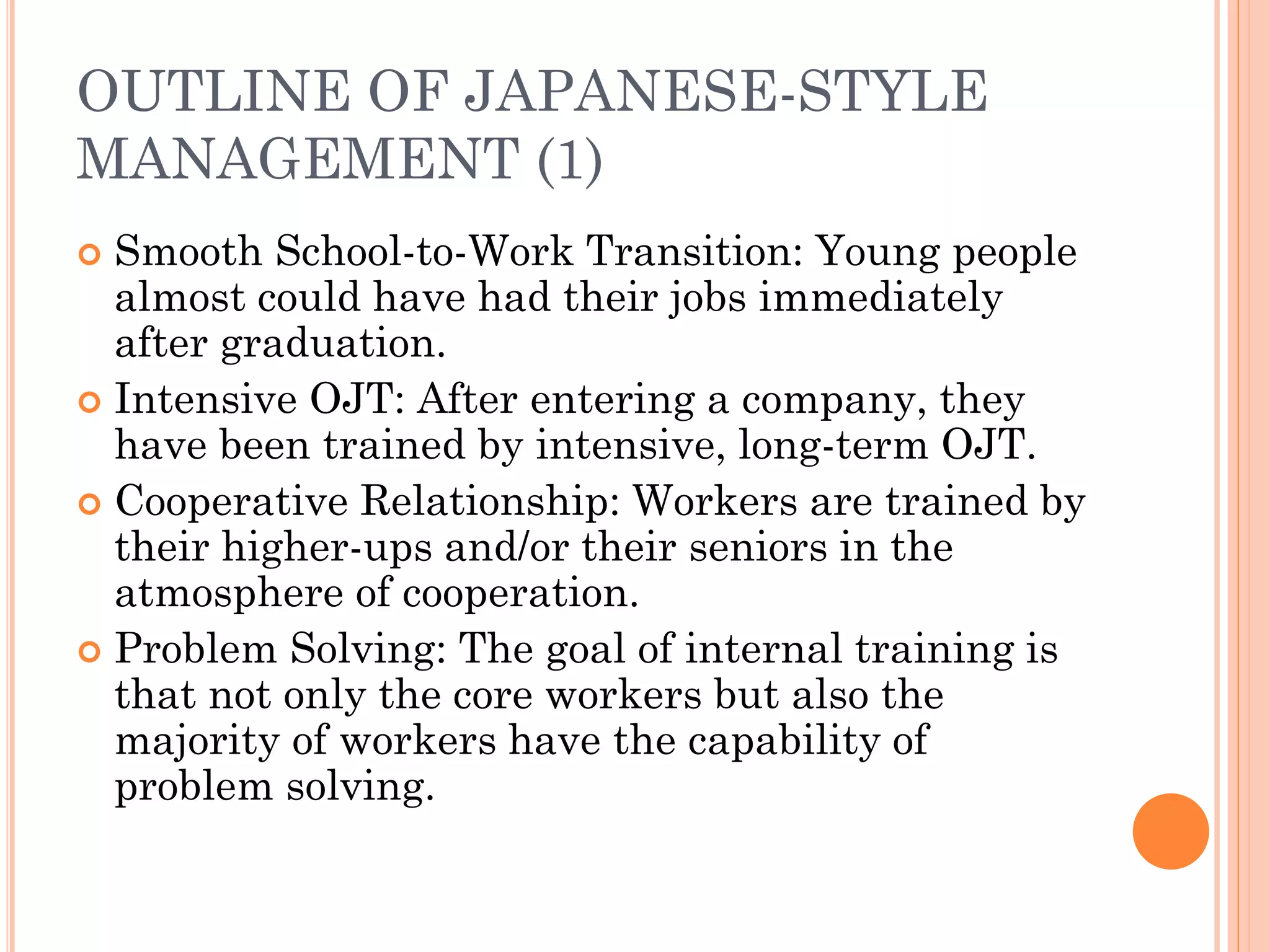
OUTLINE OF JAPANESE-STYLE
MANAGEMENT (1)
 Smooth School-to-Work Transition: Young people
almost could have had their jobs immediately
after graduation.
 Intensive OJT: After entering a company, they
have been trained by intensive, long-term OJT.
 Cooperative Relationship: Workers are trained by
their higher-ups and/or their seniors in the
atmosphere of cooperation.
 Problem Solving: The goal of internal training is
that not only the core workers but also the
majority of workers have the capability of
problem solving.
OUTLINE OF JAPANESE-STYLE
MANAGEMENT (2)
 The HR Development is supported by related HR
practices/institutions as below:
 Seniority Based Wage/Promotion: Their wages and
positions have been raised step by step with their seniority.
 Job Security: Their jobs have been guaranteed until the
mandatory retirement.
 Enterprise Union: They have been the members of
enterprise unions which bargain/consult with the
management about the conditions of “life-time
commitment.”
 Government’s HRD Policies Valuing ILMs: Japanese
Government traditionally has not supported workers who
hopping for jobs, but supported management who bring
their employees up.
“JAPANESE-STYLE MANAGEMENT” AND
VARIETIES OF HRM/IR
 Job based HRM
vs. HRM based on Personal Factors
 Market-oriented Unions and Industrial
Relations
vs. Organization-oriented Unions and IR
 Market-mediated Employment Relations
vs. Internalized Employment Relations
 Scio-economic IR System
vs. Voluntary IR System
REFERENCES
 Freeman,R.B. and J.L.Medoff [1984]. What Do Unions Do?, New York: Basic
books.
 Fujimoto, Takahiro [2003] Noryoku Kokiku Kyosoj: Nippon No Jidosya
Sangyo Wa Naze Chuyoinoka, Chuo-Koron-Shinsya.
 Huselid, Mark A. [1995]. “The Impact of Human Resource Management
Practices on Turnover, Productivity, and Corporate Financial Performance”,
Academy of Management Journal 38(3) 635-672).
 Kato,T. and M.Morishima [2002]. “The Productivity Effects of Participatory
Employment Practices: Evidence from New Japanese Panel Data”,
Industrial Relations, Vol. 41(4).
 Koike, Kazuo [1999] Shigoto No Keizaigaku, Tokyo: Toyo-keizai-shimpo-sya.
 Sugiyama, Naoshi [2014] “Toyota Ni Okeru Chingin Seido No Tenkai”,
Chukyo-Keiei-Kenkyu, Vol. 23, No. 1-2.
 Taguchi, Kazuo [2004] “Shin-Nippon-Seitetu Ni Miru Chingin Seido No
Sengo Shi”, Kikai-Keizai-Kenkyu, No.35.
 Tsuru, Tsuyoshi, and Kentaro Nakajima [2012] (Discussion Paper Series A
No.559) “Seihin Achitecture To Jinzai Management: Kigyo Enquête Chosa
Ni Motozuku Nicchukan Hikaku”, Institute of Economic Research,
Hitotsubashi University.
THANK YOU FOR LISTENING!

Japanese-style human resource management

  • 1.
    WHAT IS THEJAPANESE-STYLE HUMAN RESOURCE MANAGEMENT? JONGWON WOO
  • 2.
  • 3.
    A FACTORY INCHINA: ON THE WALL, THERE IS A SHEET TO ANNOUNCE SOMETHING TO WORKERS.
  • 4.
    A FACTORY INJAPAN: ON THE WALL, THERE IS A SHEET TO SHOW SOMETHING TO WORKERS.
  • 5.
    WHAT IS THE“SKILL MATRIX” SHOWING? able to do the job with support able to do the job without support able to teach the job able to do problem solving
  • 6.
    TOYOTA PRODUCTION SYSTEM(TPS) OR TOYOTA WAY (TW) http://www.toyota- global.com/investors/financial_data/high- light.html
  • 7.
    LEAD TIME OFPRODUCT DEVELOPMENT  The read time of Japanese automakers is the shortest.  They cleverly make use of simultaneous engineering. http://ocw.u- tokyo.ac.jp/lecture_files/eco_02/9/notes/ja/J _ba2_9.pdf#search='%E9%96%8B%E7%99 %BA+%E3%83%AA%E3%83%BC%E3%83 %89%E3%82%BF%E3%82%A4%E3%83% A0+%E6%AF%94%E8%BC%83'
  • 8.
    “SIMULTANEOUS ENGINEERING”  Forsimultaneous engineering, it is critically needed that the related departments like development and production keep close communication and cooperation each other. http://webhotel2.tut.fi/projects/caeds/teksti t/PDM/PDM_CE.pdf#search='Concurrent+ Engineering+Figure'
  • 9.
    ROLE OF SKILLEDWORKERS IS CRITICAL Foremen at every workplaces shorten the operation time and rewrite the operation standard sheets. Not only foremen but also seniors at every workplaces tackle the operational problems and accomplish the Kaizen.
  • 10.
    THE ECONOMIC EFFECTOF KAIZEN IN TOYOTA: TOTAL EFFECT IS 1,670 BILLION YEN DURING 12 YEARS FROM 1992 TO 2003
  • 11.
    WAGE SYSTEM ATTOYOTA  The total amount of compensation depends on the “ability”.  White collar workers are granted from 7 to 1 ability grade, and blue collar workers are granted from 9 to 1 ability grade, respectively. White collor workers Blue collar workers Individual wage based on ability (50%) Basic wage based on ability (50%) Individual wage based on ability (30%) Basic wage based on ability (30%) Wage based on productivity (20%) Wage based on seniority (20%) SUGIYAMA,Naoshi[2014]
  • 12.
    JIT (JUST INTIME) NOT ONLY IN THE PRODUCTION BUT ALSO IN THE SUPPLY CHAIN Provided by “lot”: A few parts are in stock. Provided in the “order”: Suppliers deliver parts in sequence.
  • 13.
    THE STRONG POINTSOF TOYOTA [PRODUCT]  Speedy and flexible development of new product  “Lean Production”: continuous Kaizen of QCD (Quality, Cost, and Delivery) [ORGANIZATION]  Flexible work organization  Close cooperation between sections  Smooth communication between engineers and operators [HUMAN RESOURCES]  Flexible placement of employees  All round skilled workers  Strong commitment to the growth of company
  • 14.
    PART 2 WHAT KINDOF HRM SUPPORTS THE COMPETITIVENESS OF JAPANESE FIRMS?
  • 15.
    LONG-TERM EMPLOYMENT SUPPORTSTHE EMPLOYEES’ COMMITMENT TO THE COMPANY AND THEIR ‘FIRM-SPECIFIC’ SKILLS  As of the length of service year, the average of Japan is about 12 years, longer than that of USA or that of Great Britain.  However, no longer than those of some European countries like Germany, France, and Italy. JILPT(2014)"DatabookofInternational LabourStatistics"
  • 16.
    THE PRACTICE OFHIRING NEW GRADUATES AND TRAINING THEM SUPPORTS EMPLOYEES’ STRONG COMMITMENT TO THE COMPANY AND THEIR FLEXIBLE PLACEMENT  As of unemployment rate of 15-24 years old, Japan is one of the countries where it is the least.  This is related with the hiring practice of Japanese firms. JILPT(2014)"DatabookofInternational LabourStatistics"
  • 17.
    THE SENIORITY BASEDWAGE SUPPORTS THE INCENTIVE OF EMPLOYEES TO DEVELOP THEIR ‘FIRM-SPECIFIC’ SKILLS AND/OR KEEP THEIR ROYALTY TO COMPANY
  • 18.
    JAPAN’S SENIORITY-BASED WAGES STRENGTHENEMPLOYEES’ INCENTIVE TO DEVELOP THEIR CAREER IN THE COMPANY  As of the service year and wage profile, the wage of Japan, especially that of male is sharply increasing in proportion to the service years.  This is called the seniority-based wage. JILPT(2014)"DatabookofInternational LabourStatistics"
  • 19.
    INTERNAL TRAINING, ESPECIALLY“OJT” IS SUPPORTING JAPANESE WORKERS INTERNAL CAREER  Q) (Asking firms) What type of training do you think important?  A) 73.5% of firms answer OJT is important. MLHW(2014)"SurveyonAbility Development"
  • 20.
    TO MAINTAIN THEINCENTIVE OF EMPLOYEES, JAPANESE FIRMS RESTRAIN THE IMPLEMENTATION OF “FAST TRACK”  There is not so many “fast tracks” in Japan as in the US or in Germany.  The chances of promotion are granted to the majority of employees. ProvidesbyProf.TeiichSekiguchi Existence of Fast Track 5.4 38.4 28.2 89.9 49.5 51.9 0% 10% 20% 30% 40% 50% 60% 70% 80% 90% 100% Japan US Germany N. A. No Fast Track After Several Years Experience From the Entry Level
  • 21.
    THE “SLOW PROMOTION”SUPPORTS EMPLOYEES’ MOTIVATION ON ONE HAND, THEIR COOPERATION ON THE OTHER HAND Timing of Promotion (Average Length of Service at the Promotion to the Current Positions Ocuurered) 0 5 10 15 20 25 30 HRM - Dept. Head (BUCHYOU) HRM - Section Chief (KACHOU) Sales - Dept. Head (BUCHYOU) Sales - Section Chief (KACHOU) Accoounting - Dept. Head (BUCHYOU) Accounting - Sectrion Chief (KACHOU) US JAPAN  The length of service necessary for the promotion to the department/section chief in Japan is almost double of that in the US. ProvidesbyProf.TeiichSekiguchi
  • 22.
    CAREER CONTINUATION INJAPAN HELPS WORKERS MORE INCORPORATED TO THEIR COMPANY ProvidesbyProf.TeiichSekiguchi
  • 23.
    NO COLLAR LINESBETWEEN REGULAR MEMBERS IN A FIRM  There is no formal collar line within regular employees. The same compensation and appraisal system and rules have been applied to both white collar and blue collar employees, regardless of their current job assignment or specialty.  The difference of annual earning levels of top level white collar workers and lowest level blue collar workers is far smaller in Japan than firms in the Western countries.
  • 24.
    RANKING SYSTEM BASEDON “ABILITY” SUPPORTS ALL OF THE JAPANESE HRM: AN EMPLOYEE CAN BE PROMOTED EVEN IF THERE IS NOT A JOB VACANCY  In this case of Nippon steel corporation, employees are graded according to the “job” on one hand (left side), and to the “ability” on the other hand (right side). TAGUCHI,Kazuo[2004]
  • 25.
    THE COMPREHENSIVE ASSESSMENTOF EMPLOYEES HELPS ALL OF JAPANESE HRM WORK SMOOTHLY  Workers are evaluated according to “performance”, “ability”, and “morale and attitude,” respectively.  The results are reflected in wages, bonuses, and promotion. Ability Morale and Attitude Performance
  • 26.
    NOT INDUSTRIAL UNIONBUT ENTERPRISE UNION MORE HELPS EMPLOYEES COMMIT TO HIS/HER COMPANY ProvidesbyProf.TeiichSekiguchi
  • 27.
    THE UNION PUTTOGETHER BY WHITE AND BLUE COLLAR WORKERS MAKES THEIR COOPERATION EASIER ProvidesbyProf.TeiichSekiguchi
  • 28.
    ENTERPRISE UNIONS SUPPORTTHE COOPERATIVE RELATIONS BETWEEN LABOR AND MANAGEMENT  As for the number of days not worked because of labor dispute, they are very small in Japan.  It shows that the relationship between labor and management in Japan is very peaceful.  This is related with the characteristics of enterprise unions. JILPT(2014)"DatabookofInternational LabourStatistics"
  • 29.
    “WHITE-COLLARIZATION” OF BLUE COLLARWORKERS IN JAPAN  In Japan, there is no clear distinction between salaried employees and wage earners.  Everyone is a “Salary Man” and earns his compensation in a single category “Kyuro”.  The level of consciousness and behaviors of blue collar employees are very close to those of white collar employees.  Generally, Japanese blue collar employees are earnest to acquire skills and knowledge.  Also, they show strong commitment and loyalty to their firm.  “Kaizen movement” and “QC circle” are typical examples of their commitment.
  • 30.
    PART 3 “JAPANESE-STYLE MANAGEMENT”IN THE VARIETIES OF HRM/IR
  • 31.
    OUTLINE OF JAPANESE-STYLE MANAGEMENT(1)  Smooth School-to-Work Transition: Young people almost could have had their jobs immediately after graduation.  Intensive OJT: After entering a company, they have been trained by intensive, long-term OJT.  Cooperative Relationship: Workers are trained by their higher-ups and/or their seniors in the atmosphere of cooperation.  Problem Solving: The goal of internal training is that not only the core workers but also the majority of workers have the capability of problem solving.
  • 32.
    OUTLINE OF JAPANESE-STYLE MANAGEMENT(2)  The HR Development is supported by related HR practices/institutions as below:  Seniority Based Wage/Promotion: Their wages and positions have been raised step by step with their seniority.  Job Security: Their jobs have been guaranteed until the mandatory retirement.  Enterprise Union: They have been the members of enterprise unions which bargain/consult with the management about the conditions of “life-time commitment.”  Government’s HRD Policies Valuing ILMs: Japanese Government traditionally has not supported workers who hopping for jobs, but supported management who bring their employees up.
  • 33.
    “JAPANESE-STYLE MANAGEMENT” AND VARIETIESOF HRM/IR  Job based HRM vs. HRM based on Personal Factors  Market-oriented Unions and Industrial Relations vs. Organization-oriented Unions and IR  Market-mediated Employment Relations vs. Internalized Employment Relations  Scio-economic IR System vs. Voluntary IR System
  • 34.
    REFERENCES  Freeman,R.B. andJ.L.Medoff [1984]. What Do Unions Do?, New York: Basic books.  Fujimoto, Takahiro [2003] Noryoku Kokiku Kyosoj: Nippon No Jidosya Sangyo Wa Naze Chuyoinoka, Chuo-Koron-Shinsya.  Huselid, Mark A. [1995]. “The Impact of Human Resource Management Practices on Turnover, Productivity, and Corporate Financial Performance”, Academy of Management Journal 38(3) 635-672).  Kato,T. and M.Morishima [2002]. “The Productivity Effects of Participatory Employment Practices: Evidence from New Japanese Panel Data”, Industrial Relations, Vol. 41(4).  Koike, Kazuo [1999] Shigoto No Keizaigaku, Tokyo: Toyo-keizai-shimpo-sya.  Sugiyama, Naoshi [2014] “Toyota Ni Okeru Chingin Seido No Tenkai”, Chukyo-Keiei-Kenkyu, Vol. 23, No. 1-2.  Taguchi, Kazuo [2004] “Shin-Nippon-Seitetu Ni Miru Chingin Seido No Sengo Shi”, Kikai-Keizai-Kenkyu, No.35.  Tsuru, Tsuyoshi, and Kentaro Nakajima [2012] (Discussion Paper Series A No.559) “Seihin Achitecture To Jinzai Management: Kigyo Enquête Chosa Ni Motozuku Nicchukan Hikaku”, Institute of Economic Research, Hitotsubashi University.
  • 35.
    THANK YOU FORLISTENING!