PRINCIPLES OF MANAGEMENT
SEMINAR ON
“DIFFERENCE IN
MANAGEMENT PHILSOPHIES
OF JAPANESE AND
AMERICANS
CORPORATIONS”
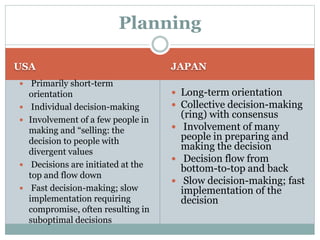
USA JAPAN
 Primarily short-term
orientation
 Individual decision-making
 Involvement of a few people in
making and “selling: the
decision to people with
divergent values
 Decisions are initiated at the
top and flow down
 Fast decision-making; slow
implementation requiring
compromise, often resulting in
suboptimal decisions
 Long-term orientation
 Collective decision-making
(ring) with consensus
 Involvement of many
people in preparing and
making the decision
 Decision flow from
bottom-to-top and back
 Slow decision-making; fast
implementation of the
decision
Planning
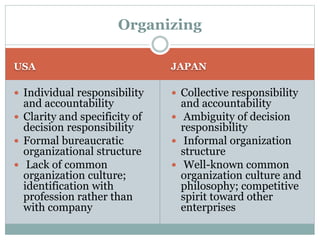
USA JAPAN
 Individual responsibility
and accountability
 Clarity and specificity of
decision responsibility
 Formal bureaucratic
organizational structure
 Lack of common
organization culture;
identification with
profession rather than
with company
 Collective responsibility
and accountability
 Ambiguity of decision
responsibility
 Informal organization
structure
 Well-known common
organization culture and
philosophy; competitive
spirit toward other
enterprises
Organizing
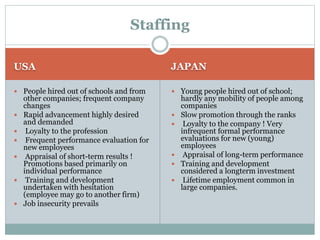
USA JAPAN
 People hired out of schools and from
other companies; frequent company
changes
 Rapid advancement highly desired
and demanded
 Loyalty to the profession
 Frequent performance evaluation for
new employees
 Appraisal of short-term results !
Promotions based primarily on
individual performance
 Training and development
undertaken with hesitation
(employee may go to another firm)
 Job insecurity prevails
 Young people hired out of school;
hardly any mobility of people among
companies
 Slow promotion through the ranks
 Loyalty to the company ! Very
infrequent formal performance
evaluations for new (young)
employees
 Appraisal of long-term performance
 Training and development
considered a longterm investment
 Lifetime employment common in
large companies.
Staffing
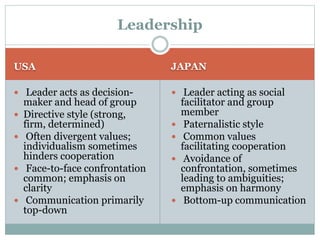
USA JAPAN
 Leader acts as decision-
maker and head of group
 Directive style (strong,
firm, determined)
 Often divergent values;
individualism sometimes
hinders cooperation
 Face-to-face confrontation
common; emphasis on
clarity
 Communication primarily
top-down
 Leader acting as social
facilitator and group
member
 Paternalistic style
 Common values
facilitating cooperation
 Avoidance of
confrontation, sometimes
leading to ambiguities;
emphasis on harmony
 Bottom-up communication
Leadership
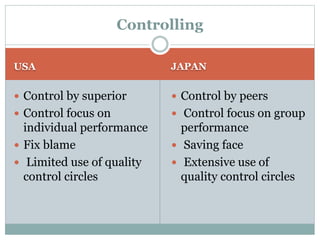
USA JAPAN
 Control by superior
 Control focus on
individual performance
 Fix blame
 Limited use of quality
control circles
 Control by peers
 Control focus on group
performance
 Saving face
 Extensive use of
quality control circles
Controlling
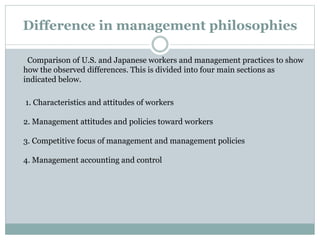
Difference in management philosophies
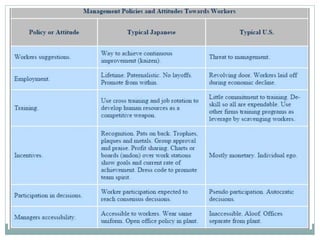
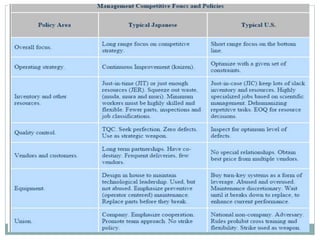
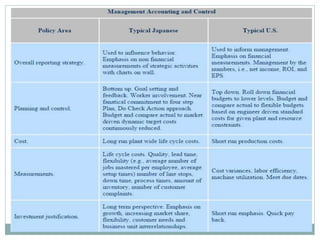
Comparison of U.S. and Japanese workers and management practices to show
how the observed differences. This is divided into four main sections as
indicated below.
1. Characteristics and attitudes of workers
2. Management attitudes and policies toward workers
3. Competitive focus of management and management policies
4. Management accounting and control
CASE STUDY …
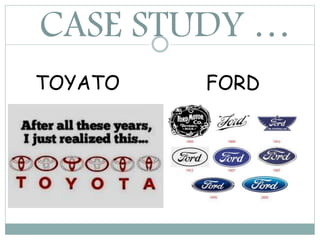
TOYATO FORD
Toyota
Toyota Motor Corporation is a Japanese automotive manufacturer
headquartered in Toyota, Aichi, Japan
History- The company was founded by Kiichiro Toyoda in 1937 as a spinoff
from his father's company Toyota Industries to create automobiles. Three years
earlier, in 1934, while still a department of Toyota Industries, it created its first
product, the Type A engine, and, in 1936, its first passenger car, the Toyota AA.
Current scenario- Toyota was the largest automobile manufacturer in 2012
(by production) ahead of the Volkswagen Group and General Motors. . In March
2014 the multinational corporation consisted of 338,875 employees
worldwide and, as of November 2014, is the twelfth-largest company in the
world by revenue. It also holds a 51.2% stake in Daihatsu, a 16.66% stake in Fuji
Heavy Industries, a 5.9% stake in Isuzu, and a 0.27% stake in Tesla, as well as
joint-ventures with two in China (GAC Toyota and Sichuan FAW Toyota Motor),
one in India (Toyota Kirloskar), one in the Czech Republic (TPCA), along with
several "nonautomotive" companies. TMC is part of the Toyota Group, one of
the largest conglomerates in the world.
Ford
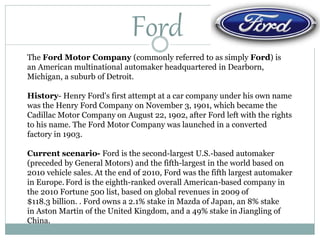
The Ford Motor Company (commonly referred to as simply Ford) is
an American multinational automaker headquartered in Dearborn,
Michigan, a suburb of Detroit.
History- Henry Ford's first attempt at a car company under his own name
was the Henry Ford Company on November 3, 1901, which became the
Cadillac Motor Company on August 22, 1902, after Ford left with the rights
to his name. The Ford Motor Company was launched in a converted
factory in 1903.
Current scenario- Ford is the second-largest U.S.-based automaker
(preceded by General Motors) and the fifth-largest in the world based on
2010 vehicle sales. At the end of 2010, Ford was the fifth largest automaker
in Europe. Ford is the eighth-ranked overall American-based company in
the 2010 Fortune 500 list, based on global revenues in 2009 of
$118.3 billion. . Ford owns a 2.1% stake in Mazda of Japan, an 8% stake
in Aston Martin of the United Kingdom, and a 49% stake in Jiangling of
China.
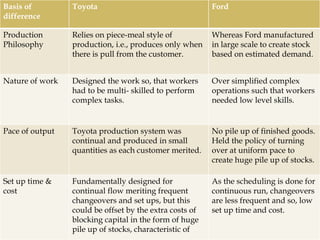
Basis of
difference
Toyota Ford
Production
Philosophy
Relies on piece-meal style of
production, i.e., produces only when
there is pull from the customer.
Whereas Ford manufactured
in large scale to create stock
based on estimated demand.
Nature of work Designed the work so, that workers
had to be multi- skilled to perform
complex tasks.
Over simplified complex
operations such that workers
needed low level skills.
Pace of output Toyota production system was
continual and produced in small
quantities as each customer merited.
No pile up of finished goods.
Held the policy of turning
over at uniform pace to
create huge pile up of stocks.
Set up time &
cost
Fundamentally designed for
continual flow meriting frequent
changeovers and set ups, but this
could be offset by the extra costs of
blocking capital in the form of huge
pile up of stocks, characteristic of
As the scheduling is done for
continuous run, changeovers
are less frequent and so, low
set up time and cost.
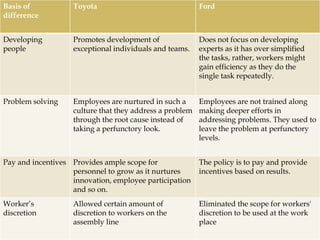
Basis of
difference
Toyota Ford
Developing
people
Promotes development of
exceptional individuals and teams.
Does not focus on developing
experts as it has over simplified
the tasks, rather, workers might
gain efficiency as they do the
single task repeatedly.
Problem solving Employees are nurtured in such a
culture that they address a problem
through the root cause instead of
taking a perfunctory look.
Employees are not trained along
making deeper efforts in
addressing problems. They used to
leave the problem at perfunctory
levels.
Pay and incentives Provides ample scope for
personnel to grow as it nurtures
innovation, employee participation
and so on.
The policy is to pay and provide
incentives based on results.
Worker’s
discretion
Allowed certain amount of
discretion to workers on the
assembly line
Eliminated the scope for workers'
discretion to be used at the work
place
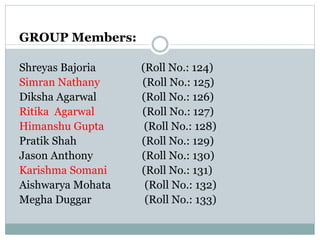
GROUP Members:
Shreyas Bajoria (Roll No.: 124)
Simran Nathany (Roll No.: 125)
Diksha Agarwal (Roll No.: 126)
Ritika Agarwal (Roll No.: 127)
Himanshu Gupta (Roll No.: 128)
Pratik Shah (Roll No.: 129)
Jason Anthony (Roll No.: 130)
Karishma Somani (Roll No.: 131)
Aishwarya Mohata (Roll No.: 132)
Megha Duggar (Roll No.: 133)
Sources
•www.wikipedia.com
•www.ukessays.com
•www.toyota.org
•“The Toyota way” – by Jeffery Liker
THANK YOU !!

management philosophies difference between USA and japan

  • 1.
    PRINCIPLES OF MANAGEMENT SEMINARON “DIFFERENCE IN MANAGEMENT PHILSOPHIES OF JAPANESE AND AMERICANS CORPORATIONS”
  • 2.
    USA JAPAN  Primarilyshort-term orientation  Individual decision-making  Involvement of a few people in making and “selling: the decision to people with divergent values  Decisions are initiated at the top and flow down  Fast decision-making; slow implementation requiring compromise, often resulting in suboptimal decisions  Long-term orientation  Collective decision-making (ring) with consensus  Involvement of many people in preparing and making the decision  Decision flow from bottom-to-top and back  Slow decision-making; fast implementation of the decision Planning
  • 3.
    USA JAPAN  Individualresponsibility and accountability  Clarity and specificity of decision responsibility  Formal bureaucratic organizational structure  Lack of common organization culture; identification with profession rather than with company  Collective responsibility and accountability  Ambiguity of decision responsibility  Informal organization structure  Well-known common organization culture and philosophy; competitive spirit toward other enterprises Organizing
  • 4.
    USA JAPAN  Peoplehired out of schools and from other companies; frequent company changes  Rapid advancement highly desired and demanded  Loyalty to the profession  Frequent performance evaluation for new employees  Appraisal of short-term results ! Promotions based primarily on individual performance  Training and development undertaken with hesitation (employee may go to another firm)  Job insecurity prevails  Young people hired out of school; hardly any mobility of people among companies  Slow promotion through the ranks  Loyalty to the company ! Very infrequent formal performance evaluations for new (young) employees  Appraisal of long-term performance  Training and development considered a longterm investment  Lifetime employment common in large companies. Staffing
  • 5.
    USA JAPAN  Leaderacts as decision- maker and head of group  Directive style (strong, firm, determined)  Often divergent values; individualism sometimes hinders cooperation  Face-to-face confrontation common; emphasis on clarity  Communication primarily top-down  Leader acting as social facilitator and group member  Paternalistic style  Common values facilitating cooperation  Avoidance of confrontation, sometimes leading to ambiguities; emphasis on harmony  Bottom-up communication Leadership
  • 6.
    USA JAPAN  Controlby superior  Control focus on individual performance  Fix blame  Limited use of quality control circles  Control by peers  Control focus on group performance  Saving face  Extensive use of quality control circles Controlling
  • 7.
    Difference in managementphilosophies Comparison of U.S. and Japanese workers and management practices to show how the observed differences. This is divided into four main sections as indicated below. 1. Characteristics and attitudes of workers 2. Management attitudes and policies toward workers 3. Competitive focus of management and management policies 4. Management accounting and control
  • 12.
  • 13.
    Toyota Toyota Motor Corporationis a Japanese automotive manufacturer headquartered in Toyota, Aichi, Japan History- The company was founded by Kiichiro Toyoda in 1937 as a spinoff from his father's company Toyota Industries to create automobiles. Three years earlier, in 1934, while still a department of Toyota Industries, it created its first product, the Type A engine, and, in 1936, its first passenger car, the Toyota AA. Current scenario- Toyota was the largest automobile manufacturer in 2012 (by production) ahead of the Volkswagen Group and General Motors. . In March 2014 the multinational corporation consisted of 338,875 employees worldwide and, as of November 2014, is the twelfth-largest company in the world by revenue. It also holds a 51.2% stake in Daihatsu, a 16.66% stake in Fuji Heavy Industries, a 5.9% stake in Isuzu, and a 0.27% stake in Tesla, as well as joint-ventures with two in China (GAC Toyota and Sichuan FAW Toyota Motor), one in India (Toyota Kirloskar), one in the Czech Republic (TPCA), along with several "nonautomotive" companies. TMC is part of the Toyota Group, one of the largest conglomerates in the world.
  • 14.
    Ford The Ford MotorCompany (commonly referred to as simply Ford) is an American multinational automaker headquartered in Dearborn, Michigan, a suburb of Detroit. History- Henry Ford's first attempt at a car company under his own name was the Henry Ford Company on November 3, 1901, which became the Cadillac Motor Company on August 22, 1902, after Ford left with the rights to his name. The Ford Motor Company was launched in a converted factory in 1903. Current scenario- Ford is the second-largest U.S.-based automaker (preceded by General Motors) and the fifth-largest in the world based on 2010 vehicle sales. At the end of 2010, Ford was the fifth largest automaker in Europe. Ford is the eighth-ranked overall American-based company in the 2010 Fortune 500 list, based on global revenues in 2009 of $118.3 billion. . Ford owns a 2.1% stake in Mazda of Japan, an 8% stake in Aston Martin of the United Kingdom, and a 49% stake in Jiangling of China.
  • 16.
    Basis of difference Toyota Ford Production Philosophy Relieson piece-meal style of production, i.e., produces only when there is pull from the customer. Whereas Ford manufactured in large scale to create stock based on estimated demand. Nature of work Designed the work so, that workers had to be multi- skilled to perform complex tasks. Over simplified complex operations such that workers needed low level skills. Pace of output Toyota production system was continual and produced in small quantities as each customer merited. No pile up of finished goods. Held the policy of turning over at uniform pace to create huge pile up of stocks. Set up time & cost Fundamentally designed for continual flow meriting frequent changeovers and set ups, but this could be offset by the extra costs of blocking capital in the form of huge pile up of stocks, characteristic of As the scheduling is done for continuous run, changeovers are less frequent and so, low set up time and cost.
  • 17.
    Basis of difference Toyota Ford Developing people Promotesdevelopment of exceptional individuals and teams. Does not focus on developing experts as it has over simplified the tasks, rather, workers might gain efficiency as they do the single task repeatedly. Problem solving Employees are nurtured in such a culture that they address a problem through the root cause instead of taking a perfunctory look. Employees are not trained along making deeper efforts in addressing problems. They used to leave the problem at perfunctory levels. Pay and incentives Provides ample scope for personnel to grow as it nurtures innovation, employee participation and so on. The policy is to pay and provide incentives based on results. Worker’s discretion Allowed certain amount of discretion to workers on the assembly line Eliminated the scope for workers' discretion to be used at the work place
  • 18.
    GROUP Members: Shreyas Bajoria(Roll No.: 124) Simran Nathany (Roll No.: 125) Diksha Agarwal (Roll No.: 126) Ritika Agarwal (Roll No.: 127) Himanshu Gupta (Roll No.: 128) Pratik Shah (Roll No.: 129) Jason Anthony (Roll No.: 130) Karishma Somani (Roll No.: 131) Aishwarya Mohata (Roll No.: 132) Megha Duggar (Roll No.: 133)
  • 19.