TOYOTA PRODUCTION SYSTEM
       TAIICHI OHNO
         LEAP TO LEAN


                             BY:-
                        JIGNESH GALA
                          KRISHNA R
Genealogy of Toyota Production
           System
•   Toyoda Spinning and Weaving: 1932 – 1942
•   Toyota Motor Company : 1943
•   Two pillars of Toyota Production System
•   Idea of Autonomation: Auto-activated Loom
•   The habit of Watching
Product Importance
• Usage of proper equipments & producing
  cheaply
• Spending money on good machines
• Learn to use the machines correctly
• The Japanese-Style Production Technique
American production system V/s
     Japanese production
• Mass production system • Small quantity
• Raw materials carried    production of different
  along conveyor belts     variety
• Assembly line moves at • Movement of both
  a fixed speed            labor and machines
• Warehousing of parts     eliminating wastes
                         • Complete elimination of
                           Warehouse
Pillars of TPS
• Just in time
• Autonomation
Evolution of TPS
•   Asking WHY five times
•   Concept of Waste
•   Analysis of Waste
•   Standard Work sheet preparation
•   Evolution of Kanban
Why should we ask why ?
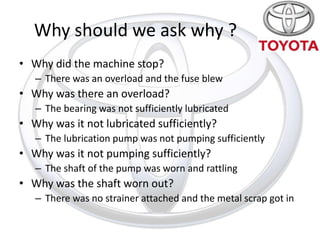
• Why did the machine stop?
   – There was an overload and the fuse blew
• Why was there an overload?
   – The bearing was not sufficiently lubricated
• Why was it not lubricated sufficiently?
   – The lubrication pump was not pumping sufficiently
• Why was it not pumping sufficiently?
   – The shaft of the pump was worn and rattling
• Why was the shaft worn out?
   – There was no strainer attached and the metal scrap got in
Waste –Concept and analysis
• Present Capacity =Work + Waste

• There are seven basic categories of Waste
Writing the work sheet
• Cannot be done theoretically
• One must have knowledge of ground level
  activities
• Proper design of work procedure is critical
• Work must be standardised
KANBAN
• Tool used to operate the TPS
• Inspiration from American Supermarkets
• Basic function is to carry information
• 3 Types of info:-
1) Pickup information
2) Transfer information
3) Production information
• Functions                         • Rules of use
• Provides Pickup or transport    • Later process picks up No of
  information                       items indicated by Kanban
• Provides production             • Earlier process produces
  information                       items in Indicated
• Prevents overproduction and       Qty+Sequence
  excessive transport
                                  • No items are made without
• Serves as a work order
                                    Kanban
  attached to goods
• Identifies process making
                                  • Always attach Kanban to
  defects thus preventing           goods
  defective products              • Defective products are not
• Reveals existing problems and     sent on to next process
  maintains inventory control     • Reducing the No of Kanban
                                    increases their sensitivity
Establishing the Flow
• Requirement as basis for Kanban
  implementation
• Production Levelling
• Market diversification
Challenges to production
            Levelling
• Originally conceived to produce small
  quantities of many types of products
• Must lower the Peaks and valleys in
  production system
• Places a huge demand on the Die-press
  Section
• Thus for each different part the die would
  have to change
Results of Production Levelling
• Result was from 2-3 hours in the 40s the
  Change and setup of dies is now only a few
  minutes (<3 min )
Further Developments
• Automatic nervous system in business
  organisation
• Computer: only a source of information
• Production Schedule and Planning
  – Number of cars to be produced
  – Monthly, Weekly Schedules
• Adjusting to production schedule when actual
  production takes place
• Economy at Toyota means Manpower reduction
  and cost reduction
• Reduction also needs to be carefully studied
  – E.g. Installing electrical control to replace a worker
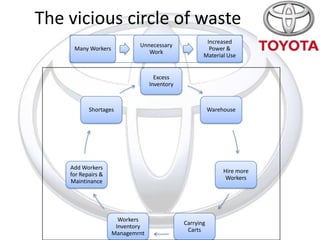
• The vicious circle of waste
The vicious circle of waste
                                                     Increased
                            Unnecessary
     Many Workers                                     Power &
                               Work
                                                    Material Use


                                   Excess
                                 Inventory


           Shortages                                    Warehouse


    Add Workers
                                                             Hire more
    for Repairs &
                                                              Workers
    Maintinance


                      Workers
                                             Carrying
                     Inventory
                                              Carts
                    Managemrnt
Managing Time, Machine &
           Labor
• Appropriate tact time should be determined
• Operating and Operable rates
• Relationship between Production Quantity
  and Number of Workers
  – E.g. 10 workers  100 pieces
    With improvements  120 pieces
    Demand decreases
    How to tackle the problem?
The Number game
• Forecasting the exact number of quantity
  required
• To avoid over production it is necessary that
  – Production Quantity = Required Number
• Car dealers across send their orders daily to
  Toyota Automobile Sales Company at Nagoya
• Classification of Orders
• Estimation of Quantity
Misconception about
          Equipments
• High Performance Machines
• High-productive machine and High-speed
  machines are not always the same
• Life of Machines should be depending upon its
  operable rate
• Replacement of Machine should be the last
  option
“Worker Saving”
• Toyota uses term “worker saving” instead of
  “labor saving”
• Labor saving means using equipments such as
  lift, bulldozer, etc… which is directly connected
  to reducing the man power
• If worker is replaced simply to make the work
  easy then it may result costly to install an
  equipment
The Ford System
•   Mass production system
•   Raw materials carried along conveyor belts
•   Assembly line moves at a fixed speed
•   Warehousing of parts
Toyota production system

Toyota production system

  • 1.
    TOYOTA PRODUCTION SYSTEM TAIICHI OHNO LEAP TO LEAN BY:- JIGNESH GALA KRISHNA R
  • 3.
    Genealogy of ToyotaProduction System • Toyoda Spinning and Weaving: 1932 – 1942 • Toyota Motor Company : 1943 • Two pillars of Toyota Production System • Idea of Autonomation: Auto-activated Loom • The habit of Watching
  • 4.
    Product Importance • Usageof proper equipments & producing cheaply • Spending money on good machines • Learn to use the machines correctly • The Japanese-Style Production Technique
  • 5.
    American production systemV/s Japanese production • Mass production system • Small quantity • Raw materials carried production of different along conveyor belts variety • Assembly line moves at • Movement of both a fixed speed labor and machines • Warehousing of parts eliminating wastes • Complete elimination of Warehouse
  • 6.
    Pillars of TPS •Just in time • Autonomation
  • 7.
    Evolution of TPS • Asking WHY five times • Concept of Waste • Analysis of Waste • Standard Work sheet preparation • Evolution of Kanban
  • 8.
    Why should weask why ? • Why did the machine stop? – There was an overload and the fuse blew • Why was there an overload? – The bearing was not sufficiently lubricated • Why was it not lubricated sufficiently? – The lubrication pump was not pumping sufficiently • Why was it not pumping sufficiently? – The shaft of the pump was worn and rattling • Why was the shaft worn out? – There was no strainer attached and the metal scrap got in
  • 9.
    Waste –Concept andanalysis • Present Capacity =Work + Waste • There are seven basic categories of Waste
  • 10.
    Writing the worksheet • Cannot be done theoretically • One must have knowledge of ground level activities • Proper design of work procedure is critical • Work must be standardised
  • 11.
    KANBAN • Tool usedto operate the TPS • Inspiration from American Supermarkets • Basic function is to carry information • 3 Types of info:- 1) Pickup information 2) Transfer information 3) Production information
  • 12.
    • Functions • Rules of use • Provides Pickup or transport • Later process picks up No of information items indicated by Kanban • Provides production • Earlier process produces information items in Indicated • Prevents overproduction and Qty+Sequence excessive transport • No items are made without • Serves as a work order Kanban attached to goods • Identifies process making • Always attach Kanban to defects thus preventing goods defective products • Defective products are not • Reveals existing problems and sent on to next process maintains inventory control • Reducing the No of Kanban increases their sensitivity
  • 13.
    Establishing the Flow •Requirement as basis for Kanban implementation • Production Levelling • Market diversification
  • 14.
    Challenges to production Levelling • Originally conceived to produce small quantities of many types of products • Must lower the Peaks and valleys in production system • Places a huge demand on the Die-press Section • Thus for each different part the die would have to change
  • 15.
    Results of ProductionLevelling • Result was from 2-3 hours in the 40s the Change and setup of dies is now only a few minutes (<3 min )
  • 16.
    Further Developments • Automaticnervous system in business organisation • Computer: only a source of information • Production Schedule and Planning – Number of cars to be produced – Monthly, Weekly Schedules • Adjusting to production schedule when actual production takes place
  • 17.
    • Economy atToyota means Manpower reduction and cost reduction • Reduction also needs to be carefully studied – E.g. Installing electrical control to replace a worker • The vicious circle of waste
  • 18.
    The vicious circleof waste Increased Unnecessary Many Workers Power & Work Material Use Excess Inventory Shortages Warehouse Add Workers Hire more for Repairs & Workers Maintinance Workers Carrying Inventory Carts Managemrnt
  • 19.
    Managing Time, Machine& Labor • Appropriate tact time should be determined • Operating and Operable rates • Relationship between Production Quantity and Number of Workers – E.g. 10 workers  100 pieces With improvements  120 pieces Demand decreases How to tackle the problem?
  • 20.
    The Number game •Forecasting the exact number of quantity required • To avoid over production it is necessary that – Production Quantity = Required Number • Car dealers across send their orders daily to Toyota Automobile Sales Company at Nagoya • Classification of Orders • Estimation of Quantity
  • 21.
    Misconception about Equipments • High Performance Machines • High-productive machine and High-speed machines are not always the same • Life of Machines should be depending upon its operable rate • Replacement of Machine should be the last option
  • 22.
    “Worker Saving” • Toyotauses term “worker saving” instead of “labor saving” • Labor saving means using equipments such as lift, bulldozer, etc… which is directly connected to reducing the man power • If worker is replaced simply to make the work easy then it may result costly to install an equipment
  • 23.
    The Ford System • Mass production system • Raw materials carried along conveyor belts • Assembly line moves at a fixed speed • Warehousing of parts