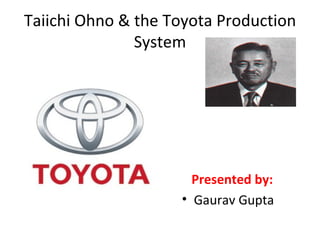
Taiichi Ohno & the Toyota Production System Presented by:   Gaurav Gupta
Introduction Toyota’s History Toyota’s first export to U.S. was not successful In 2004 Toyota’s net earning was double the combined net earnings of automobile majors.
Taiichi Ohno Born in 1912 in China. He introduced JIT and Kanban system. In 1975, Ohno became the Vice President of Toyota. Died in 1990 in  Toyota city.
The Toyota Production System(TPS ) Collaborative effort of Ohno , Sakichi , Kiichiro and Eiji. Focus was on ‘Reduction of cost through  elimination of the waste. TPS  consists of two parts : ‘ the hard or the technical part’ and ‘ the soft or people related part’
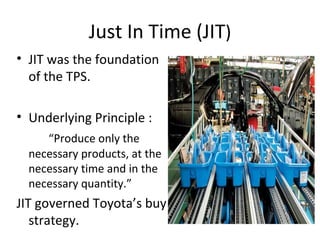
Just In Time (JIT ) JIT was the foundation of the TPS. Underlying Principle : “ Produce only the necessary products, at the necessary time and in the necessary quantity.”  JIT governed Toyota’s buy strategy.
The concept of JIT was based on the  ‘ Reverse Reasoning’ Based on the ‘PULL’ system of manufacturing and not on ‘PUSH’ system. Complexity of the process gave birth to the ‘Kanban System.’ DEMAND  ASSEMBLY DELIVERY OF PARTS SUPPLY BY SUPPLIER
The word Kan means "visual" in Japanese  and the word "ban" means "card". So Kanban refers to "visual cards".
What Are The Benefits of Kanban? Reduces inventory and product obsolescence Reduces waste and scrap Provides flexibility in production Increases Output Reduces Total Cost
KAIZEN Means ‘continuous improvement’. Eliminating all ‘waste’. Observation. Understand the problem. Commitment of  the management. Poka-yoke or error proofing.
Pre-requisites for kaizen Discard conventional fixed ideas. Don’t make excuses. Correct it right away , if you make a mistake. Seek the wisdom of ten people rather than that of one. Think of how to do it , not why it cannot be done. Ask ‘Why?’ five times.
HUMAN ELEMENTS Team work Safety work place Visible control Conduct production activities .
JIDOKA Andon cord Training & development Physical fitness Preference to engineers.
Ohno’s Seven Wastes Defects Over Production  Waiting Transporting Movement Inappropriate Processing Inventory
Push System Raw material Parts Manufacture Assembly Product
Pull System Demand Assembly Parts Supply Raw Materials
Conclusion Benefits Challenges
Thank You

Toyota

  • 1.
    Taiichi Ohno &the Toyota Production System Presented by: Gaurav Gupta
  • 2.
    Introduction Toyota’s HistoryToyota’s first export to U.S. was not successful In 2004 Toyota’s net earning was double the combined net earnings of automobile majors.
  • 3.
    Taiichi Ohno Bornin 1912 in China. He introduced JIT and Kanban system. In 1975, Ohno became the Vice President of Toyota. Died in 1990 in Toyota city.
  • 4.
    The Toyota ProductionSystem(TPS ) Collaborative effort of Ohno , Sakichi , Kiichiro and Eiji. Focus was on ‘Reduction of cost through elimination of the waste. TPS consists of two parts : ‘ the hard or the technical part’ and ‘ the soft or people related part’
  • 5.
    Just In Time(JIT ) JIT was the foundation of the TPS. Underlying Principle : “ Produce only the necessary products, at the necessary time and in the necessary quantity.” JIT governed Toyota’s buy strategy.
  • 6.
    The concept ofJIT was based on the ‘ Reverse Reasoning’ Based on the ‘PULL’ system of manufacturing and not on ‘PUSH’ system. Complexity of the process gave birth to the ‘Kanban System.’ DEMAND ASSEMBLY DELIVERY OF PARTS SUPPLY BY SUPPLIER
  • 7.
    The word Kanmeans "visual" in Japanese and the word "ban" means "card". So Kanban refers to "visual cards".
  • 8.
    What Are TheBenefits of Kanban? Reduces inventory and product obsolescence Reduces waste and scrap Provides flexibility in production Increases Output Reduces Total Cost
  • 9.
    KAIZEN Means ‘continuousimprovement’. Eliminating all ‘waste’. Observation. Understand the problem. Commitment of the management. Poka-yoke or error proofing.
  • 10.
    Pre-requisites for kaizenDiscard conventional fixed ideas. Don’t make excuses. Correct it right away , if you make a mistake. Seek the wisdom of ten people rather than that of one. Think of how to do it , not why it cannot be done. Ask ‘Why?’ five times.
  • 11.
    HUMAN ELEMENTS Teamwork Safety work place Visible control Conduct production activities .
  • 12.
    JIDOKA Andon cordTraining & development Physical fitness Preference to engineers.
  • 13.
    Ohno’s Seven WastesDefects Over Production Waiting Transporting Movement Inappropriate Processing Inventory
  • 14.
    Push System Rawmaterial Parts Manufacture Assembly Product
  • 15.
    Pull System DemandAssembly Parts Supply Raw Materials
  • 16.
  • 17.